



Abstract

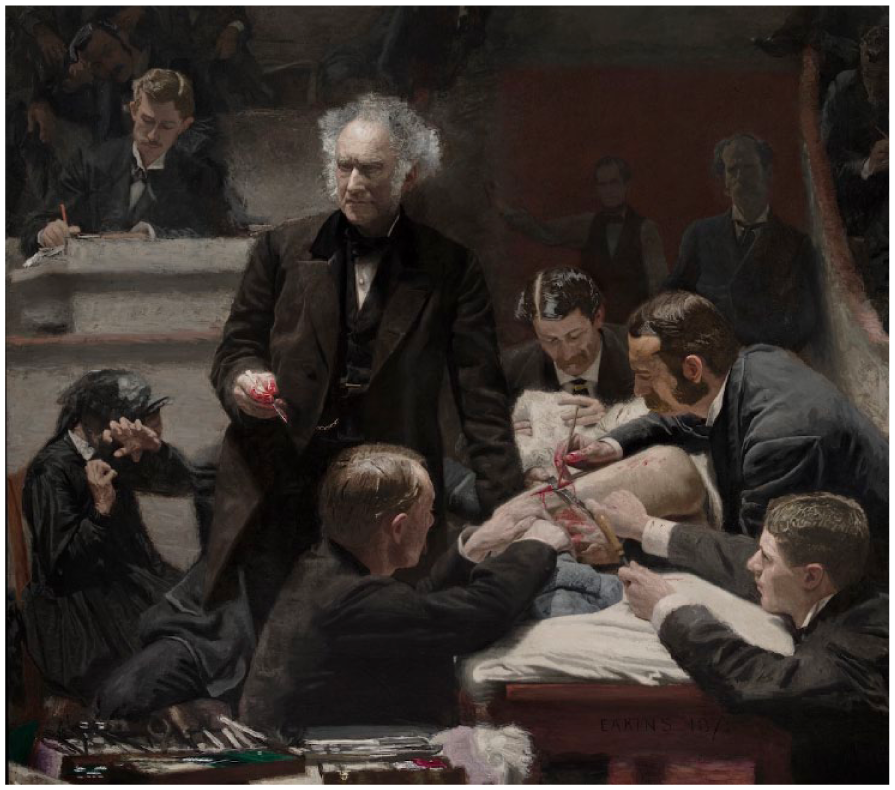
‘The Gross Clinic’ by Thomas Eakins, 1875. Oil on canvas painting depicting Dr Samuel Gross and colleagues operating in black frock coats at Jefferson Medical College, Philadelphia. Image in the public domain.
During the late 19th century, ‘improved knowledge of microorganisms and of their influence in the causation of the transmissible wound diseases. . .completely revolutionised surgical ideals, and led to. . .extensive alterations in surgical methods.’ 2
First trialled in 1865 as a means of reducing the morbidity and mortality associated with compound fractures and abscesses, Joseph Lister’s ‘antiseptic system of treatment’ was found to be effective,3,4 but necessitated ‘scrupulous attention to detail. . .to attain anything like uniformity of successful results.’ 5 Notably, however, Lister did not advocate the employment of any special surgical attire, and up until the time of his retirement in 1893, ‘never wore a white gown, nor a mask, nor gloves.’ Rather, he predominantly operated in a black frock coat, with his sleeves rolled back, and the coat collar turned up, ‘so that his white starched collar would not be made sodden by the cloud of carbolic spray’. 6
The frock coat was widely considered to be ‘the only correct garb’ of the 19th century surgeon. 7 St Clair Thompson, who worked with Lister at King’s College Hospital in 1883, wore ‘an old blue frock coat’ which he had used ‘for years previously in the dissecting room’ and was ‘stiff and glazed with blood.’ 6 If an operation was expected to be more bloody than usual, Lister would occasionally remove his coat, turn up his shirt sleeves and pin an ‘ordinary unsterilised huckaback towel over his waistcoat (for his own protection not that of the patient).’ 8 Interestingly, some of his contemporaries considered operating in shirt sleeves to be ‘an indignity’, while others perceived the frock coat as sartorially inadequate; in Paris, Jules Péan ‘always wore a full dress suit in the Hôtel-Dieu operating room.’ 9
Surgeons in Germany were among the first to adopt, and later refine, Lister’s techniques. 10 At the University of Kiel, Friedrich von Esmarch and colleagues began managing wounds ‘strictly according to Lister’ in 1875. 11 Four years later, they altered their protocol for the management of antiseptic dressings, and subsequently replaced carbolic acid with mercury bichloride (also known as corrosive sublimate) following the publication of research by Robert Koch which demonstrated that a highly dilute solution of bichloride was capable of killing ‘even the most resistant organisms. . .in a few minutes.’ 12
Outlining the ‘technique of antiseptic wound treatment and permanent dressing’ utilised at the Esmarch clinic in 1883, Gustav Neuber highlighted the importance of ‘meticulous cleanliness of all persons involved’ and noted that white linen operating gowns had been worn in Kiel for ‘for several years.’ These gowns were replaced as ‘soon as they became soiled. . .possibly after each operation, but at least daily’, and the surgeon, assistants and nurses also wore ‘aprons made of thin rubber material’ which covered ‘two-thirds of the body circumference from the neck to the feet.’ 11
In the summer of 1885, Neuber commissioned the construction of a new private surgical hospital at no. 8 Königsweg, Kiel. This included five separate operating theatres, and permitted him to trial ‘aseptic wound treatment’, in which the exclusion of pathogens from the surgical environment (through the employment of ‘absolute cleanliness’) would be used as a means of ‘abolishing or at least significantly reducing the need for antiseptic wound irrigation.’ Prior to each procedure, doctors, attendants and nurses ‘first washed themselves outside the operating room’ and were ‘sprinkled with sublimate water right in front of the door.’ Dressed in linen caps and sterilised surgical gowns, they then put on ‘lightweight waterproof aprons and rubber boots’ which had been ‘soaped after each use and cleaned with mercury bichloride’ before ‘washing themselves again and disinfecting their forearms, hands and face with sublimate water.’ In the ‘interest of general cleanliness’ Neuber insisted on ‘full baths for the staff to be repeated weekly, and frequent changes of underwear.’ 13
Although aseptic surgical techniques were increasingly accepted during the 1890s,2,14,15 not all were willing to embrace such change. In a lecture read before the Pathological Society of Reading in October 1896, Frederick Treves, lecturer on surgery at the London Hospital, lamented the ‘extravagances which have brought certain Continental operating theatres into ridicule.’ These included ‘the exquisite ceremonial of washing on the part of the operator’ as well as the wearing of ‘robes of white macintosh, and. . .India rubber fishing boots’, which Treves viewed as ‘a fervent idolatrous ritual brought down to the level of a popular performance.’ 16
Elsewhere, the theatre attire which had been introduced by ‘the German school’ of aseptic surgery was gradually modified. In 1894, Hunter Robb, Associate in gynaecology at Johns Hopkins University, wrote that ‘it is safer and better that all should put on a complete change of costume rather than simply draw on a sterilised coat and pair of trousers over the ordinary clothes.’ Robb recommended the use of one- or two-piece ‘operating suits’ fashioned from twilled muslin. These were ‘thoroughly sterilised’ before being worn. The thin material was ‘better suited for the temperature of the operating room’ compared with warm outdoor clothes, and could be easily washed and re-sterilised. Furthermore, the suits were ‘not nearly so cumbersome and awkward to work in as a sheet or rubber apron’ and prevented ordinary clothes ‘from being soiled, or of carrying away on them the disagreeable odour of the fumes of the anaesthetic.’ In addition, Robb suggested that the operator, assistants and nurses should wear white canvas shoes with low tops and rubber soles. These were ‘clean and noiseless’ and their employment prevented ‘soiling of the street shoes during an operation.’ Curiously, he did not champion the use of head coverings, suggesting instead that the surgeon would ‘do well to moisten the hair before an operation, since particles of dust might fall down from his head into the open wound, and thus, particularly if some inflammatory condition of the scalp were present, might produce a dangerous infection.’ 15
Two decades later at the Royal Victoria Hospital, Montreal, surgical staff wore clean (but not sterile) ‘white linen blouses and trousers’ inside the operating theatre, alongside a cap which covered the hair. These outfits were changed each day, or sooner, if necessary. 17
Around the same time, Francis Reder from St. Louis, Missouri, outlined what he considered to be the ‘proper garb’ of the 20th century surgeon. This comprised a ‘medium heavy shirt of a cotton fabric’ and cotton ‘duck trousers’, both of which were ‘worn next to the skin.’ Prior to operating, the surgeon’s forehead was encircled with a length of gauze bandage, which was extended down to the level of the eyebrows. A further length of gauze was wrapped in a similar manner to ‘cover the chin, mouth and cheeks.’ This bandage was secured on top of the head, onto which was placed an operating cap. Finally, after washing the hands and arms, an ankle length, long-sleeved sterile gown made from medium weight Galatea cotton fabric was donned with assistance from a nurse. 18
While this rather extreme bandaging technique was never popular, it is illustrative of the fundamental shift that had occurred. The stiff blood-soaked dress coats of the Victorian era had been replaced by clean, washable, dedicated theatre attire, beginning an evolutionary process that would only become more complex as the 20th century progressed.