




Abstract
To walke on the bottom at a considerable depth of water, and to be there at liberty to act, or manage one’s self to the best advantage as if one trodd upon the drie ground, is without doubt a contrivance of great use in … saving things lost in shipps or otherwise under water. Edmond Halley, 6 March 1689
1
In 1687, news of the successful recovery of brass cannons, gold ingots and ‘vast quantities of Pieces of Eight’ from the Spanish Galleon Nuestra Señora de la Pura y Limpia Conceptión, which had sunk in the West Indies more than 40 years earlier, was ‘trumpeted all over the world, and set men’s heads at work to get more’. 2 While the treasure had been ‘fetch’d out of the sea … by naked divers’, 2 even the most skilful of these individuals could hold their breath for only a matter of minutes before returning to the surface, and on descending to ‘considerable’ depths, the pressure of the water was often found to make their ‘eyes bloodshot, and frequently to occasion spitting of blood’. 3
As a result, an ‘abundance of people … allur’d with the hopes of gaining vast riches’ from shipwrecks turned their attention to the development of ‘diving engines’, which would allow them to remain deeply submerged for a ‘competent while’.2,3 These were of ‘various make, some like a bell, others a tub, some like a compleat suit of armour of copper, and leather between the joynts, and pipes to convey wind, and a Polyphemus eye in the forehead to give light’. 2
Among those spurred into action was Edmond Halley, who on 6 March 1689 outlined a theoretical ‘method for walking under water’ at a meeting of the Royal Society. 1 This was a modification of the ‘common diving bell’, 3 which had been used for decades by salvors as a means of storing ‘a considerable quantity of air … near the bottom … to save the trouble of coming up to the topp for breath’ during the ‘lifting up of guns … or any other things, that are drowned below the water’.1,4 However this arrangement still required the diver to hold their breath when working outside the bell, and there was no means of replenishing the air within.
To ‘obviate this inconvenience and to contrive a means to be under water and to move there breathing all the while’, Halley proposed a mobile hemispherical or cylindrical diving bell made of copper or wood, which incorporated four brass or lead wheels at its base. Aware that the air inside the bell would be compressed by half for every 33 ft of depth, and the water level within would rise accordingly, he suggested the sinking down of ‘vessels of compressed air … which being received below and opened under the cavity’, would ‘increase the air … till such time as all the water is expelled’. As a result, Halley postulated that a diver ‘provided with such boots as the fishermen use’, could be ‘clothed and stand dry on the bottom of the sea, thought it be 20 fathoms deep’. 1
Two years later, Halley gained practical experience of diving when engaged in an attempt to salvage cargo from a frigate lost off the Sussex coast. Eschewing the concept of a mobile bell, he constructed a wooden ‘truncate-cone’, which was coated with lead and suspended from the mast of a ship. The apparatus incorporated a ‘strong but clear glass’ in the top ‘to let in the light from above; and … a cock to let out the hot air that had been breathed’. Using a system of weighted barrels made to ‘rise and fall alternately, after the manner of two buckets in a well’, fresh air was supplied ‘so quick, and in so great plenty’ that Halley had ‘been one of five … together at the bottom, in nine or ten fathoms of water, for above an hour and a half at a time, without any sort of ill consequence’. 3 Wearing a ‘double or triple flannel or knit woollen waistcoat’ beneath ‘a well liquored leather suit’, a girdle of heavy weights and a pair of lead clogs, a diver could work outside the bell using a ‘cap of maintenance’ to breathe. This helmet, ‘made to weigh about half a hundred weight’, enclosed the diver’s head, but was open at its base. It therefore functioned as a miniature bell, and received ‘a constant stream of air’ from the interior of the ‘great bell’, via a ‘flexible pipe … secured against the pressure of the water by a spiral brass wire’ running from end to end.5,6
Diving bells, supplied with air by Halley’s method, were commonly employed in underwater salvage and submarine engineering operations until 1788, when John Smeaton, engineer to Ramsgate Harbour, introduced a cast iron ‘diving chest’, which provided its occupants ‘with a constant influx of fresh air … by a forcing air pump, in a boat, upon the water’s surface’. This modification enabled divers to ‘stay under water for any length of time’, and was subsequently widely adopted. 7
Despite this advance, diving bells were expensive to build and maintain, and cumbersome to use. In 1828, Charles and John Deane began work to modify a smoke helmet (which Charles had designed 5 years earlier) for underwater use. This worked on the same principle as Halley’s ‘cap of maintenance’, but was supplied with air from the surface. An early version, used in August 1829 to salvage ‘pig lead, tiles, and ingots of copper’ from the wreck of the Carn Brea Castle, which lay ‘at the back of the Isle of Wight, in about four fathoms water’, consisted ‘simply of a leathern head-piece, which was supplied with air through a pipe connected with the nozzle of a huge pair of bellows’.8,9 A separate suit made from waxed leather and canvas covered the diver’s arms, legs and body. Air escaped from the opening between the bottom of the head-piece and the dress. 10
In the years that followed, ‘Deane’s patent diving apparatus’ 11 was substantially upgraded to comprise ‘a copper helmet, with three glass eye plates, protected by brass bars … supplied with a constant current of pure atmospheric air from a brass rotary air-pump, through a flexible Indian rubber tube’, and ‘a dress made of Macintosh’s patent waterproof cloth’. 12 Using this equipment, a diver could descend to depths in excess of 20 fathoms, and ‘remain down several hours … freely enabled to transverse the bottom of the sea, and to search out the hidden treasures of the deep’. 11
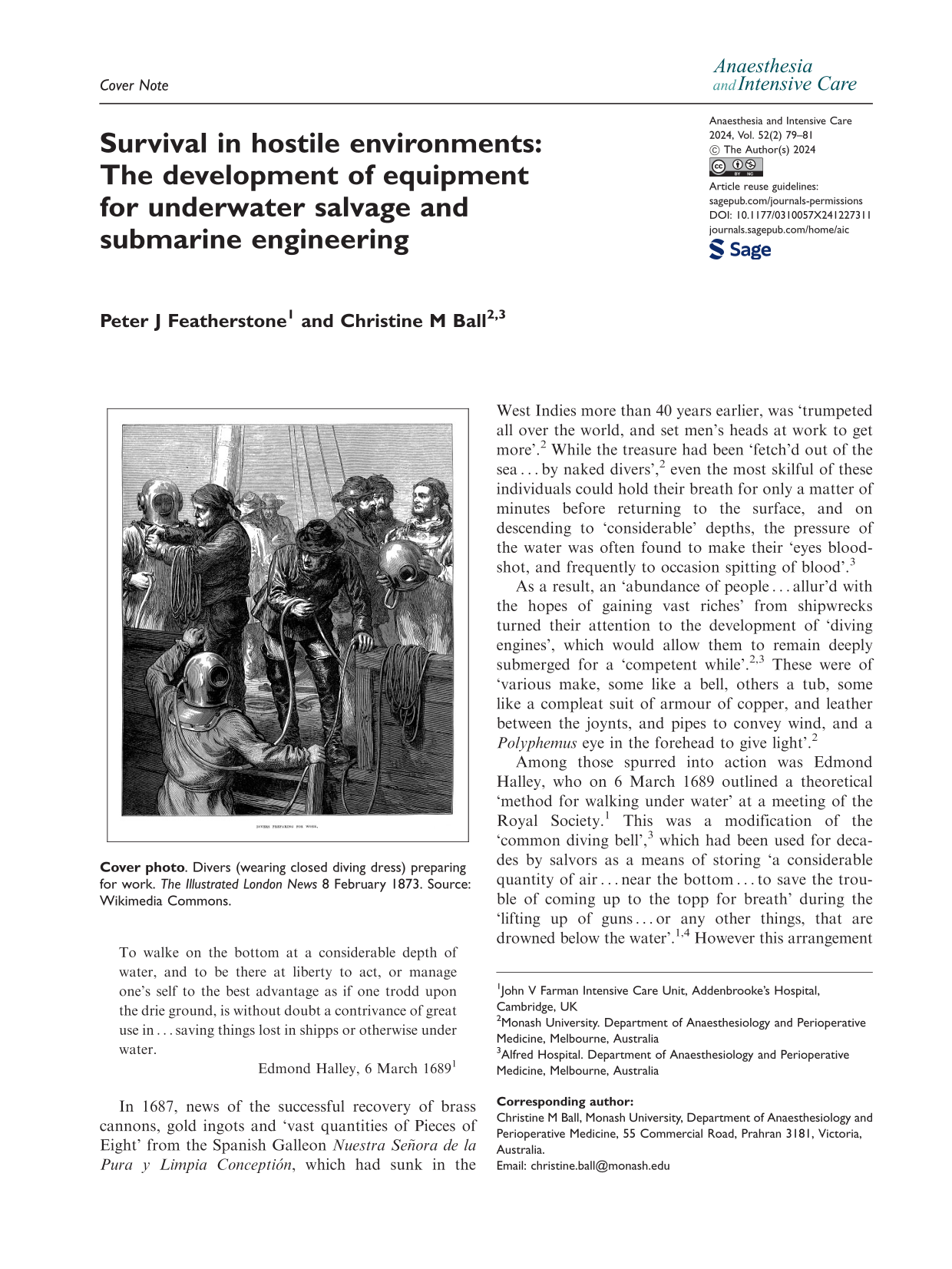
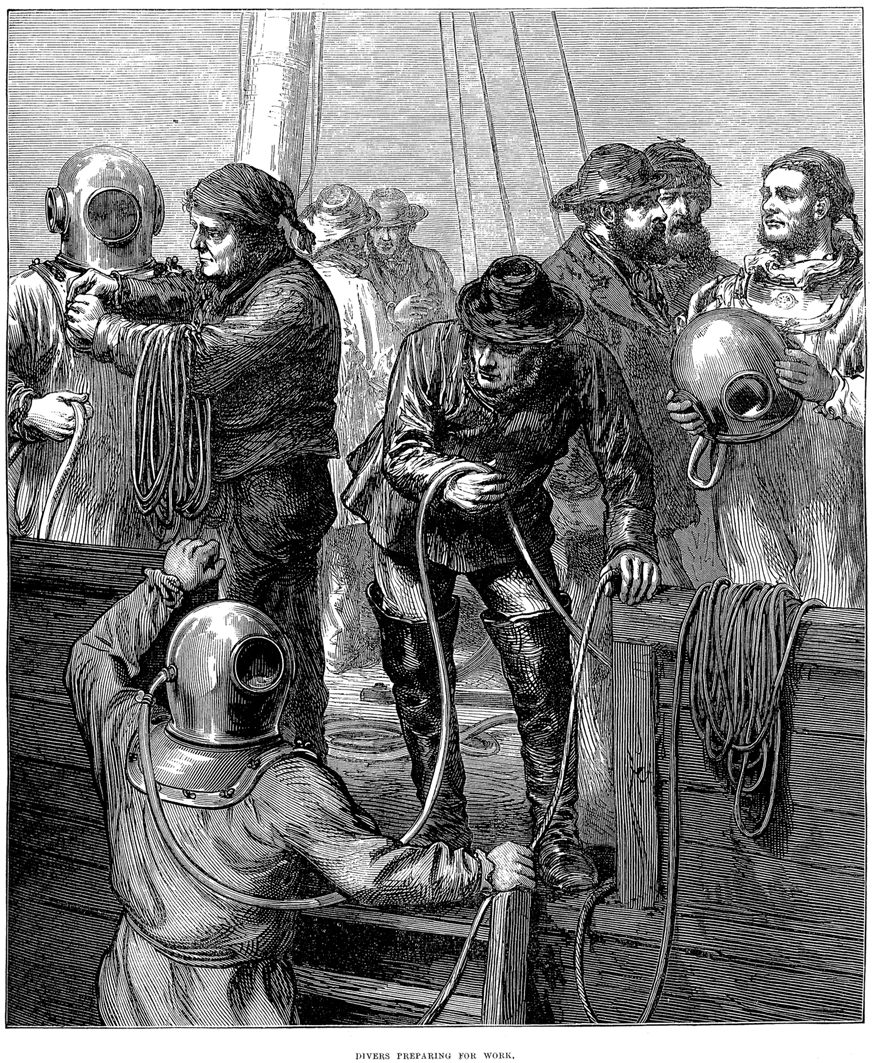
Notably however, the water within the Deane open helmet ‘reached within a few inches of the diver’s mouth, so that he had to work in a vertical position’, and it was susceptible to flooding if the diver fell forward. 13 In 1838, George Edwards, Superintendent of the Port of Lowestoft, devised a watertight bolted flange between the lower edge of the helmet and the upper edge of the Macintosh suit. 14 This closed diving dress allowed the wearer to remain dry and work in any position. Modified versions were produced by various manufacturers and remained in widespread use for more than a century.