




Abstract

In Australia, the term ‘specialist international medical graduates’ (SIMGs) refers to medical practitioners who have completed speciality training and examination requirements in a country other than Australia or New Zealand, and which is not accredited by an Australian or New Zealand medical speciality college. Individual specialist medical colleges are responsible for the examination and accreditation of SIMGs, implementing measures reflective of those for local specialist trainees. The evaluation of SIMGs by the Australian and New Zealand College of Anaesthetists (ANZCA) is comparative to that required of local Fellows of ANZCA. SIMGs deemed as requiring further performance assessment are required to sit the ANZCA final fellowship examination medical viva and anaesthesia viva sections and are allowed up to five attempts to complete these assessments successfully.
This letter is to highlight the availability and efficacy of an intensive preparation course for SIMGs sitting the ANZCA final fellowship examination.
Historically, SIMGs undertaking the ANZCA final examination have underperformed relative to local candidates. For examination results made available since 2011, it is apparent that there is a significant discrepancy between overall pass rates, as shown in Figure 1. 1 Despite ANZCA altering the criteria in 2019 requiring SIMG candidates to pass only the anaesthesia viva component of the final examination, poor performance of SIMG candidates has persisted. 1
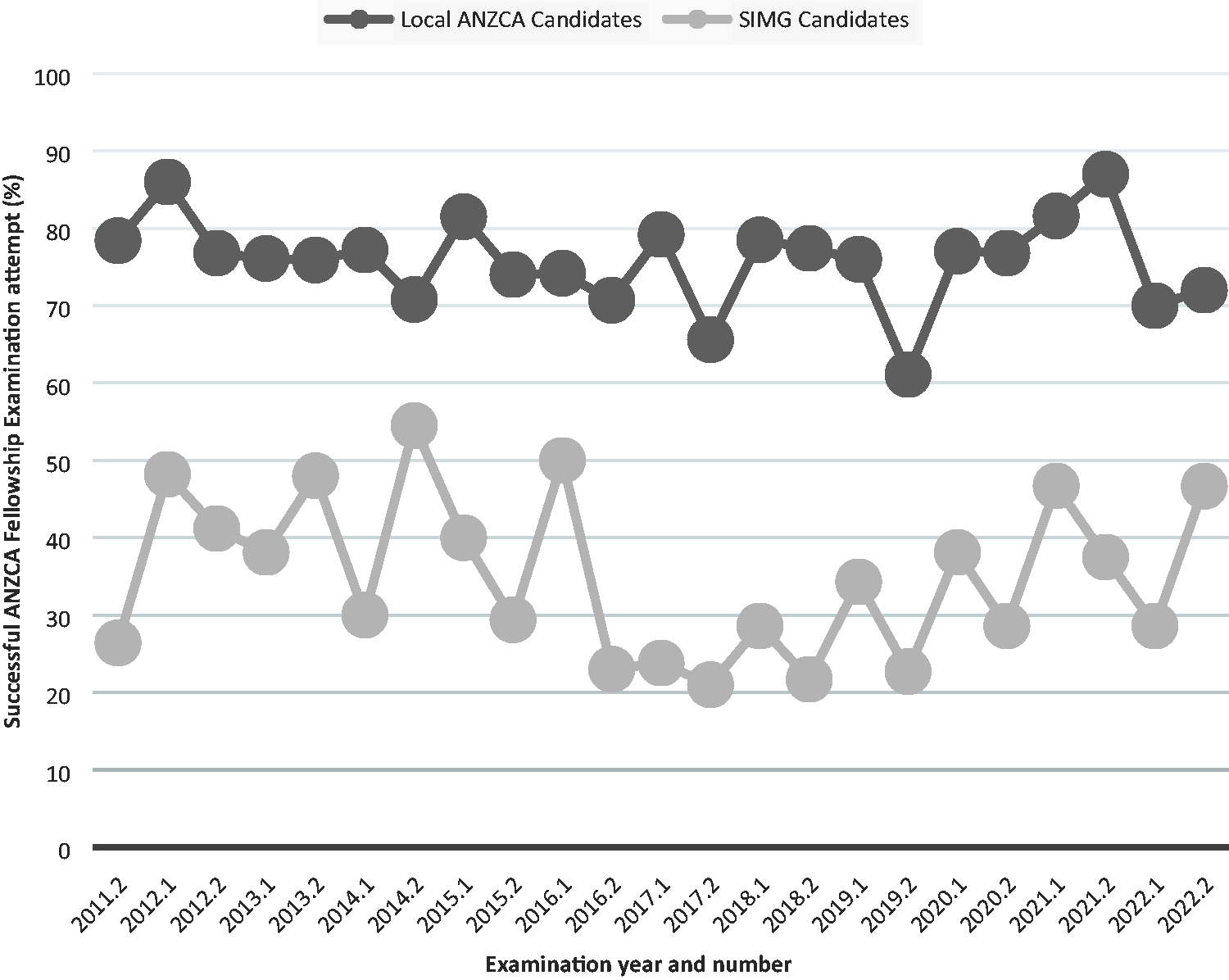
Australia and New Zealand College of Anaesthetists (ANZCA) final fellowship examination pass rate percentages comparing local and specialist international medical graduate (SIMG) candidates.
To address this trend, in 2021 Lahiru Amaratunge (LA) and Narguess Jahangiri (NJ) established an ANZCA final examination preparation course, known as the I-Excel course, focused on the specific needs of SIMGs, which is delivered in an online and video-conferencing format. From its commencement to the time of this letter submission, the course has had 39 participants, with better pass rates than the SIMG average. Of note, all SIMGs who have passed the ANZCA final examination since 2021 have undertaken the I-Excel course. The authors believe that the I-Excel course format provides a significant positive influence on SIMG ANZCA final examination performance.
For SIMGs arriving in Australia, their conditional registration is often fulfilled through work in a hospital cited as an ‘area of need’. Often, this area of need is in a rural location, leaving them relatively professionally isolated from most local candidates preparing for the ANZCA final examination. 2 A 2010 paper entitled ‘Workforce education issues for international medical graduate specialists in anaesthesia’ highlighted the issues facing SIMGs in anaesthesia as they work to attain ANZCA fellowship. 2 The findings from this paper called for future policy change to incorporate understandings of workforce issues faced by SIMG candidates, and for further research and support with the implementation of ongoing education and training able to be delivered by distance learning. The recommendations from this paper were revisited by Higgins et al. in 2013 in which the paper titled ‘Educational support for specialist international medical graduates in anaesthesia’ found tutorials delivered by video conferencing a feasible method to assist SIMGs in preparing appropriately for specialist examinations. 3
Following survey of and discussion with past and present SIMG candidates, the challenges identified by LA and NJ included language and cultural barriers, time constraints, lack of familiarity with the Australian and New Zealand medical systems, lack of familiarity with the written components of the examination, and lack of contact with ANZCA Fellows. Previous research into education problems for SIMGs in anaesthesia discovered issues of time constraints, familial responsibilities, and social responsibilities as the principal barriers in preventing effective study (Table 1). 2
Summary of the issues facing specialist international medical graduates (SIMGs) and the strategies implemented in the I-Excel course.
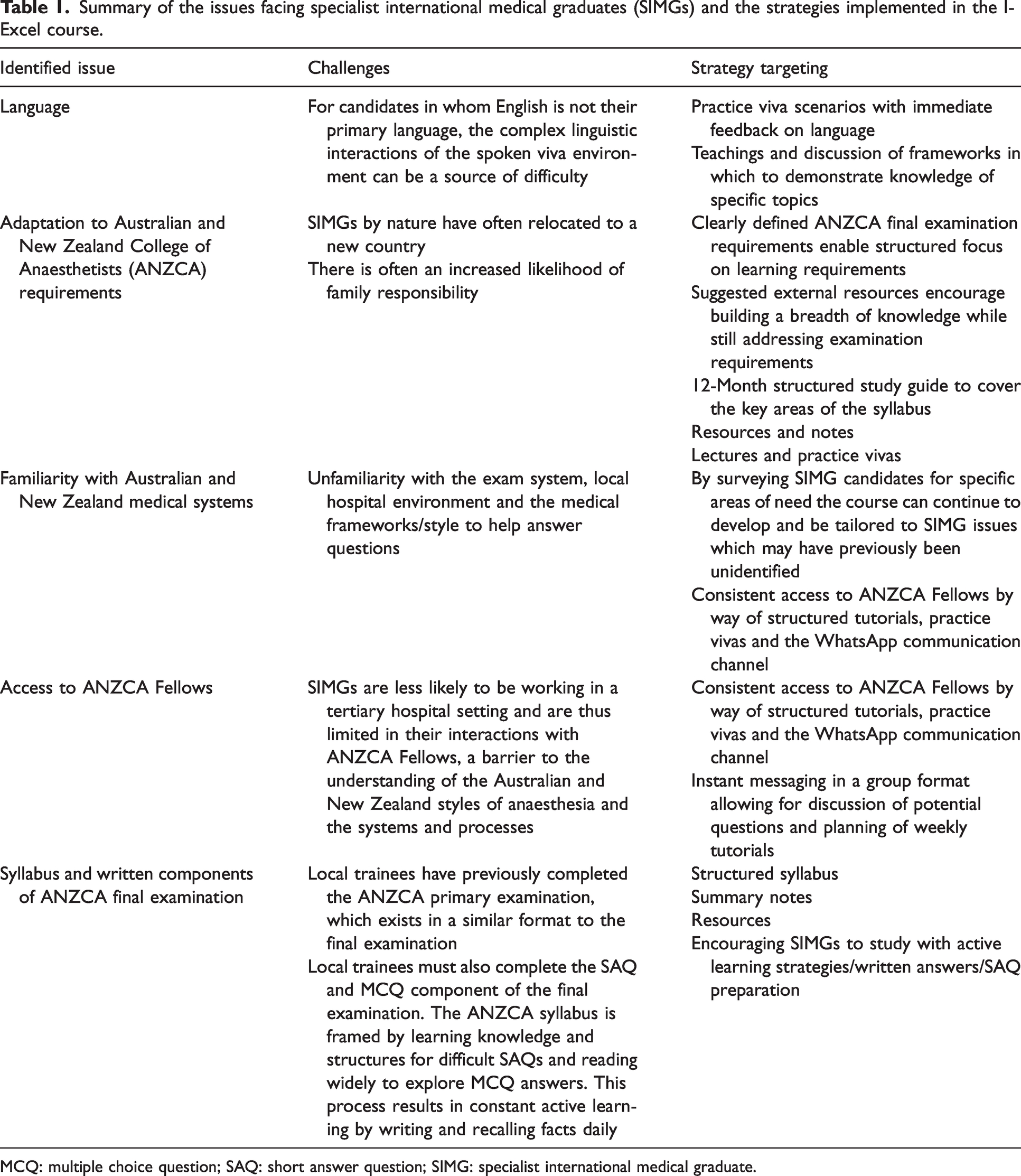
MCQ: multiple choice question; SAQ: short answer question; SIMG: specialist international medical graduate.
We sought to target the issues identified by previous research and SIMGs as contributing to the weaker performance in the final examination relative to local candidates. Previous efforts have been made to support SIMG candidates to achieve success in their specialist examinations.3,4 However, this course is the first Australian SIMG-specific course combining a learning management system, live online lectures and examination practice.
The I-Excel course is the first 12-month completely online SIMG-specific ANZCA final examination preparation course. 5 Given the online nature of its delivery, it is accessible at any time and has an expanding archive of core content. The course is currently open to SIMGs at a cost of US$99 per month and registration is available at any time. However, is it suggested by the authors that candidates undertake 12 months of the course to cover the entire exam syllabus. The I-Excel course is completely not for profit with all content creation, tutorials, lectures, and practice vivas undertaken on a volunteer basis. As of submission date, the I-Excel course has raised over AUD$33,000 for reputable charities.
The course is organised such that SIMG-identified issues are targeted in a structured manner. Following online registration, participants are encouraged anonymously to identify SIMG candidate areas of need to allow the course to continue to develop and be tailored to SIMG issues that may have previously been unidentified. Participants are then able to connect by way of WhatsApp (whatsapp.com). The link and access to the WhatsApp communication channel is made available to the participant on course registration.
A 12-month content and study planner is available, which covers the key areas of the ANZCA final examination syllabus and additionally encourages preparation prior to weekly live content and viva sessions. This planner is accompanied by suggested resources specific to the final examination including study notes, practice vivas and previous examination reports. By accumulating these resources, it reduces candidate time spent locating and collaborating content and counters the disadvantage of local trainees regularly inheriting resources from colleagues.
Published ANZCA examination reports allow for final examination results to be analysed according to specific examination components, and are presented according to whether candidates were local or SIMGs. These results are seen in the 2021.2, 2022.1 and 2022.2 ANZCA final examination reports with I-Excel candidates achieving pass rates of 66.6%, 50% and 58.3%, respectively, while, in contrast, none of the other SIMG candidates achieved a pass mark. Since I-Excel commencement, this exhibits a cumulative 17 passing efforts from a total of 29 attempts from course participants at a pass rate of 58.6%. This is significantly higher than the SIMG pass rates without I-Excel exam preparation. However, there is still a significant difference compared with local ANZCA candidates who have pass rates of 87%, 80.9% and 83.7%, respectively, for the 2021.2, 2022.1 and 2022.2 final examination anaesthetic viva component. 1
Course feedback was obtained from informal, voluntary, and anonymous candidate-reported surveys on course structure and content quality as a means of quality assurance and evaluation. The feedback was overwhelmingly favourable relating to the importance of live viva sessions, technique drills and interaction and feedback from guest examiners. There were many reports on the importance of having a community providing support, belonging and self-confidence. A 10-point scale from 1 (least satisfied) to 10 (most satisfied) was used informally to quantify participants’ perception of knowledge gained, exam technique gained, community support and whether they were likely to recommend the course, and overall satisfaction. The total average score of 45.4 from a possible 50 indicated a high level of satisfaction among course participants.
The success of the I-Excel course in improving ANZCA final examination pass rates for SIMG candidates has significant implications for future candidates within the ANZCA programme and to other specialities. Current and future ANZCA SIMG candidates have a pathway for final examination preparation with consistent ANZCA Fellow exposure, structured tutorials and observed viva practice with improved pass rates.
Footnotes
Author Contribution(s)
Declaration of conflicting interests
The authors declared no potential conflicts of interest with respect to the research, authorship, and/or publication of this article.
Funding
The authors received no financial support for the research, authorship, and/or publication of this article.
