




Abstract

‘We cannot, so to say, return the premature infant to its proper place of abode, the interior of the uterus; but we can with some success endeavour to create an environment … which shall in some points at least resemble the intrauterine nidus.’ John Ballantyne, May 1902.
1
It later transpired that a similar double-walled incubator had been introduced at the Imperial Foundling Hospital in St Petersburg in 1835, and by the mid-1850s, more than 40 of these devices were in service in Moscow. 6 The following decade at Leipzig Maternity Hospital, Carl Credé began using a copper wärmwanne (warming tub) for infants with a birth weight <2500 g. 7
Two novel incubators emerged during the early 1880s. In Dresden, Franz Winckel proposed the ‘permanent bath’, in which babies born between 28 and 36 weeks of gestation were immersed ‘up to the chin’ in warm water. 8 Supported by an inflated rubber collar, the infant’s head protruded through a padded opening in the lid of the apparatus, allowing ‘even very restless’ neonates to remain in the bath ‘for several days in succession’ and ‘drink and sleep without apparent inconvenience.’8,9 Meanwhile in Paris, Stéphane Tarnier conceived the idea for his ‘couveuse’ following a visit to the poultry incubators at the Jardin Zoologique d’Acclimatation. 10 Constructed by Odile Martin, and put into regular use at the Maternité Port Royal in 1881, the Tarnier–Martin couveuse comprised an insulated wooden box separated into two compartments. The lower of these contained a 71 l hot water tank fed from an external boiler, known as a ‘thermosiphon’. Air entering through small apertures in the base of the incubator was thus warmed, before rising by convection into the upper compartment, which was large enough to hold two infants. Early results published by Alfred Auvard in 1883 demonstrated that combined with spoon feeding every 2–3 hours with asses’ milk, the couveuse reduced the mortality rate for preterm babies weighing <2000 g from 66% to 38%. 11
Auvard subsequently modified the incubator, making it smaller and replacing the expensive thermosiphon and metal reservoir with removable sandstone balls filled with hot water. This new model was considered ‘so simple that any village carpenter can make it, and cheap enough to be within the means of all but the most destitute.’ 12 By 1887 the Tarnier–Auvard couveuse was ‘employed daily at the Maternité, in preference to the larger appliance’, accompanied by gavage feeding with breast milk supplied by the mother or a wet nurse. 3
Two years later, Érasme Bonnaire and Tarnier first attempted to increase the ambient oxygen concentration within the incubator in a desperate attempt to salvage a congenitally cyanotic baby who had been born ‘somewhat prematurely’ and failed to thrive despite several days of support ‘by the usual therapeutic resources’. The gas was introduced into the base of the couveuse at intervals throughout the day. Under this influence ‘the general condition rapidly improved’ and after a week the infant was strong enough to live outside the incubator. He left the hospital ‘at the age of six weeks not cured of his blue disease, but able-bodied enough to no longer need special medical care.’ 13 In 1892 Camille Landais reported similarly encouraging results with supplemental oxygen in the treatment of ‘various pathological conditions afflicting newborn babies’ 14 and mechanisms for its delivery were incorporated in several subsequent incubators, including the ‘brooder for premature infants’ devised by Thomas Rotch and John Putnam in Boston, in 1893.15,16
Around the same time in Nice, Alexandre Lion founded the Œuvre Maternelle des Couveuses d’Enfants (Maternal Charity of Infant Incubators). Utilising a thermostatically-controlled metal and glass incubator of his own design, Lion’s philanthropic organisation provided free care for premature babies. More than 25 ‘institutes’ were established in France and cities in other European countries. 17 The most famous of these was located on the Boulevard Poissonière in Paris, where, for 50 centimes, members of the public could marvel at the incubators, neonates and nurses. In 1896, more than 50,000 visitors passed through its doors. 18 During the same year, a display of live infants in Lion incubators aroused ‘lively interest’ among attendees of the Great Industrial Exposition of Berlin. 19
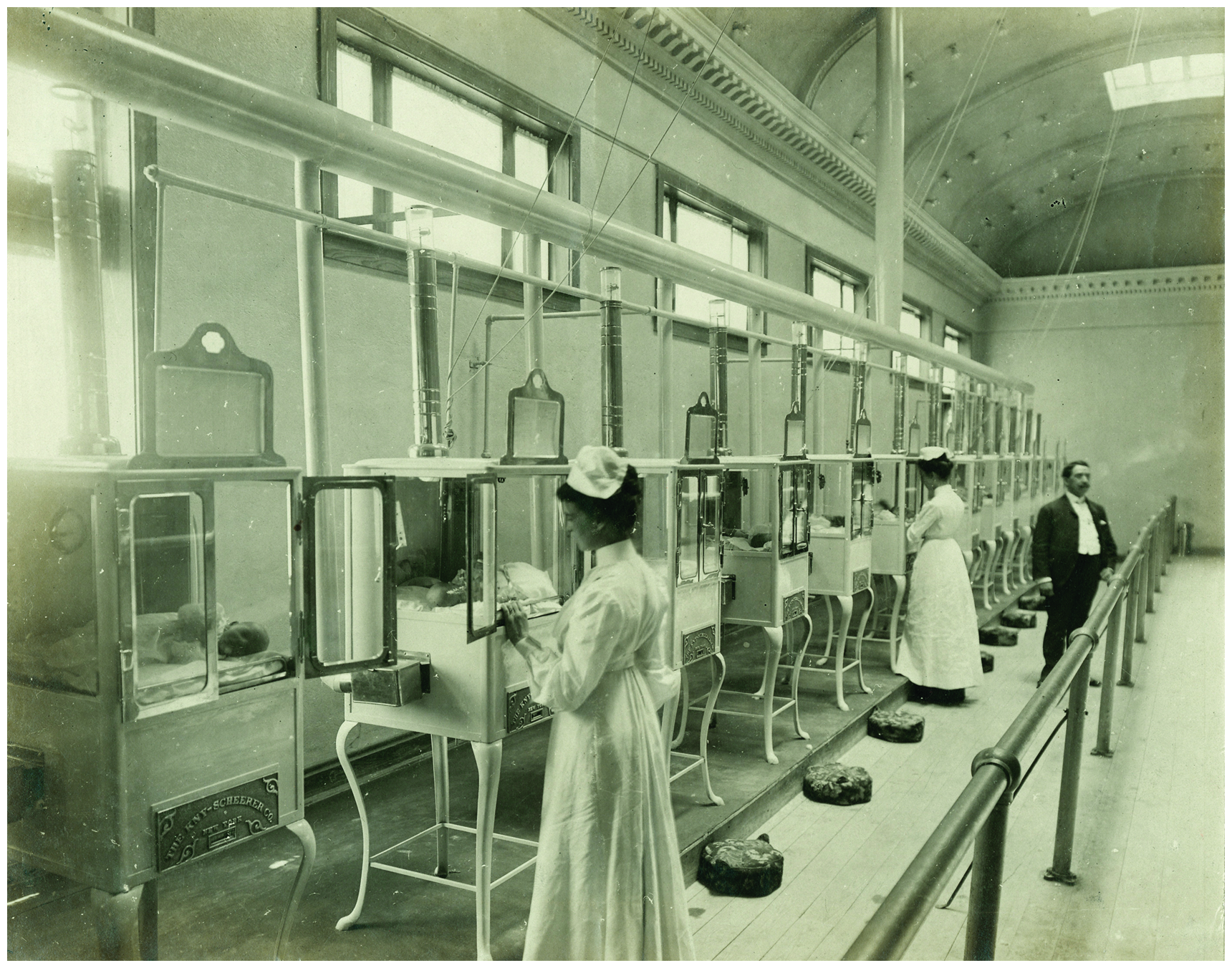
Following this lead, several entrepreneurs set up ‘incubator-baby side-shows’ 20 using Lion incubators manufactured by Paul Altmann in Berlin and the Kny-Scheerer Company of New York. Among the greatest protagonists was Martin Couney, who was responsible for incubator exhibits at several world’s fairs, as well as a seasonal show which ran at Coney Island, New York from 1903 to 1943. 21 These public displays received mixed reviews in medical journals22,23 and also ‘attracted the notice of unscrupulous imitators’. 24 In 1904, a syndicate composed of ‘a hardware dealer, a jeweller, a shoemaker, and a showman’ obtained the concession to run the baby incubator exhibit at the 1904 Louisiana Purchase Exposition, held in St Louis, Missouri.25,26 In an excoriating review by The Lancet’s special sanitary commissioner, it was reported that the show was ‘a flagrant and indecent prostitution of what pretends to be medical science’, with the incubator pavilion surrounded by ‘a railway line … a ladies’ lavatory … a merry-go-round with its blaring machine organ … and the Cairo Street’, in which the ‘dancing was quite as improper as anything seen in Paris.’ 25
While a handful of new incubators emerged during the early 1900s,27,28 many doctors became increasingly concerned that their closed design prevented the delivery of ‘sufficient fresh air to the infant’ and abandoned their use entirely. 29 Indeed, by 1916 in the United States, the devices were deemed ‘passé, except at county fairs and side-shows.’ 30
In response, Julius Hess developed the electrically-heated water-jacketed infant incubator and bed. 31 This was conceptually similar to the warming cradles described above, and allowed currents of room air to circulate freely around the baby. During the early 1930s, Hess created an oxygen unit which replaced the cover and canopy supplied with the bed. This permitted the delivery of 38–80% oxygen. In an early trial of the apparatus at the Sarah Morris Hospital for Children in Chicago, 128 preterm neonates received oxygen therapy, and it became customary ‘to put all premature infants weighing <1200 g in the oxygen bed for 24 hours after admission.’ 32 As further evidence emerged that oxygen ameliorated the respiratory embarrassment, cyanosis and asphyxia associated with prematurity, more elaborate incubators which facilitated the prolonged administration of high concentrations of the gas were developed.33,34 By the early 1950s, the delivery of >50% oxygen for 28 days had become standard practice in the management of neonates under 1500 g in America. 35
Concomitantly, however, there was a growing awareness that intensive oxygen therapy might be the cause of retrolental fibroplasia (RLF), a condition which had been first recognised in premature infants in 1942 and quickly became the leading cause of blindness in children. 33 The possible link between the two was formally suggested in a paper published by Kate Campbell in the Medical Journal of Australia in July 1951 36 and definitively proven in a cooperative study undertaken in 18 US hospitals during 1953 and 1954. 35 As a result, neonatologists rapidly altered their practice, administering oxygen only at times of clinical need, and in concentrations <40%. The incidence of RLF reduced dramatically. 33
Footnotes
Declaration of conflicting interests
The authors declared no potential conflicts of interest with respect to the research, authorship, and/or publication of this article.
Funding
The authors received no financial support for the research, authorship, and/or publication of this article.