



Abstract
The Scottish chemist Dr Alexander Kellas was a most unlikely athlete, described by fellow mountaineer George Mallory as ‘slight in build, thin, short, stooping and narrow chested’. 1 But he was one of the most experienced mountaineers of his time and an expert in high altitude physiology. In 1916, he delivered a paper at the Royal Geographical Society to a group of fellow climbers. 2 Everyone in the audience was well-acquainted with the classic symptoms of mountain sickness–headache, disorientation, nausea and fatigue–but the cause had been a subject of considerable debate, with suggestions ranging from barometric pressure, dehydration or lack of oxygen to noxious gases emitted by the mountains. 3
Kellas began his talk by explaining the historical work of Dr Paul Bert at the Sorbonne in the 1870s. With the financial support of Dr Denis Jourdanet, Bert had constructed pressure chambers to allow altitude research in a sea-level laboratory. 4 Bert’s experiments had established that the symptoms of altitude sickness were due entirely to hypoxia, leading him to recommend the use of supplemental oxygen for ‘mountain travellers and aeronauts’.5,6 Subsequently, balloon aviators were able to reach dizzying new heights with the use of oxygen, but not without some catastrophic accidents due to equipment failure. 7
Kellas continued his talk with an explanation of the benefits and mechanisms of acclimatisation, and a detailed coverage of the haemoglobin-dissociation curve. While he believed this knowledge could be used to advantage and suggested the Himalayas could be climbed without oxygen by someone in peak physical fitness, he also believed the development of equipment for delivery of oxygen should be explored.
The Himalayas had been closed to foreigners in the early part of the 20th century. Instead, climbers headed for other challenging peaks, with the Duke of the Abruzzi, Prince Luigi Amedeo, setting a new climbing record of 24,500 feet on Choglisa in the Kashmir in 1909. When Tibet declared independence in 1912, mountaineers became more hopeful of obtaining climbing permits for the Himalayas. Kellas’ lecture was therefore of intense interest, and oxygen was just one of the tools being considered by the various teams aiming to summit Mount Everest.
The first serious attempt on Everest was made in 1922: a joint effort between the Alpine Club and the Royal Geographical Society in Britain. 8 There was considerable debate about oxygen–ranging from the practical difficulties of the equipment to the ‘un-Britishness’ of using artificial aids. Among the climbers, Australian George Finch was the most enthusiastic promoter of oxygen. He had been convinced after a meeting with Professor Georges Dreyer at Oxford University, a pioneer in aviation research with a particular interest in the use of oxygen at altitude. 9
Finch’s arguments were convincing. In early 1922, he and a team of other interested parties met with the manufacturers at Siebe Gorman in London and within two months they had designed the first Mount Everest Oxygen Apparatus. It was extremely heavy. Four stainless steel cylinders, each containing 240 l of oxygen, were strapped on to a metal frame and worn like a backpack. Each pair of cylinders fed separately into a reducing valve worn on the chest so the climber could easily switch from one to the other. Safety release valves upstream of the pressure reducing valve further added to this bulky arrangement. In total the system weighed 15 kg. To design an appropriate mask, expedition members ran up four flights of stairs with the equipment. The original ‘economiser’ mask, with two expiratory valves, nearly asphyxiated one of the party due to excessive expiratory resistance. Eventually Finch stripped away the mask altogether, leaving the climber with a mouthpiece held between the teeth. Distal to this, he added a reservoir bag fashioned from a toy football bladder, connected via a glass T-piece into the supply hose. This was more economical, while also allowing the climber to visualise the oxygen use and the pressure in the system. It became a feature of subsequent open circuit equipment.
The 1922 Everest expedition was physically and technically challenging, with Finch modifying the equipment at many steps along the way. Ultimately, he and Geoffrey Bruce set a new climbing record but were unable to reach the summit of Everest, partly due to problems with their oxygen equipment. By the expedition of 1924, it was believed Finch had been overly influenced by work with aviators and that many of his safety features could be removed as, unlike pilots, climbers had the option of resting in the event of oxygen supply failure.10,11 Expedition climber Andrew ‘Sandy’ Irvine removed the spare pair of cylinders and pared down the system to only 10 kg. According to his climbing partner, George Mallory, he effectively created ‘an entirely new instrument’. 10 It is not known whether Irvine or Mallory reached the summit in 1924 since both died during the attempt. Many years later, Mallory’s body was found with a severed rope, suggesting there had been an accident, but providing no further information about whether they were going up or down, or the limits of their climb. 12 How much oxygen they took with them on the last day is also unknown but an unanticipated weather event which created very low barometric pressure may have led to greater hypoxia and contributed to their deaths. 13
It was almost 30 years later that the mountain was finally conquered. The party that set out for Everest in 1953 was large, with many climbers, including Edmund Hillary, Tenzing Norgay, Tom Bourdillon and Charles Evans. They were also equipped with two completely different oxygen delivery systems. Bourdillon, a pioneering rocket scientist, had designed a closed-circuit system with his father. It had a close-fitting mask, a soda lime absorber for carbon dioxide and a rebreathing bag. He planned to climb with this while most other climbers would use the now conventional open circuit.
After a period of acclimatisation, experimental climbs and oxygen drops, everything was in place. Bourdillon and neurosurgeon Charles Evans made the first attempt at the summit, both using the experimental closed circuit. On the final day, they changed the oxygen cylinders and the soda lime at 28,200 feet, risking frostbite in the process. But Evans’ respiratory rate began to rise rapidly as they climbed further, quickly exhausting the soda lime. They were forced to turn back after reaching the South Summit, some 300 feet from the top. Both climbers suffered hypoxic symptoms on the descent, which was ‘unpleasant’, but ‘a number of spectacular and unintentional slides proved the apparatus to be unexpectedly robust’. 14
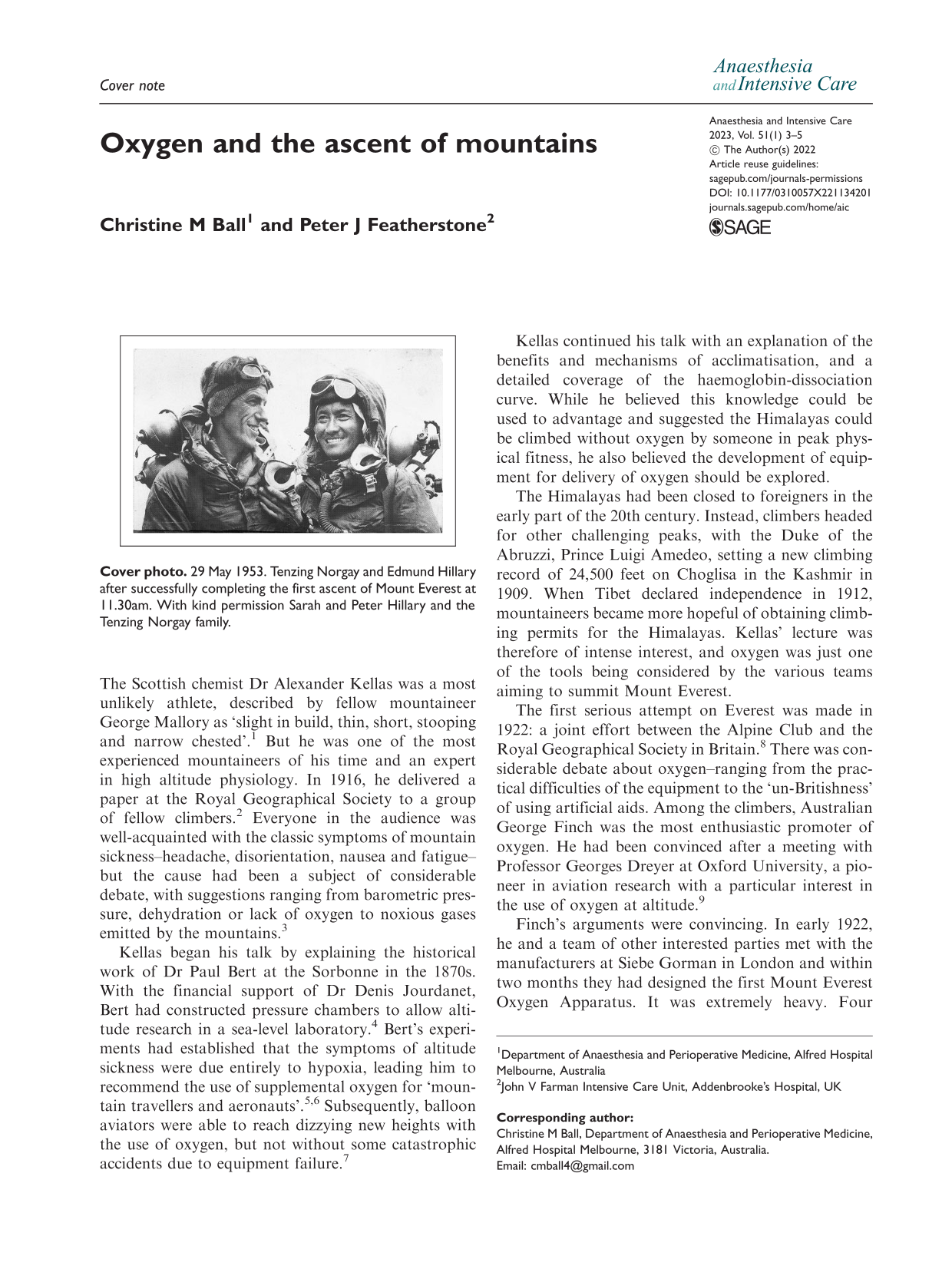
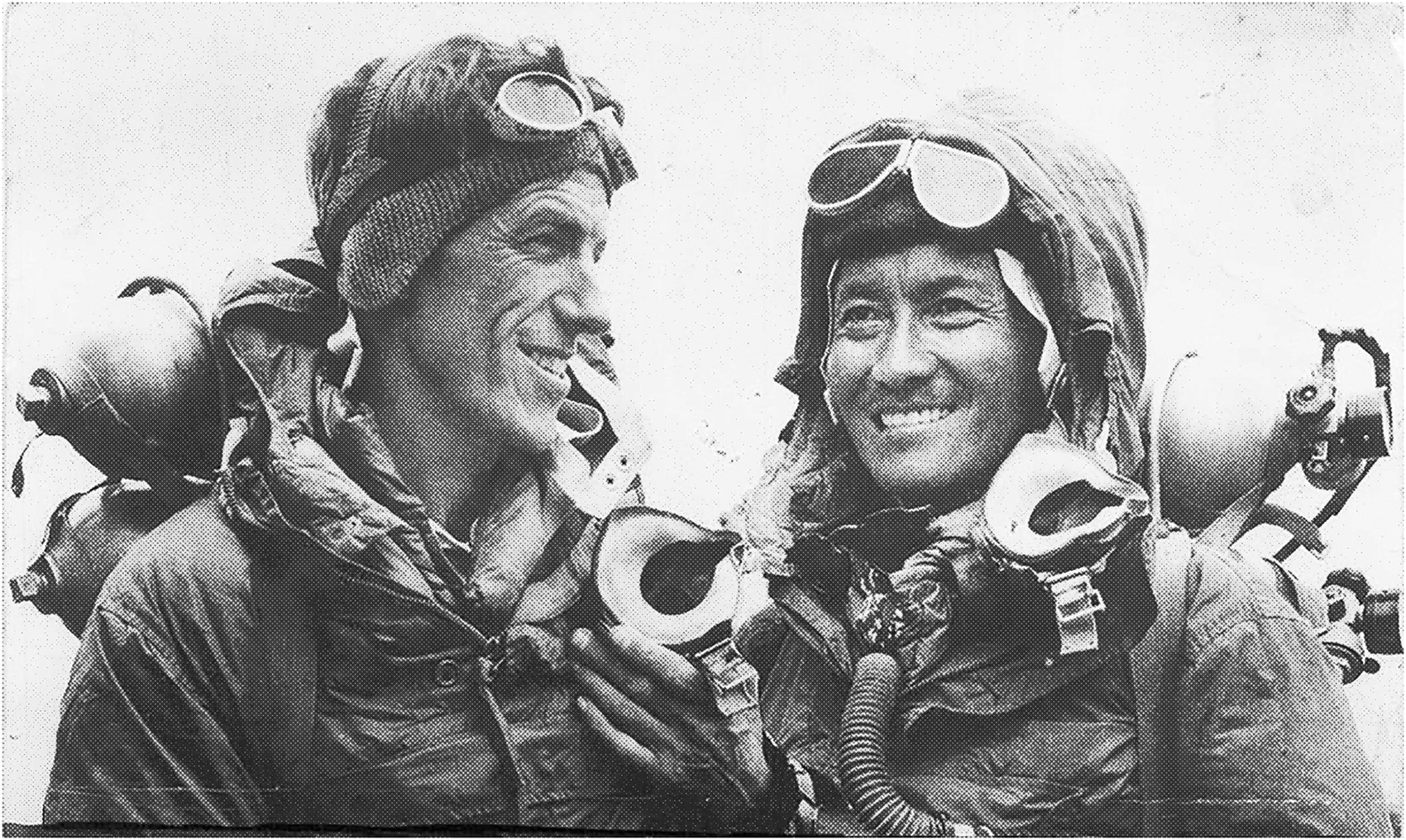
Hillary and Norgay then made the second and ultimately successful attempt, using a more conventional open circuit. 14 Before their final climb, they camped at 27,900 feet with sleeping oxygen at 1 l/min piped into their sleeping bags. Departing at 06:30 on 29 May, they made their final assault with oxygen flow rates of 3 l/min. Close to the top, Tenzing began to struggle, and they discovered ice inside the masks. Fortunately, they were able to remove this without damaging the valves, reaching the summit at 11:30. After removing their masks briefly for photographs, the men descended using flow rates of 2 l/min.
In 1978, Reinhold Messner and Peter Habeler climbed to the summit of Mount Everest without oxygen, a feat that has since been repeated. 15 But it remains unusual; most climbs are undertaken with oxygen. Oxygen, while allowing us to conquer the mountains, has now turned climbing Mount Everest into a commercial enterprise, one which is mired in controversy over faulty equipment, unfit tourists, fatalities–and piles of discarded oxygen equipment. 16