



Abstract

It is full of surprises and adventures, and incongruities, and contradictions, and incredibilities; but they are all true, they all happened (Mark Twain regarding Australian history on his visit to Australia in 1895 1 ).
Anaesthesia and Intensive Care has been pivotal in encouraging, supporting and recording medical history in our region and beyond for 50 years. The history of our specialty is diverse and continually changing. It includes the history of anaesthesia, resuscitation, pain medicine, intensive care medicine, pharmacology, medical equipment, public health, military medicine, people, disaster medicine; organisations like anaesthetic departments, hospitals, colleges and faculties; and temporally ranges from Greek mythology to the current pandemic.2,3
This year marks the 175th anniversary of the first administrations of ether anaesthesia in Sydney, New South Wales, and Launceston, Tasmania, in June 1847. The first issue of the journal in 1972 carried a pivotal paper by Dr Gwen Wilson,
4
the first international doyenne of anaesthesia history from Australia, entitled The tyrant overcome: a review of the history of anaesthesia in Australia. The title referred to ‘the tyranny of distance’ that Australia has suffered from as described by famous historian Geoffrey Blainey,
5
and Wilson extrapolated this to the over 100 days it took for the news of anaesthesia to arrive in Australia from England by sailing ship in 1847. Anaesthesia was met with scepticism by many at the time. The famed German explorer of Australia, Ludwig Leichhardt, returned from his second expedition to the interior of Australia in June 1847—when Pugh in Launceston, Belisario in Sydney and possibly Buchanan in Stroud were administering the first anaesthetics. While in Sydney, Leichhardt recorded in a letter to his brother-in-law in October 1847: Wherever is this new discovery for deadening pain by inhaling ether going to take us? Won’t it turn us into delicate, pain-shy creatures incapable of bearing the least hurt with manly patience?
6
Six months later Dr Leichhardt and six others were last seen leaving the Darling Downs in southern Queensland for the interior and were never heard from again. We still suffer from and are challenged by this tyranny of distance with the current demand for anaesthesia services in rural Australia. This is not new as exemplified by the recent paper in the journal describing where the pilot with the Royal Flying Doctor Service in the 1950s was trained to administer emergency anaesthesia in very remote locations to extremely sick patients! 7
Since that first issue of the journal, over 140 original papers relating to the history of our specialty have been published in the journal. 8 Prior to 2004, the journal also published orations and addresses such as the Geoffrey Kaye Oration, given by the outgoing President of the Australian Society of Anaesthetists (ASA) every 2 years. These orations and also obituaries have since been published in Australian Anaesthetist or the Bulletin of the Australian and New Zealand College of Anaesthetists, but it is pleasing to have the 2021 Geoffrey Kaye Oration by the Past President of the ASA, Dr Suzi Nou, published in the 2022 history supplement. 9 The Journal has also reviewed over 60 books that have been published globally and relate to the history of anaesthesia.
So, who do we look toward to make submissions? Interested member readers, enthusiastic and amateur medical historians of all disciplines and other professional historians with expertise in the history of medicine. Like all other submissions to the journal, all history submissions to the journal are reviewed by two independent reviewers with expertise in the history of anaesthesia and medicine to ensure relevance, accuracy and academic standards. Many submissions are significantly improved by this editorial process.
The most prestigious recognition of contributions to anaesthesia history globally is the Wood Library-Museum Laureate of the History of Anesthesia from the American Society of Anesthesiologists. Two Australian anaesthetists have been among the eight laureates to date and both have been major contributors and closely involved with the journal. Dr Gwen Wilson was the first laureate in 1996 and Dr Christine Ball is the current laureate and a member of the editorial board of the journal. 10
History supplement
The first annual history supplement to the journal occurred in 2005. This was pioneered by the Executive Editor, Jeanette Thirlwell, who realised that there was a small but constant flow of quality historical papers being submitted and that this was enough to warrant a specific supplement. Jeanette with Richard Bailey edited these from 2005 (volume 33) to 2014 (volume 41). The history supplement was then edited by this author until the current date, with the 18th supplement being published this year. Most supplements also have a cover note. To the end of 2021, there have been 106 original papers published in the 17 issues, with 10% coming from outside of Australia and New Zealand. There have been regular contributions reflecting the valuable heritage held by the ASA in the Richard Bailey Library and the Harry Daly Museum at the new ASA headquarters in Naremburn in Sydney. The style of the supplement is in keeping with the rest of the journal and so reflects a medical journal and not that of the humanities as many history journals are.
Cover notes
The early issues of Anaesthesia and Intensive Care showed a stylised morphine molecule, but it is now renowned worldwide for the superb historical cover notes and images which for 38 years have graced the cover of each issue of the journal.11,12 These succinct and accurate historical notes have been superbly illustrated with key images from the Geoffrey Kaye Museum at the Australian and New Zealand College of Anaesthetists (ANZCA) in Melbourne and from institutions and sources from around the world. These notes were initially pioneered by Gwen Wilson, and the vast diversity of topics has been contributed to predominantly by Rod Westhorpe, Christine Ball and Peter Featherstone, with over 210 individual historical notes published continuously, in every issue, since 1984.
Awards
The quality of historical research published in the journal and affiliated with the ASA has been rewarded by a diversity of awards over the years from the History of Anaesthesia Society (UK) and the Anaesthesia History Association (USA), see Tables 1 and 2.3,13–20
David Zuck Memorial Prize winners. 13
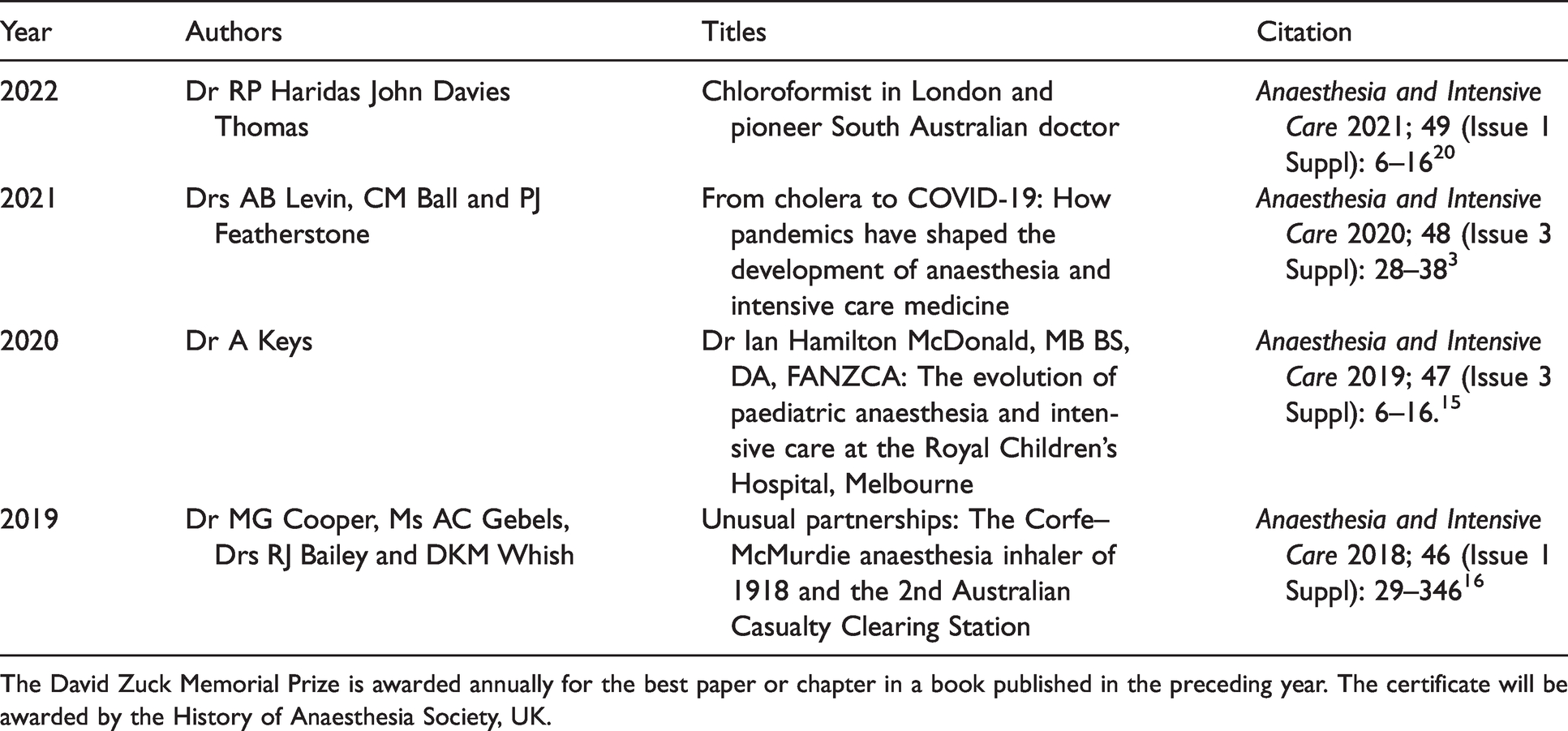
The David Zuck Memorial Prize is awarded annually for the best paper or chapter in a book published in the preceding year. The certificate will be awarded by the History of Anaesthesia Society, UK.
David M Little Prize winners. 14
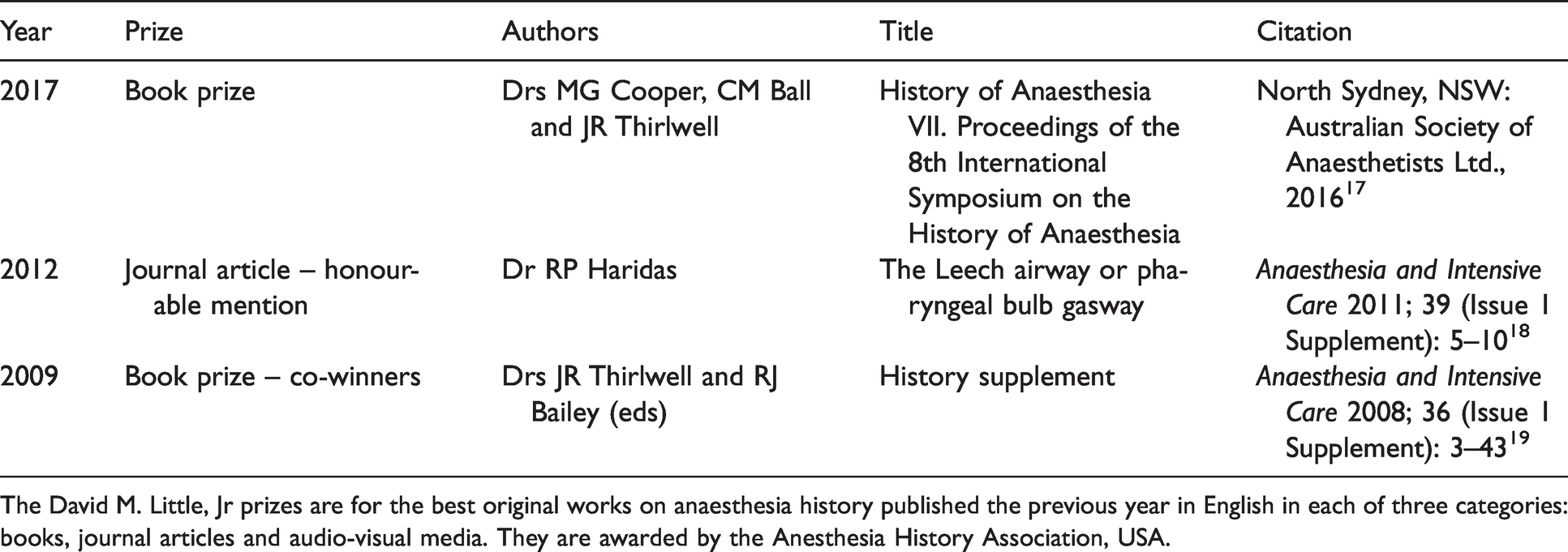
The David M. Little, Jr prizes are for the best original works on anaesthesia history published the previous year in English in each of three categories: books, journal articles and audio-visual media. They are awarded by the Anesthesia History Association, USA.
To stimulate further the study of medical history in Australia and New Zealand, the Australian Society of Anaesthetists has instituted a biennial award for the best publication in the annual history supplement of Anaesthesia and Intensive Care, which includes a cash prize of A$600 21 (see Table 3).3,16,22
Biennial HALMA History award winners.
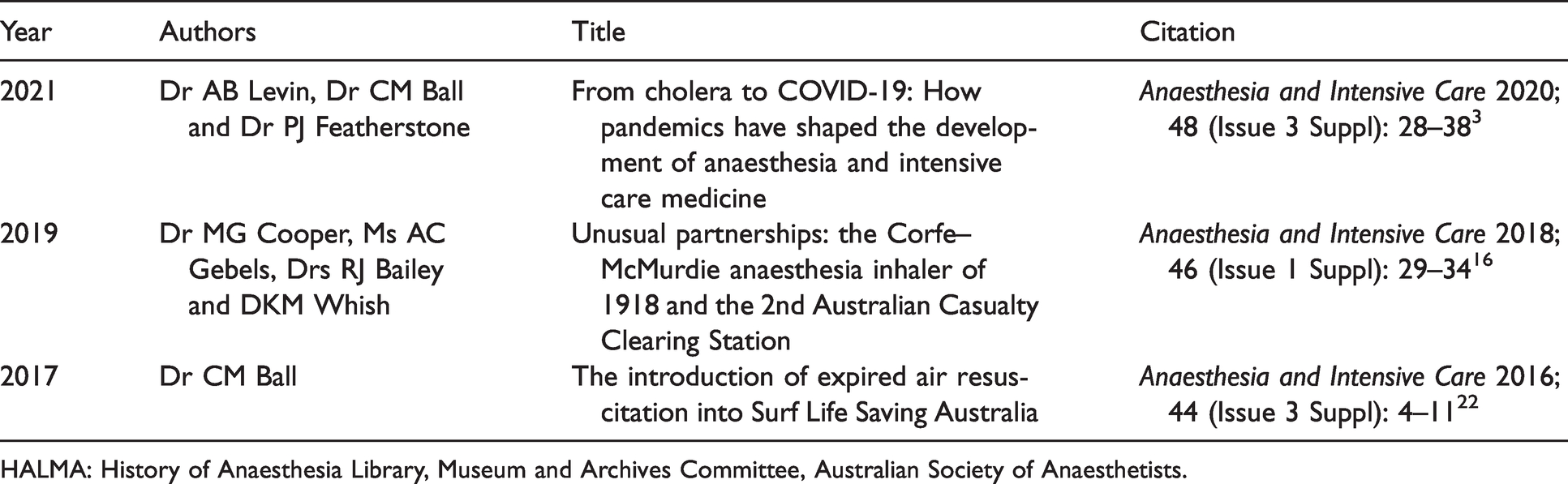
HALMA: History of Anaesthesia Library, Museum and Archives Committee, Australian Society of Anaesthetists.
Conclusion
Anaesthesia, pain medicine, resuscitation and intensive care medicine are ‘young’ specialties in medicine, but have a diverse and interesting history that continues to be explored, researched and documented. Anaesthesia and Intensive Care is proud to be involved in taking this ongoing progressive and academic approach to recording and preserving our rich heritage. And you have seen even greater births than these, for you have seen the application of anesthesia to surgery practice, whereby the ancient dominion of pain, which began with the first created life, came to an end in this earth forever (Mark Twain to the poet Walt Whitman, on his 70th birthday, May 188923).
Footnotes
Author Contribution(s)
Declaration of conflicting interests
The author(s) have no conflicts of interest to declare.
Funding
The author(s) received no financial support for the research, authorship, and/or publication of this article.
