




Abstract

Until a more perfect apparatus is made available, safety in the use of the carbon dioxid technic must lie in the intelligence and skill of the physician who utilizes the method.
1
Ralph Waters, 1943
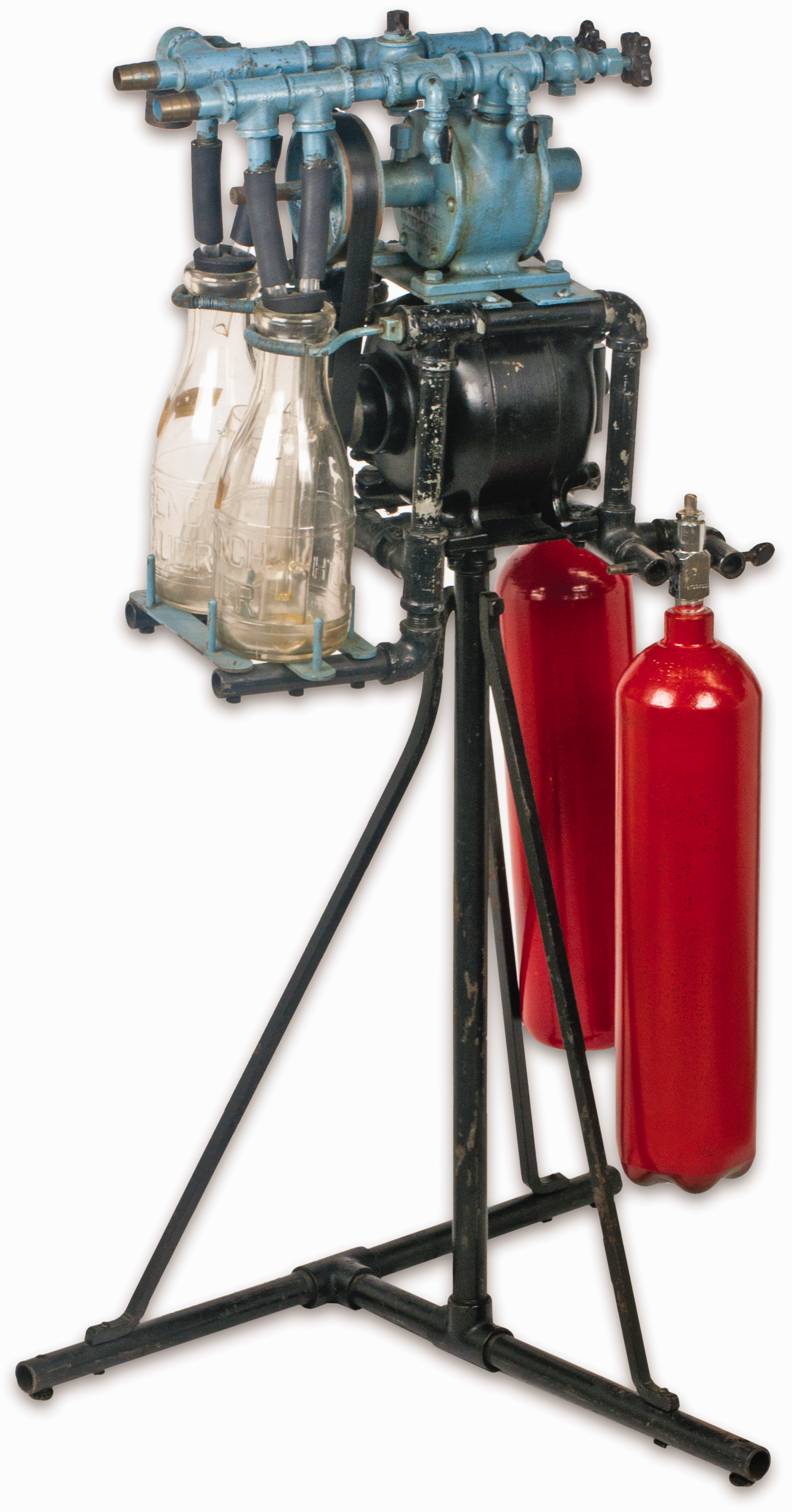
Jackson carbon dioxide absorber. Courtesy of the Wood-Library Museum, Schaumburg, IL, USA.
The device was too complex to interest others but it did provide inspiration. In Wisconsin, Ralph Waters became interested in carbon dioxide absorption techniques as a result of Jackson’s work, but he was hampered by the lack of a readily available carbon dioxide absorber. ‘Wilson’s soda lime’, patented in 1920, provided the solution, with convenient sized granules for many commercial applications—including anaesthesia. 3 Using this soda lime, Waters spent over two years developing his to-and-fro system, a simple arrangement which interspersed a soda lime canister between a tight-fitting mask and a two-gallon bag. At the far end of the bag, a piece of tubing connected to oxygen and nitrous oxide cylinders; ether or ethyl chloride could be added to the circuit via a port in the soda lime canister. ‘Oxygen consumption will be found to vary up to seven or eight hundred cubic centimetres per minute (2 to 3 or more holes with a water sight feed).’ 4 If this was done correctly, Waters stated that anaesthesia could be safely maintained for several hours.
Less portable anaesthetic systems with carbon dioxide absorbers were developed elsewhere. The German surgeon, Franz Kuhn, worked with Dräger on a number of prototypes in the early 1900s, but these remained experimental, largely due to concerns about chemical reactions between chloroform and the carbon dioxide absorbers.5,6 Subsequently Carl Gauss, at the University of Würzburg, created a circle breathing system for acetylene anaesthesia. The machine, made for him by Dräger, used caustic potash for the absorption of carbon dioxide. 7 Circle systems appeared several years later in America.8,9
As anaesthetists adopted these new anaesthetic delivery systems, focus shifted to the soda lime itself. The quality of the soda lime was important—if it was too soft, it generated dust, potentially contaminating the circuit and getting in the patient’s eyes. After prolonged use, it also absorbed water and caked in the canister. 1 But soda lime that was too hard was less effective. There was also no simple way of knowing when it was expired. Initially, Waters suggested expired gases could be bubbled through a solution of barium hydroxide, which would cloud if carbon dioxide was present. 10 Practically though, he concluded that canisters should be changed every five hours, but could be functional for ten. Many, like Gilbert Troup in Western Australia, found their own solutions: ‘A piece of strapping on the to and fro absorber divided into eight squares will allow a record to be kept of the number of hours the container has been used. A complete cross in a square represents one hour.’ 11 Experimental dyes were added in the 1940s and there was even a patent filed for a self-indicating soda lime. 12 But the change of colour correlated poorly with the actual expiry point, making the use of a transparent canister ‘scarcely justifiable’. 1 There was also the concern that their use would ‘…be misleading or even dangerous in the hands of those inexperienced with the physiological effects of an excess of carbon dioxide’. 13
More concerning was the possibility that interactions between soda lime and anaesthetic agents could lead to dangerous by-products. Phosgene was a known decomposition product of chloroform, but initial concerns that more phosgene may be created due to an interaction with soda lime proved unfounded. 14 However, toxic metabolites were something that continued to be of concern with every new anaesthetic agent. Trichloroethylene (Trilene, Imperial Chemical Industries, London, UK), discovered in 1934, was an anaesthetic agent with superior analgesic properties. In 1944, Australian anaesthetist, Margaret ‘Gretta’ McClelland, while working in London, drew attention to a number of nerve palsies relating to the use of Trilene in a rebreathing system. It soon became apparent that, in the presence of soda lime, Trilene decomposed to toxic metabolites—notably phosgene—in sufficient quantities even to affect patients subsequently anaesthetised with the circuit. 15
Other commercial alternatives to soda lime soon appeared, with Baralyme® (Allied Healthcare Products, St Louis, MO, USA), first described in 1941, providing the most significant competition. 16 There were many discussions about the optimal size and shape of the canisters, the packing density, and how the gas stream channelled through the absorber, consuming some areas more selectively. Throughout the 1950s, canisters grew in size from 500 cc to 750 cc—culminating in an enormous 3300 cc canister in 1958. 17 Double canisters were first suggested in 1953 and, once this system was widely accepted, canisters shrank back down to a more manageable size. Double canisters also improved the usefulness of indicator dyes—because spill-over of colour into the second canister probably meant the first was exhausted. Dyes subsequently became ubiquitous—ethyl violet for soda lime, mimosa red for Baralyme and other more unusual dyes, such as Clayton’s yellow for the Mallinckrodt soda lime (Mallinckrodt Baker, Inc., Phillipsburg, NJ, USA). 18
Infection was another concern. In 1941, after deliberately contaminating circuits for experimental purposes, John Adriani and Emery Rovenstine concluded: ‘the possibility of cross infection, by using a canister for one patient and immediately for another, is remote’. 13 But by the 1960s, it was apparent that anaesthetic breathing circuits were a serious source of respiratory infection. 19 While it was relatively easy to change and sterilise circuits, soda lime canisters proved more problematic—and a clear source of infection—leading to calls for individual use, disposable canisters and the use of bacterial filters. 20
Carbon dioxide absorption remains important in anaesthesia today, albeit with the added safety of end-tidal carbon dioxide monitoring. Before release, each new anaesthetic agent must be investigated for interaction with soda lime. Despite this, discussions on the subject continue to occupy the literature—carbon monoxide 21 and most persistently, compound A and sevoflurane, featuring in recent years. 22 Meanwhile, new carbon dioxide absorbers continue to be explored as cost and environmental concerns dominate discussions about low-flow anaesthesia.23,24
Footnotes
Declaration of conflicting interests
The author(s) declared no potential conflicts of interest with respect to the research, authorship, and/or publication of this article.
Funding
The author(s) received no financial support for the research, authorship, and/or publication of this article.