



Abstract

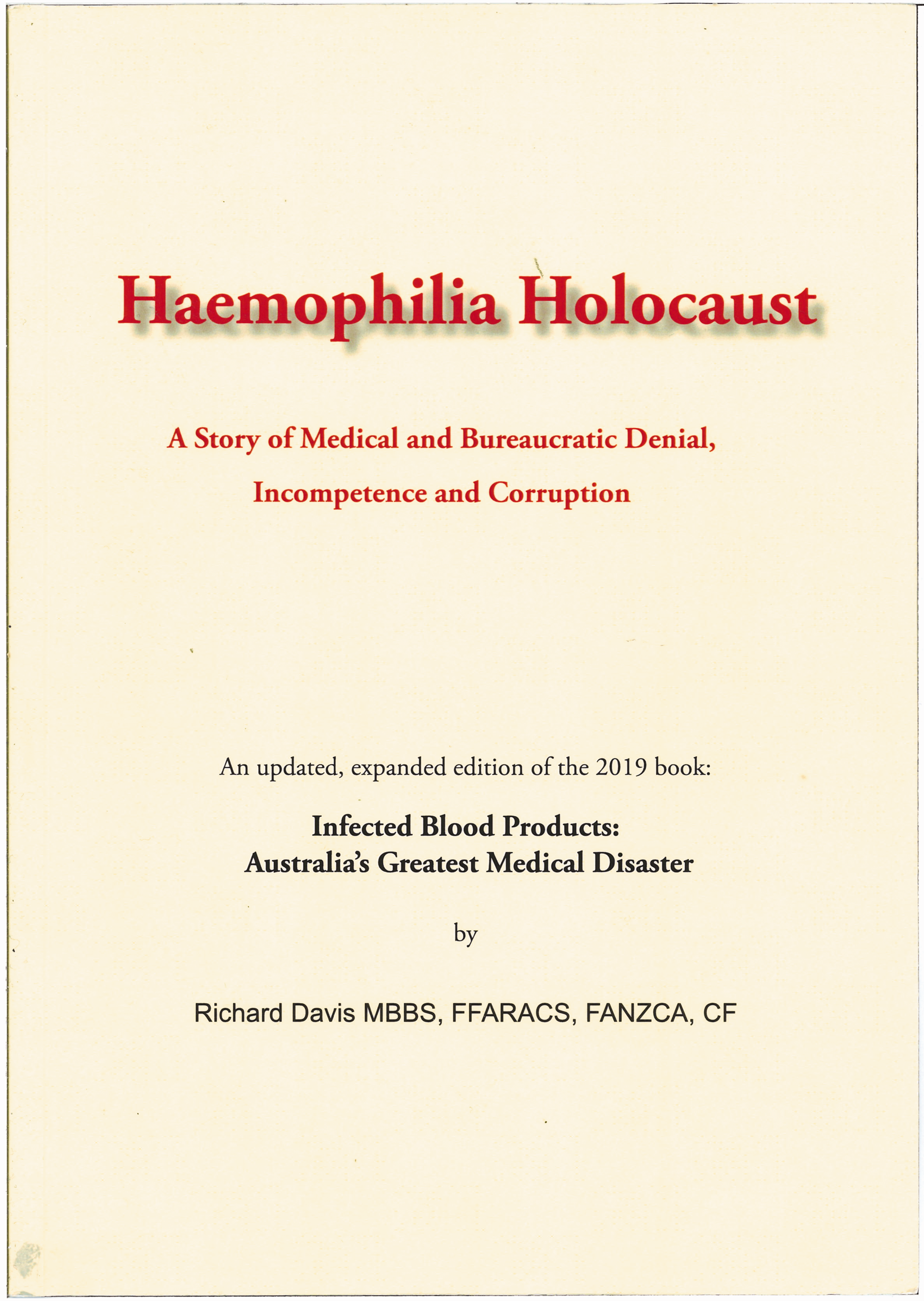
This short self-published book is an impassioned polemic by an anaesthetist who had the foresight to anticipate the events of the 1980s when blood transfusion became the vehicle for the transmission of HIV (and hepatitis C) prior to the development of effective donor blood screening. His passion derives partly from seeing a friend die due to HIV-infected factor IX concentrate in 1984, probably given unnecessarily. His passion must also reflect the frustration of recognising what could have been avoided if his warnings about the dangers of blood transfusions had been heeded.
Even before the advent of HIV, the dangers of pooled factor VIII concentrate (as opposed to cryoprecipitate from a much smaller donor pool) were anticipated by some. Similarly, concerns about an unidentified (‘non-A non-B’) hepatitis were raised by some who suggested using surrogate markers such as liver enzymes to exclude some donors.
In the 1970s, Doctor Richard Davis became an advocate (and pioneering practitioner) of autologous preoperative blood donation, as a way of avoiding transfusion-related infection. At the time he was seen as unnecessarily alarmist. He has had the ‘misfortune’ to be proved right.
In his book, the author documents the unfortunate saga of this controversial period, and includes disturbing accounts of intellectual arrogance, pride, incompetence, conflicts of interest, and (possibly) corruption. He deals with the Australian story, and also includes a survey of similar ‘disasters’ in many other countries. Autologous preoperative blood donation was underutilised. Transmission of HIV and Hep C could have been minimised by avoiding multi-donor clotting factor replacement. There was international trade in blood components including the use of blood sourced from the indigent and from prisoners. He details ‘cover-ups’ by blood bankers, government agencies, the Red Cross, CSL (the Commonwealth Serum Laboratories, then publicly-owned) and by profit-seeking corporations. It is horrifying reading and needs to be on the historical record.
Unfortunately, the book suffers greatly from a lack of rigorous and unimpassioned editorial guidance. As published, it is a collection of facts, anecdotes, factoids and opinions, at times somewhat disordered, and unconventionally referenced. It also suffers from a lack of historical perspective: clinical practices and social attitudes have changed remarkably since the 1980s.
The author emphasises the failures of blood banks, but perhaps underemphasises that many perioperative blood transfusions that occurred during the 1970s and 1980s were probably unnecessary, particularly if surgical practices aiming to avoid blood wastage had been used. With modern surgery and patient blood management, transfusion for most elective surgery is becoming very unusual. The foresight of haematologist James Isbister is notable in this regard. Perhaps ironically, his call for widespread preoperative autologous donation is now difficult to support (i.e. due to low transfusion rates), although it should be a part of our armamentarium.
Doctor Davis describes the transfusion-related infection of patients during the 1980s as ‘Australia's greatest medical disaster’. Particularly at these times, I think many would consider that there were other medical disasters of greater significance. But the transfusion-related disaster of the 1970s–1980s does deserve greater recognition. There are lessons that still need to be learnt. And there can be little doubt that pride, arrogance, incompetence and corruption will be encountered again during the current Covid crisis.
The author concludes with 12 recommendations that are certainly worthy of strong consideration. His last is that there should be a Senate Review or Royal Commission into the tainted blood disaster. Some would question the value of such an exercise, but there does need to be a dispassionate, comprehensive analysis of this unfortunate medical episode. He apologises at the end of his book, recognising that he does not have the skills to undertake such an analysis. This is a work that still needs to be completed.
Despite the shortcomings of the publication itself, it will be a valuable resource for others to use and learn from. It is entirely commendable that Doctor Davis has put in the great effort to document his valuable knowledge. I hope it is some consolation to him that he has placed this unique and valuable perspective on record.
Footnotes
Author Contribution(s)
Declaration of conflicting interests
The author(s) have no conflicts of interest to declare.
Funding
The author(s) received no financial support for the research, authorship, and/or publication of this article.
