



Abstract
Although the value of oxygen gas as a remedial agent has long been known to the medical profession, the difficulty and expense attending its production in quantities sufficient to be of real service has heretofore prevented its general use. New York Oxygen Gas Company, 18701
In the century following its discovery, 2 oxygen was largely produced by the thermal decomposition of various chemical compounds. Such endeavours were costly, owing to the large volume of raw materials and high temperatures required, and the small quantities of oxygen produced were often contaminated with high levels of impurities. As early as 1798, Jean-Antoine Chaptal noted, ‘I have uniformly observed that the use of oxygen gas, evolved from the mercuric oxides, produces salivation, at the end of a few days’ use’. 3 In addition, many of these reagents were potentially dangerous: ‘An English pharmacist, in preparing oxygen from the peroxide of manganese, was severely wounded by the explosion of the retort in which it was being manipulated, a pupil who assisted him being killed by the accident. An analysis of the peroxide … showed that it contained a considerable quantity of charcoal, which, by its rapid combustion in the gas, had caused the explosion’. 3
By the early 1860s, it had become clear that potassium chlorate was ‘the substance which most readily yields the whole of its oxygen’ 3 when heated in the presence of the catalyst manganese dioxide. The addition of a small amount of ferrous carbonate served as a safeguard against the evolution of chlorine gas. The oxygen produced by this reaction was suitably pure, and the price of potassium chlorate sufficiently low, that several small companies began to exploit the technique commercially. 4 While most of gas they produced was destined for theatres and music halls, where it was employed in the production of limelight (an intense light created by directing an oxyhydrogen flame at a cylinder of quicklime), a handful of individuals focused their attention on the production, storage and distribution of oxygen for medical use.
In 1864 in Paris, 5 Stanislas Limousin constructed ‘an ingenuous and convenient apparatus for preparing oxygen’ which could be ‘easily and economically arranged in any drug-store or pharmacy’. 3 This liberated approximately 230–240 litres of oxygen for each kilogram of potassium chlorate heated. The gas was purified by passage through a solution of caustic soda and stored in either a large metal gasometer or air-tight India rubber bags, ranging from 10 to 40 litres in volume. 5 Such was his success that Limousin opened a special room, close to his dispensary in Rue Blanche, where oxygen could be inhaled under his supervision. Each ‘séance’, which included the inhalation of up to 10 litres ‘pure oxygen gas’, cost one franc. 6 Additionally, Limousin also offered delivery of oxygen to all districts of Paris, using the rubber gas bags. However, their distinctive odour frequently proved disagreeable to patients, and they were lined with talc dust, which could cause bronchial irritation. 3 Furthermore, the bags had a tendency to deteriorate rapidly, making them ‘useful only for transporting gas to the patient’s home’. 6 Later versions, produced in the USA for Samuel Wallian, were encased in ‘fancy cloth … both as a matter of taste and for the sake of protecting them from injury … overdistension … and handling’. 3
Pressurised cylinders offered a more robust means of distributing gases, and in London in 1868, George Barth succeeded in compressing 15 gallons of oxygen into a copper cylinder using a hand pump. 7 Two years later, the New York Oxygen Gas Company was able to supply physicians ‘in any part of the city’ with oxygen pressurised to 17 atmospheres in 100- and 200-gallon cylinders made from copper or cast iron. 1
For those unable to obtain compressed gas, the company also marketed a portable apparatus for generating oxygen from potassium chlorate and manganese dioxide at the bedside. The equipment was packed in a ‘neat box for convenience of carrying’ and included a powerful spirit lamp for heating the chemicals. 1 A supply of gas could be produced in 15 minutes, and ‘by having two retorts, and using them alternately’, a continuous supply of oxygen could be maintained. 1
So far, the commercial production of oxygen had only taken place on a small scale. However, in 1879, Arthur and Léon Quentin Brin attended a lecture at the Conservatoire des Art et Métiers in Paris, during which Jean-Baptiste Boussingault, Professor of Agricultural Chemistry, outlined a method which might feasibly be used to isolate oxygen from the atmosphere in very large quantities. 8
Some 28 years earlier, Boussingault had demonstrated that barium oxide reacted with air at 538°C to form barium dioxide. Raising the temperature of this compound to 871°C resulted in regeneration of barium oxide (which could be reused) and the release of almost pure oxygen. 8 However, Boussingault found that the barium oxide became inactive after the reaction had been repeated more than 12 times and had been unable to make the process industrially viable. 9
The Brin brothers set about overcoming these issues, and by 1884 had opened a small facility in the 16th arrondissement of Paris, where they tested their improved process for the production of oxygen using barium oxide. 10 A year later, they demonstrated this patented ‘Brin process’ at the International Inventions Exhibition in South Kensington, and attracted the interest of British investors, who subsequently founded Brin’s Oxygen Company in January 1886. Production began at the factory at 69 Horseferry Road, Westminster, the following year. 4 Simultaneous advances in steel manufacturing soon allowed the company to store and distribute oxygen in seamless steel cylinders which were able to withstand high pressures. Several companies were subsequently licenced to produce oxygen using Brin’s patented process, in both the UK and Europe. 4
In 1906, the company was renamed the British Oxygen Company, and abandoned the use of barium oxide, instead separating pure oxygen (and other gases) from liquefied air. Efficient methods for the industrial production of liquid air had been introduced by Carl Linde (founder of the Linde company) in Germany and Georges Claude (founder of Air Liquide) in France, in 1895 and 1902, respectively. By 1905, modified distillation columns capable of producing large volumes of pure oxygen gas had been developed, and the Brin process was rendered obsolete. 11
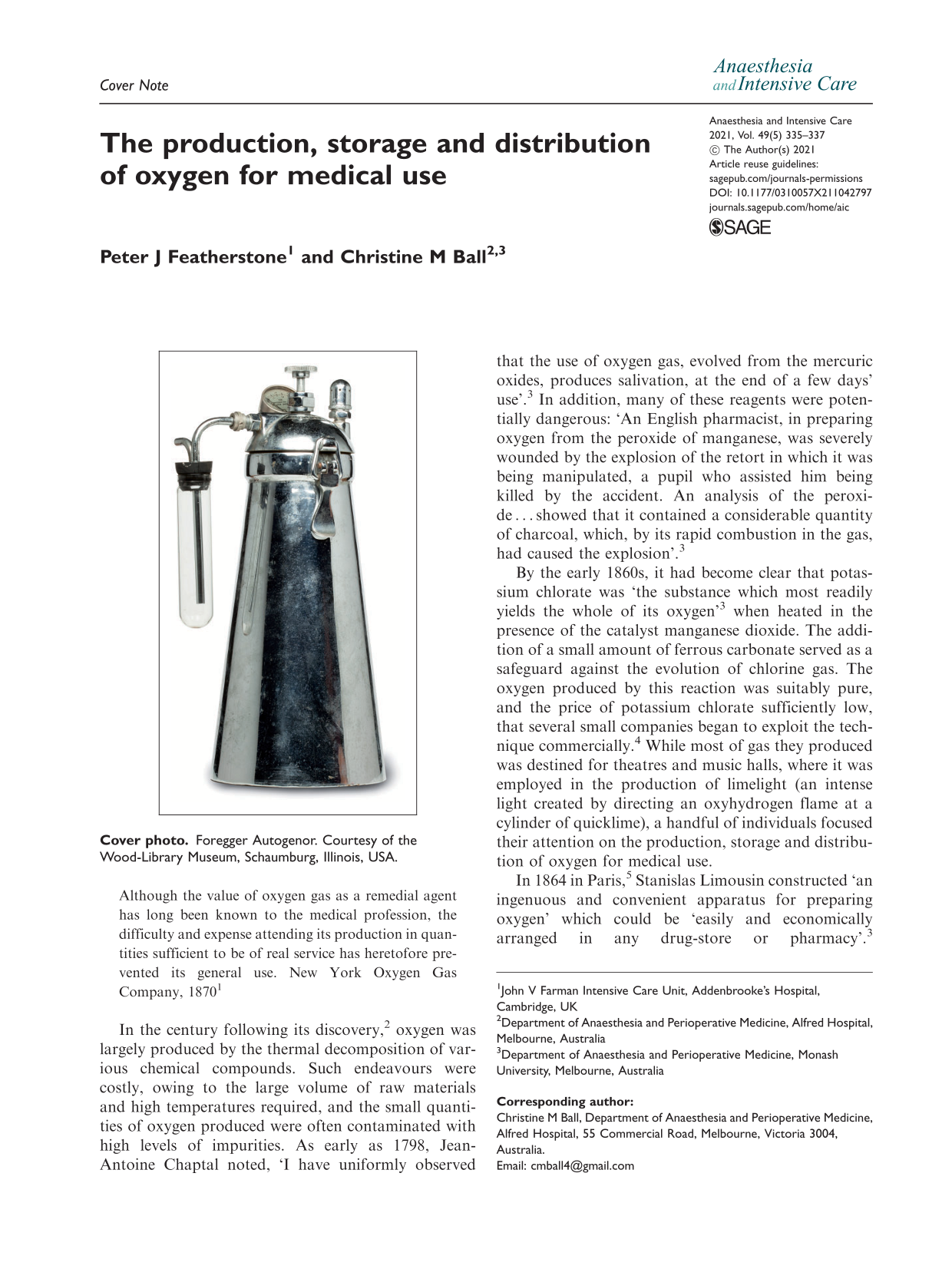
Around the same time, there was a short-lived resurgence of interest in portable oxygen generators, including a device produced by Messrs Kamm and Co., which made use of potassium chlorate and manganese dioxide, 12 and the Autogenor, patented by Richard von Foregger in 1908. This produced oxygen by the action of water on fused sodium peroxide, and then stored and delivered the gas under pressure, making it suitable for the delivery of anaesthesia. 13
Technology for the production, storage and distribution of liquid oxygen was developed in Germany during the 1920s and early 1930s by Paul Heylandt. 4 However, more than two decades later, most oxygen used in hospitals in the UK continued to be supplied in pressurised cylinders. In 1957, it was reported that approximately 150 of these institutions had internal pipelines fed by cylinder manifolds, and five were equipped with vacuum insulated evaporators to take liquid oxygen. 11
The COVID-19 pandemic has recently highlighted the shortages and inequalities in access to oxygen which continue to exist in many low- to middle- income countries today. 14
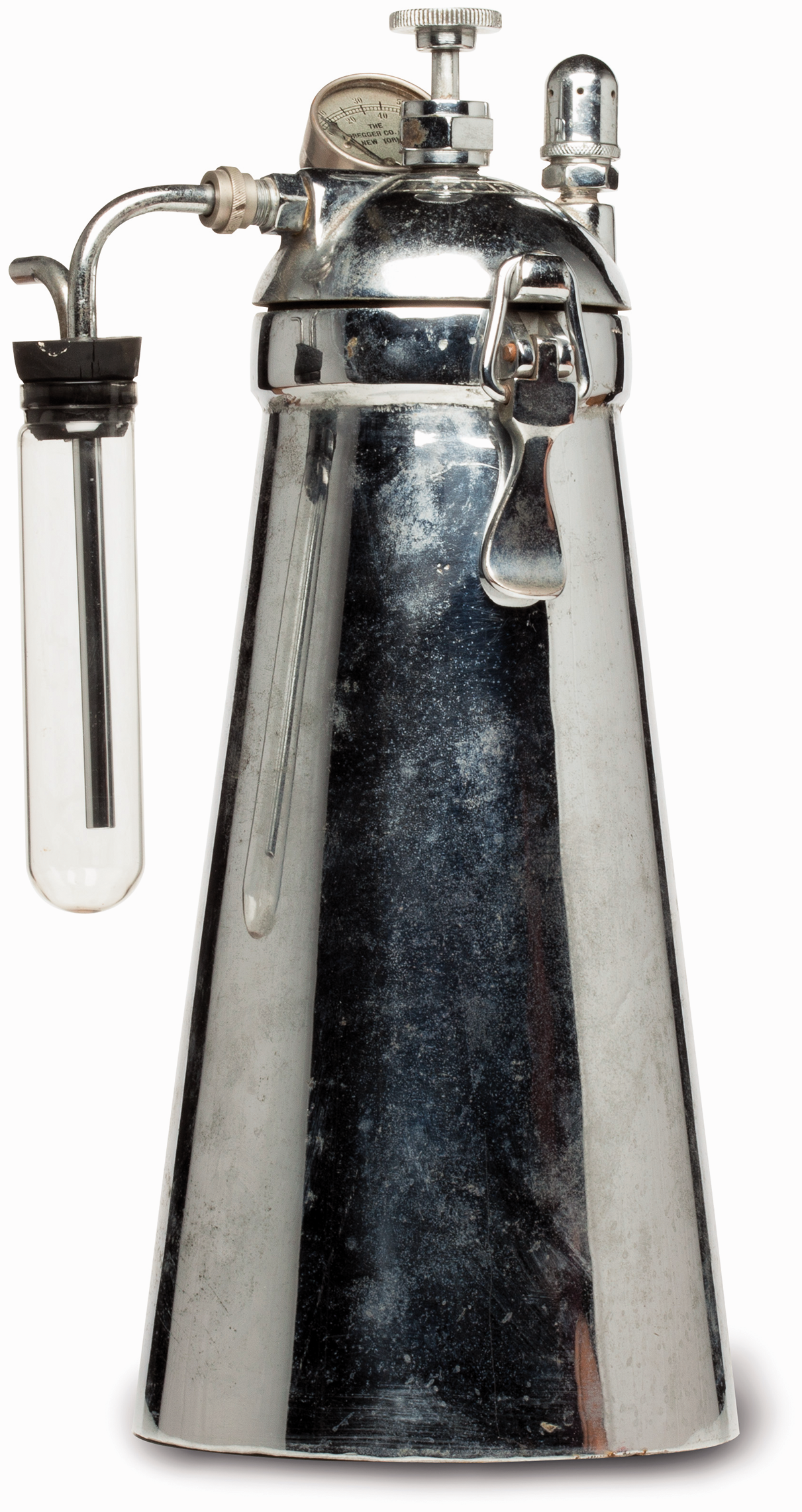
Foregger Autogenor. Courtesy of the Wood-Library Museum, Schaumburg, Illinois, USA.