



Abstract

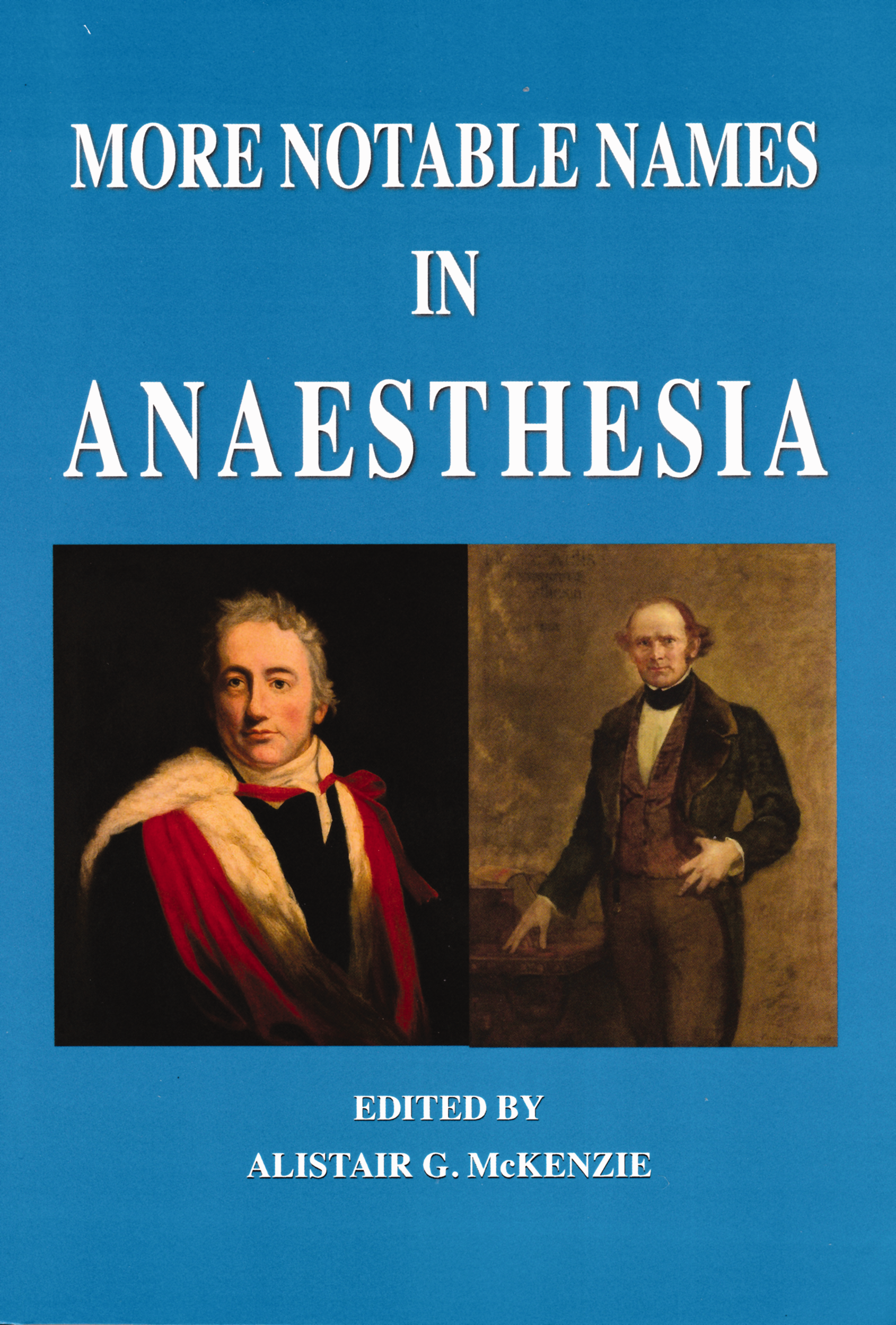
More Notable Names in Anaesthesia is a book that comprehensively examines significant names in the history of anaesthesia. In some ways it could be seen as a companion piece to the excellent Notable Names in Anaesthesia edited by JR Maltby from 2002. The book is similar in format but covers new ground in describing other more contemporary and well-known figures of historical anaesthetic significance.
The chapters cover the life of these historical figures but also detailed examinations of their particular anaesthetic contributions. Some of the chapters are based on eponymous awards, prizes or lectures, named after the anaesthetist and their achievements. For example, there are chapters for the Bjorn Ibsen Lecture, Humphry Davy Award, as well as the Robert Orton Medal (known to Australian anaesthetists as the award given for distinguished service to anaesthesia).
The chapters commence with an outline of the person’s life and career achievements, and then go on to outline the particular achievement for which they have been recognised. In all there are about 70 chapters, each outlining significant moments in the history of anaesthesia. The chapters are both engaging and informative, as well as being set out in an easy chronological order.
Pleasingly, a large amount of the book is dedicated to those figures who may be less well known but whose ideas or pieces of equipment are universally valued by anaesthetists the world over. Examples include Takuo Aoyagio (pulse oximetry), James Prescott Joule (defibrillator setting), David Grob (train-of-four monitoring). I particularly enjoyed the chapter on Michael Tunstall, whose contributions included Entonox® (BOC, Guildford, Surrey, England), neonatal resuscitation, failed intubation drills and the isolated forearm technique.
Previous books have not fully recognised the contributions of anaesthetists from parts of the world other than Europe and the USA. This book also highlights the contribution of anaesthetists from South Africa, Japan, Australia, and New Zealand.
Of particular interest to Australian anaesthetists will be the chapters on the Richard Bailey Library and the Harry Daly Museum. The Australian Society of Anaesthetists (ASA) library was originally established in 1937 as a practical reference library, eventually to find an established home at the ASA headquarters in Sydney. Dr Richard Bailey was appointed the Honorary Librarian and Archivist for the library that eventually came to be named in his honour. The library has close to 3000 titles relating to the history of anaesthesia and is of international standing. This includes a collection of 300 titles relating to mesmerism—a particular interest of Dr Bailey.
The Harry Daly Museum chapter concentrates on Dr Harry Daly, who donated his collection of anaesthetic equipment in the 1950s. Since then, the museum has grown to house some 4000 items, including Dr Mark Lidwell’s early ether inhaler and Dr Duncan Campbell’s design for a compact ventilator from the 1970s, that many of us would have used for years.
To the credit of the editor, we now have an informative and entertaining record of the historical anaesthetic achievements. This is a book that all who are interested in the history of anaesthesia will appreciate and enjoy. I would recommend it as a useful addition to all anaesthetic departments.
Supplemental Material
sj-pdf-1-aic-10.1177_0310057X211027895 - Supplemental material for McKenzie AG (ed). More Notable Names In Anaesthesia
Supplemental material, sj-pdf-1-aic-10.1177_0310057X211027895 for McKenzie AG (ed). More Notable Names In Anaesthesia by Mark A Lovell: for the DIRECT-MT Investigators in Anaesthesia and Intensive Care
Supplemental Material
sj-pdf-2-aic-10.1177_0310057X211027895 - Supplemental material for McKenzie AG (ed). More Notable Names In Anaesthesia
Supplemental material, sj-pdf-2-aic-10.1177_0310057X211027895 for McKenzie AG (ed). More Notable Names In Anaesthesia by Mark A Lovell: for the DIRECT-MT Investigators in Anaesthesia and Intensive Care

Supplementary Material
Please find the following supplemental material available below.
For Open Access articles published under a Creative Commons License, all supplemental material carries the same license as the article it is associated with.
For non-Open Access articles published, all supplemental material carries a non-exclusive license, and permission requests for re-use of supplemental material or any part of supplemental material shall be sent directly to the copyright owner as specified in the copyright notice associated with the article.
