




Abstract
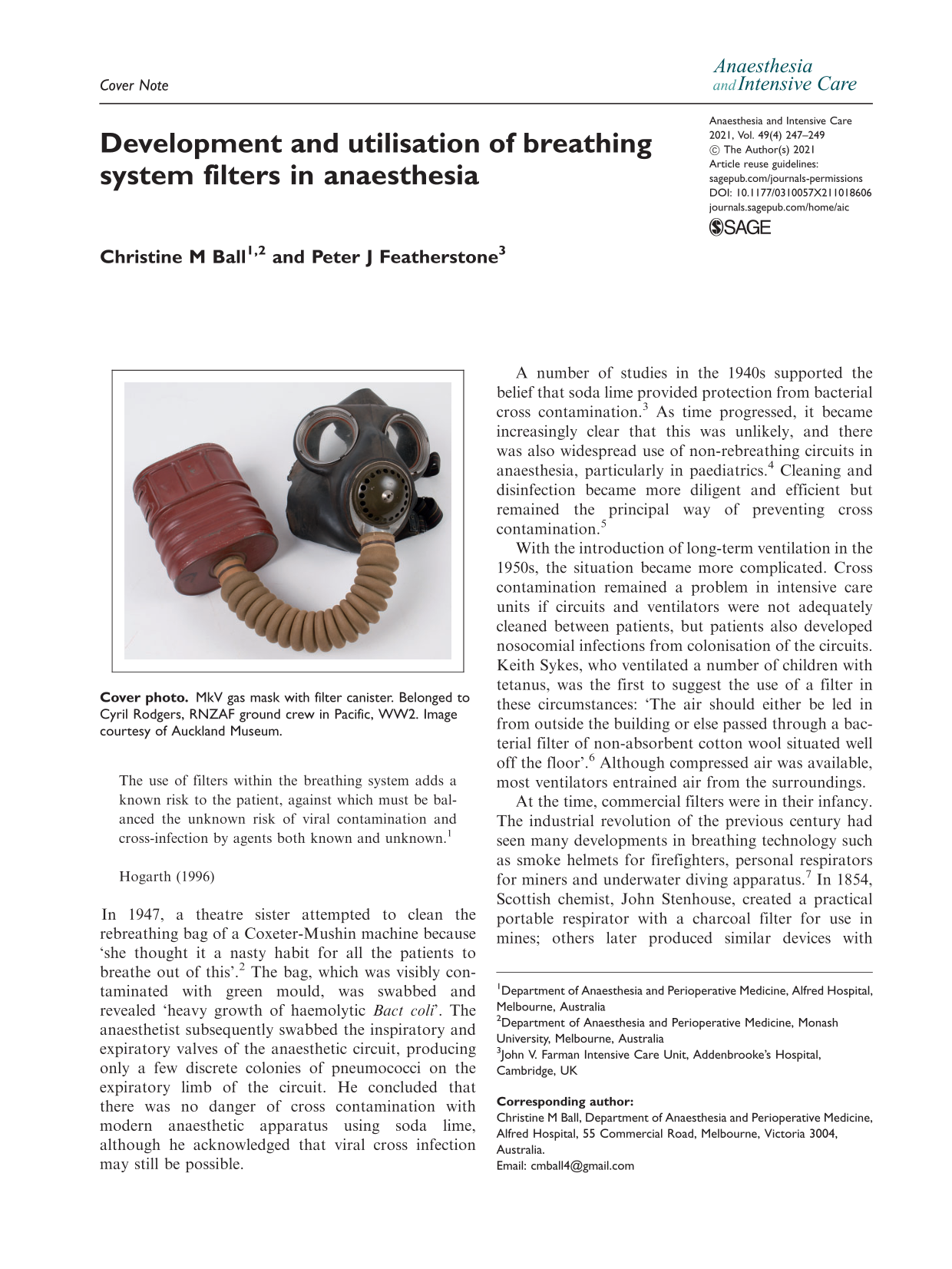
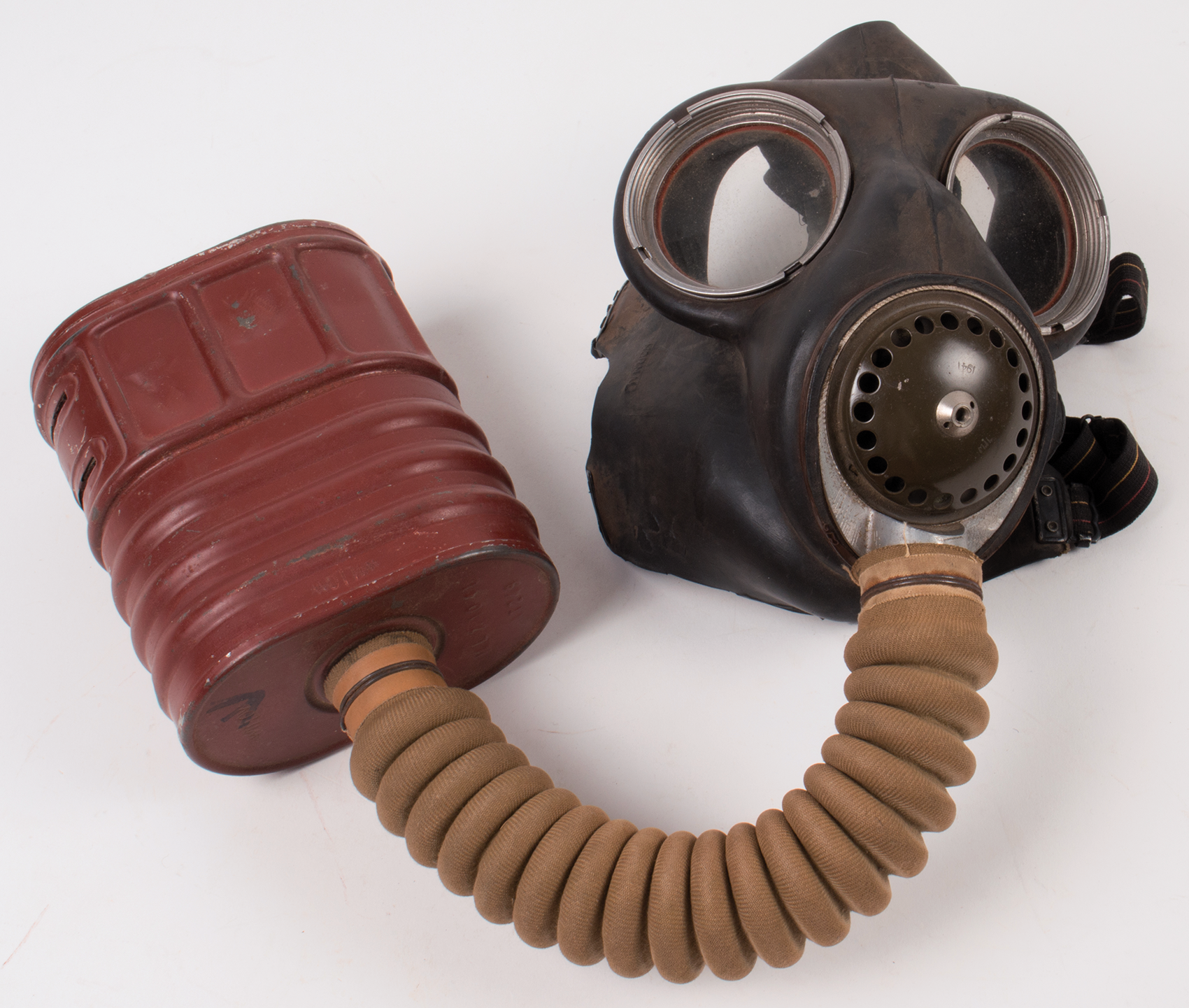
MkV gas mask with filter canister. Belonged to Cyril Rodgers, RNZAF ground crew in Pacific, WW2. Image courtesy of Auckland Museum.
The use of filters within the breathing system adds a known risk to the patient, against which must be balanced the unknown risk of viral contamination and cross-infection by agents both known and unknown. 1
Hogarth (1996)
In 1947, a theatre sister attempted to clean the rebreathing bag of a Coxeter-Mushin machine because ‘she thought it a nasty habit for all the patients to breathe out of this’. 2 The bag, which was visibly contaminated with green mould, was swabbed and revealed ‘heavy growth of haemolytic Bact coli’. The anaesthetist subsequently swabbed the inspiratory and expiratory valves of the anaesthetic circuit, producing only a few discrete colonies of pneumococci on the expiratory limb of the circuit. He concluded that there was no danger of cross contamination with modern anaesthetic apparatus using soda lime, although he acknowledged that viral cross infection may still be possible.
A number of studies in the 1940s supported the belief that soda lime provided protection from bacterial cross contamination. 3 As time progressed, it became increasingly clear that this was unlikely, and there was also widespread use of non-rebreathing circuits in anaesthesia, particularly in paediatrics. 4 Cleaning and disinfection became more diligent and efficient but remained the principal way of preventing cross contamination. 5
With the introduction of long-term ventilation in the 1950s, the situation became more complicated. Cross contamination remained a problem in intensive care units if circuits and ventilators were not adequately cleaned between patients, but patients also developed nosocomial infections from colonisation of the circuits. Keith Sykes, who ventilated a number of children with tetanus, was the first to suggest the use of a filter in these circumstances: ‘The air should either be led in from outside the building or else passed through a bacterial filter of non-absorbent cotton wool situated well off the floor’. 6 Although compressed air was available, most ventilators entrained air from the surroundings.
At the time, commercial filters were in their infancy. The industrial revolution of the previous century had seen many developments in breathing technology such as smoke helmets for firefighters, personal respirators for miners and underwater diving apparatus. 7 In 1854, Scottish chemist, John Stenhouse, created a practical portable respirator with a charcoal filter for use in mines; others later produced similar devices with woollen filters. This technology developed slowly until the sudden, unexpected use of chemical weapons in the Second Battle of Ypres in World War I. Cotton masks based on Stenhouse’s original design were rapidly deployed, and as fully enclosing facemasks were created, replaceable canisters with gas neutralising chemical filters were hung below the masks.
Gas mask filters were modified and refined during World War II, but their final construction was highly classified until the 1950s. In the early 1940s, a captured German gas mask canister provided the Allied Forces with a remarkable piece of paper. 8 The paper, passed by the British Army to the US Army Chemical Corps, showed very high efficiency for capturing chemical smoke. Both the US Army Chemical Corps and the Naval Research Laboratory worked to create a version of the paper successfully—essentially a combination of crocidolite asbestos and cellulose or grass pulp—for use in gas masks.
Since operational buildings also required protection from warfare agents, the Army Chemical Corps developed a ‘collective protector’, requiring much higher air flows than the simple gas mask filters. The collective protector used the newly created cellulose-asbestos paper, known as CC-6 paper, but fabricated it into deep pleats, with spaces between the pleats to allow for the high air flow. Known as ‘an absolute filter’, this was the precursor of the high efficiency particulate air (HEPA) filter. Greater filtration (particles down to 0.1 mm) was provided by the nuclear version of this filter, known as AEC No. 1.
These filters were eventually declassified and described in the 1952 Handbook on Air Cleaning, published by the US Atomic Energy Commission. 9 After trialling many potential substitutes for CC-6 paper, the Naval Research Laboratory eventually found a way to make glass fibres as small as 0.25 mm in diameter, eliminating both the asbestos and the cellulose components. The safety implications of removing the asbestos were probably not appreciated at the time, but the substitution of glass for paper allowed the manufacture of non-combustible filters, regarded as a very desirable feature. From that point, filters rapidly found their way into many facets of life—from air conditioning units to microelectronic and pharmaceutical manufacturing facilities.
In 1963, Bishop and his colleagues at Guy’s Hospital described the first use of an absolute filter in an intensive care unit. 10 They noted that mechanically ventilated patients almost invariably developed respiratory tract infections, usually with bacteria found commonly in the air in the hospitals. These bacteria were around 0.5–3 microns in diameter and were easily filtered by commercially available absolute filters. They acquired a ‘Glove Box’ filter, manufactured by Messrs. Vokes Ltd, and attached it to the air inlet port of a Radcliffe respirator. The filter was 17 cm × 11.5 cm and made of pleated glass paper enclosed in a Bakelite box. The manufacturers estimated that the filter would last for a year with ‘normal use’—as long as the hospital was not too dusty. They predicted excessive dust would clog the filter and necessitate its replacement. Otherwise, the filter could be safely sterilised with ethylene oxide, along with all the other ventilator circuitry, with no adverse effect on performance.
As more filters became commercially available, it was inevitable that their use would be suggested in anaesthetic circuits. In 1979, Ping et al. at the University of British Columbia investigated the use of bacterial filters for anaesthesia in two groups of patients: one healthy group and the other with chronic respiratory conditions with excessive respiratory secretions. They concluded that ‘the use of bacterial filters was unnecessary when a strict regimen of cleaning and pasteurization of equipment was followed’. 11 Despite this, filters proliferated on the market, many combined with heat and moisture exchangers. Then, in 1993, five patients on a single operating list in New South Wales developed hepatitis C. 12 Subsequent investigations revealed that these patients had been operated on sequentially, using the same anaesthetic circuit, with the first of the patients having significant risk factors for the virus.
As a result of this event, in 1996, the Association of Anaesthetists of Great Britain and Ireland recommended the use of breathing system filters or a change of circuit for each patient. 13 Many Australian hospitals adopted these recommendations, but the American Society of Anesthesiologists only recommended the use of filters in patients with tuberculosis. It was recognised that filters also introduced many possible problems with increased dead space and resistance, and the potential for barotrauma, blockage and disconnection. But guidance continued to evolve, and international standards were established in 2002.14,15
Over the last 20 years, breathing system filters have become more common in anaesthesia, but the recent appearance of SARS-CoV-2 has heightened the debate about which filters should be used and where they should be positioned in the breathing system. Meanwhile, there is little argument that some sort of breathing system filter is essential for safe airway management during the current pandemic.16,17