




Abstract

The surgeon William Halsted was an early American adopter of Joseph Lister’s antiseptic techniques. When the chief scrub nurse at Johns Hopkins Hospital began complaining of dermatitis from mercuric chloride in 1890, Halsted approached the newly formed Goodyear Tire and Rubber Company in Ohio and persuaded them to make thin rubber gloves for her. These proved so successful that other surgical staff began wearing them as well. 1 The operating surgeons found them fairly cumbersome, but in 1899, Halsted’s assistant, Joseph Bloodgood, reported a significant reduction in infection rates in a series of 450 patients undergoing hernia repair using sterile surgical gloves. 2 The use of surgical gloves grew exponentially from that point. The reusable gloves were washed and repaired before sterilising.
With limited exposure to antiseptics, anaesthetists did not need to wear gloves to protect their skin and were slower to adopt their use. A popular 1920s textbook detailing a spinal anaesthetic technique suggested: ‘The administrator should disinfect his hands very carefully and thoroughly, as for an actual operation; it is not necessary to wear sterile gloves, though some anaesthetists do so’. 3 By 1937, the advice had changed: ‘the administrator should always wear a sterile gown and gloves’. 4 There is no evidence that any operating theatre personnel wore gloves to protect themselves from infection or contamination in the early 20th century.
Facemasks appeared around the same time as gloves. In 1897, German scientist Carl Fluegge established that droplets expelled in saliva spread bacteria, and his colleague, Johann Mikulicz-Radecki, then working in Breslau, suggested that a gauze facemask might decrease the spread of bacteria in operating theatres. 5 , 6 It was soon apparent that masks had widespread application, protecting medical staff and patients from diseases such as diphtheria and tuberculosis, and preventing them transmitting diseases between patients. 7 In 1918, physician George Weaver from Chicago reported a marked drop in infectious diseases among nursing staff wearing masks while managing patients with diphtheria, meningitis and scarlet fever. He noted, physicians ‘always wear gauze masks when doing intubations and taking throat cultures, and to a considerable extent when examining patients’. 8 The masks consisted of two layers of gauze, fitted over the chin and the nose and tied with two tapes behind the head.
Surgeons also began wearing masks to prevent surgical site infections, with some surgeons ‘even [going] so far as to request that the anaesthetist, as well as the assistant, shall wear a mask…’. 9 As masks became more acceptable in operating theatres and the infectious disease wards, debate ensued about the most appropriate material. Initially, two types of masks were popular: a filtering, absorbing mask, usually made of gauze, and an impervious, deflecting mask, with an added layer of rubber or cellophane. Many different masks were subsequently developed, and their filtering or deflecting powers were subject to more rigorous testing. By the 1950s, masks were generally worn by everyone in the operating theatre, including the anaesthetist.
In the 1960s, British orthopaedic surgeon John Charnley developed and popularised the low-friction total hip arthroplasty, an operation initially complicated by significant delayed infection rates. 10 To reduce this problem, Charnley designed the first laminar flow enclosure and introduced modifications to operating room airflow. 11 The laminar flow enclosure was assembled after the patient was anaesthetised, enclosing the surgical team and the lower half of the patient; the patient’s head and arms remained outside the enclosure with the anaesthetist. Illustrations from the time show that the anaesthetist still wore a mask but no gloves.
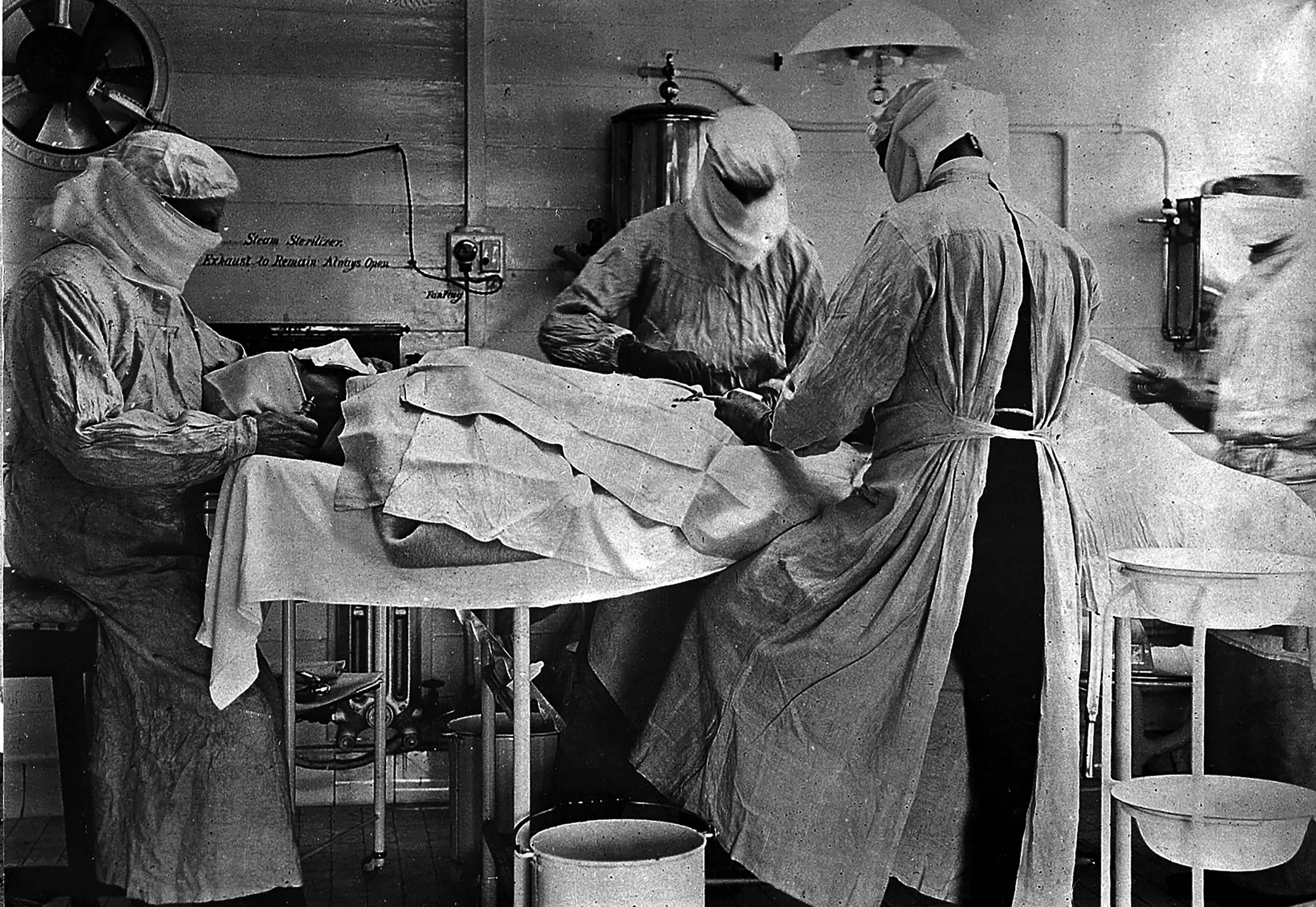
World War I operating theatre in H.M.S. Burbis. Credit: Wellcome Collection. Attribution 4.0 International (CC BY 4.0).
By the 1960s, gloves were worn for all sterile procedures, and masks were generally required in the operating theatre. However, neither was readily available. Gloves were still repaired and re-sterilised, standard gauze masks were washed and reused many times, and reflective masks with layers of rubber or other material were uncomfortable. The Ansell Rubber Company, founded in 1905 when Eric Ansell acquired the condom machinery from Dunlop UK, manufactured the first disposable surgical glove, the Gammex, in 1965. 12 From that point on, surgical gloves became more accessible. Masks also became more available as a range of companies began making disposable masks in bulk. 13
Anaesthetists, although aware of the risk of blood-borne infections such as hepatitis, still only wore gloves for more complicated sterile procedures, such as central line insertion, and seldom used them for simple intravenous access or personal protection. Blood-borne infections were seen as an occupational hazard and a result of an accidental needle stick injury—not something that could be avoided.
This situation changed completely with the emergence of human immunodeficiency virus (HIV) in the 1980s, a new disease with no known treatment, which was, at the time, universally fatal.
HIV caused tremendous anxiety among healthcare professionals, particularly as it became evident they were contracting the disease through exposure at work. In response to this problem, the Centers for Disease Control and Prevention (CDC) created the universal blood and body fluid precautions in 1987. 14 These precautions emphasised handwashing and the use of gloves for all procedures where contact with bodily fluids was likely. Anaesthetists were quick to adopt these precautions, but sterile paired packaged gloves were expensive and impractical. Glove manufacturers responded to the evolving emergency by making boxes of disposable gloves which could be worn on either hand. Unfortunately, as glove use grew exponentially, so did the incidence of latex allergy. 15 In the 1990s, latex allergy became a major problem for anaesthetists and other operating theatre personnel; some anaesthetists were forced to stop work because their own allergies became severe, while others found they were faced with a rising rate of anaphylaxis to latex in the operating theatre. 16
Glove powder led to airborne latex particles, further compounding the issue. Glove powder had long been a problem, and as early as the 1940s, there were reports of talc leading to adhesions in the peritoneum and pericardium, and granulomas in various parts of the body. 17 Other substances, such as cornstarch, were used instead of talc, but the problem persisted. In 1984, the first powder-free glove was released in the UK by the London Rubber Company under the trade name Regent Biogel. 18 Subsequently, the identification of the relevant allergens has allowed the manufacture of low-allergenic, low-protein, powder-free rubber gloves. 19 Synthetic gloves, made of substances such as nitrile, vinyl and neoprene, have also been developed, although these are generally less robust and less flexible than latex gloves. Powdered gloves were banned in the USA by the Food and Drug Administration in 2016—effective 18 January 2017. 20 In Australia, powdered gloves are allowed but are not recommended by the current National Health and Medical Research Council guidelines. 21
Despite the risks to their own health, anaesthetists have had a variable response to personal protective measures. A survey of Australian anaesthetists in 1999 reported poor compliance with universal precautions. 22 Similarly, hand hygiene has often been neglected. 23 Masks have also been a contentious issue. Over the last few decades, controlled airflow in operating theatres and the widespread use of antibiotics has reduced the risk of surgical site infection and diminished enthusiasm for wearing masks amongst anaesthetists. In 2001, Marcus Skinner and Brett Sutton from Tasmania concluded that surgical masks should not be mandatory for anaesthetists in ‘the setting of a modern operating theatre, with laminar flow/steriflow systems’. 24 They also noted the available evidence suggested ‘surgical masks offer incomplete protection from airborne bacteria and viruses’. 24
In 2019–2020, the emergence of severe acute respiratory syndrome coronavirus 2 (SARS-CoV-2) re-focused anaesthetists’ attention on protective masks and universal precautions. It remains to be seen whether masks and other protective equipment such as eye shields remain ubiquitous once the pandemic is over.