




Abstract

The balloon … has done for us that which no other power ever accomplished; it has gratified the desire natural to us all to view the earth in a new aspect, and to sustain ourselves in an element hitherto the exclusive domain of birds and insects. We have been able to ascend among the phenomena of the heavens, and to exchange conjecture for instrumental facts, recorded as elevations exceeding the highest mountains of the earth. James Glaisher, 1871
Hydrogen balloons were capable of rising rapidly to great heights. On 20 November 1785, Jean-Pierre Blanchard took to the skies above Ghent: ‘In less than two minutes, I was more than 4500 ft from the earth … the expansion of the inflammable air was such … that I mounted to an incredible height, which according to the record of my instruments was 32,000 ft from the earth.’ 2 While many doubted the accuracy of Blanchard’s barometric readings, his account was among the first to outline the dangers of high altitude flight: ‘I sailed in the immensity of the air at the mercy of the winds, experiencing a cold which no mortal ever felt in the severest climates. Nature grew languid [and] I felt a numbness, prelude to a dangerous sleep.’ 2
In the decades that followed, the balloon largely became an ‘object of exhibition’ and a ‘vehicle for carrying air excursionists desirous of excitement’. 1 The majority of aeronauts chose to fly ‘well within recognition of the visible scenery of the earth’, rather than ‘prove their capacity for vertical ascents’. 1 However, during the latter half of the 19th century, balloons were increasingly employed in high altitude scientific research.
In July 1862, James Glaisher, superintendent of the Magnetic and Meteorological Royal Observatory, Greenwich, commenced a series of ascents from Wolverhampton, accompanied by the professional balloonist Henry Coxwell. Their balloon was filled with 90,000 ft3 of coal gas (which had widely replaced the use of hydrogen), and carried an array of instruments that Glaisher utilised to measure various parameters suggested by a committee of the British Association for the Advancement of Science.1,3
On 5 September 1862, Glaisher and Coxwell embarked on their third flight. Within half an hour the balloon had attained an altitude of 17,000 ft, and Coxwell was noted to be ‘panting for breath’. 1 Twenty minutes later the balloon climbed above 29,000 ft, and Glaisher developed visual impairment and loss of motor function in his arms and legs. He later recalled: ‘I thought I had been seized with asphyxia, and believed I should experience nothing more as death would come unless we speedily descended: other thoughts were entering my mind when I suddenly became unconscious’. 1 When he awoke seven minutes later, the balloon was falling rapidly. Coxwell (who had transiently lost the use of his hands and was also nearly rendered insensible) had managed to vent some gas by seizing the valve cord ‘with his teeth, and dipping his head two or three times, until the balloon took a decided turn downwards’. 1 Readings from several instruments suggested their maximum altitude may have been as high as 37,000 ft. Glaisher subsequently noted that he had: ‘experienced the limit of our power of breathing in the attenuated atmosphere’, but postulated that ‘artificial appliances might be contrived’ to allow aeronauts to ‘continue … higher still’. 1
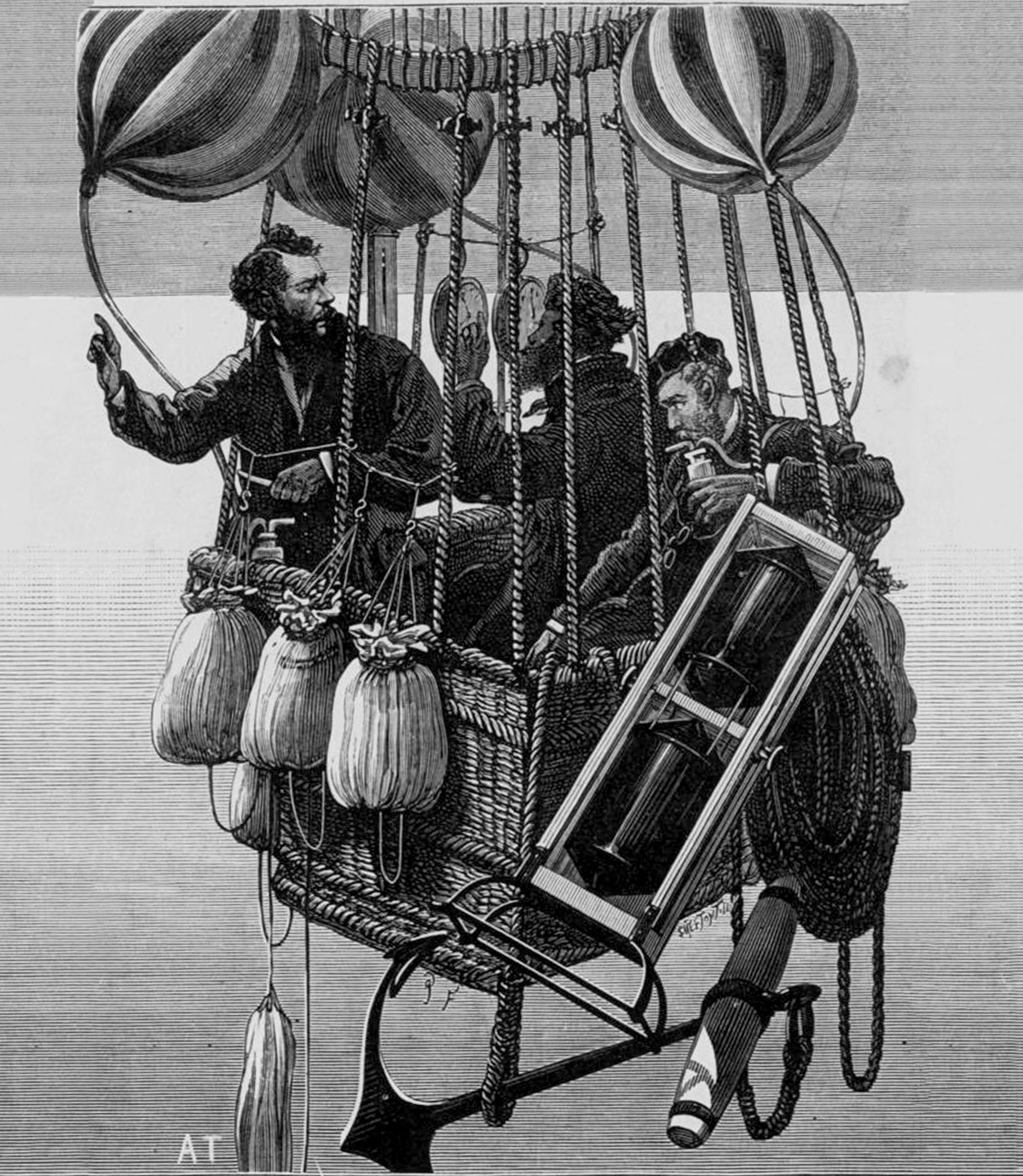
Cover photo. Depiction of the basket of the balloon Zénith during its ascent 15 April 1875. The striped bags contained a mixture of 70% oxygen and 30% nitrogen. On the left, Théodore Sivel cuts the cords holding the ballast sand bags; in the centre, Gaston Tissandier observes the barometer; and on the right, Joseph Crocé-Spinelli, is about to breathe oxygen via the pipe stem attached to the wash bottle.
Reproduced from: Tissandier G. Histoire de mes ascensions. Récit de quarante voyages aériens (1868–1886). Paris: Maurice Dreyfous, 1887.
Source: ETH-Bibliothek Zürich https://doi.org/10.3931/e-rara-11460 (accessed February 2020).
The following decade, Paul Bert, Professor of Physiology at the Sorbonne, began to investigate formally the effects of hypobaric pressure on humans and animals. His work proved that the symptoms experienced at high altitude were due to ‘the diminution of the tension of the oxygen’, and he therefore suggested the use of supplemental oxygen as a ‘practical precept … for mountain travellers and aeronauts’. 2
In March 1874, balloonists Joseph Crocé-Spinelli and Théodore Sivel visited Bert’s laboratory, where they underwent decompression to a pressure of 304 mmHg (equivalent to an elevation of 24,000 ft) in a double hypobaric chamber. Both men experienced impairment of hearing and vision, and mental dullness, such that ‘the simplest calculations seemed very difficult’. 2 However, these symptoms improved significantly with a few breaths of ‘superoxygenated air’ from a rubber bag.
Thirteen days later, the pair ascended to a similar altitude in a balloon named the Étoile Polaire (Polar Star). The basket was equipped with bags containing two different gas mixtures prepared by Bert: ‘one of 40% oxygen and 60% nitrogen, and the other of 70% oxygen and 30% nitrogen’. 2 The intermittent inhalation of 40% oxygen appeared to ameliorate deleterious symptoms up to an altitude of 20,000 ft, and in the ‘most rarefied regions’ 70% oxygen proved beneficial. 2
Emboldened by their experience, Crocé-Spinelli and Sivel embarked on a further high altitude ascent on 15 April 1875, using the balloon Zénith. They were accompanied by Gaston Tissandier, editor of La Nature, and carried three gas bags made from goldbeater’s skin (a product made from processed animal intestines), each containing a mixture of 70% oxygen and 30% nitrogen. A length of rubber tubing connected the bottom of each gas bag to a small wash bottle filled with water flavoured with benzoin. This aromatic liquid served to ‘neutralise as much as possible the detestable smell which the greased goldbeater’s skin gave the gaseous mixture’. 2 ‘Fresh and perfumed’ oxygen was then inhaled through a curved pipe stem attached to the wash bottle; this could be held in the mouth, leaving the aeronaut’s hands free. 2
The balloon took off at 11.35 hours and by 13.20 hours had reached 23,000 ft. Shortly after, Sivel cut three bags of ballast and the balloon rose rapidly. Tissandier later wrote: ‘Soon I wanted to seize the oxygen tube, but could not raise my arm … I wanted to cry out “We are at 8000 metres!” but my tongue was paralysed. Suddenly I closed my eyes and fell inert, entirely losing consciousness. It was about 13.30 hours … at about 15.30 hours, I opened my eyes again, I felt numb, weak, but my mind was active … Sivel’s face was black, his eyes dull, his mouth open and full of blood. Crocé’s eyes were half shut and his mouth bloody’. 2
Tissandier was the sole survivor of the Zénith balloon tragedy, and in the aftermath, became convinced that his companions would have survived if they had been able to access their supplemental oxygen. He believed that they too had lost motor function in their arms, and ‘the tubes conducting the vital air must have slipped from their paralysed hands’. 2 Thousands of Parisians attended the funerals of Crocé-Spinelli and Sivel on 20 April 1875, 4 and their deaths spurred on the development of more sophisticated oxygen delivery systems for high altitude flight.
Footnotes
Declaration of conflicting interests
The author(s) declared no potential conflicts of interest with respect to the research, authorship, and/or publication of this article.
Funding
The author(s) received no financial support for the research, authorship, and/or publication of this article.