




Abstract

‘Quick lime, therefore, does not attract air when in its most ordinary form, but is capable of being joined to one particular species only, which is dispersed through the atmosphere, either in the shape of an extremely subtle powder, or more probably in that of an elastic fluid. To this I have given the name of fixed air’, Joseph Black, 1782. 1
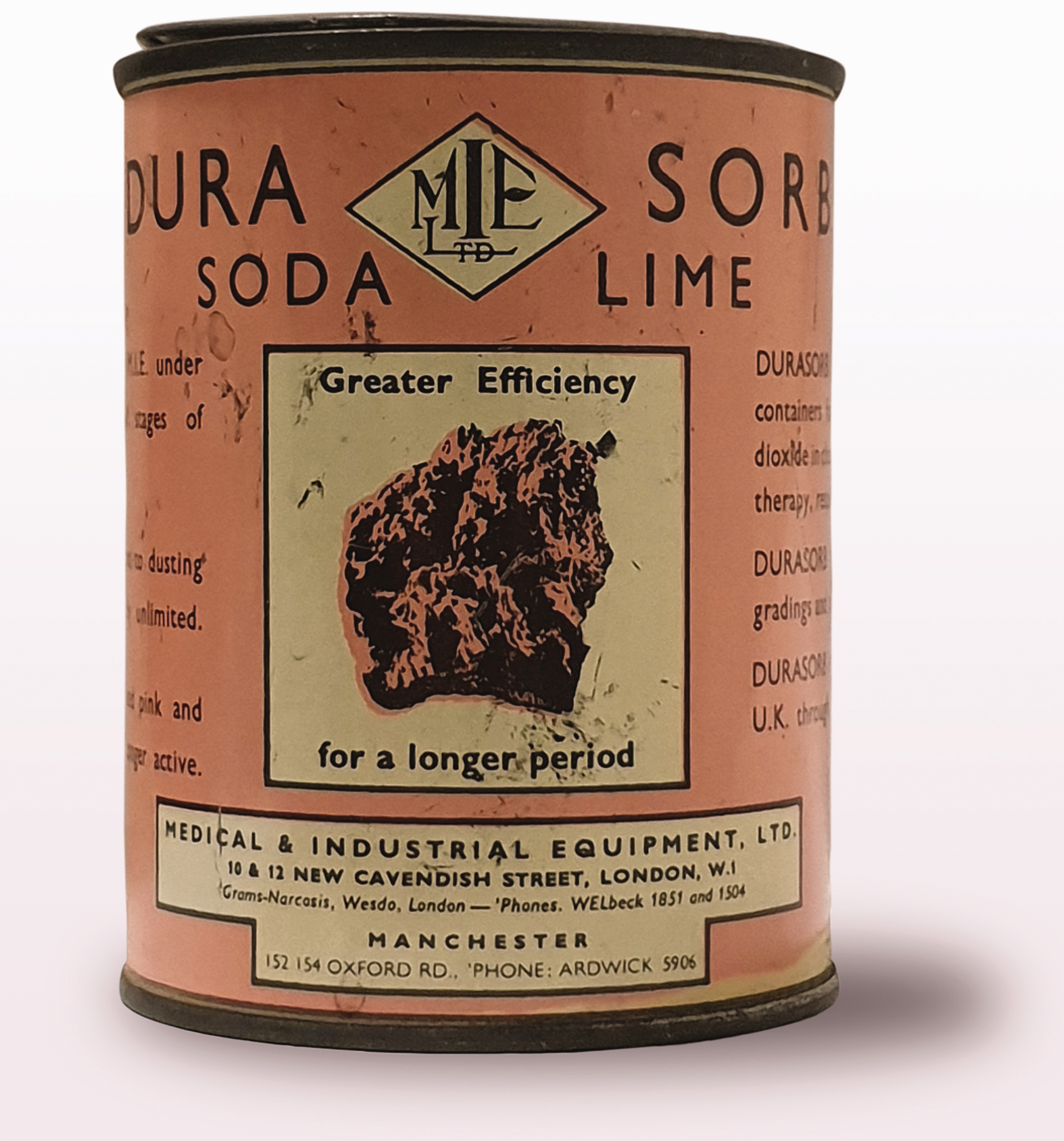
Joseph Black first described fixed air, or carbon dioxide, in 1782, along with the ability of quicklime (calcium oxide) to absorb it. Over the ensuing decades, as carbon dioxide became better understood, its potential toxicity was hotly debated. Mining accidents were frequent in the early 19th century. They were usually due to explosions from combustible gases in the exposed coal seams, known as firedamp, interacting disastrously with the flames from miners’ candles. After these explosions, increased levels of carbon dioxide were observed, causing anxiety about rescue operations. In 1840, Professor Thomas Graham from University College London, suggested the safety of rescuers could be improved by ‘inhaling the air through a cushion filled with a mixture of slaked lime and pounded sulphate of soda’. 2 Although the Royal Humane Society reported his suggestion, it found no practical application at the time.
John Snow, then a young physician, believed Graham was erroneously attributing the toxicity of mine air to carbon dioxide. He suspected carbon dioxide killed by displacing oxygen from the air, leading to hypoxia. After a series of elegant experiments in the early 1840s, Snow concluded that 5%–6% carbon dioxide was independently toxic, but lower concentrations could hasten death if oxygen levels were also low. 2 Later, when investigating anaesthetic agents in 1850, he inhaled ether and chloroform in oxygen via a rebreathing system containing potassium hydroxide to eliminate carbon dioxide. 3 He established he could prolong anaesthesia in this way but did not extend this to his clinical anaesthetic practice. On one occasion, he used the apparatus to administer oxygen to a cholera patient but the patient ‘was not saved or relieved by it’. 3
At the time, there was little reason for anyone to consider rebreathing systems for anaesthesia; ether and chloroform were readily available, relatively inexpensive and generally simple to administer. This situation changed in late March 1868 when the dentist Thomas Evans demonstrated nitrous oxide to members of the Odontological Society in London. 4 The dentists were quick to appreciate the potential benefits of nitrous oxide and immediately established a committee to investigate the gas. Dentist Charles Fox subsequently purchased a nitrous oxide gasometer and began making nitrous oxide in his surgery. 5 Together, he and the anaesthetist Joseph Clover conducted numerous experiments on themselves and their patients over the next few months. Clover found it was difficult to maintain an adequate seal with a padded facemask, especially in men with beards. This was a significant problem as adequate nitrous oxide anaesthesia required patients to inhale pure nitrous oxide without dilution with air. To improve the concentration of nitrous oxide, Clover added a supplementary bag just below the facemask to allow rebreathing of exhaled gases; he reasoned this would diminish air entrainment around the mask. 6 He suggested, once the patient was calm, the bag should be compressed every five breaths to remove the carbon dioxide: ‘I have had no reason to think that any harm results from the small amount of carbonic acid breathed in using my apparatus’. 6
Clover’s dental colleague, Arthur Coleman, was more concerned with the cost of nitrous oxide. He developed a breathing system with an expiratory valve, which could be closed to allow the patient to continuously rebreathe nitrous oxide from a bag. The gas passed over ‘lumps of quicklime recently slaked with water [producing calcium hydroxide]’. 7 A commercial version of this apparatus was created by the manufacturing company, Coxeter, and described at the same time as their first compressed gas cylinders in 1869. 8 Pure nitrous oxide anaesthetics were necessarily short and Coleman eventually abandoned the use of quicklime concluding, like Clover, that limited rebreathing of carbon dioxide was not problematic. However, he remained concerned with expense. As late as 1881, Coleman was still trying to devise a way of reusing nitrous oxide at the London Dental Hospital by capturing patient’s expired gases, washing them through slaked lime and storing in another gasometer for future use. 7 Although fully supportive of patients rebreathing their own air, his colleague, John Kyan, felt reusing nitrous oxide for subsequent patients would damage the reputation of the gas: ‘How repulsive, then, must it not be to inhale a limited quantity of secondhand gas, deprived, it is true, of such carbonic acid gas as it may have acquired in its first use, but possibly impregnated with something deleterious’. 9
Other applications were soon found for carbon dioxide absorption techniques. In 1879, a young English engineer, Henry Albert Fleuss, conducted a series of experiments with a diving suit. His work attracted the attention of Benjamin Ward Richardson, a physician with a career-long interest in anaesthesia. Fleuss’s diving suit had two canisters ‘filled with small pellets of porous India-rubber charged with caustic soda’ 10 and a source of compressed oxygen. It allowed him to remain under water for up to two hours without any ill effects. After working closely with Fleuss at the Royal Polytechnic Institute, Richardson concluded the suit would also be useful for ‘entering wells, burning houses, and mines that are charged with suffocating gases’. 10 For work in mines, he believed a ‘telephonic connection’ with the man in the suit would be possible and ‘a remarkably useful advance’. He concluded: ‘The next step onward will be to construct a small closed canoe, on which the apparatus can be fitted on a larger scale’. Subsequently, carbon dioxide absorption became essential to submarine development. Richardson also remarked that by using a modification of the suit, ‘the aeronaut may be able to rise much higher than he has done’, 11 an interesting comment given that the skies were still only accessible by balloon. He even postulated that aeronauts could have ‘a car specially constructed on such a plan’. 11 Although carbon dioxide absorption is not required for plane travel, it has become critical to space exploration, as evidenced by the near-fatal events on the Apollo 13 mission. 12
World War I saw the widespread use of poisonous gases and therefore the need for gas masks to protect soldiers. These incorporated increasingly sophisticated absorbents as the war progressed, and by the end of the hostilities, both British and American canisters contained a mixture of charcoal and soda lime, known as ‘war gas mixture’. 13 The charcoal rapidly absorbed all gases and served as a reservoir for the more stable ones, whereas the soda lime acted as a large capacity, permanent reservoir for more volatile acid and oxidisable gases. In some cases, such as phosgene, there was a slow transfer of gas from the charcoal to the soda lime. Having worked on the development of soda lime during the war, Robert E Wilson and Claude P McNeil filed a patent for ‘Soda-lime composition and method of preparing the same’ 14 in 1918. The patent was granted in 1920 and subsequently ‘Wilson’s soda lime’ became widely available. The final composition was a complex mix of sodium hydroxide, calcium oxides and hydroxides, sodium permanganate, slow setting cement and diatomaceous earth. Two years later, Ralph Waters, then in Kansas City, began work using carbon dioxide absorption techniques as a means of reusing anaesthetic agents for anaesthesia. He reported his findings with Wilson’s soda lime in a to-and-fro canister in 1926. 15
Footnotes
Declaration of conflicting interests
The author(s) declared no potential conflicts of interest with respect to the research, authorship, and/or publication of this article.
Funding
The author(s) received no financial support for the research, authorship, and/or publication of this article.