




Abstract

The use of supplemental oxygen is routine in the post-anaesthesia care unit (PACU) setting. For patients who use continuous positive airway pressure (CPAP) devices, adaptors may be required to add supplemental oxygen. Adapters are often unavailable however, so this benchtop study was performed to determine the inspired fractions of oxygen that could be achieved by the addition of oxygen by way of a simple facemask placed over the inlet of the CPAP machine.
A CPAP machine (Philips Respironics REMstar Auto A-Flex, North Ryde, Australia) with a Simplus mask (Fisher and Paykel Healthcare Ltd., Auckland, New Zealand) was attached to a face/upper airway model constructed of polyvinyl chloride pipe. A standard anaesthesia gas sampling tube was placed within the model airway, which was connected to a 3 l calibration pump (Cardinal Health, Dublin, OH, USA) serving as a simple model lung. The sampling tube was connected to a Carescape Monitor B650 (GE Healthcare, Chicago, IL, USA) to measure the fraction of inspired oxygen (FiO2). A simple Hudson facemask was placed over the air inlet of the CPAP machine, with oxygen being delivered from a standard wall flowmeter.
Two-point calibration of the monitor was performed at FiO2 of 0.21 and 1.0. Tidal volumes of 500–900 ml, calibrated with a Wright’s spirometer, were set on the calibration pump with each volume tested at 8 cmH2O and 12 cmH2O CPAP.
For each volume and pressure tested, a simulated respiratory cycle was initiated with room air. At two minute intervals the oxygen flow was increased by 2 l/minute to a maximum of 14 l/minute. The maximum FiO2 achieved over each two minute period was recorded.
The results are demonstrated graphically in Figures 1 and 2.
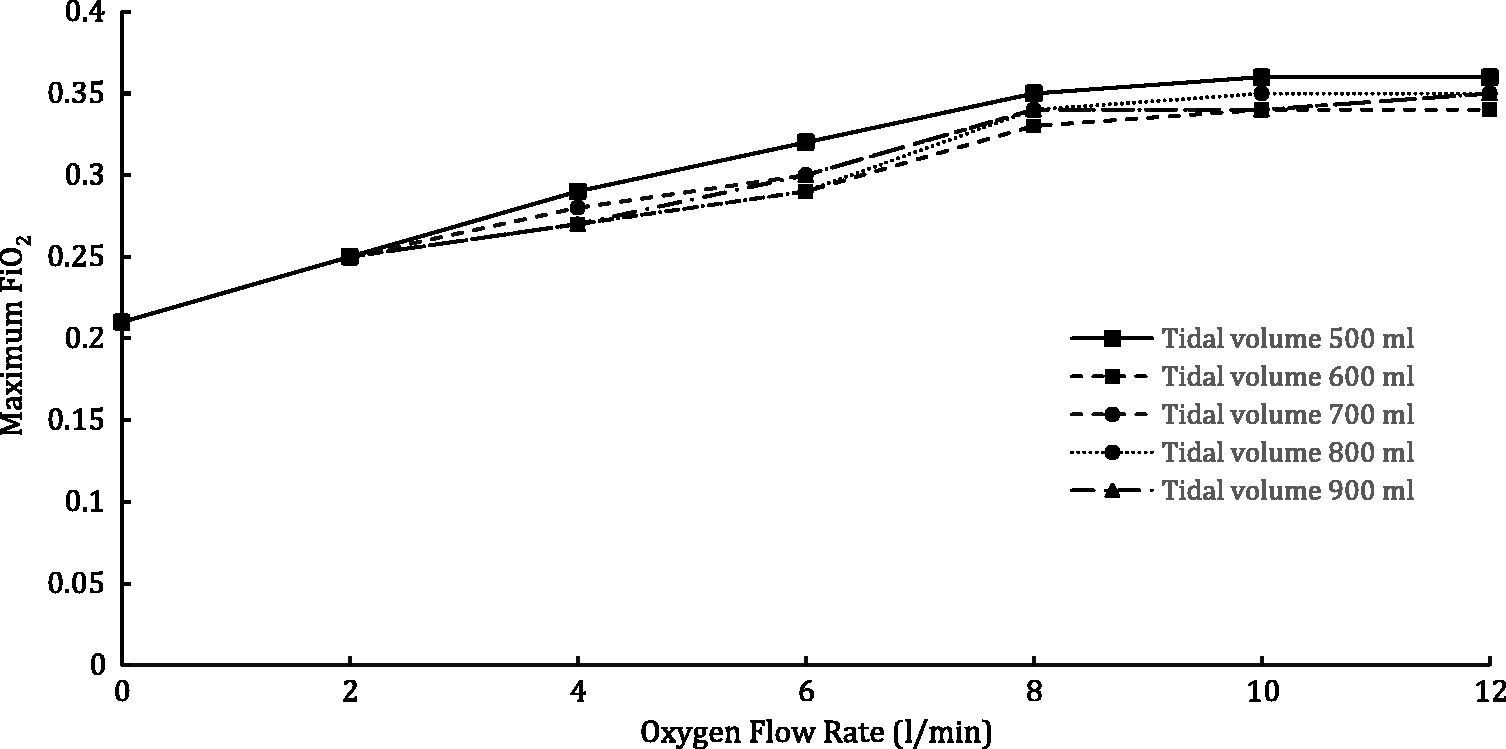
Maximum fraction of inspired oxygen (FiO2) achieved over 2-minute ventilation periods at varying oxygen flow rates and tidal volumes with continuous positive airway pressure (CPAP) of 8 cmH2O.
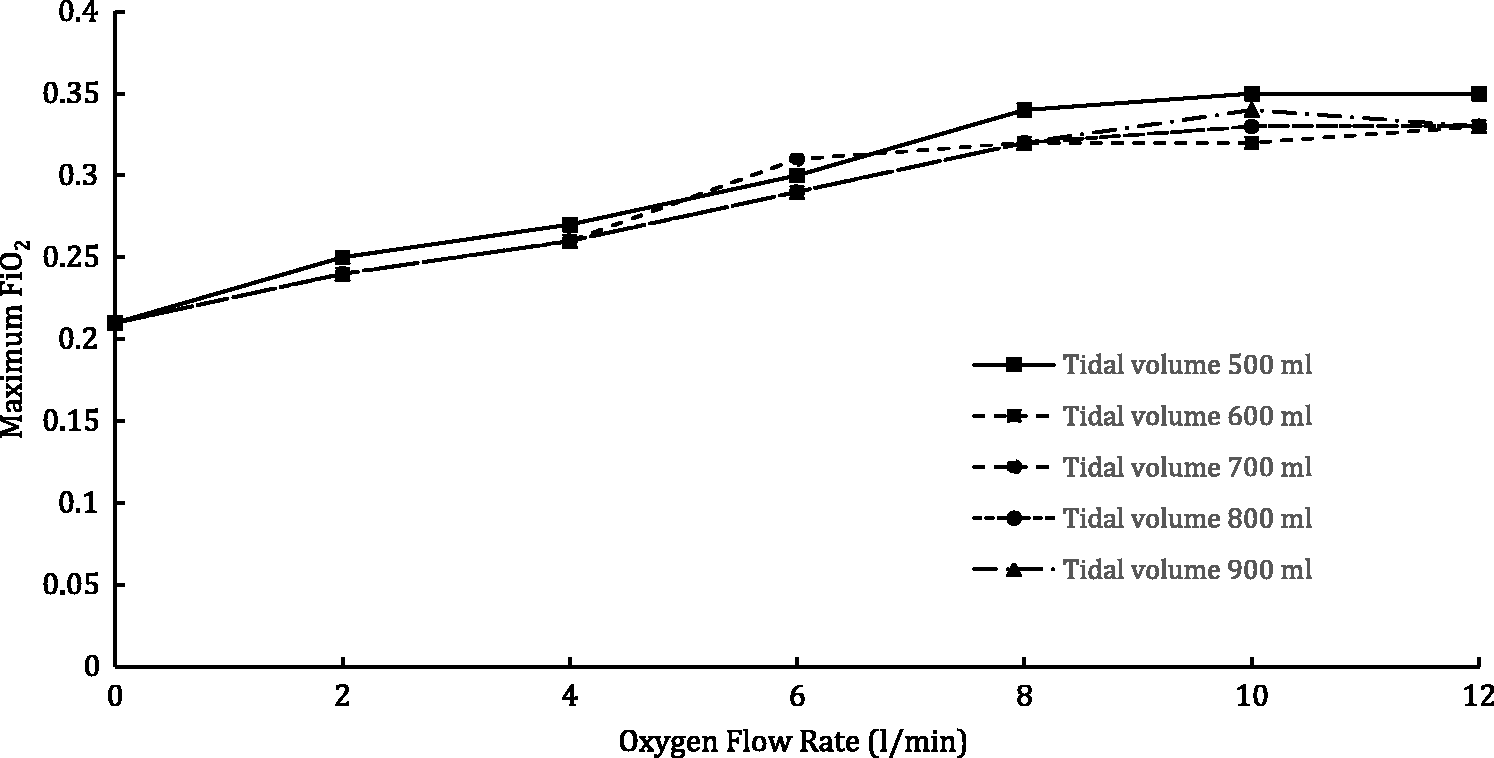
Maximum fraction of inspired oxygen (FiO2) achieved over two-minute ventilation periods at varying oxygen flow rates and tidal volumes with continuous positive airway pressure (CPAP) of 12 cmH2O.
Our benchtop study demonstrated that supplemental oxygen can effectively be added to a CPAP circuit through the use of a simple facemask delivering oxygen to the CPAP machine air intake. An FiO2 of 0.30 can be achieved at all tidal volumes and pressures tested using an oxygen flow rate of at least 7 l/minute. This is similar to the FiO2 of 0.3–0.4 routinely delivered in the PACU setting using 6 l/minute oxygen by way of a simple facemask.1,2
This method of supplemental oxygen delivery by CPAP may be more effective and better tolerated than other techniques. The application of nasal prongs under the CPAP mask, for example, may be associated with poor patient tolerance and leaks. It should, however, only be used after checking the device manual to ensure it does not compromise safety features of the specific CPAP machine.
Footnotes
Acknowledgement
The author(s) wish to acknowledge the assistance of staff members of the Department of Pulmonary Physiology, Sir Charles Gairdner Hospital, for their advice and assistance in facilitating this study.
Declaration of conflicting interests
The author(s) declared no potential conflicts of interest with respect to the research, authorship, and/or publication of this article.
Funding
The author(s) received no financial support for the research, authorship, and/or publication of this article.
