



Abstract

It is well known that the administration of oxygen often produces at least temporary benefit in cases of serious interference with the respiratory or circulatory functions; but sufficient attention has not hitherto been paid either to what precise benefit may be expected from the administration of oxygen, or how it can best be administered. John Scott Haldane, 1917
1
In 1912, Leonard Hill, lecturer in physiology at the London Hospital Medical School, observed that these methods were ‘ludicrously inefficient’, and described a novel mask, which he claimed could deliver ‘a very high percentage of oxygen’ to patients with pneumonia. 2 Made by Messrs. Down Brothers, this consisted of a celluloid facepiece, over which a curtain of washable material was attached. A hollow handle served as the oxygen inlet, and allowed the curtain of material to be adjusted so that its edges were directly apposed to the skin around the mouth and nose. The flow of oxygen from the cylinder was increased until the patient reported an ‘agreeable cooling effect’ on their face, or the operator heard ‘the right degree of hissing noise’. 1 Hill reported that the apparatus had yielded the ‘most striking results’ in two cases of pneumonia: ‘the irregular pulse … becomes regular, stronger and less rapid, the ashen colour of the lips becomes red, and the patient recovers consciousness’. 2
Four years later at the University of Oxford, John Haldane designed a simple apparatus to remedy the ‘haphazard methods hitherto used in administering … oxygen’. 1 This comprised a 2 L reservoir bag supplied with oxygen from a cylinder and connected to a facemask via a length of wide-bore rubber tubing; a non-return valve was included in the tubing at its origin from the bag. The facemask was constructed from metal, with a soft rubber cushion around its rim, and secured in position by an elastic strap. In addition to an inlet for oxygen, the mask contained one-way valves for the inlet of air and outlet of expired gases. The supply of oxygen could be accurately adjusted to a maximum of 10 L/min. Haldane noted: ‘If only a little oxygen is turned on the patient will be breathing mostly air, but by turning on more oxygen the proportion … can be increased till nothing but pure oxygen is being inspired … Where prolonged administration of oxygen seems desirable, the minimum quantity of oxygen which will remove the cyanosis should be carefully ascertained by observation of the patient’. 1
The Haldane apparatus was supplied to members of the Royal Army Medical Corps serving in France and Belgium from 1916 onwards, 3 and it was utilised in the management of acute pulmonary oedema secondary to phosgene and other irritant gas poisoning. A lightweight version was available for front-line and stretcher work, 4 and a further adaptation, made at the suggestion of Lieutenant-Colonel C. Gordon Douglas, enabled two or four casualties to be treated at one time. 5 Despite its advantages, some medical officers were reluctant to use the device, and many men, suffering from ‘nervous irritation and great difficulty in getting breath at all’, were intolerant of the facemask. 6
Following a serious drift-gas attack in August 1916, Captain Adrian Stokes improvised a means of delivering oxygen intranasally. 3 A lubricated no. 8 rubber catheter was passed into the nose until its tip was lying in the nasopharynx. The remainder of the catheter was then looped back over the ear and fixed to the side of the face with a piece of strapping. Captain John Ryle later recorded: ‘I have seen men grey-white in colour, almost pulseless, with respiration rates of 60 to the minute and upwards, and pouring forth serous froth from the nose and mouth so fast that one had to tip up the stretchers at the foot to allow it to run more freely, improve steadily during a continuous administration of oxygen by the intranasal route lasting 24, 48, and even 72 hours, and finally go down the line safe and comfortable’. 7 Nasal oxygen was also trialled in influenzal pneumonia, purulent bronchitis, trench nephritis and cases of severe haemorrhage.6,8
Both the Haldane apparatus and nasal catheters continued to be utilised for the administration of oxygen after the war.9,10 In 1925, H. Whitridge Davies and A. Rae Gilchrist modified the Haldane apparatus to include a water bottle between the reservoir bag and the tubing. 11 This provided a means of humidifying oxygen, and regulating its flow, based on observation of bubbling within the bottle. In addition to a facemask, the device was supplied with a forked metal tube possessing two nasal prongs. Once positioned appropriately, the nasal tube was secured to the forehead with an elasticated band. Its use afforded ‘a welcome change’ for patients receiving continuous oxygen therapy, ‘for after an hour or so a mask may become somewhat annoying’. 11
Poor patient tolerance of the Haldane facemask during prolonged use resulted in the introduction of a mouth-only mask in 1928, 12 and the widespread adoption of nasal cannulae of various designs.13–15 In 1936, Hugh Marriott and Kenneth Robson modified a laryngologist’s head-mirror strap to carry a nickel-plated copper tube to which two nasal catheters, made from thin bicycle valve tubing, were attached. Experiments demonstrated that mean alveolar oxygen concentrations of 29%–59% could be achieved with flows of 4–16 L/min. 14
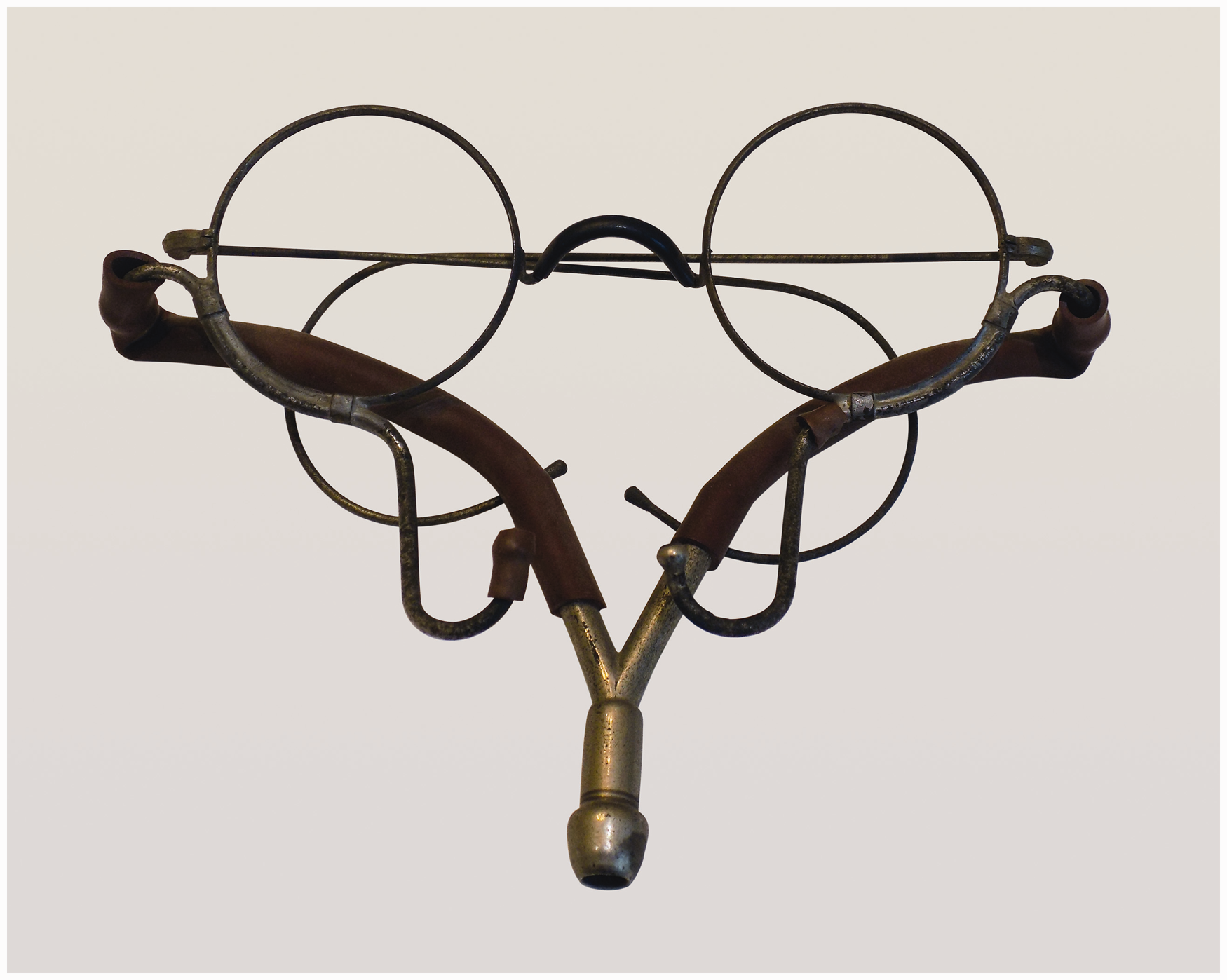
Shortly afterwards, A. Tudor Edwards reported that the head strap could cause discomfort when worn for any length of time, and occasionally produced ‘an intense headache owing to the constriction’. 15 He therefore devised a nasal catheter carrier which he incorporated into a spectacle frame. These were made in sizes suitable for adults and children, and where the patient already wore spectacles, a modification of the device permitted the carrier to be clipped on to them, so that the patient could retain their own lenses. 15
Footnotes
Declaration of conflicting interests
The author(s) declared no potential conflicts of interest with respect to the research, authorship and/or publication of this article.
Funding
The author(s) received no financial support for the research, authorship and/or publication of this article.