



Abstract
John McWilliam was appointed Regius Professor of the Institutes of Medicine (later Physiology) at the University of Aberdeen in 1886, at the age of only 29.
1
The following year he established that electric shocks induced ventricular fibrillation (VF) and, having witnessed this phenomenon in many animals, including mammals, concluded it must also be a cause of sudden death in humans.
2
His research then focused on ways of restarting the heart after cardiac arrest. While he recognised that most cardiac arrests were hopeless, he considered there were probably some situations, such as excessive vagal stimulation, which could be reversible.
3
Believing that one single dramatic shock would induce VF and knowing that a small shock would only lead to a single cardiac contraction, he proposed ‘We want a much more effective and speedy mode of exciting rhythmic contraction … a periodic series of single induction shocks sent through the heart at approximately the normal rate of cardiac action’.
3
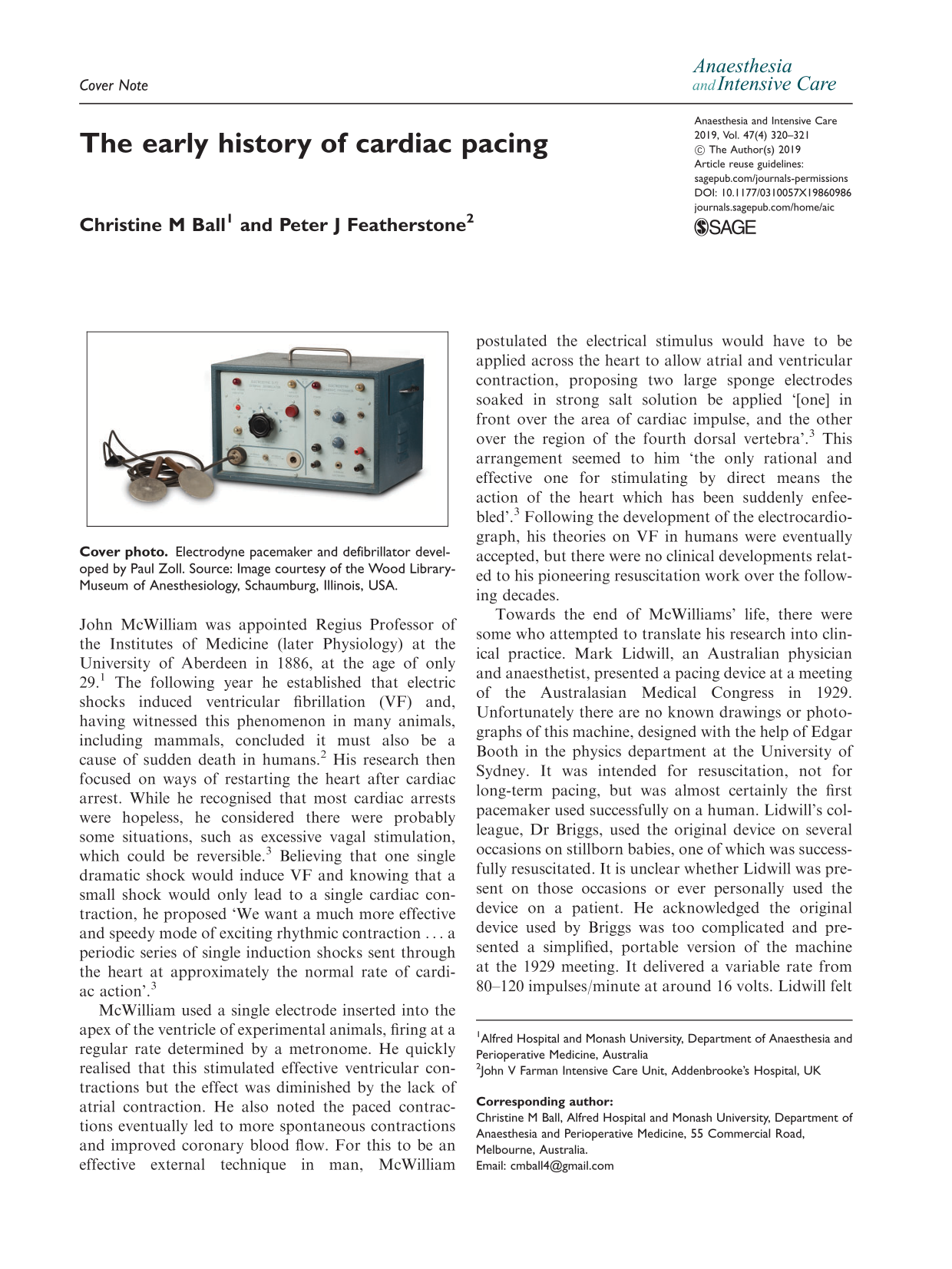
Electrodyne pacemaker and defibrillator developed by Paul Zoll. Source: Image courtesy of the Wood Library-Museum of Anesthesiology, Schaumburg, Illinois, USA.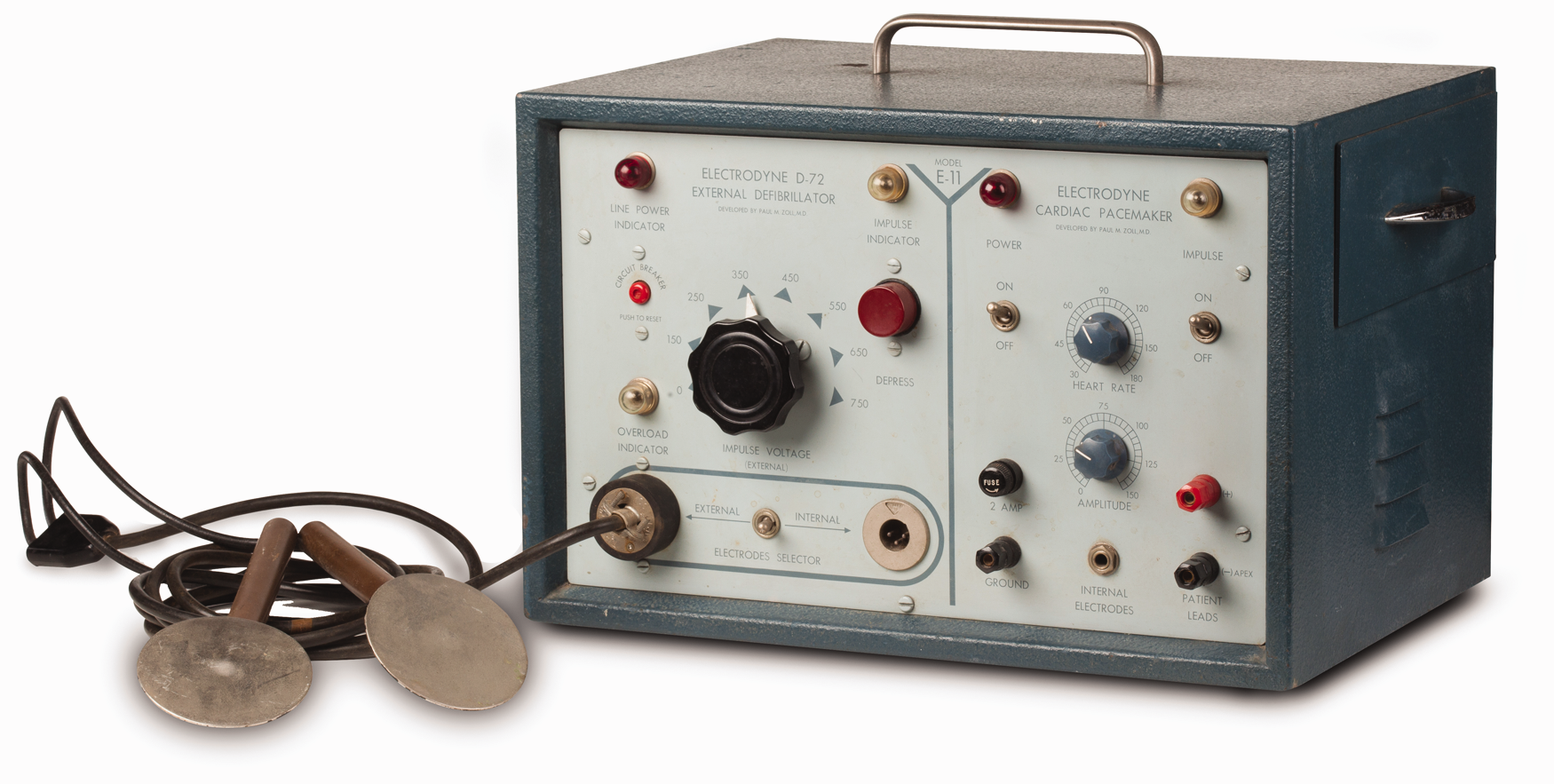
McWilliam used a single electrode inserted into the apex of the ventricle of experimental animals, firing at a regular rate determined by a metronome. He quickly realised that this stimulated effective ventricular contractions but the effect was diminished by the lack of atrial contraction. He also noted the paced contractions eventually led to more spontaneous contractions and improved coronary blood flow. For this to be an effective external technique in man, McWilliam postulated the electrical stimulus would have to be applied across the heart to allow atrial and ventricular contraction, proposing two large sponge electrodes soaked in strong salt solution be applied ‘[one] in front over the area of cardiac impulse, and the other over the region of the fourth dorsal vertebra’. 3 This arrangement seemed to him ‘the only rational and effective one for stimulating by direct means the action of the heart which has been suddenly enfeebled’. 3 Following the development of the electrocardiograph, his theories on VF in humans were eventually accepted, but there were no clinical developments related to his pioneering resuscitation work over the following decades.
Towards the end of McWilliams’ life, there were some who attempted to translate his research into clinical practice. Mark Lidwill, an Australian physician and anaesthetist, presented a pacing device at a meeting of the Australasian Medical Congress in 1929. Unfortunately there are no known drawings or photographs of this machine, designed with the help of Edgar Booth in the physics department at the University of Sydney. It was intended for resuscitation, not for long-term pacing, but was almost certainly the first pacemaker used successfully on a human. Lidwill’s colleague, Dr Briggs, used the original device on several occasions on stillborn babies, one of which was successfully resuscitated. It is unclear whether Lidwill was present on those occasions or ever personally used the device on a patient. He acknowledged the original device used by Briggs was too complicated and presented a simplified, portable version of the machine at the 1929 meeting. It delivered a variable rate from 80–120 impulses/minute at around 16 volts. Lidwill felt it would be particularly useful in cardiac failure from chloroform anaesthesia, drowning and gas poisoning. It ‘requires only to be plugged in to a lighting point and its use does not require very much intelligence’. 4 One pole was attached to a pad soaked in salt solution and placed on the skin, and the other to an insulated needle inserted into the ventricle. The machine was discussed in the Medical Journal of Australia two years later but no further successful resuscitations were mentioned. 5
Cardiologist Albert Hyman acknowledged Lidwill’s pacemaker in 1932, although he wrongly attributed it to Dr Gould, a person who did not exist. 6 Hyman and his engineer brother, Charles Hyman, filed a patent in early 1930 for their machine. Like Lidwill’s, it utilised an insulated needle, inserted during cardiac arrest where the heart was ‘in healthy condition but because of severe shock or other unusual cause has ceased to beat’. 7 Although Hyman claimed ‘the number of patients successfully treated is still very small’, he did not publish any case reports and the pacemaker never became popular as a resuscitation device.
It was the development of open-heart surgery that eventually drove further research into pacemakers. In the early 1950s, Wilfred Bigelow and John Callaghan experimented with deep hypothermic arrest in dogs in order to perform brief cardiac surgical procedures. 8 They provided artificial respiration with a phrenic nerve stimulator created by engineer John Hopps, and when they encountered difficulties restarting the heart in some of the animals, applied the stimulator to the sino-atrial node instead. In this manner they were able to resuscitate four dogs and suggested that a stimulating wire could be left in place during chest closure and rewarming in subsequent procedures. More definitive experiments were conducted the following year, conclusively establishing that artificial pacing was safe and effective in animals subjected to hypothermic arrest. 9
Paul Zoll, a Harvard cardiologist, conducted his own animal research, initially using one external pacing wire and one in the oesophagus. Eventually he settled on two subcutaneous needle electrodes positioned across the heart. In 1952, he reported two patients resuscitated with external pacing wires, one of whom survived to leave hospital despite 52 hours of pacing. During that time they tried various heart rates noting ‘at 60 beats per minute, the patient was confused, spoke unintelligibly, and showed facial asymmetry and ocular deviations … [these changes] cleared promptly when the rate was raised to 90 per minute’. 10
As cardiac surgery developed throughout the 1950s, postoperative complete heart block became increasingly problematic. External pacing was of limited use as it led to disturbing skeletal muscle contraction and chest pain. C Walton Lillehei and colleagues at the University of Minnesota worked with engineers Eric Bakken and his brother-in-law, Palmer Hermundslie, at the newly formed company, Medtronic, to create a pacemaker that utilised an ‘electrode implanted in the ventricular myocardium’. 11 They brought the wire out through the skin and connected the other pole to a subcutaneous electrode on the chest wall. Frequent power failures and the potential for electrocution led Bakken to develop the first battery powered pacemaker, described as ‘only slightly larger than a pack of cigarettes’. 11 The device, the first ‘wearable pacemaker’, was hung around the patient’s neck; by 1960 Lillehei and colleagues had used it on 66 patients. 11 Advances in pacemaker technology proceeded rapidly from that time, with the first successful implantable pacemaker inserted in 1960 in Buffalo, New York. The device was the result of collaboration between the engineer Wilson Greatbatch and the surgeon William Chardack. Although they encountered many early difficulties, this device ultimately revolutionised the treatment of complete heart block. 12