




Abstract
James Simpson’s middle name ‘Young’ does not appear in the parish record of his baptism or in the official records of his studies at the University of Edinburgh. The earliest documentary evidence we have identified of Simpson signing his name as ‘James Y. Simpson’ is correspondence dated November 1832 to Walter Grindlay, his future father-in-law. Correspondence from Simpson in 1835, a directory listing in 1836, and Simpson’s articles in the Edinburgh Medical and Surgical Journal in 1836 and 1838, refute suggestions that Simpson assumed the middle name ‘Young’ when he applied for the Chair of Midwifery in Edinburgh in 1839. We are unable to confirm whether Simpson used the middle name ‘Young’ informally or in correspondence while he was studying at Edinburgh University, or whether he formally assumed the name following his graduation in 1832.
Keywords
Many anaesthetists or anaesthesia historians may not be aware that Professor (later Sir) James Simpson’s middle name ‘Young’ does not appear in the church record of his baptism or in the official records of his studies at the University of Edinburgh. Simpson appears to have formally adopted the middle name ‘Young’ (i.e., he used the middle name or the initial ‘Y’ in his correspondence and publications) at some point while studying in Edinburgh or after graduation from the University of Edinburgh. Anaesthesia historians who have commented on Simpson’s middle name ‘Young’ have not been in agreement in explaining the possible origin(s) of the name or when Simpson might have adopted it.1–7 Furthermore, they have not provided any evidence to support their claims.
Following the publication of a paper on the etymology of the word ‘anaesthesia’, 8 the first author received two comments relating to the use of quotation marks for James Simpson’s middle name ‘Young’. This led to a discussion on the subject of Simpson’s adopted middle name, and became the stimulus for our research. In this essay, we review statements regarding Simpson’s middle name ‘Young’, outline possible explanations for it, and present the results of our inquiries into its origin.
Sir James Young Simpson (1811–1870)
James Simpson (Figure 1) was born on 7 June 1811 (Figure 2) in Bathgate, Linlithgowshire (now referred to as West Lothian), Scotland, UK. He was the seventh son and eighth child of David Simpson (1760–1830) and Mary Jarvey (1771–1820). Simpson’s mother was descended from a Huguenot family named Gervais or Gervaise; anaesthesia historian Stanley Sykes listed five versions of her surname: Jarvey, Jervay, Jarvie, Jervie and Tarvey, the last (‘Tarvey’) being a misreading of the name Jarvey. 2
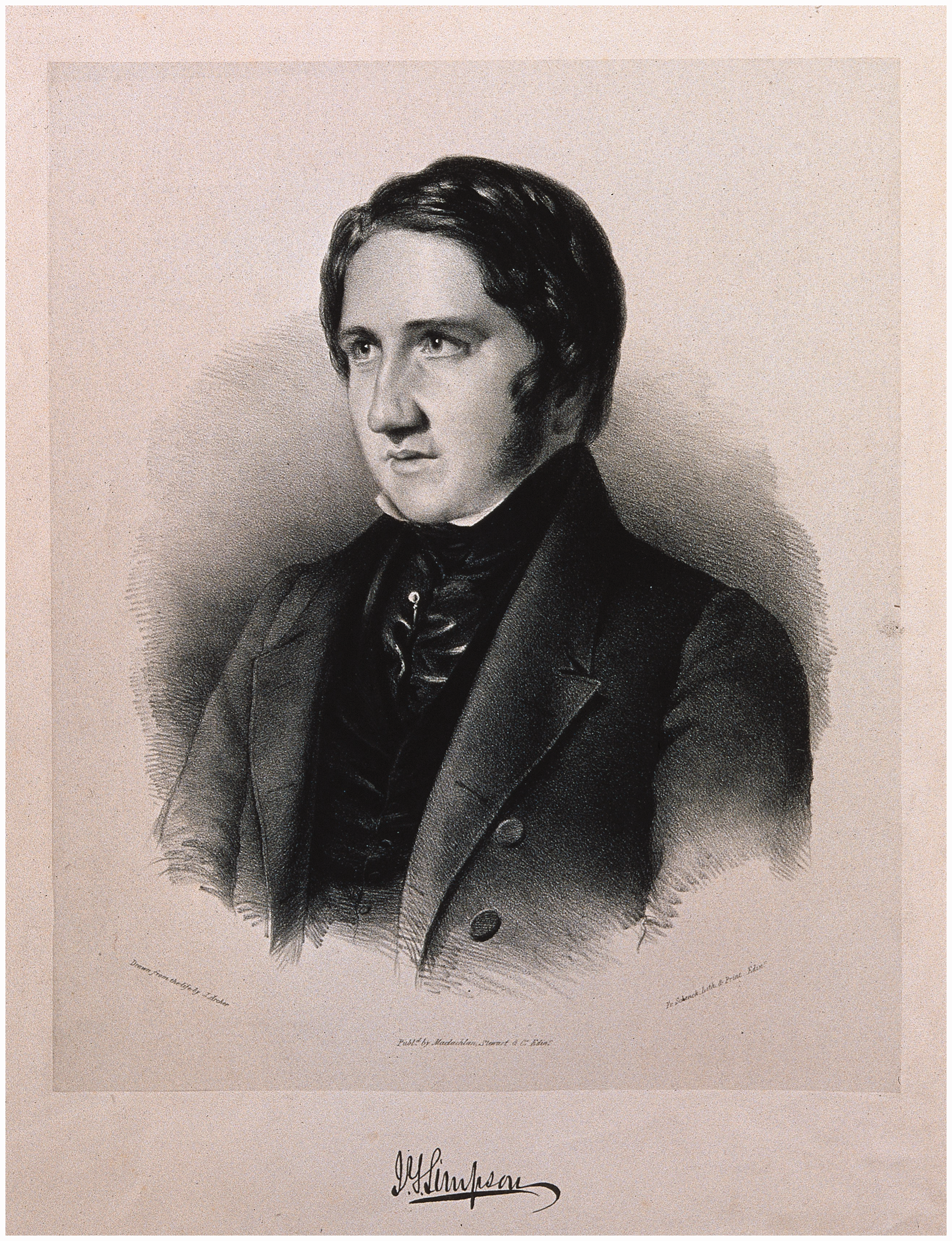
Portrait of Sir James Young Simpson, MD (1811–1870). Lithograph of a drawing by J. Archer, 1848. Source: reproduced with permission from the Wellcome Library, London, UK (Wellcome Library no. 8770i).

Birth and baptism record for James Simpson in the Old Parish Register for Bathgate. Crown copyright from National Records of Scotland, OPR 662/2, page 100.
In 1825, at the age of 14, Simpson enrolled at Edinburgh University as an arts (classics and literature) student. He commenced medical studies at the university two years later. In 1829, Simpson passed the examinations of the Royal College of Surgeons of Edinburgh (LRCS, Edin.), and thereafter practised briefly as a country doctor before returning to Edinburgh in 1831 to complete his MD thesis. He was awarded an MD by the University of Edinburgh in 1832. The title of his thesis was De Causa Mortis in Quibusdam Inflammationibus Proxima (‘Concerning the cause of death in certain acute inflammations’, title of thesis translated by Dr Richard Bailey, Sydney, Australia).
Simpson married Janet (Jessie) Grindlay (1818–1870) on 26 December 1839 at St John’s Church, Toxteth Park, Liverpool (Figure 3). He was appointed Professor of Midwifery at the University of Edinburgh two months later in February 1840, at the age of 28. Simpson administered sulphuric ether (by inhalation) for obstetric analgesia in January 1847; in November of the same year, he described the anaesthetic and analgesic effects of inhaled chloroform.
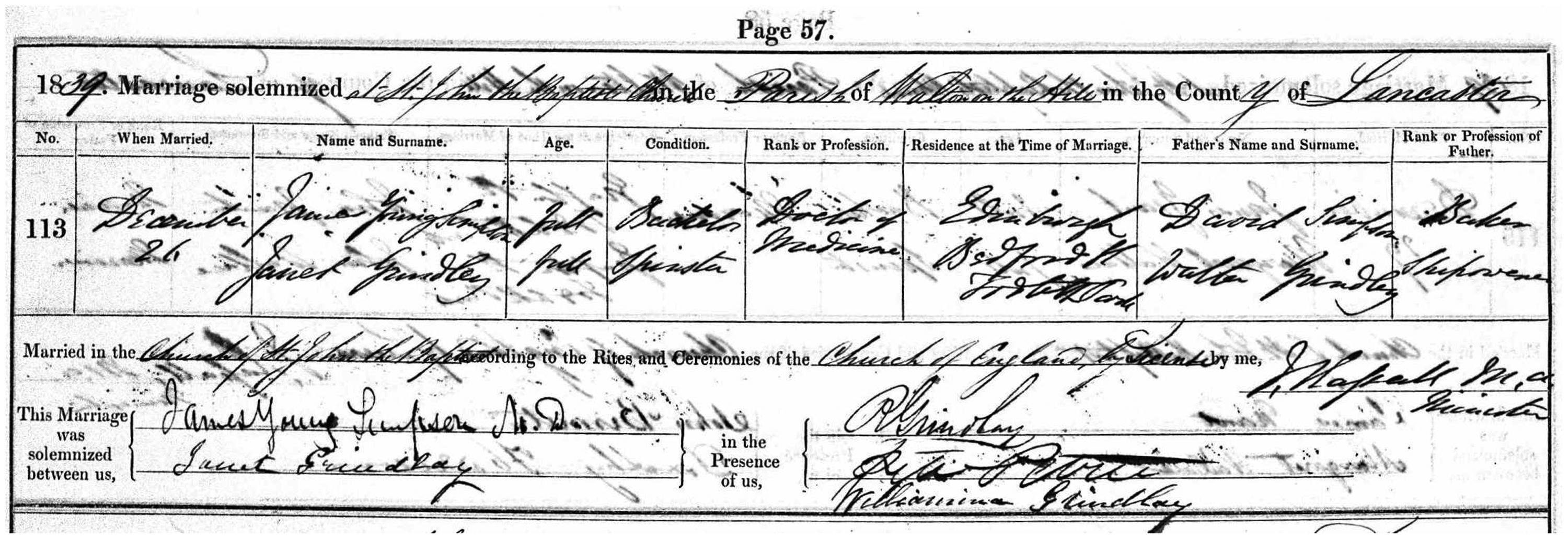
Marriage entry of James Young Simpson and Janet Grindlay, who were married on 26 December 1839. Entry No. 113, page 57 of Book No. 2 of the Register of Marriages for the Church of St John the Baptist, Toxteth Park, in the parish of Walton on the Hill, Lancashire, England.
Review of published statements regarding Simpson’s middle name ‘Young’
The origin of Simpson’s middle name ‘Young’ was not discussed in three nineteenth-century biographies of Simpson.9–11 In fact, the biographers did not even disclose to readers that ‘Young’ was, apparently, an adopted middle name of Simpson. The biographers—John Duns, Eve Blantyre Simpson (Simpson’s daughter) and H. Laing Gordon—might, if there had been any particular reason to remark upon it, have been in the best position to provide definitive information from Simpson’s family and friends on the subject of his middle name.
More recently, anaesthesia historians who have commented on Simpson’s middle name ‘Young’ have not been in agreement on when the middle name was assumed by Simpson, or the likely reason(s) for the name.1–7 In addition, these historians have not provided any evidence to support their claims.
In 1960, Armstrong Davison commented, ‘the story of how and why he [Simpson] assumed his second name, “Young”, indicates his forceful, tactless behaviour’, but the author did not proceed to relate the ‘story’ in his article. 1
Stanley Sykes was unaware of Simpson’s assumed middle name until it was mentioned to him by a ‘Highland Scot’. 2 In 1960, Sykes read an article by Armstrong Davison in which the same claim was made. Sykes, reporting on his communication with Armstrong Davison, noted (on p. 35) that ‘Simpson had been rather conscious of his age—or lack of it—when he applied for the Chair of Midwifery at Edinburgh in 1839 and, perhaps in a spirit of bravado, had called himself James “Young” Simpson’. 2 Sykes was able to confirm that the middle name ‘Young’ does not appear in Simpson’s baptismal record, and accepted Armstrong Davison’s explanation that Simpson had assumed the middle name ‘Young’ around the time of his application for the Professorship at Edinburgh University.
In an editorial commemorating the sesquicentenary of the discovery of the anaesthetic effects of chloroform, Rae and Wildsmith noted, ‘In November 1839, at the age of 28 yr, and at sometime having acquired the sobriquet “Young”, he applied for the vacant Chair of Midwifery in Edinburgh, an appointment determined by the Lord Provost, magistrates and town council’. 3
The editorial of Rae and Wildsmith elicited correspondence from Conacher, who wrote: ‘The acquisition of the sobriquet, “Young”, intrigued a generation of assiduous anaesthesia historians’, before quoting Armstrong Davison and reporting that Sykes ‘devoted much of a chapter to the rumour, confirming that the whispers of the adoption of a middle name, with which Simpson had not been baptized, were true. Sykes concluded it was an affectation adopted, when at the age of 28 yr and very conscious of his youth, Simpson had the temerity to apply for the Chair of Midwifery in Edinburgh’. 4
Rae and Wildsmith, in their reply to Conacher, reworked their earlier rather imprecise statement (that Simpson had ‘sometime’ acquired the middle name) to now assert that Simpson’s middle name was derived from his childhood: The source of the sobriquet “Young” seems self-evident to us. He was the youngest of nine children, born 4 yr after his immediate senior – surely he was neither the first nor the last such child to be nicknamed “Young”. The really intriguing aspect is why Armstrong Davison and Sykes were so obsessed with the issue. Both use it to denigrate Simpson, but neither provided any primary source information – very uncharacteristic behaviour for such “assiduous historians”.
4
Morrice McCrae, author of Simpson: The Turbulent Life of a Medical Pioneer, commented in an endnote in the book: ‘On his birth certificate he was named simply James Simpson. He became James Young Simpson while a student at Edinburgh. The reason is unclear’. 5
In 2011, Jean Horton provided a new explanation that ascribed Simpson’s acquisition of a middle name to the time when he commenced his medical practice in Edinburgh: ‘He may have adopted this additional name when he set up in private practice, as there was a James Simson in the City who was a surgeon. He probably chose the name Young as he was often called “Young Simpson”’. 6
Also in 2011, Alistair McKenzie wrote that Simpson acquired the middle name ‘Young’ while he was a student at the University of Edinburgh: ‘During this time, he acquired the middle name “Young” – he was too young for admission to pursue an MD’. 7 McKenzie did not provide any reference for this statement.
Possible explanations for the adopted middle name ‘Young’
We considered six possible explanations for Simpson’s middle name ‘Young’:
The middle name ‘Young’ may have been used by Simpson’s ancestors at some time. Simpson’s parents had intended to call him ‘James Young Simpson’ but the full name was not recorded in the parish register. Simpson was called ‘Young’ by his family because he was the youngest boy in the family, or he might have been called ‘Young Simpson’ at school. Simpson was a bright student and was called ‘young philosopher’
9
by his family and/or at school. Simpson was 14 when he enrolled at Edinburgh University, and he commenced his medical studies at the age of 16. He might have acquired ‘Young’ as a nickname at university because of his age or youthful appearance. Following the completion of his medical training, Simpson wanted to distinguish himself from other persons called James Simpson, or especially from an Edinburgh surgeon called James Simson. This may have prompted Simpson to adopt an old nickname or epithet as a middle name, or the name ‘Young’ may have been inspired by two famous physicians who had the surname ‘Young’:
Thomas Young (d. 1783) was Professor of Midwifery at Edinburgh University (appointed in 1756). Thomas Young (1773–1829) was an English polymath and physician, who studied at the Medical School in Edinburgh for a year or two. Thomas Young was described as ‘The Last Man Who Knew Everything’. He died in 1829, while Simpson was a student at Edinburgh University.
The first two explanations appear to be the least likely to be true. The other explanations are considered by us to be more plausible, though we have not identified a definitive statement to support any explanation. The next section contains information pertinent to our inquiry into Simpson’s middle name.
Results of our research
Ancestral name ‘Young’
In 2011, Jean Horton presented a detailed family history of Simpson at the History of Anaesthesia Society meeting held in Edinburgh on the 200th anniversary of Simpson’s birth. 5 None of Simpson’s ancestors had the name ‘Young’. We did not find evidence in currently available online ancestry databases (e.g., Ancestry.com) that any of Simpson’s ancestors had the name ‘Young’ or variants of the name.
Shortly before completing this article, the authors made an unexpected discovery. Although we did not find the name ‘Young’ in any record of Simpson’s ancestors, a sister-in-law of Simpson had the surname ‘Young’. Simpson’s brother, David (1804–1865), who was a baker in Edinburgh and with whom Simpson lodged for a number of years, married Helen Young (1810–1885) on 1 November 1831. David and Helen moved to Australia where David died in Hamilton, Victoria, in March 1865. Helen died in Nalang, South Australia, in April 1885. Might contact with Helen Young’s father James Young have influenced James Simpson to choose ‘Young’, perhaps his old nickname, as a middle name?
Simpson’s parents had intended to call him ‘James Young Simpson’
While we cannot confirm or exclude this possibility, we note that none of Simpson’s siblings had a middle name.
Official records of the University of Edinburgh
Simpson appears to have enrolled in 1825 at the University of Edinburgh as James Simpson. His name was signed without the middle name ‘Young’ in the matriculation records of the university for 1825 and 1827. Simpson’s name on his MD testamur (awarded in 1832), now held by the Edinburgh University Library, does not have the middle name ‘Young’.
Moreover, Simpson’s name appears in published lists of graduates of the university as ‘James Simpson’ or ‘Jacobus Simpson’ (e.g., ‘Jacobus Simpson, Scotus. De Causa Mortis in quibusdam Inflammationibus proxima’ on page 96 of an 1867 publication, List of the Graduates in Medicine in the University of Edinburgh, From MDCCV. to MDCCCLXVI 12 ).
Edinburgh directories
We examined the annual directories of Edinburgh to identify listings of Simpson and other persons called ‘James Simpson’ or ‘James Simson’.
The Post Office Annual Directory, for 1831–32 (published in 1831) 13 listed three persons called James Simpson (p. 169). Two years later, the Gray’s Annual Directory: 1833–34 (published in 1833) 14 listed 12 persons called James Simpson (p. 131).
The earliest directory listing of Simpson as a surgeon was in The Post-Office Annual Directory, and Calendar, for 1836–7 (published in 1836). 15 James Y. Simpson’s address was 7 Duncan Street (p. 244), which was also the address of his brother David Simpson, a baker (p. 164). At this time, Simpson was boarding with his brother David Simpson (and his wife Helen, née Young). The directory lists three persons called James Simpson, among them ‘Dr James Y. M.D. surgeon, 5 Lothian road’ (p. 89), which we presume was a location where Simpson attended to patients (5 Lothian Road, Edinburgh, is the present street address of St Cuthbert’s Church; a charity poorhouse attached to the church was demolished in 1867). In the list of surgeons, Simpson’s address was 7 Duncan Street (p. 244). No other Simpsons are listed among Edinburgh’s ‘Doctors’ (i.e., physicians) or ‘Surgeons’. This directory also lists a surgeon called James Simson, who was at 42 Frederick Street (p. 244).
Edinburgh Medical and Surgical Journal, 1828–1838
The name ‘James Simpson’ appeared in two published lists in the Edinburgh Medical and Surgical Journal. The first, in 1829, was a list of successful candidates in the examinations of the Royal College of Surgeons of Edinburgh (volume 32, p. 443). In 1832, Simpson’s name was published in the list of graduates of Edinburgh University (volume 38, p. 469).
In 1836 (volume 46, p. 65) and 1837 (volume 47, p. 395), the name ‘J. Y. Simpson’ appeared in two articles in the Journal (both articles were not written by Simpson).
Simpson published two articles in the Edinburgh Medical and Surgical Journal in the period that we examined (from 1828 to 1838). 16 , 17 In both articles, Simpson’s name includes his middle initial. Simpson’s earliest publication in the Journal was an 1836 article on diseases of the placenta. 16 He published an article on cholera in 1838. 17
Published letters of Simpson
Simpson’s middle name or middle initial can be found in transcripts of a number of letters that he wrote between 1835 and 1840; the transcripts were published in 1873 by John Duns in Memoir of Sir James Y. Simpson, Bart. 9 We identified two journal articles containing transcripts (but no images) of Simpson’s letters, 18 , 19 and two published images of letters penned by Simpson. 20 , 21 The earliest of these letters was penned in 1835, 20 so they were not helpful in determining when Simpson might have commenced using the middle name ‘Young’.
Unpublished correspondence from Simpson
The James Young Simpson Collection, at the Royal College of Surgeons of Edinburgh, contains a letter from Simpson to Walter Grindlay, his future father-in-law (Item 1407). The four-page letter, dated November 1832, is signed as ‘James Y. Simpson M.D.’ (Figure 4). This is the earliest known document in which Simpson’s name appears with the middle initial ‘Y’.
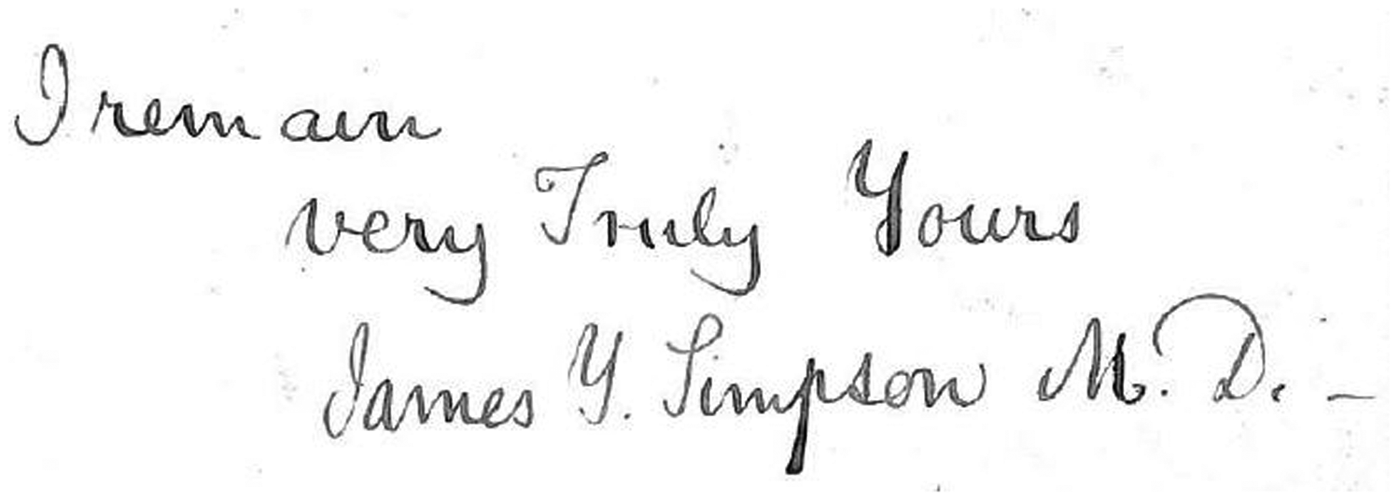
Simpson’s signature in a four-page letter penned to Walter Grindlay in November 1832. This is the earliest known correspondence that was signed as ‘James Y. Simpson MD’. Image from item 1407 in the Sir James Young Simpson Collection at the Royal College of Surgeons of Edinburgh, Edinburgh, Scotland, UK. Source: reproduced with permission from the Royal College of Surgeons of Edinburgh.
Simpson’s handwriting in the letter to Walter Grindlay (Figure 4) is similar to his handwriting in a letter dated 24 September 1835 (Figure 5). 20 An image of the letter from 1835 was published in 1911 in the ‘Sir James Y. Simpson Centenary Number’ of the Edinburgh Medical Journal (Plate VIII). [The original letter was then in possession of the Royal College of Physicians of Edinburgh. The location of the letter is now unknown.]
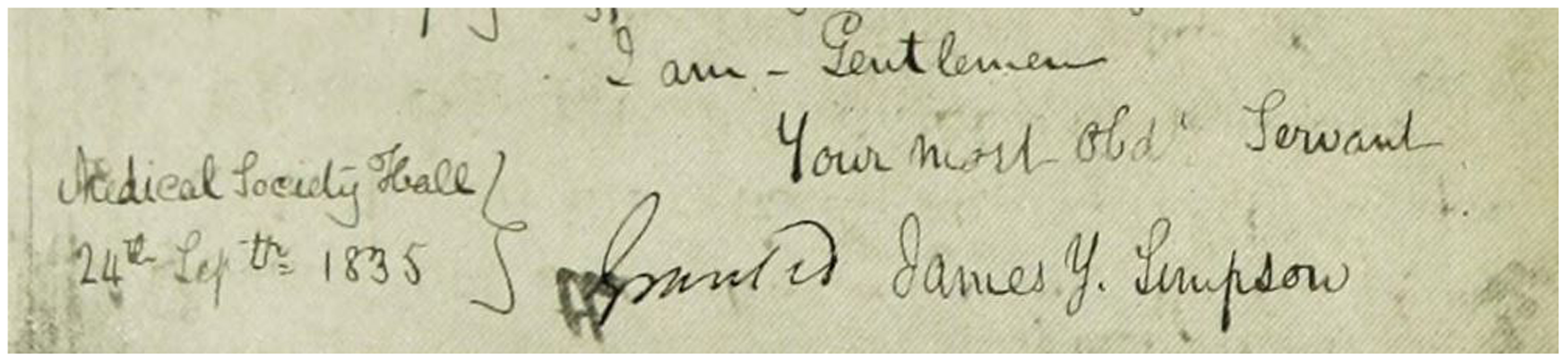
Simpson’s signature in a letter, dated 24 September 1835, reproduced in Edinburgh Medical Journal, 1911 (Plate VIII). 20
Society memberships
Simpson’s biographer John Duns, in referring to Simpson’s membership of scientific societies, records that ‘In 1833, Dr. Simpson became a member of the Royal Medical Society of Edinburgh’. 9 Around this time, according to Duns, Simpson also became a member of the now defunct Royal Physical Society of Edinburgh. Duns then quotes from the records of the Royal Physical Society of Edinburgh, providing us with an example, ca. 1833, of Simpson’s use of his middle initial: ‘Dr. James Y. Simpson petitioned for a seat in the Royal Physical Society: recommended by Edwards Forbes’. Simpson would later become president of both societies.
Conclusion
We do not know precisely when Simpson adopted the middle name ‘Young’ or why this particular name was chosen. None of his paternal or maternal ancestors have the name ‘Young’. We expect that Simpson would have discussed his middle name with his family; however, we do not have access to extant correspondence between Simpson and his family. The name ‘Young’ could have been an old nickname or epithet of Simpson: ‘Young Simpson’.
We have established that Simpson’s name is recorded as ‘James Simpson’ in student records at the University of Edinburgh, including his graduation in 1832 with an MD degree. This does not exclude the possibility that Simpson was already using the middle name ‘Young’ during his student years at the university. The earliest documentary evidence we found of Simpson signing his name as ‘James Y. Simpson’ is correspondence from him dated November 1832 to Walter Grindlay, his future father-in-law. This letter was written a few months after Simpson had received his MD degree. Simpson, with his newly acquired degree, and now considering a medical practice in Edinburgh, might have sought (as proposed by Jean Horton) to distinguish himself from a surgeon called James Simson. In this scenario, the middle name ‘Young’ was acquired following the completion of Simpson’s MD degree.
From 1835, we find Simpson using the middle name ‘Young’ or the middle initial ‘Y’ in correspondence, 20 in a listing of his name in the public directory of Edinburgh, 15 and in articles published in medical journals. 16 , 17 Together with Simpson’s 1832 letter to Grindlay (Figure 4), these findings refute assertions that Simpson assumed the middle name ‘Young’ when he applied for the Chair of Midwifery in 1839.2–4 A few questions remain to be answered. Was ‘Young’ a childhood nickname of Simpson? When did Simpson commence signing his name with the assumed middle name or middle initial? Did this occur while he was a student at Edinburgh University, or did he assume the middle name after completing his MD degree?
Footnotes
Acknowledgements
The authors thank Aaron Fleming (Library and Archive Assistant, Royal College of Surgeons of Edinburgh, Edinburgh, Scotland) and staff of the Edinburgh University Library for assistance in obtaining copies of documents that are cited in the article.
Declaration of conflicting interests
The author(s) declared no potential conflicts of interest with respect to the research, authorship and/or publication of this article.
Funding
The author(s) received no financial support for the research, authorship and/or publication of this article.