



Abstract

The Hewitt wide-bore inhaler (Figure 1), a modification of Clover’s ‘Portable Regulating Ether Inhaler’, was first described in 1901 by Frederic W Hewitt, MA, MD (1857–1916).1,2 The original manufacturer of the Hewitt inhaler was George Barth and Co. of 54 Poland Street, London, United Kingdom. Hewitt’s inhaler was copied by other manufacturers of medical equipment, leading Hewitt to warn in the Lancet in 1906 of the hazards of using unauthorized copies of the inhaler. 3
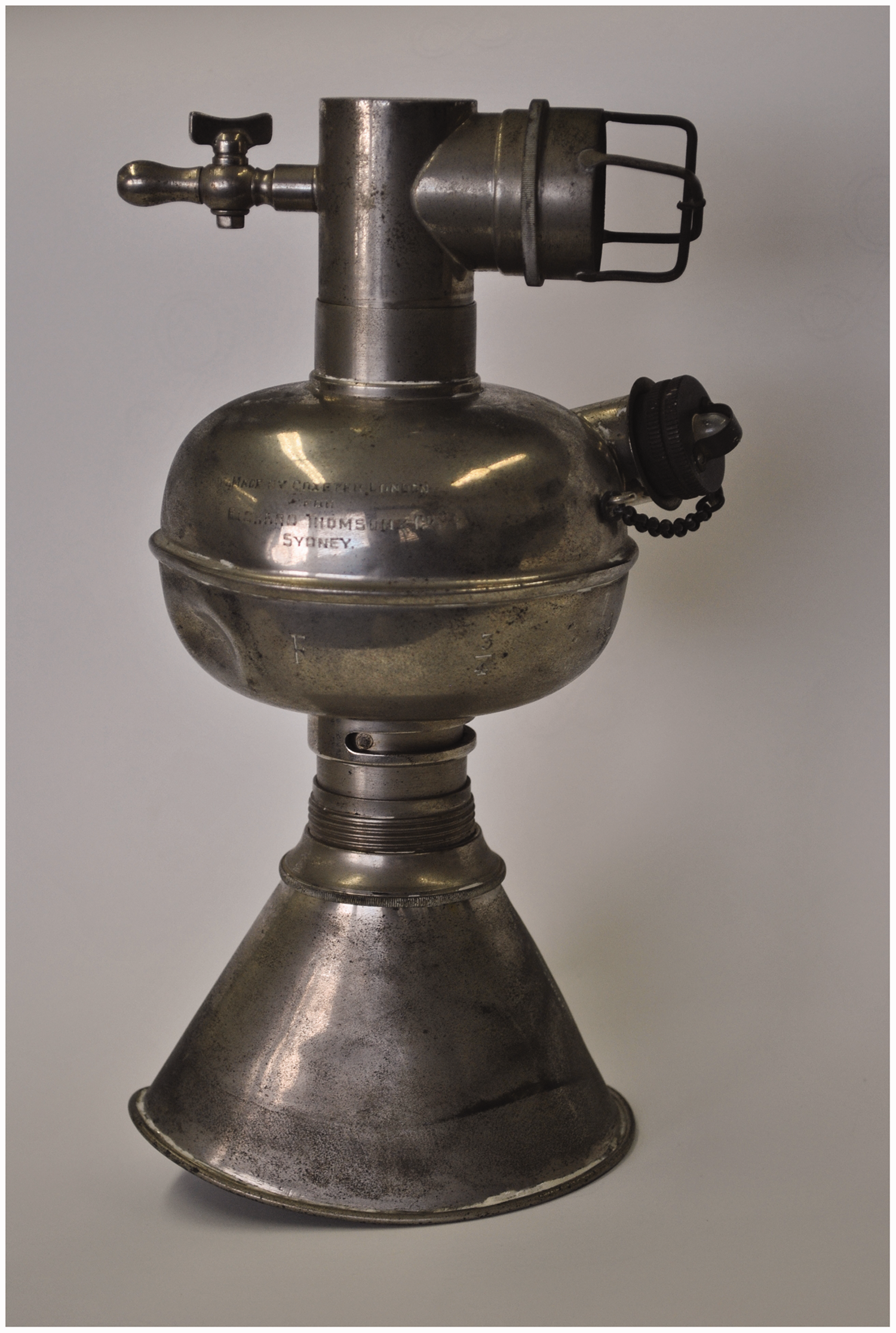
The Hewitt wide-bore ether inhaler. Source: reproduced with permission from Australian Society of Anaesthetists.
Hewitt made several improvements to the Clover inhaler. The most significant change was an increase in the diameter of the central tube through which the patient breathed, thereby reducing the incidence of laboured breathing, stridor and cyanosis in the patient. Other design changes include a facepiece or mask that was screwed on so it did not detach easily and a central breathing tube that rotated within the ether reservoir. In contrast, the reservoir of the Clover inhaler rotated around the central tube, an arrangement that occasionally presented difficulties in refilling with ether during the administration of anaesthesia. The Hewitt and Clover inhalers were closed systems that, by design, enabled rebreathing. In 1901, Hewitt wrote, ‘Some degree of cyanosis is to be expected, especially during the first two or three minutes. Later on in the administration it may be treated by removing the inhaler for fresh air from time to time’. 2
Hewitt, though, was not the first to describe the innovation of a wide-bore inner tube. A similar improvement was described in 1899 by T Wilson-Smith. 4 In 1942, GS Thompson of Sydney, New South Wales, offered two additional modifications: the rebreathing bag of the Clover or Hewitt inhaler was replaced by an inspiratory valve, and an expiratory valve was inserted into the side of the facemask. 5
The Hewitt inhaler (Figure 1) in the Harry Daly Museum of the Australian Society of Anaesthetists was sold in Australia by Richard Thomson Ltd, a company established in 1878. The name of the company is stamped on the metal facepiece of the inhaler: ‘MADE BY COXETER & SON/LONDON. FOR/RICHARD THOMSON/SYDNEY’ (Figure 2). In 1914–1915, Richard Thomson was in partnership with Ludwig Herman Bruck, who was also a publisher, medical bookseller and an agent involved in the transfer of medical practices. The provenance of the inhaler is not known. The Harry Daly Museum has six Hewitt inhalers made by three manufacturers.
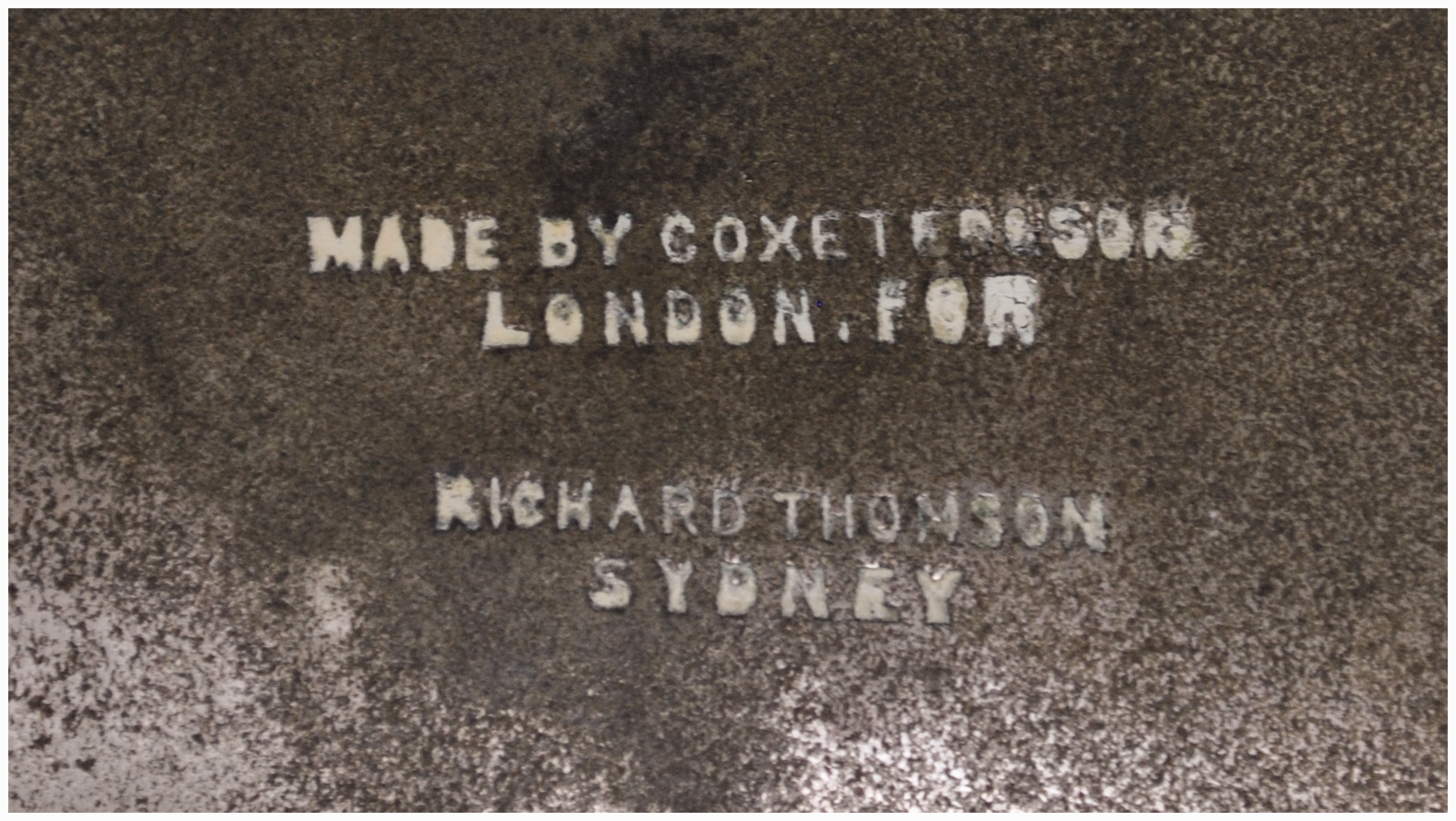
The text stamped on the facepiece of the Hewitt inhaler. Source: reproduced with permission from Australian Society of Anaesthetists.
Footnotes
Declaration of conflicting interests
The author(s) declare that there is no conflict of interest relevant to the submitted manuscript.
Funding
The author(s) received no financial support for the research, authorship and/or publication of this article.