



Abstract
Valentine Greatrakes (1628/9–1682/3) was also known as Greatrake, Greatraks, Greatorex and the ‘Irish Stroker’. He was an Irish faith healer who cured his patients by touching or stroking and was born on 14 February, hence his first name Valentine.
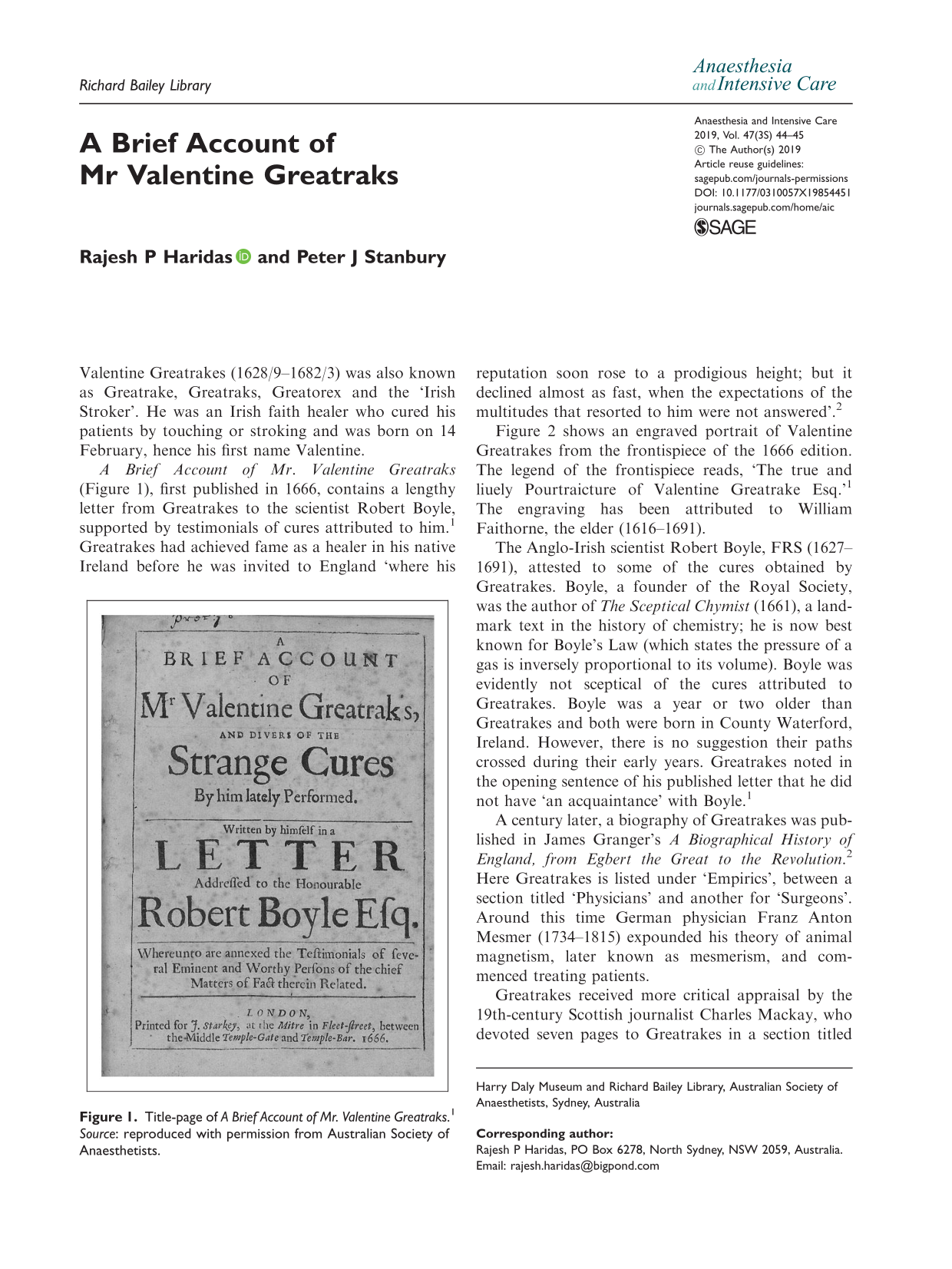
A Brief Account of Mr. Valentine Greatraks (Figure 1), first published in 1666, contains a lengthy letter from Greatrakes to the scientist Robert Boyle, supported by testimonials of cures attributed to him. 1 Greatrakes had achieved fame as a healer in his native Ireland before he was invited to England ‘where his reputation soon rose to a prodigious height; but it declined almost as fast, when the expectations of the multitudes that resorted to him were not answered’. 2

Title-page of A Brief Account of Mr. Valentine Greatraks. 1
Figure 2 shows an engraved portrait of Valentine Greatrakes from the frontispiece of the 1666 edition. The legend of the frontispiece reads, ‘The true and liuely Pourtraicture of Valentine Greatrake Esq.’ 1 The engraving has been attributed to William Faithorne, the elder (1616–1691).
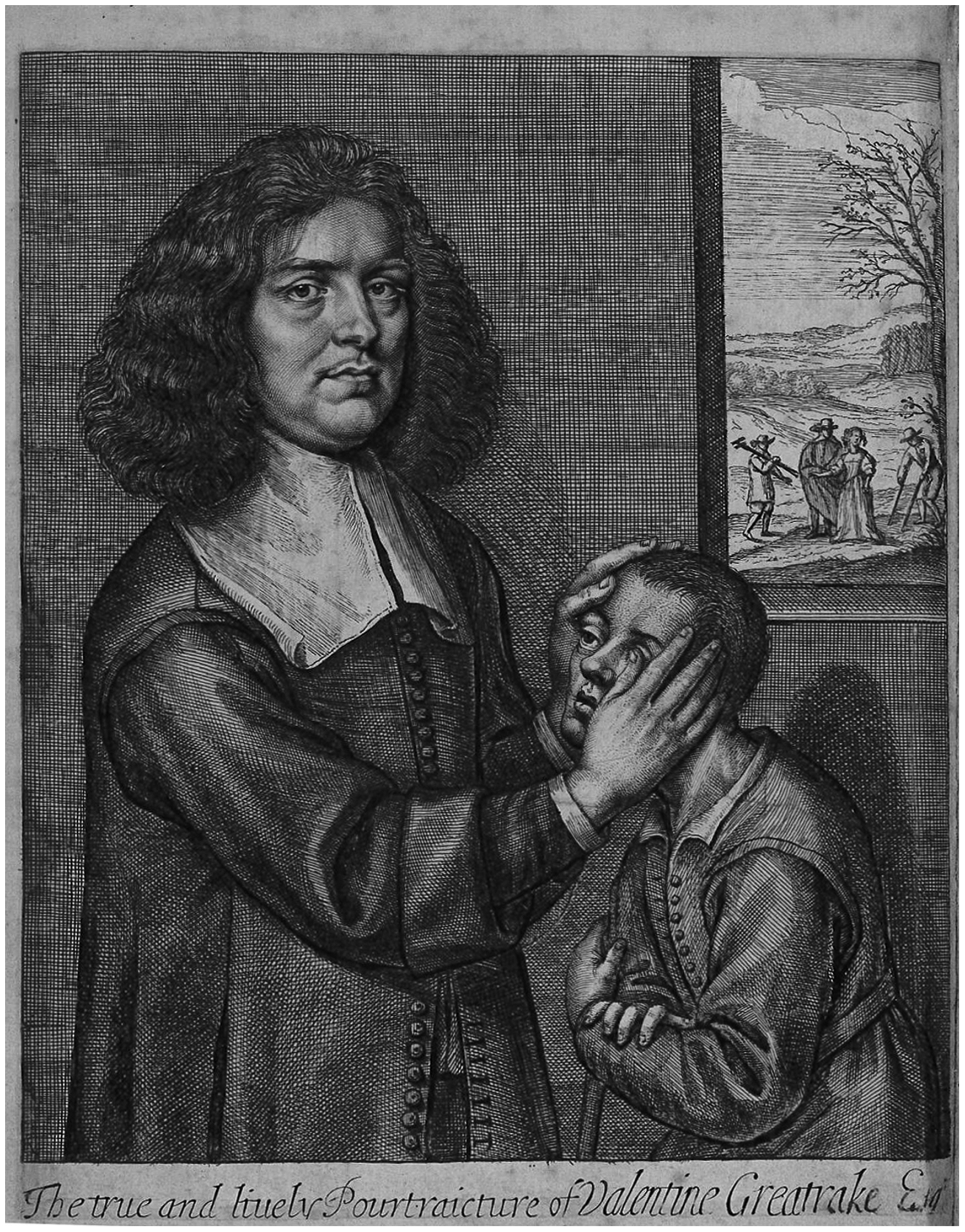
Engraved portrait of Valentine Greatrakes. Frontispiece of the 1666 edition of A Brief Account of Mr Valentine Greatraks. 1
The Anglo-Irish scientist Robert Boyle, FRS (1627–1691), attested to some of the cures obtained by Greatrakes. Boyle, a founder of the Royal Society, was the author of The Sceptical Chymist (1661), a landmark text in the history of chemistry; he is now best known for Boyle’s Law (which states the pressure of a gas is inversely proportional to its volume). Boyle was evidently not sceptical of the cures attributed to Greatrakes. Boyle was a year or two older than Greatrakes and both were born in County Waterford, Ireland. However, there is no suggestion their paths crossed during their early years. Greatrakes noted in the opening sentence of his published letter that he did not have ‘an acquaintance’ with Boyle. 1
A century later, a biography of Greatrakes was published in James Granger’s A Biographical History of England, from Egbert the Great to the Revolution. 2 Here Greatrakes is listed under ‘Empirics’, between a section titled ‘Physicians’ and another for ‘Surgeons’. Around this time German physician Franz Anton Mesmer (1734–1815) expounded his theory of animal magnetism, later known as mesmerism, and commenced treating patients.
Greatrakes received more critical appraisal by the 19th-century Scottish journalist Charles Mackay, who devoted seven pages to Greatrakes in a section titled ‘The Magnetisers’ in the third volume of Memoirs of Extraordinary Popular Delusions. 3 Often cited in discussions of financial bubbles, this well-known work is an early study of crowd psychology.
Greatrakes’ letter to Boyle is dated 8 May 1666, suggesting the pamphlet 1 was published a few months before the Great Fire of London in September 1666. Books from this period are rare as many stocks were lost in the fire. The copy in the Richard Bailey Library was acquired in 2019 as a donation from Dr Richard Bailey, anaesthesia historian, bibliophile and first honorary librarian of the historical library of the Australian Society of Anaesthetists. The pamphlet is bound in grained leather with marbled endpapers in a typically 19th-century manner. The inside of the front board has a bookplate of Dr Hugh W Diamond (1809–1886), a 19th-century British psychiatrist who documented the facial expressions of psychiatric patients using the newly developed techniques of photography.
Footnotes
Declaration of conflicting interests
The author(s) declared no potential conflicts of interest with respect to the research, authorship and/or publication of this article.
Funding
The author(s) received no financial support for the research, authorship and/or publication of this article.