



Abstract

As the 18th century drew to a close, Giovani Aldini moistened his hand with salt water and thrust it into the ear of a recently killed ox. With his other hand he applied the exposed spinal cord of a decapitated frog to the ox’s tongue, causing the frog to convulse violently. 1 Later, in the anatomical theatres of St Thomas’s and Guy’s hospitals, he performed similar experiments for an appreciative crowd, applying frog nerve/muscle preparations to his own tongue. His intent was to establish the veracity of Luigi Galvani’s theory—that animals had an intrinsic electrical system, independent of any external source of electricity. Controversy had raged over Galvani’s theory in previous years, with the other great philosopher and scientist, Alessandro Volta, convinced the explanation for Galvani’s observations lay in an external source of electricity. Although Volta was incorrect, his attempts to prove Galvani wrong led him to build the first voltaic pile, or battery, thus revolutionising the applicability of the developing science of electricity. Aldini, Galvani’s nephew, summed up the controversy some years later ‘Though these two philosophers pursued different routes, they concurred to throw considerable light on the same points of science…’. 1
Combining the theories of Galvani with the charge provided by the new voltaic pile, Aldini sought to determine the effects of external electricity on a recently deceased body; 26-year-old George Foster had been dead for at least an hour when his body began its journey from the gallows at Newgate to the College of Surgeons. 2 The first electrical experiment horrified bystanders as ‘…the jaw began to quiver, the adjoining muscles were horribly contorted, and the left eye actually opened’. 1 By the time they exposed the heart, several hours had passed and no contractions could be produced. But summing up the hours of experiments, Aldini concluded that ‘vitality might, perhaps, have been restored if many circumstances had not rendered it impossible’. 1
Prior to these experiments, there had been occasional reports of people restored to life with electric shocks. These patients had been treated with rudimentary equipment and it is unlikely the small shock produced had any effect on the heart; more likely the pain had finally restored them to consciousness. But these reports fuelled debate and, in 1792, James Curry published a review of resuscitation attempts suggesting ‘…when the several measures recommended above, have been steadily pursued for an hour or more, without any appearance of returning life, Electricity should be tried’. 3 He recommended applying shocks through the chest, the spine and the limbs, but expressed doubt about the usefulness of shocks to the brain. Aldini’s later experiments led him to recommend electricity as a first line treatment in resuscitation, a view that was soon embraced by the medical profession.
Many devices were subsequently designed to provide electricity for resuscitation, such as the widely publicised ‘improved Galvanic apparatus of Dr. de Santis’. 4 This apparatus required the patient to be strapped to a special chair and ventilated with bellows via a laryngeal tube, while a metal cannula was passed down into the stomach. Once the galvanic pile was prepared, one wire was attached to the tube in the stomach and the other applied to ‘different parts of the external surface of the body’. 4 Worryingly, it suggested that the strength of the galvanic pile be tested first by dipping a finger of each hand into the solution. There were many other strange, cumbersome pieces of equipment created in the subsequent years but none were simple or quick to assemble (the cover photo shows an example of an early magneto-electric apparatus).
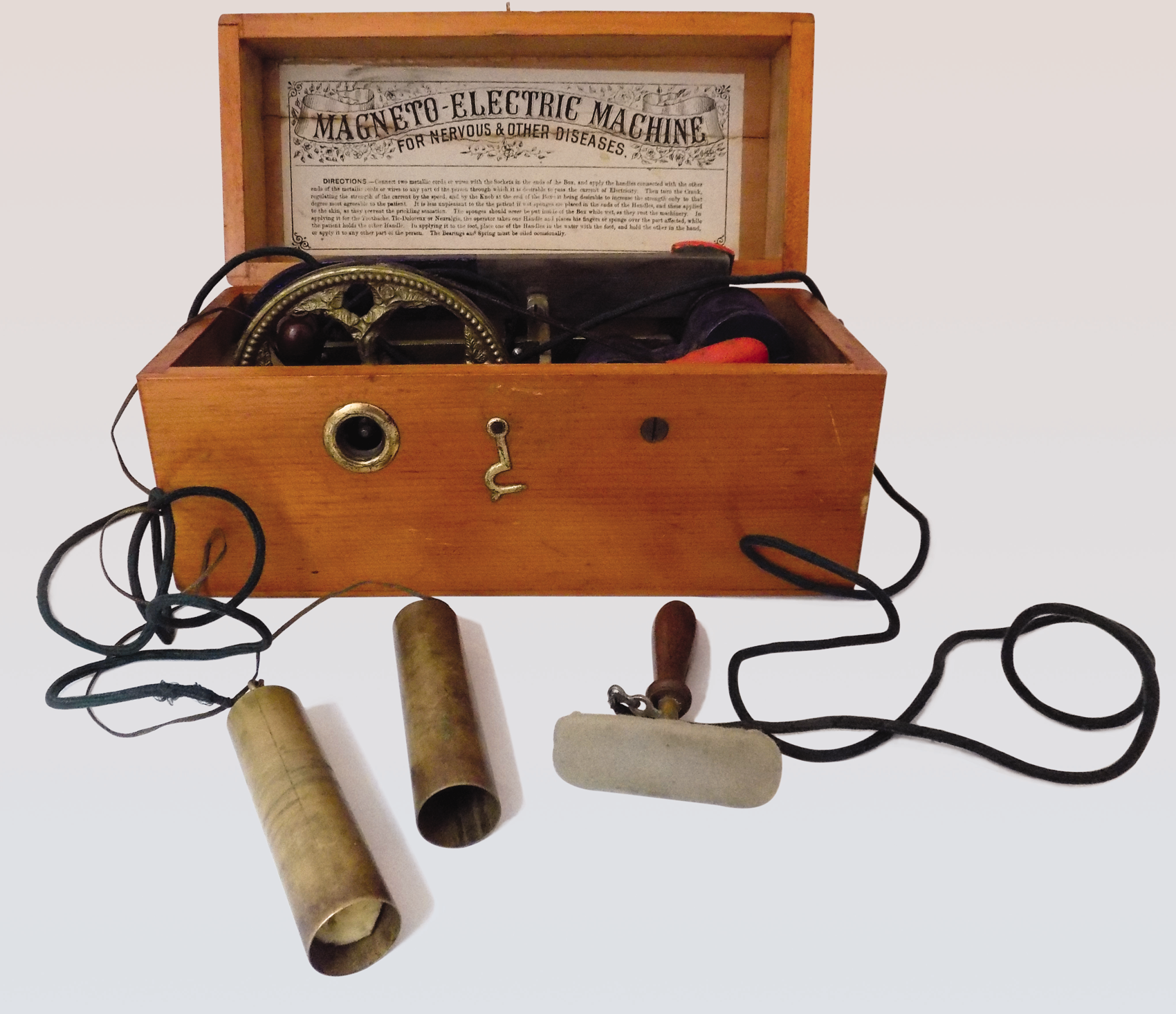
Magneto-electric machine for nervous and other diseases (c 1880). Image courtesy of the Geoffrey Kaye Museum of Anaesthetic History.
Despite the difficulties involved in creating and storing electricity, many other medical applications were found—some practical, some quite bizarre. Aldini cured a man with extreme melancholy with electric shocks to the brain and, although he never achieved the same success with any other patient, others began using electricity to treat depression, hysteria and other psychological problems. Electric shocks were applied with varying success for conditions ranging from paralysis, blindness, deafness and incontinence to dysmenorrhoea and labour pains. Many opportunists set up electrical businesses, promising cures to the gullible public: ‘one of them … pockets some thousands a year in his practice. There is scarcely a part of London where these irregulars do not exist’. 5 On the other hand, the publication of Mary Shelley’s Frankenstein in 1818 heightened public distrust of the use of electricity in resuscitation, with fears of zombie-like resurrection from over-zealous doctors.
While still a medical student, Golding Bird was put in charge of the newly formed department of electricity and galvanism at Guy’s Hospital in 1836. 6 Later, as physician to the hospital, he made it his mission to rescue galvanism from the realms of quackery—‘it cannot be concealed that not a little of their success is to be traced to the fact of the majority of our own body having paid little or no attention to the study of the physical sciences’. 5 In the early years he devised his own modifications of galvanic batteries, but by the 1840s, more practical electromagnetic equipment became available due to the discovery of electromagnetic induction by Michael Faraday in 1831. Bird published a series of lectures on medical electricity, a book that became a popular resource for doctors seeking information on the subject. In it he touched on resuscitation, reporting several patients with narcotic overdose who were kept alive by repeated electric shocks. 7 He also mentioned its possible use in drowning but noted that suitable equipment was unlikely to be readily to hand.
It was chloroform anaesthesia that really awakened interest in galvanism as a means of resuscitation. Since deaths from chloroform were witnessed and iatrogenic, every possible action was employed in an attempt to restore life. The Chloroform Committee of 1864 collected data on many attempted resuscitations noting ‘the most powerful effects were those produced when galvanism was applied to the neck’. 8 They also observed: ‘the power of the agent was increased by connecting one of the poles of the galvanic coil with a needle inserted into the diaphragm’. On some occasions, ‘when the heart had ceased to move’, the needle was also inserted directly into the heart with occasional ‘striking results’.
Subsequently Arthur Sansom published a textbook on chloroform anaesthesia suggesting ‘it is better for conductors to be either side of the neck, i.e. over both the phrenics’. 9 He advised that resuscitation attempts should not be delayed but that a messenger should be sent to find suitable electrical equipment: ‘An ordinary magneto-electric arrangement for medical use will answer the purpose’. Pulses of electricity were suggested, ‘interrupted at regular intervals, to imitate natural respiration’. Although there were some, like John Snow and Joseph Clover, who believed chloroform had a direct effect on the heart, the prevailing wisdom was that it stopped respiration and, if respiration could be restored, the heart would start again of its own accord. Galvanism was being used in this context as a respiratory stimulant, although it is theoretically possible that some successful resuscitations were due to unintentional defibrillation.
Although Sansom was prescriptive about the application of electricity to the neck, many anecdotal reports in the literature reveal that electricity was often applied through the chest from back to front, or from the right side of the neck to the apex of the heart. Noone really had any idea how it worked; it was essentially a measure of desperation. Ventricular fibrillation had been observed in dogs but was not thought to occur in humans. It was eventually described by John McWilliam in 1889: ‘…it is very possible that fibrillar contraction comes into play—that the inhibited heart may be put beyond the chance of recovery by the lapse of the ventricles into delirium’. 10 His work heralded a 20th century discussion on the use of electricity for cardiac resuscitation, but it was to be many decades before defibrillators were invented.