




Abstract
The concept of the ‘polycrisis’ is communicatively potent. That potency partially explains why the term has made its way to the fore in debate after debate since its use by the President of the European Commission Jean-Claude Juncker in 2015. But it also owes its prominence to its political function. This article uses a symptomatic reading of Adam Tooze to demonstrate that the concept replaces structural explanations with a profusion of empirical data; perceives that data from the implicit standpoint of the bourgeois state; imagines this state as a universal objectivity without a class basis and, as a result, implies a political programme based on the stabilisation of the existing social relations of production.
Keywords
Introduction
At first sight, the concept of a polycrisis explains everything. Describing ‘where disparate crises interact such that the overall impact far exceeds the sum of each part’ (World Economic Forum 2023a), it articulates the pattern of proliferating and mutually amplifying crises that can be seen in every sphere. However, this communicative potency obscures a series of specific theoretical presuppositions that have significant political implications. This article uses the method of symptomatic reading to identify these presuppositions, thereby laying the ground for a critique of the concept. This reading finds that it replaces structural explanation with a profusion of empirical data; perceives that data from the implicit standpoint of the bourgeois state; imagines this state as a universal objectivity without a class basis; and as a result, implies a political programme based on the stabilisation of the existing social relations of production.
The spiders’ web
Although he did not invent it, prolific left-liberal historian Adam Tooze has been one of the polycrisis’ most eloquent advocates. 1 He has a contradictory relationship to the concept. It is his most influential contribution to the theoretical vocabulary of the moment, and it has played a significant role in shaping the politics of key figures, including many in and around the late Biden administration in the US. Despite this appeal, Tooze describes it as ‘clearly somewhat facile conceptually’ (Tooze, 2024). But even facile ideas have effects.
In a 2022 Financial Times editorial titled ‘Welcome to the World of Polycrisis’, Tooze opens his account of the concept by defining its simplest element: a singular crisis. ‘A problem becomes a crisis when it challenges our ability to cope and thus threatens our identity’ (Tooze 2022b). This definition implies a subject without describing it. The threshold between problem and crisis is defined in relation to this subject. Only when the implied subject has their identity threatened does that boundary get crossed. What makes the polycrisis a polycrisis is that the subject in question faces multiple such threats, and so has to react to multiple crises at once: ‘In the polycrisis the shocks are disparate, but they interact so that the whole is even more overwhelming than the sum of the parts’. These two statements, taken together, allow us to understand the kind of internal relations between the crises implied by the concept. Disparate phenomena develop over time to become crises, and then develop some kind of relationship among themselves that amplifies their effect and threatens to overwhelm the subject’s ability to cope and, therefore, the subject’s identity. These different problems do not have a common source or origin; they cannot be linked to an underlying structure or system. To turn this concept into a topography, we could see it as something like a spider’s web.
The key determining relationships in this topography are those between the discrete crises and the central subject. The relationships of crisis to crisis are secondary and described in terms of amplification rather than causation or other forms of interaction. This conceptual topography therefore suggests a certain kind of theoretical task. To understand the polycrisis, it is sufficient to take the standpoint of the subject and identify all the relationships it has with the crises surrounding it. The task at hand becomes a kind of mapping, where the goal is to produce a full account of all the relationships the subject is in. If we look at research conducted using the polycrisis concept, we find exactly this task being undertaken. The World Economic Forum global risk report featured extensive discussion of the concept of polycrisis, and its representation of the risks mapped out looks exactly as you would expect (Figure 1).
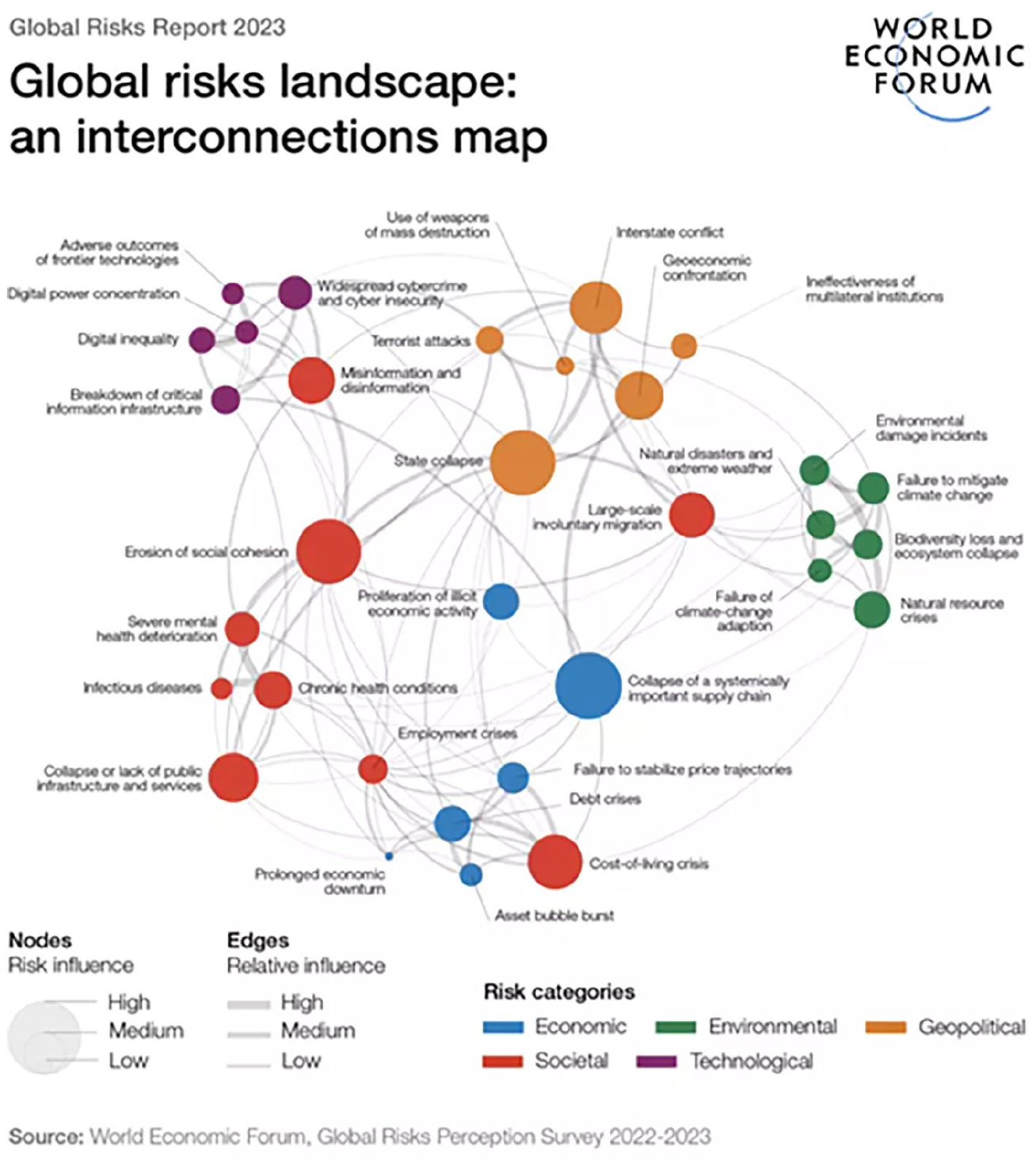
The World Economic Forum’s (2023a) illustration of the polycrisis.
This map is inaccurate only insofar as the subject is not represented – instead, the viewer is interpolated into that role. We are the spider at the centre of the web, and the determining connections that structure the concept are invisibly extending out of the screen towards us. The relationships between the different crises on the map are only the secondary ones. The development of nodes and clusters serves to add some complexity to the web’s connections, but the discrete origins of the crises themselves are defended against structural interpretation. The spider’s web is a manifestation of the Latourian injunctions to ‘keep the social flat!’ (Latour 2007: 190).
Perry Anderson has criticised Tooze for his tendency to repress structural explanation and rely on the deployment of a vast scope of empirical detail in its place (Anderson 2019). Anderson argues that in Tooze’s trilogy of books on the latter part of the First World War, the Nazi economy and the 2008 financial crisis (Tooze, 2007, 2015, 2019), he relies on a specifically Keynesian perspective that limits itself to a ‘situational and tactical awareness’ and represses structural investigation of his given objects (be they imperialism, economic crisis or finance capital). When structural features do come into view in this trilogy, Anderson says, they do so ‘only from the point of view of actors attempting to deal with them’. Tooze has responded to this critique by affirming his anti-structural analysis (Tooze 2024). Rather than attempting to interrogate how the many crises that make up the polycrisis are determined, the concept aims rather to identify how the fragments combine into an assemblage. It moves back and forth across the web, offering the reader access to the complexity of the social world an open network of connections. The polycrisis is a concept that is well suited to describing many crises and grasping a huge range of empirical detail–but it does so while refusing any account of where these crises came from or how they interact with each other. The only point of unity that spans all these crises is the central actor in the web, but the identity of that actor still remains unclear.
Hegel and Keynes
This account of the spider’s web of the polycrisis having been established, we can turn to the most pressing problem posed by Tooze’s initial statement. ‘A problem becomes a crisis when it challenges our ability to cope and thus threatens our identity’. ‘Our ability’, ‘our identity’ – who are we? The identity of this subject needs to be established in order to understand the standpoint of the concept of polycrisis. This standpoint is the one from which the profusion of empirical data scattered around it is understood; it is the point through which everything has to be interpreted. What clues does Tooze give us to make this identification? First, this subject is agentive, it has the ability to act in response to crises. Second, it also has an identity, by which he means a consistent objective existence. And finally, it is a collective subject that we all have a relationship to. In fact, this relationship is so commonsensical that it is possible to use ‘our’ to refer to this subject without explanation and to assume that its identity can be quite naturally assumed by the reader. This last point suggests that the identification of individuals with this universal collective subject that can act on their behalf is an assumption that is deeply embedded within the dominant ideology (i.e. the ideas of the ruling class).
This implied subject takes the form of an objective universality, and specifically, the objective universality as realised in a concrete social organisation. Tooze’s implied subject is almost identical with Hegel’s conception of the state (Hegel 1820: 283).
In relation to the spheres of civil law and private welfare, the spheres of the family and civil society, the state is on the one hand an external necessity and the higher power to whose nature their laws and interests are subordinate and on which they depend. But on the other hand, it is their immanent end, and its strength consists in the unity of its universal and ultimate end with the particular interest of individuals, in the fact that they have duties towards the state to the same extent as they also have rights.
Hegel’s state in Elements of the Philosophy of Right is the logical result of multiple competing interests: the existence of difference rights (e.g. the right to private property) embedded in the institutions of the family and civil society creates the duty to support an arbiter that can resolve conflicts between these rights. This combination of right and duty creates the state as an objective universality, and in doing so unites the particular interests of a diverse range of subjects. There is a certain self-evident similarity in the conceptions of the state present here and in Tooze’s articulation, but to develop the connection further we need to draw a lineage of thinking about the state and crisis via a third term. The path from Hegel to Tooze runs via Keynes.
Geoff Mann’s insightful reading of Keynes sees his ideas as representative of a much wider tendency in liberal thought, one which pre-existed the historic personage of Keynes and repeatedly came to the fore at moments of crisis (Mann, 2016, 2017). Mann argues that Keynesianism can be best understood not as a specific set of economic arguments or policy suggestions, but as the strongest articulation of this wider current of liberal thought on crisis and stabilisation. The ultimate goal of this wider Keynesian current is to save civilisation from breakdown. In the historic circumstances of the early 20th century, this took on the specific form of preserving liberal capitalism. The threat of breakdown results from the fact that Keynes sees civil society as a sphere of self-interested particularity which gives rise to contradictions between individual and collective interests. If these contradictions are not adequately governed by an external actor, they give rise to violent conflict that threatens to send civilisation into terminal decline (Mann 2016). This decline is not a remote future possibility, but an imminent threat. Keynesianism attempts to provide an answer to this threat that defends individual liberty and maintains existing institutions. As Mann puts it, ‘When an outraged Robespierre asked the bourgeois Convention of 1792, “Citizens! Would you want a revolution without revolution?” Keynesians were those who thought to themselves, “Yes, actually. That is exactly what we want”’ (Mann 2016: 122). The method of Keynesianism is to use gradual institutional changes implemented by technocrats to harmonise civil society and negate the possibility of violent breakdown. These changes operate primarily at the level of the economy but can also extend to the sociocultural terrain. This programme of anti-revolutionary reform is fundamentally based on the political function of the state, as the universal institution which legitimates the technocratic bureaucracy and gives it the levers required to implement its programme. The state is seen as a social organisation operating above and separately from classes as ‘the great “reconciler” of individual and collective interests . . . which can harmonise the particular and the universal, materially and ideologically, without sacrificing either’ (Mann, 2016: 124). For Keynes, civilisation will be saved through the state’s capacity to stabilise itself and the civil society that both produces and relies upon it. 2
But Mann also finds much deeper roots to this idea. He argues that ‘Hegel was the first Keynesian’ (Mann 2016: 128), and there is a fundamental homology in the Hegelian and Keynesian conceptualisations of the state and civil society. Hegel’s reaction to the French Revolution, and the figure of Robespierre in particular, was a first instance of a tendency that reoccurred again and again over the next two hundred years (Mann 2017). If the state is a concrete social organisation based on the contradictory and competing interests that exist in the society that produces it, then the continued existence of the state relies on the continues existence of those relations. The rational development of the state must, in the Hegelian model, amend this organisation without destroying its foundations.
The lineage of thinking about the state that runs from Hegel to Keynes and then to Tooze makes it possible to go back to that enigmatic definition of crisis that was the starting point of this discussion, but this time, with the identity of the subject in mind. Tooze says: ‘A problem becomes a crisis when it challenges our ability to cope and thus threatens our identity’. What he means by ‘identity’ is not discussed at any length. It seems to have some significant ambiguity: it would be quite possible for a reader to assume that he means cultural identity. But in light of our identification of the Hegelian-Keynesian desire for a revolution without a revolution, we can reinterpret this statement: now, it reads like a desire to resolve the destabilising effect of the polycrisis without giving in to proletarian attempts to smash the state on the one hand and fascistic attempts to totally unleash the state’s capacity for violence on the other. Because the state is constructed on the basis of the diverse and contradictory private interests that exist in civil society, maintaining this identity means using the state’s capacity and its role as the great reconciler to stabilise the unstable. Inevitably, such reconciliation involves a modification of the exact forms taken by the social relations of production in a social formation. But this modification occurs only insofar as it can be made strictly compatible with the fundamental identity of the state, and ergo of those relations, of that base, that supports it.
A Keynesian-Latourian stability
We have now established that the polycrisis is a concept that can be topographically represented as a spiders’ web with a subject at the centre. The identity of that subject is the state, which is implied as an objective universality that represents ‘us’ and exerts agency on our behalf. When confronted with a crisis the state has to act as a reconciler and defuse the destabilising tensions that emerge from civil society without challenging the identity of the state or the social relations of production. But how does this change when a crisis becomes a polycrisis? In other words, what is the political task specifically implied by the mutually amplifying effects of multiple crises?
Tooze initially identified what is unchanging about this new task: the state continues to cope with the challenges caused by each disparate crisis impinging upon it and maintain its identity in the face of disturbance. But he goes on to complicate this picture. The horizontal amplification effects between the crises that make up the polycrisis mean that the state faces a new kind of challenge. In previous conjunctures – Tooze gives the example of the 1970s – ‘we’, the particular subjects under the objective universal, could deliberate between different responses to the singular crisis of our time. He argues that at that point, it was possible to pick a single solution to a single problem and pursue it, whereas now the diversity of amplifying crises poses challenges of another magnitude. The polycrisis tests the limits of the state’s capacity to facilitate ‘our’ deliberation and action. Reconciliation is now more technically complicated than it was previously. The political programme implied by this model and its central subject is one of stabilisation by any means necessary, even if those means look very unlike those that have historically been deployed by the state. This willingness to innovate the face of novel complexity finds some of its source in Bruno Latour, another one of Tooze’s key influences. Latour’s political paradigm has been described by Tooze as a ‘revival of the agora’, and a defence of those ‘institutions that give us some grip on reality’, such as the University (Tooze 2022a). Latour himself characterised it as ‘progressively composing the common world’ or finding forms of assembly that match the complexity of the social world (Latour 2007: 189, 260). The reconciliation achieved by this constant process of reform is never final. Instead, it must constantly respond to new, distinct crises with new, distinct solutions. Tooze draws the editorial to a close by characterising the future as a ‘tightrope walk without end’.
What is implicit in the politics of the editorial was made more explicit in a 2023 interview with the World Economic Forum, in which Tooze argues that Keynes is a meta-theorist of complexity who innovated by establishing a political approach that focused on eliminating key stressors (high unemployment) with the lever of economic policy applied by technocrats (World Economic Forum, 2023b). Once those stressors are handled, then the limited political capital that remains can be directed towards building consensus and a functioning democracy based on political agreement. This consensus building must, in the Latourian mould, respond to the ways in which the social is assembled: it cannot be a simple revival of old models of liberal democracy, but has to involve a contemporary modification of the agora. Perhaps, in this moment, one could see the most radical interpretations of polycrisis opening themselves up to a more transformative politics. But the subject at the centre of the crisis seems certain to limit those aspirations. New kinds of agora will not mean a challenge to class rule. This political line is not just one interpretation of the implications of the polycrisis, it is baked into the concept on a deeper level: it is implied by its topography. The concept is a Hegelian-Keynesian-Latourian all the way down. The polycrisis serves one project – to revive the agora, reconcile divergent interests and man the battlements of the bourgeois state.
Conclusion
Thinking in the conceptual mould of the polycrisis represses structural explanations and replaces them with description via a profusion of data. It perceives these data from the implicit standpoint of the bourgeois state – which is imagined as truly universal and rational; and as a result, it discounts the class character of that state and the existence of class struggle as the dynamic conflict at the base of capitalist social formations. And finally, the concept implies a political programme based on the constant stabilisation of the capitalist mode of production, in which fiscal and monetary policy is used to buy time, release pressure and create the space for limited forms of ‘democratic’ reconfiguration. It should not come as a surprise that an idea which fits so neatly within the constraints of the dominant ideology has become so popular with the dominant classes.
The polycrisis is a mirage. At first, it looks like it offers a way to grasp the specific nature of our conjecture. But then its initial empirical descriptions never develop any further. They fail to lead to any kind of theory of the social formation. For readers without access to the levers of the state or capital, this has a disorientating effect. In running towards the mirage, the pursuer ends up thinking like the state from which they are, in reality, excluded. The class struggle recedes into the distance, and in its place, they find themselves confronted by an alien and ineffective demand: that they come up with ideas about how the system that dominates and exploits them could be stabilised.
Instead of the polycrisis, we need something else: a way of thinking that analyses how social formations are transformed through the antagonistic reproduction (or non-reproduction) of their social relations of production, their economic base, across the course of crisis-ridden conjunctures. After all, mirages are at their most tempting when the sun is high in the sky and water is scarce. In his response to Anderson’s critique, Tooze positions Anderson’s Marxism as a closed doctrine, willfully blind to its isolation in the ivory tower, shackled to concepts derived from the 19th century and unwilling to grapple with historical change (Tooze 2024). His reply forecloses the possibility of Marxist thought that is rooted in the conjuncture and articulated from the perspective of the working class. But it is exactly this possibility that must continue to be pursued. 3
The task of developing a conceptual approach that supersedes the polycrisis lies beyond this article. It will have to be sufficient to note that the process of development required to reach this point will not be starting from scratch. Marx left many enigmatic clues as to the direction this development could take, but perhaps the most striking comes from the unfinished third volume of Capital (Marx 1894: 927–8): The specific economic form, in which unpaid surplus-labour is pumped out of direct producers, determines the relationship of rulers and ruled, as it grows directly out of production itself and, in turn, reacts upon it as a determining element. Upon this, however, is founded the entire formation of the economic community which grows up out of the production relations themselves, thereby simultaneously its specific political form. It is always the direct relationship of the owners of the conditions of production to the direct producers – a relation always naturally corresponding to a definite stage in the development of the methods of labour and thereby its social productivity – which reveals the innermost secret, the hidden basis of the entire social structure and with it the political form of the relation of sovereignty and dependence, in short, the corresponding specific form of the state. This does not prevent the same economic basis – the same from the standpoint of its main conditions – due to innumerable different empirical circumstances, natural environment, racial relations, external historical influences, etc. from showing infinite variations and gradations in appearance, which can be ascertained only by analysis of the empirically given circumstances.
Footnotes
Acknowledgements
Kai Heron, Roberto Mozzachiodi and George Briley all discussed and sharpened the initial ideas behind this paper. Adam Mrozowicki gave me the opportunity to present the first version of it at the 7th Social Boundaries of Work conference in Wroclaw.
