




Abstract
This article aims to reconstruct the ‘silent’ reformulation of the notion of disability within social policy systems in recent decades. Particular attention is given to the practices implemented in the United Kingdom as an example of a conditional welfare state with advanced workfare arrangements (primarily in the form of the Employment and Support Allowance scheme). The redefinition of disability from the perspective of changes in the criteria determining social benefits – that is, in reality, limiting the social rights of this, as one British economist put it, ‘silent minority’ – is framed as part of a broader trend termed ‘antisocial social policy’ and is captured through the lens of welfare scarcity, a component of welfare sociology. This proposed framing, based on a Marx-inspired critical analysis, fills the gaps in the concept of welfare state retrenchment which excessively focuses on conservative right-wing politics.
Introduction
Research on disability in its broadest sense – which according to the classification of the World Health Organization (WHO) (1980: 29–30) includes components such as disease/disorder, impairment, disability and handicap, whereas the revised version (WHO 1999) more strongly emphasises medical, social and environmental determinants – is characterised by highly diversified theoretical and methodological approaches (see also Resolution WHA54.21 of 22 May 2001, adopted by WHO and the United Nations Convention on the Rights of Persons with Disabilities (UN CRPD) that entered into force in 2008). The presentation of the complex phenomenon of disability is also influenced by axiological positions, from the perspectives of which analyses are conducted and conclusions and recommendations are formulated. This article aims at tracing – in the spirit of neoliberal projects – the redefinitions of disability that subordinate this diverse phenomenon to the requirements of capitalist labour markets in practically every possible area. To this end, we will use welfare scarcity approach, which is a component of the sociological concept of social welfare (Baranowski 2019), to present the profound paradoxes of institutions intended to support people with disabilities. Welfare scarcity is a broader concept than the political phenomenon of welfare state retrenchment, as it is not limited to welfare state institutions and the political dimension (Pierson 1994, 1996; Starke 2006, 2021). In the same way that social welfare is broader in scope than the welfare state (although it covers the all-important area of redistribution and social protection), welfare scarcity involves practices to ‘cut back entitlements and weaken the political foundations of the welfare state’ (Starke 2006: 105). In fact, the institutions that should support people with disabilities are characterised by – to use a term that is also a concretisation of welfare scarcity in the dimension of the welfare state – ‘antisocial social policy’ (Baranowski 2017: 15–17), which captures the specificity of the functioning of the conditional welfare state. This conditional welfare state within – to use David Matthews’ (2021) term – the political apparatus of a monopoly capitalist society clearly separates ‘impairment’, defined within a biomedical approach, from ‘disability’, determined by the ‘organisation of the mode of production based on the maximisation of profit’ (see also Russell 2001). Such a distinction can cause a series of abuses, significantly worsening the situation of the people who are already suffering from negative experiences and are ‘second class citizens’ (Benstead 2019) in Britain’s neoliberal reality.
The contribution of this article is to apply an original concept of welfare scarcity grounded in a Marx-inspired critical analysis of social relations to systematically trace the progressively worsening situation of disabled individuals in the United Kingdom. The study utilises secondary scholarly works, official documents, and public data.
The following sections examine the central assumptions of conditional welfare states under the welfare scarcity approach, the treatment of disability from the perspective of neoliberal labour regimes, including the social model of disability (Oliver 1990), and the definitional and legal developments concerning disability. The article ends with conclusions and their discussion.
Conditional welfare states and welfare scarcity
In the broadest sense of the term, the institutions of the welfare state are specific to contemporary developed states; these institutions, while historically adopting specific practical solutions based on different normative patterns, have in the post-World War II period pursued ambitious plans to develop social rights that extend the category of citizenship (Marshall 1992 [1950]). Especially in the context of the old continent, some spoke of the ‘Golden age’ of the welfare state from 1945 to the mid-1970s (cf. Pierson 2004); in the British context, they spoke of the ‘classic’ welfare state (Harrison 2009: 238). Since the so-called neoliberal turn of the 1980s (cf. Abrahamson 2012; Baranowski 2020; Mabbett 2013), priorities have fundamentally changed, which is evident in how welfare state institutions operate. The distinguished models of welfare states have long served with the opposing logic of satisfying social and individual needs. Wilensky and Lebeaux (1958) distinguished between residual and institutional regimes (see also Mishra 1977), Titmuss (1974) outlined the residual welfare, industrial achievement-performance and institutional-redistributive models, and Furniss and Tilton (1977) proposed the positive state, social security state and social welfare state.
Nevertheless, Gøsta Esping-Andersen (1990), a Danish sociologist, proposed the most influential typology that includes a division of the welfare states into liberal, conservative/corporatist and social democratic welfare regimes. This does not change the fact that each typology – and when considering model welfare regimes, note also the critical positions on the denotative possibilities of these regimes (cf. Baranowski & Jabkowski 2022; Kasza 2002) – was less generous and had more conditional solutions than the previous.
Conditionality within the institutions of the welfare state does not constitute anything surprising or controversial; it can be interpreted in terms of the citizen’s responsibilities (cf. Streeck 2023). As Peter Dwyer (1998) has noted, ‘the association between rights and responsibilities is an issue that is of central importance to any notion of citizenship’ (p. 493). However, problems arise when social policies are constructed in such a way that state assistance (a) does not reach those in need, (b) stigmatises those at risk of social exclusion or are socially excluded and (c) is burdened with disciplinary practices that are absurd from the perspective of human dignity. In addition, welfare state agendas through specific sets of regulations may put into practice the assumptions of neoliberalism (neoliberal economic and social order), understood as ‘a particular organisation of capitalism’ (Campbell 2005: 197). Furthermore, ‘the most basic feature of neoliberalism is the systematic use of state power to impose (financial) market imperatives, in a domestic process that is replicated internationally by “globalisation”’ (Saad-Filho & Johnston 2005: 3).
Thus, we arrive at a system of interconnected vessels in which the specific neoliberal economic order uses the institutions of the welfare state to promote, or rather enforce, behaviour that is in line with its logic (welfare-to-work), ignoring to an enormous extent the needs of disadvantaged groups (Dwyer 2004; Paret 2018; Stone 1984).
As Sara Watson (2015) noted, contemporary welfare solutions are subordinated to the requirements of liberal labour markets, and the ‘increasing emphasis on workfare arguably represents a new vision of the welfare state. Instead of protecting society from market forces, social policy is now being used as a tool to actively commodify labour’ (p. 646).
The category of conditionality has been systematically expanded in terms of both the subject matter – that is, the term itself and its meaning – and the subjective perspective – that is, the groups affected by it. People with disabilities are an emblematic example of the radicalism of practices conditioned by the demands of liberal labour markets that characterise neoliberalism (cf. Soldatic 2018; Soldatic & Meekosha 2012). This set of procedures can be described as ‘antisocial social policy’ (cf. Baranowski 2017), highlighting the profound contradiction within the changing institutions of the welfare state. This contradiction leads to a situation not of realising social welfare (the principles of ‘equality of opportunity, equitable distribution of wealth, and public responsibility for those who cannot provide the minimal provisions of a good life for themselves or their families’, International Labour Organization 2018: n.p.) as the primary goal of the functioning of state institutions and their dependents (private companies and third sector organisations funded by the state) but of creating welfare scarcity, understood as ‘the impossibility (deficit) of satisfying [the material and non-material needs – M.B.]’ (Baranowski 2019: 9). The situation is reminiscent of the Poor Laws, the logic of which was quite clear – hard work under severe rigour in so-called workhouses intended to discourage the use of social assistance. This was when the label of the ‘deserving poor’ was clearly articulated, which in various forms is still used today (cf. Moffitt 2015; Oliver 1990, 2013). Grover and Soldatic (2013) see this analogy in the context of disability, arguing that ‘(. . .) there has arguably been a reassertion of the old Poor Law binary of the ‘deserving’ and ‘undeserving’ and, in turn, a reshaping of disability citizenship regimes with diminishing citizenship entitlements’ (p. 217) (cf. Dorn & Keirns 2010).
In this sense, welfare scarcity means social welfare à rebours – that is, the failure to satisfy the tangible and intangible needs of a given community at the individual and supra-individual level, which forces individuals to sell (more precisely – lease) their own labour force on labour markets, often despite objective health-related difficulties. At the individual level, this involves a state of psychological ill-being, as ‘in an economy that already has a limited number of job openings, placing labour market expectations on people with disabilities may be unrealistic’ (Owen & Harris 2012: n.p.). In particular, the United Kingdom’s incapacity benefit system could be described as ‘an exemplar of a “compliance-based system” characterised by high conditionality and weak rehabilitation measures’ (Dwyer et al. 2019: 314), the hallmarks of welfare scarcity (and the accompanying ill-being). Moreover, antisocial social policy as a component of welfare scarcity includes, in addition to the reduction of funding for welfare programmes and the logic that ‘all citizens must pay for all benefits they receive’ (Stone 2017: 597), more fuzzy and at first sight ambiguous solutions. For example, the repertoire of practices of this distorted form of social policy includes the ‘unfair’ redistribution of minimum-income support – which in Greece, for example, goes to just one of the five poorest households – understood as the bottom 10% of the distribution of market income and contributory earnings-replacement benefits (OECD 2020: 7–9). It implies that, in this case, although the benefits have not been reduced, they have not gone to those most in need. Furthermore, as research shows (Pinilla-Roncancio & Alkire 2021: 215), people with disabilities and their families ‘face higher levels of multidimensional poverty in more developed countries’.
Disability in neoliberal labour regimes
The concept of disability, as mentioned above, is an extraordinarily complex and multidimensional phenomenon in which medical, legal, socio-political, ethical and economic thinking overlap. Although the most significant tensions are between the medical and socio-political approaches (cf. Burchardt 2000; Fisher & Goodley 2007; Haegele & Hodge 2016; Mabbett 2005; Marks 1997; Rothman 2010; Shakespeare 2006), the remainder of this article primarily focuses on the economic dimension, which significantly affects the other areas (economic relations grow out of and transform social relations, and it is, after all, according to Oliver (1990, 2013) social model of disability, ‘a society which disables persons with impairments’). Therefore, the category of disability itself is deeply rooted in the history of capitalism and its labour regimes (Clifford 2020; Russell & Malhotra 2002), and this area marks a significant field of interest in this study.
Although most examples of the redefinition of disability in the sense of conditionality concern the United Kingdom, as a classic representative of the residual welfare state model, note that, to a varying extent, these practices appear in other economies, both developed and developing. An example of the latter is Poland, where, according to the Act on Social Assistance (Dz. U. of 2004, No. 64, item 593, as amended), there is no definition of disability. Instead, there is a concept of ‘total inability to work’, which means: ‘total inability to work within the meaning of the regulations on pensions from the Social Insurance Fund or being classified in the 1st or 2nd group of invalids or having a significant or moderate degree of disability within the meaning of the regulations on professional and social rehabilitation and employment of disabled persons’. (Woźniak 2008: 64)
This clearly shows that in Poland, disability is considered purely in the context of work regimes (ability to work) and not as an autonomous phenomenon of both medical and socio-political nature. This, in turn, results in measurable consequences for people with disabilities. An analogous situation exists in Bulgaria (Mladenov 2015), Slovakia (Gould & Harris 2012) and Australia (Grover & Soldatic 2013).
In the United Kingdom, however, the Welfare Reform Act was introduced in 2007, explicitly changing the conditions of the benefits under the existing Income Support and Severe Disablement Allowance schemes. These two schemes were replaced by the income-related Employment and Support Allowance (ESA), which explicitly extended the behavioural conditionality category to incapacity benefits. However, the latter’s introduction took place as early as 1995 and hit people with disabilities (cf. Banks et al. 2015). Slowly but consistently, a complex and conditional system – to use the term – of support for people with disabilities has been built in the United Kingdom (Piggott & Grover 2009). It formally includes not only ESA but also housing benefits, income-based Jobseeker’s Allowance (JSA) and other components (see Figure 1). However, let’s return to ESA, which plays a crucial role in the United Kingdom’s social policy system as it provides financial support to individuals who are unable to work due to illness or disability. The point is that this welfare benefit involves assessing claimants’ ability to engage in work-related activities and their willingness to participate in support and training programmes. Claimants in this category may be subject to additional requirements and sanctions if they do not fulfil their agreed-upon behavioural conditions, which can affect their eligibility for incapacity benefits (Gulland 2011).
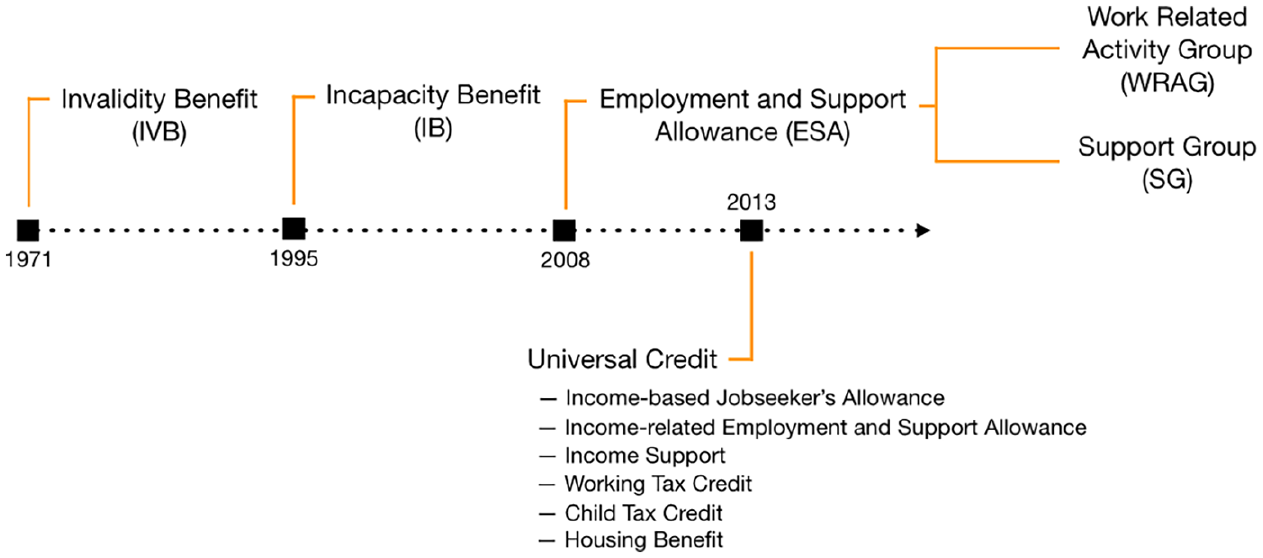
Changes in support systems for people with disabilities.
Note also that the support system for people with disabilities must include their families and carers. In complicated cases, family members take on the burden of caring for people who are bedridden or in need of constant care. It should not be forgotten that people with disabilities are themselves often carers for other household members, thus providing care and being – indeed – ‘doubly’ unrecognised by the welfare system. Here, we come to the issue of unpaid domestic work – most often done by women (Federici 2012: 115–125) – care work, emotional labour, community projects and rehabilitation (Blattner 2021: 18; see also Dellve et al. 2003; Reisine & Fifield 1988; Turner et al. 2017) as well as the institutional support of the carers of people with disabilities; in general, ‘the employment gap between people with and without disabilities is still significant’ (Blattner 2021: 9; Bruyère et al. 2016). Considering paid work as the primary determinant of stratification position also applies to people with disabilities, as their role in the labour market determines their social and political situation. This is closely related to the education system, the social perception of disability and the neoliberal requirement of resourcefulness (as presented by the architects of New Labour – ‘no rights without responsibilities’). In the United States, for example, [n]early half of prime-age adults who live in poverty have one or more disabilities, far above the national average, and the poverty rate for working-age people with disabilities is nearly two and a half times higher than for those without disabilities. (Birnel & Day 2018)
The authors noted, ‘[t]he reasons are complex, but suffice to say that causation runs in both directions: being poor can increase the likelihood of becoming disabled, and being disabled can increase the likelihood of being poor’ (Birnel & Day 2018). With the latest data from the Family Resources Survey: Financial Year 2020 to 2021. In the United Kingdom, it was already known two decades ago that earnings for men with disabilities are 25% lower than for their non-disabled counterparts. The differences are even more significant when the situation of women is taken into account (Burchard 2000). Kirk-Wade 2022 indicating that 14.6 million people have a disability (representing around 22% of the total population), it is clear that this phenomenon has enormous social implications. Especially in the context of social reproduction, which draws attention to ‘an unequal sexual division of labor and the traditional expectations concerning women’s role in the family and society’ (Federici 2012: 124). In other words, the phenomenon of disability is not only about people in need of support, but also about unpaid care provided most often by women in households (including migrant women or women deprived of social security because their work is unrecognised in the capitalist system that – as Harman (2010) pointed out – ‘creates periodic havoc for all those who live within it’ (p. 85)).
From (innocent) semantics to (brutal) conditionality
To explore the consistent plan to subject people with disabilities to the rigid requirements of neoliberal labour regimes, at least some of the legal changes introduced must be traced. What we propose to call welfare scarcity in the context of the phenomenon of disability initially started to take form through seemingly minor and innocent semantic changes in legal acts. This aspect was fully perceived and described by Guy Standing (2014), who nota bene classified people with disabilities as precariat and denizens, which strongly corresponds with the welfare scarcity proposed here. The British economist stated, Disability policy has also been subject to linguistic manipulation, intended to shift imagery away from rights to moralistic demands. Thus the British government abolished the term ‘benefits’ in favour of ‘allowances’; then ‘disability living allowance’ became ‘personal independence payment’ (PIP). Entitlement is not based on a person’s condition but on how it is supposed to affect him or her, enabling policymakers to tighten conditions and reduce eligibility. (Standing 2014: n.p.)
These seemingly insignificant linguistic transformations – which make sense even in the context of replacing ‘benefits’ with ‘allowances’, as they eliminate the pejorative connotations of the former – ultimately proved to be a veritable Trojan horse of the neoliberal conditionality offensive. In this sense, Susan George’s (1999) bitter words about how ‘the ideological and promotional work of the right has been absolutely brilliant’ take on even greater significance. The socio-political researcher also explained neoliberalism’s success: ‘They have spent hundreds of millions of dollars, but the result has been worth every penny to them because they have made neo-liberalism seem as if it were the natural and normal condition of humankind’ (George 1999: n.p.). The acceptance of the guidelines of neoliberalism as ‘the natural and normal condition’ at the level of general human relations paved the way for changes in the treatment of the most vulnerable groups in society (particularly due to the structural determinants of the social system and its mechanisms of labelling, stigma and prejudice, and not the phenomenon of disability itself). Now the latter, which include people with disabilities (an internally heterogeneous group, including both profoundly learning-disabled people who require constant care and people who are independent although, for example, with limited mobility), could be held responsible for their social welfare. The ‘natural’ instruments for this purpose are employability and the labour market, and the usefulness of these ‘linguistic manipulations’ makes complete sense. In the British case, note also that no differences exist between the main political parties concerning the treatment of people with disabilities. Therefore, the scope-widening welfare scarcity (with its detailing of antisocial social policies) seems better suited to explaining the changes in disability social policies than Paul Pierson’s (1996) welfare state retrenchment based primarily on ‘political shifts to the right’ (p. 145). In the following passage, Guy Standing exposes not only the position of the formal opponents of the right but also the hypocrisy of their arguments: For two decades the main UK political parties have adopted a similar ideological position towards disabled people. The New Labour government set a ten-year plan to cut one million from the 2.8 million receiving disability benefits, arguing that more people should be pushed into jobs. It replaced the ‘sick note’ with a ‘fit note’, making local general practitioners (doctors) part of the social policy apparatus. The Secretary of State for Health said: ‘We know that being in work can be good for your wellbeing’ (ME Association 2009), a glib generalisation epitomising the labourist prejudice. (Standing 2014: n.p.)
Regardless of the governing option, both the Tories and Labour have consistently introduced creeping changes within disability legislation in the United Kingdom for almost two decades (cf. Dwyer 2004). These changes are intentional and move in one direction – namely, the recognition of disability as ‘the corporeal requirements of the labour process, providing the broad context within which evaluations are made and the basis on which many social policies operate’ (Matthews 2021: n.p.). This is why semantic issues are important: changing the words also changes their connotations and, above all, the general social attitudes towards people with disabilities. After all, ‘who is considered disabled is bound up with the welfare state’s role in regulating and reproducing the supply of labour’ (Matthews 2021).
Owing to these seemingly innocuous changes in terms, a new system of conditionality is emerging that completely changes the way support for disabled people has worked to date. Table 1 summarises four groups of people within the UK welfare-to-work scheme with high levels of conditionality for those potentially excluded or at risk of social exclusion.
Workfare conditionality in Britain.
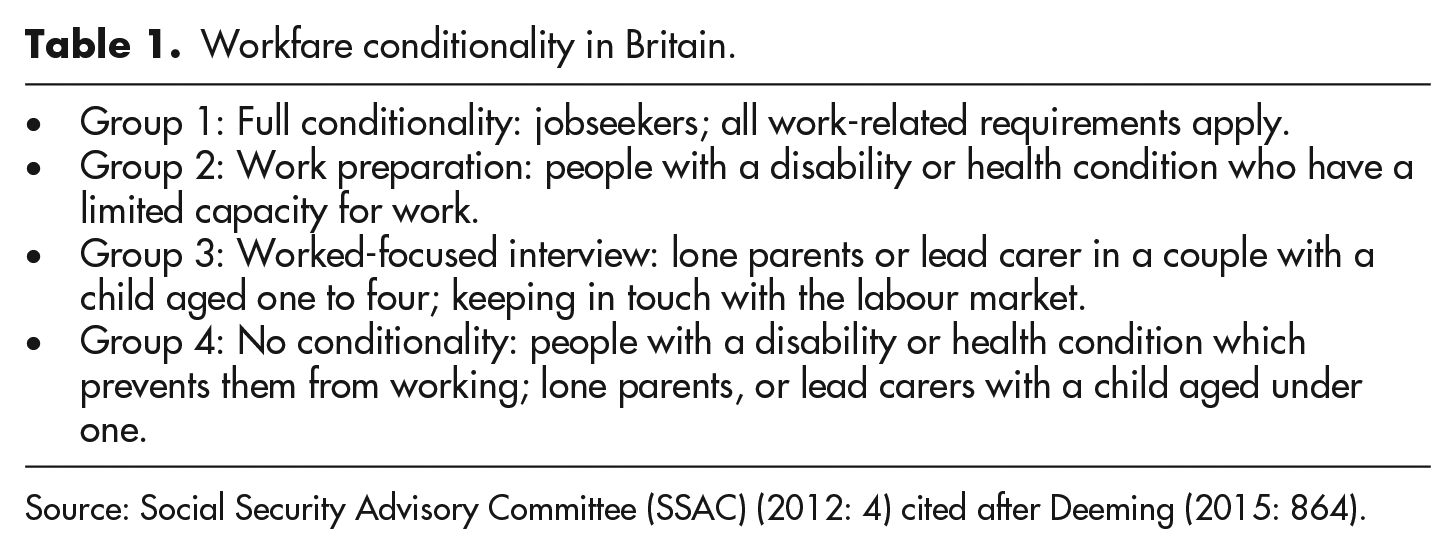
Source: Social Security Advisory Committee (SSAC) (2012: 4) cited after Deeming (2015: 864).
At first glance, we have quite precisely defined the social groups categorised into specific conditionality types, within which particular expectations have been formulated. People with disabilities or health conditions are found in groups 2 and 4; within the latter, no special conditions must be fulfilled. In addition, it is to be understood as a certificate of incapacity owing to a disability or health condition. This is where another problem arises, as genuine changes followed the ‘semantic revolution’ in the medical assessment system of health conditions. As part of the spirit of neoliberalism, the institutions of disability assessment have been privatised. British researchers have noted that ‘the delivery of WCA is outsourced to private sector organisations; initially ATOS and since 2015 Maximus’ (BBC 2014; Hansford et al. 2019: 352). However, these researchers did not add that Atos introduced a controversial computerised test used to judge claimants’ ability to work, resulting in a situation where ‘three-quarters of claimants who applied for sickness benefit were found fit to work or abandon their claims before completing their medical assessment’ (Mulholland 2011). A Facebook group called Atos Miracles was also formed that ‘ironically celebrated the apparent miraculous cure achieved by those assessed and found to be fit’ (Ryan 2019: 49).
Note that according to Allegra Stratton (2011), citing a study for Compass, ‘up to 500,000 people have been wrongly judged fit for work and disallowed incapacity benefit over the past 15 years [1996–2011 – M.B.]’.
Ellen Clifford (2020) in The War on Disabled People pointed out, ‘the root of the problem lies deeper than with the respective outsourced providers – at the level of the fundamental intention and design of the system’ (pp. 87–88). Privatisation is one of the many elements of the conditionality machine that has been created, to which should be added, among other things, the closure of Remploy factories that employed people with disabilities or the complex system of penalties for failing to comply with training, visits or calls to officials called general practitioners (GPs). Concerning the latter, it is worth turning attention to the accounts of people with disabilities themselves (cf. Hansford et al. 2019; McNeill et al. 2017).
System of social welfare conditionality against persons with disabilities
The systematically expanded system of conditionality of social welfare institutions, accompanied by an offensive in the media and political pronouncements, began to include people with disabilities (Darke 2004; Hall 2019; Sayce 1998). Legal changes – first semantic and then practical – and the privatisation of some services enabled the implementation of a complex system; the United Nations Special Rapporteur stated that ‘the UK welfare system’s shift to focusing on “getting people into employment at all costs” is bringing “misery,” and that welfare reform policies “negatively impact many claimants’ mental health”’ (Alston 2018: 5; see also Hansford et al. 2019).
Figure 2 presents the formal scheme of the introduced ESA system. Even in its graphical form, the implemented system seems to be complicated, yet practice usually differs from the theoretical assumptions of officials. Moreover, this bureaucratic ‘journey’ involves people from disadvantaged, vulnerable groups, who often need help themselves (for more on ‘bureaucratic technologies’, see Graeber 2015).
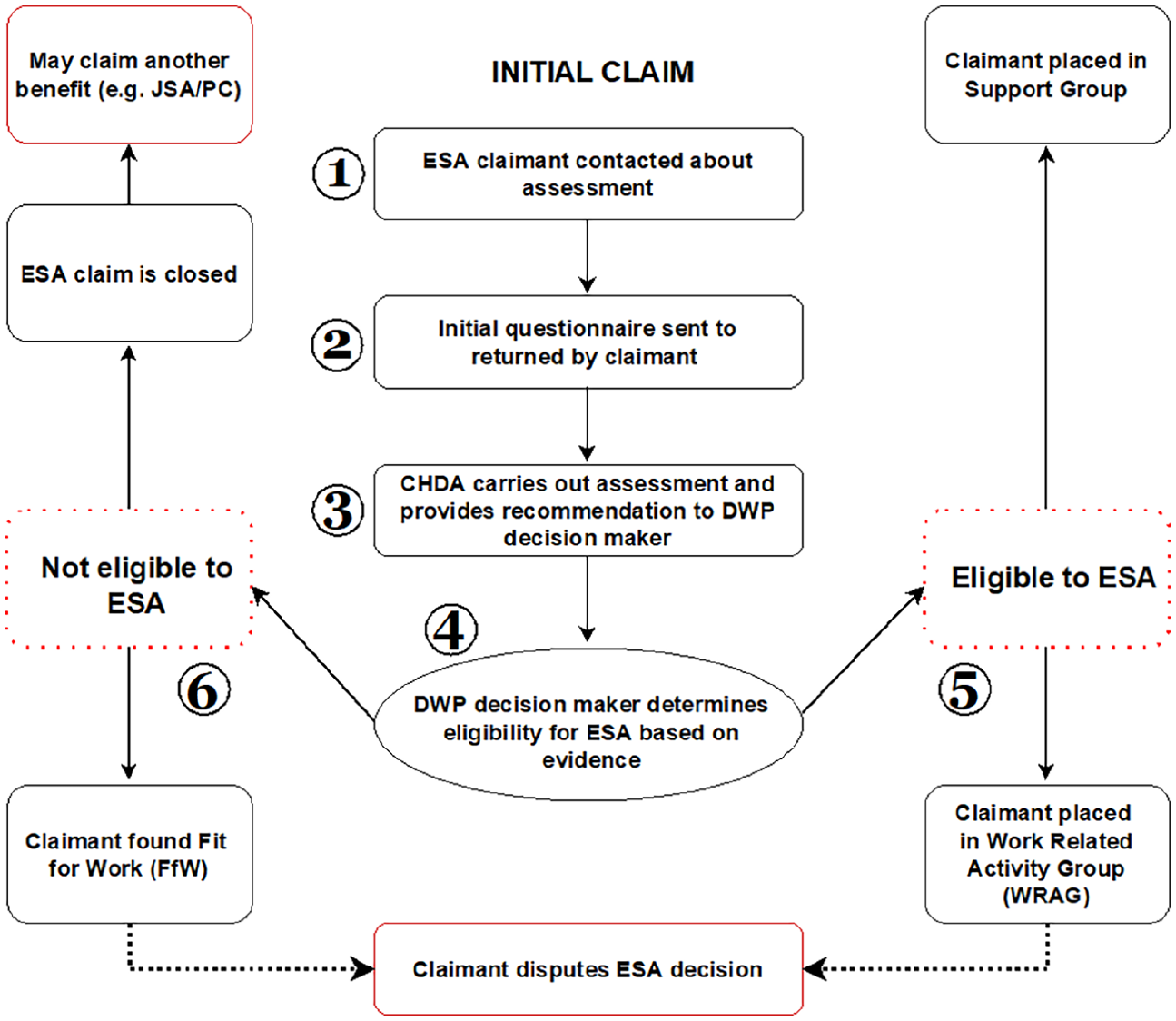
Employment and Support Allowance new claims customer journey.
However, what is most relevant to ESA is invisible in this scheme; ‘emerging qualitative work suggests the UK disability welfare reforms risk worsening wellbeing and increasing the stigma attached to benefit receipt’ (Curnock et al. 2016: 2; see also Garthwaite 2014, 2015; Patrick 2011). As Steven pointed out, at the time of the interview, the 32-year-old was recovering from numerous operations: I’m on ESA now and I’ve won the case, so I’ve got a 12-month period, but I have to come into this place here which, to be fair, I find pointless. It’s just they never leave you alone. They’ll try everything. If they don’t get a letter on time, if they don’t get a phone call, they’ll stop your benefit, and it’s wrong. (McNeill et al. 2017: 180)
Such examples can be multiplied to show the dysfunctional and oppressive nature of the system created, to which the term ‘welfare scarcity’ fits. After all, how else can one explain a situation in which people are deprived of their livelihoods if, owing to surgery, falling into a coma or being in a psychiatric hospital, they are unable to attend a GP appointment? In 2017, Iain Duncan Smith, former work and pensions minister and the architect of Universal Credit and personal independence payment, himself stated that the work capability assessment is ‘too harsh’ (Benefits and Work 2017). Universal Credit, introduced in 2013, is intended to be an innovation within the United Kingdom’s welfare agenda. Its link to the work regime is not in dispute, as its fundamental purpose is to help to ‘ensure that people are better off in work than on benefits’ (Universal Credit 2013).
Nevertheless, an analysis of government expenditure on disability living allowance in the United Kingdom between 1992/1993 and 2022/1923 clearly shows that reductions in budget spending began in 2014, by coincidence just after the introduction of Universal Credit (Figure 3). For the last 8 years, disability living allowance benefits have seen drastic reductions (expenditure reductions have reached almost three times the amount of 2014/2015).
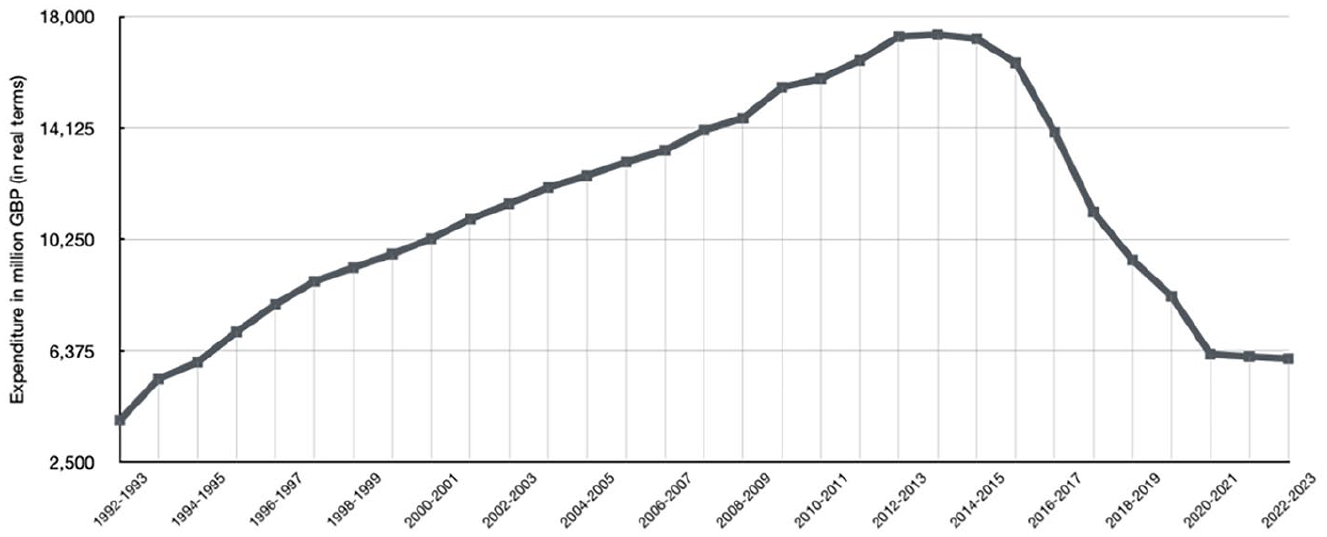
Government expenditure on disability living allowance in the United Kingdom from 1992/1993 to 2022/2023 (in million GBP).
Expenditure precisely on disability benefits is of particular interest, as it can serve as an indicator of the effectiveness of the changes in the approach to disability described above from a work regime and conditionality perspective. Official data indicate that the employment of people with disabilities increased by 2.2 million from March 2014 to March 2023 (Annual Report & Account 2022–23 2023: 39). Therefore, overly harsh solutions have perhaps achieved their intended objectives – that is, a reduction in the number of people receiving disability benefits (cf. Standing 2014: n.p.).
Conclusion and discussion
According to WHO (2021), ‘the number of people with disability is dramatically increasing’ due to ‘demographic trends and increases in chronic health conditions’. Although this article focuses on the United Kingdom as an ‘exemplary’ illustration of the welfare-to-work model, note that ‘over 1 billion people are estimated to experience disability’, which ‘corresponds to about 15% of the world’s population, with up to 190 million (3.8%) people aged 15 years and older having significant difficulties, often requiring health care services’ (WHO 2021). Indeed, the legal standards and social security systems of countries with less-developed economies than the United Kingdom potentially put increased pressure on people with disabilities.
In this context, note also the US Personal Responsibility and Work Opportunity Reconciliation Act of 1996, after the signing of which President Clinton (1999) stated, ‘this legislation provides an historic opportunity to end welfare as we know it and transform our broken welfare system by promoting the fundamental values of work, responsibility, and family’ (p. 1329). This shows that the pressure towards conditionality goes far beyond the United Kingdom (cf. Clasen 2011; Etherington & Ingold 2012; Getman et al. 2023).
Disability activation processes, although presented in this article in a negative light based on UK legal developments and practices, also have a number of positive sides (insofar as they work in the interests of disadvantaged groups and pursue the emancipatory goals of the social inclusion of people struggling with health problems). However, as Steven Graby (2015) noted, ‘the “work ethic” has been mobilised by neoliberals and neoconservatives in government and the mass media to justify the cutting of vital support systems for disabled people, who are being demonised as “workshy,” “scroungers,” etc (p. 132)’. Furthermore, note that in papers published as long as three decades ago, especially in countries with long traditions of a conditional welfare state, authors emphasised that ‘the disabled population has a dismal employment record’ (Oi 1991: 31), which in fact took the form of claims about ‘the increased generosity of disability transfer payments’ (Parsons 1980, as cited in Leonard 1986; Oi 1991: 33). All of this was building the foundations for more radical changes that, over time, extended to the ‘quiet minority’ (Standing 2014: 254). I propose to place the changes described in this article within a broader trend called welfare scarcity, as they are systematically implemented through conditionality in welfare benefits; as Watts et al. (2014) noted, ‘the scope and scale of behavioural forms of conditionality, as well as the severity of the sanctions applied for failure to comply with the required conduct (e.g. attending appointments with employment advisers), has increased substantially since the 1980s’ (p. 3).
The system’s effectiveness is tested by the form of support for the most vulnerable social categories, and people with disabilities are the best example. The standards analysed here clearly show the direction of the changes being implemented: the movement towards conditionality, which, based on the model of the Poor Laws, enforces – in many cases absurdly ridiculous – economic activity within the framework of neoliberal labour markets. This activity does not even pretend to realise the principles of social welfare; on the contrary, it is part of the consistently implemented procedures of welfare scarcity, the aim of which is increasing the objectification, commodification and stigmatisation of the ‘recipients’ or ‘beneficiaries’. It is a situation, as Chris Harman (2010: 139) described it, that ‘public expenditures become a central focus for class struggle in a way in which they were not in Marx’s time’ (p. 139).
The changes described in the British welfare system are destroying the social fabric through a neoliberal logic that, let us add clearly, has no hard financial justification (cf. Standing 2014) but only pursues surveillance and disciplinary and stigmatising objectives. Social cohesion is being destroyed, and producing a new cohesion that includes people with disabilities will take decades. New approaches based on a critique of existing antisocial arrangements are being proposed, including the recent publication of Transforming Support: The Health and Disability White Paper (2023). However, from the perspective of welfare scarcity, while correcting ‘harsh’ solutions, even these new proposals aim to ‘help more disabled people to start, stay and succeed in work’ (Transforming Support: The Health and Disability White Paper 2023: 5).
