




Abstract
The trade union bureaucracy debate has significant implications for both analysis and union strategy. Recently receiving renewed academic attention, this debate centres around whether there is a dichotomy between rank-and-file workers and full-time union officials, and whether these officials – the trade union bureaucracy – tend towards industrial conservatism. The case study of labour relations in the Pilbara iron ore industry in the north of Western Australia 1965–1986 enriches our analysis of the trade union bureaucracy by viewing its role in the class struggle over a number of decades, in varying contexts of union development, union power and union decline. Throughout this entire period, there was significant conflict between the bureaucracy and rank and file. The remoteness of the Pilbara region, and workers’ industrial militancy makes it an extreme case suited to unveiling insights on the nature of the trade union bureaucracy. The Australian focus broadens a largely British debate. This article also offers a greater consideration of the role of full-time shop stewards’ convenors than has occurred previously. Finally, the trade union bureaucracy theory illuminates our understanding of this period in Pilbara labour history.
Keywords
Introduction
Intra-union relations help shape union strategy and the outcome of industrial disputes. Union officials – the trade union bureaucracy – tend to be a conservatising force in industrial relations. As negotiators between capital and labour, they form a separate social layer to workers. This forms the core of the theory of the trade union bureaucracy and rank and file. This has long been an important, if minority, framework used by radical scholars to analyse industrial disputes, as well as informing the union activity of many activists. 1 It is also a controversial one, with critics who deny the existence of a dichotomy between the union bureaucracy and rank-and-file unionists, or a conservative tendency among union officials. This debate between supporters and opponents of the theory goes back decades but has recently been renewed (Darlington & Upchurch 2012; McIlroy 2014). This article contributes to this discussion, arguing in support of the theory of the trade union bureaucracy by deploying the case study of labour relations in the Pilbara iron ore industry in the north of Western Australia 1965–1986.
This case also enriches our analysis of the trade union bureaucracy by viewing its role in the class struggle over a number of decades, in varying contexts, something that very few studies have done. This better allows us to view the role of the union bureaucracy in all its complexity, rather than focus mainly on its role in one strike (important as that is). Workers’ industrial militancy and the geographical isolation of the Pilbara helps to draw out insights regarding the trade union bureaucracy. Furthermore, it offers a greater consideration of the role of full-time shop stewards’ convenors, who have not been sufficiently dealt with in previous research. It broadens the arena of debate by applying the theory to a non-British case and considering Australian literature engaging with the theory. The application of this theory also illuminates our understanding of this period in Pilbara labour history.
The conservatism or moderation of union officials is evident irrespective of the circumstances of the workplace, and applies both to demands sought of employers, and the means to obtain those demands. This is because the union bureaucracy is an intermediate social layer – neither worker nor boss – which negotiates the sale of labour power and resolves disputes between workers and employers. Union officials work for the union, not the employer, so are not subject to the workplace conditions of the members they represent. The union bureaucracy seeks to defend the perceived interest of the union as an institution, placing a high value on industrial legality. By contrast, workers use unions as a tool to win their demands. The union bureaucracy and rank and file have differing, if overlapping, interests.
This article begins with a review of the literature, before applying the theory to the case study of trade unionism in the Pilbara iron ore industry in the north of Western Australia from 1965 to 1986. During this period, there were significant changes in trade unionism during three phases: union development, union strength, and the beginnings of de-unionisation. Throughout all phases, there were significant divisions between the union bureaucracy and the rank and file. The article concludes by assessing the merits of both supporters and opponents of the trade union bureaucracy theory, including by discussing the role of convenors.
Literature review
An academic debate on the trade union bureaucracy which had lay dormant since the 1980s has recently been renewed. Marxist industrial relations scholars Ralph Darlington and Martin Upchurch (2012) set out and re-affirmed the theory in a 2012 article, prompting criticism from John McIlroy (2014). This literature review engages with this most recent debate, contextualising it in the earlier work of both opponents Edmund Heery and John Kelly (1990) as well as supporters of the theory such as Tom Bramble (1993a, 1993b, 2005). 2
Key advocates of the trade union bureaucracy theory
Tom Bramble, Ralph Darlington and Martin Upchurch are the key Marxist academics who have written in support of the theory of the trade union bureaucracy and rank and file. Broadly speaking, the article shares these authors’ approach. The trade union bureaucracy is argued to form a separate social layer to workers with different interests to rank-and-file union members (Darlington & Upchurch 2012: 80). This bureaucracy possesses a ‘contingent conservatism’ (Bramble 1993a) both in the demands sought from employers, and the methods desired to achieve these demands. This layer is neither an employer of labour, nor is it exploited by capital. The position of union officials as professional negotiators makes them subject to pressures from both sides of the class divide (Darlington 2014a: 11), as well as from the capitalist state. Their conservatism, therefore, is not an iron-clad law, but rather a tendency to some degree ‘contingent’ on ‘the pressure placed on them by members’ (Bramble 1993b: 42). Overall, however, they are ‘a moderating force in class relations’ (Tierney 2017: 540).
The bureaucracy has an interest in achieving some results for its members and in the continued viability of the union itself (Bramble 2005: 75). This concern is for the continued existence of the union as an institution and for its own sake, not simply as a tool for winning change. The phenomenon can work both ways. It can act as a disciplining factor in that ‘going too far’ can open the union to de-registration from the state and union officials’ role as negotiating partners. However, anti-union attacks from employers or governments, or pressure from below, can lead to union officials sanctioning industrial action (Darlington 2014a: 11). The union bureaucracy are not agents of the capitalist class. Union officials have agency and act with a degree of autonomy from all actors with whom they deal: workers, employers and the state. They also differ among themselves in strategy, tactics and political sympathies. However, as Bramble (2005) has argued, ‘despite these differences, the structural position of trade union officials within capitalism sets limits on even the most militant of them’ (p. 77).
Bramble, Darlington and Upchurch’s arguments regarding the social role of union officials, and their bargaining function, relates to union officials’ position as mediators, negotiating between capitalism’s two opposing social classes. The union bureaucracy also has access to information, financial and other resources of the union, giving them a degree of power over the membership. The authors also refer to the relationship of the union bureaucracy with social democracy as an influencing factor.
These authors vary slightly with respect to who makes up the union bureaucracy. Darlington and Upchurch (2012) include local officials such as union organisers but write that their article ‘is primarily concerned with the few dozen individuals who are the principal national officials of the larger unions in Britain’ (p. 3). Elsewhere, Darlington (2018) refers mainly to national officials: ‘a conflict of priorities/interests between reps, activists and members, on the one hand, and full-time national union officers’ (p. 628); ‘the problem of bureaucracy is not only rooted in the interests of a specific layer of full-time national union officers’ (p. 628), but ‘potentially conflicting priorities/interests between union members and full-time national/local union officers’ (p. 627). Bramble (2005: 74), by contrast, argues that the trade union bureaucracy comprises all full-time union employees with a political or industrial role, that is from union organisers right through to national secretaries, and encompassing industrial officers and in-house lawyers and so on.
The role of convenors
Recent scholars using the framework of the trade union bureaucracy give little attention to the role of shop stewards’ convenors and their categorisation as part of the trade union bureaucracy or rank and file (Bollard 2010; Darlington & Upchurch 2012; Tierney 2017). The full-time nature of the union role for some convenors could suggest that they are part of the bureaucracy. However, the fact that they are paid by the company and can have their privileges withdrawn by it points to them being considered part of the rank and file. Notably, convenors can be sacked or made redundant by management, whereas union officials cannot.
Advocates of the trade union bureaucracy theory writing in the late 1970s and early 1980s were ambivalent as to whether convenors are part of the union bureaucracy or rank and file. Political theorist Alex Callinicos (1982: n.p.; italics mine), contended that a large increase in the number of full-time shop stewards in the late 1970s had extended ‘the trade-union bureaucracy down into the workplace, creating within shop-floor organisation a layer of stewards isolated from the workers they represent’, though added that’ [N]ot only are ‘even full-time stewards normally subject to election and re-election, they are liable to victimization by management . . . and will lose their jobs if their plants are closed. All this sets them apart from union officials’ (Callinicos, 1982: n.p.). Marxist author and activist Tony Cliff (1979: n.p.) writes that ‘The position of full time convenors is not identical with that of full time union officials. But quite often there is a greater similarity between these two categories than between either of them and the rank and file workers’. Dave Lyddon (1977), a former car worker and industrial relations scholar, writes of full-time convenors being incorporated by management in a corporatist ‘workers’ participation’ scheme at the car firm British Leyland in the 1970s. He considers the scheme to have ‘helped create an “elite” among the shop stewards’ (Lyddon 1977: n.p.) where convenors are paid by the company and provided with phone and office facilities.
Opponents of the theory
Following Richard Hyman (1979), McIlroy (2014) sharply rebutted Darlington and Upchurch, contending that there is no fundamental dichotomy between the bureaucracy and the rank and file, as bureaucracy pervades the whole trade union movement from top to bottom. McIlroy (2014) writes that bureaucracy is ‘intrinsic to trade unionism’ and ‘infuses its organisation and practice and inevitably, if differentially, affects all those undertaking, or ancillary to, representative functions’ (p. 514) but also argues that ‘its greatest pressure is on professionals: leading officials, national, regional and local staff and full-time executive members’ (p. 514).
McIlroy (2014) sees division between the bureaucracy and rank and file only in times of crisis: Theory claims, and history confirms, that outside a developing crisis, and emergence of an influential revolutionary party, experience of exploitation does not significantly contribute to a division within trade unionism with the bureaucracy on one side and members and stewards – some of whom daily confront bureaucratic pressures at work – on the other. (pp. 516–517)
Jonathon Zeitlin (1989) also argues that scholars ‘. . . of a “rank-and-filist” bent were naturally attracted to the more turbulent periods of British labour history . . .’ (p. 43) as they ‘celebrated shop steward organization, informal bargaining and unofficial strikes’ that occurred in the 1960s and 1970s when they were writing.
McIlroy (2014) also argues that the theory of the trade union bureaucracy ‘. . . misunderstands the imbrication of leaders’ personal interests with organisational interests . . .’ (p. 497). For McIlroy (2014), the ‘reformist practice and economistic consciousness’ generated by trade unionism itself is the primary problem, ‘although its leading functionaries remain a subordinate problem’ (p. 497).
McIlroy (2014) states that advocates of the theory view trade unionism as ‘characterised by an embedded conflict of interest between a conservative, privileged bureaucracy and a militant, radical rank and file’ (p. 497). Edmund Heery and John Kelly (1990) have also critiqued the theory using evidence from interviews and observation of union meetings from 1985 to 1987, which show some union officials expressing more militant views than members.
Application of the theory
Case studies have mainly applied the theory to large strikes (e.g. Bollard 2010; Tierney 2017). Historian Robert Bollard (2010), for example, draws out the dichotomy between the union bureaucracy and rank and file during the 1917 great strike in Australia, where officials of both the left and right left played a conservative role. (Interestingly, in that era, trade union officials were not full-time union employees.) An exception is Bramble’s (1993a, 1993b) research on the Vehicle Builders Employees’ Federation, representing unskilled car workers in Australia, from 1963 to 1991. In the early 1960s, a conservative, bureaucratic, and predominantly Anglo-Australian union leadership were out of touch with the largely migrant workforce. Throughout the late 1960s and 1970s, largely migrant shop stewards usurped much of the union bureaucracy’s negotiating role. The 1980s saw a ‘counteroffensive by management and the VBEF leadership’ against militant shop stewards. In all these periods, a significant division between the bureaucracy and rank and file was on display, though much of the period under discussion cannot be called ‘turbulent’ or seen as a ‘crisis’ situation. Bramble (1993a: 28) does, however, view periods of large-scale industrial action as ‘especially’ encouraging conservatism among the union bureaucracy and militancy among the rank and file. It is of note that in this study, union officials did not play a progressive role in any of the historical periods, unlike in the Pilbara (discussed further below).
The literature shows that the long-standing, recently reignited debate centres around two interrelated questions. First, the existence of a dichotomy between the trade union bureaucracy and rank and file and second, whether the union bureaucracy tends towards conservatism in the industrial sphere. Most contributions either analyse a single strike, or else are entirely theoretical. Very few analyse industrial relations over a longer time span. Most of the debate has occurred in the United Kingdom; this literature has largely not engaged with Australian scholarship. Finally, the question of convenors is under-theorised.
Method
The case study chosen – the rise and fall of trade unionism in the Pilbara iron ore industry – mirrors the fortunes of Australian trade unionism more broadly, but in an exaggerated and time compressed way. The 1970s in Australia was a period of union strength, but Pilbara miners were among the most strike prone in the country. Union power and density declined throughout the 1980s and 1990s in Australia, but the 1986–1987 Robe River dispute in the Pilbara was one of the earliest attempts at attacking unions in this period. Today, union density in the industry is well below the Australian average, and management’s authority is unchallenged. This case study offers insights into the trade union bureaucracy as the decisions of union officials – and the often tense interaction between officials and grassroots unionists – is central to the story of union development, union strength and union decline. The remoteness of the region added to the distance between union officials and the rank and file, quite literally. The time period involved – roughly two decades – allows us to interrogate bureaucracy-rank and file relations in a number of different industrial contexts.
Data for this case study were collected using document analysis and interviews. Documents include Trades and Labor Council of Western Australia (TLC) archives and archives of the Australian Manufacturing Workers’ Union (AMWU) and the Electrical Trades’ Union (ETU). The union press, popular press and business press were all used. The main sources were the journals for the ETU and the AEU (predecessor of the AMWU), 3 the West Australian, the daily newspaper for the state of Western Australia, where the Pilbara region is located, and the Australian Financial Review. I conducted 22 semi-structured interviews with former union officials, shop stewards and convenors, as well as a manager and an academic. The sample chosen was deliberately weighted towards rank-and-file unionists, as their voices are underrepresented in official documents and institutional studies. The majority of interviewees were former shop stewards or convenors or had been both a shop steward and convenor. I have also used a set of existing interviews with Pilbara industrial relations stakeholders, mainly conducted by Stuart Reid in the early 1990s. 4 Twenty of these interviews cover the period from late 1960s to the 1980s, and include convenors, foremen and managers from Goldsworthy and Hamersley Iron, and union officials. They have a higher proportion of convenors, managers and union officials than my sample, but do not include shop stewards. I have also listened to 17 interviews Reid held with participants during the Robe River dispute itself, with shop stewards, convenors, union officials and women activists.
Case study – Pilbara iron ore unionism
The Pilbara region is a vast, remote region in the north west of Australia. It is roughly 500,000 square kilometres, around the size of Spain, and is over 1,200 kilometres from Perth, the capital of Western Australia. Yet, this region holds major significance to the Australian economy. Iron ore exports from the region amounted to 39% of global supply in 2018 (Chamber of Minerals and Energy of Western Australia 2024). Tonnage and export income have continued to increase in value from the establishment of the industry, most dramatically from the mid 2000s (see Figure 1). Industrially, however, the region has been transformed from a union stronghold in the 1970s and 1980s to having minimal union presence today. Union density is now estimated only at 5% (Ellem 2017: 8) compared to 14% Australia-wide across all industries and 13% in the mining industry (Australian Bureau of Statistics 2020).
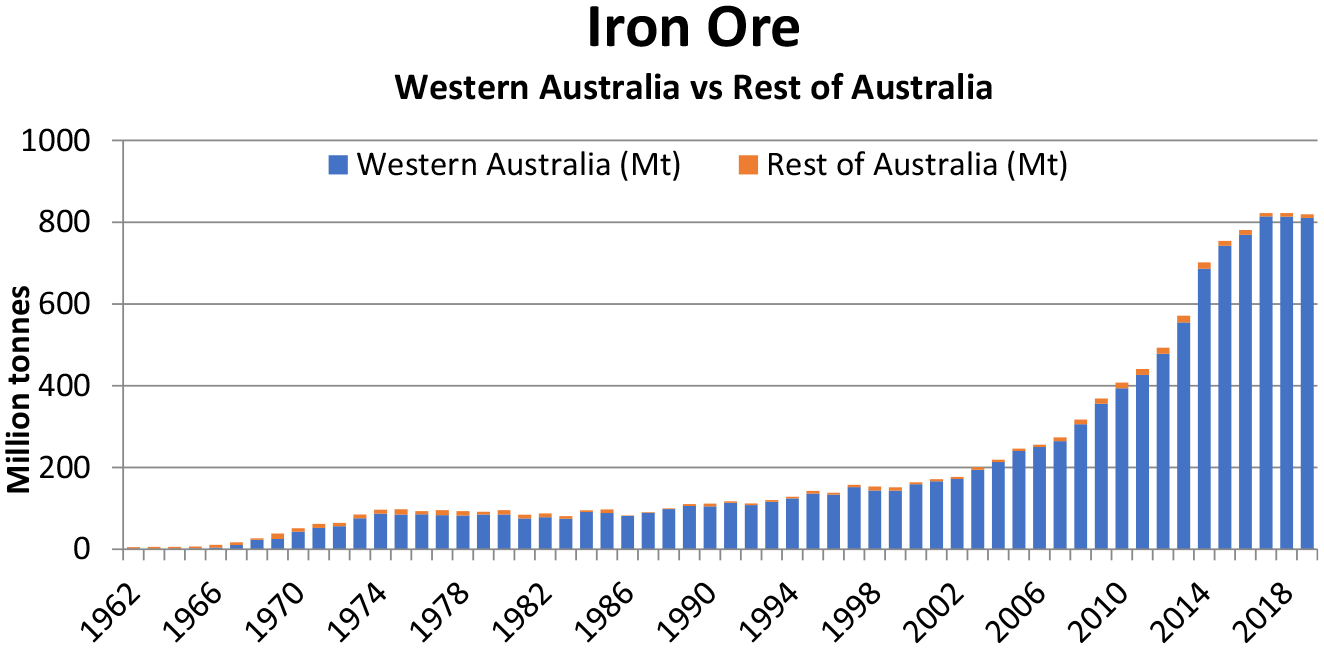
Iron ore exports – Western Australia versus rest of Australia.
The remoteness of the Pilbara region and the high levels of strike days make it an extreme case suited to unveiling insights on the nature of the trade union bureaucracy. As Flyvbjerg (2006) argues, Atypical or extreme cases often reveal more information because they activate more basic mechanisms in the situation studied. From both an understanding oriented and action oriented perspective, it is often more important to clarify the deeper causes behind a given problem and its consequences than to describe the symptoms of the problem and how frequently they occur. (p. 229)
The localised grassroots structures and industrial militancy exacerbated existing features of the union bureaucracy/rank-and-file relationship.
While the region was known for many years to have large deposits of iron ore, a ban on iron ore exports prevented this from being exploited until this was lifted in 1960, leading to a period of rapid development. By 1972, four iron ore companies were operating: Mount Newman Mining (now BHP), Hamersley Iron (now Rio Tinto), Goldsworthy Mining and Cliffs Robe River Iron Associates (now Rio Tinto; Tracy 1994: 17–18). Four main unions operated from the 1960s to the 1980s. The Australian Workers’ Union (AWU) was the largest, with just under 50% of the workforce. They covered ‘unskilled’ workers and are right-wing politically. The Australian Manufacturing Workers’ Union (AMWU) covered around 20%. Representing boilermakers’ and fitters, this was a more militant and left-wing union, with substantial communist influence in the national leadership. The Electrical Trades’ Union (ETU) and Federated Engine Drivers and Firemen’s Union (FEDFU) both represented around 10%–15% of the iron ore workforce (Lovett 1980: 52). The latter union, representing train drivers and crane operators, had a reputation as a craft-based, and very sectional union. From 1967, union membership was compulsory, but struggles had to be fought in the late 1960s and early 1970s – and at Robe River, even later – to ensure that this was adhered to (Vassiley 2018: 124–125). Australia’s industrial relations system features compulsory arbitration. This compels employers to recognise registered unions, conferring certain benefits, but conversely acts to discipline union officials with the threat of their union being deregistered should they breach industrial relations legislation (Lansbury and Wailes 2004: 121, 133). Broadly speaking, however, the industrial relations context in the period reviewed was significantly less restrictive for unions than currently.
Phase 1 – 1965–1972 – union development
The union bureaucracy and rank-and-file workers have overlapping, but distinct interests. In the early period of Pilbara iron ore mining labour history, union officials and rank-and-file leaders both played mobilising roles in fighting for union recognition. However, union officials also directed workers to stop striking on numerous occasions, playing a moderating role in class struggle. They encountered significant hostility from workers, demonstrating the dichotomy between the two groups.
The rapid development of a new industry with arduous working conditions provided the basis for the joint mobilising role played by the union bureaucracy and rank-and-file unionists. In a few short years, mining towns were established, thousands of kilometres of railroad laid down, a port built and the existing one at Port Hedland expanded. As many tonnes of iron ore as could be produced would be sold. The union bureaucracy did not want to be cut out of this new industry, realising that gaining a foothold would strengthen their organisations. Unions with their headquarters in the state’s capital Perth, over 1,000 kilometres away, sent Perth-based organisers on weeks-long trips to unionise the industry. They found a welcome reception among workers experiencing authoritarian management, low wages and long hours. While trips to the remote Pilbara region were costly, once shop stewards and combined union committees were established, the sites could largely organise themselves and bring in revenue. Organisers would travel to a mine site, meet with the workers, find out their grievances and get shop stewards elected. Some shop stewards had come to the Pilbara from militant sites in the United Kingdom or Australia’s Eastern states, while others simply felt the need to speak up at the appalling conditions (Vassiley 2018). Strikes and class struggle built union membership and structures.
The formalisation of the shop steward role was opposed by some union officials. The 1969 Iron Ore Award gave formal rights to shop stewards, while circumscribing their role. The companies themselves requested a clause recognising stewards ‘in order to gain some level of formal control over the growing power of the site union structures, particularly at the shop steward level’ (Lovett 1980). Shop stewards gained the right to discuss grievances with management but could not call meetings during work hours or take industrial action while consulting with the company (Lovett 1980: 74). Some union officials were against this limited recognition lest their negotiating role be usurped (Ellem 2017: 39–40; Frenkel 1978: 400). The very structures union organisers had helped establish made it easier for workers to employ a self-confident, grassroots form of unionism which sidelined the union bureaucracy.
The union bureaucracy sanctioned strikes in order to get union structures established, but even in this phase of union development, officials opposed some strikes or tried to wind them down. For example, in September 1969, unionists at Goldsworthy Mining defied both the union bureaucracy and the Industrial Commission, striking for 5 days to successfully re-instate a sacked shop steward (Dust Row Halts Ore Output 1969: 2; Half Yearly Report 1969: 10; Iron Ore Men End Two Strikes 1969: 2). The next month there was a weeks-long strike at another company, Hamersley Iron, where ‘union officials were given hostile treatment by mass meetings of the workers’ (Lovett 1980: 81). These trends accelerated in later years.
Phase 2 – 1973–1986 – ‘union power’
The period 1973–1986 was one of grassroots union power which saw a very conflictual relationship between rank-and-file workers and the trade union bureaucracy. Rank-and-file union leaders – shop stewards and convenors – achieved substantial independence from the officials, whose negotiating role they partially usurped. Workers struck frequently, impinging on managerial prerogative but also the prerogatives of the union bureaucracy. Union officials played a classically moderating role in attempting to wind up strikes.
Rank-and-file unionists played an increasingly important role in formal negotiations with management throughout the 1970s, clashing with union officials. In the 1974 negotiations involving all four iron ore companies, grassroots unionists were minor participants but reportedly would repeatedly pass notes to union officials who ‘felt inhibited by the presence of site union reps and that their bargaining positions had been compromised’ (Lovett 1980: 91). The following year, Mount Newman workers cost the company AUS$400,000 in lost production when they struck to demand more representation for shop stewards’ convenors on the negotiating committee (2000 Newman Men Stood Down 1975: 3). In 1977, grassroots unionists imposed their will on management and the union bureaucracy. Workers took strike action to successfully insist that award negotiations would take place company by company, not a united front of the four companies favoured by union officials.
The 10-week 1979 Hamersley Iron strike was initially organised entirely by the rank and file, who refused to let the union bureaucracy participate in negotiations or strike organisation (Thompson & Bartlem 1980: 26). The recollections of union convenor Harry Hoskin give a flavour of the rank-and-file/bureaucracy relationship. Hoskin recalls a mass meeting where an AWU official was remonstrating with workers, noting that that Hamersley Iron had ‘eight ships out on the harbour’. Hoskin (Interviewed by author, 17 May 2018) took the microphone and said, ‘Charlie are you working for us or working for Hamersley f-ing Iron? . . . We don’t care if there’s 80 ships in, the more the merrier. Your job is to negotiate on our behalf’. Well, I got a standing ovation [laughing] . . . After the meeting Charlie came up and got a hold of me, he said ‘What was that all about?’ I said, ‘Oh well sometimes you’ve got to be given a bit of a prod Charlie’.
Workers established the position of full-time convenors, paid by the company, but fully engaged on union business, at least for the larger unions on the bigger sites. The arrangement was imposed on management reluctantly (Dufty 1984) and provided an alternative locus of power to the union officials. For Goldsworthy manager Derek Miller (Interviewed by Anne Bloemen, 13 December 1995), the involvement of union officials in industrial relations was ‘a matter of principle’ because ‘there is still a degree of responsibility in state union officials that is not necessary in the local convenor’. Grassroots unionists, then, had an official role in the company, for example, in dispute resolution proceedings and convenors even signed off on industrial agreements.
Strikes again illustrate the rank and file/bureaucracy dichotomy and the tendency to conservatism of union officials. The average Pilbara iron ore worker struck for just over 11 days in 1973, compared with a quarter of a day for the average Western Australian worker (Lovett 1980: 86). These disputes in the Pilbara were overwhelmingly initiated by the rank and file (Dufty 1980: 393). Union officials frequently tried and failed to get workers back to work. As metalworkers’ organiser Colin Hollett told Senior Commissioner Eric Kelly ‘. . . it does not take just today or half an hour for an official to go to site and suddenly convince with rhetoric workers to return to work. It can take a considerable period of time . . .’ (Dufty 1984: 90). Australian Workers’ Union Port Hedland organiser Charlie Butcher told a journalist in 1976 that companies flew union officials to sites with striking workers: ‘We spend our time going from one town to another putting people back to work’ (Juddery 1976). Butcher added that this task that ‘you’d sometimes wonder who we work for, the workers or the companies’ (Juddery 1976). This indicates a more conservative industrial strategy on the part of the officials, and that the union bureaucracy was far more likely to see the company’s side of the argument.
Shop stewards and convenors negotiated and enforced conditions on the shop floor, not the union bureaucracy. The frontier of control shifted towards workers. For example, managers were banned from using ‘the tools’. In the early days of the industry, managers undermined strikes by ‘scabbing’ and carrying out blue-collar tasks. Reflective of the shift in power that had occurred, companies did not adopt this practice during the union power period. (‘Restrictive’) Work practices gave grassroots unionists influence over staffing levels, overtime, the work process and safety matter. Control over work practices was to be the subject of bitter struggle in the 1986–1987 Robe River dispute, discussed below.
Unusually, grassroots unionists also had a degree of financial independence from the union bureaucracy. Darlington and Upchurch (2012: 6) cite ‘financial resources’ as one of the ways union officials exercise power over the membership, as they ordinarily control union finances. In the Pilbara, workers largely counteracted this by paying levies into locally controlled funds worth tens of thousands of dollars, in addition to regular union dues which went to the Perth union offices (Haynes, Interviewed by author, 26 August 2019; Kruger, Interviewed by author, 28 May 2019). These funds were used to sustain workers in weeks-long strikes, to offer solidarity to workers at other Pilbara iron ore companies on strike, to donate to charity (Haynes, Interviewed by author, 26 August 2019), to assist members or their families in hardships or emergencies (Kruger, Interviewed by author, 28 May 2019), and even in support of unionised workers overseas. Rank-and-file unionists could thus call and organise long strikes without agreement from union officials. The large, regular contributions to the fund further demonstrate the commitment and loyalty shown by union members towards local union structures.
The Pilbara’s remoteness enhanced the autonomy of the rank and file from the union bureaucracy and facilitated its militancy. Mining workers not only worked together but lived near each other in mining towns. This close proximity of workers to one another provided opportunities for union organisation and industrial action, and shaped the way this took place. Their shared interests, separate from that of the union bureaucracy, were more easily understood and acted upon when the industrial situation could be discussed not only at work, but at the pub and on the sporting field. Most union officials travelled to the Pilbara by plane from over 1000 kilometres away. They were outsiders, not only to the workplace, but also to the region. Even within the Pilbara, there are hundreds of kilometres between minesites, so each minesite had, in many ways, its own autonomy. The (physical) distance between the union officials and workers exacerbated the pre-existing features of the rank-and-file/bureaucracy dichotomy. There was more tension and distinct interests became clearer. The union bureaucracy was less able to play a mediating, cushioning role as they were further away, less connected with the tight-knit community. Their conservatism became more visible. Most unions did not employ local organisers until the 1970s (the exception here was the AWU’s lone organiser Gil Barr). Yet workers could be hostile even to local union officials (who may, it should be remembered, still have to travel hundreds of kilometres to resolve a dispute), indicating that while remoteness may have exaggerated features of the union bureaucracy/rank and file relationship, it was not this factor alone driving tensions.
The 1983 Prices and Incomes Accord (hereafter ‘the Accord’) partnered the union bureaucracy with the newly elected Bob Hawke Labor Government. This was a corporatist agreement in which Australia’s peak union federation (the Australian Council of Trade Unions) agreed that its affiliates would not strike in return for promises of ‘the maintenance of real wages over time’, policies to reduce unemployment, and an increase in ‘the social wage’ (Bramble 2008: 120). Union officials, in particular, the left of the union bureaucracy, were key to the implementation of the agreement. AMWU official Jack Marks, from a Communist Party background, stated that ‘the current economic policy is not one where Members are able to struggle and make gains in the traditional way’, 5 that is, by industrial action. The well-funded Iron Ore Industry Consultative Council (IOICC) – comprising the iron ore companies, governments and union officials, convenors and shop stewards – was the Pilbara-wide manifestation of the Accord’s tripartite bodies. The union bureaucracy, Labor governments and management consciously attempted to co-opt convenors. Convenors spent days at a time on council meetings which occurred four times a year, and weeks at a time on overseas all-expenses-paid ‘junkets’, travelling first class.
While unionists found ways to increase their wages despite the Accord’s wage suppression (Haynes, Interviewed by author, 5 May 2017), strike days were reduced. In keeping with the Accord’s notion of capital-labour cooperation, the union bureaucracy emphasised the ideology of partnership between workers and management. Pilbara trade unionism became relatively more moderate, and the union bureaucracy exerted more influence over the rank and file. While the rank and file did not lose the ability to act independently of their officials, they did so less frequently. These changes, however, were far less substantial than what was to come with the 1986–1987 Robe River dispute.
Phase 3 – 1986–1987 – the Robe River dispute
Robe River was the first of the iron ore companies to successfully destroy union power. 6 Their full-frontal attack on workers and unionism was met by a conservative approach from the union bureaucracy, both with respect to the issues at stake and the action taken. The company’s risky – though ultimately successful – strategy broke from their own historic strategies of union ‘appeasement’ throughout the period of union power and differed sharply from the Accord-era ‘consensus’ cooperative model of industrial relations followed by the vast majority of businesses, unions and the government at a national level. Robe River lay down the gauntlet on 31 July 1986 when it announced it would no longer recognise shop stewards or convenors, would reclassify workers at will and unilaterally change previously agreed work practices.
The issue for the union bureaucracy was not the attack on workers’ influence over the work process, referred to as ‘restrictive practices’. AWU North West organiser Kelvin McCann, for example, assured journalists that the unions were not opposed to removing restrictive practices: ‘In fact the AWU had been working to remove some of the outdated restrictive practices even to the point that the workforce had accused it of being in league with the company . . .’ (Olney & Wainwright 1986). 7 Rather, it was the company’s attempt to remove any influence from the unions.
The union bureaucracy’s strategy in this dispute was to appeal to the industrial tribunal, as well as state and federal Labor Governments, and avoid striking at all costs. Industrial action was acknowledged by all commentators as the natural response. The union bureaucracy expended considerable effort convincing workers not to strike. As union official John Rodda acknowledged, ‘It wouldn’t have taken much to pull the whole Pilbara out . . . it took more work on those particular officials’ part to keep everybody at work than it would have been to pull the pin’ (Rodda & Murie 1986). Union officials such as McCann immediately and publicly urged the workforce not to take part in any strike action (Olney & Wainwright 1986). Strikes did not take place for another 5 months, despite a lack of success for unions through the tribunal and political allies, and workers experiencing severe bullying and intimidation from management. In December, 30 members of the Federated Engine Drivers’ and Firemens’ Union (FEDFU) struck over a safety issue, and shortly afterwards the rest of the workforce voted to strike indefinitely, unsanctioned by the union bureaucracy (Daily News 1986). 8 Yet, the union bureaucracy, as well as some convenors, used its powers of persuasion to avert industrial action. In the final days of the dispute, union officials flew up from Perth with a lawyer to tell unionists that solidarity action would mean ‘extremely costly litigation by the entire union movement’ (Smith & Thompson 1987: 303). After more than a month on strike, and notwithstanding significant disquiet, union members wound up the strike and agreed to a ‘peace package’ negotiated by ACTU President Simon Crean. Workers had initially rejected the package as Crean had angered workers by agreeing to the deal before consulting them. Union power was no more, and the company succeeded in its goal of abolishing convenor positions, removing ‘restrictive practices’, reinstating managerial prerogative, and reducing head count. Crean would become a senior business figure in later life, chairing the Australian Livestock Exports Council from 2014 to 2020.
Some rank-and-file militants had argued for industrial action, both at Robe River and further afield, to push back the company. Pilbara waterside workers (Dowe & Haynes, Interviewed by author, 20 August 2017), workers at other Pilbara iron ore companies, New South Wales coal miners 9 and Perth unionists offered solidarity (Haynes, Interviewed by author, 26 August 2019). Yet the union bureaucracy consciously isolated union militants supportive of industrial action, even working with the company to do so. (Haynes, Interviewed by author, 5 May 2017) remembers that while Robe River had banned workers from having any meetings, for example, in community halls, they allowed union officials access to the same venues to address members. He and other militants were prevented from travelling to other sites and companies to argue their case.
Discussion of the case and the rank-and-file/union bureaucracy interplay
The case as it relates to the bureaucracy/rank-and-file interplay
The period of union development demonstrates the mobilising role the trade union bureaucracy can sometimes play. During these years, it sought to embed trade unionism in the region, an aim closely aligned with workers’ interests. Workers joined unions as part of a struggle with the boss, in order to curb authoritarian management practices, and improve wages and conditions. The union bureaucracy’s actions here did not come about because of pressure from the rank-and-file, or from the state (Bollard 2010: 46–47). Rather, it was motivated to play a more progressive role in order to establish union structures in an emerging industrial region.
The trade union bureaucracy theory does not suggest that union officials are always conservative and demobilising, despite being wrongly characterised in this manner (e.g. McIlroy 2014). Union officials’ role is certainly more complex than one of simply winding up workers’ struggle, as these early years of Pilbara iron ore unionism demonstrate. Yet, even in these early years, the trade union bureaucracy sought to work within the framework of the state’s industrial relations legislation. They frequently tried, often unsuccessfully, to get striking workers back to work. This occurred whether the officials were politically left-wing, or more moderate. For workers, however, these strikes started to ‘tame’ the bosses, and, in the early period, win dramatic changes in pay and conditions.
Throughout the period of union power, the dichotomy and conflict intensified. Similar phenomena occurred in metropolitan Australian workplaces in the cities during this period (Bramble 1993b; Oldham 2020), but the Pilbara’s remoteness added to the independence enjoyed by the rank and file. Perth union officials were seen as outsiders, while even the few Pilbara-based officials could be located hundreds of kilometres from some mine sites. The union bureaucracy’s distance from workers was not just geographical, as shown by union organiser Charlie Butcher’s comment above that flying from site to site getting workers back to work (or trying to) on planes paid for by mining companies could give the appearance they worked for the company rather than workers. Certainly, iron ore companies felt that union officials would be more receptive to their point of view than rank-and-file unionists. In a similar vein was convenor Harry Hoskin’s hostile comment to an AWU at a mass meeting, questioning whether he worked for union members or the company.
Union members lived and worked together, reinforcing their sense of shared interests. Workers encroached on the traditional prerogatives of management, while convenors impinged on those of the union bureaucracy, even signing off on industrial instruments. Unusually, the possession by rank-and-file unionists of large, locally controlled funds removed ‘financial resources’ from the bureaucracy, something political economist Jane Hardy (2021) refers to as an ‘important weapon[s] constraining how far and enthusiastically policy is implemented’ (p. 89). Winning and maintaining gains was dependent upon grassroots militancy, a militancy which often excluded the union bureaucracy.
During the Robe River dispute, the union bureaucracy re-asserted control over union affairs and management re-asserted control over the worksite. Union strategy involved lobbying and using industrial tribunals, not strikes, despite a minority of the workforce advocating for industrial militancy. This dispute illustrates a number of features of the trade union bureaucracy including its conservatism in opposing and mobilising against militant tactics such as indefinite strikes. So too was it conservative in the demands sought – union officials were willing to negotiate away key conditions built up over years. The role of social democratic parties is also relevant – the Australian Labor Party’s Accord was an important context for the union bureaucracy’s decision to curb industrial action, as union officials were especially keen to portray the unions as moderate and industrially responsible. The dispute was a chance for them to take back control from an unruly workforce, and convenors who had usurped a lot of their power. That full-time convenors could be directed to return ‘to the tools’ reflects a key difference between convenors and union officials. Finally, we see an important division between the rank and file, and in particular, the section of it arguing for a strike strategy, and the trade union bureaucracy, who universally opposed it.
This case has investigated the relationship between the rank and file and the union bureaucracy over an extended time period, showing that the trade union bureaucracy’s tendency towards moderation and the dichotomy between members and union officials occurs, contra McIlroy, outside of times of crisis. Western Australia from the 1960s to the 1980s clearly was far removed from a period of revolutionary crisis, and no influential revolutionary party existed.
If the period under review had nothing to do with revolutionary crisis, and is broader in scope than simply one strike, it nevertheless represents a ‘turbulent period’ of Australian labour history. Zeitlin criticises supporters of the theory for choosing such periods to study. Yet, while [a] key element of Zeitlin’s criticism was his allegation that such historians were obsessed with periods of radical insurgency . . . such episodes of revolt are valuable because they illustrate in a stark and unequivocal way the inherently conservative nature of the trade union bureaucracy
as Bollard (2010: 39) argues. At higher points in class struggle, such as the Pilbara in the 1970s and 1980s, this dichotomy is more readily apparent. As authors Stephen Hawke and Michael Gallagher (1989) note in a different context, the best drama ‘provides profound insights into its characters by placing them in extreme situations that reveal their true natures and the forces that motivate them’ (p. 326). Given Marxist scholars view working-class struggle as the agent of social transformation, it is legitimate and unsurprising that this is reflected in their choice of research topic.
McIlroy’s assertion that supporters of the trade union bureaucracy theory view trade unionism as ‘characterised by an embedded conflict of interest between a conservative, privileged bureaucracy and a militant, radical rank and file’ attacks a straw-person. For example, Bramble (1993b) writes that we should reject arguments ‘that full-time officials are always conservative, or that rank-and-file members are always ready to fight militant struggles’ (p. 41). The trade union bureaucracy can at times play a more progressive role, as noted earlier, while union members are often far from radical or militant.
Heery and Kelly make similar arguments to McIlroy in this respect. Their case study of the United Kingdom union officials advocating more militant views than union members in the period 1985–1987 does not match the experience of the Pilbara mining industry, and contextual factors such as 1980s working-class defeats in the United Kingdom may also explain the data. In any case, this does not negate the tendency of the trade union bureaucracy towards conservatism. While beyond the scope of this article, many union members will agree with the strategy and tactics pursued by their union officials, or even, as in this case, express less militant views partly because workers’ alienation under capitalist society makes ‘reformist politics’ the natural ideology for workers. While the dichotomy between bureaucracy and rank and file does not always appear sharply posed under superficial observation, it is still real. Workers’ class position offers possibilities of militant struggle, and radical politics. Meanwhile, the social position of the bureaucracy as professional negotiators over the sale of workers’ labour power tends towards compromise and conservatism.
It is union officials’ social position that is key to understanding their tendency to be a moderating force in relations between workers and the capitalist class. Their negotiating role between capitalism’s two antagonistic classes drives them to manage class conflict, not spur it on. The union bureaucracy is not subject to the exploitation of the working class. They are removed from the workplace, and, in this case study, from the tight-knit working-class communities formed around company towns. For the bureaucracy, trade unions are an ‘institution’, by contrast, workers’ struggle encourages a ‘unions as movement’ dynamic (Darlington 2014b).
Convenors and the union hierarchy
Convenors were very much a part of the rank and file in the Pilbara experience, and their role was central to the exercising of union strength throughout the 1970s and 1980s. Convenors lived in the same town as their fellow workers, and were based at the worksite. Their allegiance was to the members they struggled alongside and represented. The union bureaucracy did not support the establishment of full-time convenors, and union officials such as FEDFU’s Dick Keegan (1991) disparagingly described convenors as having ‘all power and no responsibility’. Managers viewed state union officials as more reliable than convenors, offering evidence that they are either part of the rank-and-file, or at least closer to it than to the union bureaucracy. Union officials frequently found themselves on the other side from a combined bloc of stewards and convenors, such as at the start of the 1979 Hamersley Iron dispute when they insisted on negotiating with management themselves, or when Mount Newman workers struck in 1975 to demand more representation for convenors on the bargaining committee.
The very existence of the full-time convenor was dependent on a high level of class struggle. In the case of Robe River, it was taken away by management. Companies may try to co-opt convenors, sometimes successfully. Pilbara convenors were not uniformly class-conscious and militant. Some convenors accepted company offers to become foremen or superintendents, crossing the class divide. In other times and places, companies may find it useful to pay a pliant union representative who is based at the workplace. In the UK context described by Callinicos, and Lyddon, management and the state had increased the number of full-time convenors dramatically, and provided them with facilities to try to control shop floor union militancy. This made them more remote from the rank and file. Nevertheless, Callinicos and Cliff note that convenors are more subject to rank-and-file pressure than union officials, and, like their constituents, can be sacked by management.
Some caveats should be put on the categorisation of convenors as part of the rank and file. Full-time convenors’ removal from the work process can contribute to their distancing from the rest of the rank and file, and their openness to further pressure from management and the union bureaucracy. Where their office is located, and, more subjectively, the frequency of their contact with shop stewards and union members is significant. Finally, the convenor’s role will tend to appear more akin to that of a union official during periods of union retreat.
The Pilbara case offers evidence that the theory of the trade union bureaucracy applies to all levels within the hierarchy of the union officialdom. Darlington and Upchurch (2012) lack clarity as to who composes the union bureaucracy, evading the question of whether the analysis applies to the lower levels of the union bureaucracy such as union organisers, and to what degree. Darlington and Upchurch (2012) also do not take into account differentiation within the union bureaucracy based on a union official’s proximity to workers, although Darlington (1994: 288) does this elsewhere. A union organiser in regular contact with members will feel pressure from them, while a national official will feel more pressured by Industrial Commissioners, politicians and managers. However, though organisers may feel more inclined towards militancy than more senior officials, they must act under direction from their own line managers or risk being sacked (Smith 2020).
Contribution to understanding industrial relations in the Pilbara
Finally, the Marxist theory of the trade union bureaucracy deepens our understanding of the history of industrial relations in the Pilbara iron ore industry. Thompson, Dufty and Ellem’s key accounts of Pilbara unionism in the era of union power (see, for example, Dufty, 1980, 1984; Ellem 2015, 2017; Thompson 1987; Thompson & Bartlem 1980) refer repeatedly to the interraction between the union rank and file and trade union officials, especially those based in Perth. Ellem (2015: 14), for instance, argues that ‘local unions’, that is, unionists in the Pilbara led by convenors and shop stewards, ‘became as problematical for full-time leaderships in Perth as for local managers’. The relationship between these two sections of unions is characterised as a significant one filled with conflict, but these authors do not theorise this relationship or analyse adequately why this conflict occurs. Here, we have offered an explanation of this important facet of Pilbara industrial relations historically, arguing that the social position of the union bureaucracy and its tendency towards industrial conservatism helps explain the conflict between union officials and the rank and file. The Pilbara’s isolation is best seen not as a determining factor in this conflict, but rather as exacerbating already existing tendencies. As an ‘extreme case’, Pilbara labour relations provides insights into the nature of the trade union bureaucracy more generally.
Conclusion
The experience of Pilbara trade unionism from 1965 to 1986 evidences a significant division between the trade union bureaucracy and rank and file unionists. Whether in the period of union development, union power or union decline, the diverging interests and conflict between these different social groupings was present. That is to say, this divergence occurred outside a period of crisis. It simply was not the case that the differences within the two groups were as large as the divisions between them. Rather, the negotiating role and social position meant that the officials were inclined towards moderation. This includes trade union organisers, whose role in this case study very clearly follows the characteristics of the union bureaucracy inherent in the theory. Convenors, however, are best viewed as part of the rank and file in the Pilbara experience. Their role does share some of the features of the union bureaucracy, such as negotiation, and they can work on union business full-time. Though they cannot be categorised as part of the union bureaucracy – they are hired, fired and paid by the boss – their social position is more contextual than that of union officials, shop stewards or workers.
The trade union bureaucracy theory holds continued relevance. It has explanatory power with respect to the tactics and strategies of union officials. It is not possible to forecast the circumstances in which union officials may play a more progressive role in future labour struggles, but the evidence from the Pilbara case shows that the union bureaucracy can do so when unionising new territory. The theory does not disparage union officials – many of whom are hardworking and committed to the trade union cause – for the sake of it. It is far from the contentless moral criticism McIlroy (2014: 520) depicts it as. Criticism of the tactics and strategy of union officials, rather, is based on a materialist analysis of why officials will commonly advocate more moderate courses of action, and demands. The theory can assist industrial relations scholars and labour historians to investigate industrial disputation.
Strategies for union renewal have been the source of a significant amount of recent scholarship. Future research might fruitfully investigate the importance of the rank and file/union bureaucracy interplay to rebuilding a strong trade union movement. Much literature on union renewal does not account for the differing interests between these two groups, and the conservatism of the latter (Ellem et al. 2019; Heery 2015; Holgate 2021; McAlevey 2016; an exception is Hardy 2021). Finally, the trade union bureaucracy theory continues to serve as a guide to action for many activists, pointing towards the necessity to rebuild networks of rank-and-file militants, and to increase the organisation and consciousness of workers. This will be crucial if union movements are to recover from their current malaise.
Footnotes
Acknowledgements
Thanks to Tom Bramble, Kaye Broadbent, Scott Fitzgerald, Bobbie Oliver and Liz Ross for comments on this article in draft, or on the PhD project on which it was based, and to the anonymous referees for their careful review of the manuscript. The study received human research ethics approval from the Curtin University Human Research Ethics Committee (EC00262), Approval Number #HRE2017-0072.
Funding
The author(s) disclosed receipt of the following financial support for the research, authorship, and/or publication of this article: The author acknowledges the contribution of an Australian Government Research Training Program Scholarship in supporting this research, specifically an Australian Postgraduate Award and a Curtin Research Scholarship for a PhD at Curtin University, Western Australia.
