




Abstract
The past two decades have seen increasing mentions of health equity and the importance of addressing the social determinants of health in USA public health statements. Yet, there is little uptake of these concepts into USA public policy. We see this, in part, as being due to the unwillingness of the USA public health community – including its network of Masters of Public Health Programs – to address the fundamental cause of health inequities: the United States’ capitalist economic system which skews the distribution of the social determinants of health in favour of the wealthy and powerful. We illustrate this reluctance by examining how the Bloomberg School of Public Health of Johns Hopkins University conceptualises the promotion of health equity through its International Declaration of Health Rights. Nothing in the Declaration considers how the economic system threatens health yet it is presented as a model for public health education. We review its shortcomings and show how revision to it is unlikely since the School is endowed by its namesake billionaire Michael Bloomberg who has denounced any attempts at redistributing wealth and income in the service of public health. Evidence of how public health messaging is already shaped by powerful economic interests embedded within the United States’ capitalist system substantiates concerns that have been raised about such branding and its effects on public health discourse and action.
Keywords
And your education! Is not that also social, and determined by the social conditions under which you educate, by the intervention direct or indirect, of society, by means of schools, etc.? The Communists have not invented the intervention of society in education; they do but seek to alter the character of that intervention, and to rescue education from the influence of the ruling class.
Introduction
Promoting health equity and reducing health inequalities are goals in the USA Department of Health’s Healthy People 2030 (United States Department of Health 2022), accrediting criteria for USA schools of public health (Council on Education for Public Health (CEPH) 2021), the National Academy of Medicine’s Perspectives on Health Equity & Social Determinants of Health (Bogard at al. 2017), and Centers for Disease Control and Prevention (CDCP 2022) statements. Such activities require promoting the quality and equitable distribution of resources needed for health – the social determinants of health (SDOH) – through public policy action. Yet, few Master of Public Health (MPH) programmes in the United States engage with these issues. Gonzales et al. (2019) find only 6 of 50 MPH programmes in Health Policy and Management require a health equity course.
The overwhelming proportion (>90%) of core social and behavioural science textbooks in 46 USA (and three Canadian) MPH programmes emphasise health-related behaviours, and when the broader environment is considered, it is only in relation to their influence upon these behaviours (Westbrook & Harvey 2023). Harvey and McGladrey’s (2019) examination of epidemiological theory in the syllabi of core courses in 30 prominent USA MPH programmes found behavioural theory represented 93% of the approaches taught. In response, Harvey (2020) urges teaching of fundamental causes, structural violence, political economy, and critical race theories, among others. He even directs attention to Marxist theory for ideas for furthering health equity in the United States (Harvey 2021).
The lack of attention by USA schools of public health to improving the SDOH are often attributed to individualism in health discourse, dominance of biomedical and behavioural health models, and lack of instructor training in public policy analysis (Hofrichter 2003). Moreover, Slaughter and Leslie (1997) show how decreasing availability of public funding contributes to resource dependency of higher education institutions on non-government sources of funding such as corporate or private philanthropy. These sources of funding can force institutions to align activities with those of the capitalist market, influencing research, curriculum, and administration of the institution. Philanthrocapitalism further embeds schools of public health within neoliberal capitalism, where their very existence is becoming increasingly dependent on financial support of ultra rich donors.
In this article, we direct attention to how these processes play out in the prominent 1 Bloomberg School of Public Health (the School) of Johns Hopkins University’s International Declaration of Health Rights (the Declaration) which has been advanced as an exemplar of a social justice approach to public health. Instead, we identify many shortcomings that are a function of its embeddedness within capitalist structures, processes and values. In addition, the School’s significant endowment by billionaire Michael Bloomberg – whose opposition to any form of redistribution is well known – makes revision to the Declaration unlikely. The School’s – and other public health MPH programmes – unwillingness to acknowledge the United States’ capitalist economic system as a threat to health indicates that prospects for improving the country’s problematic health scene are dim. We conclude that our findings of the School and its Declaration’s reluctance to address broader economic and political health determinants are consistent with other findings concerning most MPH programmes in the United States (Harvey & McGladrey 2019; Westbrook & Harvey 2023). The School’s high profile and reputation makes such an analysis especially timely. As a contrast to this limited focus, we provide examples of public health schools – most from outside the United States – where a critical political economy analysis is central to these schools’ missions.
The Bloomberg School of Public Health and its International Declaration of Health Rights
Lawrence (2019) urges incorporating human rights and SDOH perspective into public health curricula and gives the School as an example. He showcases its Declaration – recited by MPH graduates at convocation – as a means of promoting health equity (see Figure 1). The School states, The International Declaration of Health Rights was created by Bloomberg School of Public Health students, faculty, and alumni in 1991 on the occasion of the School’s 75th anniversary. The Declaration is a commitment ‘to advocacy and action to promote the health rights of all human beings’. (Bloomberg School of Public Health 2020)
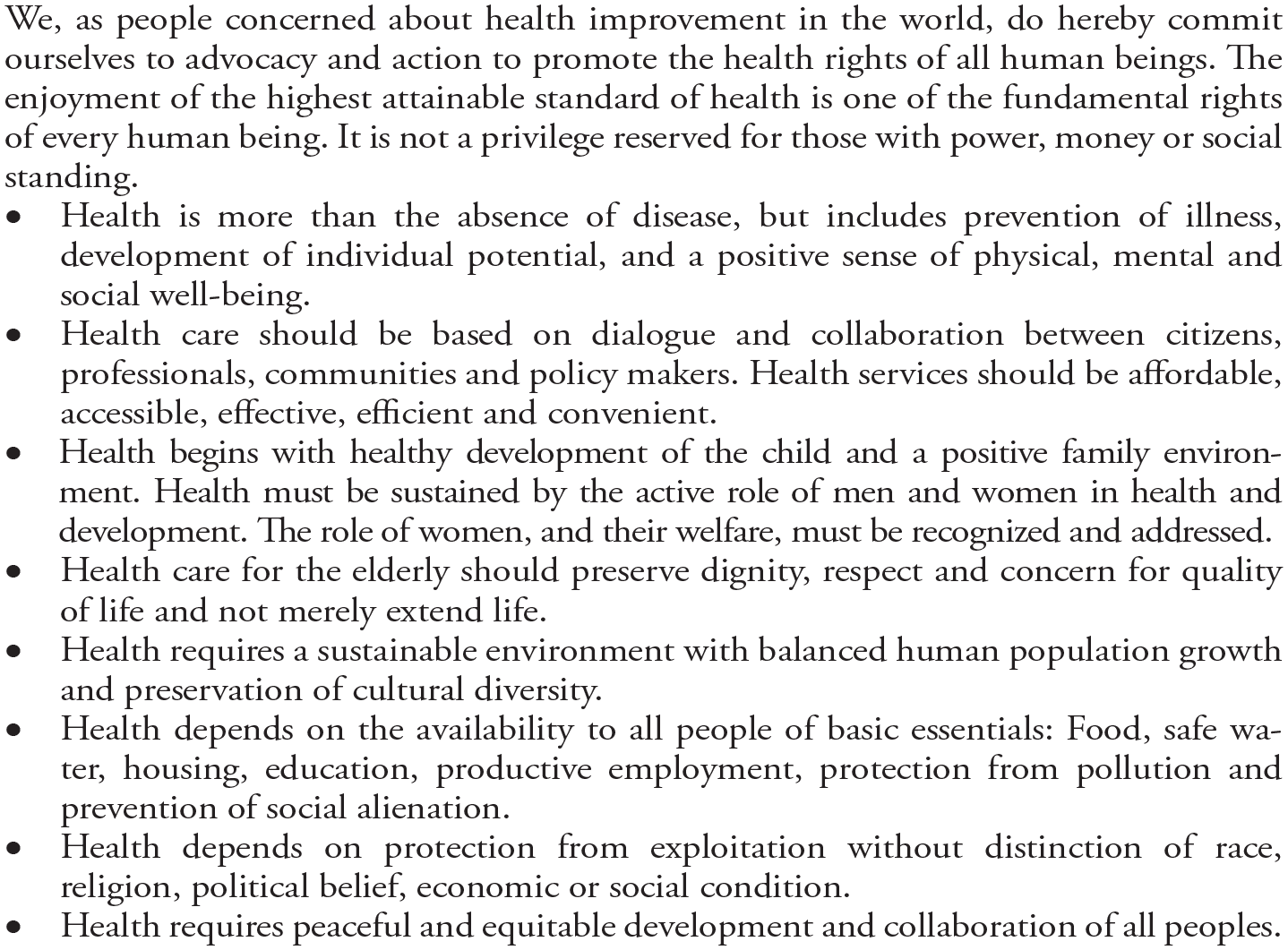
The Bloomberg School of Public Health of John Hopkins University’s International Declaration of Health Rights.
The Declaration is prominently placed on the School’s website with the mission to educate current and future public health leaders to embrace the values of ‘[integrity, diversity, and civility . . . social justice, health equity, and engaged citizenship] in their research and practice’ (Bloomberg School of Public Health 2022a).
Lawrence’s (2019) endorsement is noteworthy as the School is an influential school of public health in the United States with a global reach through its international programmes. In contrast to Lawrence’s endorsement, we see significant problems with the Declaration’s definition of health, human rights approach, avowed goals, and failure to consider the economic and political structures and processes that shape health.
Critical political economy analysis
We carry out a critical analysis of the contents of the School’s Declaration through a critical social science lens which makes explicit issues of power and influence (Harvey 1990). Specifically, we expose the ideological presuppositions embedded within the surface language of the Declaration and place these against what is known about the political economy of health in the United States. In our discussion, we relate these findings to Marx’s concepts of base and superstructure, Gramsci’s concept of cultural hegemony, Engels’, Marx’s, and others’ critique of bourgeois charity, and concerns about corporate domination of university structures and processes through philanthrocapitalism.
The declaration
Health as a fundamental right
We, as people concerned about health improvement in the world, do hereby commit ourselves to advocacy and action to promote the health rights of all human beings. The enjoyment of the highest attainable standard of health is one of the fundamental rights of every human being. It is not a privilege reserved for those with power, money or social standing.
The Declaration adopts the World Health Organization (WHO) definition of health as a fundamental human right. The United Nations’ (UN 2008) Universal Declaration of Human Rights (UDHR) called for ‘the highest attainable standard of health’.
Human rights approaches have been critiqued as a product of their time, steeped in contradictions that question their usefulness. For Teeple (2004), human rights approaches represent individualistic conceptions of freedom based on private property ownership such that attaining them is largely dependent on access to financial resources.
Human rights fall within three generally agreed upon categories: civil, political and social (Bambra et al. 2005; Moses 2019; Teeple 2004). Civil rights are those of the ‘economic man’, they shape civil society into a marketplace where individual producers sell labour power in self-interest and pursuit of wealth. Political rights, the ‘rights of citizens’, are usually limited to ‘the rights to vote, to be elected, to reform or amend the constitution if elected, and to petition the government’ (Teeple 2004: 12).
Social rights are uncertain as they are not usually constitutionally guaranteed, thereby dependent on presiding governments, state regulation, and provision of services and include health services, education, labour protections, trade union rights to organise and strike, and benefits for non-producing members of society (e.g. the young, elderly, and unemployed) (Teeple 2004).
Sklair (2009) provides two groups of rights similar to the above with one being civil and political rights and the other economic and social rights. Sklair (2009) argues that guaranteeing economic and social rights is less a priority for most states and this is especially the situation in neoliberal capitalist economy jurisdictions, such as the United States.
The right to private property – according to Teeple (2004) – is one of the most important contradictions contained within the rights framework. Private property rights are only realised when no other right opposes it; political and especially social rights are therefore usually subordinate. Teeple (2004) writes, The very nature of the system of private property leads each person to exclude all other from the enjoyment of privately owned goods and services, except through mutual exchange; it also reproduces its possessors as solitary individuals and stands opposed to all relations implying unity, community, or social bond of any sort, except those based on contract or material self-interest. (p. 35)
The second important contradiction arises when corporations are given the constitutional rights of individuals, which ‘legalised its authoritarian role in the workplace and its right to take the wealth of community, region or country’ (Teeple 2004: 37). Corporations also enjoy legislative protections against organised labour and taxation of its wealth. By exercising its civil right to private property and ownership of the means of production, the corporation limits access to goods and services that should be available to members of society as social rights. Globalisation and concentration of transnational capital – all examples of the human rights of corporations – exacerbate inequalities (Labonté & Stuckler 2016; Teeple 2004). A particularly timely examination of these issues is presented by Claudio Schuftan with Howard Waitzkin et al. (2023) who conclude, Proactively, we need to create a shared critical awareness about the capitalist economic and social system that consistently fails to respect, protect, and fulfill human rights. Actions to change these conditions benefit from a re-learning that rejects the traditional human rights discourse and transitions to a new post-capitalist human rights discourse. (p. 85)
Compared to other wealthy nations, the United States does poorly in providing human rights. On the EU and OECD Social Justice Index for 2019, the United States ranked 36th of 41 nations (Hellman et al. 2019). USA performance was especially problematic for Poverty Prevention (rank 41), Social Inclusion and Non-discrimination (rank 37), and Intergenerational Justice (rank 37).
In addition, the United States avoids the United Nations (UN) critique of its human rights record by failing to ratify UN rights declarations such as Convention on the Rights of Persons with Disabilities (2007); Declaration on the Rights of Indigenous Peoples (2007); Convention on the Rights of the Child (1989); Convention on the Elimination of All Forms of Discrimination Against Women (1979); and International Covenant on Economic, Social and Cultural Rights (1966), among many others (Council on Foreign Relations 2022). The Declaration neglects this dismal record.
WHO definition of health
Health is more than the absence of disease, but includes prevention of illness, development of individual potential, and a positive sense of physical, mental and social well-being.
The WHO definition broadened understanding of health and its determinants and opened the health concept to a wider community outside the healthcare sector. However, Blaxter (2010) argues the WHO definition epitomises ‘the whole of human existence and has been criticised as difficult to measure and impossible to achieve’ (p. 19). More importantly, the definition was situated within the immediate post-Second World War period where Keynesian welfare state reforms were on the rise and before the 1970’s onset of neoliberal ideology, scaling back of the welfare state, and economic globalisation. Indeed, Nobile (2014) argues that during the era of the WHO definition, global peace and health were inseparable, with recognition that health was related to economic and political conditions and a willingness of governments to act to promote the health of populations.
Newer definitions, similar to the WHO’s, continue to focus on the individual, directing attention away from the political, economic and social environments in which people are embedded. Mills calls this tendency in sociological analysis psychologism whereby societal structures are ignored in favour of the individual and their immediate milieus (Mills 1960). Elsewhere, we propose a definition of health that makes explicit that health is dependent on four interconnected and interdependent conditions: economic, political, social, and individual (Medvedyuk & Raphael 2023): Health – as experienced by the individual (experiential) and their ability to carry out life’s activities (functional) – is a product of the interaction of economic and political systems’ equitable or inequitable distribution of financial resources, political power, and social supports with the individual’s unique biological and psychological dispositions and situations. (p. 7)
The Declaration therefore, endorses an individualised definition of health, eschewing emphasis on the broader factors of health and their embeddedness within societal economic and political structures and processes.
Health care
Health care should be based on dialogue and collaboration between citizens, professionals, communities and policy makers. Health services should be affordable, accessible, effective, efficient and convenient. Health care for the elderly should preserve dignity, respect and concern for quality of life and not merely extend life.
The United States is unique among wealthy nations in not providing universal access to health care. Its strong profit-driven component has been implicated in the problematic USA health profile (Waitzkin 2018). The Declaration makes two mentions of the healthcare system.
The first statement about health care is remarkable for its omission of the unique failure of the United States to offer universal health care. Unmentioned are the 43% of working-age adults inadequately insured; this figure includes 9% who were uninsured, another 11% with a gap in coverage over the past year, and 23% who are underinsured (King 2022). In addition, ‘Half (49%) of people surveyed said they would be unable to pay for an unexpected $1,000 medical bill within 30 days, including 68% of adults with low income, 69% of Black adults and 63% of Latinx/Hispanic adults’ (King 2022).
Of course, health services should be affordable, accessible, effective, efficient, and convenient. How that is possible within the United States’ profit-driven, non-universal health system begs attention from a major school of public health. The statement on elderly health care is a homily saying little.
Children, parents, and mothers
Health begins with healthy development of the child and a positive family environment. Health must be sustained by the active role of men and women in health and development. The role of women, and their welfare, must be recognized and addressed.
The Declaration gives a nod to healthy child development with vague statements about parents and families and the ‘role of women’. The statement provides little insight into how healthy child development, and parents’ abilities to support such development are profoundly limited in a society whose social inequalities are among the highest among OECD nations (Raphael 2012).
Mention of the cumulative effects of adverse circumstances upon both children’s and adults’ health is omitted. The USA’s child poverty rate of 18%, the 36th highest of 37 OECD nations (OECD 2022d), its lack of paid parental leave, and its failure to provide childcare services go unmentioned (Bezruchka 2012). The United Nations International Children's Emergency Fund (UNICEF) report cards of children’s health and well-being rank the United States among the worst of wealthy nations in poverty rates, material inequality, health, and environments promoting health (Innocenti Research Centre 2022).
The role of women – which is called to be recognised – is left undefined and can be interpreted as calling for women to take on the majority of child rearing. The United States’ gender wage gap is 32nd highest among 37 OECD nations (OECD 2022b). Its public spending on families ranks 37th of 38 OECD nations (OECD 2022a).
Sustainable environment
Health requires a sustainable environment with balanced human population growth and preservation of cultural diversity.
The statement on a sustainable environment with reference to balanced human population growth omits mention of the environmental crisis. In addition, its call for balanced population growth implies the sources of distributional inequality of resources across the globe – including scarcity in many regions – has nothing to do with economic globalisation, capitalism’s relentless drive for accumulation, or the neoliberal agenda which intensifies these problems. The United States’ record on climate change-related environmental policy – ranked 57th of 63 nations on the Climate Change Performance Index – is overlooked (Germanwatch 2024).
Basic essentials
Health depends on the availability to all people of basic essentials: Food, safe water, housing, education, productive employment, protection from pollution and prevention of social alienation.
There is mention of what the WHO initially termed prerequisites, and more recently, SDOH, although neither term is mentioned. Its list of resources are basic essentials which implies the need to address material deprivation associated with absolute poverty and is more appropriate to developing jurisdictions than one of the world’s richest nations. There is no recognition of the role public policy plays in making these resources available nor the economic and political barriers to doing so.
The Declaration says nothing about equitable distribution of income and wealth, or other resources that would promote flourishing rather than mere survival. This, in the face of findings that the top 1% of USA households now has 15 times the wealth of the bottom 50% of Americans combined (Beer 2022). The United States’ ranking 31st of 35 OECD nations on controlling income inequality is unmentioned (OECD 2022c). The number of food-insecure households in the United States is 10.2% or 13.5 million households (United States Department of Agriculture 2022).
The mention of social alienation is especially relevant in light of the rise of right-wing populism in the United States and the growing belief in conspiracy theories which deny the validity of the United States’ admittedly flawed electoral process. How achieving the aims of the Declaration would address this is questionable.
Freedom from exploitation
Health depends on protection from exploitation without distinction of race, religion, political belief, economic or social condition.
The Declaration calls for protection from exploitation for those whose racial/ethnic category, religion, political belief, economic or social condition may make them susceptible. No definition of exploitation is provided. We think about exploitation in two ways. The first considers Wright’s (1995) concept of economic oppression. This occurs when (1) the material welfare of one group is causally related to the material deprivations of another; (2) the causal relation in (1) involves coercively enforced exclusion from access to productive resources and (3) this exclusion is morally indictable (Wright 1995). In this definition, the presence of deprivation is caused by excessive accumulation by others.
The second is that exploitation is an inherent feature of capitalism. For Marx, the worker being forced during the course of employment to produce surplus value to benefit those who control the means of production is the key feature of exploitation (Holstrom 1977). The end of such exploitation is not possible in a class-dominated economic system such as capitalism.
The Declaration does not acknowledge that the concept of exploitation is an essential component of capitalism in general and takes a particularly virulent form in the United States. As such, the Declaration provides little direction for identifying and improving situations which threaten health. The United States’ profoundly low unionisation and collective employment agreement rates – key factors in preventing exploitation of workers – of 10.3% and 12.1%, respectively, are among the lowest of OECD nations (OECD 2022e).
Peaceful and equitable development
Health requires peaceful and equitable development and collaboration of all peoples
We doubt many oppose equitable development and collaboration. How that is possible under transnational global capitalism – of which the United States is the centre – is unexamined (Quark et al. 2022; Stokes 2018).
Blind spots
While we would not necessarily expect any school of public health to call for the end of capitalism, we do expect that there would be some allusion to the current form of USA capitalism and its well-documented threats to health (Freudenberg 2021). Similarly, the failure to raise the issue of the United States’ health care system’s clear inadequacy in addressing the needs of many Americans is problematic. Especially noticeable is the Declaration’s calls for provision of basic essentials rather than access to the resources citizens should expect in a wealthy nation. The Declaration is the public face of the School’s programmes and its approach to public health. The School’s MPH students may be required to take a course on the social determinants of health, but it is only 12 hours long – even undergraduate students at York University’s Health Policy & Management programme in Canada are required to take a 36-hour social determinants of health course and a 36-hour public policy course. Our perusal of their course offerings find little evidence of a critical political economy perspective that interrogates economic and political systems as implicated in the issues we have identified with the Declaration.2, 3
Discussion
It is difficult to avoid the conclusion that the School’s Declaration and its lauding illustrates a variation on what Waitzkin Pérez and Anderson (2021) describe as lip-service to addressing the problem of health inequities: 4
Meanwhile, political leaders show little hesitancy in funding unthreatening research and education focusing on the social determinants of health (SDOH). These activities focusing on the SDOH create a symbolic image of concern even though key policies continue to worsen the SDOH, to the benefit of those at the top in hierarchies of power and finance. (p. 51)
This led Waitzkin et al. (2021) to prefer the term ‘social determination of health’ to ‘social determinants of health’. The reason being that the former draws attention to ‘the concrete ways in which social contradictions impinge on groups and, ultimately on individuals in a society to cause illness and early death’ (Waitzkin et al., 2021: 48). These social contradictions include the antagonistic forces in society that may be destructive while at the same time producing resources.
The primary instance of a social contradiction is the role of social class within capitalist societies which arise because the working class – necessary to create societal resources – is also those who are more likely to experience adverse health effects associated with the living and working conditions under capitalism (Waitzkin et al. 2021). In the present time, these involve a polycrisis in the United States which we have described in previous sections.
More immediately, there is a social contradiction of the School espousing its commitment to promoting health equity while embedded within the capitalist structures and processes that threaten health. And the most obvious aspect of this contradiction is it is being endowed and named after a capitalist billionaire who has denounced any attempts at redistribution in the service of public health.
The neglect of class and the political economy of health
Health equity-oriented documents, statements, academic and majority of training programmes in the United States neglect class and its effect upon health. USA public health authorities and researchers’ consideration of health equity usually default to issues of race and gender, but not class (Hofrichter 2003). For example, Taillepierre et al. (2016) argue MPH programmes usually fail to mention class, public policy, economics or politics. Michael Harvey (2021) details these omissions: The political economy of health is necessary for explaining and addressing persistent health inequalities and emerging public health crises under global capitalism, a political–economic system that shapes nearly all aspects of our lives but that attracts relatively little attention in the field of public health. If public health is to fully engage with the structural determinants of health and the system that produces them, the political economy of health will have to move from the field’s margins to the mainstream. (p. 298)
Marx and Gramsci
The finding that the School offers an approach to health equity that does not question the dominance and influence of the capitalist economic system upon health is not surprising as universities are part of the capitalist superstructure. Marx (1978 [1859]) terms the structures and processes of the economic system and the relations it generates as the base of capitalist society. The base consists of the forces and relations of production which, in its present form, creates the inequitable distribution of resources leading to the United States’ problematic health profile but at the same time benefits the corporate and business sectors. Marx (1978 [1859]) uses the term superstructure to refer to the political, legal, and ideological edifice built upon these relations: In the social production of their existence, men inevitably enter into definite relations, which are independent of their will, namely relations of production . . . . The totality of these relations of production constitutes the economic structure of society, the real foundation, on which arises a legal and political superstructure and to which correspond definite forms of social consciousness.
The first aspect of superstructure is the ideology that justifies the economic system that creates these social relations and their resulting social inequalities. The second aspect is the structural institution of capitalist ideology. This involves governmental actions such as laws, regulations, policies and rules that maintain these class-based relations. In the modern era, structural institutions of the superstructure include a media and university system increasingly dominated by economic interests and the promotion of particular ideological approaches to social service provision, health promotion and, of course, health equity. At the ground level, the superstructure of capitalist ideology in the United States makes the Declaration an innocuous statement that promises good will but in essence says nothing about the sources of health inequity which the Declaration is supposed to address.
The Declaration’s failures and its recitation by graduates suggests the relevance of Gramsci’s concept of cultural hegemony, whereby the ideas and values of the ruling classes – in the present case, the corporate and philanthrocapitalist sectors – are imposed upon and accepted by those being dominated (Gramsci 2000). This process has much to offer in explaining corporate and business involvement with post-secondary education in general and public health education, in particular.
As described by Cole (2017), hegemony refers to the ability of a group of people to hold power over social institutions, and thus, to influence the everyday thoughts, expectations and behaviour of the rest of society by directing the normative ideas, values and beliefs that become the dominant worldview of a society.
Schools of public health increasingly enter into partnerships with the corporate sector (Fliss et al. 2021). Marks (2018) outlines numerous perils of such partnerships relevant to the School’s public persona: agenda distortion, reciprocity and lack of integrity.
Agenda distortion occurs when an entity shifts its mission and activities to conform to the perceived exigencies of corporate partners. Reciprocity is the process by which the entity takes measures to support the partner, even though such activities may go against its expressed mission. Finally, a lack of integrity by the entity in such a partnership threatens its ability to influence public policy as these partnerships can take measures that would promote the common good off the table. Marks (2018) statement appears especially relevant when we consider how the Bloomberg School of Public Health has received over US$300 million from donor Michael Bloomberg – Johns Hopkins University has received at least an addition US$1.8 billion from Bloomberg – whose problematic views on public health are detailed in following sections (McDaniels & Cohn 2016; Philanthropy New York 2018): When a civil society organization (CSO) has close relations with one or more corporations or trade associations and . . . when it receives funding from such entities, the CSO is likely to be influenced by that interaction and, in turn, to exercise influence on industry’s behalf. The CSO may do this unwittingly as a result of subtle reciprocity. The organization’s staff may not realize that they are exercising self-censorship, and modifying or shaping their views to avoid undermining the short-term commercial interests of an industry sponsor. CSOs may unintentionally serve as proxies for industry or at the very least provide them with ‘credibility enhancement’. (Marks 2018: 72)
The influence of the corporate sector upon public health discourse around health threatening commercial products such as tobacco and food is well established (Lacy-Nichols et al. 2022). Freudenberg (2021) extends this analysis to issues of education, health care, working conditions, transportation and social connections. Influence upon public health education is unknown but Fliss et al.’s (2021) call for such inquiry seems timely.
Philanthropy, academia, global health, and the maintenance of the status quo
Historically, capitalist philanthropy has shaped public health priorities and this is also the case in global health initiatives (Birn & Richter 2018). The Rockefeller Foundation (RF) and the Bill and Melinda Gates Foundation (BMGF) played key roles in shaping the role and influence of philanthropy in health both locally and abroad.
In academia, philanthropic foundations have made significant financial contributions to renowned institutions such as Harvard, MIT, Columbia, and John Hopkins among others (Roelofs 2007). For example, between 1916 and 1932, the RF ‘provided funding, leadership, and institutional prototype’ (Thomas 2016: 2) for the establishment of 10 public health schools around the world, including the John Hopkins School of Hygiene and Public Health. BMGF committed US$20 million to the creation of the Bill and Melinda Gates Institute for Population and Reproductive Health at the Johns Hopkins University School of Public Health (Gates Foundation 2023).
Birn and Richter (2008) state that philanthropic capital ‘increasingly influences civil society movements, universities and researchers, and government programs’ (p. 202). The RF and BMGF ‘significantly shaped the institutions, ideologies, and practices of the international global health field, shaping a belief in narrow, technology-centred, disease-control approaches’ (Birn & Richter 2018: 198), rather than a concern with issues of how ‘poverty, militarism, racism, and environmental degradation are related by-products of the capitalist system’ (Roelofs 1995: 3), which are ruled out. Philanthropic foundations thus serve as ‘cooling down agencies’ and ‘effectively serve to inhibit activism and grassroot organizing, thus preserving elite class hegemony’ (Roelofs 2007: 480).
Global health-related philanthropy – Michael Bloomberg’s foundation cooperates with Johns Hopkins University in such efforts – masks and deflects neoliberal inspired wrongdoing. Morvaridi (2012) argues, ‘This form of neoliberal capitalist philanthropy is both politically and ideologically committed to market-based social investment through partnerships, to make the market work or work better for capital’ (p. 1191).
The school and its namesake
Consider the namesake of the School, media magnate billionaire Michael Bloomberg – the 12th richest person in the world with wealth estimated at US$82 billion (Mille 2022) – and former mayor of New York City (NYC) whose rejection of any attempts at income and wealth redistribution is well known. His contributions to the School totals well over US$300,000,000 to date (Bloomberg School of Public Health 2022b).
As mayor of NYC Bloomberg ushered in public health policies centred on risk factors of physical activity, diet, air pollution, and tobacco smoke (Rhodes-Bratton et al. 2017). Bloomberg not only gave no attention to issues of income inequality and the importance of the socio-political context in promoting public health, he actively attacked such concerns (McNamara 2012).
When City Council Speaker Christine Quinn considered introducing a living wage bill, Bloomberg stated, ‘The last time people tried to set rates, basically, was in the Soviet Union, and that didn’t work out very well’ (Murphy 2012) and ‘You just cannot force employers to pay a rate that doesn’t-isn’t sustainable in their business and it’s not the government’s business to do this’ (Walker 2012).
When Dr Ritika Goel asked Bloomberg about reducing income inequality between the 1% and others through the ‘Buffett Rule’ Bloomberg’s response was that it is ‘total bullshit’ (Goel 2012). Later, in 2020, Bloomberg stated, I think income inequality is a very big problem. But the bigger problem is, you can take money from the rich and move it over to the poor. If you do it too much then the rich stop producing and everybody loses. (Olding & Stein 2020)
The School carries Bloomberg’s name. Fliss et al. (2021) identify issues with branding schools of public health (Figure 2), providing instances of such branding. The most relevant aspects of branding the School appears to us to be directing curricula, tipping content towards industry and donor perspectives, and proscribing research priorities. Marks (2018) suggests partnerships with corporations and business interests can unduly influence and distort research agendas ‘of academic departments, universities, and entire fields of research’ (p. 75).
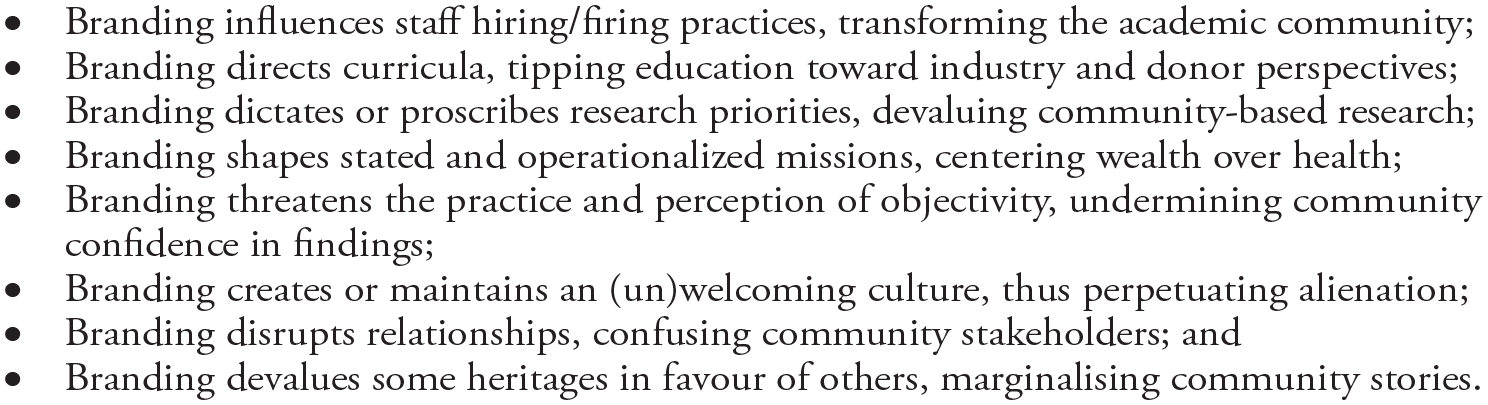
Ethical considerations of branding Schools of Public Health in the United States.
In the present case, we do not know to what extent Bloomberg’s contributions actually shape the positions of the School. Certainly, the Declaration does not contain anything to offend Bloomberg’s sensibilities. In regard to Bloomberg’s public health activities, Goel (2012) concludes, Mayor Bloomberg only supports public health as far as it is convenient. He supports public health as long as it does not threaten the greater social and political power structures in the US. He supports public health as long as it does not mean acknowledging his own contribution, through Wall Street, in creating and maintaining the ill health of his constituents.
Looking afield, we see Bloomberg Philanthropies’ annual report Ensuring Safer, Longer, Healthier Lives identifying and addressing ‘leading causes of death from noncommunicable diseases and injuries’ (Bloomberg & Philanthropies 2023). Not surprisingly, issues of concern are narrow and include preventing cardiovascular diseases, tobacco reduction, obesity prevention and promoting of healthy diets. The disturbing health effects of neoliberal inspired economic globalisation are excluded from consideration (Schrecker 2020).
The neglect of the SDOH and the structures, processes, and values that drive them in these philanthropic activities by Bloomberg and others are apparent. And at least a portion of the motivations behind these philanthropic efforts likely correspond with Friedrich Engels’s (2009 [1845]) view of bourgeois charity as provided in The Condition of the Working Class in England and Marx and Engels’ (2004 [1848]) statement in The Communist Manifesto respectively: The English bourgeoisie is charitable out of self-interest; it gives nothing outright, but regards its gifts as a business matter, makes a bargain with the poor, saying: ‘If I spend this much upon benevolent institutions, I thereby purchase the right not to be troubled any further, and you are bound thereby to stay in your dusky holes and not to irritate my tender nerves by exposing your misery’. (Engels 2009 [1845]) A part of the bourgeoisie is desirous of redressing social grievances in order to secure the continued existence of bourgeois society. To this section belong economists, philanthropists, humanitarians, improvers of the condition of the working class, organisers of charity, members of societies for the prevention of cruelty to animals, temperance fanatics, hole-and-corner reformers of every imaginable kind. (Marx & Engels 2004 [1848])
More recently, numerous writers have commented on how charity not only distracts attention from the ravages of capitalist economies but also serves to entrench capitalism (Kapoor 2012; Morvaridi 2012). Bagakis (2017) in his ‘10 points about the “benefits”’ that accrue to philanthrocapitalism states, ‘Capitalist philanthropy is a way for capitalism to maintain itself while giving the impression that its the solution to its own inequities’.
Livingstone (2013) argues in relation to charity in general, but with relevance to the philanthropic contributions by the wealthy to universities: Charity perpetuates the need for charity itself, reproducing its current form through capitalism, rather than struggling for the decomposition of the present social quagmire and the reforming of a society in which charity, poverty and capitalist reproduction do not exist. This is the displacement of struggle. This is why people give, why capitalist charity exists: through donating, volunteering and the ‘branding’ of charities themselves, charity continues to recreate the sins of capitalist inequalities. (p. 350)
Thomas Humphrey Marshall, Rudolf Virchow and Friedrich Engels
Like others, the Declaration latches onto the concept of ‘human rights’ as a justification for their concern with promoting health equity. A more fruitful path would be the promotion of social rights as formulated initially by T.H. Marshall (1950) which is enjoying a resurgence of interest (Moses 2019). For Marshall, social rights represents the desired state which builds upon the earlier achievement of civil and political rights. Social rights associated with social citizenship involve, [T]he whole range from the right to a modicum of economic welfare and security to the right to share to the fuIl in the social heritage and to live the life of a civilised being according to the standards prevailing in the society. The institutions most closely connected with it are the educational system and the social services. (Marshall 1950: 11)
The means by which social rights would come about according to Marshall would be movement towards a form of socialism that would have aspects of centralised planning combined with individual and community engagement and control. Such an approach would offer a more enveloping model for achieving health equity than the individually based concept of universal human rights, an approach which, interestingly, was not endorsed by Marshall in his writings (Moses 2019).
Virchow’s famous dictums such as ‘If medicine is to fulfil her great task, then she must enter the political and social life’, ‘The physicians are the natural attorneys of the poor’ and ‘Disease is not something personal and special, but only a manifestation of life under modified conditions’ are commonly evoked in health and medical literature (Waitzkin et al. 2021). His writings not only call for professional advocacy and action but also direct explicit attention to the economic and political structures that restrict democracy and threaten health. The implications being that the public health community should serve as social advocates for democratic representation, fair wages, and better living and working conditions, all issues passed over by the Declaration.
Engels’s analysis (see Govender et al. 2023) of how capitalist processes shape health also offers a blueprint for alternative forms of public health education of how economic and political systems threaten health. Practical means of doing so within the social medicine tradition are available (Freudenberg 2021; Waitzkin et al. 2021). Placing the quality and distribution of the social determinants of health within an explicitly socialist framework that requires movement towards a post-capitalist socialist state is also gaining traction (Das 2023; Raphael & Bryant 2023).
Alternative forms of public health education
In this section, we provide examples of various courses and programmes of public health that draw explicit attention to the role political and economic arrangements have on health. We do so to provide contrasts to the School’s approach as typified by its Declaration and its limited emphasis on broader factors shaping health, a critique that appears to apply to most MPH programmes in the United States. The examples we provide of the few USA schools that take such an approach act to serve as ‘exceptions that prove the rule’.
The critical traditions that highlight structural conditions as either promoting or threatening health are most common in the United Kingdom and South America, among other localities. Critical discourse is prominent outside of the United States, further confirming our argument that it is the United States’ form of capitalism that makes critiques of broader health determinants less common and increasingly marginalised.
We made inquiries with domestic and international colleagues and identified noteworthy examples – there are others – of public health programmes which provide a critical political economy approach. These are the Master’s and Post-Graduate Courses of Public Health Program at the Universitat Pompeu Fabra in Barcelona, Spain (Universitat Pompeu Fabra 2023c), the Master’s and Postgraduate Diploma of Public Health Programs at Newcastle University, the United Kingdom (Newcastle University 2023 a,b,c), Global Health program at Essex University in the United Kingdom (University of Essex 2023), the MA and PhD Graduate Programme in Health Policy and Equity at York University in Toronto, Canada (York University 2023a), and the School of Public Health at the University of Toronto (University of Toronto 2023).
USA programmes include MPHs at Simmons University (Simmons University 2023), the School of Public Health and Health Policy at City University of New York (CUNY 2023), the Berkeley Center for Social Medicine (UC Berkeley 2023). Schools with courses focusing on political economy are the School of Public at the University of Washington (University of Washington 2023), Joseph J Zilber College of Public Health at the University of Wisconsin-Milwaukee (University of Wisconsin-Milwaukee 2023) and the University of Michigan School of Public Health (University of Michigan School of Public Health 2023).
The flagship course at the Universitat Pompeu Fabra, Health and Society states (Universitat Pompeu Fabra 2023b), According to the currently dominant biomedical approach, the main ‘culprits’ in the production of diseases and health are biological and genetic agents, individual habits harmful to health, and deficiencies in access and use of health services . . . these causes have a smaller impact on population health than it may seem. Firstly, because they are proximal or ‘final’ causes originated, in constant interaction with other more distal causes, by social determinants . . . Second, because these social determinants are in turn produced, or strongly influenced, by political causes originating in the very unequal power relations existing in each society according to ‘axes’ related to social class, gender, ethnicity, immigration and territory.
Universitat Pompeu Fabra also offers a course entitled Understanding Global Health Inequalities: A Transdisciplinary Critical Approach (Universitat Pompeu Fabra 2023a) as well as a short course in English in the Fall Institute in Health Policy and Management called Emerging Dimensions of Social Determinants of Health Inequalities: A Transdisciplinary Integrated Approach (Universitat Pompeu Fabra 2023a).
Newcastle’s Advanced Social Determinants of Health course (Newcastle University 2023a) and Public Policy, Health and Health Inequalities course (Newcastle University 2023b) provide a critical political economy analysis to contemporary health issues. The Global Public Health programme at Essex University, the United Kingdom, offers numerous courses with a critical political economy lens (University of Essex 2023).
The Health Policy and Equity Graduate Program at York University (2023a) offers Political Economy of Health Inequalities, Health Equity Analytic Orientations and Human Rights and Health Equity courses among others taught through a critical political economy perspective (York University 2023b).
Simmons University in the United States offers Health Equity and Social Justice, Global Health and Political Economy and Socio-structural Determinants of Health courses that cover, respectively, (1) foundational knowledge of health equity, social justice and human rights; (2) colonialism, imperialism, globalisation, trade, labour, war and conflict, militarism, privatisation, aid, development and peacebuilding and (3) socio-structural determinants of health with a focus on social justice and systems of oppression (Simmons University 2023).
The Social Medicine Consortium Campaign Against Racism is an international group of emerging scholars with an explicit purpose of overcoming racial capitalism with active participation from schools of public health and related educational programmes in North America, Latin America, and Africa (Social Medicine Consortium 2023).
There are also schools of public health, social medicine, and collective health affiliated with the Latin American Association of Social Medicine and the Brazilian Association of Collective Health (see Note 3 in Harvey et al. 2023) and programmes of public health affiliated with the international Association of Health Policy in Europe (with schools in Greece, Turkey, Germany, and Italy among others).
‘While the Hopkins approach remains fairly hegemonic, this situation seems to be changing rapidly as people around the world recognize the failures of the global political-economic systems grounded in racial capitalism’ (H. Waitzkin, personal communication, 31 October 2023; for details, see Waitzkin et al. 2021, especially chapter 10). Finally, The University of British Columbia’s Department of Political Science offers a course on the politics of health which analyses power in its various manifestations in public health. It was found to stimulate interest by political science students in the issues presented in this article (Shroff et al. 2021).
Limitations
The limitation of our study lays in the fact that much of our analysis is focused on one document, the Declaration. We did make inquiries about the broader curriculum of the School and see no reason to believe that it differs widely from most of the MPH curricula previously examined by Harvey and McGladrey (2019) and Westbrook and Harvey (2023).
Conclusion
Lawrence’s (2019) praise of the School’s Declaration seems misplaced. It is noteworthy that in a country where regressive politics and a skewed economic system creates some of the highest levels of social and income inequalities among wealthy nations, politics and economics are left out of health messaging from one of the country’s best known public health schools. 5 We have suggested numerous reasons – including the School’s naming itself after a critic of redistribution and managing the economy – why such avoidance continues. We are not alone in this concern. The numerous considerations wrought by branding of schools of public health by Fliss et al. (2021) require further exploration.
In this article, we have directed attention to the shortcomings of the Declaration and hope to spur reflection on the role USA schools of public health can play in promoting health equity. Our critique of the Declaration is timely as the United States is an outlier in the extent to which its health-related public policies threaten its own health profile. But also important is that Johns Hopkins’ public health footprint has a global reach such that the shortcomings of the Declaration should be a concern to all. 6
We have therefore demonstrated that this supposed icon of health equity – the Declaration – is sorely deficient and placed this deficiency in the context of problems associated with capital’s impact on higher education. Running MPH students through a Bloomberg School of Public Health does not contradict Serna and Woulfe’s (2017) view that schooling at all levels is a ‘primary means for the perpetuation of the dominant class’s ideologies, values, and power’ (p. 1). Finally, Johns Hopkins taking money and naming its School of Public Health after a billionaire media magnate whose anti-health equity promoting positions are well known merely demonstrates that the capitalist university knows no shame. 7
