




Abstract
This article explores the theory of exploitation which Marx sets out in Capital. It argues that Marx assumes that there are five modes of extraction of surplus value. These are associated with the following principles: (1) extended duration of the working day; (2) enhanced productivity (due to the introduction of new technology); (3) efficient organization of the process of production; (4) increased intensity of labour and (5) depressed consumption of the labourer. The article argues that Marx’s theory of exploitation is not as systematic as it could have been. For this reason it is ripe for a theoretical reconstruction. The article also discusses the views of recent commentators who have developed the idea of ‘super-exploitation’, which is taken from Marx’s writings. There is a tendency in this literature to associate this notion with the principle of depressed consumption and to argue that it is especially relevant for understanding of what is happening in the societies of the Global South. Those concerned identify this as a third mode of extracting surplus value, in addition to the principle of extended duration (absolute surplus value) and enhanced productivity (relative surplus value). The article argues that this procedure overlooks certain aspects of Marx’s theory of exploitation, especially those having to do with the efficient organization or rational administration of labour within the process of production.
Introduction
The idea of super-exploitation is primarily associated with the work of the Brazilian Marxist, Ruy Mauro Marini (1932–1997). Until quite recently Marini has been a relatively neglected figure, at least in the English-speaking world, although this is now changing. His most significant work, Dialéctica de la dependencia was published in 1973. An English translation of it, by Amanda Latimer, has recently been published by Monthly Review Press with the title The Dialectics of Dependency (Marini 2022). Other scholars who have emphasized the contemporary significance of Marini and his ideas include Andy Higginbottom, John Smith and Adrian Sotelo Valencia (Higginbottom 2010, 2011, 2012–2013, 2014, 2018; Smith 2016; Sotelo Valencia 2015, 2020). In what follows, I consider the idea of super-exploitation from the standpoint of Marx’s theory of exploitation in Capital. I shall assume that the reader is familiar with Marx’s technical vocabulary, the core concepts of the economic theory, together with the algebraic notation which he uses to express these concepts.
Of significance here are Marx’s views regarding the long-term tendency for the rate of profit to fall in Capital Volume III. Given Marx’s definitions of his core theoretical terms, and employing the algebraic notation which Marx himself employs, it can be demonstrated that
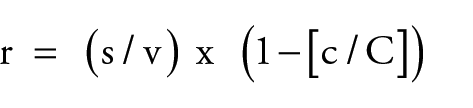
Expressed in words, this mathematical formula states what Marx takes to be a ‘law’ of capitalist development, namely, that the rate of profit (r) equals the rate of surplus value (s/v), or the rate of exploitation, multiplied by (one minus the organic composition of capital) (1 – [c/C]) Given this law, which Marx argues can be demonstrated mathematically, if the organic composition of capital rises over time, as Marx says that it does, then it necessarily follows that the rate of profit must fall, provided the rate of surplus value or rate of exploitation remains the same.
Marx notes in Capital Volume III that there are a number of countervailing tendencies which taken together might offset this tendency for the rate of profit to fall. Of particular importance, here, are Marx’s remarks about foreign trade and his suggestion that the exportation of capital and production ‘abroad’ (where labour is plentiful and wage costs are low), or to areas where production involves more ‘living labour’, would generate a higher rate of profit than that which could be secured by the same amount of capital investment ‘at home’. Marx assumes that the rate of exploitation or the rate of surplus value in the countries of what we now call the Global South, which dependency theorists term the ‘periphery’, is higher than that which is to be found in the societies of the Global North, at the ‘core’, which possess a higher organic composition of capital, and in which production is more machine intensive, and that this higher rate of exploitation at the periphery is a significant factor in offsetting the long-term tendency for the rate of profit to fall in the societies of Northern and Western Europe. At the beginning of the 20th century, a number of Marxist theoreticians, not least Lenin in his Imperialism: The Highest Stage of Capitalism (Lenin 2011 [1916]), used these ideas of Marx’s to explain the phenomenon of imperialism, in its specific form of colonialism.
So far as contemporary capitalism is concerned, what is essentially the same phenomenon is associated with ‘outsourcing’, or the ‘global labour arbitrage’ of capitalist production in the era of globalization (Bellamy Foster & McChesney 2012: 137–143; Bieler & Morton 2018: 170–171; Smith 2016: 187–223; Sotelo Valencia 2020: 81). A number of commentators writing today have emphasized that according to Marx one of the most significant ways which might be employed to counteract the long-term tendency for the rate of profit to fall is to increase the rate of exploitation, especially they suggest in the societies of the Global South, up to a point that is at least in line with the ever-increasing organic composition of capital. This idea is central to recent thinking about the notion of super-exploitation and its significance for contemporary capitalism in the age of globalization (Bellamy Foster & McChesney 2012: 138–139, 171–172, 181–182; Higginbottom 2010; Latimer 2021 [2016]; Osorio 2014; Smith 2016; Sotelo Valencia 2014, 2015, 2020).
The discussion which follows has two parts. In the first, I discuss the theory of economic exploitation which Marx sets out in the three volumes of Capital, focusing on what he has to say about the different ways in which an increased amount of surplus value might be extracted from the workers who are employed under the conditions associated with the capitalist mode of production. If it is true, as Marx argues, that the historical development of capitalism is associated with an ever-increasing organic composition of capital, and a consequent long-term tendency for the rate of profit to fall, this suggests that in order to counteract this tendency the capitalist employers of labour will do everything that they can to increase profitability by squeezing out of their employees as much surplus value as possible. Marx suggests that there are a number of different ways in which this might be done. One question here is how many such ways did he have in mind?
Marx’s remarks on this subject in Capital are not always consistent. He says different things at different times about exploitation, across all three volumes of Capital, and even within Volume I of that work, and he does not bring all of these disparate observations together at any one point in order to present his readers with a systematic theory. Sometimes Marx suggests that there are just two significant ways of extracting surplus value, which he associates with the notions of absolute surplus value and relative surplus value, respectively (Marx 1974a [1867]), IV, XII: 296–304, ‘The Concept of Relative Surplus Value’; and V, XVI: 476–485, ‘Absolute and Relative Surplus Value’). At other times he assumes that there are three such modes (Marx 1974a [1867] V, XVII: 486–496, ‘Changes of Magnitude in the Price of Labour-Power and in Surplus Value’).And on yet other occasions, as we shall see, he suggests that there are more than three. I argue that Marx actually identifies five significant modes of extraction of surplus value in Capital, which I shall consider in turn.
In the second part of the article, I offer an assessment of Ruy Mauro Marini’s recently rediscovered, and currently popular, notion of super-exploitation, considered from the standpoint of the account of Marx’s theory that is offered in part one. I argue that those who employ this concept appear at times to assume that Marx attaches importance to just three of the five modes which seem to me to be significant. In my view, therefore, although their understanding of Marx’s theory of exploitation in Capital is fine as far as it goes, and identifies aspects of Marx’s theory which hitherto have been overlooked, or have not received as much attention as they deserve, nevertheless it is not (sufficiently) comprehensive.
Marx’s theory of exploitation in Capital
In Capital Volume I, Marx sets out what might be called a theory of exploitation. This explains what exploitation as he understands it involves, or how and why it occurs under the capitalist mode of production. In a capitalist society, Marx argues, this is a matter of the different ways in which the surplus product that is produced, or the surplus value that is created by the workers, is taken away from them, syphoned off or as Marx says ‘pumped out’ (Marx 1974b [1895]: VI, XLVII, II, 791–792; VII, XLVIII, III, 822). Marx emphasizes that this takes place primarily through the wages-profits system. It is profit which makes it possible for the capitalist employers of labour to live a life of idle luxury which involves them consuming without working, while those who do the work do not get to consume the full fruits of their own labour.
In order to illustrate Marx’s theory of exploitation, we may consider what Marx has to say about the exploitation of labour over the course of a working day, using his own example in Capital Volume I as the basis for the discussion (Marx 1974a [1867]: II, VII, 2, 181–189. Again I shall assume that the reader is familiar with the details of this example, as well as with Marx’s technical vocabulary.
When discussing exploitation in Capital Volume I, Marx begins by introducing his readers to the concepts of absolute and relative surplus value (Marx 1974a [1867]: IV, XII, 299; V, XVI, 476–485). He appears at first sight, therefore, to suggest that there are only two mechanisms of exploitation, or just two modes of surplus value extraction, the first of which is associated with the notion of absolute surplus value and the second with that of relative surplus value.
Marx associates (and seems at times to identify) what he refers to as absolute surplus value with the length of the working day only, and hence with the duration of total labour time, understood as an absolute quantity, or a fixed period of time. He associates relative surplus value (and seems at times to identify this concept) with the division between that portion of the working day which the worker spends working for himself, adding value equivalent to the wages paid, and that portion of the working day which is spent working (for nothing), adding value (surplus value) to the commodities produced, which is then pocketed by the capitalist employer of labour as surplus value or profit (Marx 1974a [1867]: III, X, 1, 222). The division of the working day into these two periods of ‘necessary labour time’ and ‘surplus labour time’, irrespective of the absolute length of the working day, is what Marx has in mind when he talks about the extraction of relative surplus value and about the rate of surplus value, or the rate of exploitation (Marx 1974a [1867] III, IX, 1, 209; III, XI, 288; IV, XII, 296; IV, XVI, 477).
When discussing his example Marx assumes that the working day, ‘a-b-c’, is 12 hours long and that 6 hours of the day is ‘necessary labour’ and the other 6 hours is ‘surplus labour’. So ‘necessary labour’ = ‘a-b’ = 6 hours and ‘surplus labour’ = ‘b-c’, which also =6 hours. Hence, in his example, the ‘rate of exploitation’, or the ‘rate of surplus value’, measured by reference to the duration of labour only, is 6/6, or 100%. Marx expresses this diagrammatically as follows (Marx 1974a [1867]: III, X, 1, 222).
NECESSARY LABOUR TIME: v SURPLUS LABOUR TIME: s A______________________________B______________________________C
Marx has a tendency in Volume I to associate the extraction of relative surplus value with the introduction of technology, or new machinery into the production process. This enhances the productivity of labour, or makes it more efficient. He occasionally suggests that this is the only mechanism by means of which relative surplus value may be extracted. However, he does not always take that view. For example, at one point he states explicitly that there are a number of ‘particular modes of producing relative surplus-value’ (in the plural – my emphasis) (Marx 1974a [1867]: IV, XII, 304).
Whatever he says elsewhere, therefore, Marx does not always maintain that there is only one way in which relative surplus value can be produced, specifically by the introduction of new machinery. He suggests, at different times, that under the capitalist mode of production in its industrial phase there are five different dimensions, or five different ways in which surplus value is appropriated, four of which might be associated with the notion of relative surplus value. Consequently, there are in total five aspects to Marx’s overall theory of exploitation, each of which is associated with a particular mode of the extraction of surplus value. I shall refer to these as involving the principles of:
Extended duration
Enhanced productivity
Efficient organization
Increased intensity
Depressed consumption
The first of these modes for extracting surplus value is associated, at least initially, with the notion of absolute surplus value, although in certain circumstances extending the length of the working day could also increase the production of relative surplus value. I shall say more about this below. All four of the other modes, and not only the second of them, may be associated with Marx’s concept of relative surplus value. They all may be thought of as being different ways of increasing the rate of exploitation by shifting the division of the working day between necessary labour time and surplus labour time, and by squeezing out of the workers an ever-increasing amount of surplus value. In the diagram below, this is represented by the fact that the line A-B, portraying necessary labour time as a proportion of total labour time expended by an individual worker reduces in length in comparison with line B-C, which represents surplus labour time.
A _____________________ B _________________C1_______C2
A ________________B ______________________ C
A ___________B ___________________________ C
A ______B ________________________________ C
A __B ____________________________________ C
Marx suggests that all five of these modes of extraction of surplus value, including even the first, could in certain circumstances make a contribution to increasing the rate of exploitation of the labourer, indicated by the balance that is drawn between necessary and surplus labour time over the course of the working day. If they are all taken together, therefore, they add up to a comprehensive theory of exploitation. I shall say something about each of them in turn.
Marx claims that this first mode of extraction of surplus value, or this first dimension of his theory of exploitation, has to do with the extraction of absolute rather than relative surplus value. It seems clear enough, however, that, in the second scenario envisaged above, the proportion of necessary labour time to surplus labour time over the course of the extended working day has altered. So in those specific circumstances extending the working day would not only lead to an increase in absolute surplus value. It would also lead to an increase in relative surplus value, and in the rate of surplus value or exploitation.
The same result is arrived at if the calculation is carried out in monetary terms. The value created and added by the worker over the course of the working day would remain at 6s, as before. However, 4s 6d of this is now pocketed by the capitalist, and 1s 6d by the worker. The rate of exploitation, or s/v, has again therefore increased from 100% to 300% as a consequence of the introduction of new machinery. Here, although the rate of surplus value or exploitation has tripled, nevertheless the consumption level of the workers, expressed in absolute terms, would ex hypothesi remain the same. In other words, although it is true that the workers do not benefit at all from the results of the enhanced productivity that are associated with the introduction of new machinery, nevertheless it is also true that their consumption level in absolute terms, or the real wage, however that is expressed, in monetary terms or otherwise, would remain the same.
Another way of thinking about this would be to say that the quantity and/or quality, and indeed the variety, of the consumables in the basket has changed as a consequence of these technological developments, so that things which were formerly considered to be luxuries come, at a later time, to be regarded as necessities. Hence, in the society in question, the material standard of living that is associated with the idea of satisfying basic human needs, also, shifts over time. On this view, Marx holds that perceptions of what these needs are, and perhaps even the needs themselves to some extent, are not ‘natural’, in the sense of being absolute, fixed and unalterable, or having to do with the requirements of the human body, understood solely as a physical or a biological organism. Rather, they contain a ‘moral’ component. As such, they are historically or culturally mediated. Hence, in any given society they might change in time, as society ‘progresses’ as a consequence of ongoing technological innovation (see below).
It is clear from the above that for Marx the principle of enhanced productivity, associated with the introduction of new machinery, does not necessarily lead to an increase in the rate of surplus value or exploitation, although it could do so. Nor is it necessarily associated with a depression of the consumption level of the workers, although again this might occur. Indeed, it is possible in principle that workers might actually benefit materially from these developments, or at the very least that their living standards might not be lowered. Marx accepts, however, that as a matter of fact the introduction of new machinery, under the capitalist mode of production, is invariably associated with an increased level of exploitation of the workers who employ it.
There is yet another possibility, which so far has not been mentioned. It is that a consequence of the introduction of a new and more efficient machine into the production process could in principle lead to a shortening of the length of the working day, and to a consequent increase in leisure time for workers. As Marx points out, this is a possibility that is alluded to by a number of his predecessors, including John Stuart Mill and David Ricardo and (Marx 1974a [1867] IV, XV, 1, 351; Mill 1902 [1776]: IV, VI, §2, 455; Ricardo 1984 [1817] XXXI, 263–272). This would occur if the new machinery was employed literally as a labour-saving device in order to benefit the mass of labourers by improving their quality of life in areas having to do with issues other than consumption or their material standard of living. In his ‘Fragment on Machines’ in the Grundrisse, Marx observes that whatever will be the case in the communist society of the future, under the conditions of the capitalist mode of production in the society of the present, this has never in fact occurred, although as a theoretical possibility it should not be ruled out (Marx 1973[1857–1858]: 701–702, 706, 708, 711; see also MacKenzie 1984; Ramirez 2019; Sherwood 1985). This particular aspect of Marx’s thought was drawn out in the 1980s by Andre Gorz (see below).
Marx acknowledges that this mode of extraction of surplus value, by more efficient co-operation, or by a more rational administration of the labour process, is not inherently coercive or oppressive. Indeed, it could in principle be a good thing, if, for example, the increased output was used to increase the consumption level of the workforce, or to create more leisure time. This is something which Marx envisages would be the case in the communist society of the future, after the abolition of the wages-and-profits system. It is only under the conditions associated with the capitalist mode of production in the 19th century that it leads to undesirable results, not least because of its association with the principle of the increased intensity of the labour process. In Marx’s words, ‘we must distinguish between the increased productiveness’ of labour which has to do with its organization or which is ‘due to the development of the social process of production’, and that which is ‘due to the capitalist exploitation of that process’ (Marx 1974a [1867]: IV, XV, 4, 398).
Marx accepts that there is nothing in principle which necessarily implies that a rationally organized or administered production process must be associated with an increased level of what he refers to as the ‘intensity’ of labour (see below). On the contrary, it might be associated with a decrease rather than an increase in its level of intensity. For Marx, it is the organization of labour under capitalism that is the problem, rather than the organization of labour per se. Nevertheless, Marx also acknowledges that as a matter of fact, as opposed to a matter of theoretical principle, the organization of labour under the capitalist mode of production has led to an increase in the level of intensity of labour. This is part of what Marx has in mind when he alludes to the idea of workers being slaves to the machines which they operate within the factory.
Here we are in effect talking about a second aspect of the organization of labour within the factory, which has to do with labour discipline (Marx 1974a [1867]: IV, XV, 4, 399–402). When discussing this issue Marx refers to the workforce as being subjected to the kind of `barrack discipline’ which is to be associated with an army. This system of harsh labour discipline within a factory, he argues, ‘fully develops the before mentioned labour of overlooking, thereby dividing the workpeople into operatives and overlookers, into private soldiers and sergeants of an industrial army’ (Marx 1974a [1867] IV, XV, 399). He also says that the fact that ‘a capitalist should command on the field of production, is now as indispensable as that a general should command on the field of battle’ (Marx 1974a [1867] IV, XIII, 312–313).
We have seen that this is partly a matter of what Marx refers to as the superintendence or management of labour, that is, decision-making relating to how labour is to be organized – what is to be produced, in what quantities, by who, where, when, how and so on. It is a matter of the rational or ‘scientific’ administration of the production process. However, it also has to do with providing workers with an ‘incentive’ (sic) to work as hard as they possibly can, given the mental and physical limitations of the human body, as a natural, biological organism. In other words, it has to do with making employees work ‘harder’, or faster, or more ‘enthusiastically’ (sic), that is, putting more ‘effort’, `commitment’ and `energy’ into their work. Mechanisms for increasing the intensification of labour, understood in this way, would be such things as greater monitoring of the labour-force, the introduction of speed-ups, shorter break times and so on. A familiar example would be the speeding up of the production line in Charlie Chaplin’s film, Modern Times.
Marx usually thinks about such ‘incentives’ (sic) in negative and not positive terms. He tends to assume that it involves sticks rather than carrots, coercion rather than bribery or manipulation. He associates the idea of increasing the intensity of labour with that of oppression. Marx, therefore, assumes that under this mode labour productivity is increased primarily by the kind of means which have traditionally been associated with slavery. In Capital Volume I, he associates this aspect of exploitation with slave labour, which in turn he associates with domination and oppression, or with the use of coercive force (Marx 1974a [1867]: IV, XV, 4, 399–400; VII, XXV, 4, 604). In his view, this extremely harsh system of labour discipline was a significant aspect of the organization of labour in the factories of 19th century England, or of capitalist mode of production in its industrial phase.
In practice, of course, this coercive aspect of the capitalist mode of production in 19th century England was inextricably connected to the principle of rational or more efficient administration of the labour process. Nevertheless, conceptually, it is a different aspect altogether. For it is possible in principle to increase the administrative efficiency of the labour process without making labour more coercive or oppressive. Moreover, it is also possible in principle to make labour more coercive and oppressive, thereby (within limits) increasing its productivity, without any parallel increase in organizational efficiency. I say ‘within limits’ here because there is a point beyond which increasing the level of intensity of labour, as Marx understands it, would lead to a decline rather than to an increase in productivity, given the natural or biological limitations of the human body as a physiological organism. This would be a consequence of what some economists refer to as the law of diminishing returns.
As in the case of enhanced productivity, due to the introduction of new technology, here also different scenarios are theoretically possible.
Throughout Volumes I and II of Capital, Marx tends to assume that commodities sell at their values (Marx 1974a [1867]: II, V, 163fn1; III, IX, 2, 212fn1; Marx (1977 [1893/1885]), I, 1, 26; Marx 1974b [1894]: II, VIII 153; II, VIII, 150; II, X, 178, 188, 193, 195). However, in Volume III, he abandons this assumption. There he associates the principle of depressed consumption with the idea that it is possible for the price of the commodity labour-power to fall below its value, or below the monetary price that it would have it were sold at its value. Indeed, even in Volume I, there are one or two occasions when he acknowledges that that this is both a theoretical and a practical possibility (Marx 1974a [1867] IV, XV, 5, 405–406; V, XVII, 486; V, XVII, III, 493). In Volume III, it is only because he abandons his earlier assumption that all commodities sell at their values that it is possible for him at that point to introduce a consideration of the issue of ‘The Depression of Wages Below the Value of Labour-Power’ into his discussion of ‘Countervailing Influences’ to the long-term tendency of the rate of profit to fall (Marx 1974b [1894] III, XIV, II, 235–236). However, his treatment of this idea is exceedingly brief. What he does say about it there gives the impression that consideration of this possibility has been added as an afterthought.
In order for it to make sense to talk about the price of labour-power falling below its value, it is necessary that the minimum standard of living of workers should be regarded, as Marx sometimes does regard it, for example, in his chapter on ‘The Buying and Selling of Labour Power’ in Capital Volume I, not entirely naturalistically, but rather as to some extent a historically or culturally mediated average that is considered appropriate for a particular society at a particular time (Marx 1974a [1867]: II, VI, 168). For it is only by making this assumption that it becomes possible in principle for the real wage, in a given society and time, to stand below this average, although always at or above and never below what Marx regarded as the naturally determined minimum. Whether this average is thought of as applying only to a particular national economy, on the one hand, or to the global economy on the other, is a moot question.
To conclude this discussion of Marx’s views regarding the five different modes of extraction of surplus value, it is arguable that the most significant weakness of Marx’s theory of exploitation in Capital is that it is not sufficiently systematic. For example, as we have seen, in Chapter XII of Volume I, entitled ‘The Concept of Relative Surplus Value’ (Marx 1974a [1867] IV, XII, 296–304), Marx suggests that there are just two modes of extraction of surplus value, which he associates with the notions of absolute surplus value and relative surplus value, respectively. These are associated with the principle of extended duration and that of enhanced productivity due to the introduction of new machinery referred to above. This binary account does not take into consideration the principle of the more efficient organization of labour, the possibility of its increased intensity or the principle of depressed consumption. These are either overlooked altogether by Marx at this point, or it is implicitly assumed by him that they are subsumed under the principle of the extended duration and/or that of the enhanced productivity of labour.
The account which Marx offers later on of the mechanisms which exist for extracting surplus value in Chapter XVII of Capital Volume I, ‘Changes of Magnitude in the Price of Labour-Power and in Surplus Value’, is somewhat more comprehensive than that which is associated with this binary approach. There Marx’s approach is a ternary rather than a binary one. For in addition to the principles of extended duration and enhanced productivity, he includes a reference to the possibility of the increased intensity of labour. His procedure in this chapter is to explore in turn what happens to each of these three aspects of the exploitation of labour if and when the other two are held constant. Consequently, the chapter has three sections. In the first, he holds the duration of labour and its intensity constant, and considers what then happens when the productivity of labour changes (Marx 1974a [1867]: V, XVII, I, 487–491). In the second, he holds the duration of labour and its productivity constant and explores what would happen if the intensity of labour were altered (Marx 1974a [1867] V, XVII, II, 491–492). And in the third section, he holds the productivity and intensity of labour constant, while exploring the significance of an alteration in its duration (Marx 1974a [1867] V, XVII, III, 492–494). However, although it is an improvement on the binary approach which Marx adopts in Chapter XII, ‘The Concept of Relative Surplus Value’, this ternary account also contains significant omissions. For example, it overlooks the issue of the efficient organization of labour as well as that of the possibility of depressed consumption.
I have suggested that Marx’s discussion of the various different dimensions of exploitation in Capital is not as systematic as it might have been. It could be argued that in the account which he offers his readers, there is ripe for a theoretical reconstruction. I have discussed the notion of reconstruction elsewhere, when offering a typology of the different ways in which it is possible to classify approaches to the reading of texts (Burns 2011a, 2011b: 12–26). One reason why in general such a reconstruction may be thought to be necessary is because at least some of the ideas of an author are considered to be out-of-date. The idea of a theoretical construction may, therefore, be associated with that of bringing the social and political thought of an author up-to-date either by adding new ideas to it, or by re-thinking old ones, or perhaps shifting the emphasis by bringing to the fore certain ideas which, although they are present in the writings of an author, were not regarded by that author as being significant enough to require a more detailed elaboration. This idea has an obvious application to Marx’s theory of exploitation, not least in relation to what he has to say about the principle of depressed consumption. Marx says very little about the idea of extracting surplus value by depressing the consumption levels of workers Capital, and yet some recent commentators on his work, who endorse the notion of super-exploitation, have argued that this particular mode of extracting surplus value is particularly important for capitalism today, especially in the countries of the Global South.
A second reason for thinking that there is a need for a reconstruction of the thought of a particular author about a particular subject is because there are ambiguities, inconsistencies or omissions in their views about that subject. It may, therefore, be felt that there is a need to reorganize their ideas and present them in a more systematic manner. It should be clear from everything that has been said so far that this third reason for thinking that that a theoretical reconstruction is required does have an application to what Marx has to say about exploitation across the three volumes of Capital.
Marx and the concept of super-exploitation
Those like Ruy Mauro Marini who use the concept of super-exploitation point out that Marx appears at times to identify just two modes of extraction of surplus value in Capital, associated with the notions of absolute and relative surplus value, respectively (Marini 2022: 163). These are the first and second of the five modes identified earlier, which are associated with the principles of extended duration and enhanced productivity due to the introduction of machinery. Marini argues that this binary approach to understanding capitalist exploitation overlooks the significance of a third mode of extraction of surplus value, to which Marx himself does at times draw the attention of his readers.
According to Marini, this third mode is associated with the notion of depressed consumption, or the lowering of the living standards of workers, especially in the countries of Latin America, to a level where the real wage stands below what it would be if the commodity labour-power were to sell at its true value. In the words of Marini, ‘there is a third procedure’, or another ‘mode of increasing surplus labour time’, in addition to those which Marx associates with the notions of absolute and relative surplus value, which ‘consists of reducing the worker’s consumption beyond its normal limit’ (Marini 2022: 130, 139; see also Bieler & Morton 2018: 170–171; Higginbottom 2010: 4, 6–7, 10; Higginbottom 2011: 272–273, 277, 283–284; Higginbottom 2012–2013: 253, 255–256, 264–265; Higginbottom 2014: 32; Higginbottom 2018: 52; Kay 1989: 144–145; Latimer 2021 [2016]: 2546, 2551; Osorio 2014: 17; Smith 2016: 197, 236–239, 243–245, 250–251; Sotelo Valencia 2015: 94, 2020: 52, 81, 91–92, 99–100; Williams 1975: 6).
Following Marini, advocates of the notion of super-exploitation also draw attention to the fact that the possibility of depressed consumption is referred to by Marx in Capital Volume I. Indeed, as noted earlier, in Chapter XIV of that work, which discusses countervailing tendencies to the tendency of the rate of profit to fall, Marx devotes a section (albeit an extremely brief one) to the discussion of this idea (Marx 1974b [1894]: XIV, 2, 167). However, Marx does not at any point incorporate this idea into a systematic account of his theory of exploitation. Rather, this comes across to the reader as an ad hoc addition to a preliminary version of that theory which relies on the binary distinction between absolute and relative surplus value.
According to Marini and other advocates of the concept of super-exploitation, this third mode of extraction of surplus value does not map neatly onto Marx’s binary distinction between absolute and relative surplus value. In their view it is necessary, therefore, to revise Marx’s theory of exploitation in Capital, bearing in mind what he says about the principle of depressed consumption. They argue that this third component of Marx’s theory of exploitation needs to be drawn out and its significance emphasized if Marx’s theory is to have salience today, not least for those who are interested in what is happening in the Global South.
I am sympathetic towards this view. However, I have at least some reservations about the use by Marxists of the concept of super-exploitation. The main reason for this should be clear. In their opinion, Marx holds that there are just three modes of the extraction of surplus value, namely, extended duration (associated with the concept of absolute surplus value), enhanced productivity (associated with the concept of relative surplus value) and a third mode which is associated with the idea of depressed consumption, and which ostensibly should be regarded as having nothing to do with either the concept of absolute surplus value or that of relative surplus value. Against this view, I have argued that there are at least five modes of extraction of surplus value which can be found in Marx’s writings. It follows from this that either advocates of the idea of super-exploitation must overlook the other two, namely, the principle of more efficient organization of labour and the principle of its increased intensity, or alternatively they must subsume them under one or more of the other three modes that I have identified.
It is arguable that Marini and other theorists of super-exploitation do not distinguish clearly enough between the idea of extracting surplus value by increasing the intensification of labour and the idea of extracting it by depressing the consumption level of workers. For example, Marini states at one point that ‘the concept of super-exploitation’ refers to ‘a method of producing relative surplus value’ which ‘corresponds to an increase in the intensity of labour’ (Marini 2022: 161). This remark is of interest for two reasons. The first is that here Marini associates his third mode of extraction of surplus value, not with that of depressed consumption, but rather with what is, conceptually speaking, the very different principle of labour intensification. In other words, despite his claim that for Marx there are three modes of extraction of surplus value, rather than just two, he nevertheless draws attention to the fact that Marx also refers at times to the existence of a fourth mode. The second reason why this statement is of interest is because Marini refers to this third mode as a method for producing relative surplus value. He quite rightly acknowledges, therefore, that for Marx the enhanced productivity which is a consequence of the introduction of new machinery is not the only method by means of which relative surplus value may be produced.
Following Marini, the theorists of super-exploitation writing today have a tendency to associate the notion of depressed consumption with that of oppression, or with more coercive social relations of production, akin to those which are usually associated with slavery (Camarinha Lopes & de Araujo 2013: 176; Higginbottom 2014: 28; Latimer 2021 [2016]: 2554; Smith 2016: 237, 239–240, 247). However, like Marini, they too do not distinguish clearly enough between that aspect of Marx’s theory of exploitation which focuses on the intensification of labour and the aspect of it which focuses on the notion of depressed consumption.
Marini’s suggestion that Marx believed that depressed consumption and the intensification of labour amount to the same thing in practice, and that they are always observed to occur together, is a plausible one (Marini 2022: 161). It is not obviously inappropriate to argue that there is a close, empirically observable connection between them. For it is most unlikely that in practice the former could be achieved in the absence of the latter. However, although this may well be the case, nevertheless, theoretically or conceptually speaking, these are two very different ways of extracting surplus value. For as we have seen it is possible in principle to increase the intensification of labour without depressing consumption, just as it is also possible in principle to depress consumption by other means, for example, simply by cutting real wages, without necessarily increasing the level of intensity of labour. Combining or merging together these two principles seems to me therefore to overlook something significant about Marx’s theory of exploitation. In order to adequately grasp that theory, we need to clearly differentiate, conceptually, between these two different aspects of it. Only if this analytic distinction is made will the account that is offered of Marx’s theory be sufficiently nuanced.
Despite claiming that for Marx there are only three modes of extraction of surplus value, the third of which involves the notion of depressed consumption, which must be considered in addition to the principles of extended duration and enhanced productivity, some of those who endorse the notion of super-exploitation also acknowledge at times that things are not quite so straightforward as this. They concede that for Marx, and also for Ruy Mauro Marini, there are other modes also (see Camarinha Lopes & de Araujo 2013: 176 and 176fn; Higginbottom 2012–2013: 266, 2014: 30, 2018: 52; Latimer 2021 [2016]: 2550; Sotelo Valencia 2015: 92 (citing Marini), 2020: 48). In most of these cases, importance is also attached to the principle of the increased intensification of labour in the production process, in other words to an increased level of coercion and oppression of workers. However, as we have seen, this possibility tends not to be considered separately from the principle of depressed consumption, as I think it should be.
A further observation that might be made in relation to the idea of super-exploitation, if it is assessed from the standpoint of the theory of exploitation that is set out by Marx in the three volumes of Capital, is that its advocates tend to overlook the significance of what I have called the principle of the efficient organization or rational administration of the labour process, which is just one aspect of what Marx has in mind in Capital Volume I when he talks about the management or the superintendence of labour within the work-place under the factory system. The reason for this omission is perhaps because of their concern with what is happening in the societies of the Global South, which may explain why they are so keen to focus their attention on the notion of depressed consumption and the increased level of coercion and repression in those societies.
This overlooked aspect of Marx’s theory of exploitation in Capital may be connected to a critique of the theory and practice of managerialism, especially but not only in the advanced societies of the Global North and West. One significant feature here is the increased level of surveillance or monitoring of the workforce (Malmgren 2019; Moore Upchurch & Whittaker 2018; Williams & Raekstad 2022; Venkatesh 2021; Zuboff 2019), which has been made possible by the technological developments which are associated with the emergence of digital or cyber capitalism in the automated society of the early 21st century (Dyer-Witheford 1999, 2015; Fuchs 2014, 2019; Fuchs & Fisher 2015; Fuchs & Mosco 2015; Healy 2020; Huws 2003, 2014; Schiller 2000). As George Orwell (2019 [1948]) pointed out long ago in his dystopian novel Nineteen Eighty Four, this enhanced electronic surveillance is becoming increasingly a general feature of life in contemporary society. Shoshona Zuboff’s (2019) notion of ‘surveillance capitalism’ is relevant here.
The significance of the factory as the basic unit of production in capitalist society today should not be overlooked. Nevertheless, so far as the work-place is concerned, surveillance of employees also takes place in the home. In the case of home-working, it does not seem inappropriate, in this context, to talk about a new form of ‘cottage industry’, a modern version of ‘the putting out system’ which is discussed by Marx in Capital, although this is of course very different in a number of respects from what Marx has in mind when he talks about the significance of domestic labour for the emergence of capitalism in 16th century England. Although he was not a Marxist, Alvin Toffler’s notion of an ‘electronic cottage’, first advanced by him as long ago as 1980, is significant here (Toffler 1980: 204–217; see also Forester 1988; Frankel 1987: 149–154; Miles 1988).
Conclusion
In this article, I have offered an account of Marx’s theory of exploitation in the three volumes of Capital which takes into account five different modes of the extraction of surplus value, just one of which has to do with increasing the rate of exploitation by depressing the consumption level of workers. This is an aspect of Marx’s thought which is emphasized by Ruy Mauro Marini and also by a number of other commentators writing today, who have endorsed his notion of super-exploitation. Marx, of course, does not himself possess the concept of super-exploitation. At least, there is no equivalent term in his writings which might be used to express this concept. So far as Marx is concerned, even if all five of these different modes of extracting surplus value are considered together, they add up to a comprehensive theory, not of super-exploitation, but rather of exploitation plain and simple.
John Bellamy Foster and Ronal McChesney, in their book The Endless Crisis, draw the attention of their readers to the living and working conditions of factory workers in China today (Bellamy Foster & McChesney 2012: 137–154). To cite just one example, they point out that a study of production in China’s industrialized Pearl River Delta region in 2005 found that ‘some workers were compelled to work up to sixteen hours continuously, and that corporal punishment was routinely employed as a means of worker discipline’ (Bellamy Foster & McChesney 2012: 138–139). In this work, the authors argue that these extreme working conditions in the factories which produce commodities for sale in the global market of today may be regarded as a manifestation of super-exploitation.
However, very similar working conditions to those identified by Bellamy Foster and McChesney are referred to by Marx in Capital Volume I, when describing working-life in the factories of late 18th and early 19th century England. We could of course say that the workers whose living conditions are discussed by Marx were indeed victims of super-exploitation, and in a sense that would be true. However, Marx himself does not talk in that way. It would be more accurate, given the way in which Marx does talk about exploitation in Capital, Volume I, to say that those who are employed in factories in China today are being exploited in much the same way, both as to the different modes of extraction of surplus value and also to the level or rate of exploitation, as Marx thought the workers in 19th century England were. In other words, so far as the conditions of employment, material standard of living and overall quality of life of factory workers are concerned, in certain parts of today’s global economy very little of significance has changed. There has been no progress or improvement at all, in this regard, since Marx talked about the exploitation of workers in the 19th century. In fact their conditions of employment may even be worse.
The point of the exercise here is not to so much to set out a critique of the idea of super-exploitation, from the standpoint of Marx’s theory of exploitation in Capital. Rather it is, hopefully, to attempt to establish the continued relevance of Marx’s theory of exploitation today. Once the process of theoretical reconstruction has been carried out, it is clear that this is a theory of exploitation which is both comprehensive and systematic. As such, it helps us to better understand what is happening in both the societies of the Global North as well as in those of the Global South.
So far as the societies of the Global North are concerned, this conclusion involves resisting the argument of ‘post-industrial utopians’ such as Andre Gorz, writing in the 1980s, who, relying to some extent on a reading of Marx’s ‘Fragment on Machines’ in the Grundrisse, referred to earlier, maintained that the technological developments associated with contemporary capitalism have created the possibility of abundance and a very high material standard of living for workers in the ‘consumer societies’ of Northern and Western Europe (Gorz 1982, 1985; see also Bastani 2019; Frankel 1987). Given recent historical developments in these societies, it is clear why Andre Gorz has been characterized as a utopian thinker (Frankel 1987: 12–18).
At the time that Gorz was writing, it might perhaps be said that his view of contemporary capitalism did not pay sufficient attention to the need to think about it in global terms. In particular, it tended to overlook or downplay the significance of what was happening in the societies of the Global South. In short, it was somewhat Eurocentric. Moreover, quite apart from this overlooking of the living conditions of workers which obtain in those societies of the South, it is evident that, whatever relevance it may have had four decades ago, Gorz’s overly optimistic analysis at that time does not have any relevance for those who live and work in the societies of the Global North today. The recent grinding down of the standard of living of workers, especially of members of the ‘precariat’ in these societies (Standing 2011), gives the lie to this claim. As Adrian Sotelo Valencia has suggested, it is arguable that the principle of depressed consumption that is associated with the notion of super-exploitation has an application to the societies of the North today, as well as to those in the South (Sotelo Valencia 2015, 2020).
All of this makes Marx’s comprehensive theory of exploitation in Capital, once it has been reconstructed, as relevant as ever, not least because of the current standard of living crisis (in 2022). Perhaps, the most significant issue here continues to be, as it was in the 19th century, that of the absolute standard of living of those who are located at the bottom of the social hierarchy (the marginalized, the excluded, the poor, the oppressed and the dispossessed), whether in the societies of the South or those of the North. Consequently, as Marx suggests, it has to do with the issue of the equitable distribution of the social product, both nationally and internationally or globally. Marx’s theory of exploitation in Capital is just as relevant in the increasingly globalized and increasingly automated capitalist society of today as it was in the 19th century.
Footnotes
Funding
The author disclosed receipt of the following financial support for the research, authorship, and/or publication of this article: This research was funded by a grant (No. S-MIP-21-48) from the Research Council of Lithuania.
