




Abstract
Many recent protest movements, from the 2011 square occupation movements to the Gilets Jaunes display typical populist features, starting from an appeal to the people vs the elites. Drawing on my work on social movements in the 2010s in this article, I discuss the different components and implications of this ‘populist turn’ and its differences vis-à-vis other forms of populism, and in particular right-wing populism. I claim that social movements’ populism involves the adoption of a ‘popular identity’ as a unifying notion as a means to compensate for identity fragmentation; an identification with social majorities evident in Occupy Wall Street’s famous ‘we are the 99%’ slogan, which departs from the minoritarian identification of previous movements; and an appeal to common sense and the nation vis-à-vis the militant antagonism and cosmopolitanism prevalent in many previous social movement waves. This cultural transformation within social movements is, on the one hand, an indication of changing political opportunities and the unlocking of new areas of support for protest movements and, on the other hand, the product of social movements’ self-reflection and the attempt to escape the self-ghettoising tendencies of previous protest waves. However, this populist turn has also raised concerns among some activists, especially concerning the association of the ‘popular’ with the ‘national’ and a perception that popular identity involves undermining internal diversity and pluralism.
Keywords
Introduction
As we gather together in solidarity to express a feeling of mass injustice, we must not lose sight of what brought us together. We write so that all people who feel wronged by the corporate forces of the world can know that we are your allies. As one people, united, we acknowledge the reality: that the future of the human race requires the cooperation of its members; that our system must protect our rights, and upon corruption of that system, it is up to the individuals to protect their own rights, and those of their neighbors; that a democratic government derives its just power from the people, but corporations do not seek consent to extract wealth from the people and the Earth; and that no true democracy is attainable when the process is determined by economic power.
This excerpt from the ‘Declaration of the Occupation of New York City’ accepted by the NYC General Assembly of Occupy Wall Street on 29 September 2011, strongly reminiscent of the ‘We the people’ preamble of the United States Constitution, is a concentrated sample of what in this paper I will describe as a ‘populist turn in social movements’. Some of the most iconic protest movements that developed over the course of the 2010s–starting with the 2011 ‘movements of the squares’ wave of Occupy Wall Street in the United States and other English-speaking countries, the Indignados in Spain and the Aganaktismenoi in Greece, and ending with late 2010s popular mobilisations against austerity and social injustice, such as the 2018–2019 Gilets Jaunes (Yellow Vests) in France – adopted a discourse and collective identity that be described as ‘populist’, in the basic sense of involving an appeal to the people against the elite (Canovan 1999; Laclau 2005).
While in recent years, much has been made of the ‘populist zeitgeist’ (Mudde 2004) or ‘populist moment’ (Mouffe 2018), in the context of electoral politics, and the rise of figures as Donald Trump, Marine Le Pen, Jair Bolsonaro and Matteo Salvini on the right, and the left revival seen in candidates as Jeremy Corbyn in the United Kingdom and Bernie Sanders in the United States, and left parties like Podemos and Syriza, relatively little attention has been paid to parallel trends on the terrain of social movements. Building on my previous work on the movements of the squares (Gerbaudo 2017), and including in the discussion the Yellow Vests movement, in this article I want to clarify what this populist turn in social movements amounts to, and what its implications are. Excavating the nature of the ‘popular identity’ (Laclau 2005) of 2010s popular movements and contrasting it with the culture of pre-2008 activism, and, in particular, the anti-globalisation movement, I outline three component traits: (1) majoritarianism, (2) the appeal to common sense, and (3) the connection between the popular and the national. First, the popular identity of 2010s popular movements involves a recuperation of majoritarianism, as seen in the emphasis on strength in numbers and popular backing. Second, in deploying a discourse of ‘the people’ these movements cast themselves in the common-sense language of reasonability and normality, emphasising how their action is not ideological motivated but the product of social necessity. Third, the popular identity of new popular movements involves a return of ‘the national’ manifested in the use of national flags and other symbols of the nation in some of these protests, which is at loggerheads with the cosmopolitan identity of the anti-globalisation movement.
Taken together these three traits project a profoundly different subjectivity from the one prevalent during anti-globalisation protests and manifest a process of cultural self-reflection and transformation in response to changing political opportunities. While at the aegis of neoliberal capitalism presenting oneself as the purveyor of the desires of the majority may have looked as far-fetched, the crisis of global capitalism has opened new spaces for emerging political actors to claim popular support. Activists have tried to break with what many perceived as the self-ghettoising tendencies of previous protest movements, and particularly of the anti-globalisation movement of the 1990s and early 2000s, and their incapacity to attract people beyond the activist milieu. However, as we shall see in the course of the article, this trend has also produced serious frictions. Some have argued that the adoption of a popular identity detracts attention from class conflicts, and risks undermining internal pluralism in protest movements. Furthermore, others have been concerned about the risks involved in adopting national identities and the way it opens protest movements to infiltration by right-wing groups. These questions raise important strategic issues for future social movements.
A new protest cycle
To understand the populist turn in protest movements we need to start from the protests of 2011, which remains a memorable year at the start of a turbulent decade marked by the explosion of many protest movements the world over. Inspired by the events of the Arab Spring, and the all-out occupation of Tahrir Square in Egypt, activists in Spain, Greece, the United States, the United Kingdom, and several other countries. Spanish activists were the first in the West to successfully import and adapt the ‘Tahrir model’, with its all-out occupation of a central city square, to mobilise against austerity and rising unemployment and hold to account the political class. The ‘15-M’ protests of 15 May 2011, initially called by the online group Democracia Real Ya (Real Democracy Now), evolved in a month-long occupation of Puerta del Sol, in central Madrid, and in the mushrooming of protest camps all over Spain. In June 2011, Greek protestors followed the Spanish example. Thousands of people occupied Syntagma Square in Athens against the austerity package of the so-called ‘Troika’ (European Central Bank, International Monetary Fund, and the European Commission). In the autumn it was the turn of the US activists of Occupy Wall Street, who on 17 September 2011 occupied Zuccotti Park, a small square at a short distance from the headquarters of the New York Stock Exchange, leading to copy-cat protests in many other English-speaking countries.
By the beginning of 2012, most Indignados and Occupy protest camps had been either evicted or lifted by protestors. However, these movements left a lasting impression and inspired further protests, with the Turkish Taksim Square protests of late May and June 2013, and the June 2013 anti-government protests in Brazil widely considered as a continuation of the 2011 protests. In the following years, similar protest movements have continued to emerge, from mobilisations against austerity to campaigns against corruption and in defence of democracy. Towards the end of the decade, the rise of the Gilets Jaunes in France seemed to mark a new high in this wave of mobilisation. The initial event was a petition against a rise in oil prices launched in May 2018 on an online platform that attracted 1 million signatures. The yellow vest was chosen as a symbol because it is a familiar everyday object: a piece of equipment all motorists are legally required to have in their cars. Yet, progressively the movement came to encompass a greater number of social issues, from unemployment to failing public services, and lack of democracy. Large Yellow Vests protests began in November 2018, with protestors taking over roundabouts in suburban areas of France. This tactic became for these movements the equivalent of what occupied squares were for the Occupy wave (Shultziner & Kornblit 2020), while weekly demonstrations were organised every Saturday around France, with the main demonstration in Paris.
These movements can be seen as part of a common ‘protest cycle’ (Tarrow 1993), beginning right in the aftermath of the 2008 financial crisis, with protests against austerity culminating in 2011 and the following years, and ending with pro-democracy and anti-austerity protests in the second half of the 2010s and ending symbolically with the beginning of the pandemic. These movements involved a common ‘repertoire of contention’ (Tilly 1978: 151), which centred around the occupation public squares with long term protest camps (Feigenbaum et al. 2013), hence their naming as ‘movements of the squares’, and of roundabouts in the case of the Yellow Vests movement. This protest cycle appears partly in continuity with the anti-globalisation protests of the late 1990s and early 2000s, especially in terms of its adoption of libertarian motives and assembly democracy (Gerbaudo 2017). But the elements of discontinuity are perhaps more apparent, both in the development of new protest tactics and at the level of discourse and collective identity.
An intense debate developed about the meaning of these ‘newest social movements’. Scholars have focused on several features, including the use of direct democratic practices (Maeckelbergh 2012), their claim to horizontality (Castells 2012), and the raising of the issue of economic inequality and their focus on a structural criticism of capitalism (Della Porta 2015; Shultziner & Kornblit 2020). A key vantage point from which to explore the nature of these protests is the transformation in protest identity, namely the forms of self-awareness and public presentation they put forward (Polletta & Jasper 2001). In line with Alberto Melucci’s (1996) influential analysis, collective identity should not be seen as a ‘fixed entity’ but rather as a dynamic process by means of which social movements establish ‘the orientations of their action and the field of opportunities and constraints in which such action takes place’ (p. 70). The construction of identity is a central task of social movements, with important implications for their strategy. It involves choices about how they frame social problems and possible solutions to them (Benford & Snow 2000). What kind of collective identity has been dominant in the social movements of the 2010s? And what are its implications?
Protest identity after the Great Financial Crisis
When comparing the collective identity of the 2010s protest movements with that of prior cycles of mobilisation, one of the most notable differences is the recurrent presence in the former of a discourse of ‘the people’. This was already seen in the opening quote from the Occupy Wall Street New York assembly declaration in the incipit of this article, which refers to ‘one people united’. Across many other movements, similar expressions were used. This was the case with the Aganaktismenoi movement which often used terms such as ‘demos’ (people) and ‘polites’ (citizens) in their discourse, and the Indignados’ references to ‘pueblo’ (people), ‘gente’ (folk), and ‘ciudadanos’ (citizens) and their insistence on the distance between citizens and their representatives. Perhaps even more evident was the adoption of a ‘popular identity’ in the Yellow Vests that often appealed to the Jacobin imaginary of the insurgent people in slogans such as ‘révolution citoyenne’ (citizen revolution) or ‘le pouvoir au peuple’ (power to the people). For example, the final declaration of the Commercy assembly of 30 November 2018 concluded with the slogan ‘Vive le pouvoir au people, par le peuple, pour le peuple!’ (long live to power to the people, for the people, by the people). This discourse led many pundits such as CNN journalist Fareed Zakaria (2018) to describe this movement as populist.
That the movements of the squares entailed a ‘return of the people’ has been noted by many theorists, including Jodi Dean (2012) in her discussion of these movements as fighting for a ‘sovereignty of the people’ (pp. 19–118), and Alain Badiou’s (2012) analysis of the 2011 wave as a ‘people’s revolution’ (p. 110). Similar observations have been made about the Gilets Jaunes due to their opposition to the establishment (Jeanpierre 2019). Furthermore, some scholars have made similar arguments about this wave of social movements containing a populist element (Aslanidis 2016, 2017; de Nadal 2021; Moffitt 2017). Yet, the meaning and implications of this adoption of the subject of the people remain undeveloped. To this end, it is worth approaching this revival of popular identity starting from a historical perspective, exploring how references to the people seen in contemporary social movements, while sounding unfamiliar in comparison with movement discourse in recent decades, are reminiscent of previous waves of social struggle.
The populism voiced by social movements of the 2010s has a long and storied pedigree. Without going back to ancient populism, and the struggles of the Roman plebs, its modern point of inception can be found in the Jacobin tradition and its main influence, the work of Jean-Jacques Rousseau’s ([1762] 1968) and in particular his Social Contract. In this work, Rousseau argued that sovereignty resided in the people alone, rather than in the monarch, and that political decisions should derive from the ‘general will’ of the population, establishing the principle now known as popular sovereignty. Thereby the people came to play the role of the universal subject, one from which the legitimacy of power derived. This was evident in the French revolution and in Jacobinism, and the same principle has ever since been espoused by many revolutionary and independence movement. Popular identity was deployed in a wide range of progressive social and political movements. These include the French and American revolution, the Spring of Nations of 1848, the Chartist movement in the United Kingdom in the mid of 19th century with its demand of a ‘People’s Charter’ (Charlton 1997), the so-called ‘anarcho-populist’ Narodnaya Volya (The People’s Will) movement in Russia (Venturi 1960), the People’s Party in the United States (Kazin 1995; Postel 2007), but also the popular fronts in Europe in the 1930s (Jackson 1988) and many socialist and social-democratic movements over the course of the 20th century (Laclau 2005). Common to all these different movements, regardless of their specificity, was the adoption of a reference to ‘the people’ as a unifying banner.
This notion of ‘the people’ as a unifying actor also had a deep influence on the Gramscian stream of Marxist scholarship (Gramsci 1971; Poulantzas 1973, 1978; Laclau 2005), which tried to depart from narrow Marxist economic determinism, and its conception of the industrial working class as the revolutionary subject (see, for example, Laclau & Mouffe 1985: 65–67). Gramsci (1971), already writing in the interwar period, emphasised the importance of educating and mobilising that ‘amorphous mass’ called ‘the people’ that had often been a passive agent in history and create broad class alliances. For him, the otherwise nebulous idea of the people acquires the greatest strength moments of ‘organic crisis’ (Gramsci 1971: 276). Poulantzas (1973), working in the 1970s, underlined the importance of constructing a coalition of ‘popular classes’ comprising, besides the working class, also elements of the lower middle classes (p. 78), and this phrase was used by social movement theorists such as Alain Touraine (1981). The work of Laclau on populism, which has been extremely influential in capturing the logic of both social and political movements in the 2010s, has to be understood as the continuation of this Gramscian tradition. Laclau (2005) argues that rhetoric appeals to the people of the populist type are ubiquitous in contemporary democratic politics (p. 169). Unsatisfied demands come to cluster around a common ‘popular identity’ (Laclau 2005: 77–81) in opposition to unresponsive institutions.
As we have seen, appeals to popular identity have been part of the cultural repertoire of social and political struggles at least since the French revolution. If the current recuperation of popular identity is noteworthy, it is because such identity was long marginalised in the new social movements that emerged in the aftermath of 1968 in the West up to the anti-globalisation movement. Protestors tended to embrace more single-issue identities, particularly in the form of civil rights campaigns defined in terms of race, gender, or age and in single-issue and identity politics mobilisations (Calhoun 1994). Indeed, these single-issue campaigns were often accompanied by umbrella terms trying to unite them. However, rather than ‘the people’, activists preferred terms that emphasised plurality. This is the case with Michael Hardt and Antonio Negri’s (2004) notion of the ‘multitude’ that became very popular in anti-globalisation circles (Mazzarella 2010), the phrase ‘movement of movements’ often used by activists, or discussions of ‘intersectional politics’ (Verloo 2013). This stance went with a rejection of totalising identities seen as authoritarian and oppressive (Fominaya 2010), and the connected embrace of the principle of ‘unity in diversity’: a celebration of the internal complexity of the movement as a value in itself (Chesters & Welsh 2006). My claim is that the movements of the 2010s have overcome this suspicion of strong unifying identities and that the espousal of the notion of ‘the people’ revolves around this shift.
Unpacking popular identity
Popular identity is a seemingly all-encompassing and bulky notion. To better understand what it involves we need unpack it, and focus on three core traits (summarised in Table 1.) which have underpinned those historical manifestations of popular identity that are particularly relevant for an understanding of the 2010s movements: (1) majoritarianism, (2) appeal to common sense, and (3) invocation of the national community.
Protest culture in the anti-globalisation movement and the movements of the squares.
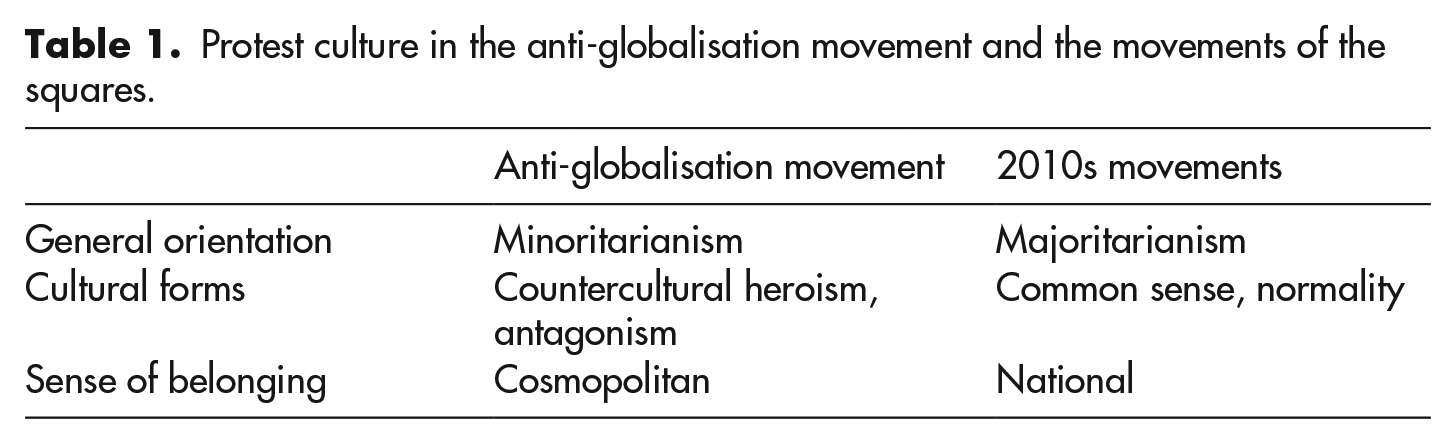
The term ‘majoritarianism’ here does not refer to a type of electoral system (e.g. majoritarian versus proportional) but to a certain ethical and political outlook. Popular movements are majoritarian because they are marked by an aspiration to express the will of the large majority of the population. Popular movements through history have been traditionally accompanied by a belief in the legitimacy of majority rule, the idea that the many have more right to make collective decisions than the few (see, for example, Postel 2007). In this sense, popular movements are at odds with the minoritarianism dominant in other movements, and in particular in some streams of anarchism, as seen in Emma Goldman’s (2012) despise of the majority which ‘cannot reason; it has no judgement’ (p. 70). Furthermore, an appeal to minorities rather than majorities has been a strong trait of so-called ‘identity politics’ (Calhoun 1994), involving a defence of cultural, social, religious, ethnic, and sexual minorities against overbearing majorities.
The attempt to appropriate the ‘common sense’ as that ‘chaotic aggregate of disparate conceptions’ held by the majority (Gramsci 1971: 422) is the logical accompaniment of majoritarianism. Many popular movements, from the Chartists to the US People’s Party, have tried to cast their action in the language of normality, reasonability, and respectability. They have framed themselves as champions of the legitimate grievances of the ‘common man’ or the ‘average man’ opposed to irrational and self-serving elites (Kazin 1995). This search for normality is clearly at odds with the orientation of many recent social movements, strongly connected with countercultures (Roszak 1969). These and similar movements have often valued diversity and exceptionality, to counter homogenising social norms. The anti-globalisation movement, and in particular its autonomous and direct-action component (Juris 2008), was deeply imbued with such countercultural spirit. Participation in it was tied to an oppositional lifestyle, including practices such as squatting, veganism, and ‘dumpster diving’ (Day 2005). As Blair Taylor (2013) has argued ‘just as the New Left drew numbers from the hippie counterculture, many in the anti-globalisation movement came out of the countercultural upsurge of the Nineties, in particular the political punk subculture’ (in Bieger et al. 2013: 87).
Finally, popular identity has a strong connection with national identity, per Antonio Gramsci’s observation that ‘popular’ and ‘national’ can almost be considered as synonyms (Gramsci & Forgacs 1988, 366). Popular movements often presented themselves as defenders of the national community, using the imaginary of the nation as a unifying symbol for an otherwise highly diversified social constituency (Laclau 2005: 184–186). This has been seen, for example, in the Spring of Nations of 1848 (also known as ‘Springtime of the People’), with its attempt to establish new independent nation-states against empires, and also in the way, the Left popular fronts of the 1930s invoked national identity to galvanise supporters in the fight against fascism (Jackson 1988). As we shall see, the nexus between the popular and the national which comes back to the fore in contemporary movements is at odds with the suspicion of the nation of much late 19th- and 20th-century socialism and more so with the cosmopolitan identity (Della Porta et al. 2006) of the anti-globalisation movement.
Having established a theoretical and analytical framework to explore different traits of popular identity, in the continuation of this article we shall examine to what extent these traits are represented empirically in the movements of the 2010s, and how they differ from the identity frames prevalent during the anti-globalisation protest cycle.
Searching for the ‘social majority’
No message uttered from protest movements during the 2010s has stuck more powerfully in the public imagination than the by now famous Occupy Wall Street’s slogan ‘we are the 99%’. What made this sentence so resonant was its capacity to capture the widespread discontent spawned by the economic crisis of 2007–2008, and the sense of possibility it engendered in protest movements. This slogan is the most representative expression of what has sometimes been described as a new majoritarianism (Juris et al. 2012) that has been a central trait of social movements over this decade. Central to this majoritarianism is a renewed belief in the power of ‘numbers’ of the type that animated many movements of the modern era (see, for example, Tilly & Wood 2015).
This is perfectly captured in the statistical opposition of the 99% of common people against the 1% of greedy elites, that echoes the traditional opposition the legitimate demands of the ‘many’ against the arrogance of the ‘few’, of ‘oi polloi’ against the arrogance of ‘oi oligoi’ (Balot & Trochimchuk 2012). We find frequent expressions of faith in the power and virtue of the majority as seen in the proclaim ‘we are many’, used in the title of an activist/researcher book on Occupy Wall Street (Khatib et al. 2012), or in the slogan ‘we are legion’ utilised by hacker group Anonymous. In Spain, the indignados cast themselves as expressions of the entirety of the citizenry (ciudadania) allied against the institutions, leading to talking of an emerging ideology of ciudadanismo (‘citizenism’). Activists in the Indignados movement and in Podemos often referred to a ‘social majority’ to express their desire to represent a broad section of society. Similar was the inclusive label of ‘aganaktismenoi polites’ (indignant citizens) adopted by Greek protestors, who in their communiqués from Syntagma square presented themselves as the ‘majority of the people’ against the ‘profit of the few’ (Real Democracy Greece 2011). Likewise, the Gilets Jaunes insisted on the fact that they represented all the citizens and had the majority on their side. Similar echoes can be found in the Gilets Jaunes movement that emerged in France in 2018, and its celebration of diverse social support. Across these movements a majoritarian stance was premised on the perception that being on the side of the majority is crucial to political legitimacy.
The majoritariann turn can be best understood by contrasting it with the minoritarian stance dominant in large sections of the anti-globalisation movement. This position was poetically expressed by Subcomandante Marcos – the leader of the Zapatista smovement in South-Eastern Mexico and possibly the anti-globalisation movement most influential ideologue – in the ensuing self-description: Marcos is gay in San Francisco, Black in South Africa, an Asian in Europe, a Chicano in San Ysidro, an anarchist in Spain, a Palestinian in Israel, a Mayan Indian in the streets of San Cristobal, a Jew in Germany, a Gypsy in Poland, a Mohawk in Quebec, a pacifist in Bosnia, a single woman on the Metro at 10pm, a peasant without land, a gang member in the slums, an unemployed worker, an unhappy student and, of course, a Zapatista in the mountains. Marcos is all the exploited, marginalised, oppressed minorities resisting and saying ‘Enough’. (Marcos and Vodovnik 2004: 14)
In line with Marcos’ celebration of the dignity of minorities, the anti-globalisation movement cast itself as a site of convergence where these numerically inferior, yet morally superior, groupings could come together, such as in the occasion of counter-summit protests (anti-G8, anti-WTO, etc.) and World Social Forums (Routledge 2003). But apart from their amassing in these international protests, participants in the movement seemed to believe that while being ‘everywhere’, as expressed in the title of a famous activist book published around the time of counter-summit protests (Credland et al. 2003), they could hardly lay a claim to numerical superiority in any specific location.
To be fair, already in the anti-globalisation movement, one could find hints of a majoritarian discourse, implying numerical superiority as a ground for legitimacy. This could be seen in slogans as ‘You G8, we 6 Billion’, trying to cast the G8 as a small elite standing against the interest of the overwhelming majority of the world population; in the Zapatistas appeals to ‘humanity against neoliberalism’; in the naming of People’s Global Action, a key campaign group during the early phase of anti-globalisation struggles; or in refences to the citizenry in different anti-globalisation protests (Pleyers 2010, 131). Despite these majoritarian inklings, the discourse of the anti-globalisation movement remained mostly anchored to a minoritarian orientation, and a suspicion of the ‘silent majority’ complicit in consumerism. In this sense, the anti-globalisation movement was a continuation of a long-standing anti-majoritarian spirit seen in many movements of the second half of the 20th century, as represented in a famous 1968 poster where the words ‘Nous sommes la majorité’ (we are the majority) was overlaid on the image of a truncheon-armed policeman.
Populist movements with popular support
The majoritarian ambition of popular social movements in the 2010s needs to be understood in light of the strong popular support this protest wave has enjoyed. These movements have mobilised a heterogeneous constituency, as seen in the diversity of participants in protest camps, as the ones in Puerta del Sol in Madrid, Syntagma Square, in Athens and Zuccotti Park in New York (Calvo 2013; Cordero-Guzman 2011; Milkman et al. 2013). Furthermore, many of their participants were not people with prior protest experience and affiliation. These movements varied strongly in participation across different countries. While it has been estimated that between 6.5 and 8 million Spaniards participated in the indignados movement in one way or another (RTVE 2011), significantly lower was the participation in Occupy Wall Street in the United States. In the case of the French Yellow Vests movement, it is estimated that 3 million people participated in protests (Dormagen & Pion 2021). Even more impressive yet has been the widespread public sympathy these movements have earned at their peak, with most countries seeing a wide majority of public opinion expressing support for them and their cause.
In June 2011 a poll by el Pais gave 66% of Spaniards as sympathising for the indignados, with 81% agreeing with the reasons for the protests (Garea 2011). Such level of support continued in the following months, topping 68% in a new poll conducted on the occasion of the first anniversary of the movement (Lobera 2012) and even going up to 78% on the second anniversary (Garea 2013). In Greece, an opinion poll in June 2011 gave 86% of Greeks as holding a positive opinion of the aganaktismenoi (Public Issue 2011). High, though comparatively lower, levels of public support have been enjoyed by Occupy Wall Street. In mid-October 2011 a New York Times poll stated that 46% of Americans agreed with the movement (Zeleny & Thee-Brean 2011), though support declined steadily in 2012, with some people blaming the confrontational tactics used by Occupy Oakland (Enten 2012). Similarly popular has been the Gilets Jaunes movement which at its inception commanded 72% of public support (Chrisafis 2018), before receding in 2019.
Hence, the majoritarianism of these movements was not only a matter of identity and propaganda. It was objectively backed up by the strong popular sympathy they managed to attract. Such strong popular support needs to be understood as a reflection of more favourable political opportunities (Tarrow 1998: 71–75) unlocked for protest movements in the aftermath of the Great Financial Crisis (Mirowski 2013). Widespread social discontent produced by the great financial crisis and the incapacity of existing political forces and social movements to channel it has allowed protest movements to tap into a diverse array of demographics, including many people with no prior protest experience (Milkman et al. 2013 and Calvo 2013; Shultziner and Kornblit 2020). Yet, in turn, arguably these political opportunities would have never come to fruition had social movements not developed a discourse and forms of collective identity capable of capturing them.
This change in perspective has partly come as a result of an active process of self-reflection, aimed at overcoming what many activists involved in this wave saw as the ‘self-ghettoising’ tendencies of previous movements. This is summed up by the words of Leonidas a Indignados participant in Barcelona who asserted that while ‘the anti-globalisation movement represented only the militant Left, what we needed instead was to mobilise all the people’ (Gerbaudo 2017: 106). All in all, these movements were imbued with the desire to overcome pre-existing political affiliations and appeal to people who were not politicised and organisationally affiliated, as seen in the frequent ban to display factional political symbols in protest events. Their dominant frame was to forge a broad coalition capable of uniting people with very different backgrounds and persuasions, yet united by material interests and opposition to the elites.
Appealing to common sense and the nation
In their complex, these different identity expressions conjure up an understanding of social movements’ populism as an appeal to all citizens who feel wronged by political and economic elites that are accused of impoverishing and disenfranchising them. This is most clearly a populist framing but a very different populism from that usually associated with the term ‘populism’ in mainstream discourse, strongly informed by its association with the populist right of the likes of Donald Trump in the United States, Matteo Salvini in Italy, and Jair Bolsonaro in Brazil. It is a populism whose popular identity is strongly ‘inclusionary’ rather than ‘exclusionary’ (Mudde & Kaltwasser 2013) as it discursively sets a very low bar for entry. Furthermore, its negative counterpart is not constituted by immigrants and foreigners, as it is for the populist right, but rather by economic elites against which the discourse of these social movements is often directed, as seen in the polemic against the 1% in Occupy Wall Street, or against Macron accused to be the ‘president of the rich’ by the Gilets Jaunes.
The inclusionary character of social movement populism and majoritarianism is seen in their attempt to reclaim common sense and adopt an aura of normality that is at odds with the countercultural orientation of many previous social movements. Indicative of this trend is the manifesto of Democracia Real Ya, one of the leading groups in the Spanish indignados: We are normal and common people. We are like you: people who get up every morning to study, work or find a job, people who have family and friends. People who work hard every day to provide a better future for those around us. Some of us consider ourselves progressive, others conservative. Some of us are believers, some not. Some of us have clearly defined ideologies, others are apolitical, but we are all concerned and angry about the political, economic, and social outlook that we see around us: corruption among politicians, businessmen, bankers, leaving us helpless, without a voice. This situation has become normal, a daily suffering, without hope. But if we join forces, we can change it. It’s time to change things, time to build a better society together. (Democracia Real Ya 2011)
This text epitomises both how they appealed to a very diverse set of constituencies, and how they tried to shed associations of protest with adventurism and militancy, to present themselves as people just ‘like you’. Further indicative of this trend is the indignados slogan ‘no somos anti-sistema. Es el sistema que es contra nosotros’ (We are not against the system. It is the system that is against us), by means of which activists strived to counter news media labelling of activists as irrational ‘anti-sistemas’ (anti-system people), bent on subversion for subversion’s sake.
Partly similar was the stance of the Gilets Jaunes movement that presented itself as an avenue for ordinary citizens rather than political militants. In the ‘assembly of assemblies’ of Commercy declaration of 26 to 27 January 2019 protestors presented themselves as ‘the Yellow Vests of roundabouts, car parks, squares, assemblies, demonstrations’, highlighting how their protests were embedded in every spaces. The very use of the yellow vest signified an attachment to everyday experience of ordinary and working people. Furthermore, protestors used it as a surface on which to write slogans against politicians, as well as the number of the department they were coming from, as if to indicate they were just ordinary people, often coming from provincial areas and with a sense of pride in their community. Compared to the 2011 protest wave, if anything the Gilets Jaunes achieved an even greater degree of local penetration, with strong support in small and medium towns of what the media described as ‘forgotten France’ (Shultziner & Kornblit 2020).
Within the Gilets Jaunes appeal to common sense and normality was partly obfuscated by the image of violence associated with movement, due to the frequent clashes with police, and the heavy toll it took on the movement (Bock 2019). The media attempted to depict protestors as ‘mechants’ (evil), ‘racaille’ (scum) or ‘casseurs’ (thugs). Yet, protestors constantly insisted that violence had to be blamed on the police. For example, in the above mentioned ‘assembly of assemblies’ document it was stated that ‘We revolt against the high cost of living, precariousness and misery. We want, for our loved ones, our families and our children, to live in dignity’, while deflecting accusations of violence by saying ‘We condemn all violence against protesters whether it comes from law enforcement or violent groups’.
Connected to this attempt to reclaim common sense has been these movements’ recuperation of national identity. While the anti-globalisation movement adopted, almost by definition, a cosmopolitan identification (Della Porta 2007) and the project of a ‘globalisation from below’ (Della Porta et al. 2006), trying to build alliances across borders, in the movements of the 2010s references to national identity were clearly dominant, though often accompanied by claims to international solidarity. This was already evident in the movements of the Arab Spring, which had much influence on ensuing protests in the West, that presented themselves as movements of national liberation and used often national flags to represent the people. The Occupy Wall Street movement contained many references to national identity, from the stars and stripes flag appearing in different encampments to protestors dressed as unionists or as Captain America, to a discourse often making references to US history and its struggle for equality and democracy.
Elsewhere references to national identity were far more divisive and controversial. During the 2011 and ensuing protests in Syntagma square in Athens, the use of national flags was associated with one of the two sections of the squares, the so-called ‘upper square’, closer to parliament. This was the part of the square hegemonised by right-wing groups, including the Free Greeks (Eleutheoi Ellenes) that called for an exit from the euro, and even occasionally by the neo-fascist Golden Dawn. In Spain, protestors did not use the national flag because of its strong association with the Franco period, but some adopted the Spanish Republican flag, a symbol of resistance against fascism. References to national identity were far more explicit in the Gilets Jaunes movement. The French flag was often seen in demonstrations and encampments in roundabouts, while the movement heavily tapped into the national imaginary of the French revolution. All in all, this use of national symbols constitutes a clear break from the imaginary of the anti-globalisation movement, and its cosmopolitan view. Yet, as we shall see this is also the aspect of the populist turn that has raised most concerns among many activists.
Challenges of a popular reunion
The adoption of a popular identity in the 2010s protest wave constitutes a major transformation in protest culture. As I have argued over the course of the article, this populist turn involves different elements: a majoritarian appeal, trying to ally disparate sections of society and emphasise strength in numbers, and an appeal to common sense and national identity as unifying factors and sources of legitimacy. Concluding our analysis, I shall focus on some of the implications of this populist turn and the controversies it has generated among activists.
If approached from a sympathetic angle, the populist turn can be seen as a positive evolution in protest culture, trying to tap into new political opportunities while addressing some of the limits of previous protest movements. This development is the reflection of a profoundly different zeitgeist from that prevalent at the height of neoliberal hegemony in the 1990s and 2000s. While appeals to the entirety of the people to fight against the elites, would have felt out of place in the anti-globalisation protest cycle, at a time when neoliberalism was mostly uncontested as the dominant ideology, they have found a fertile terrain in societies deeply impacted by rising unemployment and cuts to public services as in the aftermath of the 2008 financial crisis. Many activists I interviewed in my work (2017) expressed the desire of overcoming the mistakes of previous movements and include people previously marginalised by politics.
The populist turn is coherent with the understanding of the world and social ills put forward by these movements. The 2010s popular protest movements have constantly painted the diagnosis of an atomised and fragmented society, unnecessarily divided across religious, gender, ethnic, and class lines, in a way that ultimately favoured elites. They have persistently called on citizens to ‘come together’ and ‘act together’ against common enemies, framing the question of economic inequality as a rallying point to fight against the establishment. In this sense, the adoption of a popular discourse can be seen as conducive to a syncretic moment compensating for the condition of cultural fragmentation of advanced capitalist societies (Nicholson & Seidman 1995). Indeed, many of these movements took the semblance of social rituals of popular reunion and fraternisation aimed at healing social rifts while focusing anger against economic and political elites. This discourse seems to have been very effective in mobilising ordinary citizens as seen in the wide support these movements have managed to harness. However, within these social movements, some criticisms were raised about its implications. Three issues of contention have been brought to the fore: (1) the risk of undermining internal pluralism, (2) the threat of nationalistic drifts, and (3) the inherent haziness and instability of popular identities.
Some activists and scholars have argued that utilising a discourse of ‘the people’ led to an elision of diversity and pluralism, in a way that ultimately reinforced the subaltern position of gender-based groups and ethnic and cultural minorities. Indicative of this position is the criticism of Jeffrey Juris et al. (2012) regarding ‘Occupy’s homogenizing discourse and practice’ which they saw as leading ‘to a difficulty recognizing and addressing internal specificity and difference’ (pp. 435–436). In October 2011 the People of Colour Working group criticised a draft declaration of the assembly in Zuccotti Park, the initial version of the one quoted at the beginning of the chapter, which described participants as ‘one people, formerly divided by the color of our skin, gender, sexual orientation, religion, or lack thereof, political party and cultural background’. Some activists have even retrieved in the 99% versus 1% discourse traces of a colonial mentality (Kilibarda 2012). In the Spanish Indignados, similar conflicts developed around this question. During the May 2011 protests in Puerta del Sol a feminist banner was removed, because it was felt by some to be too sectional and not fitting with the ‘ecumenical’ spirit of the camp (Europa Press 2011). While some of these criticisms are debatable or exaggerated, it is evident that the adoption of a popular identity implies a trade-off between unity and pluralism, in terms of the representation of the different identities of the movements and groups supporting it.
Yet more vociferous has been the debate about the adoption of references to the nation with the fear it may lead to a nationalistic drift and hi-jack by the far right. In 2011, this worry was echoed from Greece where right-wing movements such as Golden Dawn in Greece tried to captivate the movement, to the United States where antisemitic groups created social media pages claiming a connection to the movement where ‘the 1%’ was equated with Jews. Similar fears emerged in the Gilets Jaunes movement, where there were repeated attempts of infiltration by various right-wing groups. These tensions surfaced in some incidents, such as in the 9 February 2019 march in Lyon where leftist activists clashed with far-right protestors.
Risks of infiltration are always a threat in popular movements with diverse support and an inclusive ethos. However, the adoption of national identity does not automatically mean the adoption of a nationalistic stance. In fact, throughout the history of modern protest, social movements have often resorted to the use of national symbology (Calhoun 1993). Furthermore, this attitude reflects that – counter to the seamless narrative of a globally interconnected world – nations continue to constitute the main horizon of everyday experience for the majority of citizens (Calhoun 2007; Castells 2012: 335). Finally, social movements are compelled to articulate political demands and action in a national framework in view of the absence of democratic institutions that could act as interlocutors (Fraser 2007). What is clear, is that the national identity mobilised by these movements is very different from that mobilised by the populist right, and almost invariably it does not involve animosity against migrants and foreigners, but to the contrary has a strong inclusionary character.
A final issue of concern is the very haziness of popular identities and the way in which they can exacerbate the tendency towards the impermanence of protest movements. As Laclau notes, vagueness is something intrinsic in popular identity, because it potentially encompasses the totality of the citizenry, and therefore cannot be reduced to specific sections within it (Laclau 2005: 118). While some Marxists tend to see this adoption of popular identity as detracting from class politics (Žižek 2006), they view as the only legitimate form of political identity, it is evident that vis-à-vis the great fragmentation of social identities in our society, mobilising popular identity can serve a ‘syncretic’ role as previously discussed.
All in all, the populist turn of social movements in the 2010s constitutes a very significant cultural shift. In adopting popular identity, protest movements have shed the minoritarianism prevalent in previous movements, their countercultural emphasis on voluntaristic rebelliousness, and their adoption of cosmopolitan identity. In so doing they have tried to tap into the same ‘populist zeitgeist’ (Mudde 2004) that has been mobilised by many forces, especially of the right, in the field of electoral politics, but with the intention of gearing it towards progressive and egalitarian ends, rather than towards nativism and chauvinism. Theirs has been an adamantly ‘inclusionary’ rather than exclusionary populism as that mobilised by the likes of Trump Salvini and Bolsonaro (Mudde and Kaltwasser 2013).
Some signs seem to point to the fact that the populist moment may be fading giving way to a post-populist phase (Gerbaudo 2021). Yet, the populist turn of protest movements is likely to play a lasting role in defining the direction of travel of social movements in coming years, laying emphasis on the need for unity and solidarity across a diverse set of constituencies, the urgency of focusing on the issue of economic inequality, and the connected priority of the fight against economic elites and the political class abetting them. The 2010s have been a turbulent decade after which politics will never be the same, and this also applies to the field of protest movements, which has not been immune to the “populist moment” traversing society at large.