




Abstract
In this article, an interpretation of Marx’s notions of abstraction and concretization is presented. Unlike Leszek Nowak’s approach, Marx’s use of idealizations is not a reversible process of adding and removing idealizing assumptions. Marx had a richer use of the term abstraction, one in which concretization involves a creative moment of conceptual innovation. Marx adds new variables and new assumptions and elaborates new categories at different levels of abstraction in order to show the unity between appearances and essences. De-idealization, according to Marx, involves both recomposition and de-isolation. Also, concretization, for Marx, does not follow a linear approximation to reality, but rather a hermeneutical circle that is constantly in the process of reframing categories to provide answers to different questions. As a case study, this article shows an interpretation of Marx’s labor theory of value.
Introduction
The notion of ‘idealizations’ was popularized by the Polish philosopher Leszek Nowak (1943–2009), who reinterpreted the methodological ideas expressed by Marx in his introduction of the ‘Fundamental elements for the critique of Political Economy’, better known as Grundrisse (Marx 2005). Therein, Marx stated that, in the correct method of Political Economy, one must depart from the analysis of concrete facts and that, through the use of abstraction, one must then decompose the concrete element into parts, which must be analyzed separately. Once each part has been studied in isolation, one then begins the return process, from abstract to concrete, where each analyzed part is re-integrated in a systematic view, which helps one better understand the concrete fact itself (Marx 2005).
Nowak reformulated Marx’s view on the abstract–concrete relationship using other terms: idealization and de-idealization. Idealization is a mental operation utilized by scientists, wherein they idealize assumptions (Nowak 1980, 1992; Nowakowa & Nowak 2000). These assumptions could be exaggerations (e.g. Vacuum assumption, ideal gases, infinite masses, perfect rationality) that misrepresent a fact in order to simplify the empirical subject matter. This simplification facilitates mathematical and conceptual manipulation within a model. Nowak’s view is that idealization seeks to neutralize secondary properties, in order to isolate primary properties, or the essence, of phenomena (Nowak 1980, 1992; Nowakowa & Nowak 2000). This essence could be understood as a scientific law which operates under ideal conditions, in a pure state, where no disturbance factors exist. Then, the process of de-idealization takes place, in which the idealizations are reintroduced, but are now substituted with more realistic assumptions (Nowak 1980, 1992; Nowakowa & Nowak 2000).
However, it seems that some Marxian methodological ideas are not sufficiently represented by the Nowakian interpretation. One example of this is how Marx addressed what he called ‘concrete forms’. In volume III of Capital, he said, ‘. . . Our concern is rather to discover and present the concrete forms which grow out of the process of capital’s movement considered as a whole’ (Marx 1991: 1; emphasis in the original). By concrete forms, it seems that Marx meant theoretical entities that emerge through the interaction of different processes, in this case, the processes of production and circulation. Examples of these concrete forms, studied in volume III of Capital, are competition, the cyclical tendencies of the average rate of profit, the production of a mass of surplus value and its distribution among different kinds of capital (industrial, commercial, banking, and rentiers), the antagonisms of these different capitals, the role of fictitious capital in speculation, the absolute and relative ground-rent, and the social reproduction of different social classes in the system. These elements suggest that concretization, at least in volume III of Capital, is not simply a process of reversion of idealizations. It seems that concretization, according to Marx, follows a more complex and creative process of conceptual innovation. In this sense, the main question this article will address is the following: was Nowak’s reformulation of Marx’s method an appropriate way to understand Marx’s notion of abstraction and concretization? If not, then how should we understand both terms, according to Marx?
In this article, I will present a critical review of Nowak’s interpretation of Marx’s method, and as an alternative, I will present an interpretation of Marx’s concept of abstraction and concretization elaborated from a contemporary philosophy of science view. The subject might be of interest for scholars specialized in the study of Marx’s methodological ideas because discussing Nowak’s work might help to understand some specific ways in which Marx used and produced different abstractions to study the capitalist system. Marx uses the term abstraction in different senses throughout his work. Ollman (2015) distinguished between ‘abstraction as a verb’, ‘abstraction as a noun’, and ‘real abstraction’. The former is used to refer to a practice of elaboration of categories of thought. The second refers to the product of that practice that, in this article, I will characterize as a model because Marx thought counterfactually using abstractions (or schemas) which contained several assumptions that he carefully manipulated to understand different possibilities and limits of capitalist development. Real abstraction, on the contrary, refers to a substantive ontological level, where social relations have an objectivity such as would be the case with abstract labor understood by Marx (1992: 156) as a phantom-like objectivity. Nowak seems to focus on the first two senses of abstraction by trying to show how Marx used idealizing assumptions to construct abstractions as a noun to ultimately arrive at knowledge of essences behind appearances where ‘real abstractions’ are situated.
The study of the idealizations and de-idealizations that Marx made in Capital could provide useful methodological elements for studies that carry out analyses of concrete facts from Marxist categories such as cryptocurrencies and digital commodities (Rotta & Paraná 2022), the commodification of knowledge and information (Rotta & Teixeira 2019), urban studies and real estate speculation (Swyngedouw 2019), and analyses on agrarian issues on peripheral realities (Das 2019), among other cases of applications, where concrete applications of Marxian categories to case studies could be understood as different cases of de-idealization. But, as we will see with the idea of the hermeneutic circles and some insights from contemporary philosophy of science (as ontologization), the process of de-idealization is never linear and mechanical. It requires a complex and situated process of reformulation of the categories that force to have a non-dogmatic, but a dialectical vision of the Marxist categories themselves which underlines its malleable character in order to make plausible interpretations of singular realities like the Latin-American countries (Bautista 2014).
This way of putting things may be useful to know how Marx combined different methods and techniques from different authors of both German idealism and English Classical Political Economy: Hegel and Ricardo. From Hegel, as we shall see, Marx retained the idea that abstraction is a way of understanding the ontological movement of the real through the elaboration of an appropriate set of categories that present essence and appearance, identity and difference, and quantity and quality as a dynamic organic unity (Moseley 2019; Ollman 2019). From Ricardo, Marx retained a specific way of using abstraction that is not in Hegel: the use of assumptions and idealizations for counterfactual reasoning (Reuten 1999). Let us recall that Ricardo is one of the first authors of Political Economy in making use of ceteris paribus assumptions that later were an important antecedent of modern practices of modeling (Morgan 2012; Morgan & Knuuttila 2012). Marx, in this sense, might be recognized as an important antecedent of this kind of practices, where model-based reasoning is important for understanding causal relationships (Reuten 1999). This idea, as we shall see, could be defended by highlighting the role idealizations had in Marx’s counterfactual thinking about the different possibilities and limits of capitalist development.
In this context, I will defend the following thesis: Karl Marx used idealizations in Capital to study capitalism. But Marx’s use of idealizations does not follow a reversible process of adding and removing idealizations as Nowak put it. It is more complex. Idealizations are used by Marx to study abstract forms (like surplus value), but also to study concrete forms (such as the transformation of value into prices). This is so because Marx’s use of idealizations is part of a rather general process of abstraction that might be understood as a process of making different categories, concepts, and models that shape specific ways of thinking (Bautista 2014; Dussel 2001; Ollman 2015; Sacristán 2014). In this context, concretization, according to Marx, is not a simple process of reversion of idealizations. It is a creative process of elaboration of new categories and concepts that answer a variety of questions at different levels of abstraction (Dussel 2001; Knuuttila & Morgan 2019), wherein ‘concrete forms’ never cease to be abstract but help us to interpret facts framing and reframing different categories (Gadamer 2006; Grondin 2015).
To defend the above thesis, the rest of the article is divided as follows. In ‘Nowak’s interpretation of Marx: the idealizational method’ section, the Nowakian approach to Marx’s method is presented extensively and some critiques are shown. In spite of Nowak’s historical merits (he was the first to show the advantages of idealization in counterfactual reasoning in the philosophy of science), it seems that he oversimplified Marx’s notion of abstraction, as we will see in ‘Marx’s view on abstraction’ section. In ‘The path to the abstract: abstract labor and surplus value’ section, I will show the ‘path of abstraction’ that Marx followed in Capital (Volume 1) through his theory of value: Marx departed from an apparent category (the commodity form) and arrived at an essence: surplus value understood as unpaid abstract labor. Subsequently, as I will show in ‘The path to the concrete: the transformation of values into prices’ section, Marx followed a ‘path to the concrete’ where, in volume III of Capital, he dealt with the transformation of values into prices and explicitly elaborated new categories and concepts that might be understood as de-idealization by recomposition (Knuuttila & Morgan 2019). In ‘Concretization as a creative process of framing and reframing hermeneutical circles’ section, I further elaborate on Marx’s notion of concretization, presenting connections with the current philosophical literature to point toward a hermeneutical interpretation of Marx’ method. ‘Final remarks’ section presents some final remarks.
Nowak’s interpretation of Marx: the idealizational method
Leszek Nowak (1992) identified his own approach as neo-Hegelian. This approach interpreted Hegel’s notion of abstraction as idealization. As was previously stated, Nowak elaborated the terms idealization and de-idealization to reinterpret Marx’s view of abstraction and concretization. Nowak claimed that this is the proper scientific method to be used in both natural and social sciences.
Idealization is, according to Nowak, a simplifying assumption that tends toward a limit which misrepresents some properties of target systems. The objective is to neutralize secondary aspects of phenomena in order to isolate their primary and essential aspects. Idealizations could have the following forms
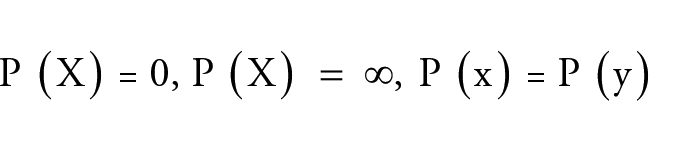
This means that idealizations tend toward a limit: zero, infinite, and equilibriums between different magnitudes. Idealizations are counterfactual statements and might be extreme, semi-, or weak falsehoods (Hausman 1992; Mäki 1992; Nowak 1980), but all involve some kind of simplification in order to facilitate the conceptual and mathematical manipulation of certain target system representations.
Examples of idealizations that Nowak mentioned in his work are the assumption of ideal gases, perfectly rigid bodies, and perfect vacuums. Examples of some of Marx’s idealizing assumptions, which we will see below, include the homogeneous technical composition of different capitals at a social scale and average rates of profit. According to Nowak, a scientific law, . . . is basically a deformation of phenomena. It resembles much more the logical structure of a caricature than that of the generalization of facts. The crucial point for a proper understanding of the idealizational procedure is that it differs fundamentally from that of abstraction. Abstraction, i.e. the omitting of properties, leads from individuals to sets of individuals (and from sets of individuals to families of sets, etc.). Idealization does not do this. Omission of the dimensions of physical bodies does not yield any set of physical bodies but the mass-point. Abstraction is generalization. Idealization is not. (Nowak 1992: 10–11; emphasis added)
As we can see, for Nowak, a scientific law is a deformation of phenomena, quite similar to a caricature, and it is the outcome of the process of idealization. This process ‘differs fundamentally from that of abstraction’, wherein the ‘omission of properties’ leads from ‘sets of individuals’ to ‘families of sets’, where its main purpose, as Nancy Cartwright (1989) would put it, is to ‘subtract’ relevant features of the real objects that are of interest to isolate from the rest that are not relevant. Non-relevant features are omitted in the analysis. In contrast, idealization does not do this. For Nowak, abstraction is a form of generalization, while idealization is not. It is an isolation tool (Mäki 1992). ‘The method of idealization is basically a method of deformation, . . . it transforms our world into ideal worlds’ (Nowakowa & Nowak 2000: 9). For this reason, this approach claims that the use of idealizations is quite similar to caricatures: A cartoonist leaves out some details of the object presented, thus stressing what s/he claims to be characteristic of it. S/he does, roughly, a similar thing to what a theoretician does: both deform the objects of their study. Science consists of the same procedure which we find in caricature. Both deform the world which we inhabit. (Nowakowa & Nowak 2000: 11)
A similar view on idealization was hold by Cartwright (1989: 187) who claimed that ‘. . . in idealization we start with a concrete object and we mentally rearrange some of its inconvenient features – some of its specific properties – before we try to write down a law for it’. As an example, Cartwright (1989: 188) uses the case of the frictionless plane, where ‘we ignore the small perturbations produced by friction. But in fact we cannot just delete factors. Instead we replace them by others which are easier to think about, or with which it is easier to calculate’ (emphasis in the original). In this sense, an idealization seeks to ‘change’ some particular characteristics of the objects being studied (such as the frictionless plane) in order to remove inconvenient properties to produce an ideal model. Irrelevant aspects for the analysis are not erased, but they are exchanged for others with which it is easier to think.
For the application of an idealized scientific law in specific cases, there should be a process of concretization. This is a procedure of approximation, where the idealizing conditions previously introduced are removed and substituted by more realistic assumptions (Nowak 1980, 1992, 1994; Nowakowa & Nowak 2000). The neglected factor is then substituted by its realistic negation and it is reintroduced as a correction in the formula (Nowak 1992). ‘This procedure of concretization leads to a more realistic statement referring to less abstract conditions than the initial idealizational statement’ (Nowak 1992: 11).
When there is a process of de-idealization, certain deviations (or errors) of scientific law occur (Nowak 1992). These deviations are explained by the joint influence of several factors that were left over during the process of idealization. Now they play a role in the dynamics of what is modeled. For Nowak, normally ‘final concretization’ is not met in science (Nowak 1992). Eventually, the progress of science will lead to a substitution of idealizations by rather realistic assumptions. It seems that Nowak points to the desirability of de-idealization (Knuuttila & Morgan 2019). This is problematic, as we will see in ‘Concretization as a creative process of framing and reframing hermeneutical circles’ section.
According to Nowak (1992), the history of empirical science has passed through two stages in its development: inductive and idealizational moments. The first was based on a positivist methodology. The second is based on an idealizational methodology, where ‘. . . In physics the methodological breakthrough is connected with the work of Galileo . . . in biology the idealizational breakthrough was accomplished by Darwin . . . in economy by Marx . . . and in linguistics by Chomsky’ (Nowak 1992: 16). This is why Nowak (1980: 38) used to say that ‘Marx was the Galileo of social sciences’. It seems that Nowak’s view on the scientific method was monistic because he was of the opinion that there was a common method in natural and social sciences that every scientist should follow.
It is important to say that Nowak was interested in rebuilding Marx’s notion of abstraction as idealization and he embraced some cases of Marx’s Capital to show similarities with natural sciences. One example Nowak embraced is a version of the law of value (presented by Marx in Volume III of Capital). This law is expressed by Nowak in the following equation
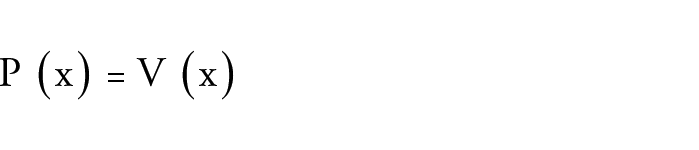
where V (x) = the amount of socially necessary labor time used for the production of a commodity X and P = the price of commodity X. However, on an empirical level, we see that there are many prices that are not equivalent to their value. Why? Nowak’s answer has to do with the use of idealizations: values and prices coincide only in ideal conditions, where the implicit idealizations in Marx’s law of value are, according to Nowak, the following: (a) market equilibrium, (b) perfect competition, (c) closed economies, (d) equal individual and social rates of surplus value, and (e) no differences in the technical composition of the agricultural and industrial sectors.
To use this law to calculate current prices, according to Nowak, we need to utilize a reverse process of de-idealization. This de-idealization is achieved by removing, correcting, or replacing the distorting assumptions with more realistic ones (Nowak 1980). For example, instead of perfect competition, one can assume imperfect (or monopolistic) competition, and instead of closed economies one can assume open economies, differences in the productivity of the agricultural and industrial sectors, differences in the technical composition of capital, and so on.
Nowak (1980: 25) correctly said that . . . Marx conducts his inquiry in a way which is not only incompatible with the common-sense view of science, but also in a way which is incompatible with the claims of modern philosophy of science: the law of value . . . is neither a law in the positivist sense, nor a law in the hypotheticist sense.
This is so because the scientific laws formulated by Marx are not generalizations made from particular observations (like how empiricists would characterize scientific laws, as mere regularities obtained by observation) or conjectures (as Karl Popper would say) that are contrastable with ‘our world’ by deductions and refutations. In this respect, Nowak (1980: 24–25) said, . . . The law of value, to use Popper’s terminology, is fulfilled in the world which differs from ours in its nomological structure. That is why Marx never uses the law for a direct explanation of empirical phenomena, but ‘transforms’ it establishing the statements being fulfilled in the worlds which are nomologically closer and closer to our world.
It is true that the ‘law of value’, as it was formulated by Nowak, holds that P(x) = V(x) is only possible under ideal conditions (through idealizing assumptions). However, the term ‘transforms’, in Nowak’s interpretation, is a specific way to understand concretization, but it is not the only one. There are several ways to de-idealize a model (Knuuttila & Morgan 2019; Suárez 1999; Winther 2020) and, as we will see in ‘The path to the concrete: the transformation of values into prices’ section, Marx followed a process of concretization by recomposing his abstractions, rather than by a mere substitution of idealizations, as Nowak suggested.
The Nowakian interpretation of Marx’s method is synthesized as follows: ‘. . . the main task of Capital: to build an idealizational theory of the bourgeois economy. And, at the same time, to introduce the method of idealization into the social sciences’ (Nowak 1980: 38). And this method of idealization was followed by Marx, in three steps: ‘(I) Marx introduces idealizing assumptions, (II) next he establishes the idealizational law, (III) and he concretizes it gradually or approximates it’ (Nowak 1980: 31).
As we will see in the following sections, this is not an accurate interpretation of what Marx was doing in his three volumes of Capital. First, although it is true that Marx used idealizations, his use of abstraction is not reducible to them. It is more complex. Second, Marx was not only interested in establishing an idealizational law, but a rather comprehensive set of concepts and categories to provide an understanding of daily-life phenomena. As we will see, hermeneutic aspects (Dussel 2001) here are relevant to understanding Marx’s purposes of modeling. Third, the process of ‘concretization’ is not only a gradual process of replacing idealizations with realistic assumptions. In volume III of Capital, Marx substituted certain idealizing assumptions with other idealizing assumptions and introduced new assumptions to build new abstractions that could answer different issues. Concretization, as we will see, is a creative process (Knuuttila & Morgan 2019) of constructing new abstractions (or models) that are not necessarily more realistic than the previous ones, but which contain more variables. Fourth and finally, it is misleading to attribute to Marx the Galilean methods Nowak had in mind. Marx was actually building hermeneutic circles that sought to provide a comprehensive and dynamic view of capitalism as we shall see in ‘Concretization as a creative process of framing and reframing hermeneutical circles’ section.
Other points that can be mentioned to show how Nowak’s portrayal is not adequate for understanding science in general is his failure to recognize that models have a wide variety of epistemological goals. The use of idealizations, in this context, is highly sensitive to those goals. Julian Reiss (2013) distinguishes, for example, between describing, explaining, predicting, and intervening in the world. Describing may involve idealizations to build ‘data models’ which seek to better measure phenomena, like statistics on poverty (Reiss 2013). Explaining may involve, in turn, idealizations to formulate laws under ideal conditions that, as in Nowak’s case, are used to address essential aspects of phenomena, to subtract causal mechanisms (Reiss 2013). Other idealizations are used only to facilitate mathematical manipulation to achieve accurate predictions, where representational purposes are not relevant (Ross 2016). Such is the case of expected utility theory, where idealizations build non-human agents that afford a flexible model that might be applied to predict the behavior of non-human agents such as plants, genes, animals, and bacteria (Ross 2012, 2016). There are other idealizations that can be used to facilitate intervention in the world, as suggested by Rasmus Winther (2020), with the concept of ‘ontologization’, where, following the metaphor of maps, simplified and distorted representations of reality can be made in order to facilitate several social practices in the world. Instances of some goals achieved by using maps are to get to a place (like using GPS), to identify natural resources of a country in maps which highlight certain features, or to make decisions considering some socioeconomic variables of a country such as distribution of poverty (Winther 2020).
The point is that the current philosophy of science tends to present a more pluralistic view on idealizations, de-idealizations, models, and abstraction than Nowak presented at the time with his vision. Nowak thought that idealizations were the method of modern science and he did not think that idealizations were just isolation techniques, or just a method, among others, of model making (Morgan 2012). As we shall see in ‘Concretization as a creative process of framing and reframing hermeneutical circles’ section, the pluralistic tendencies of the current philosophy of science should lead us to identify and recognize the great variety in which both idealizations and de-idealizations of theoretical models can be made, as well as the great variety of epistemological goals that are pursued in the different scientific practices.
Marx’s view on abstraction
Karl Marx (1818–1883) used to identify abstraction with thinking (Bautista 2014; Dussel 2001; Kosik 1976; Ollman 2015; Sacristán 2014) and thinking is grounded in categories. For categories, Marx followed the German tradition (mainly Hegel), which, in turn, had an Aristotelian influence. A category is a name given to properties (or processes) of the world. It is what can be preached about. It is the basis of thought. One cannot think without categories. In the Aristotelian tradition, categories were of 10 types: substance, quantity, quality, relationship, place, time, position, possession, action, and passion. According to Aristotle, categories are fixed and these categories exist in the world as natural classes. On the contrary, according to Hegel, categories are not fixed. They are in motion and are malleable (Bautista 2014; Dussel 2001; Kosik 1976). They constantly adapt to change.
There are categories that arise from taking into account some factors and not others (Bautista 2014; Dussel 2001). This generates the idea that there are categories that are at different levels of abstraction. For example, use value and exchange value are two different categories that are on the same level of abstraction; concrete labor and abstract labor are at another level of abstraction; and the valorization process and working process are at another level of abstraction. On his ‘path to the abstract’, Marx was making simplifications and decomposing to elaborate an appropriate set of categories and grasp the movement of his target. I will further elaborate on this argument in ‘The path to the abstract: abstract labor and surplus value’ section.
What is important here is to say that Marx understood abstraction as a process of creating categories (Dussel 2001; Ollman 2015; Sacristán 2014). Abstraction might be understood as the process of creating different categories, concepts, and models that shape specific ways of thinking (Bautista 2014; Dussel 2001; Ollman 2015; Sacristán 2014), which both enlightens and obscures according to the problem under study (Levins 2006). Abstraction as a cognitive process is grounded in social practices, where different practices form different categories (Martínez & Huang 2011; Radder 2006; Winther 2014). ‘Our abstractions always reflect choices’ (Levins 2006: 743). Marx perceived a close correlation between abstractions and social practices.
According to Marx, everybody uses abstraction, but not all use it properly. For example, his Critique of Political Economy is mainly a critique, both of the categories used by the bourgeois economists and of the common sense that presented capitalism as an absolute, natural, and eternal system, covering up the relative, historical, and contingent characteristics of the system (Bautista 2014; Kosik 1976). In this sense, we might say that Marx’s Critique of Political Economy is a critique of a superficial way of using abstraction that might produce pernicious reifications, that is, the treatment of ‘theory or projection as if it were a real, concrete thing that also is and describes the entire world’ (Winther 2020: 89). When an abstraction is a pernicious reification, ‘we overestimate our representation’s capacities and promises. We show no hint of skepticism about it, or acceptance of its potential limitations . . . our abstraction is universalized and narrowed, in addition to being utterly ontologized’ (Winther 2020: 89).
The correct use of abstraction, according to Marx, is related to a proper implementation of scientific methods that social sciences should use to produce adequate understanding of facts through an adequate set of categories (Dussel 2001; Sacristán 2014). This requires going beyond appearances. In Grundrisse, as we already saw, Marx argued that the correct scientific method for use in Social Sciences begins with what is concrete. Here it is important to utilize an interpretation from the Czech philosopher Karel Kosik (1926–2003) to better understand Marx. In Dialectic of the Concrete, Kosik (1976: 1) said that ‘. . . Dialectical thinking . . . distinguishes between the idea of a thing and the concept of a thing’. The ‘idea of a thing’ is a preconceived notion that is part of a daily-life routine, which gives this ‘thing’ a certain appearance. This appearance is part of a ‘pseudo-concrete world’ which ‘. . . is the chiaroscuro of truth and deceit. It thrives in ambiguity’ (Kosik 1976: 3). The ‘essence’ is not immediately revealed. Subsequently, . . . To capture the phenomenon of a certain thing is to investigate and describe how the thing itself manifests itself in that phenomenon but also how it hides in it . . . Reality is the unity of the phenomenon and the essence. (Kosik 1976: 3)
This unity between essence and appearance was exactly what Marx was thinking when, in Grundrisse, he exposed the decomposition of the whole into parts to be analyzed in isolation in order to reconstruct the totality in the latter stage of the process of synthesis. The process of abstraction, according to Marx, takes us from the concrete (or ‘pseudo-concrete’, as Kosik would say) world, to the abstract. Then, from abstract to concrete, there is a process of dissolution of pseudo-concrete ideas. Karel Kosik said, . . . In destroying the pseudo-concrete, dialectical thinking does not deny the existence or the objective character of these phenomena, but rather abolishes their fictitious independence by demonstrating their mediatedness, and counters their claim to autonomy with proving their derivative character. (Kosik 1976: 6)
This idea of the destruction of the pseudo-concrete is nothing more than avoiding thinking with ‘fictitious independence’ of social facts to demonstrate their mediatedness, that is, they belong to a system of interdependent relations. According to Marx (2005: 101), ‘the method of rising from the abstract to the concrete is only the way in which thought appropriates the concrete, reproduces it as the concrete in the mind’. For Marx, ‘rising from the abstract to the concrete’ is important in order to arrive at an already concrete thought that was, in reality, the ‘starting point’. In this way, that which is concrete is understood as the ‘unity of the diverse’, the ‘synthesis of multiple determinations’.
In Figure 1, the first arrow that goes from concrete to abstract would correspond to the moment of ‘analysis’ during investigation: the process of questioning the ‘pseudo-concrete world’. The second arrow that goes from abstract to concrete would correspond to the moment of ‘synthesis’ of the investigation: the process of demystification wherein unity between the essence and appearances is shown.
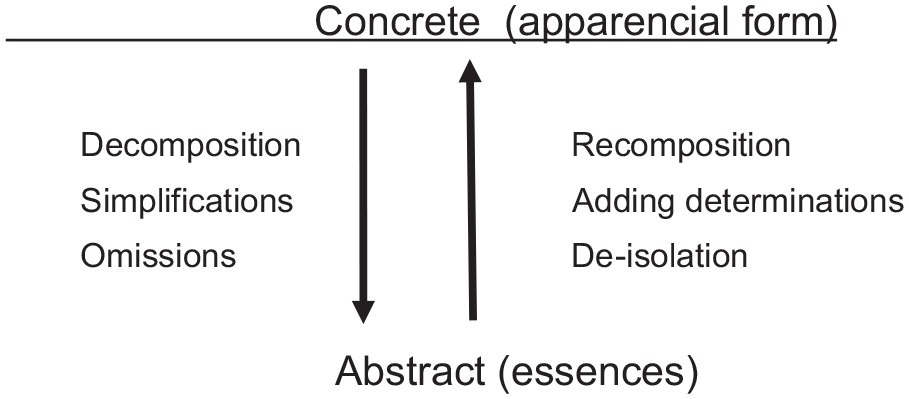
The relation abstract-concrete.
We can put the relation abstraction-concretization as a circular and feedback relationship between abstraction and ontologization (Winther 2020). Abstraction starts from the world and, through a cognitive process situated in social practices, tends to generate abstract representations where, according to Winther (2020: 60–79), three moments take place: calibration of units and coordinates, data collection and management, and generalization. In the first moment, following the metaphor of maps, we might characterize abstracting as producing maps (Winther 2020), where the representations are calibrated through the formulation of coordinates. Then, in the second moment, we move on to data collection to regenerate abstract representations from the evidence. Finally, generalization is performed by means of some protocols specific to each scientific practice, where there may be a careful selection of information that is considered generalizable, the formulation of the desired scale of the abstraction as well as its simplification (to make it manageable) (Winther 2020: 60–79). About ontologization, I will discuss in ‘Concretization as a creative process of framing and reframing hermeneutical circles’ section, but here it is enough saying that ontologization regards to the role abstractions have in shaping the world, where, in the case of the Marxian tradition, ‘thought begins to be radically critical when it opens itself to the ontological, because it is only when it is located in this position that thinking ‘can’ open itself to the transontological’ (Bautista 2014: 170), where the transontological is understood as a critique of the existing material living conditions (the ontological) in order to seek to transcend toward a new civilizational horizon.
Returning to the subject of abstraction, we might understand simplification as . . . a deliberate simplifying of something complicated (a situation, a concept, etc.) . . . It may involve a distortion of the original or it can simply mean a leaving aside of some components in a complex in order to focus the better on the remaining ones. (McMullin 1985: 248)
Simplification might involve the use of idealizating assumptions, as we saw in ‘Nowak’s interpretation of Marx: the idealizational method’ section with Nowak’s account. And certainly, Marx used this kind of simplification in his process of creating categories. Simplification is also closely related to decomposition because, in order to simplify, it is necessary to set some components of a complex aside. Decomposition requires identifying the components that are constitutive of a totality to make the separation of each component possible, so that they can be analyzed separately in isolation (Mäki 1992, 2011).
Recomposition, adding variables, and de-isolation are part of Marx’s concretization path (de-idealization), wherein he reassembles each part before analyzing it in isolation. In the process of integrating each part in a systematic totality, a new set of relations would emerge. This led him to create new categories and use new idealizations, as we will see in ‘The path to the concrete: the transformation of values into prices’ section. In this sense, I share the view of Moseley (2019: 283) who states that ‘capital in general and competition are the two main levels of abstraction in Marx’s theory in Capital and that they correspond to the theories of the production of surplus value in Capital I and II and the distribution of surplus value in Capital III’. Marx follows, as Moseley (2019) has shown a Hegelian logical structure in Capital, where ‘capital in general’ and ‘competition’ correspond with Hegel’s concepts of ‘universality’ and ‘particularity’, where the conclusions of the first level of abstraction are presupposed in the second level of abstraction. In Marx’s case, the total surplus value determined at the first level of abstraction of capital in general is presupposed in the theory of the distribution of surplus value. (Moseley 2019: 285)
But I think it should be emphasized that universality and particularity correspond to an essence and appearance that Marx wanted to show as an organic unity throughout the three volumes of Capital.
The distinction between essence and appearance is, for Marx, both methodological and ontological. Marx understood scientific explanation as ‘. . . the presentation of the unfolding [Entwicklung] of the thing itself’ (Sacristán 2014: 33). In order to show the unfolding of the capitalist system, Marx needed the distinction between essence and appearance to be a methodological point of departure that could situate aspects of the market related to the circulation process of commodities at the appearances level and at the level of essences: the production process of commodities. In volume III, Marx presented the unfolding of the internal relations of the capitalist system as unity between the essence (production process) and appearance (circulation process). In such a sense, the distinction between essence and appearance is an analytical distinction that led Marx to establish the separation between two spheres, which he analyzed in isolation in volumes I and II of Capital, and then synthesized as a unity in volume III. However, the distinction between essence and appearance is also an ontological distinction because, for Marx, the capitalist system is constituted by the two processes that, in combination, perpetuate themselves as a system that reproduces its own material conditions of existence throughout time (Harvey 2018).
In the next two sections, I will show how Marx applied this notion of abstraction in Capital. In ‘The path to the abstract: abstract labor and surplus value’ section, I will show how Marx made a path to the abstract in volume I of Capital to examine the appearance form (commodity) until arriving at the essence (living labor as a source of value). Later, in volume III he established a path to the concrete, in which production and circulation were studied as a unit, as a result of which some ‘concrete forms’ emerged. In studying these forms, a creative moment of conceptual innovation was necessary to develop new categories and concepts. I will exemplify the return process with the transformation of values into prices.
The path to the abstract: abstract labor and surplus value
The first chapter of volume I of Capital starts with the following claim: The wealth of societies in which the capitalist mode of production prevails appears as an ‘immense collection of commodities’; the individual commodity appears as its elementary form. Our investigation therefore begins with the analysis of the commodity. (Marx 1992: 1)
As we can see, Marx started his research, in volume I of Capital, from an apparent form: the commodity form. A commodity appears as an elementary or cellular-social form because, in some sense, it is the first experience (subjective and intersubjective) that all persons have of living under the capitalist system. It is in the interaction with the commodity that the person realizes that almost every good and service is bought and sold in the market and that it has a price.
Commodities are valuable. But in what sense are they valuable? How should we understand the term ‘value’? Value is a relationship between objects and subjects. These relationships are presented as double characters: as use value and as exchange value (Marx 1992). The use value is the quality that a commodity has given its material features that serve to satisfy specific human needs. The exchange value, on the contrary, is the amount of what one commodity is worth in terms of another. Use value tells us about the qualitative features of a commodity, while exchange value tells us about the quantitative features of a commodity, that is, how much X is worth in terms of Y. A commodity must have both a use value and an exchange value to be exchanged in the market. All commodities have a use value, but not everything that has a use value is a commodity (e.g. Gifts).
The case of cryptocurrencies such as Bitcoin can be useful to see the relevance of Marx’s distinctions in the analysis of new phenomena in contemporary capitalism. Cryptocurrencies can actually be characterized as digital commodities that have both use value and exchange value (Rotta & Paraná 2022). In the first case, digital commodities have use value because they are objectified in electronic forms, in bits and bytes, where it is the work of digital mining that produces them. The production process of digital commodities is increasingly automated and involves computers, robots and electric power, where complex transaction verification networks are formed in blockchains. The whole process requires huge electricity expenses (Rotta & Paraná 2022). As there is no liability to anyone on the blockchain, and due to its digital durability, Bitcoins have the following use values: it can be accumulated as a digital asset, used for transfer payments across international borders, online transactions, speculation, tax avoidance, wealth sheltering, and ransomware payments (Rotta & Paraná 2022). Its exchange value is determined by the socially necessary labor time (a term below explained) required to produce it considering the available technology, as well as its demand in the markets, since the Bitcoin, rather than being a currency, is a digital commodity oriented to obtain profit (Rotta & Paraná 2022). Bitcoin has very little added value because little living labor (below explained) is involved in its production process, but it is a valuable commodity that is bought and sold in the market for a price that becomes very volatile (Rotta & Paraná 2022).
Commodities are an outcome of work. But to understand the exchange of commodities, we need to focus on exchange value, not use value (Marx 1992). In other words, we omit the use value from the analysis and only consider the exchange value. But, when we do this abstraction, we omit the physical and sensitive properties of the goods. The qualities of the commodity are set aside (Marx 1992). However, when we abstract the use value, only one property remains in common: all commodities are the product of work. The abstraction of the use value of commodities also modifies the product of work in such a way that all the qualitative characteristics of the product (its material, sensitive properties) that give it a use value vanish. ‘. . . There is nothing left of them in each case but the same phantom-like objectivity; they are merely congealed quantities of homogeneous human labor’ (Marx 1992: 156). This happens because, together with the abstraction of the use value, all concrete and specific forms of the various uses (concrete work that produced these commodities) disappear. Human work ceases to have qualitative differences and becomes only quantitative, as it is all undifferentiated human work, that is, abstractly human work or just abstract labor (Marx 1992).
As we can see, in the Marxian approach, through the use of abstraction, we tried to reach the essence of the phenomenon: in this case, the exchange of commodities. By abstracting the use value, we arrive at the notion of ‘abstract labor’. Abstract labor is a social substance, an intersubjective substance that is common to all commodities. In this sense, abstract labor represents a ‘universal’ to which Marx arrived at through an application of Hegelian logic (Moseley 2019) and it is a key category to be able to explain market exchange, where what is actually exchanged is the quantity of humanly undifferentiated labor. Such quantity of labor is measured by the amount of socially necessary labor time for production (Marx 1992). It is precisely abstract labor that explains how in the market it is exchanged commodities qualitatively different among them, but equiparated.
Up until this point, we could say that the quantity of labor is a measure of value, like David Ricardo thought. But there is another question that Marx tried to answer and this led him beyond Ricardo’s views: where does abstract labor come from? Answering this question led Marx to characterize labor also as a source of value (Dussel 2001).
Marx then followed a series of steps, reasoning first that all commodities are the outcome of human labor. Second, that human labor is the product of an activity: work, which led him, in chapter 7 of Capital, to analyze the labor and valorization processes (Marx 1992). Third, that in the labor process, concrete labor is performed that produces use values. However, at the same time, there is a process of valorization, where value is created in terms of the quantity of socially necessary labor time that is objectified in the commodity (Marx 1992). Fourth, that the valorization process involves quantitative relations where the capital has the following components: constant capital, variable capital, and surplus value (Marx 1992). Fifth, that in the valorization process there is labor that is already objectified in the constant capital, which requires living labor to transfer its value to the final commodity (Marx 1992). Living labor, hence, is a key category in Marx’s categorical framework because it transfers value, reproduces its own value (variable capital), and creates a surplus of value that Marx called surplus value (Marx 1992). Living labor ‘. . . creates (from the nothingness of the capital) value. It is the “substance” (in the Hegelian sense) as the cause that produces an effect: value’ (Dussel 2001: 10)
Up until now in this section, we have seen how Marx used abstraction. We have seen some mental operations that took place: setting components aside, omissions, separating, decomposing, cognitive identification of patterns, classifications, and the identification of different levels of abstraction. Marx has been, up until this point, in a stage of analysis, where his goal was to remove appearances until he was able to arrive at an essence. Figure 2 shows how Marx digs deeper, throughout his work, into different levels of abstraction, at each level producing the appropriate categories to capture the movement of the valorization process. This is why, in volume 3 of Capital, he said that ‘. . . all science would be superfluous if the form of appearance of things directly coincided with their essence’ (Marx 1991: 1022). All science requires abstraction for its proper development (Sacristán 2014).
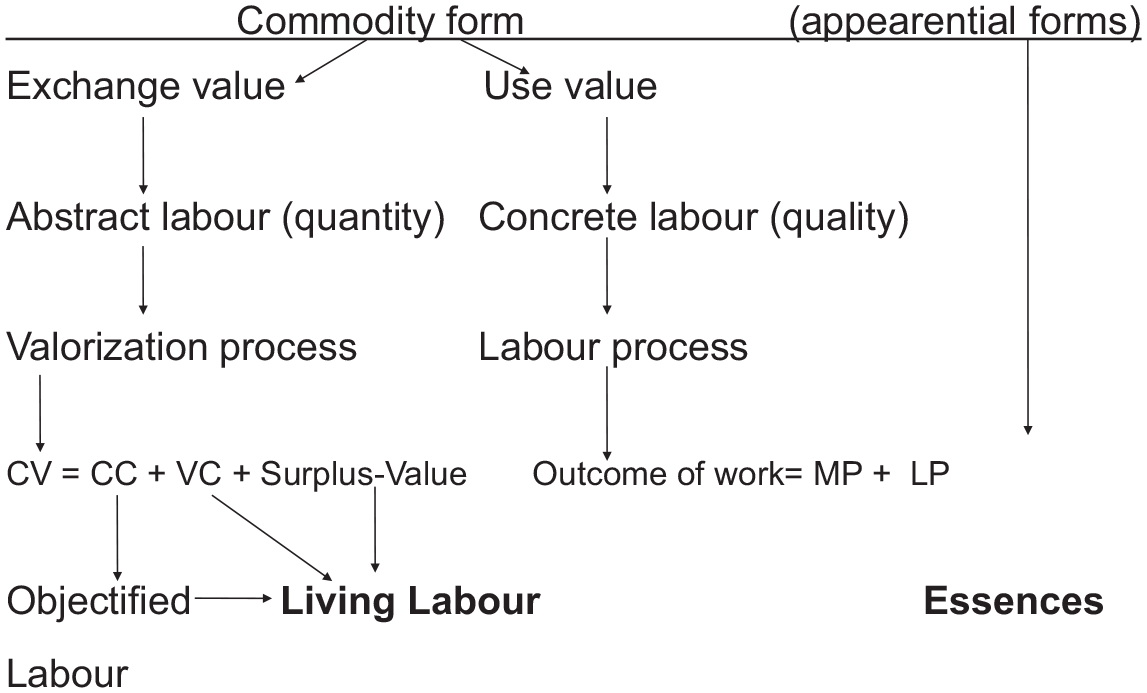
The path to the abstract: theory of value.
In Figure 2, there are five different levels of abstraction identified, ranging from more apparent forms (commodity form) to the rather essential levels (living labor as the fundamental category of the capitalist valorization process). In the middle, there are some mediation strategies that Marx elaborated following a ‘substantial logic’ (Coniglione 1989; Dussel 2001; Hegel 2010; Moseley 2019), wherein he asked questions and then carefully elaborated the appropriate categories to ultimately capture an essential movement. The idea of different levels of abstraction does not mean that one level is more real or unreal than others. Appearances and essences are an identity and both have the same level of reality (Hegel 2010; Kosik 1976).
There is an advantage to the fact that different levels of abstraction exist where the categories are placed: it provides more systematicity in thinking. But also, these levels of abstraction follow a substantive logic: they allow us, little by little, to penetrate the appearance in order to reach the essence. This penetration of appearance has to be made following a logical order of argument, delving deeper and deeper, until the purest forms that we wish to analyze and understand are reached. Thus, Marx delves deeper and deeper into appearances to grasp a key concept: surplus value as produced by living labor.
Surplus value is an incomprehensible concept without categories: concrete and abstract labor, constant and variable capital, socially necessary labor time, and surplus labor time. Then, some idealizations are relevant to study how surplus value is produced in the working day:
Values and prices are equivalent,
Labor power and socially necessary labor time are equivalent, and
Wages received by workers correspond to the variable capital.
Next, it is established the following definitions of the two main components of the working day: A-B (socially necessary labor time = wage) and B-C (surplus labor time = unpaid labor). In this sense, the working day is no longer a mere continuum, but a temporary differentiated length of time as Figure 3 shows.
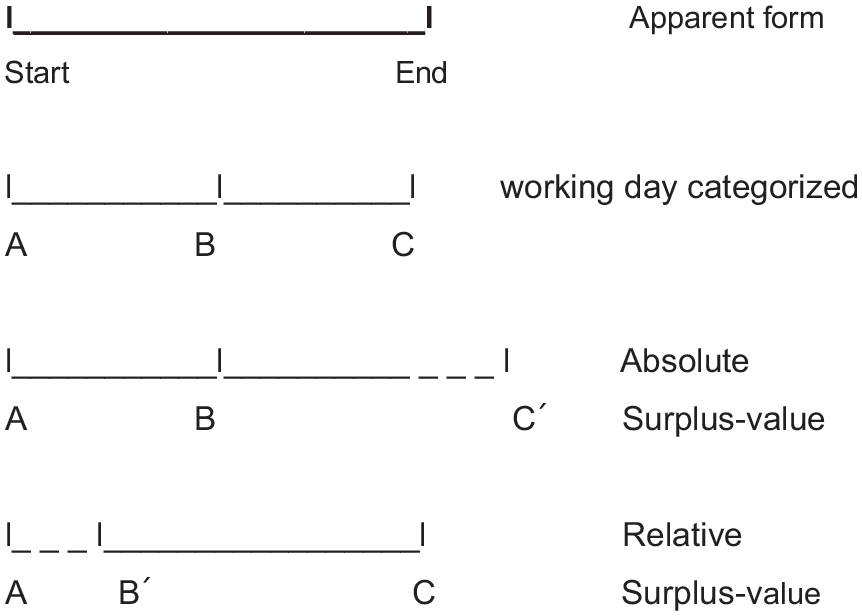
The working day analyzed.
Then, one idealization is used to study the surplus value rate, also known as exploitation rate (Marx 1992): Cc = 0. We might understand the surplus value rate as the proportion of surplus value divided by variable capital, that is, Srv/Vc. An example of this is the following: if a worker obtains a wage of 100 dollars, but produces a number of commodities equivalent to 200 dollars, the surplus value rate is 100%.
The Marxian approach is interested in studying the different possibilities of capital to increase surplus value. This exploration is made possible by means of idealizations. Assuming that wages and socially necessary labor time remain constant, and the technological composition of capital remains the same, capital could potentially produce more surplus value through the prolongation of the working day. The proportion of C + C’ is called absolute surplus value (Marx 1992).
Another possibility is considering that the working day is fixed in length. In this situation, increasing the production of surplus value requires the reduction of socially necessary labor time. This might be achieved by increasing the productivity of labor. New machinery, tools, and techniques might be introduced in the factory to increase efficiency throughout the working day. The intensity of labor is also increased, in such a way that each worker produces the equivalent to their own value (salary) in less time: from B to B′. Hence, the amount of unpaid labor is increased from B′ to C. This is the case that Marx (1992) called relative surplus value.
Finally, we could obtain the mass of surplus value by multiplying the amount of surplus value produced by each worker by the total number of workers (in a factory, economic sector, or country). In this way, the ‘mass of surplus value’ is distributed throughout the entire capitalist system. In order to understand this redistribution of surplus value, Marx had to create a process of ‘concretization’ to study how the mass of surplus value is ‘realized’ in the Market and distributed in different types of capital, leading Marx (1991), in volume III, to deal with more ‘concrete forms’.
The path to the concrete: the transformation of values into prices
In volume III, Marx (1991) studied production and circulation as a unity, dealing with multiple questions and emergent phenomena. Here, I will show just one path of concretization: the transformation of value into prices. However, it is important to say that there are other ‘concretizations’ Marx used to deal with different concrete forms, always producing models with different idealizations. In the first and second sections of volume III of Capital, Marx presented a model about the transformation of value into prices, focusing on the transformation of surplus value into profit, the transformation of the rate of surplus value into the rate of profit, and the transformation of profit into average profit. The first two elements are related to what Marx called ‘transubstantiation’ and the third includes a substitution of one idealization by another, in order to create a new model. According to Marx, there is a transubstantiation of surplus value in the Market, where value is converted into profit. To show this transubstantiation, Marx made a model that involves a series of assumptions that simplify trends to make them intelligible: there are five branches of economy, each social capital has the same technical and organic composition, productivity is constant, there are not significant differences in rate between the various sectors, and there is no interchange with foreign economies.
In this process, one important assumption that Marx maintained in the previous two volumes of Capital is now negated: that values and prices coincide (V = P). As a result, Marx considered the possibility that values and prices do not coincide (Marx 1991).
The aim of the Marxian analysis here is to make the theoretical approach more concrete, moving to another level of abstraction, adding more variables and making new idealizations. Then, a transition from an individual level to a societal level takes place. In doing so, the notion of the Price of Production (PP) emerges. PP is a media that contains the cost price, which involves constant and variable capital, plus an average rate of profit that is ‘equalized’ in the market by competition (Marx 1991). Then, we sum up this average rate of profit and the cost of production to obtain production prices
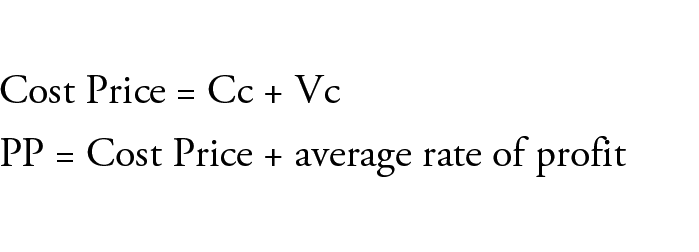
The PP, in turn, is the gravitational axis around which current market prices oscillate through supply and demand. Therefore, market prices are nothing more than mere deviations from the production prices (Marx 1991). However, according to Marx, at the social level, values and prices would coincide only under ideal conditions. Here, again, the Marxian approach is interested in understanding why actual behaviors have deviations from pure state capitalism. Equilibria, then, is simply an idealization, a theoretical possibility of capitalism. But the rule is actually disequilibrium because the incorporation of the set of variables portrayed a picture of capitalism as a dynamic, but unstable system, where it is common that not all value created converts to value realized in the Market. This is why it is common that values and prices often do not coincide.
As we can see in Figure 4, in the process of concretization of transformation of values into prices, the Marxian approach is transitioning from an individual level to a social level, from the simple to the complex, from the micro to the macro creating different categories and new assumptions. The concretization of abstraction here does not imply the requirement that this process make it more ‘realistic’. It simply entails the addition of new variables that require the recomposition of the model, though not in the sense of Nowak’s reversible process. Instead, in Marx’s concretization process, a substitution of some idealizations by others takes place, in order to add more variables (as averages rates) in his abstractions. In the process, variables are taken into account and recomposed into the model (Knuuttila & Morgan 2019).
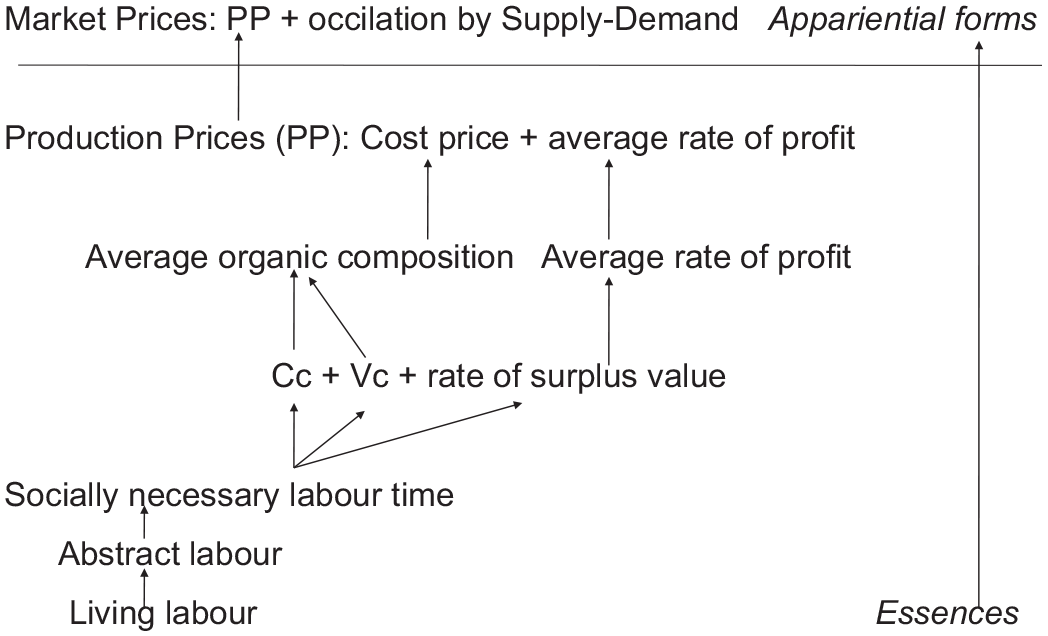
The concretization path.
The subsequent sections of volume 3 have to do with the level of abstraction that Moseley (2019) identifies as competition, where Marx is interested in the particular, that is, the analysis of the distribution of surplus value of different capitals: (a) the tendency of the average rate of profit to fall, (b) the distribution of surplus value in different kinds of capital (industrial, commercial, bankers, rentiers) that, as a whole, constitute a collective capital, and (c) the social reproduction of the three main social classes: workers, capitalists, and landlords. These sections, reading from a methodological point of view, are nothing more than further theoretical developments that add more determinations, once again, at a social level. In those sections, Marx creates different theoretical abstractions where he reformulates his assumptions and reassembles different concepts and categories, always geared to show the identity between essence and appearance. Here, concretization follows a kind of hermeneutical circle that I will explain in the next section.
Concretization as a creative process of framing and reframing hermeneutical circles
In the philosophical literature on models and idealizations, the legacy of Nowak is undeniable. He had the historical merit of highlighting the role of idealizations in counterfactual reasoning. However, as we saw in this article, there are reasons to say that Marx did not use the idealizational method portrayed by Nowak. First, in the path to the abstract, Marx elaborated new categories to delve into, from the ‘pseudo-concrete world’ (appearances) to the abstract, identifying different levels of abstraction. Then, when he arrived at the notion of surplus value produced by living labor, he took the path to the concrete, which was not as linear as Nowak said, with just a simple reversible process (Knuuttila & Morgan 2019). As Hans Radder (2006) put it, concretization, understood as simply adding back, is trivial. Omitting and reconsidering elements that were set aside do not add anything conceptually (Radder 2006).
As we saw in ‘The path to the concrete: the transformation of values into prices’ section, the process of concretization, according to Marx, is more complex. Therefore, a question arises: if idealization and de-idealization are not reversible processes, how should we understand de-idealization? According to Tarja Knuuttila and Mary Morgan (2019), there are at least four different ways to de-idealize a model (or a theory): recomposing, reformulating, concretizing, and situating. Recomposing refers to the reconfiguration of the parts of a model with respect to the causal structure of the world (Knuuttila & Morgan 2019). Reformulating, in turn, has to do with issues of representation in mathematical molding, which involves integration issues, tractability issues, and translation issues (Knuuttila & Morgan 2019). By concretization, Knuuttila and Morgan understood the concept of replacing idealizing assumptions by rather realistic assumptions, but they highlighted that de-idealization is not always desirable because concept-formation is associated with modeling (Knuuttila & Morgan 2019). ‘. . . Being more concrete does not necessarily mean being more realistic or accurate to any particular observable objects in the world’ (Knuuttila & Morgan 2019: 652). Finally, situating is related to the application of the model to a specific situation. ‘. . . One obvious place we can see this happening is when a simple mathematical model used in theorizing is de-idealized into a statistical model as it becomes fitted to data’ (Knuuttila & Morgan 2019: 652). Situating a model is to locate a model in a specific context to achieve a specific goal.
These distinctions are useful to show that there is not only one single process of de-idealization. Actually, there is a menu of processes of de-idealization and their use depends on the different purposes pursued by scientists (Knuuttila & Morgan 2019). They remind us that the process of de-idealization is a complex matter that points out the necessity to think about it as a rather creative process.
However, the process of de-idealization that Marx followed does not easily fall into the classification presented by Knuuttila and Morgan (2019). It is not clear that Marx ‘reformulated’ his models in the sense of Knuuttila and Morgan (2009) because Marx did not make intensive use of mathematics in his research, nor is it clear that he followed a ‘situating’ strategy because in fact Marx, in Capital, is not interested in doing applied research as it would be understood in contemporary social sciences in case studies.
As we already showed in ‘The path to the concrete: the transformation of values into prices’ section, Marx did not follow a linear process of concretization where he was replacing idealizing assumptions by realistic assumptions. We should recall that ‘in practice, theory-application does not typically follow the pattern of deidealisation’ (Suárez 1999: 180). Such is the case of the study of the property of some materials that exhibit superconductivity (a property of extraordinary conduction behavior under special circumstances), where Fritz and Heinz London, both physicists at the beginning of the 20th century, recognized the need to develop a new model based on the recognition of the Meissner effect (the sudden expulsion of magnetic flux from a superconductor when cooled below its transition temperature). The central point made by Suárez (1999) is that the Londons did not derive an equation of application to the subject of superconductivity from the more general and idealized laws that constitute the electromagnetic theory, nor did they introduce new parameters to ‘de-idealize’ and adapt the law. Rather, a completely new model of diamagnetism had to be elaborated, which implied the formulation of new notions and relationships between the variables involved (Suárez 1999: 184–189).
In Marx’s case, as in the case of superconductivity, there is no derivation of equations for specific applications from a more ‘basic’ set of scientific laws. Rather, it seems that Marx was following a strategy of concretization by recomposing his abstractions because he was moving through different levels of abstractions and trying to take into account different causal factors. We might say that, in volume III of Capital, Marx was also in a process of de-isolation (Mäki 1992, 2011) because he was incorporating in his analysis both production and circulation, studied in volume I and II respectively, but also new variables to analyze the role they had with respect to a basic mechanism analyzed in isolation. Also, a relaxation of some idealizations took place. The epistemic goal of de-isolation, according to Mäki (1992, 2011), is to arrive at a ‘whole-truth’. But the difference with von Thünen’s ‘isolated state’ was that, for Marx, the study of the ‘whole-truth’ requires adopting a kind of emergentism where new properties (which he labeled as ‘concrete forms’) emerged, by taking into account the processes of both production and circulation. As we saw in ‘The path to the concrete: the transformation of values into prices’ section, he had to modify his models, changing assumptions in order to see the new relations that emerged as concrete forms.
While it is not so simple to say that Marx followed a specific de-idealization and de-isolation strategy, then how was the process of return that he followed. This point is important because, as Levins (2006: 752) puts it, ‘abstracting is only one part of the process of seeking understanding. The inverse process is the return to the world from which the abstractions were made’. A concept that becomes crucial is understanding, as we shall see below. In the meantime, it is worth remembering something that Karel Kosik said about how we might interpret the process of concretization that Marx followed: . . . If reality is a dialectical, structured whole, then concrete cognition of reality does not amount to systematically narrating acts with facts and findings with findings; rather, it is a process of concretization which proceeds from the whole to its parts and from the parts to the whole, from phenomena to the essence and, from the essence to phenomena, from totality to contradictions and from contradictions to totality. It arrives at concreteness precisely in this spiral process of totalization in which all concepts move with respect to one another, and mutually illuminate one another. (Kosik 1976: 23; emphasis added)
The key idea here is that concretization is not a linear process. It is, as Kosik said, a ‘spiral process’ from the whole to its parts and from the parts to the whole, from phenomena to the essence and from essence to phenomena, from totality to contradictions and from contradictions to totality. This ‘spiral process’ is nothing more than a hermeneutical circle.
Hermeneutic circles arise as part of a process of understanding either a text or objective facts. According to Gadamer (2006: 269), ‘a person who is trying to understand a text is always projecting. He projects a meaning for the text as a whole as soon as some initial meaning emerges in the text’. This initial projection of meaning is then modified as one progresses in the reading of the whole text, where one gradually penetrates into the understanding of the meaning of the whole. Thus, preconceptions and prejudices are gradually modified. In the process of understanding, it is very important ‘to be aware of one’s own bias, so that the text can present itself in all its otherness and thus assert its own truth against one’s own fore meanings’ (Gadamer 2006: 271), which goes against the main bias of modernity: bias against bias itself (Gadamer 2006). Gadamer and the hermeneutic tradition thus tend to make visible the role of the subject in the process of creating understanding.
The hermeneutic circle is established between the object of study (be it the text or facts of the world) and the subject, and leads to a substitution of fore-conceptions by more suitable ones, thus generating new projections that constitute the movement of understanding (Gadamer 2006; Grondin 2015). The understanding of the whole must be in terms of the detail and the detail in terms of the whole. It is a circular relationship also between whole and part, where the anticipation of meaning in which the whole is envisaged becomes actual understanding when the parts that are determined by the whole themselves also determine this whole . . . Thus the movement of understanding is constantly from the whole to the part and back to the whole. (Gadamer 2006: 291)
Gadamer’s hermeneutic circles can be applied to Marx’s work who situates himself as a critical subject of capitalism, and from his formation as a German philosopher, he reads the authors of classical Political Economy, thus building hermeneutic circles with their texts. Thus, preconceptions and prejudices that Marx had are modified and are expressed in the formation of a categorical framework, in movement, which is constantly changing. Thus, Marx’s work develops a critique of the categorical errors of bourgeois Political Economy, its argumentative leaps, and its theoretical gaps. Next, he elaborated on new categories to capture these new relationships. This conceptual innovation was the outcome of his critical reading of the authors of the Classical Political Economy and the formulation of his own categorical framework (Dussel 2001). This categorical framework allows him to improve his understanding of the functioning of the capitalist system. We should recall, with Gadamer (2006: 291), that ‘the harmony of all the details with the whole is the criterion of correct understanding. The failure to achieve this harmony means that understanding has failed’. In the case of Marx’s categorical framework, this harmony was achieved because there is an appropriate set of categories, well ordered, that allows adequate interpretations of facts, that is, understanding. In hermeneutical circles, a part has a sense in a totality of categories (Gadamer 2006; Grondin 2015). Totalities are more than the simple sum of constitutive parts (categories). Totality and parts are in a dialectical relation, that is, in a codependent relationship of reciprocity.
The visibility of the role of the hermeneutic circle in Marx also makes it possible to understand the unavoidable hermeneutical moment of Economics and Social Sciences because the kind of social objects that economics deals with are commonsensible (Mäki 2012). These objects involve a kind of pre-understandings by agents (Mäki 2012). Agents, with their interactions, contribute to give some entities a degree of reality that is presented as externalities which dominate human society. Such externalities, such as the market, are presented as natural and eternal social objects and assumed as ‘pseudo-concrete worlds’ (Kosik 1976). But they are, in the end, reproduced by repeated social practices – fetishized (Kosik 1976) – such that they are not critiqued with such pre-understandings. Here, the task of Marx might be understood as the critique of the dominant set of categories to show another set of categories that gives a view of capitalism as a system that is not static, absolute, natural, and eternal, but instead dynamic, relative, historical, and contingent, subject to human action. This idea has to do with a performativity thesis that Marx assumes in his notion of praxis.
In this sense, it is convenient to think of Marx’s concretization also as ontologization, that is, as the act of applying or using abstract representations. ‘It is making or imagining a world according to a map, theory, model, or other representation, whether this is done consciously or unconsciously’ (Winther 2020: 81). This use of abstract representations can serve ‘to do work in the world, whether to change it, or to imagine the world to be a certain way and plan and act accordingly’ (Winther 2020: 60). Winther (2020: 61) formulates the distinction as follows: ‘mapmaking is an example of abstraction. Map use is a case of ontologizing’. But it must be emphasized that abstractions not only represent the world, but also construct it in a material sense because their uses also shape the world (Morgan 2012; Winther 2020), even more so if we consider that there is a circular relationship between the categorical frameworks with which we understand the world and the objective processes that are in the world.
Marx, deep down, was interested in his abstractions serving not only to understand his world, but to transform it. In that sense, Marx sought to construct a kind of map that we might use to situate ourselves in a scientific representation (Winther 2020: 97) of what the capitalist system is. Thus, we merely-see-as the global economy, or the different national capitalisms, as singular expressions of the abstract concept of capitalism that Marx carefully built through the three volumes of Capital. The practice enriches the theory and it opens the possibility of pluralistic ontologizing (Winther 2020: 128), where different social practices should produce different theoretical reflections about the processes of changing the world to form a transontological critique, that is, ‘the critique that is located with thinking beyond the ontological horizon that sustains or gives meaning to a system of domination’ (Bautista 2014: 170).
The main lesson of this section is that if we realize that Marx was making hermeneutical circles, then we should conclude that it is misleading to attribute to him the kind of Galilean methods that Nowak affirmed. This is so because Marx came from a very different epistemological tradition than Galileo did. Galileo was a neo-platonist, an essentialist, and an idealist thinker that gave more priority to the mathematical representation of essences than appearances and considered that essences are eternal, necessary, and immutable. Marx, in turn, was more Hegelian, giving priority to the unity between essences and appearances, where essences and appearances are in constant interaction, and essences are not eternal or immutable. Hence, the mental image Marx had of science was very different from Galileo’s. Here, Marx was following the notion of science that was held by German idealists: science as a kind of wisdom (wissenschaft), which was not the concept of modern science at that time, which, in turn, was highly influenced by Newtonian positions (Dussel 2001; Sacristán 2014). For Marx, as was stated previously, science had to do with the critique of appearances, the exposition of the internal development or unfolding of a matter, and the elaboration of hermeneutical circles that provide comprehensive wisdom about what the capitalist system is, to guide social action in our world.
Final remarks
In this article, we critically analyzed Nowak’s interpretation of Marx’s method. We presented the method of idealization, highlighting its strengths and limitations. We then presented an alternative interpretation of Marx’s notion of abstraction, showing that Marx had a richer notion of abstraction than the one portrayed by Nowak, which required understanding, specifically, of Marx’s process of concretization. In particular, we saw that the use of idealizations, according to Marx, is not merely a reversible process. As we saw, Marx’s version of de-idealization involves a more creative process of creating new categories and introducing new variables and new idealizations. In this sense, Marx’s process of de-idealization might be understood as recomposition and de-isolation. As such, de-idealization does not follow a linear path of successive approximation (as Nowak would put it of adding back idealizations) because Marx adopted a strategy of recomposing and de-isolating his abstractions, adding more variables that change the whole in different moments of argumentation. This process of concretization might be understood as a constant elaboration of hermeneutical circles where totality is more ‘concrete’ as it incorporates more variables and relations always oriented to ontologization because Marx wanted to change the world. Further philosophical research about Marx’s notion of abstraction might analyze his view on scientific laws and the notion of ‘pure state capitalism’, highlighting the differences and similarities between that Marx’s manners of making models and other scientific modeling practices. In Marx’s modeling practices, it is inevitable to consider a hermeneutic component in his understanding of science.
