




Abstract
The Modern Slavery Act was passed in 2015, ostensibly to tackle exploitation. Despite being promoted for its ‘world-leading’ qualities, the legislation’s weaknesses have, even at this relatively early stage of its implementation, been well documented. This is unsurprising; legislators were aware they were passing a bill that could have had stronger enforcement mechanisms, opting instead for a weaker alternative. This article takes these shortcomings as its starting point to ask who, or what, benefits from the Modern Slavery Act, if not those it is purportedly aimed to help. The response is that the main beneficiaries of the Modern Slavery Act are capitalism, and the Conservative government that created the bill. The Modern Slavery Act operates through the modern slavery discourse that positions unfree forms of labour as aberrations that operate outside of capitalism, and once unfree labour practices have been framed in this way, the capitalist free market is identified not as a causal factor but as the solution. In addition, the Conservative government used the Modern Slavery Act domestically as a counterpoint to its hostile environment policy to soften their image for part of the electorate. When viewed as an artefact of capitalist thinking and state management, it becomes clear that the Modern Slavery Act makes a not insignificant contribution to the legitimacy of both capitalism and the government by conferring upon them a degree of legitimacy as the routes through which the unfree will be liberated.
Introduction
Theresa May (2016) set out her stall on modern slavery as Home Secretary and then as Prime Minister, calling it a ‘barbaric evil’ and ‘the great human rights issue of our time’. May (2016) also played an instrumental role in passing the 2015 Modern Slavery Act (MSA), making it a flagship policy, which she has variously called ‘world-leading’ and ‘ground-breaking’. This signalled a new level of engagement from the government within the context of a growing discourse and body of research into a set of practices which sit under this relatively new label. Setting aside for one moment issues with the term modern slavery (which will be discussed below), recent research has explored its presence in the global supply chains that produce a range of foodstuffs and consumer goods that make their way around the world (Gold et al. 2015: 485). Sectors that have been investigated range from the agricultural commodity production of tobacco, chocolate and sugar cane, to fishing, apparel and electronic consumer goods (Craig et al. 2019; Greer & Purvis 2016: 56; McGrath 2013).
In addition, there is a growing awareness that modern slavery is not exclusive to the developing world, but also exists within the United Kingdom, particularly in labour-intensive sectors such as construction, agriculture and hospitality (Crates 2018). While no accurate number can be provided due to the hidden nature of these practices, the Global Slavery Index (2018) estimates there may be as many as 40 million people living in some form of modern slavery worldwide. The methodology used to reach this estimate has been brought into question, and as a result, this number must be used with caution, but it nevertheless provides a picture of the worst-case scenario (Gallagher 2017). It is equally challenging to verify the extent of modern slavery within the United Kingdom. The only official indication is the number of annual referrals of potential victims to the Home Office with 7,000 in 2018 alone, which is considered to be the tip of the iceberg (Myska 2019).
As a response, the MSA serves two purposes. The first is to consolidate existing laws under a single act, meaning perpetrators can be prosecuted for crimes relating to modern slavery, rather than through disparate charges as was previously the case. The second, and most novel, element is the Transparency in Supply Chains (TISC) Clause found in section 54, which aims to address the presence of modern slavery in supply chains. The TISC clause constitutes a requirement for all companies with a turnover above £36 million per annum, and with any part of their operation in the United Kingdom, to produce an annual statement which details what actions they have taken, if any, to combat slavery and human trafficking in their organisation and supply chain. This statement must then be published in a prominent place on their website to make it accessible to anyone who wishes to read it.
However, few believe the TISC clause to be an effective response to the problem it purports to address. To begin with, the TISC clause follows a corporate social responsibility tradition of letting industry voluntarily self-regulate, which, as Banerjee (2020) argues, decades of research has shown is not an effective way of bringing about change. It has also been pointed out that the TISC clause assumes that consumers will possess the desire and know how to interpret and act upon the information in transparency statements; it is sufficient to only target larger companies; self-reported information will be reliable; and companies can attain accurate information about their own supply chains, assuming they wish to do so (Aaronson & Wham 2016: 18; Buist 2017; Carrington et al. 2016: 23; Chilton & Sarfaty 2016: 7; New 2015: 700; Theron 2019: 202).
These criticisms also extend to the implementation of the legislation, the results of which have been analysed by scholars and non-governmental organisations (NGOs). With few exceptions, the findings show that the response has been lacklustre; most firms have either failed to produce a statement at all or produced vague claims about tackling modern slavery which detail ill-defined actions and measures taken, suggesting the requirement is often treated as a box-ticking exercise (Aaronson & Wham 2016; Bardwell & Carrier 2017; Cole & Stevenson 2018; Core 2017; Mares 2018: 213; Mantouvalou 2018: 1042). Similar conclusions have been drawn about the response to the Act from UK universities, revealing compliance levels that mirror those of the private sector more broadly (Rogerson et al. 2020). As there have been no repercussions for those not producing statements, the government has shown that it does not intend to actively enforce this part of the legislation.
Evidently, the weaknesses of the legislation are at this point well documented and the impact is not expected to be significant. This is not a view that would be surprising even to the government that created and passed the Act. The particular form the legislation took was the outcome of a process through which other, more robust proposals for the TISC clause element were rejected that would have introduced criminal liability for modern slavery in supply chains, requiring companies to take significant steps to address this (English 2019: 109; Gadd & Broad 2018: 1445; O’Connell Davidson 2015: 155–156). In other words, the weaknesses of the MSA were known in advance, and a conscious decision was made to take a ‘light touch’ approach which avoided making companies directly responsible for what occurs in their supply chains. This begs the question of who, or what, benefits from the MSA, if not the exploited? This article will argue that the MSA can in fact be viewed as a success, albeit not for the victims of modern slavery. The main beneficiaries of the MSA are capitalism and the Conservative government, both of which are lent legitimacy through the passing of the legislation in its current form.
The argument will draw on the tools provided by Open Marxism (OM). In contradistinction to traditional readings of Marx’s work that analyse capitalism as a system of laws, OM is a school of thought that argues ‘the existent relations of economic objectivity are socially constituted in their entirety’ (Bonefeld 2014: 5). Capitalism, in this view, is a socially constituted system, and as such phenomena are understood as forms, which are ‘a mode of existence – something exists only in and through the forms it takes’ (Burnham 1994: 225). Central to this is the role class struggle plays in the creation of forms, or structures. As Clarke (1991: 40) puts it, this structure and struggle cannot be separated, because it is only through struggle that structures are imposed and reproduced. Thus the ‘laws of motion’ of capitalism cannot be seen as external ‘economic’ laws, but are only realised in and through the class struggle.
This has consequences for the constitutive role of class antagonism in capitalism as well as for an understanding of the state as a manifestation of these social relations and its role in ‘managing’ capitalism (Clarke 1991: 40).
While OM often operates at a level of abstraction, there is value in using the tools it provides to engage with empirical phenomena. It is essential to use abstractions of how capital and the state function to develop an understanding of the problems governments face, but it is also important to understand how these abstractions operate in the world (Burnham 2006: 80–81). This also responds to a point made by Roberts (2002), who argues that to reject empirical application would be to throw ‘the empiricist baby out with the illusionary bath water’. Roberts (2002) makes the case for going beyond the class antagonism that is so central to OM to consider not just how these social relations are constituted but how they are ‘refracted’, or in other words experienced outside of this central concern. The aim here is to treat the MSA as an artefact, or instance, of capitalism, which captures the thinking that goes into its daily reproduction, and as an example of how the state enshrines the logic of capital into a particular bill, even one that is not at first glance ‘economic’ in nature.
The article is broken down into three parts. The first explores recent literature to critically engage with, and reject, the idea that unfree labour is an aberration of, or is exogenous to, capitalism. This section also shows how the MSA makes a contribution to this fallacy by relying on individualised notions of exploitation which are disconnected from less severe forms, and from capitalism’s role in creating and maintaining unfree labour relations. The second section explores the consequence of this denial by looking at how the TISC clause positions capitalism not as a causal factor, but as the route through which unfree labour will be eradicated. It does this by utilising the free market to bring about an ‘ethical’ business case to make unfree labour unviable and unprofitable. The third and final section will outline how the Conservative government has attempted to confer upon itself a degree of legitimacy through the domestic implementation of the MSA, which is designed to act as a counterpoint for their hostile environment policies, intended to place the government, at least in appearance, on the side of the exploited.
Unfree labour and capitalism
The first way in which capitalism can be viewed as a beneficiary of the MSA is through the legislation’s reproduction of the idea that modern slavery practices are an aberration of capitalism, and somehow exogenous to the ways in which capitalism functions. This begins with the use of the term modern slavery, which is not a technical term, and nor does it have an internationally agreed legal definition; as a result, it is subject to a variety of interpretations across borders and professions, through which context determines ‘what is meant by “slavery”, where journalistic, legal, sociological, comparative and historical meanings differ widely’ (Cohen 2006: 35). Consequently, the term modern slavery is often used for its emotive power, rather than for either analytical or technical precision (kempadoo 2015: 11).
One outcome of this is to create what Bunting and Quirk (2018: 9) call ‘a politics of exceptionality’ whereby slavery ‘is promoted as a unique and exceptional evil that stands apart from other “lesser” challenges’. The effect is to create a disconnect between the worst forms of exploitation and all others, resulting in the most severe cases being viewed as representative of the modern slavery label, justifying its perceived distinctiveness. This lack of clarity also enables connections to be made with slavery of the past, making modern slavery a seemingly clear-cut moral issue of an abhorrent set of practices that ought not to exist but inexplicably still do (Broad & Turnbull 2019: 128). Consequently, the term modern slavery ends up being deployed for political purposes. An example of this is the strategy used by the Conservative government to pass the MSA, by making explicit connections between the need to pass the MSA with the work of abolitionists such as William Wilberforce (Robinson 2015: 130). This positioned the MSA as an unquestionable good, making it somewhat easier for the government to make its case in favour of passing the bill, with the emotional power of the issue taking centre stage.
For these reasons, modern slavery is best understood as an umbrella term for practices that are loosely linked through being characterised by an absence of freedom, such as forced labour, debt bondage, trafficking and child labour, rather than as a term with its own specificity. Nonetheless, the term modern slavery is now used widely, and was popularised in no small part through the work of so-called ‘new abolitionists’, whose work embodies this notion of the politics of exceptionality. New abolitionists’ work is based on personalised accounts of the authors’ own travels and experiences to see for themselves how people are being exploited around the world (see Bales 1999, 2005; Kara 2017). The exploitative relation in these accounts is an interpersonal one, focusing on one person’s control of another, with causes remaining largely confined to this dynamic. One example where an external factor is brought in is found in Bales’s (2005: 114–115) account of how a slaveholder may watch television and pick up new ideas about methods of production used in industry and copy them. Capitalism is viewed here as a background factor which may inspire new methods of exploitation, but it is otherwise left out as a causal element. Ultimately, responsibility is placed on the reprehensible individual, positioning modern slavery as an aberration of capitalism rather than something that is in any way directly connected to how it functions.
The lack of systemic analyses in these accounts has been critiqued for positioning modern slavery practices as being ‘exceptional to, and incompatible with, the dominant political and economic world order’ (O’Connell Davidson 2015: 12). Focusing on the individual in this way overlooks any ‘systemic and institutional features’ of capitalism, or laws and regulations regarding the way free markets function, or labour and its movement (Fudge 2018: 415). It is instead those operating outside of expected norms of liberal capitalism that are found to be at fault, positioning modern slavery as an aberration. This leads to a superficial view of why modern slavery exists and persists, lacking any analytical depth (Rogaly 2015). In exploring the connection between labour exploitation and capitalism, it is therefore necessary to use a term other than modern slavery. An alternative that can be given analytical purpose is unfree labour. However, given the disagreement within recent scholarship over precisely what constitutes unfree labour, and how it is connected to capitalism, it will be necessary to survey some of these different understandings.
One notable example is found in the work of Tom Brass (2014a, 2014b, 2017), whose concept of deproletarianisation draws on a Marxian understanding of what constitutes free labour’s unfree counterpart. Deproletarianisation counterposes the ability of those in free wage labour to sell their one remaining commodity – their labour power – after being dispossessed of the land from which they would otherwise achieve their subsistence, with those in unfree labour, who lack even this ability. The result, for Brass (1997: 61), is that workers ‘face a “double dispossession”’ as they are not only freed from the means of production but also ‘freed of the means of commodifying labour power itself’. Deproletarianisation therefore represents the ‘ultimate subordination’ of workers as they are left with nothing to commodify (Brass 1994: 259). Brass’s (2014a: 571) argument is that this occurs within capitalism, and in fact unfree labour may, in some circumstances, be the favoured form of labour by capital. This is because capital’s concern, to the extent it can be reified, is with cheap labour, regardless of the form it takes.
Deproletarianisation has been criticised for its reliance on this free/unfree labour binary. First, this forces all existing labour relations into one of only two categories (Phillips 2013: 176). It has been argued that this does not, or cannot, reflect the complexity of empirically observed labour conditions which contain varying degrees of freedom, too complicated and ambiguous to situate in this binary (Guérin 2013: 406). Second, this appears to position free labour as desirable and free of its own coercions (Rioux et al. 2019: 17). Several scholars have instead argued in favour of a continuum, ranging from ‘decent’ working conditions through to forced labour where free will is absent in the relation, and a range of practices in between (Barrientos et al. 2013; LeBaron 2015; Phillips 2013). This, it is argued, more accurately portrays the ‘vast, messy and overlapping matrix of unfreedoms that characterise labour in the global economy today’ (LeBaron & Ayers 2013: 876), and thus provides a more nuanced understanding that corresponds more closely to the variety of lived experiences of workers. This continuum view can also be used to acknowledge that working conditions are often prone to change, rather than being static, so a worker may lose or gain certain freedoms throughout the duration of their time in a particular role.
While this raises important questions regarding the possibility of categorising all forms of labour into one of only two categories, it leaves unresolved issues of its own. Not the least of which is the lack of any substantive connection to capitalism within the notion of the continuum itself. In contrast to unfree labour, which is rooted in Marxian notions of so-called free labour, the continuum is simply a position that suggests there are a multitude of labour practices, and places emphasis on the acknowledgement of this. It is only in points made elsewhere that this is rooted in anything like a system-level analysis. For example, it is argued that entry into exploitation such as forced labour is often framed by conditions such as poverty, or ‘neoliberal restructuring’ such as deregulation, privatisation and the erosion of welfare systems (LeBaron & Ayers 2013: 888; LeBaron et al. 2018: 62). Within this explanation, the argument follows that more individuals find themselves vulnerable to increased inequality and reduced protections, ending up in forced labour as a result through either ‘coercive underpinning’ of the entry into the labour market or a ‘precluded exit’ through debt (LeBaron & Ayers 2013: 888). While it is not disputed here that this may exacerbate labour exploitation in its most severe forms, this does not explain where exploitation originates in the first instance; or in other words, it fails to identify a root cause.
One way of overcoming these issues is to reconfigure the way free and unfree labour are understood by re-framing the continuum to include forms of labour that go beyond those possible within capitalism. This is achieved through a typology (Figure 1) which acknowledges the economic compulsion in all forms of labour under capitalism, while retaining the distinction between free and unfree forms of labour. Here, unfree labour is understood as the term under which a range of exploitative conditions exist, rather than being affixed to conditions of being able or unable to commodify labour power. The other forms of labour included are those without economic compulsion, including ‘fully decommodified’ and ‘truly free’ labour. These latter forms would exist either through significant modifications to capitalism, or if it were transcended altogether. By resetting the boundaries on the forms of labour under consideration within the continuum, the framework is no longer restricted to the confines of what capitalism is able to offer, such as ‘decent’ work.
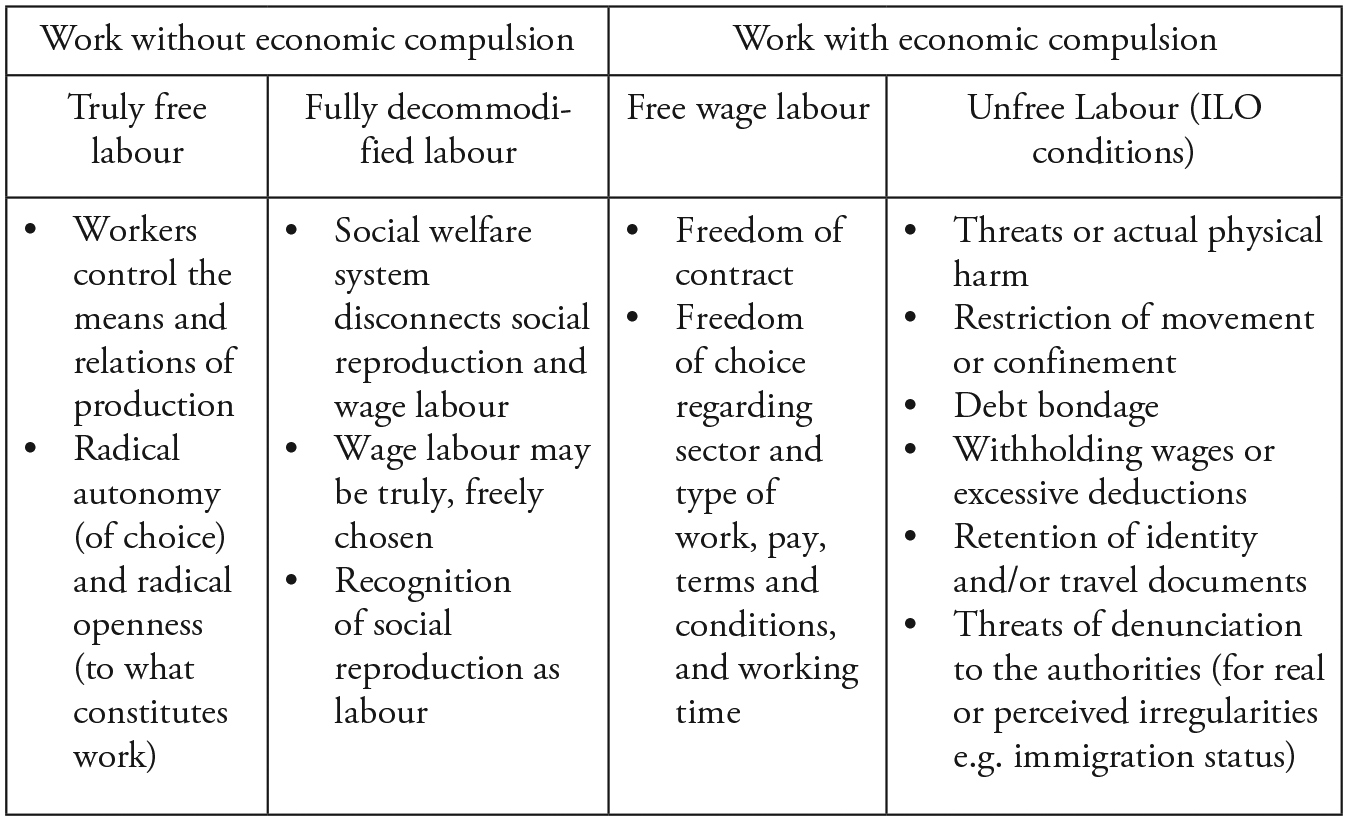
Typology of Free and Unfree Labour
Re-framing the possible forms of labour in this way roots both free and unfree forms of labour within the same economic compulsion created by capitalism. This is a reference to the condition in which the working class is ‘compelled to sell its labour power voluntarily to the owner of the means of subsistence’ (Bonefeld 2014: 101). This notion of ‘voluntary compulsion’ captures the contradictory nature of both the individual and social conditions found within free wage labour under capitalism, whereby it is possible to reject an employer, but it is not possible to reject all employers. Economic compulsion is therefore not incidental to how capitalism operates, it is an intrinsic component.
There is a further complication around consent where in some cases individuals will have agreed to enter into conditions that would be classified as unfree labour. Research has shown that some workers enter into exploitative, unfree labour conditions because it is ‘their best available option’ (Howard 2018: 266). It is for reasons such as this that the economic compulsion is an important point of emphasis behind even free labour, whereby the boundary between the two, and the notion of consent, blurs. For unfree labour in its most severe form, the economic compulsion is ever-present, as with free labour, but this time the voluntary component – and therefore also the contradiction – is peeled back to reveal only the compulsion. As such, unfree labour is no aberration of capitalism; it is simply another facet of the compulsion to work that inevitably and incessantly bears down on the working classes. This is itself driven by capitalism’s need for the exploitation of labour in the Marxist sense, in which surplus value is realised for the owners of capital by retaining part of the value workers create (Bonefeld 2014: 93). That is not to deny the immediacy or responsibility of one person exploiting another; it is to move beyond this level of analysis to explore the underlying system that incentivises and encourages this behaviour. It is to show that all labour under capitalism is rooted in the same imperatives and that the socio-economic compulsion is equally capable of operating at the individual level as it is the social. It also reveals the ways in which exploitation is divided into socially acceptable (free wage labour) and unacceptable (unfree labour) forms.
This is not just an abstract theoretical argument, or a recategorisation of different forms of labour. Capitalism has, throughout its history, deployed, and profited from, a range of labour practices even if they have not always been conceptualised as sharing the same root cause. For example, in some cases in the United States, former slaves that had been granted their ‘freedom’ were required to work for their enslavers for a set period of time under the same conditions, and then may have worked for the same person again for a wage once this period came to an end (Cohen 2006: 14; Gerstenberger 2014; O’Connell Davidson 2010). This example illustrates the challenges posed by attempts to place a set of labour practices either within or outside of capitalism even where slavery was legal. Of course, contemporary forms of unfree labour are different in one very important way from historical forms of slavery: it is no longer possible to legally own a person as property. As such, the focus on the economic compulsion that drives people into unfree labour conditions, or keeps them there, becomes all the more important to acknowledge and understand, rather than focusing solely on physical force or coercion.
This view of aberration is therefore not only about the character of unfree labour but also fundamentally about the nature of capitalism. Unfreedom cannot be characterised as an exception to the norm within capitalism unless that norm is understood as one of freedom. The MSA operates through, and embodies, the fetishised forms that capitalism is reliant upon for its continued existence. Without the illusory freedom enjoyed by the ‘free’ wage labourer, the system of economic compulsion is exposed. The idea that free labour is free of contradiction is not the only element of capitalism that must be reproduced, but this illusion nevertheless makes it easier to contain the issues that arise from class antagonism in order for the state to maintain stability within capitalism. The stronger the narrative that capitalism is a system of freedom, the more challenging it becomes for those that oppose it. As such, one of the key contributions of the MSA is to embody the view that unfree labour is an unfortunate aberration of capitalism, and to create an exception of those practices that are deemed to fall outside of the freedom thought to characterise this system.
The TISC clause as ethical capitalism
Once unfree labour has been framed as an aberration, capitalism can be positioned not as a causal factor but as the solution, which is achieved within the MSA by the TISC clause. In response to the question of how the TISC clause is intended to bring about a reduction in unfree labour in both domestic and international supply chains, Theresa May’s 2019 speech to the International Labour Organisation about the MSA provides some enlightenment: ‘the most powerful voice of all belongs not to business or government, but to the consumer’ (May 2019). In other words, the transparency statements large companies are now obliged to produce will provide information to consumers, whether direct or through the campaigning efforts of NGOs, which they can then use to alter their purchasing decisions. As Aaronson and Wham (2016: 17) put it, ‘the U.K. government clearly hopes that transparency will create a virtuous circle’ in which companies release their annual statements so consumers can keep themselves appraised of what measures they are taking, and consumers can then ‘prod affected businesses to take steps to rid their supply chain of slavery’.
The idea of placing the onus to bring about change on those purchasing goods or services can be explained by the concept of consumer sovereignty. Consumers are considered sovereign because ‘the ideology of consumer choice is that all wants are, at least in principal, equal’ (Dickinson & Carsky 2005: 27). This means, in a free market society, individuals should be free to purchase whatever they wish, and this will determine what goods companies produce (Shaw et al. 2006: 1052). In other words, if consumers buy something, the market responds by making more of that thing; if consumers stop purchasing something, it will stop being made. In this way, consumers are seen as creating the societies they live in through the purchasing choices they make, in the same way that politics is decided by citizens voting in elections (Kardos et al. 2016: 672; Schwarzkopf 2011: 115). Shaw et al. (2006:1054) extend the concept of consumption beyond voting to suggest ‘citizenship and consumption are not divorced concepts’ but are in fact different elements of the same function as, due to the importance of consumption in capitalism, it ‘has become a vehicle within which to exercise citizenship’. In this understanding, consumers are not just exercising product preferences, but are shaping society itself.
In this view, it is incumbent upon consumers to collectively purchase their way into an ethical, slavery-free world, rendering modern slavery practices unviable for businesses (Aaronson & Wham 2016: 17; Conway 2018; LeBaron & Ruhmkorf 2017: 20; Theron 2019: 197). If certain companies are not taking significant steps to eradicate unfree labour from their supply chains, then consumer pressure will encourage them to do so. This is not seen as a burden by supporters of the legislation; in fact, it is viewed as an opportunity. As Kevin Hyland, the first anti-slavery commissioner – a position created by the MSA – argues, ‘operating ethically and operating profitably are no longer mutually exclusive concepts. The business case for having ethical, slave-free, supply chains is in fact very strong’ (Sutherland et al. 2017). In this view, there is an alignment between what is good for business, good for the consumer and good for those working in unfree labour conditions. The TISC clause therefore sends a clear signal that the government is content to hand responsibility over to consumers, who are able to address modern slavery in international supply chains with each purchase.
It is perhaps worth emphasising that the efficacy of the TISC clause is not at issue here – there is already a broad consensus on its shortcomings, as discussed above. What is of interest is the way the TISC clause has framed capitalism as the solution. Through the notion of sovereign consumers driving change, the TISC clause reproduces a worldview that Adam Smith would have recognised, in which political economy is understood to mean two entities – the state and economy – that may have influence on one another, but ultimately remain separate. This leads to the view that the state is able to exert some influence over what occurs in the economy but, ultimately, the market functions best with minimal intervention. As Duska (2000: 116) points out, the result for a Smithian view is that the economy will produce ‘more social benefit than if visible hands (government intervention) try to intervene and bring about just results’. This is partly because individual actors operating through the market can harness more information than any government is able to, which means when the state does attempt to guide economic activity, the outcomes are poor and ‘seldom the result that the government intended’ (Bishop 2000: 31).
However, as Duska (2000: 116) points out, even Smith cautioned that ‘the free pursuit of self-interest must be limited by considerations of justice and fairness’. Smith believed that if enough information was available, individuals would make judgements about when their self-interested decisions would negatively impact others and change them accordingly (Duska 2000: 116; Kulshreshtha 2005: 394). It is evident that the way in which the TISC clause is intended to work reflects this classical political economy view of capitalism, in which the free market, populated by informed and conscientious consumers, is the most suitable avenue for addressing unfree labour. This understanding therefore makes sense of not only how the TISC clause is intended to work, and why capitalism is viewed as the solution, but also why the state has retreated from taking stronger action.
From an OM perspective, it is clear that the state cannot ‘withdraw’ from managing the contradiction that arises from the class antagonism or let the market address labour-related issues as though it were not already intervening. This is because OM rejects the view of ‘the state in capitalist society’, viewing the state instead as ‘being itself one aspect of the social relations of capital’ (Holloway & Picciotto 1991: 97). This leads Holloway and Picciotto (1991: 97) to the conclusion that the state is not only a form of capital but also a manifestation of it and therefore embodies the struggle between capital and labour, meaning it ‘plays a vital part in the maintenance and reproduction of capital as a relation of class domination’. This means that the state as a manifestation of capital, and particularly in a global capitalist system, is both subject to the logic of capital accumulation and plays an important role in its reproduction (Pascual & Ghiotto 2020). However, this also means the state’s actions are not predetermined in any functionalist sense. There is scope for ‘intervening’ on behalf of labour.
Despite the role the state plays in the maintenance of these capitalist social relations, the TISC clause makes it clear the government is only willing to draw minimally on the state’s resources to intervene. This was perhaps a predictable outcome because the task of eradicating unfree labour from supply chains would involve addressing the social relations located in the sphere of production. As Holloway and Picciotto (1991: 115) argue, ‘so long as politics can be confined to the sphere of circulation and separated from the “economic” spheres of production, liberalism has achieved its object’. The separation of these spheres is achieved through not only the appearance of responsibility having been transferred away from the state in how unfree labour in supply chains is tackled but also the substance of responsibility. The state has passed a bill with no enforcement mechanism actively in place that asks non-state actors to tackle unfree labour. If the TISC clause was supported by enforcement, this would still only constitute a minor intervention, but it would at least constitute a commitment of state resource beyond the legislation being passed into law.
Using legislation to prompt capitalism to better itself is also reliant on another idea found in classical political economy: that of the perfectibility of capitalism. As Rowthorn (1973: 6) points out, all that is needed is ‘better information or some other piecemeal change designed to remove imperfections in an otherwise perfect mechanism’. Certainly, the TISC clause is the provider of that ‘better information’. In this way, capitalism is presented in a functionalist sense in which it is inherently stable and that only small changes need to be made to encourage its natural equilibrium (Rowthorn 1973: 6). While this often relates to the economy more broadly, this reasoning can permeate other areas, and in this case allows the government to convincingly deny that more substantive action is needed to address unfree labour in supply chains. Without presenting the free market in this way, it would be incumbent upon the state to take further action. Instead, the state has chosen to confer upon capitalism legitimacy as a conduit through which to bring about ethical supply chains which in turn, it is argued, can bring about a reduction of unfree labour conditions and in doing so has prescribed a central causal factor of unfree labour as its cure.
The contradiction of domestic enforcement
The final beneficiary is the Conservative government which used the MSA to develop the appearance of a victim-focused approach through its domestic implementation, a position undermined by its own hostile environment policy agenda. The domestic implementation and enforcement of the MSA stands in contrast to the TISC clause, first of all by focusing on the criminality of modern slavery. For example, when discussing the need for legislation, Theresa May (2013) called modern slavery a ‘disgusting crime’, and went on to say that the new Home Office approach would result in ‘more arrests, more prosecutions’. As Van Dyke (2019: 47) notes, this focus on a criminal justice response means ‘law enforcement agencies play a central role in identifying victims and investigating cases, and the judicial system in holding offenders to account’. The message is clear: the state would be taking a stand and would prosecute those guilty of enslaving others. In addition, May (2013) also states that ‘at the heart of tackling this heinous crime, must be the needs and interests of the victim’. It is not just that criminals will be prosecuted; victims will also be given the support they need.
Putting these claims to one side to contextualise the passing of the MSA makes its purpose as an image-management tool clear, however. The MSA was rushed through Parliament to ensure the bill passed before the 2015 general election, which was important because the MSA was to be used as a counterpoint to their 2014 Immigration Act (Van Dyke 2019: 61). It was felt that the Immigration Act would not be palatable to some of their potential voters – in particular, those belonging to the Anglican and Catholic churches – due to its explicit aim of making ‘the UK the least attractive destination for illegal immigrants’ (Fudge 2018: 426–427; Robinson 2015: 130–131). The MSA was therefore able to provide some balance for this new tougher stance on immigration, embodied in the hostile environment agenda which was also introduced by Theresa May. This allowed the Conservatives to pass a flagship piece of legislation around which they could hang their moral credentials, proving they were no longer the ‘nasty party’, a term that was coined perhaps not coincidentally by Theresa May several years before becoming leader of the Conservative Party.
This strategy can be understood through looking at the broader purposes of governance or legislation beyond those stated by legislators. As Burnham (2000: 22) argues when discussing depoliticisation strategies governments use, the purpose of certain forms of governance is ‘to construct new public perceptions concerning the “neutrality” (thereby boosting the credibility) of the state’. In the sense that Burnham (2000) uses it here, this would usually refer to the passing of responsibility to another body that can be viewed as operating freely or at least semi-autonomously from the state. However, this can help make sense of the domestic implementation of the MSA. In this context, the concept of depoliticisation becomes inverted, which takes the form of the government politicising, or in other words visibly taking on responsibility, for one agenda (modern slavery) to counterbalance another (immigration). One of the key purposes of the MSA is therefore to develop this view of neutrality through the government repositioning themselves as being on the side of the exploited. However, the credibility of this claim is only available in the absence of a critical view of where the government’s priorities lie.
It is clear that these two pieces of legislation are incompatible, and that the legislation being undermined is the one purportedly passed to protect victims. This view is supported in the first instance by the relative strength of the bills. Whereas the MSA consolidated existing laws in relation to exploitative practices, it did not introduce significantly different or new measures domestically, save for the limited effects the TISC clause would have on national supply chains. In contrast, the Immigration Act brought in new measures such as ‘limiting migrant access to public services and increasing to £20,000 the penalty for employers found to have hired a migrant worker without the appropriate work authorization’ (Fudge 2018: 426–427). The bill was updated in the Immigration Act of 2016 which introduced new measures that made illegal working a criminal offence, with pay being treated as proceeds of crime; prevented illegal migrants from accessing services such as housing and bank accounts; made it easier for government to deport illegal migrants; and removed legal aid for migrants (Balch 2019: 86; Fudge 2018: 427).
Regardless of how these measures are viewed as a response to the presence of illegal immigrants, what is known is that many of those vulnerable to unfree labour often have uncertain immigration status, and the introduction of this ‘Hostile Environment’ results in a reduced likelihood that victims of unfree labour will come forwards to seek help (Balch 2019: 86; Robert 2019: 151). One example of the conflation of these two apparently contradictory agendas is highlighted by Balch (2019: 86), who notes that in Operation Magnify, nail bars were raided for suspected modern slavery offences, resulting in more people being detained for immigration offences than were identified as victims. Another is the high number of rejections of leave to remain applications for children recognised as being victims of modern slavery (Bradley & Dugan 2019). Data released on the 10th anniversary of the UK Anti-Slavery Day show only 28 children being granted leave to remain over a 4-year period, of the 4,695 individuals recognised as foreign modern slavery victims (Townsend 2020). As Rowlinson (2018: 3) points out, the MSA ‘offers protection for a particular category of enslaved workers, even as labour rights in general and the rights of migrant workers in particular are eroded’.
Highlighting the contradictions brought about through the Immigration Act and its subsequent iterations makes sense of the way in which the focus has remained on the appearance rather than the substance of the legislation. This raises a question about the inevitability of this outcome and whether a capitalist state could reasonably be expected to side with labour when doing so would be politically challenging. In historical terms at least, as Temperley (1977: 96) points out, ‘with notably few exceptions what ended New World slavery was not the beneficent working of economic forces – the invisible hand of Adam Smith – but the intervention of the state’. OM can provide an explanation of why this is the case. While the logic of capital does influence and shape what is deemed possible, this does not lead to predetermined outcomes or necessarily mean the interests of capital will always trump those of labour (Dönmez & Sutton 2016: 696). This view even extends to the views of Adam Smith, which Bonefeld (2013: 234) contends constitute the view that ‘the state is the political form of the invisible hand’, meaning the question is not whether the state will intervene but how.
It is against this view of the state as a form of capital which cannot avoid intervening in the economy of which it is a part that the intentions and substance of the MSA must be judged. What is immediately clear is that the approach to domestic enforcement, and the way the legislation was marketed by the Conservatives, is in direct contrast in appearance to that of the TISC clause. Whereas the latter is viewed as an economic issue, domestic implementation is viewed as being disconnected from the economy through the use of the notion of criminalisation and the subsequent focus on perpetrators rather than businesses. In other words, this approach and characterisation also avoids the issue raised above regarding the separation of politics from the ‘economic’ sphere of production (Holloway & Picciotto 1991: 115). As Kempadoo (2015: 16) argues, ‘capitalism is not only left untroubled but given a boost’ by this criminalisation because it places unfree labour outside of the economic sphere. This allows the government to present themselves as intervening without being concerned that they are, or even appear to be, intervening in an economic matter. This makes clear that while the government is unwilling to take action that would disturb capital accumulation, it is willing at least to be seen to intervene in labour exploitation domestically, albeit in a manner that is rendered somewhat hollow when trumped by the hostile environment agenda.
Conclusion
Prior research on the MSA has for the most part analysed the legislation to make judgements about its efficacy or shortcomings. This approach takes the Act at face value by operating, implicitly or otherwise, under the assumption that the purpose of the Act is to tackle the presence of unfree forms of labour. In contrast, this article has put to one side this assumption and concomitant judgements regarding efficacy, approaching the MSA instead as an artefact of capitalism and capitalist state management. This reveals that the Act has beneficiaries outside of those it purports to help, namely capitalism and the Conservative government that created the bill.
Three key insights are developed in support of this argument. The first highlights how the MSA contributes to the view of unfree labour as being incompatible with capitalism. This reinforces the idea that free wage labour is the only form of labour recognised as legitimate within capitalism, which in turn draws attention away from capitalism’s essential character as a system that demands labour from the working classes. The second is found in revealing how the Act legitimises capitalism as a system capable of creating outcomes that favour workers whereby the state allows the free market to do the work, albeit with some minor encouragement. The beneficiaries of this are twofold: capitalism benefits through the imagined ethical possibilities of the free market attached to the TISC clause, and the government by avoiding being held to a significantly higher degree of responsibility to tackle unfree labour. The final part details how capitalism is shielded from criticism through the domestic implementation of the Act which once again places unfree labour outside of the economic sphere of capitalism, in this case through its criminalisation. The rhetoric surrounding the criminal justice response simultaneously allows the government to make claims about the actions it is taking against unfree labour, while it subverts its response with its own hostile environment agenda.
The key contribution of this article, then, is to develop a critique that extends beyond the direct functions of the Act itself to investigate the ways in which it lends a degree of legitimacy to the systems that create the underlying conditions through which exploitation in all its forms is able to flourish. Capitalism is reliant upon legitimacy for its survival; it is not a static, exogenous system of laws but a dynamic product of social relations that needs to be continually reproduced. As such, the MSA becomes another tool for state managers to deploy in containing the class antagonisms and contradictions that capitalism gives rise to by positioning the government as anti-exploitation. The MSA also embodies the argument that capitalism can solve exploitation in global supply chains, and that it is the bad apples that need to be removed from an otherwise healthy barrel, despite no country being spared unfree labour, or exploitation more broadly. When viewed generously, the MSA may produce a positive impact for a small number of workers as increased attention is turned towards their exploitation. When viewed through a critical lens, however, it is evident that any potential short-term gain belies how the Act reinforces and reproduces the systems through which this ‘barbaric evil’ thrives. Lifting back this veil is therefore crucial to expose the ways in which the MSA is counterproductive as a measure for tackling the root causes of unfree labour in the long term.
Footnotes
Acknowledgements
I would like to thank Dr Harry Pitts for feedback and support on an earlier version of this work, and the reviewers for their insightful comments and suggestions.
