




Abstract
This article explores the terrain of social conflict as it developed across advanced capitalist democracies throughout the ‘age of austerity’ that followed the global economic crisis. It shows how a (broadly defined) working class mobilised in different ways in different capitalist contexts, contesting the institutional forms (and the crises that emerged from them) which constitute each particular model of capitalism. Considered this way, we are able to conceptualise and explain the forms of working-class mobilisation that have emerged in opposition to contemporary neoliberalism. In doing so, we go beyond a narrow focus on workplace-focused or trade-union-led forms of working-class mobilisation, highlighting the continuing contestation of neoliberal capitalism. Drawing on a protest event analysis of 1,167 protest events in five countries (Spain, Germany, Japan, the United States and the United Kingdom), and developing a Régulation Theory approach to the study of protest/social movements, we provide an overview of the most visible patterns of social contestation in each national neoliberal capitalist context, tracing links to the institutional configurations that constitute those national models of capitalism. While there exists no direct (linear) process of causality between the model of neoliberal capitalism and the forms of mobilised dissent witnessed, nevertheless we are able to clearly trace the different pressures of capital accumulation that have given rise to the protest/social movements identified in each case, thereby allowing us to gain a better insight into both each particular model of capitalism and the forms of dissent that constitute it.
A core aspect of neoliberalism is the move to depoliticise, discipline and demobilise those forms of democratic expression and social organisation that challenge, either directly or indirectly, ‘the market’ (Brown 2019; Bruff 2019; Slobodian 2018). The reduced role and capacity of organised labour is routinely noted as a key feature of this neoliberal phase of capitalism (see, for instance, Baccaro & Howell 2017; Humphreys & Cahill 2017; Peters 2011). Trade union density, and working-class militancy and confidence are all considered to have declined (Baccaro &Howell 2017; Bengtsson and Ryner 2015; Gindin 2013; Rubery 2015). While these observations are undoubtedly accurate, they also tend to rest on the assumption that trade union mobilisation is the primary means by which workers and labour mobilise in contemporary society. They often assume that class struggle consists of trade union membership and the industrial disputes that those trade unions engage in (Atzeni 2021). Working-class mobilisation is considered predominantly in terms of whether workers act collectively as workers (see, for instance, Moody 2017: 78–87). But how does this relate to broader forms of resistance, dissent, protest and disruption within capitalist societies? Many contemporary episodes of protest, contention and social struggle are also reactions to, and against, neoliberal capitalism, despite not necessarily taking the form of industrial working-class mobilisation. Likewise, the much noted (and sometimes lamented) turn towards ‘identity politics’ also cannot be considered separate from class politics (Moran 2020). Considered this way, the mobilisation and forms of dissent expressed by the (broadly defined) working class continue to be key features of contemporary neoliberal capitalism. That said, these trends in social conflict vary across different models of neoliberal capitalism. These different forms of social mobilisation, social conflict and (broadly defined) working-class struggle require our sustained attention, in order to understand one key potential source of strain and social change in contemporary neoliberal capitalism.
To this end, the current article sets out a framework through which to consider different patterns of social mobilisation in different models of contemporary neoliberal capitalism. This framework is subsequently used to inform our mapping of the terrain of social conflict as it has developed in a number of advanced neoliberal capitalist democracies during the post-2008 period. As the article shows, the forms of social mobilisation witnessed reflect the accumulation regime, or model of neoliberal capitalism, that has developed in each country case. In seeking to understand contemporary neoliberal capitalism and likely trajectories of change, we map the different terrains of social conflict that both constitute and destabilise the capitalist contexts within which they occur.
Neoliberalism, the decline of working-class struggle and the emergence of new dissenting subjectivities
The year 2011 saw an outpouring of global unrest, which many viewed as a reaction to the global economic crisis of 2008 and the related onset of austerity politics, and which was subsequently followed throughout the 2010s by a sustained period of popular protest (Cammaerts 2018; Della Porta & Portos 2020; Giugni & Grasso 2020; Kriesi et al. 2020; Mateos & Erro 2021; Worth 2013). The general trends that comprised this new terrain of social conflict have become relatively well known, including a tendency for protests to be staged in public spaces and to be informed by a commitment to direct action and prefigurativism, as well as witnessing the emergence of grassroots-level campaigns that are facilitated by social media and which exist both outside of formal institutions, such as trade unions and left-wing political parties, and sometimes challenges those institutions from within (Della Porta 2017; Ribera-Almandoz et al. 2020).
These changed patterns of dissent are in part connected to changes to the composition of the working class that have occurred as part of the global trend of neoliberal restructuring. Within the advanced capitalist democracies, this includes the emergence of a casually employed precariat, an increasing proportion of whom are educated to the level of tertiary education (Paret 2020; Standing 2011). It also includes a shrinking (and ageing) industrial working class (Van Neuss 2018). The capacity of organised labour has been affected by contemporary employment practices, which have often hindered trade unions from recruiting and mobilising members, especially those in more precarious working conditions (Rubery 2015). Offshoring and financialisation have undermined the power resources available to organised labour, especially by expanding the exit options for capital in the capital–labour relation (Dupuis et al. 2020). At the same time, the shift towards a neoliberal socio-economy, including the move to a service-sector economy (which partly explains the higher levels of tertiary education), has been associated with a proliferation of collective identities, heightened (awareness of) ecological damage and the uneven impact of hardship and domination in terms of race and gender, each of which have prompted an expansion and development of societal grievances in ways that transcend traditional concerns around pay and the workplace. This has witnessed new and different efforts to mobilise around these expanding foci of dissent (Barca & Leonardi 2018; Caínzos & Voces 2010; Espinoza Pino 2013; Roberts & Mahtani 2010). In addition, within more traditional sections of this recomposed working class, increasingly vocal objections have emerged that focus on changes to traditional identities and detrimental socio-economic change, much of which has arguably arisen as a result of neoliberal social transformations. This, in turn, has sometimes fed into support for right-wing, populist and authoritarian opinions, protest movements, and political parties (Norris & Inglehart 2019).
These trends have been documented across the social movement studies literatures (Della Porta & Portos 2020; Giugni & Grasso 2020; Kriesi et al. 2020; Mateos & Erro 2021). Yet, mainstream social movement studies literature has typically shied away from a focus on class-related social conflict and/or an explicitly Marxist analysis (Barker et al. 2013: 3–7). Since the global economic crisis of 2007–2008, and especially following the sharp rise of protest in 2011, however, there has been a greater tendency to focus on the link between social movements and capitalism. In a partial revival of the grievance theory of social movements, Della Porta (2015) sought to show how the global wave of protests that occurred in 2011 reflected the current state of contemporary capitalism, especially the role of precarity, unemployment and austerity, in generating the grievances that underpinned that wave of mobilisation. Capitalism was therefore shown to have generated economic grievances, which in turn underpinned the emergence of protest events and movements (for similar accounts, see Grasso & Giugni 2016; Kurer et al. 2019; Quaranta 2018; see also the assessment of these claims in Kriesi et al. 2020). This updating of grievance theory responded to the empirical question of which protests happened in the post-2008 period, who they were conducted by, and the economic grievances that underpinned them. It provides little insight, however, into the substantive nature of the capitalist pressures, trends and tendencies that gave rise to the outcomes under consideration; nor does it explain how protest events and social movements have a subsequent impact upon the capitalist context within which they occur; nor how the relationship between social movements and capitalism changes over time. As such, grievance theory often fails to fully capture the complexity of what are sometimes reduced to ‘economic grievances’, including how these grievances develop, the processes that give rise to them, and the non-linear and dialectical relationship between capitalism and protest/social movements that develop over time.
In part in response to this critique, a number of Marxist contributions have sought to offer a more dialectical understanding of the relationship between social movements and capitalism (Barker 2013; Cox & Nilsen 2014; Webber 2019). Barker (2013) sought to show how social movements can be understood as a part of capitalism, challenging the pressures for obedience, subordination and exploitation which capitalism tends to generate. In this sense, social movements are not limited to the labour movement; rather they are part of a ‘social movement in general’, which is a ‘social movement against capitalism as a totality’ (Barker 2013: 53). Similarly, Cox and Nilsen (2014) describe how capitalism can be conceptualised as a relationship between social movements – social movements ‘from above’ that exist in an antagonistic tension with those ‘from below’. Engelhardt and Moore (2017) also conceptualised social movements as collective action which is internally related to a historically and spatially specific capitalist context, and which includes class relations, the state, different (hegemonic and counter-hegemonic) ideas and broader processes of social reproduction. Caruso and Cini (2020) develop a similar approach, showing how the processes of social movement formation ‘are connected to the four processes of the capitalist cycle (namely, production, distribution, realization, and consumption)’ (p. 5).
This development of a more explicitly Marxist theory of protest, social movements and social contestation is a welcome one. Yet, we claim, there remains scope for further theoretical development. In particular, it remains unclear how we should understand and compare the different ways in which different forms of contestation occur in different neoliberal capitalist contexts. Put simply, in what way do forms of social conflict (including protest and social movements) both emerge from and interact with their neoliberal capitalist context, and how and why does this differ across different contexts?
Contesting models of capitalism: a Régulation Theory approach
The present article draws on Régulation Theory (this section draws especially on the summary of Régulation Theory and its connection with Marxism summarised in Boyer 2018). This provides a ‘meso-level’ approach to the study of (national) models of capitalism and as such is able to direct our attention towards the different forms and types of contestation that emerge in different national capitalist contexts. This is underpinned by a Marxist account of capitalism but points also to the institutional forms that constitute a particular model of capitalism, or an ‘accumulation regime’, in any particular (national) context. Whereas much Régulation Theory scholarship lacks a detailed empirical account of social conflict, nevertheless we argue that the approach enables us to identify and understand forms of contestation which occur within different capitalist contexts with a greater degree of specificity than is otherwise the case with existing Marxist approaches (see also Shibata 2020 for a similar use of the approach and see Amable (2019) for a similar starting point).
Central to Régulation Theory is Marx’s conceptualisation of capitalism as a system driven by two key social relations – capital–labour relations, through which profit-driven production occurs, and the competition that underpins the relationships between capitalist firms and workers. Both of these social relations acquire institutional forms in which they are, to a degree, regularised (but yet continually open to contestation and change): the wage–labour nexus and the competition regime. These relations in turn are enabled, organised and therefore partly constituted by monetary relations, which also acquire an institutional form: a monetary and credit regime. Each of these core institutional forms must also be managed and overseen by the institutions of the nation-state, in an attempt to ensure that capital accumulation occurs at a level that is both able to expand in a (hoped for) smooth fashion and that avoids the crisis tendencies generated by accumulation (including over-accumulation, under-consumption, profit squeeze and disequilibrium/disproportionality), thereby implying an additional institutional form: the state–economy nexus. Finally, national economies obviously exist within a wider world market, a relationship that also adopts an institutional form: integration into the international economy. These five institutional forms – wage–labour nexus, competition regime, monetary and credit regime, the state–economy nexus and the integration into the international economy – are typically considered by Régulation Theory to make up the core institutions of any model of capitalism or ‘accumulation regime’ (Boyer 2018). To this, more recent scholarship has added the society–nature relationship (Brand & Wissen 2013) and, while not directly located within the Régulation Theory approach, we can also add the institutionalisation of social reproduction (Fraser & Jaeggi 2018: 33).
Each accumulation regime, or national model of capitalism, therefore consists of a configuration of these seven institutional forms, each of which are interrelated to each other. Within each accumulation regime, moreover, there is constant pressure to meet the dual challenge of maintaining social order (legitimation) and securing ongoing accumulation. Régulation Theory therefore brings the ever-present sources of instability within each accumulation regime (or national model of capitalism) more clearly into view. The need to ensure ongoing capital accumulation creates a constant drive for profitable expansion, especially through the identification of new sites of capitalist production, new productivity gains and/or increased output, creating pressure for change in one or more of the institutional forms that constitute any particular model of capitalism, and thereby generating the potential for social mobilisation as accumulation-driven change prompts opposition from those who experience its consequences. Likewise, when crises erupt, these tend to be rooted in the (unavoidable) failure to regulate the crisis tendencies generated by capital accumulation, thus also prompting grievances to emerge that are directed at those (inescapable) institutional failures which have happened.
In adopting a Régulation Theory approach that focuses on episodes of resistance and dissent, therefore, we are directed towards a consideration of the capacity for contestation arising from the pressures of capital accumulation as this occurs within one or more of the institutional forms that are central to any model of capitalism. Whereas Marxist accounts have had a tendency to focus largely on ‘economic’, directly class-based or workplace-related forms of social contestation, the advantage of the Régulation Theory approach presented here is that it draws our attention to the capacity for contestation across a far broader range of spheres of activity within any particular model of capitalism. This includes contestation over the regulation of, the efforts to restructure, and/or the emergent crises that are rooted in, the workplace, but extends far wider, to include the regulation of product and labour markets, and over the competition between firms, the operations of the banking and financial sector, the domestic and foreign policies of the state, environmental policies and the ecological harm and climate damage generated by society–nature relations under capitalism, and the processes of social reproduction that are routinely threatened by their subordination to capital accumulation.
Most importantly, such an approach enables us to make far clearer the connection between instances and episodes of contestation and the particular pressures of capital accumulation that occur in any particular capitalist context. In this sense, we can consider a range of forms of social mobilisation and dissent to be related to, and to exist against, the pressures generated by capital accumulation, where otherwise those pressures, and the responses to them, would be rendered invisible or unclear. Likewise, we can consider those actors who mobilise against the pressures which arise from the drive for capital accumulation, and which emerge in one or more of the institutional forms that comprise any particular model of capitalism, to be part of a (broadly defined) working class, as these mobilisations tend to be populated by those who are both subject to (rather than the subjects of) the pressures of capital accumulation and part of the ‘immense majority’ of individuals within capitalist society who are unable to fund their lifestyles through the revenue generated by the ownership and investment of capital (for a similar approach to the question of class, see Neilson 2018). In this sense, we adopt a similar definition of the (broadly defined) working class to that in Bailey et al. (2018), meaning those who have a shared inability ‘to join the ranks of those who can afford to live by virtue of their exploitation of others, alongside [a] vulnerability to being one of those exploited in order for others to afford to live’ (p. 3).
Method
In adopting this Régulation Theory approach, we seek in the remainder of the article to map the terrain of social conflict as it has occurred in five high-income capitalist countries – the United States, the United Kingdom, Germany, Spain and Japan – during the decade of the age of austerity that followed the 2008 global economic crisis. In doing so, we consider patterns of highly visible protest, as reported in the international press, and which we consider to represent (in a not unproblematic way) an indication of broad trends and key instances of social conflict during the period. We subsequently consider each terrain of social conflict through the Régulation Theory approach set out above, focusing on the relationship between these forms of social conflict and the pressures that arise from the model of neoliberal capitalism (or ‘accumulation regime’) within which they have occurred.
In each case, the analysis proceeds in three stages. First, we provide a brief overview of the accumulation regime as it developed in the period leading up to the 2008 global economic crisis, focusing especially on the contested institutional forms that constituted the national model of neoliberal capitalism in each case. Second, we outline the results of a protest event analysis conducted over the period 2009–2017, in which we set out the most visible forms of protest witnessed in each country and as reported in the international press (Reuters). Third, having identified the key forms of highly visible contestation in each country case, we then consider the relationship between these forms of contestation and the model of capitalism that emerged during the period up to and following the global economic crisis. In this way, we are able to map the relationship between visible forms of contestation and the different forms of social strain generated by the pressures of capital accumulation, conceptualised in terms of the institutional configuration of each national model of capitalism under consideration. In moving from visible forms of protest to the institutional forms that constitute particular models of neoliberal capitalism, we broadly follow Ollman’s (2003) depiction of the dialectical method, which starts from the ‘real concrete’ (the world as it presents itself to us) and proceeds through ‘abstraction’ (the intellectual activity of breaking this whole down into the mental units with which we think about it) to the ‘thought concrete’ (the reconstituted and now understood whole present in the mind). (p. 60)
That is, we abstract from the most visible patterns of social contestation that we identify in particular national neoliberal capitalist contexts, to the institutional configurations that constitute those national models of capitalism, thereby allowing us to gain a better insight both into the forms of contestation that have occurred and the (conflict-prone) models of capitalism from which these have emerged. In doing so, we are able to highlight, understand and account for the terrain of social conflict that marks particular models of neoliberal capitalism and, therefore, the pressures for change that these forms of social conflict create (for a similar approach, see Bruff 2021).
The national contexts selected were chosen in order to provide an insight into five notably different advanced capitalist socio-economies, including what are often referred to as liberal, coordinated and Mediterranean models of capitalism (Amable 2003). The cases also provide a sample of contexts from three continents: America, Europe and Asia. In addition, they present a sample of countries across those both deeply and less fundamentally affected by the 2008 global economic crisis. By including the case of Spain, we also include a country case that suffered very high pressure to adopt austerity measures as part of the fallout of the post-2008 period. In sampling different neoliberal socio-economies in this way, we are able to explore the different patterns of social conflict as they have occurred in different national models of neoliberal capitalism, and in doing so consider both the different forms of social mobilisation witnessed and their relationship to the particular form of neoliberal capitalism within which they emerged.
The protest event analysis we conduct involves the identification of key protest events through media reports, and which are subsequently coded according to the subject, action and target of each protest (on protest event analyses, see Bailey 2014; Franzosi 2004; Koopmans & Statham 2010). This produces a dataset that allows us to see how particular types of protests develop over time, in terms of the categories of subjects/actions/targets according to which the events are reported. 1 In compiling the dataset, we have aggregated the results so that key groups of actor types are identified and summarised in a visual form that enables the reader to see the rise and fall of different social movements as they develop over time (Figures 2 to 6). This is especially useful for the present study as it allows us to visualise the emergence of particular forms of social mobilisation and subsequently to highlight the developments that grew out of them. Protest event analysis can therefore help to answer the question of ‘what happened’, as well as enabling a subsequent round of analysis in which individual protest events and social movements, having been catalogued within the dataset, can also be explored qualitatively to consider why they occurred, what types of activity were reported and with what effect.
In order to conduct this protest event analysis, we searched the Factiva collection of Reuters Newswire, which provides English language reporting from journalists in each of the countries being studied. We searched for stories with ‘protest’, ‘demonstration’ or ‘strike’ in their index terms, selecting for the country under investigation. We included both Reuters News and Reuters Photos News in our search, as preliminary searches indicated that this was the most effective way of identifying a broad range of protest events reported. In terms of classifying activity as protest events, we included only those actions which were outside of the formal parliamentary channels of representation (thereby excluding events such as elections, formal lobbying and interest group consultation). The process of categorisation of actor type developed inductively, with the category used for each actor type being initially based on how it is reported in the news report, following which subsequent protest events were categorised using one of the existing types where that is possible, or using an alternative (new) type where that is necessary. This allows a process of aggregation whereby similar events can be coded using the same category. Furthermore, while we consider each of the forms of protest to be conducted by a broadly defined working class, the use of different actor-type categories also allows us to disaggregate this very broad category into protest actor-type categories that enable us to consider what type of activity sections of the broadly defined working class are conducting, and what identity is being adopted by/attributed to those different sections. As we are interested in what we term a ‘broadly-defined working class’ (see above), our selection method would not include any protests conducted by business leaders or political leaders. A second round of coding and clarification was subsequently conducted by one of the authors, ensuring consistency between the categories applied and the types of protest, by checking each of the protest events recorded. In order to ensure that the search was both manageable, in terms of resources, but also representative, we sampled 4 months (January, April, July and October) from 5 years during the post-2008 period (2009, 2011, 2013, 2015 and 2017) for each of the five countries. This generated an original dataset of 1,167 reported protest events, providing an overview of the key forms of visible protest in the five countries studied, with a categorisation of the number of different types of protest events reported (see Figure 1 for overall frequencies). The findings are not intended to provide comprehensive coverage of all protests occurring in these countries during the period studied, but rather a comparable sample indicative of different types of protests in each country. In doing so, the results enable us to identify key trends over time and across countries.
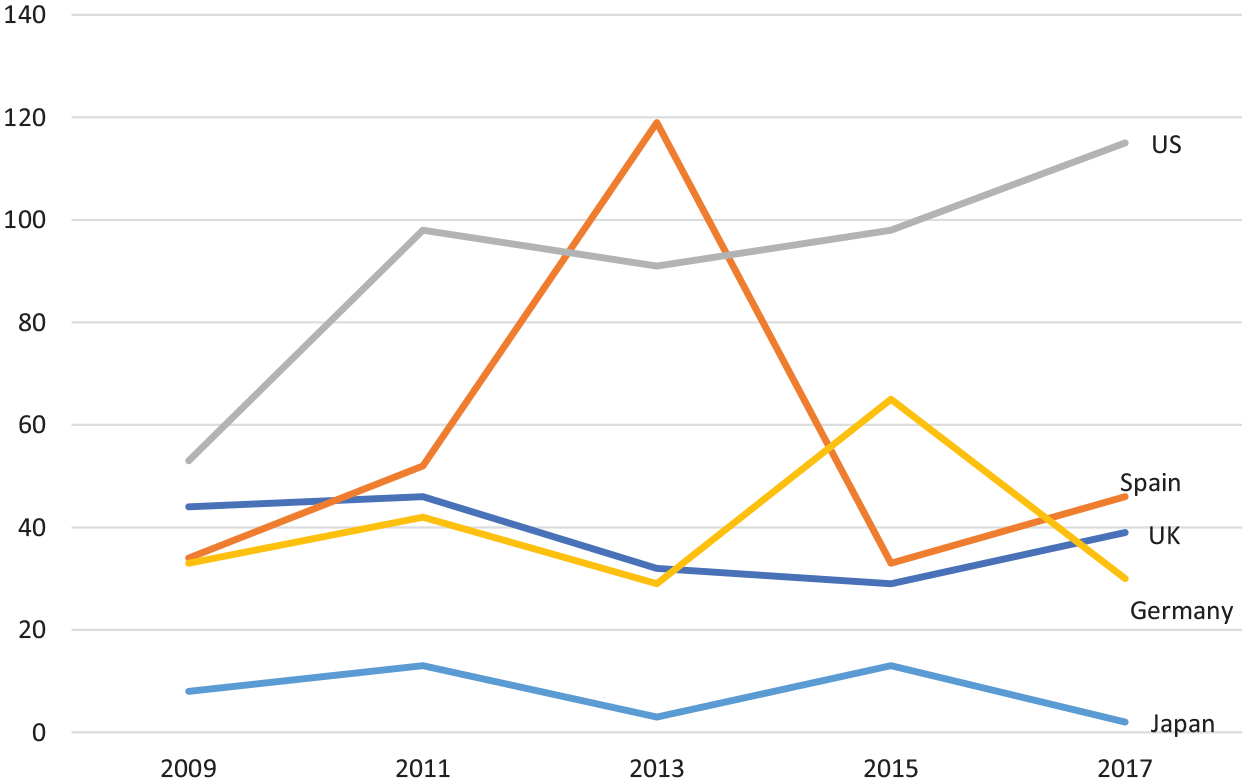
Frequency of protest events recorded, 2009–2017.
We should add that this approach is far from unproblematic and in no way is it a flawless method for identifying trends in protest and social movements (see the discussion in Wüest & Lorenzini 2020). Newspaper reports are biased in that they are driven by perceived criteria of newsworthiness, and this is especially so for international sources such as Reuters. Less visible or conflictual forms of dissent go routinely unreported on a daily basis, including in the workplace, within communities and within households. The use of an English-language source also brings with it a number of problems in terms of media focus. The resources required to compile a protest event analysis are considerable, and indeed our resources were very small in comparison, for instance, with the recent similar large-scale study by Kriesi et al. (2020; which also covers the pre-2008 period). That said, the analysis we present does enable us to capture some of the high profile and most visible instances of social conflict as they have occurred in the different contexts studied. In terms of our attempt to identify the types of mobilised actors, and to use this to identify key instances and episodes of contestation, we are therefore confident that we have managed to highlight some of these most visible episodes. Furthermore, in presenting our results in the form of figures that depict the shifting proportion of types of protest agent, we are also able to provide some important insights into the most prominent agent types as they occurred and were reported over time. The headline observations, at least in terms of the European cases, are also broadly similar to the far more extensive analysis produced by Kriesi et al. (2020). In sum, with these multiple caveats in mind, the results presented allow us to explore the terrain of social conflict as it developed in each country case, and therefore provide the basis for our subsequent consideration of the neoliberal model of capitalism in which it occurred. This is notwithstanding the fact that there is, of course, considerably more research yet to be done.
Spain: contesting the consequences of a burst housing bubble model of capitalism
The model of capitalism that developed in Spain in the lead-up to the 2008 global economic crisis was based heavily on the liberalisation of finance, which in turn acted especially to stimulate the construction sector. The finance sector became increasingly dominant within Spain’s political economy as membership of the European Union’s (EU) Economic and Monetary Union facilitated low-cost lending in Spain. This, in turn, was used to facilitate investment in both large public infrastructure projects and the private-sector housing market. As a result of these developments, Spain experienced rapid economic growth, but a decrease in labour productivity and a massive rise in overall (public and private) debt, which reached 502% of gross domestic product (GDP) by 2009 (much of which was channelled into the building sector; Buendía & Molero-Simarro 2018: 3–8). As such, in terms of our Régulation Theory approach, the monetary and credit regime was allowed to develop in such a way that it stimulated a bubble which subsequently burst in 2008. This hit the housing and construction sector especially badly, resulting in a sharp rise in unemployment, a rapid further increase in public debt and the collapse of the housing bubble.
The consequences of this burst bubble were felt across the different institutions that made up Spain’s accumulation regime, including its integration into the international economy, the wage–labour nexus, the competition regime, the state–economy nexus and social reproduction (especially housing provision). The sharp rise in public debt accrued during the course of the crisis meant that Spain’s economy (and especially financial sector) became increasingly sensitive to international speculation as a result of efforts to service the debt, eventually requiring European Central Bank (ECB) support for the country’s banking sector. While austerity measures were attached as conditions for this financial support, both the PSOE and PP Governments of Zapatero and Rajoy opted for more severe austerity measures than those which were demanded of them, including through Article 135 which introduced public spending cuts into the constitution (Perez & Matsaganis 2018: 201–202). Austerity measures included a public-sector wage freeze and mass redundancies, an increase in the retirement age, reduced spending on health and education, privatisations and a rise in VAT. This occurred alongside labour market reforms designed to make it easier to dismiss employees and reduce collective wage bargaining. These measures combined to produce a decline in the wage share (Afonso 2019: 951–952). Finally, the collapse in the housing market, combined with the effects of the recession, produced a situation whereby mortgages could not be repaid and tens of thousands of indebted households were subsequently evicted from their homes (Buendía & Molero-Simarro 2018: 9–13).
As Figure 2 indicates, the global upturn in protest activity associated with 2011, commonly termed the ‘movement of the squares’ (Varvarousis et al. 2021), is visible in our protest event analysis and depicted by the increased number of protest events for that year conducted by what we refer to as ‘radicals and anti-capitalists’. This is largely made up of the protests of the 15-M, and those that developed on the basis of the 15-M movement, which took place throughout much of 2011 and was largely organised around a series of protest camps and assemblies that began in Madrid but which were also witnessed across many cities in Spain. The 15-M sought to highlight and oppose the austerity measures and the widespread hardship that followed the 2008 crisis, witnessing a condemnation of both mainstream political parties, who were considered lacking in terms of solutions to the crisis and in many cases to blame (including through corruption) for the crisis as it had developed (largely explaining the significant presence of anti-corruption campaigner-led protests in subsequent years) (Flesher Fominaya 2020; Moreno Zacarés 2020). This was largely conducted by young precarious workers and students, in a context where youth unemployment reached levels approaching 50%. As Figure 2 shows, growing discontent during 2011 was also voiced by workers – especially those affected by public spending cuts and wage and job cuts. Steel workers, teachers and health workers all engaged in different types of protests, including demonstrations and strikes.
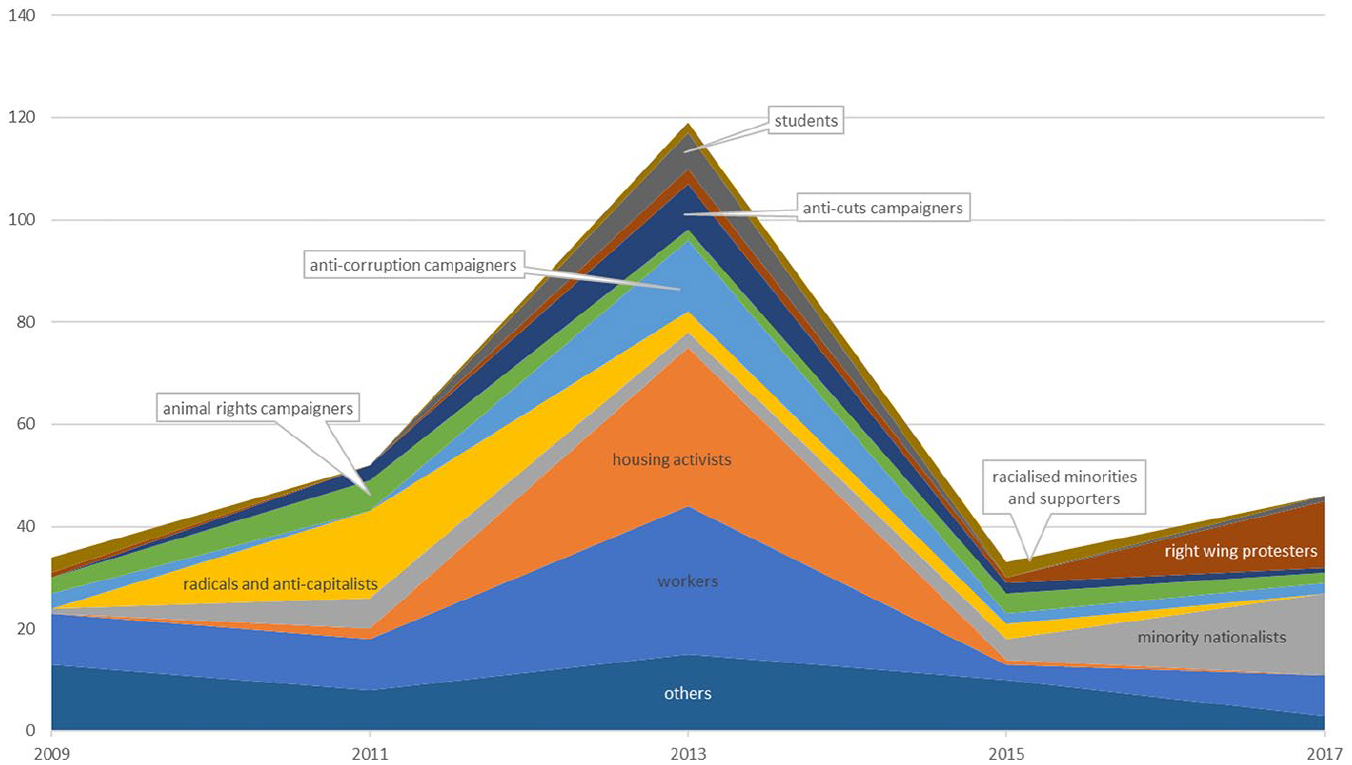
Spain, protest events by actor type, 2009–2017.
Our protest event analysis for 2013 witnessed a rise in the number of those protesting specifically against regressive changes to the state–economy relation, which had particular consequences for the means of social reproduction. These instances of dissent included opposition to reductions in the welfare state (anti-cuts campaigners) and to the higher education system (students). Anti-austerity campaigns included the so-called ‘marea blanca’ movement which was led by health workers as a series of protests against cuts to health services and against the central government’s ban on free health care for undocumented immigrants, alongside protests by jobless people, for instance, in Valencia (on links between 15-M and the Marea protests, see Bailey et al. 2018: 150–151). The student-led protests captured in the figure were also focused on opposing the increases to fees and cuts to spending on higher education in universities. We also see a rise in anti-corruption campaigns, focused on what was viewed as having been a corrupt competition regime, especially as it applied in the construction sector. This took aim at the corruption and the perceived self-serving nature of the political elite as one of the key reasons for the 2008 global economic crisis and the way that it developed in the case of Spain. This saw protests especially focused on the way in which the banking sector, political class (especially members of the Popular Party) and the housing industry, all combined to produce the housing market bubble of the pre-2008 period and the massive social costs associated with the bursting of that bubble (on this ‘iron triangle’ between ‘the state, the real estate industry, and political parties’, see Moreno Zacarés 2020). The corruption scandals that shook the PP during 2013 saw a large number of protests across the country, oftentimes directly outside the offices of the Popular Party, with slogans such as ‘“Resign Now”, “Resignation!”, “Enough”, “Thieves, resignation!”, and “Resignation, they do not represent us”’. Finally, we see protests led by housing activists largely organised by local assemblies of the group, Plataforma de Afectados por la Hipoteca (PAH; Platform for People Affected by Mortgages), who focused especially on the impact of the burst housing sector bubble upon the sphere of social reproduction, opposing the widespread evictions that took place after the housing market collapsed (Berglund 2018). Many of these housing activists had also previously participated in the 15-M protests, as the PAH had been one of the lead organisations to propose and organise the key events that made up the 15-M (Flesher Fominaya 2015: 154). They engaged both in public demonstrations to raise awareness of the issues facing those suffering from evictions due to unrepayable mortgages, and also anti-eviction movements that would seek to prevent evictions from taking place through the staging of blockades designed to obstruct bailiffs and occupying houses to accommodate evicted families (Bailey et al. 2018: 230–235).
Most of the worker-led protests reported were targeted directly on the wage–labour nexus and especially against pay cuts (for instance, by metro workers in Madrid) or job losses (such as by the workers of Bankia, and a protest camp which was staged by employees of bathroom fittings firm Roca). Other worker-led protests were staged in opposition to the Rajoy Government (again protesting both austerity measures and corruption). We also record a march by the striking coal miners and residents of the Asturian Regions, and protests against cuts to public services, for instance, witnessing health workers in Madrid gather in the capital with banners reading ‘their loot is my crisis, no bread, no peace’, ‘no to budget cuts and privatisations, Yes to public health system and services’. Worker-led protests also included that of the Panrico employees who took part in a lengthy strike over job cuts (for a detailed account of the Panrico conflict, see Bailey et al. 2018: 94–99).
Finally, as Figure 2 also shows, between 2013 and 2017 the focus of social conflict shifted to the question of Catalan independence, with a clear focus on the question of the state–economy relationship. As Clua-Losada (2018) highlights, the increasing prominence of Catalan independence as a source of conflict in part resulted from the pro-austerity approach adopted by the Madrid Government and the way in which this heightened tensions with the autonomous regions. In turn, the decision to hold a referendum in 2017 prompted a further escalation of those tensions, with protests staged by those in support of the referendum and in solidarity with those who were imprisoned due to their involvement with the holding of the referendum (Clua-Losada 2018). Likewise, many of what are depicted in Figure 2 as ‘right wing protesters’ were protests held across the country in opposition to the independence movement and in support of Spanish national unity.
In sum, in the wake of the 2008 global economic crisis, and especially the bursting of a bubble that was generated through a model of capitalism that had been built around a loose finance regime and a housing sector bubble, Spain witnessed an outburst of opposition that targeted both the institutional causes of that crisis and its consequences (Charnock et al. 2012). This saw what we have termed ‘radical and anti-capitalist’ activists taking part in the 15-M, with a strong focus on criticising what was viewed as the corrupt and self-serving nature of each of the mainstream parties making up the country’s political class and the corresponding competition regime which they had created (Flesher Fominaya 2020). The crisis and austerity measures which followed this burst housing bubble were largely blamed on this competition regime, centred around the relationship between the banking sector, the construction sector and the political class (Moreno Zacarés 2020), which translated into a key focus of the protests witnessed. This terrain of social conflict subsequently developed throughout the 2010s, with a strong focus on the impact of the burst bubble economy on developments in the state–economy nexus, social reproduction and the wage–labour nexus, including in 2013 with housing activists, anti-cuts campaigners, anti-corruption campaigners and workers, each oftentimes sharing the tactics and approaches of direct action adopted by the 15-M movement. As the decade progressed, conflict took on a regional form as the central government in Madrid was increasingly viewed as having adopted a pro-austerity position, contributing to support for regional independence in Catalonia and a corresponding right-wing backlash in support of national unity (Clua-Losada 2018). As we can see, therefore, Spain’s model of neoliberal capitalism developed throughout the decade after 2008 in such a way that saw contestation over the development of, and the crisis prompted by, the institutional forms which comprised Spain’s shifting regime of accumulation.
Germany: contesting export-focused neoliberalism
The model of neoliberal capitalism that developed in Germany both prior to, and following, the 2008 global economic crisis is perhaps best known for its relatively large focus on the manufacturing sector, with exports especially as an important source of growth. This has been facilitated by the expansion of a low-paid, flexible section of the labour market, in part in an attempt to maintain global price competitiveness for exports (Márquez-Ramos 2018). This model of accumulation has seen a continual process of restructuring of the wage–labour nexus, putting pressure upon low and intermediate-skilled workers and immigrants, who have experienced a considerable rise in the risk of being in in-work poverty (Brülle et al. 2019). One of the consequences of these developments has been a widening divide between ‘permanent staff, who experience their security as a privilege’ and ‘the precariat’ (Nachtwey 2018: 125–128). This has created insecurity and anxiety on both sides of this divide. Those with permanent positions seek to avoid the risk of falling into the precariat class; whereas precarious workers are increasingly willing to over-perform in the hope that they might gain access to more stable employment (Haipeter 2020; Nachtwey 2018: 125–128). Germany’s model of neoliberal capitalism therefore combines an export-oriented focus towards the international economy, with a tightening of the conditions of workers as a key adjustment characterising the wage–labour nexus.
It is with this in mind that we should consider the results of our protest event analysis (Figure 3). This shows a notably different terrain of social conflict to that witnessed in Spain. First, it is notable that during the year 2011, while we see a growth in protest activity by ‘radicals and anti-capitalists’ similar to that witnessed in Spain, this exists alongside the occurrence of protests (with a similar degree of prominence) staged by environmentalists and peace protesters. The increase in ‘radicals and anti-capitalists’ (and, to a lesser degree, anti-poverty/anti-cuts protests) reflects some of the trends witnessed in other countries for 2011: the ‘movement of the squares’. The large majority of these reported protest events took the form of Occupy camps set up in cities across Germany, including in Berlin, Leipzig, Frankfurt, Hamburg and Cologne. However, in a trend that appears to diverge from that in countries affected more deeply by post-2008 austerity measures, our sample of protest events also shows 2011 experiencing a rise in protests that were not directly related to the global economic crisis and subsequent ‘age of austerity’. The environmentalist protest events which took place in 2011, for instance, were opposed to development projects that threatened the society–nature relationship, such as the building of the Schoenefeld Airport and the Stuttgart 21 railway project, as well as opposing the operation of nuclear power stations. Likewise, peace protesters mobilised to oppose aspects of Germany’s integration within the international economy, for instance, witnessing opposition to the sale of tanks to Saudi Arabia. These trends perhaps reflect the lesser degree of austerity witnessed in Germany (Heuer & Mau 2017) and a corresponding occurrence of a range of forms of dissent that were unrelated to austerity. In short, austerity (and opposition to it) does not appear to have been the ‘only game in town’, in terms of social conflict, in the same way as occurred in countries such as Spain and, as we shall see, the United States. This is, at least in part, due to the lack of such a fundamental crisis in Germany’s model of capitalism as a result of the 2008 global economic crisis.
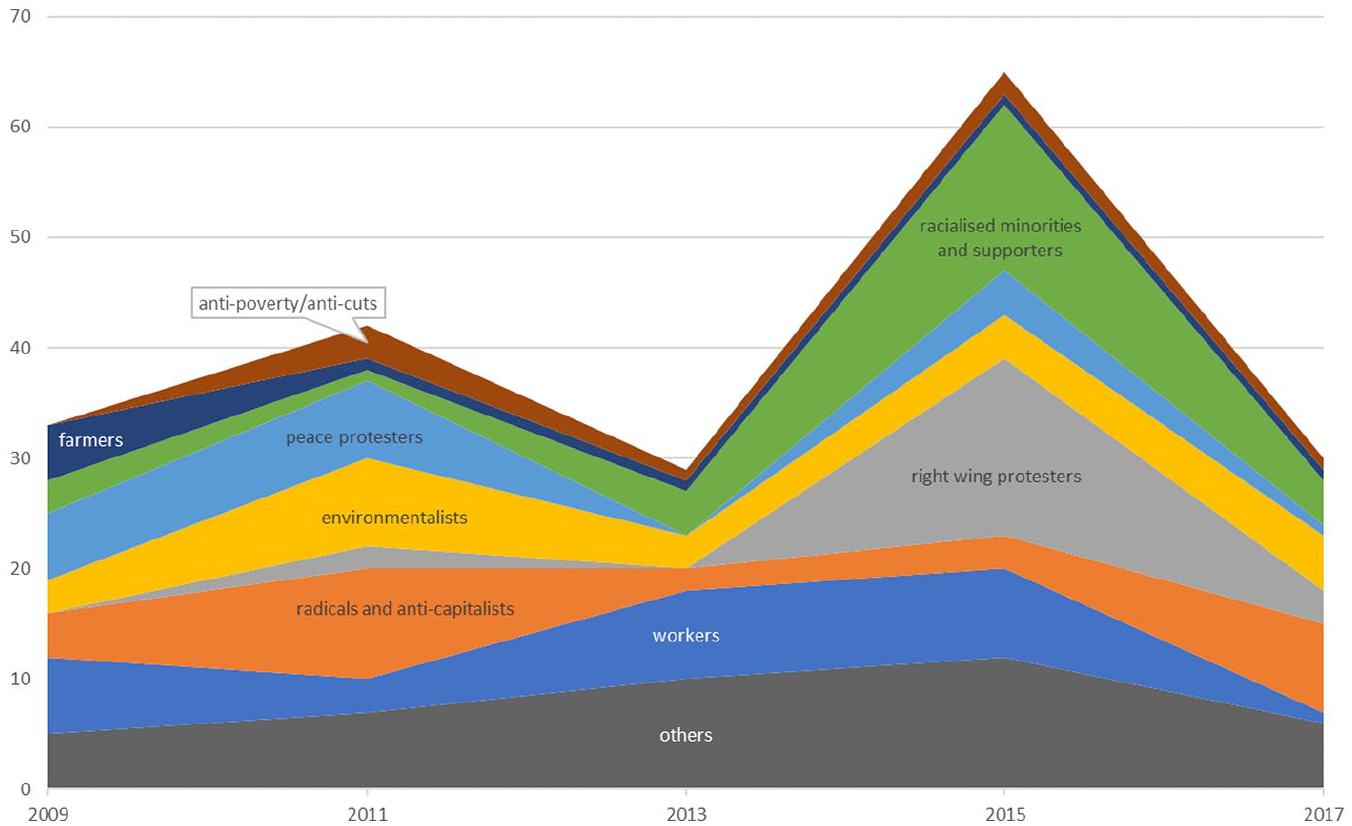
Germany, protest events by actor type, 2009–2017.
In 2015, Germany witnessed a sharp rise in the number of reported protest events, although, as Figure 3 makes clear, this largely consisted of an increase in conflict around the refugee ‘crisis’ in Germany. As we can see, this includes a considerable rise in the number of protest events in our sample conducted by what we refer to as ‘right wing protesters’. These were largely organised by the Pegida movement in opposition to the arrival of refugees from Syria and elsewhere in the Middle East and North Africa (Virchow 2016). This Pegida movement was met by a wave of counter-demonstrations, which we label here ‘racialised minorities and supporters’, who sought to oppose Pegida (Vüllers & Hellmeier 2021). This conflict saw an overlap between concerns focused on Germany’s border regime and its wage–labour nexus. This partly reflected broader social divisions within German society, arguably with roots in the socio-economic tensions associated with the liberalising trends introduced into the labour market over the preceding 20 years. Thus, the Merkel Government explicitly linked its initially liberal refugee policy to the need to increase the supply of labour into the labour market in Germany, thereby creating the potential for opposition by those ‘native’ Germans threatened by an increase in labour supply (Laubenthal 2019: 420–421). As Nachtwey (2018) describes, Pegida is ‘the expression of a radicalized middle class beset by fears of downward mobility’ (p. 196). Likewise, surveys of participants found that participants in the Pegida protests tended to be both employed and earn mid-range incomes (i.e. the key group facing downward pressure on wages and job security; Vorländer et al. 2018: 77–85). At the same time, there remains a strong commitment in Germany to anti-racism and a tradition of anti-fascist protest from across German society, which contributed to the frequency of anti-Pegida counter-demonstrations.
Worker-led protest was also a feature of the period, with trade unions IG Metall and ver.di leading many of the reported protests. This was also prompted in part by the rise in the scale of the so-called ‘precariat’ within the Germany labour market. This was reflected, for instance, in the campaign by the major trade union, IG Metall, to achieve pay increases for agency workers (on labour campaigns in Germany, see, for instance, Thelen 2019).
In sum, the development of the terrain of social conflict in Germany during the post-2008 ‘age of austerity’ can perhaps be considered in two stages. During 2011, which was the year of global protest (or ‘movement of the squares’), Germany experienced a wave of Occupy protests in cities across the country. In contrast to other high-income neoliberal capitalist contexts, however, the ‘movement of the squares’ was a less prominent feature than elsewhere. In particular, a range of protest movements continued to be significant within Germany during 2011 that focused on different aspects of Germany’s accumulation regime, including those of environmentalists and peace protests. This reflects the fact that the austerity measures adopted in Germany were not as substantial as elsewhere (Heuer & Mau 2017), due partly to the lessened impact of the crisis upon Germany’s model of capitalism in comparison with southern Europe (see Kriesi et al. 2020 for similar findings). Others have also noted that key reforms to the wage–labour nexus, the state–economy nexus and institutionalised means of social reproduction had already been initiated, with the move towards austerity reforms and the retrenchment of the welfare state in Germany prior to 2008, therefore witnessing corresponding anti-austerity protests occurring at an earlier stage in the development of Germany’s model of neoliberal capitalism, especially in opposition to the Hartz IV reforms of the Social Democratic Party of Germany (SPD) Government in the early 2000s (Bruff 2010). Nevertheless, Germany has also witnessed a gradual process of labour market liberalisation over the last two decades which has produced considerable reform to the wage–labour nexus, especially moves towards greater use of precarious employment and downward pressure upon wages and job security (Nachtwey 2018). These moves towards liberalisation overlapped with a growing disgruntlement by certain sections of the industrial working class, as well as opposition to the Merkel government’s response to the refugee crisis of 2015. This produced a growing schism between a right-wing movement opposed to the welcoming of refugees, and a more liberal section of the population seeking to offer support to migrants and opposition to movements such as Pegida. In terms of our discussion of the forms of mobilisation and opposition witnessed in Germany, therefore, we can see a number of links to the development of the national model of capitalism, with radical anti-austerity protest being relatively muted, while social divisions have been especially striking over attitudes towards refugees, which itself reflected tensions generated by the move towards the liberalisation of the German wage–labour nexus, and a perceived associated downward pressure upon the living standards and social expectations of some sections of the ‘native’ German population.
Japan: contesting a neoliberalising model of capitalism
Japan’s model of capitalism has experienced ongoing transformation since the bursting of Japan’s bubble economy in 1991. This has focused especially on introducing a number of measures designed to improve Japan’s competitiveness within the international economy. This, in turn, has resulted in a number of important changes to the pre-1991 Japanese model of capitalism, including an increase in trade and an increased role for foreign investment, prompting reforms to Japan’s competition regime and especially an erosion of the system of interlinked ownership by so-called ‘main banks’, whereby domestic banks were embedded in horizontal and vertical networks of trading and industrial companies (keiretsu) that were associated with stable patterns of long-term employment in Japan. One of the consequences of these changes has been to expose domestic firms in Japan to greater pressures to be cost competitive, which has in turn produced a growing trend whereby Japanese firms rely upon a casualised labour force that is increasingly employed through temporary agencies, thereby introducing changes to Japan’s wage–labour nexus (Shibata 2020).
The 2008 global economic crisis saw a number of further important changes to this wage–labour nexus. 790,000 non-regular workers were dismissed in the wake of declining production (Japan Ministry of Health, Labour, and Welfare 2010). We also saw a rise in the number of workers on ‘free shift’ (or ‘zero hour’) contracts, requiring workers to be available on demand without any guarantee of work. Japanese firms increasingly sought to focus on both exporting to East Asian markets (especially China) and at the same time were required to compete with the growth in lower cost (due to lower wages) of production across East Asia. Moves to liberalise trade were largely associated with the negotiations around the Trans-Pacific Partnership (TPP), which in turn contributed further to attempts to liberalise key sectors of Japan’s economy, including especially agriculture (Shibata 2020: 25–26).
With these developments in mind, we can consider our protest event analysis (Figure 4). What is perhaps most notable when we come to consider the case of Japan is the much lower number of protest events reported in our dataset compared with the other countries in this study (Figure 1). We suspect this is due to a Western-centric bias in the reporting of Reuters News. It might also reflect a tradition of relatively low levels of social conflict and protest within Japan. Nevertheless, protests have increased over the past 20 years in Japan (Chiavacci & Obinger 2018). As one of us has shown elsewhere, there is also a growing trend of especially precarious or ‘non-regular’ workers mobilising in Japan (Shibata 2020). These protest events are, however, oftentimes of a relatively non-confrontational nature, often going unnoticed by the international media.
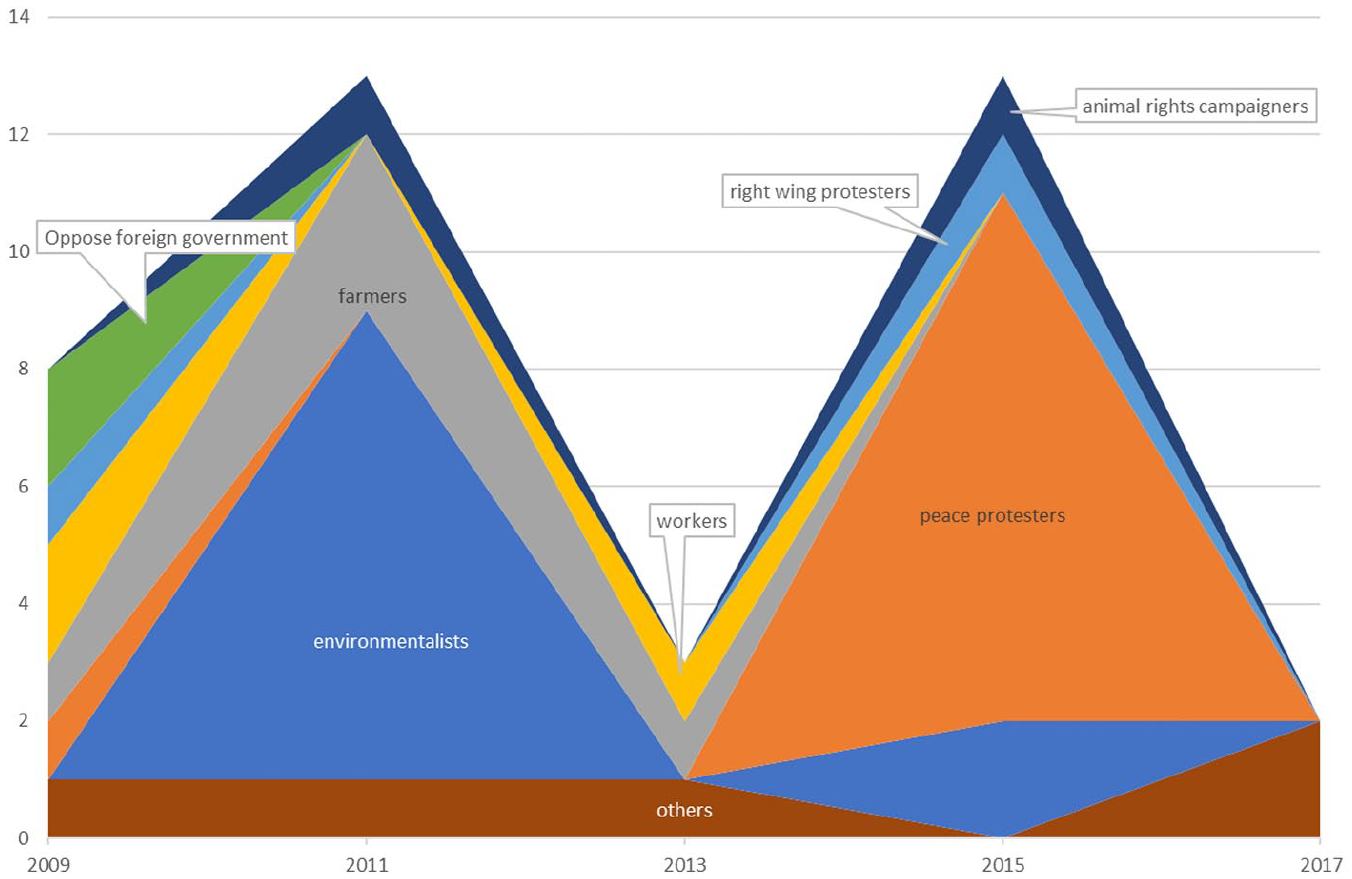
Japan, protest events by actor type, 2009–2017.
As Figure 4 shows, the two larger mobilisations captured in our protest event analysis for Japan occurred in 2011 and 2015 and were especially focused on the society–nature relationship as it features in Japan’s model of capitalism. The mobilisation in 2011 predominantly targeted Tokyo Electric Power Company (TEPCO) and the fallout of the Fukushima nuclear plant disaster (which TEPCO was held responsible for). These protests included opposition to any attempt to reopen the plant, and sought to draw attention to the plight of those workers who were required to put themselves in danger as part of the clean-up operation (Hasegawa 2014: 294). In another sign of the lack of international media attention on Japan, during 2011 an ‘anti-nuke Occupy’ camp was created, consisting of tents pitched in front of Japan’s Ministry of Economy, Trade, and Industry. This camp lasted for over 2 years, yet as Hasegawa points out, despite the fact that ‘Time magazine selected “the protester” for its 2011 person of the year award. Time magazine’s featured article on the protester did not mention any antinuclear demonstrations in Japan or the Anti-Nuke Occupy Tent protest’ (Hasegawa 2014: 293). This confirms our suspicion that there is a disproportional lack of focus on protests in Japan within international press reports.
The mobilisation of 2015 largely focused on the decision of the Abe Government to seek to re-militarise Japan as part of a set of proposed reforms to the Japanese Constitution. These protests had links to the earlier antinuclear protests that emerged following the Fukushima disaster, with environmental and peace groups overlapping in their opposition to the neoconservative agenda of the Abe administration (Chiavacci & Obinger 2018: 15). Again, however, the number of reported events captured in our dataset is relatively low for 2015 despite these developments. This partly reflects the fact that, as Hasegawa (2014) describes, many of these protests ‘were more like peaceful walks than demonstrations’ (p. 295).
Finally, what is also noteworthy is the largely absent anti-austerity protests of the type witnessed in other countries in this study. This might reflect the absence of stringent austerity measures in Japan, with public debt being allowed to rise considerably, without any corresponding move by the government to directly seek to reduce public spending or impose welfare retrenchment measures. Indeed, in 2009, Japan’s debt rose above 200% of GDP, where it has subsequently remained, reaching over 238% of GDP in 2018 (Organisation for Economic Co-operation and Development (OECD)). The particular interaction between the state–economy nexus and Japan’s monetary and credit regime, in part, therefore, explains this relative lack of anti-austerity protest (on the particular form of austerity adopted in Japan and opposition to it, see Bailey & Shibata 2019).
In sum, a number of features stand out from the Japan case. First, there is a relatively low level of visible protest witnessed during this period, at least as captured in our dataset of reported protests. This might reflect a media bias that is North Atlantic and West European in its focus, as well as the relatively non-confrontational nature of many of the protest events that occurred in the case of Japan. Second, those protests that were recorded focused largely on issues unrelated to austerity and the fallout of the 2008 crisis, witnessing instead a strong focus upon Japan’s society–nature relationship following the Fukushima disaster and on the efforts of the right-wing Abe administration to re-militarise Japan. Third, despite low numbers of reported events, a number of protests reflected one of the key features of Japan’s neoliberalisation model of capitalism: the growing move towards dependence upon non-regular and precarious employment as a core element of the Japanese model of capitalism and its wage–labour nexus (Shibata 2016). Those worker-led protests that were reported and those protests which focused on Fukushima both highlighted the specific plight of non-regular, precarious workers in the case of Japan.
The United States: contesting a financialised and racialised model of capitalism
The United States has perhaps the most neoliberal model of capitalism. Since the ‘Volcker shock’ of 1979, each US President in turn has implemented a series of reforms to the state–economy nexus, wage–labour nexus, competition regime, monetary/credit regime and the means of social reproduction. This includes reforms to fiscal policy, monetary policy and labour market policy, as well as overseeing the adoption of successive waves of legislation designed to ensure product and capital market deregulation (Rasmus 2020). This has resulted in a dominant role for the financial sector, the declining generosity of the welfare state through measures such as the 1996 Personal Responsibility and Work Opportunity Reconciliation Act, an attack on trade union activity as symbolised by the defeat of the Professional Air Traffic Controllers Organization in 1981 and a credit-based housing market bubble that grew throughout the late 1990s and early 2000s until bursting in 2007–2008.
Each of these trends contributed to higher levels of income inequality and a rise in poverty, which took a heavily racialised form, with reductions in wages and welfare provisions both landing disproportionately upon racialised minorities, witnessing 22.5% of African Americans in poverty by 2000, compared with 9.5% of non-Hispanic Whites (Eisner 2011: 141).
The increased role of finance and debt in the US model of neoliberalism saw the financial sector increasingly seek to identify new opportunities through which to originate debt, especially in the form of increasingly risky mortgage loans, as part of an ongoing and escalating search for yield. By 2006, household indebtedness was 140% of net disposable income, much of which contributed to the rise of the housing market bubble. This debt also took on a racialised character, as sub-prime mortgages were targeted at racialised minorities (Chomsisengphet & Pennington-Cross 2006; Kotz 2015: 132). By 2006, African Americans were more than twice as likely to have sub-prime credit than were non-Hispanic Whites, to the extent that an outright majority of all African American borrowers were pushed onto sub-prime loans in that year (Wyly et al. 2012).
In terms of our protest event analysis, the frequency of reported protests in our sample of events is higher than each of the other cases (Figure 1). This is perhaps relatively unsurprising given the global media focus on the United States and due to the fact that its population is much larger than each of the other countries in our sample. That said, we can compare the proportion of types of protests in the case of the United States, as illustrated in Figure 5, in order to compare the terrain of social conflict there with other capitalist contexts during the decade following the 2008 global economic crisis.
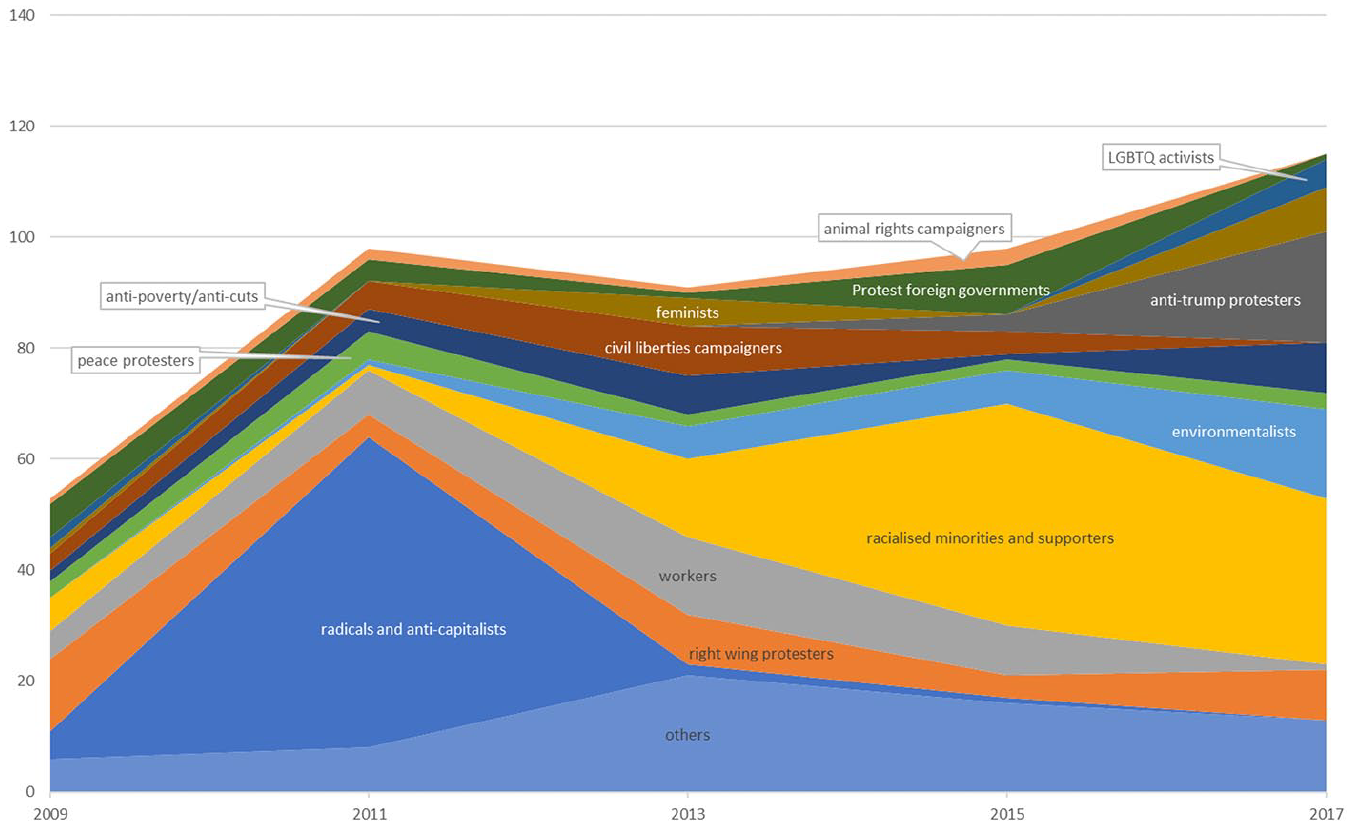
The United States, protest events by actor type, 2009–2017.
Considering first the year 2011, the very large increase in the proportion of reported protests conducted by what we term ‘radicals and anti-capitalists’ includes especially those who took part in the ‘movement of the squares’. This reflects the overwhelming prominence of the Occupy movement in the United States during 2011, which targeted explicitly the key features of the US model of capitalism, including the central role of the finance sector, the stark inequality associated with deregulated labour markets, and a competition regime and state–economy nexus which had favoured deregulation and a minimalist welfare state. Occupy camps took place in cities across the country, initially in Zuccotti Park in Manhattan (Occupy Wall Street) but also in Boston, San Francisco, Chicago, Los Angeles, Miami, Washington, Seattle and Phoenix.
By 2015, the Occupy movement had dissipated. However, the year 2015 saw the coming to prominence of the Black Lives Matter movement, witnessing a large increase in the number of protests conducted by what we categorise as ‘racialised minorities and supporters’ (see also Andrews et al. 2018, which produces similar findings). The Black Lives Matter movement had begun in 2013, in opposition to police treatment of Black people, and also reflecting broader frustrations borne of the long-term discrimination in the United States. This could be witnessed in the much higher rates of police killings of Black Americans, which was itself enabled by racialised housing patterns, and which in turn is associated with the predatory behaviour of mortgage providers selling sub-prime loans to minorities in the United States (Robinson 2020). Indeed, the inequality and hardship that emerged throughout the neoliberal period in the United States was of a highly racialised nature. As noted above, the reduction in welfare generosity and increased precarity in the labour market hit minorities worse than it did White members of the US population. Likewise, the bust housing bubble, as a result, hit racialised minorities particularly badly. This combined with a relative decline in wealth for minorities, as housing owned by minorities failed to keep up with the wealth recovery process after the crisis (Hall et al. 2015). Foreclosures were experienced by African Americans and Latinos at between double and triple the rate that they were experienced by Whites (Camp 2016). It is in this context, and with Black minorities experiencing particular hardship in the wake of the global economic crisis, that we should understand the underlying grievances that fuelled the Black Lives Matter movement. As Taylor (2016) describes, the issue of racialised policing of African Americans had its roots in a broader history of impoverishing, criminalising and denigrating Black citizens in the United States, both prior to and during the neoliberalisation of the US socio-economy. The eruption of protest around the Black Lives Matter movement, therefore, also reflected and drew upon ‘a much broader critique that situated policing within a matrix of racism and inequality in the United States and beyond’, including the fact that ‘240,000 Black people lost their homes as a result of the foreclosure crisis’ (Taylor 2016: 191).
The focus of protests in the United States, on racial injustice and the racist nature of US public policy, continued in 2017, largely in the form of opposition to President Trump’s so-called ‘Muslim Ban’. This saw a number of protest events that sought to disrupt activity within airports as a means of highlighting opposition to the racist nature of the ban. The year 2017 also saw a rise in the number of anti-Trump protests, especially at the time of his inauguration, with protests recorded in Washington, DC, New York, Seattle, San Francisco, Chicago and Portland. It also included demonstrations which called on Trump to release his tax returns as a result of suspicions that he was concealing these for personal and political gain.
In sum, the terrain of social conflict that developed in the United States during this period has clear links to the model of neoliberal capitalism in place at the time. The prominence of Occupy Wall Street, and the Occupy movement more generally, clearly highlights the scale of opposition to what was considered to be a highly inequitable system of over-financialised capitalism. This was followed in later years with a prominent focus upon the racialised nature of the US model of capitalism, a development with obvious roots in its history of slavery, Jim Crow laws and the civil rights movement, but which in more recent times was associated with the experience of Black US citizens at the hands of the police, and (more indirectly) the way in which the pre-2008 financial and housing bubble had affected Black US citizens especially badly (Farr 2021; Narayan 2017). The combination of financialisation, a burst bubble economy and highly racialised patterns of inequality, each of which were (and continued to be) central to the US model of neoliberal capitalism, played a clear role in terms of the terrain of social conflict witnessed in that country during the period under investigation.
The United Kingdom: contesting austerity-driven neoliberalism
Alongside the United States, the United Kingdom is also one of the most highly neoliberalised of the advanced capitalist democracies. This came about as a result of a long-term transformation in the wage–labour nexus, competition regime, state–economy nexus, and monetary and credit regime, all of which are typically considered to have begun with the election of the Thatcher Government in 1979. This saw an initial shift in production from manufacturing to services, prompted partly by a monetarist experiment with high interest rates, as well as the removal of state support for industries, and increasing financial market liberalisation. This occurred alongside a concerted effort to liberalise labour markets, especially through a series of reforms to employment law that ensured that the influence of trade unions was weakened, and which itself resulted in Britain’s labour market being characterised by a slowdown in real wage growth, a growth in low-paid jobs and a declining wage share. The effect of declining manufacturing exports and wage growth upon aggregate demand was partly offset by a corresponding increase in private debt, facilitated by a process of financial market deregulation, which also acted to stimulate a rapid increase in house prices, especially during the 1990s and early 2000s, providing a further line of credit which was able to boost demand despite a declining wage share (Crouch 2009; Lavery 2019: 21–28).
The immediate impact of the 2008 crisis was a rapid rise in the budget deficit and public debt. With a high level of exposure and therefore sensitivity to international speculation, the Conservative-Liberal Democrat Coalition Government elected in 2010 adopted a debt and deficit-averse position and sought to address this growth in debt by adopting a policy programme that was aimed principally at austerity measures designed to reduce public spending. This witnessed considerable pressure placed on local services, the capping of working-age benefits and increased welfare conditionality, while protecting old-age pensions (Lavery 2019: 114–118). Furthermore, in part due to the reliance of the UK model on low-paid flexible labour, efforts were made to further drive down wage costs, especially through the liberalisation of the labour market and removal of a number of labour market regulations (Heyes & Lewis 2014). As a result, real wages went into decline and the proportion of involuntary part-time or temporary employment within the labour market increased (Bailey et al. 2018: 69–70). This was also combined with an ultra-loose monetary policy – near-zero interest rates, creating asset-price inflation which was especially beneficial for the UK finance sector, as well as people holding financial assets and homeowners with mortgages – that acted to re-inflate the UK housing market. As a result, the housing market compounded the wealth inequalities that already existed between homeowners, on one hand, and those renting properties or reliant upon a dwindling supply of social housing, on the other hand. It also created intergenerational tensions between older people holding assets in the form of pensions and houses and younger people facing greater employment precariousness, higher barriers to home ownership and increased uncertainty of income (Milburn 2019).
It is in this context that we should understand the results of our protest event analysis (Figure 6). The year 2011 was marked by a notable rise in three key types of protesters, each focused in different ways upon the austerity measures adopted by the Conservative-Liberal Democrat Coalition Government elected in 2010. Thus, ‘radicals and anti-capitalists’ clearly grew in importance in the terrain of social conflict during that year, reflecting the global trend towards a movement of the squares we have noted above. This refers largely to the Occupy movement, and especially Occupy London, which camped outside St Paul’s Cathedral and also held a second camp located in Finsbury Square. The student-led protests against the steep rise in university tuition fees announced in 2010 are also visible on the figure. In addition, protests staged by anti-poverty/anti-cuts activists were undertaken by the group UK Uncut, also in opposition to the public spending cuts announced by the government in its Comprehensive Spending Review in 2010. This contestation focused on the state–economy nexus and took the form of direct action protests, whereby attempts were made to blockade or protest both outside and inside of firms, especially retail firms, identified as having avoided tax payments, including Vodafone and the Philip Green-owned chain of retail stores (on some of the key developments in the anti-austerity movement in the United Kingdom, see Bailey 2014; Bailey et al. 2018: 127–146).
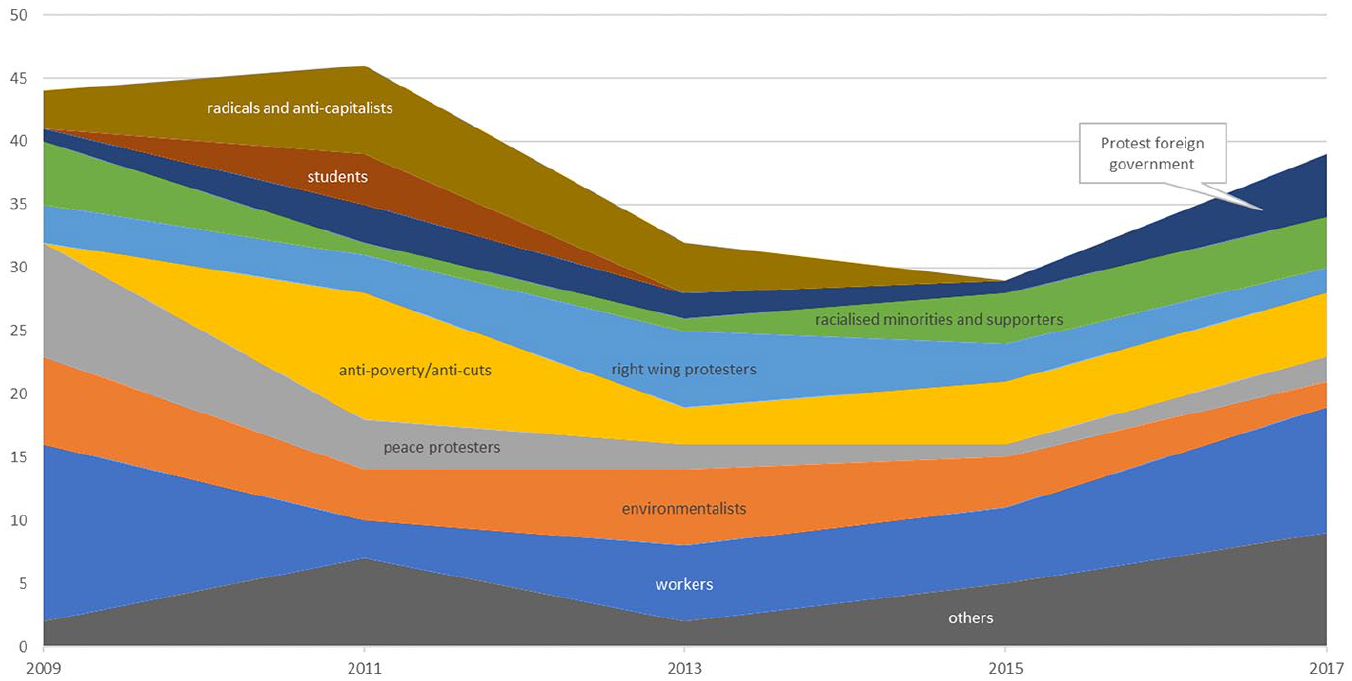
The United Kingdom, protest events by actor type, 2009–2017.
Following the events of 2011, between 2013 and 2017 the United Kingdom saw the mobilisation of a range of key groups: workers challenging ongoing trends related to the wage–labour nexus (including strikes held by workers on the London Underground railway and by the British Airways Cabin Crew); environmentalists focused on moves to introduce fracking into the British model of capitalism’s society–nature relationship (including especially anti-fracking protests at Balcombe and Preston New Road, and in opposition to a third runway at Heathrow); and anti-poverty/anti-cuts mobilisations which continued to contest reforms to the state–economy nexus and their impact upon the means of social reproduction (including support for the NHS and protests held by the People’s Assembly Against Austerity). This period also witnessed growing mobilisations by racialised minorities (including opposition to the far right English Defence League (EDL) and protests staged by Black Lives Matter) and right-wing protesters (such as far right groups, the EDL and Britain First). Finally, the year 2017 also saw a rise of protests that we have categorised as being against foreign governments. These were almost entirely focused on opposing the presidency of Donald Trump, with protests in cities across the country both to mark his inauguration and to oppose his so-called ‘Muslim travel ban’.
In sum, the terrain of social conflict in the United Kingdom reflected a number of key trends regarding the development of Britain’s model of neoliberal capitalism during this period. Two features, especially, stand out. First, there was clearly a prominent focus on the austerity measures that surrounded the fallout from the 2008 global economic crisis, especially in 2011. This included the Occupy movement, UK Uncut and the student-led anti-tuition fee movement. This is perhaps unsurprising given the scale of welfare state cuts imposed by the incoming Conservative-Liberal Democratic coalition government following its Comprehensive Spending Review in 2010 (MacLeavy 2011). It also reflects the highly neoliberal model of capitalism in the United Kingdom, with the Conservative Party widely considered to be a trailblazer for neoliberalism from the early 1980s onwards (Fuchs 2016). Second, also notable is the ongoing divisions between right-wing protesters and racialised minorities (including those suffering as a result of the country’s increasingly punitive immigration regime). In part, this tension reflects Britain’s post-colonial status as a declining imperialist power. It also occurred in a context where reductions in public spending, public services and welfare generosity were each accompanied by a legitimation strategy that sought to inculcate a nostalgia for Britain’s (imperialist) past, especially after the result of the Brexit referendum in 2016 (Bailey 2018), and included the attempt to scapegoat immigrants as the source of hardship for the ‘native’ working class in Britain (Donmez & Sutton 2020).
Conclusion
There is an expanding literature highlighting the different forms of protest that have emerged in high-income capitalist democracies, especially following the fallout of the 2008 global economic crisis. This sits awkwardly alongside a related body of literature that highlights the demobilisation and disarticulation of organised labour politics as a key feature of neoliberalism and the fragmentation of the working class into discrete identity politics. This article represents a bridge between these two contending positions – the rise of anti-neoliberal protest and the demise of organised labour – through a consideration of the shifting terrains of social conflict, considered both in terms of the activity conducted by workers as workers and by the broader range of mobilisation, conducted by what we consider a (broadly defined) working class, in five high-income neoliberal capitalist contexts (the United States, the United Kingdom, Germany, Spain and Japan). In this sense, different expressions of working-class dissent continue to proliferate. In placing different forms of protest mobilisation alongside each other, we are able to see the different forms of dissent that have emerged in different contexts, and in considering these through the lens of the Régulation Theory approach we set out above, we are able to view these forms of visible protest in terms of how they relate to the contestation of the particular model of neoliberal capitalism within which they have emerged. Whereas much (mainstream) social movement studies literature focuses on grievances, resources, political opportunity structures and framing, each understood as ‘variables’ that differ (or vary) across national contexts, we instead follow a broadly Marxist approach by seeking to conceptualise social relations that are internally constitutive of capitalism. Through the method of abstraction, we can understand how these movements dialectically relate to the capitalist context in which they occur.
The article highlights the way in which the development of each particular accumulation regime prior to 2008 was in turn related to the contestation of the different institutional forms that made up shifting accumulation regime as it subsequently adapted to the global economic crisis following 2008. While there exists no direct (linear) process of causality between the model of neoliberal capitalism and the forms of mobilised dissent witnessed, nevertheless we are able to clearly identify the different pressures of capital accumulation that have given rise to the particular mobilisations identified in each case, and trace back the ways in which these are related to the particular accumulation regimes that characterise each national model of capitalism.
We can identify both common trends and national particular ones. In terms of common trends, the anti-capitalist Occupy and ‘movement of the squares’ from 2011 is perhaps most notable, reflecting the transnational development of a radical movement marking the global crisis of neoliberalism and especially the austerity measures that were often adopted to follow it. In terms of national differences, we have sought to highlight the way in which the prevalent forms of protest that we have witnessed were each related to the pressures arising from both the process and crises of the particular model of capitalism where they occurred, considered especially in terms of one or more of the seven institutional forms that we used the Régulation Theory approach to help us identify. We see proportionally much greater protest regarding austerity and welfare state cuts, and especially the way in which these affected the state–economy nexus, wage–labour nexus and institutions of social reproduction, in Spain and the United Kingdom, than in Germany and Japan, reflecting the greater degree of austerity adopted in the national models of accumulation in those countries during the period under investigation.
As we have also sought to show, many of the protest movements that are sometimes considered ‘cultural’ or ‘identity politics’ can also be conceptualised in terms of their relationship to the accumulation regimes within which they emerge. Environmentalist movements have focused on the society–nature relationship as it has been strained or brought to crisis point by the pressures of capital accumulation, especially in Germany and Japan. The contestation of immigration and race have been traced to the racialised inequalities generated through the interaction between different institutional forms, and especially the monetary and financial regime (in the United States), trends within the wage–labour nexus (in Germany) and legacies of the (imperialist) integration into the international economy (in the United Kingdom). Movements contesting the state–economy relationship as part of Spain’s model of capitalism have been shown to have contributed to the seemingly territorially focused independence movement in Catalonia.
In terms of implications for both the future development of neoliberalism and the study of it, the article shows how and why we might expect different pressures to arise from both the contestation of ongoing attempts to regularise capital accumulation across the institutional forms that characterise any particular model of neoliberal capitalism and the consequences of the crisis tendencies as they erupt from these processes of capital accumulation and the institutional configurations that have produced those crises. In short, the contestation of capitalism, and its crises, continues.
Footnotes
Acknowledgements
We are grateful for the research assistance of Ran Yan, Milly Morris and Max Lempriere, and the funding provided by the University of Birmingham’s College of Social Science Quality Output Support Scheme and the Birmingham Business School research award scheme. Earlier versions of the paper have been presented at a number of different workshops and conferences. We are grateful for feedback in those forums, and for comments and helpful conversations with Ian Bruff, Kai Koddenbrock, Bernd Bonfert, Huw Macartney, Earl Gammon, Giulio Palermo, Sushil Oswal, Bob Brecher, Shai Kassirer, Deanna Dadusc, Zeina El Maasri, Andreas Bieler, Jon Mansell, Pierre Monforte, Athina Karatzogianni, Torsten Geelan, Christel Koop, Elio di Muccio, Greig Charnock, Gregor Gall, Andy Hodder, Owen Worth, and Sebastian Lechevalier. We are grateful to the anonymous reviewers and for the editorial guidance of Angela Wigger.
