




Abstract
This analysis starts off from the contemporary relevance of the theory of ‘the radicalism of tradition’, arguing that it presents a challenge to Marxism because Marxist work has not sufficiently attended to elements of a theory of worker subjectivity scattered in the critique of political economy. This theory is located on a lower level of abstraction than is commonly assumed and can be applied to subjective dynamics in labour militancy. However, this requires that some basic categories in Marx’s critique are reconsidered, especially those that do not seem immanent to the capitalist social formation, categories that appear, and have mostly been read, as the ahistorical ground on which properly social forms arise. Therefore, apparently ahistorical categories pertaining to use value and concrete labour’s use value for capital are explored to reconstruct a theory relating capital’s positing of labour to contemporary militancies that appropriate tradition. In contrast to the view of tradition as external to capital, the view advanced is that ‘reactionary radicalism’ relates to how capital, as totalizing social form, abstracts tradition. Furthermore, tradition is radicalized through a negative subjectivity inherent to the commodification of labour power and the real subsumption of labour; proletarian experience is a precondition of radicalized tradition.
Reactionary radicalism and Marxist theory
There is scholarly agreement that forces of labour in advanced capitalism remain on the defensive, even in the recent revival of labour militancy. Beyond ‘labour quiescence’ thoroughly discussed and charted in work on strike statistics, the recent upswing has been interpreted as a defensive response to austerity, neoliberalism, and the like. Indeed, compared to the dialectical interconnection of economic crisis and class struggle during the seventies, as a post-2008 phenomenon, the recent revival appears unambiguously caused by crisis. This is arguably tied to long-term structural change. Beverly Silver (2014) notes that a ‘Marx-type’ of struggle by new working classes migrates to rapidly industrializing areas of the global South, while a defensive ‘Polanyi-type’ predominates in the North. It seems that expanding forms of value production in advanced capitalism (notably, in services, including different areas of logistics) do not generate struggles on the scale that public workers, for instance, mount as a counter to austerity. This state of contemporary struggles is arguably linked to patterns of popular politics: to ‘polarization’ and the appearance of the radical right as a force on par with the left. It does not take an Ernst Bloch to see that radicalism today is fuelled often not by progressive but ‘reactionary’ sentiments, by a will to preserve social forms eroded by capital’s simultaneously accelerating and deindustrializing agency.
Hence the appeal of ‘the radicalism of tradition’ as a theory of revolt. Motivated by the erosion of social forms, ‘“reactionary radicals” [traditional communities of, e.g. artisans or peasants] have been at the centre of most modern revolutions and many other radical mobilizations’ (Calhoun 1983: 888). Originally developed by Craigh Calhoun and recurring in analyses of recent labour conflict (Ancelovici 2011), this theory holds that revolt is the work of communities about to be undone by modernization, not of moderns themselves, including Marx’s proletariat.
Such communities contest the logic of capital by drawing on elements of tradition, and proponents of this theory conceive tradition as exterior to capital as social form. In contrast, the view advanced here is that contemporary ‘reactionary radicalism’ relates to capital’s abstraction of tradition. Furthermore, radicalized tradition is articulated in forms of worker consciousness inherent to the commodification and real subsumption of labour; proletarian experience is a precondition of radicalized tradition. Hence, what is at issue here is not whether tradition can be configured in anti-capitalist ways, and there is indeed work by Anglo-Saxon Marxists testifying to such modalities of traditional radicalism. Rather, we seek to demonstrate the distinctly proletarian element of subjectivity in worker struggles presently mobilizing tradition. However, to appreciate this, we need to recover a Marxian theory of worker subjectivity in very little use today. To be sure, there is a long-standing Marxist engagement with proletarian subjectivity in the political and philosophical sense (Lukács 1971), but the analysis of subjectivity in Marx’s ‘mature’ critique of political economy is still to be retrieved, with repercussions for Marxist research on work and militancy. I can only indicate this lacuna but it reflects assumptions with far-reaching consequences, exemplified by Calhoun’s (1983) assessment: ‘At no point [. . .] does [Marx] develop a satisfactory account of how the class of proletarians becomes the subjective actor the proletariat’ (p. 888). This is the assumption of the notorious ‘missing subject debate’ in labour process theory.
On the fringes of this debate, scholars invoked Marx’s value form analysis (Rowlinson & Hassard 2000; Spencer 2000; Tinker 2002), and this is indeed key to his analysis of worker consciousness. However, in this regard, those scholars only provided general formulations, gesturing towards – rather than explaining – the link between value form and subjectivity. Asserting that alienated labour is a ‘real abstraction [that] finds concrete expression in the specific tendencies of degraded and deskilled work’, Spencer (2000) notes that ‘capitalist work confronts labour as an alienated activity’; labour encounters itself in a complex auto-relation (pp. 225–226). Regrettably, this problem is not further explored. The same gesturing characterizes work not oriented towards the labour process debate as such, but to an independent Marxist concern with capitalist work and value form. In this context, Taylor (2002) claims that orthodox Marxism along with labour process analysis is based on ‘an essentially one-sided conceptualization of labour as concrete labour’ (p. 103). Taylor persuasively argues that there is no pure consciousness conforming to the concrete reality of labour; the reality and experience of labour is infused by value form, impeding the formation of revolutionary consciousness. While this is crucial to the Marxian theory, there are limitations in Taylor’s account. Taylor wants to relate worker subjectivity to the ‘social totality of the capitalist order’ and, like Spencer, focus on the link between ‘individual consciousness and social form’ causing the said auto-relation and rendering people as ‘historically determined subject-objects’ (Taylor 2002: 104, 106–107). However, the concern with totality, and how social mediation via abstract labour shapes consciousness at this level, tells us little about the specific features of capitalist work translating into worker subjectivity.
In fact, the issue of ‘how we can grasp the abstract, totalising social relation of the value form in and through the study of labour [. . .] has not formed the focus of any considerable or engaged tradition of value-form-oriented social research’ (Pitts 2017: 71). According to Pitts (Pitts 2017: 74), the value form is a non-empirical reality with a practical dimension that cannot be grasped through studies ‘geared solely towards concrete labour and the experience of it’; research must attend to ‘the social totality in which abstract labour is brought into existence’. Pitts provides a valuable discussion of how to study the link between value as totalizing form and real labour processes, but the issue of how value relates to the immediate experience, hence the subjectivity, of labour warrants further theoretical work before moving to the social totality. Matters would stand differently had Marx not analysed this relationship. However, although scattered throughout his critique, this is just what he did. It is possible to build on this analysis to a greater extent than has been done in much value form theory in the West European context (cf. Starosta 2017).
Similar tendencies are found in Marxist research into social movements. Recently, mainstream social movement research has strayed from a concern with capitalism, characteristic of pioneering work during the 70s (Hetland & Goodwin 2013). However, what would it mean to ‘bring capitalism back’ into social movement studies? Goodwin and Hetland focus on how capitalism ‘enables and constrains’ the emergence of popular forces, and while one is prone to agree that neglecting how capitalism thus shapes social movements stultifies mainstream research, it is less clear what is distinctively Marxist about this. The reason Marxism is not brought back to pry the subjectivity of social movements emerges from Barker’s (2013) discussion of the relation between the social movement concept and the Marxian concept of class struggle. Barker (2013) stresses that the latter works at a higher level of abstraction than the former; classes are ‘not themselves coherent political actors’ (pp. 46–47). Hence, social movements are mediated expressions of class struggle. Barker considers the economic categories analysed in Capital in light of a similar distinction between levels of analysis: only at a more immediate level than the abstract level of Capital can real collective actors be grasped. However, the political concept of class struggle is not an abstraction of the same kind as categories in Marx’s critique of political economy and, therefore, the same relation does not obtain between these two kinds of abstraction, on one hand, and real social processes, on the other hand. Barker’s view of Capital can be contrasted with Pepperell’s (2010) analysis of how Marx’s work relates ‘forms of subjectivity to forms of objectivity by providing a micrological analysis of often very mundane social practices – by analysing what people do, subjectively and objectively, when they engage in a practice of a specific kind’ (pp. 25–26). Accordingly, categories in Marx’s critique can be used to reconstruct a theory of worker subjectivity on a lower level of abstraction than is commonly assumed.
This reconstruction requires reconsideration of some of Marx’s categories, especially those that might not seem immanent to his critique of political economy, categories that appear and have often been read as the ahistorical ground on which properly social forms (i.e. value, money, capital) arise. Below, some of these categories are explored, including use value and concrete labour’s use value for capital, categories that lend themselves to an ontological reading because of Marx’s presentational strategy of mimicking partial and one-sided views of bourgeois society (Pepperell 2010: 15). These categories must be reconsidered because the formation of subjectivity relates to real (useful and concrete) labour activity and we must appreciate its constructed qualities. Exploring the immanent and constructed quality of use value and concrete labour will allow us to see how capital’s positing of labour, through a set of mediations that include the commodification of labour power and the processes of formal and real subsumption, institutes proletarian subjectivity understood as a particular relationship to self, that is, a relation to alienated self-activity and to a residual, negative sense of self. The tendency to real subsumption, furthermore, is found critical to the development of labour militancy because of how it intensifies the problem of identification (including workers’ attachments to tradition and ideology) as a by-product of the alienating movement of capital.
The following sections present a reading of Marx’s analysis of worker subjectivity that can illuminate contemporary labour militancy. First, I set out the general lines of this reading, homing in on the analysis of the positing of concrete labour by capital in Grundrisse. The argument is specified in the next section dealing with the value forms and social processes involved in shaping worker subjectivity as analysed in Capital, volume I. The resultant forms of subjectivity are then theoretically integrated, drawing on experiences of a prototypically radicalized tradition, nursing and nurses’ struggles against neoliberal restructuring and austerity through a mode of appropriation that has become known as ‘politicization of caring’. Here, it is possible to engage with the theory of ‘the radicalism of tradition’ with a view to public workers at the forefront of the revival of class struggle in advanced capitalism. It emerges that traditions thus appropriated are not social forms exterior to capital – capital’s abstraction of tradition facilitates its appropriation, at least in parts of advanced capitalism, such as public service, where labour retains significant structural and associational power. Furthermore, appropriation is the work of a negative form of subjectivity indissociable from proletarian experience. While it arises from the very denudation and ‘absolute poverty’ of the worker (Marx 1973: 295–297), this negativity also enables workers to appropriate tradition.
Grundrisse: use value, labour and modern subjects
The following subsections provide the outlines of a theory of worker subjectivity in Grundrisse, later to be specified in a subsequent section on Capital, volume I. The subsections traverse the themes of use value, labour and modern subjectivity. Building on the constructed quality of use value, it is possible to grasp labour as something posited by capital, instituting the auto-relation Spencer and Taylor gesture towards, which for Marx is a defining trait of modern subjects.
Use value
The category of use value is central to the ensuing analysis. Far from the generic notion of ‘utility’, use value denotes a particular historical reality. To appreciate this, it is indispensable to introduce some features of Marx’s methodology.
In the section on ‘the method of political economy’, Marx famously argues that it would be improper to begin the exposition of analysis with the real and the concrete, with the real precondition (the class structure, population, etc.), since the concrete is the concentration of many determinations; a result, not a starting point. Instead, the correct way is to ascend from simple relations towards more complex relations and categories with several determinations (Marx 1973: 100–102). But the ‘ascent from the abstract to the concrete’ is not how the concrete actually develops; as an image of the real process, it is an idealist illusion. In fact, simple relations and their concepts, as a rule, require a complex concrete totality because ‘the most general abstractions arise only in the midst of the richest possible concrete development, where one thing appears as common to many, to all’ (Marx 1973: 104). This is not how matters appear, however: the simple relation will have some measure of general applicability, causing it to be projected into the past; it may even seem transhistorically valid. This complicates the issue and invites the idealist fallacy. As a further complication, the simple relation may indeed have existed before the concrete totality within which it now exists.
With money, for example, the more developed concrete whole reproduces a simple relation that also existed in less developed formations, although within the former, this relation expresses a more many-sided connection (Marx 1973: 102). Hence, in the succession of economic categories, their subject – society – must always be borne in mind. These categories express forms of being and characteristics of existence that pertain only to individual sides of this society ‘and therefore this society by no means begins only at the point where one can speak of it as such’ (Marx 1973: 106). One should start from ‘abstract determinants which obtain in more or less all forms of society, but in the above-explained sense’, Marx cautions (1973: 108, emphasis added). In the succession of those economic categories that obtain in bourgeois society, it therefore seems that this society arises on a natural and ahistorical ground, that is, on a foundation of use value and concrete labour. However, because these categories express forms of being and characteristics of existence which are aspects of bourgeois society itself, in its specificity, their foundational quality is socially determined and historically contingent.
This reading refutes much non-Marxist commentary on Marx’s critique of economic categories (e.g. Baudrillard 1975) as well as the ‘traditional Marxism’ rejected by modern value form interpretations. As a general interpretation of the concepts used in the critique of political economy, including Capital, it also jars with some recent value form readings, especially when it comes to concepts like use value that seem to be deployed in an uncritical, ontological fashion in Capital (Pepperell 2010: 58–64). Later, it will emerge that the reading is essential to the application of the Marxist critique of value form to labour militancy, but we should first attend to how this interpretation affects the understanding of the category of use value.
On this reading, the duality of the commodity (use value and exchange value) is a reality that emerges with the development of monetary functions. It requires the usage of money in its basic function as measure to bring out the quality of exchange value; only when given price does exchange value cease to be an immediate and becomes a reflected quality of the commodity (Marx 1973: 190). Delineation of exchange value in turn provides the contrast against which ‘use’ emerges as such, as an abstraction. However, only with capital – exchange value transformed into subject – does use value stand ‘opposite exchange value, as something defined as use value by exchange value’ (Marx 1973: 269). Marx stresses the importance of clarifying ‘to what extent use value exists not only as a presupposed matter, outside economics and its forms, but to what extent it enters into it’ (Marx 1973: 268). Because this issue is actualized only with the development of capital, Marx will only broach themes complicating a clear-cut distinction between exchange value and use value in the analysis of labour as use value for capital.
In this context, Marx asks, does not ‘use value as such enter into the [social, economic] form itself [. . .], e.g. in the different forms of labour?’ (Marx 1973: 267). That use value indeed enters the social form does not contradict that exchange value is the determinant instance. As a socially determined entity, use value ‘obtains its direction’ from exchange (Marx 1973: 267) and ‘use value as such becomes what it becomes through exchange value’ (Marx 1973: 269). Again, this happens (use value ceases to appear as an ahistorical, natural element and emerges as socially posited nature) because the only use value, which ‘can stand opposite capital as such [. . .] which increases, multiplies and hence preserves it as capital’ (Marx 1973: 271) – labour – has become a moment of capital (has been subsumed into capital), allowing exchange value to emerge as subject. It is now clear that ‘the distinction between use value and exchange value belongs within economics’ (Marx 1973: 320). Use value is part of a particular social formation and receives particular character therefrom.
Labour
The discussion of how we may understand the category of use value is important when interpreting Marx’s analysis of labour in Grundrisse, and we can now turn to this pivotal use value in the capitalist social formation. Labour appears to be the foundational category par exellence. As productive activity, it denotes qualitative differences and seems only externally related to the abstract category of value. To be sure, labour is value, as substance (abstract labour) and measure (socially necessary labour time), but only in a general sense: ‘general labour time which determines exchange values’ (Marx 1973: 171). Labour time ‘itself’ exists only subjectively, as singular activities; ‘in so far as it is exchangeable (itself a commodity) as such, it is defined and differentiated not only quantitatively but also qualitatively and is by no means general, self-equivalent labour time’ (Marx 1973: 171). Furthermore, while socially necessary labour time establishes branch-specific norms of productivity, real acts of labour in the same branch of work remain different from one another (Marx 1973: 173).
Thus, concrete labour, until now, appears external to the abstract social form. Later, however, Marx describes processes whereby labour is shaped as use value, for instance, by inculcating virtues of self-denial and industriousness in workers (Marx 1973: 284–289). This shaping of labour is irreducible to deskilling and intensification. It encompasses the whole range of modern labour activities, the qualitative differences between various types of labour; ‘the division and differentiation of labour [. . .] is itself only a product of history, and is in turn suspended for the great mass of [simple labour], while the qualitatively higher [skilled labour] takes its economic measure from the simple’ (Marx 1973: 612–613). In other words, the labour process and the division of labour are not neutral technological phenomena for Marx, as conceived in the thesis on the autonomous development of the forces of production of traditional Marxism and early modern sociology, but particular historical – and political – realities, which in all their variety and extension become posited by capital.
The direction taken by Marx’s analysis of wage labour should be understood in light of how the relation of exchange to productive activity is inverted, historically. Before capital develops, exchange exists on the fringes of different societies, which only exchange surplus produce. However, the act of exchange that had until then been a means of promoting production turns into the end – the very rationale of production, as ‘the exchange relation establishes itself as a power external to and independent of the producers’ (Marx 1973: 146). Therefore, it should not be assumed that Marx regarded the forms of artisanry, vocational labour and skill that exist under capitalism as ‘remnants’ of earlier modes of production, to which capital relates only externally (as in the theory of the ‘radicalism of tradition’). These too are posited rather than inherited forms. ‘Tradition’ thus posited merely designates specific configurations of the use value of labour for capital, and it will emerge that it is precisely its quality as something posited by capital that enables the politicization of tradition, that is, which makes it a possible object of militant appropriation.
The point may seem trivial. It should be recalled, however, that an influential reading, within and outside Marxism, promotes a very different interpretation: that in Marx’s analysis, capital is an exterior, negative force leaching on pristine labour. In contrast to this reading, it should be asserted that only a view of labour as posited by capital squares with the analysis in Grundrisse. Marx is very clear. Use value does seem inherent to workers themselves – but as such, it does not exist separately from their physical bodies. In this mode, use value has no actual existence, only potential existence (Marx 1973: 267). Only when workers are employed does this potential receive form as actual use value: ‘As soon as it has obtained motion from capital, this use value exists as the worker’s specific, productive activity; in his vitality itself, directed towards a specific purpose and hence expressing itself in a specific form’ (Marx 1973: 267).
However, if concrete labour is posited by capital rather than expressive of some technological teleology, hence alien to workers themselves, the question of wage workers’ relation to their self-activity arises, that is to say, the question of the subjectivity of the modern worker. What are the social psychological effects of the alien sense of self-activity implied in the analysis of labour as use value for capital? We will gain some purchase on this from an outline of modern modes of social domination in Grundrisse which foregrounds a dialectic of personality, self and social role.
Modern subjects
It has been implied that as modern wage labour develops, tradition turns into a presupposition posited by capital – a configuration of labour’s use value for capital. Tradition posited by capital tends towards what is today often referred to as the ‘ideal worker’, a set of imagined qualities that impinge on worker subjectivity, qualities prefigured in the labour process itself Granberg (2015). In terms of the theory of modern subjectivity in Grundrisse, however, the question of the psychological relationship the worker is placed in with regard to such constructs arises. Because, the Grundrisse is also the site of Marx’s remark on abstractions that achieve practical truth, a key reference in current Marxist work on ‘real abstraction’. While studies of the ‘ideal worker’ commonly deploy the frame of ‘identification’ in dealing with this relationship, this is not tenable in dealing with such practical abstractions. We should closely read this remark and clarify the peculiar psychological relation implied.
In undeveloped systems of exchange, individuals are ‘imprisoned within a certain definition’; they are identified with their social role, whereas ‘in the money relation’, such ties of personal dependence give way to an order where ‘personal ties all appear as personal relations’ (Marx 1973: 163). What we now call personal (or ‘private’) relations, where individuals relate as personalities, become accentuated as production relations and related structural relations (e.g. bureaucracy) become ‘objective’ dependence relations. Here, the roles individuals assume appear independent of their personalities. The individuals seem autonomous here because, as persons, they tend to be abstracted – and to abstract themselves – from their social conditions; ‘and these conditions, in turn, are independent of the individuals and, although created by society, appear as if they were natural conditions, not controllable by individuals’ (Marx 1973: 164). A notion of personal freedom develops as domination becomes impersonal, because the definedness of individuals, which in the former case appears as a personal restriction of the individual by another, appears in the latter case as developed into an objective restriction of the individual by relations independent of him and sufficient unto themselves. (Marx 1973: 164)
Therefore, capital’s autonomized relations correlate with how modern subjects ‘enact their roles in a distinctively theatrical way, experiencing themselves as disembedded in a determinate sense from the specific economic roles that they perform’ (Pepperell 2010: 149, emphasis added).
So, when Marx (1973) proclaims that ‘individuals are now ruled by abstractions, whereas earlier they depended on one another’, this implies a peculiar social psychological relation of self and other (p. 164). What in an ordinary intersubjective relation might result in ‘identification’ – identification of self and social role – here results in a diremption of self into self and other. In other words, roles that are not moments of capital can be integrated with the personality of individuals in a way precluded by modern, ‘objective’ dependence relations. Conversely, roles inherent to the latter cause a separation between the individual’s sense of self and its ‘extimate’ other, to use a Lacanian phrase, and this ‘other’ is the individual’s real self-activity.
Wage labour illustrates the externality taken by social functions towards the individuals who perform them: ‘the [wage] worker is [. . .] formally posited as a person who is something for himself apart from his labour’ (Marx 1973: 289). This opens a space for critique, and Marx will in fact associate this very sense of alienation in labour with an ‘enormous’ advance in consciousness: [Living] labour itself appears as alien vis-á-vis living labour capacity, whose labour it is [. . .] labour capacity’s own labour is as alien to it – and it really is, as regards its direction etc. – as are material and instrument. Which is why the product then appears to it as a combination of alien material, alien instrument and alien labour – as alien property [. . .] The recognition of the products as its own, and the judgement that its separation from the conditions of its realization is improper – forcibly imposed – is an enormous advance in consciousness. (Marx 1973: 462–463)
Turning to the analysis in Capital with this investigation of subjectivity in Grundrisse in mind, we find an analysis of the mechanisms constitutive of such proletarian subjectivity. Here, Marx elaborates on what he described as the wage worker’s becoming ‘pure use value’ for capital (Marx 1973: 305–310), giving this ‘abstraction’ of labour (Marx 1973: 295–297) a more precise meaning with the concepts of the wage form, labour power and the (formal and real) subsumption of labour. In light of the analysis in Grundrisse, moreover, these concepts can be read more dialectically than is customary; they do not just address domination but are designed to capture a sense of externalization, including the critical potentials of the modern worker subject.
Capital: wage form, labour power and real subsumption
The above analysis of worker subjectivity is outlined in very condensed form in a fragment on abstract labour in Grundrisse (Marx 1973: 295–297), and Capital can be read as an elaboration of this argument. In this fragment, Marx associates labour as the living source of value with abstract labour, which is in turn linked to a transformation where labour ceases to be ‘immersed in its particular specificity’, becoming ‘merely material [stofflich] activity, activity pure and simple’. In other words, in contrast to ‘the character of the craftsmen and guild-members etc.’, this abstraction displaces worker subjectivity from the activity of labour. This points to the subjective effects of the process Marx will refer to as the ‘real’ subsumption of labour, when the properties of labour are posited by capital resulting in a loss of worker autonomy (while in ‘formal’ subsumption, independent producers are hired, becoming wage labourers but retaining autonomy in their work). It also points to Marx’s method of attending to capital’s dismembering ‘abstraction’: its sundering of formerly fused social forms, the disintegrative by-product of the very totalization or positing which is the movement of capital.
This account of the abstraction of labour in Grundrisse will inform the analysis in the next subsections, traversing the wage form, the form of labour power and the formal and real subsumption of labour into capital, as analysed by Marx in Capital, volume I. This allows me to specify the Marxian theory outlined in the above section with regard to the militant appropriation of tradition. It will thus emerge that the wage form introduces a layer of liberal ideology, and at this stage (formal subsumption), the experience of wage labour resonates with tradition. However, wage labour increasingly discords with a tradition and the latter is abstracted as a consequence of labour’s real subsumption. Real subsumption also accentuates the auto-relation characteristic of modern worker subjectivity, a relation Capital identifies in the form of labour power. Read as a dynamic process, Marx’s analysis can thus explain how tradition becomes appropriable by workers who experience a process of subjective dislocation that also facilitates the development of a critical perspective on their working conditions.
The wage form and occupational autonomy
The wage form is the part of money capital injecting the worker into productive capital’s movement of self-expansion. As the ‘price of labour’ (by time or piece), it is analysed in the section on ‘Wages’. While an utterly real aspect of the process of accumulation, it is also a deceptive form of appearance. Since it belongs to the superficial level of the economy, the circulation sphere, the wage form relates to the creation and transmission of ideology. Marx (1976: 279–280) famously depicted this ‘noisy sphere, where everything takes place on the surface and in full view of everyone’ as the ‘very Eden of the innate rights of man’ and liberalism – of ‘freedom, equality, property and Bentham’. In other words, the exchange of commodities involves what might be called objective illusions, among which are the presumed equality and self-determination of the different parties to the exchange act. These appearances distort the relations manifested in circulation, but they are illusions of practice and not, in the first place, illusions of thought (Marx 1976: 677). The exchange of labour power as a commodity is perhaps the most important aspect of this practical ideology because it involves the mystification of the process of capitalist exploitation.
We should first note the mystifying effect that the wage form, as a form belonging to the circulation sphere, shares with such forms in general: the image of the subject of circulation as an autonomous individual. Because, while labour is treated as an object in the production process, it is treated as a subject in the circulation process (Taylor 2002: 109). Second, and concerning the specifics of the wage form, this form grounds the irrational expression of the wage as ‘value of labour’. On the surface of bourgeois society, ‘the worker’s wage appears as the price of labour, as a certain quantity of money that is paid for a certain quantity of labour’ (Marx 1976: 675). However, the wage is no such thing – It is payment for labour potential, not labour expended. Yet, it really appears to be payment for a certain quantity of labour. Hence, the wage form inverts the relation it manifests: ‘the value [. . .] of labour power is represented in its converted form as wages’ (Marx 1976: 679). The wage obscures the division of the working day into necessary and surplus labour and so obscures exploitation. Comparing the wage form to slavery and the corvée system, Marx (1976) traces the source of this mystification to the value form, to money: ‘the money-relation conceals the uncompensated labour of the wage-labourer’ (p. 680). He then describes its general significance: We may therefore understand the decisive importance of the transformation of the value and price of labour-power into the form of wages, or into the value and price of labour itself. All the notions of justice held by both the worker and the capitalist, all the mystifications of the capitalist mode of production, all capitalism’s illusions about freedom [. . .] have as their basis [this] form of appearance [. . .] which makes the actual relation invisible and presents to the eye the precise opposite of that relation. (Marx 1976: 680)
The illusion is in the activity: the worker does sell labour power as a formally free individual and does seem to be compensated for labour expended. Marx notes that this illusion is bolstered, along with its destructive effects on collectivism, by developments of the wage form. Thus, with piece wages, ‘the worker’s sense of liberty, independence and self-control’ increases along with competition among workers (Marx 1976: 697).
The wage form thus envelops work in liberal ideology. As a generic ideology, it does not pertain to any particular kind of labour. This chimes with the analysis in Grundrisse where the abstraction of labour was related to how capital, as self-expanding exchange value, is essentially oblivious to the specificity of labour, just as capital is indifferent to the particular commodity, the use value, it produces. For capital, all labour is labour ‘pure and simple’. However, with its emphasis on individual autonomy, this ideology initially resonates with tradition in that tradition pivots on the autonomy of the artisan, the profession, etcetera. Calhoun (1983: 894–895) defines tradition as something ‘more than a collection of ideas or artefacts transmitted from generation to generation’ and rejects the Weberian opposition between tradition as unreflective inheritance and rationality as conscious and sensible action. Rather, tradition is an intersubjectively meaningful, practically grounded medium of everyday interaction that presupposes and reproduces shared understanding (Calhoun 1983: 896). The traditional community will display relatively high levels of ‘autonomous social control’ – being able to ‘run its own affairs without outside intervention’ – and this autonomy is a factor in its occasional radicalization.
[To] the extent that a community is self-regulating, it has good reason to visualize a society in which it and other communities like it are entirely autonomous and free from elite interference and exploitation. Thus, traditional artisanal and peasant control of the labor process is matched by communal control over social life – in contrast to the experience of members of the modern working class, who are subjected to the constant intervention of formally trained ‘experts’ in both work and personal life. (Calhoun 1983: 901)
Although, contra Calhoun, I will propose a view of tradition as posited by capital, these lines apply to a range of relatively autonomous occupational groups, including public workers at the forefront of the recent revival of class struggle in advanced capitalism. Professional tradition (e.g. the occupational autonomy and values of educators or health professionals) is commonly seen, by scholars and militant professionals alike, to be antagonized by trajectories of public sector reform, and in particular by ‘new public management’ (NPM).
However, while such antagonism certainly does exist, the relationship between heterogenous public professions and the amorphous set of ideas associated with NPM is complex (Bezes et al. 2012). Even in fields where reforms undermined autonomy and working conditions generally, opposition was not immediate and universal; professional associations and unions sometimes welcomed reforms, which indicates the strength of liberal ideology. Reflecting its neo-institutionalist streak rather than impulses from scientific management, which also went into NPM (Hood 1991), ideals like user choice, contestability and transparency seemed to affirm professional control in a decentralized public organization. Hence, there is a need to specify what it is about NPM that sometimes provokes contestation in the form of radicalized professional tradition.
I will suggest this happens when organizational change combines with developments towards the real subsumption of labour. It will emerge that, like real subsumption undermines the practical ideology of the wage form, so does it undermine the liberalism permeating public sector reform. While in formal subsumption, labour still appears as the self-expression of the worker or the collectivity of workers, in conditions of real subsumption, the powers of labour appear as properties of capital. Before this tipping point, the wage form resonates with tradition and promotes identification (i.e. that workers recognize themselves in labour). However, already in formal subsumption, there is an aspect of capitalist relations of production that troubles this ideology.
Labour power and the problem of identity
We have examined the mystifications of the wage form: the worker not only appears to receive money for labour expended but is also rendered as an autonomous agent on equal footing with other market actors. However, as Marx emphasizes, economists confuse the act of exchange and the appropriation of labour in production. The latter is not an act of exchange at all (Marx 1973: 275). The labour contract, as Facundo Rocca (2017) argues, is akin to the state of exception: a strange legal suspension of legality through a formally voluntary surrender of subjectivity. Beyond the mystifying appearance of the wage form, this same form makes possible what is a fundamentally violent commodification of labour power. It is at this stage, beyond the façade of freedom and equality, that Marx locates a phenomenological separation effected through the determinate practice that is ‘the sale and purchase of labour-power’. This practice, foreshadowing the appropriation of labour in production, sits on a threshold between the ideology of the wage form and real forms of proletarian existence.
To sell labour power as a commodity, the worker ‘must have it at his disposal, he must be the free proprietor of his own labour-capacity, hence of his person’ (Marx 1976: 271). This involves the formal independence and equality of persons inherent to circulation, constituting the worker as part subject. The seller of labour capacity and its buyer ‘meet in the market, and enter into relations with each other on a footing of equality as owners of commodities’ (Marx 1976: 271). Apart from deceptive ideological impressions, however, there is a subjective process of separation involved in the sale and purchase of labour power. In contrast to the slave, because the worker sells labour capacity for a limited period only, the worker can alienate this capacity while retaining ownership. Marx inserts two notes clarifying the subjective upshot of this, quoting Hegel’s Philosophy of Right: through the labour contract, my ability to work is alienated to another for a restricted period and so ‘my abilities acquire an external relation to the totality and universality of my being’ (Marx 1976: 272n3).
The capitalist epoch is therefore characterized by the fact that labour-power, in the eyes of the worker himself, takes on the form of a commodity which is his property; his labour consequently takes on the form of wage-labour. On the other hand, it is only from this moment that the commodity-form of the products of labour becomes universal. (Marx 1976: 273n4)
This sundering reflects how, in modernity, and as foregrounded in the previous section on Grundrisse, people perform economic roles in a ‘theatrical’ way, experiencing themselves as disembedded from their constitutive social relations. The analysis of labour power in Capital should be read in this light. Marx is arguing that placing labour-power on the market requires a particular kind of practical enactment of self. The ‘free’ labourer is not selling themselves entire, becoming a slave [. . .] they are selling an aspect of themselves, for a limited duration. To effect the sale [. . .] the seller must ‘constantly treat his labour-power as his own property’. Sellers must [. . .] sunder themselves in two – with part of the self stepping forward to operate as an active agent – a commodity owner – while another part of the self is positioned as the passively represented object that is the subject of the sale [. . .] Since this passive material object inhabits the owner’s body, the [owner enacts his/her self] as a split subject – as an active consciousness and will, conjoined with a passive material body – as a ghost in the machine. (Pepperell 2010: 249)
This is a constitutive process of abstraction, an abstraction of the worker’s sense of self as subject (as ‘active agent’) from the self as labour capacity. The abstraction is constitutive because neither the self as agent – the ghost – nor the self as labour capacity and marketable asset – the machine – can pre-exist the process of sundering. In other words, these two forms are negatively interrelated; each can emerge only through the contrast provided by the other. Although completely negative (without positive features), this ghostly sense of self as subject or agent, arising through the relationship with the sense of self as passive object, is an irreducible part of proletarian experience. Furthermore, this peculiar relationship cannot but trouble the idea of workplace ‘identity’, bombastically invoked in the labour process debate (Knights & Willmott 1989). Although the concept of ‘tradition’ signifies a broader set of practical and phenomenological activities, there is overlap between a concept of politicized identity and the theory of the radicalism of tradition; it is key to this theory that the most radical workers during the industrial revolution did not self-identify as a class but in terms of tradition (Calhoun 1983: 887).
Studies of NPM and public professionals have also focused on workplace identity (Thomas & Davies 2005). Identity can here refer to the social status of various professions, the shared values of a profession and the attributes (intellectual, emotional, technical) considered essential to different professional roles. Conflict is understood in terms of a clash between professional identities and NPM as alien ‘identity project’. But reforms carried out since the 80s in advanced capitalism had a variegated impact on professional identities and we would be hard pressed to find any clear-cut, generally applicable opposition between new forms of management and identity (Bezes et al. 2012). However, with regard to Marx’s analysis of labour power and subjectivity, it is clear that wage labour cannot be a source of ‘identity’ to begin with. Between the self and one’s wage labour (manual or mental), there is an irreducible rift. That rift can be moderated, in craft labour for example, where labour is ‘still immersed in its particular specificity’ (Marx 1973: 297). But wage labour precludes the strong identification that prevails in ‘undeveloped systems of exchange’ where people ‘enter into connection with one another only as individuals imprisoned within a certain definition, as feudal lord and vassal, landlord and serf, etc.’ (Marx 1973: 163).
Thus, an important corollary of the analysis of labour power and subjectivity is how it foregrounds the modern problem of identity as a contingent entity susceptible to politicization, as militant ‘collective identities’, or identities that management promotes to secure ‘consent’. The subjective dislocation wrought by capital’s positing renders the subject of wage labour a potentially critical – externalized and ‘ironic’ – subject who cannot fully identify with labour activity. We will see that the problem of identity is brought to a head with labour’s real subsumption into capital, providing a final conceptual resource for a Marxist take on contemporary reactionary radicalism.
Real subsumption and the abstraction of tradition
Because real subsumption is often confused with ‘deskilling’, it is helpful to define this concept with regard to capital’s positing as described in the above section on Grundrisse. In formal subsumption, when independent producers are hired and become dependent wage workers, the properties of labour are still not posited by capital. In real subsumption, in contrast, the properties of labour originate from capital, regardless of whether labour is ‘skilled’ or not. However, confusion goes deeper in that it stems from a misunderstanding of the immanent nature of Marx’s categories, which result from a ‘critical ethnography of capitalist society undertaken from within’ (Postone 1993: 18). Accordingly, they refer to forms of being and characteristics of existence in this particular society, meaning that real subsumption is not a category of measurement but of interpretation. The category does not arise in an objectivist account of what happens at the ‘material level’ of the labour process, in abstraction from its phenomenology; real subsumption involves entangled forms of objectivity and subjectivity that fundamentally change how work is experienced.
Thus, the category refers to capital’s positing of labour, taking place through an abstraction of concrete labour which is thereby turned into capital. Subsumption is a specific kind of domination: ‘to subsume’ is to include – It is not to dominate something externally, but to incorporate it. In real subsumption, ‘the worker’s labour becomes one of the modes of existence of capital’ (Marx 1976: 988). The experience of work is profoundly transformed. Labour ceases to appear as an expression of the worker’s self-activity and instead appears as a property of capital. This is a form of fetishism: Here we find that it is not only [means of production] that rise up on their hind legs and face the worker and confront him as capital, but even the social form of labour appears as a form of development of capital. (Marx 1976: 1054)
That is, even labour itself takes on the appearance of something external, a thing; labour activity – self-activity – becomes impervious to the will of the subject of labour.
We are thus faced with an autonomization of capital through a negation of worker autonomy and, as a corollary, with an abstraction of labour into something one-sided and inorganic; while the unity of the labour process formerly derived from labour itself, this synthetic quality now resides in capital. Hence, the processes of formal and real subsumption correlate with changes in the status of tradition.
Through formal subsumption, labour activities that ‘had an aura of sanctity about them, which passed as ends in themselves, which were performed for nothing or where payment was made in round-about ways [. . .] become directly converted into [wage-labour]’ (Marx 1976: 1041). Capital’s positing and transformation of the labour process institutes new relations of domination, starting with how labour’s formal subsumption ‘dissolves the relationship between the owners of the conditions of labour and the workers into a relationship of sale and purchase, a purely financial relationship [in which] exploitation is striped of every patriarchal, political or even religious cloak’ (Marx 1976: 1027). According to Marx, reconnecting with the theme of externalization of modern social roles from Grundrisse, the new relations promote notions of self-determination and responsibility. In formal subsumption, servitude is radically altered because it becomes ‘objective in nature, voluntary in appearance [. . .] purely economic’ (Marx 1976: 1028–1029). Such purely economic, impersonal and reified relations of domination are the obverse of modern forms of individual autonomy. These forms do not make wage workers neglect their duties, however. Modern forms of individual autonomy make wage workers superior to slaves: ‘consciousness of free self-determination, of liberty, makes a much better worker of the one than of the other, as does the related sense of responsibility’ (Marx 1976: 1031). Modern relations of domination with their anonymous constraints (e.g. the decline of self-sufficiency and the threat of unemployment) render workers responsible for their own reproduction.
Thus, modern forms of individual autonomy are coterminous with the negation of collective forms of worker autonomy, and this negation becomes manifest in real subsumption. Now, because tradition pivots on forms of collective autonomy (Calhoun 1983), it ceases to resonate with the experience of wage labour when the latter becomes a mode of existence of capital. In contrast to labour still ‘immersed in its particular specificity’, really subsumed workers are not treated as collectivities who control the production process (e.g. machinists in the days of F.W. Taylor); they are dealt with as autonomous individuals, subordinated to a production process permeated by capital. This is why real subsumption correlates with capital’s positing and abstraction of tradition.
Tradition is abstracted because it is negated in the labour process through the negation of workers’ control. It finds no place in capitalist relations of domination, nor in their intrinsic ideological arsenal; in real subsumption, domination works through the automatism of the production process, bolstered by liberal ideology. What remains is an extrinsic ideological deployment of tradition within the frame of liberal responsibility to secure worker consent. Tradition thus becomes part of what was referred to as the ‘configuration of labour’s use value for capital’ in the above section on Grundrisse. In the next section, I will thus refer to how nursing tradition has been abstracted into what scholars have called a ‘virtue script’, used by management to secure a sense of loyalty and to delegitimize militancy. However, this is a hollowed-out tradition; due to the autonomization of capital, tradition is emptied of the sense of collective autonomy.
Posited by capital, tradition is thus abstracted and becomes one-sided, and the old sense of tradition as a form of collective autonomy becomes incongruous, apparently headed for the dustbin of history. However, real subsumption is a dynamic, ongoing process, affecting different aspects of different lines of work at particular stages in their development. In public services, NPM reforms were introduced in interaction with the development elements of automation, involving ‘hands-on’ management and standardized performance measures in efforts to raise labour discipline (Hood 1991). This can be interpreted in terms of a tendency towards real subsumption, undermining traditions of professional autonomy. However, like industrial traditions of craft autonomy (Montgomery 1976), traditions of worker discretion and professional control within public services endure in contentious and politicized forms.
One reason for this is that real subsumption accentuates the proletarian sense of self as agent, which was discussed in the subsection on labour power. That negative sense of self is incipient in the sale of labour power. In real subsumption, this abstraction becomes true in practice, in the real labour process. This ‘alienation [Entfremdung] of man from his own labour’ reflects how ‘the social characteristics of their labour come to confront the workers so to speak in a capitalized form’ (Marx 1973: 990, 1054). This may be decried from a romantic viewpoint, and Marx (1973: 1024–1025) notes that real subsumption also mystifies the relations of domination, making capital seem all-powerful and promoting a sense of defeatism among workers. However, illustrating the complexity of Marx’s analysis, another upshot is the accentuation of proletarian subjectivity, a mode of disidentification which undermines capital’s intrinsic liberalism and ideological deployment of tradition. As illustrated below, the disembedding of the proletarian and theatricality of labour, to use Pepperell’s idiom, also provides the belvedere from which tradition can be externally and militantly appropriated by recovering the negated element of collective autonomy.
A Marxist take on reactionary radicalism
Let us summarize the broad outlines of the subjective forms derived from the reading of Marx’s analysis of labour in Grundrisse and Capital by charting the worker subject at two hypothetical ‘points’ in time. This heuristic exercise introduces distortions resulting from how diachronous illustration locates these coeval formations outside the temporal plane that they in fact share, but this is only an illustration meant to stabilize the terminology. At time zero, the worker is only formally subsumed into capital, meaning that the separation between self as agent and self as labour capacity incipient in the sale and purchase of labour power is not yet manifest. Cohesive layers of tradition and liberal ideology encircle the worker because collective autonomy has not been negated through real subsumption; the liberal ideology of the wage form still resonates with tradition because wage labour itself still does – liberalism has not been revealed as a moment in the negation of autonomy. Thus, because collective autonomy endures in formal subsumption, the subjective configuration at time zero is cohesive (Figure 1).
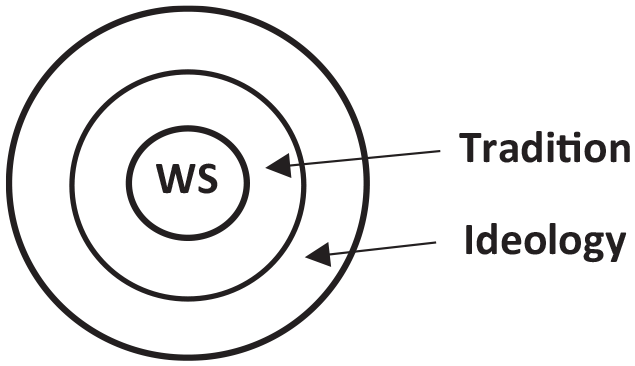
Worker subject (WS) at t0.
In contrast, at time one, the worker subject is split into self as agent and self as really subsumed labour, labour whose social form has become a property of capital. As explained above, this negative sense of self results from the subject’s non-identity with labour as self-activity. The situation at time one reflects what has been referred to as the disintegrative side of capital’s positing: the cohesive traditional and ideological layers of time zero are now fragmented. Because of the negation of collective autonomy, tradition has been abstracted into a one-sided ideology within the frame of liberal responsibility; on the other hand, the old sense of tradition as collective autonomy is fading, hence the dotted line in Figure 2.
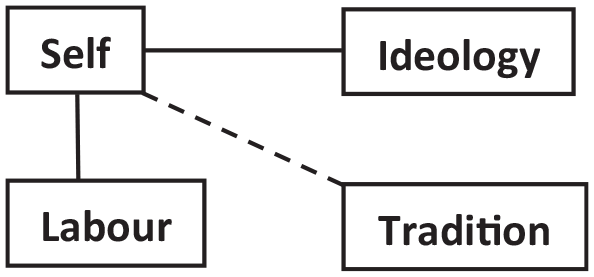
Worker subject at t1.
What has been said allows us to reconsider the social form of the ‘radicalism of tradition’. In Figure 2, the dotted line also indicates the possible militant recuperation of the old sense of tradition negated through real subsumption. In other words, it indicates the appropriation of tradition characteristic of ‘reactionary radicalism’. However, it would be insufficient and ahistorical to explain this appropriation by invoking nostalgia, or an ontological desire for autonomy, because the appropriation productively refashions the appropriated traditional element, dissociating it from the liberalism of the wage form and from ideological deployments of tradition.
To explain the conditions of possibility of this creative appropriation, we must consider why the proletarian subject (what I have called the worker’s ‘self as agent’) is critical. This subject is critical because it precludes identity in the ‘strong’ sense referred to above; there exists a subjective ‘distance’ between the self and other parts of proletarian subjectivity. The proletarian subject is disembedded; its really subsumed self-activity negatively interrelates with and thus dislocates the self as agent from the world of work. In this process, a subjective distance emerges that enables the worker to approach tradition differently than is the case in social and historical conditions that necessitate identification. In other words, because tradition has become ‘other’ – because it is no longer part of an operative and cohesive self-identity – it can be approached in indeterminate ways.
The politicization of caring
The theory can be developed more concretely by drawing on the experience of registered nurses and recent forms of nurse labour militancy. Emerging from religious institutions, this calling turned salaried profession is a prototypically radicalized tradition; nurses have become increasingly strike prone since the 80s, when states in advanced capitalism embraced neoliberal reform agendas and austerity policies (Briskin 2013). While there are national variations, nursing historically established itself as a profession by delineating and protecting a space of collective autonomy within the health and care services, deemed to require the competence of the (officially registered) nursing professional. Part of this bid for professional recognition was an appropriation of the religious notion of calling, including ideas of devotion and, relatedly, nurses’ presumed extra-monetary sense of satisfaction from ‘doing good’. Later, this element of tradition evolved into the politicized form of the ‘virtue script’, used by employers to secure consent and delegitimize nurses’ industrial action (Bessant 1992; Gordon & Nelson 2006). Furthermore, a related but reversed utilization of nursing tradition appeared in the form of the ‘politicization of caring’ (Briskin 2013), when nurses frame industrial action in terms of an expanded concept of patient advocacy.
The evolution of the traditional idea of calling into the virtue script reflects changes in the experience of care work and a development towards real subsumption, that is to say, technological and organizational changes associated with NPM reform, undermining the autonomy of nursing professionals (Rankin & Campbell 2009). In terms of the theory developed here, the virtue script is the ideological deployment of tradition within a liberal frame of individual responsibility, a frame thus welded to the idea of intrinsic (feminine) qualities disposing some individuals to do care work, individuals for whom ‘virtue is its own reward’. Posited as such, tradition becomes abstract and one-sided, leaving acquired knowledge and professional judgement, hence autonomy, by the wayside. This abstraction of tradition reflects how elements of tradition relating to collective autonomy tend to be discarded as autonomy is negated at the level of the labour process through real subsumption.
But the abstraction leaves those elements of tradition open to appropriation, and labour conflict tends to pivot on rival claims to speak for patients and the public interest, with nurses asserting their claims on the basis of their professional status as experts in caring. Research on the local experience of such struggles indicates that a process of disidentification is key to their subjective dynamic (AuthorA), that is, disidentification with the ideology of the virtue script, to be sure, but also with the reality of care work as it is posited (standardized and sped-up) by capital. The latter is expressed in terms of being objectively present though subjectively absent at work (‘just running around’), negating the exercise of professional judgement. Crucially, this is not solely a grievance but also a resource; it is a critical perspective. Real subsumption undermines identification and expels the worker (subjectively) from the world of work, manifesting the ‘ghostly’ sense of agency latent to the social form of labour power. In terms of the theory developed here, this internally external perspective is the belvedere from which the disintegration wrought by capital’s positing can be gauged, and the subjective basis on which elements can be militantly recombined.
In the context of such struggles, tradition does not exist in an external relationship to capital. Posited by capital, hence abstracted and separated from itself, tradition relates internally to capital. Likewise, the state apparatus and the values of public service do not exist in an external relation to capital and neoliberal reform (cf. Ancelovici 2011), since the institutional forms of the state derive their content from the social relations of capital (Clarke 1991). This is one key point in a Marxist take on reactionary radicalism: the militant appropriation of tradition is coterminous with capital’s positing of tradition. Second, though Calhoun (1983) insists that the most radical workers of early modern times were not class conscious, and the same can be said about several public workers at the forefront of the recent revival of class struggle, the basic subjective form in labour militancies featuring reactionary radicalism is not ‘traditional’ or ‘communal’ – it is proletarian. The disembedded, ‘ironic’, form of consciousness inherent to proletarian experience is the basis of these struggles. This form of subjectivity derives from the commodification and subsumption of labour, regardless of whether struggling workers display any wider political cosmology that might be labelled ‘class consciousness’.
Conclusion
The analysis has shown that Marx’s analysis of worker subjectivity can be applied to contemporary forms of labour militancy. Essentially, this boils down to three claims: Marx’s analysis pertains to real subjective dynamics – it is not confined to a metalevel of abstraction; Marx derives proletarian modes of selfhood from the social form of labour power and from the process of formal and real subsumption; and ‘tradition’ becomes appropriable in the context of capital’s positing of social forms.
There are limitations to this analysis. For one, in attending to the subjective preconditions of this form of militancy, the analysis does not systematically treat ‘mobilization’ or ‘structures of opportunity’. This would entail analysis of evolving sources of workers’ power in the context of different modalities of commodification of public services Granberg (2016). Another limitation is that, in showing how Marx’s analysis of worker subjectivity can be applied, it has focused on a subjective trajectory specific to the form of militancy that Calhoun (1983) calls reactionary radicalism. Although important to the present conjuncture, it should be emphasized that this is by no means the only, nor the paradigmatic, form of militancy. There are myriad others, and application of Marx’s analysis to other forms of militancy will require further theoretical and empirical work. Hence, the present analysis is not meant as a general treatment of revolutionary subjectivity. However, Marx’s analysis, though scattered and implicit, is fertile ground for such studies because of how he isolated and explored the basic determinations of proletarian experience.