




Abstract
Inequality has been increasing for decades in both rich and developing countries and the academic literature addressing it struggles to provide explanations, let alone solutions. This article is concerned with a relatively underexplored area, the relationship between macro-level inequality and organizational inequality. The core focus of the article is the recognition that the two phenomena are closely bound up one with the other. This is made possible by adopting Rousseau’s notion of inequality as hierarchy and willingness to accept subordination to authority and disparity of treatment. In doing so, we highlight similarities and dissimilarities between Rousseau and Marx. Inequality remains an issue of hierarchy at both the macro and organizational levels. As it was for Rousseau, so it is today but it is much more layered than in Rousseau’s day: inequality in society is the accepted degree of hierarchy among its members, inequality in the economy and at work is the extent to which, accepted or not, there is an imbalance of power, financial resources, remuneration of work and access to opportunities and services. The increase in inequality is due to a radical change in the socio-economic model of advanced economies. This change involves a shift towards financialization, a pressure on labour through flexibility, the decline of trade unions’ power and the retrenchment of public social spending.
Introduction and objectives
Inequality has been increasing for decades in both rich and developing countries and the academic literature addressing it struggles to provide explanations, let alone solutions. This article is concerned with a relatively underexplored area, the relationship between macro-level inequality and organizational inequality. The core focus of the article is the demonstration that the two phenomena are closely bound up one with the other, so, concomitantly, conforming that the ties between them need urgently to be adequately studied.
Macro-level inequality receives much attention from politicians and from economists; for the latter, in particular, inequality has long been a central focus of research. One motive for this sustained interest in inequality among economists and politicians is their awareness of the very high social costs that result from inequality.
While we can readily find definitions, conceptualizations and measurements of inequality in society, this is far from the case with regard to inequality in organizations. With the exception of the issues of race and gender equality at work (Piasna & Drahokoupil 2017) and the pay-gap between executives and workers (Kliman 2015), organizational inequality has been the subject of little research or debate. Management and organizational literature has included studies of inequality at work but few provide longitudinal or comparative examinations on a national let alone international level. Furthermore, specific examples of inequality (be that gender, race, executives’ compensation) are studied separately without comprehensive analysis.
Joint analyses combining the macro and the organizational level are particularly rare (Amis et al. 2018; Radoynovska 2018). While tools exist for the measurement of inequality and its social costs at the macro level, much less is known about how macro inequality affects organizations and how organizations contribute to macro inequality (Edwards 2015; Mair et al. 2016; Riaz 2015). An article (Dunne et al. 2017), discussing Piketty’s influential work, argues that management and organizational scholars should ‘contribute to the cross-disciplinary inequality research project which Capital in the 21st Century proposes . . .’. To overcome the limitations of Piketty’s work should be the aim of management and organizational scholars. But not many of them do engage with inequality and very few answered the invitation for collaborators issued by Piketty himself (Dunne et al. 2017).
This article provides one primary contribution: The development of knowledge and understanding of the phenomenon of inequality. Through a critical review of the literature, including previous empirical work by one of the authors, the causes of inequality are identified, and it is shown that the same patterns of rising inequality occurred in the past three decades at macro and organizational level and for the same reasons. This is made possible by adopting Rousseau’s notion of inequality as hierarchy and willingness to accept subordination to authority and disparity of treatment. In doing so, we highlight similarities and dissimilarities between Rousseau and Marx.
Critical to this contribution to theory development is analysis at both the macro and micro level, made possible by the collaborative work of an economist and an organizational scholar. This type of collaboration is uncommon yet demonstrates the fruitful benefits resulting from productive dialogue between economics and management literatures in the consideration of core themes, terms and concepts. This inevitably requires a synthesis of previously unconnected sources, a form of selective literature review, to establish the conceptual and theoretical foundations for the process of theory-building and development. Accordingly, we will define inequality in section ‘Inequality at work and in society’, its rise in modern societies in section ‘The rise of inequality in contemporary societies’, and the relationship between this rise and financial capitalism (section ‘Financial capitalism and inequality’), labour-market deregulation (section ‘Labour market reform and inequality’) and retrenchment of welfare state (section ‘Welfare and inequality’).
Inequality at work and in society
We chose to adopt Rousseau in this article for three reasons. He was the first to devote substantial contributions to the topic of inequality. We can draw numerous links between his work and that of Karl Marx. His notion of inequality is functional to our effort to discuss the relationship between macro and organizational inequality.
Hierarchy at work or in society are different representations of the same phenomenon: inequality. The 18th-century French philosopher, Rousseau, offers a provocative perspective on inequality that explains why we accept unequal conditions at work and in the society, why we accept institutional inequality. In 1755, he argued that equality (lack of hierarchy) was the natural condition of mankind, which would subsequently, with the rise of societies, be sacrificed to the acceptance of a social contract. Rousseau’s (1755, 1886) notion of moral and political inequality was not merely concerned with wealth or income but also with abuse of power, prevarications against the weakest and quality of life.
About a century later, Karl Marx built his theoretical system on previous contributions, including the work by Rousseau (Engle 2008; Shi 2015). Marx extends the notion of alienation discussed by Rousseau. There are important connections and similarities, but there are also key differences between the two: the idea of class struggle is almost entirely absent in Rousseau, as the use of dialectics; in Marx, we do not find the notion of state of nature and social contract.
Progress and modernity were at the centre of Rousseau’s reflection on inequality. Both Rousseau and Marx proposed a radically innovative vision of society, believed in cyclicity of progress and inspired revolutions. Both Marx and Rousseau were critical on the effects of modernity. Marx developed and extended the notion of alienation, originally introduced by Rousseau. They both discussed the origin of property and the family as the origin of the State. They both refer to a sort of general interest: ‘The famous formula of Rousseau of the general will finds its echo in Marx: It is only in the name of the general rights of society that a class society can claim general supremacy’ (Engle 2008: 5). They both adopt a historical method, and both are concerned about inequality and attribute its origin to the ‘invention’ of property although the role of property is different among Rousseau and Marx.
They both focus on inequality and fear the dominance of individual over community interest, but they offered dissimilar solutions because they identified different driving causes of inequality. Marx saw in economics (the base) the origin of inequality, hence, he argued for the eradication of the economic class system. Rousseau instead believed that inequality was introduced in the state of nature by political institutions (the superstructure), hence, he argued for individualism to be replaced by the notion of ‘general will’ as the key political principle.
For Rousseau, the establishment of society and government meant the acceptance of inequality (also in the form of hierarchy) as well as its increase. At macro level, inequality is the consequence of the end of primitive communities and the growth of increasingly large and complex forms of social organization and administration. Similarly, we can argue that the rise of organizational inequality is associated with the appearance of modern and complex forms of organization of labour and production. Industrial endeavours could not be achieved through an informal communitarian organization of work nor under a family or domestic regime. In both cases, inequality arose in the form of hierarchy, subordination at work, imbalance of economic and financial power, concentration of knowledge and information, monopolies. Capitalism was inaugurated with the dispossession from prospective workers of their independent means of sustenance (Marx 1991 [1867]) and its development is contemporary with that of the nation state (Pozo 2007).
The arrival of politics (with empowerment of a political class and delegation of power) is associated with the acceptance of macro inequality. The arrival of management can be associated with the acceptance of organizational inequality. The rules of government and management, to which mankind surrendered at the expense of equality, emerged at different historical points. First came the authority of government in the form of politics and economics. Much later, and most intensely, during the industrial revolution, the authority of management and organization was established as an unavoidable condition of modernization, development and progress.
Although politics and management can be seen as the cause and justification of inequality, they also potentially represent the solution to inequality. Both can implement policies that prevent inequality from increasing or can work towards equality, though equality today is not conceived in a form in any way close to Rousseau’s natural condition of primitive communities. Contemporary justifications of inequality (be it executives’ pay or the income gap in developed countries or asymmetry of power at work) are based on the complex nature of businesses and of societies which supposedly would not function in an environment based on principles of communitarian life, direct democracy, equality and self-organization. Both macro inequality and organizational inequality are rooted in the acceptance of a social contract of the kind described by Rousseau (1772). His approach is particularly helpful because it explains why people and workers believe that the acceptance of a degree of inequality is required by their membership of advanced societies (Pozo, 2007) and complex organizations. About a century after Rousseau, his intuition was further formalized in sociology with the transitional processes and characteristics of emerging industrial societies, for instance by Durkheim (with his reflection on shifting forms and contours of solidarity) and by Tönnies (with his classification of Gemeinschaft e Gesellschaft).
Managerial styles are themselves a good representation of what is considered an acceptable level of inequality. Literature (Hofstede 1980) on power distance and inequality shows that, for instance, Nordic countries accept less inequality than other Organisation for Economic Co-operation and Development (OECD) countries both at the social level (less discrimination of women, less income inequality, less power distance between professions and classes) and at work (smaller salary differentials, less distance between managers and employees, fewer hierarchy levels).
Several scholars have tried to explain the tolerance to inequality. At macro level, Marx (1991 [1867]), Engels (1987) and Thompson (1963) argued that the lack of class-consciousness and organization among the workers impedes a collective reaction to exploitation and inequality. Still looking at the macro level but with examples of organizational practices, Braverman (1974) argued that modern capitalism has developed mechanisms of co-optation and control of the working class that end with them accepting if not supporting capitalist society and modes of production. Fox (1985) described in detail how the working class engages with collective processes of resistance and negotiation (at both macro and micro level) in the attempt to get the best possible deal from employers but failing to do so. Burawoy (1979) argued that workers are under subtle hegemonic regimes, by which they are not only controlled but fully embedded in capitalist logics against which they no longer react. Sennett (1998) illustrated in detail how deskilling (a form of inequality in itself) makes us all more fragile and unarmed against capitalism. Cooke and Kothary (2001) argued that even the most progressive employee relations and management styles are actually not improving but worsening the condition of inequality at work. While Burawoy’s dynamics were predominantly macro, those described by Sennett, Cooke and Kothary can be observed at either macro or organizational level. Finally, contemporary experiments and surveys (World Bank 2015) have measured the gap between perceived inequality and actual inequality. People tend to underestimate the level of inequality because they usually overestimate their position in the income distribution. In addition, people are over-optimistic about levels of upward social mobility. Such biases encourage patience, even if they do not justify inequality.
In short, organizational culture, psychological bias or institutional work may contribute to the justification and perpetuation of growing levels of inequality in organizations. Or, in other words, national culture has justified the surrender to government, politics and management, and consequently to inequality. As Rousseau (1755, 1772) noted with reference to private property, man became inured to the idea as soon as the first person enclosed a plot of land and said, ‘this is mine’. Similarly, any given degree of inequality can become generally accepted through processes of institutionalization and subtle domination at either national or organizational level.
The rise of inequality in contemporary societies
Over the last three decades at least, income inequality within developed countries has increased markedly (Jaumotte & Osorio Buitron 2015). The richest 10% of the population in the OECD countries earns about 10 times the income of the poorest 10%. This ratio was ‘only’ about seven in the late 1980s (OECD 2014). At the same time, the Gini coefficient averaged across OECD countries increased from about 0.27 to 0.33 (OECD 2014). In a way, this contradicts the famous Kuznets curve (1955) according to which inequality increases in the initial phase of the development process, and then decreases as economies become richer. Piketty (2014) rejects the idea of the bell curve. What he proposes is a horizontal ‘S’ curve: inequality increases again when countries reach an advanced stage of development, unless specific counteracting policies are implemented.
Other explanations for inequalities have been put forward by Van Reenen (2011) who found support for trade-induced technological change associated with inequality. Chusseau and Dumont (2012) show that globalization, skill-biased technological change and changes in labour-market institutions that have weakened the welfare state, explain a substantial portion of the increase in inequality in a group of 12 developed countries. Atkinson et al. (2011) instead point out the decreases in the progressivity of taxation systems, particularly at the top of the distribution, as main drivers of inequality. Similarly, Facundo et al. (2013) argue that reductions in the top marginal income tax rate are the most important factor explaining inequality.
From the late 1970s, political changes created the basis (Wrenn 2014) for a new paradigm of political economy, first in the United States and in the United Kingdom with the Reagan and Thatcher administrations, and later in other advanced and emerging economies. The rise of neoliberalism gave way to financial deregulation and contributed to both the expansion of capital globally, in search of higher profits, and the intensification of finance as a prominent aspect of the economy. Finance became a prominent organizational function as corporations gave priority to financial investments rather than to core business investments. Arrighi (2010) found that the United Kingdom first and the United States later shifted from manufacturing to finance at the end of a long cycle after which profits, and therefore, the remuneration of capital in the secondary sector, became lower than financial profits. Since then, finance has played an increased role at the organizational level (Davis 2009; Fligstein 1987; Thompson 2013).
In the following three sections, looking at finance, labour-market regulation and welfare, we provide explanations of the increased levels of inequality at both macro and organizational level.
Financial capitalism and inequality
In the past decades, western economies have experienced a phenomenon called financialization: ‘a contemporary drive to subordinate and reconstitute all forms of economic activity – consumption as well as production – in relation to its financial relevance and significance’ (Willmott 2010). Most definitions of financialization agree on the identification of the financialization process as a phenomenon where there is a growing dominance of capital financial systems over bank-based financial systems (Krippner 2005); or, more broadly, where there is an increasing role of financial motives, financial markets, financial actors, and financial institutions in the operation of domestic and international economies (Epstein 2005: 3–4).
Finance, at macro level
The combined effect of globalized markets and financialization has shaped what is defined as ‘financial capitalism’. This new paradigm is characterized by a strong dependence on the financial sector, by the globalization and intensification of international trade and capital mobility, and by the ‘flexibilization’ of the labour market (Epstein 2005; ILO 2013).
Many other economies followed the American example of a finance-led regime of accumulation, which used other institutional forms such as flexible labour and compressed wages in order to increase firms’ competitiveness (Tridico 2012; Shelkova 2015). Lin and Tomaskovic-Devey (2011) argue that the increasing reliance by firms on earnings gained through financial channels has strengthened owners’ and elite workers’ negotiating power relative to other workers. This results in the exclusion of most workers from revenues therefore generating an increase of inequality.
Fordism was based on an implicit pact. Productivity gains resulting from the implementation of Taylorism would have meant mass consumption and growth. It worked well for a long time. Since the 1980s, post-Fordism financial capitalism appears to have been based on a similar pact. The gains in productivity resulting from labour flexibility should have meant more profits for corporations and financial gains for shareholders (dividends, capital gains, private pension funds). In turn, this would sustain demand and growth (Durand & Légé 2013). The working class and middle class were now among the shareholders and might have benefitted but the pact does not seem to have worked (Erturk et al. 2007b; Strange 1997). The cyclical financial crisis damaged the savings of shareholders (often all but the rich ones). Aggregate demand has been weak and so has growth in mature economies. In short, financialization has contributed to the increase of income inequality (Roberts & Kwon 2017). But Finance did not just gain an ideological foothold in the economy: Finance became crucial in our organizations and so affected directly the consciousness and practices of workers.
Finance, at organizational level
While financialization then was taking place at the macro level, something similar was occurring at the organizational level. Financialization is also an organizational phenomenon (Thompson 2013) as in the last three decades the finance function has become more important for careers and opportunities (Fligstein 1987), capturing resources and strategic priority from core business operations and other staff functions previously more prominent, like personnel.
The emphasis on finance rather than work can be observed even in the academic sphere. Work has almost disappeared as a research theme in management studies (Fleming & Mandarini 2009). What used to be sociology of work has been rebranded organizational behaviour, and what used to be industrial relations has become human-resource management (Bernardi, 2020). Finance has become a very prominent discipline in management education and finance professors have begun enjoying salaries higher, on average, than those of their colleagues from other disciplines (AACSB 2018). There are three main reasons why finance has become so important at the organizational level.
First, in the business sector finance has become more important for every organization. A firm’s financial performance has become a key indicator of success, closely and frequently scrutinized by markets, to be achieved at every cost, even at that of sacrificing long-term plans and investments on core business. Hence, finance has become a key organizational unit and an important skill for successful careers in every sector.
Second, during decades of low growth and international competition in core business markets, financial investments have become a remunerative diversification strategy, if not a new de facto core business in many cases (Peet 2011). A bigger share of the economy has moved from manufacture to finance and real estate. It has been argued that entire nations, such as the United Kingdom, explicitly abandoned industries in the primary and secondary sectors to specialize in finance (Arrighi 2010). Among non-financial corporations, it has been observed that increased financialization has caused a reduction in workers’ bargaining power and employment protection (Alvarez 2015; Darcillon 2015).
Third, financial goals (market capitalization, return of investment (ROI), earnings per share (EPS)), rather than product or market goals (productivity, innovation, market share), became key performance indicators for managers and executives. If these goals were achieved, they were rewarded with financial tools (options, pension funds, shares, profit-shares and financial derivatives resulting from mergers and acquisitions). This practice allowed the payment of colossal bonuses in virtually every industry. This latest consideration has been the subject of public indignation since the 2008 financial crisis as the bonus culture has persisted even in banks that were in the red or had been bailed out by the state.
The combination of those three reasons is clearly linked with the growing inequality at the macro and micro level.
The US super-CEO pay culture has been exported through the United Kingdom to continental Europe, where executives now enjoy similar pay rates (Erturk et al. 2005). In UK Financial Times Stock Exchange Group (FTSE) 100 companies, the ratio between chief executive and average employee pay was nine in 1978–1979 and rose to 54 in 2002/2003. In US Business Week 350 companies, the ratio was 50 in 1980, increasing up to 525 in 2000 and stabilizing at 281:1 in 2002 (Erturk et al. 2005).
Despite being the object of considerable attention from protest movements and the subject of regulation in the banking sector (capital requirements regulation and directive – CRR/CRD IV) by the European Commission, the executive bonus culture has withstood attacks made on it (Kliman 2015). At this point, it may be argued that finance is more powerful than democratic processes and institutions (Walby 2013), and that governments are integral components of financial capitalism (Peet 2011). Daguerre (2014) studied the prominent role of corporate elites, notably financial elites, in informing and shaping the political debate that started at the beginning of the 2008 crisis.
The increased role of corporate finance and the unequal destination of the ‘value’ ‘produced’ by successful managers and entrepreneurs have been justified by a new discourse. The pre-1940 critique of the rentier (value capture) gave way to the post-1980 discursive construction of the shareholder (value creation): Thus, in the 1990s in the U.K. and U.S.A. we have ‘value for money’ and ‘best value’ in political discourse about public policy, just as we have ‘shareholder value’ or ‘value based management’ in management discourse. Value was everywhere partly because it was used in a kind of social rhetoric about happy endings which many desired and few could question or dispute. (Erturk et al. 2007a: 72)
According to this dominant discourse, if executives are creating value rather than capturing rents, this should not cause outrage among the working class, especially now that they are made actors in the system by being given some form of financial involvement.
In short, finance has not only favoured scandalous compensation packages for executives but also a lack of connection between company results, stock value and bonuses. Finance has contributed to growing inequality as a cause but also as a source and justification of inequalities. In current times, the complexity and the dimension of finance have often been used as a reason for the surrender of authority to governments or markets. In other words, it has been used as a reason to adhere to a social contract drafted by ‘Finance Personnel’ (Fligstein 1987).
Labour market reform and inequality
In the age of financial capitalism, labour-capital relations are changing and, in most cases, labour represents the weaker side. Trade unions have lost their power as a result of labour-law reforms and other institutional changes (Crouch 2015), not least because of lower levels of social conflict in advanced nations compared to previous decades. Some technological transformations in manufacturing and in services have decreased trade unions’ ability to effectively represent workers and increase their membership (Acemoglu et al. 2001; Pulignano & Stewart 2006). Not surprisingly, the number of strikes has declined too (Godard 2011).
The newest modes of production have been shaped by new regulations in firing, hiring, unemployment benefits, minimum wage and so on. In most Western countries, non-standard work contracts and temporary jobs have become widespread, contributing to precariousness and instability among workers (Adams & Deakin 2014; Rodgers and Rodgers 1989).
Labour-market reforms have been introduced across the world, in varying degrees, supposedly to improve competitiveness as part of the globalization process, which most policymakers and governments believed would boost their national economy. Labour flexibility has increased almost everywhere in Europe and in advanced economies over the last 20 years (Crouch 2015; OECD 2013).
Individualized employment relations at organizational level
Globalization has been used in managerial rhetoric to justify new corporate strategies (delocalization, outsourcing, flexibilization of work), while the field of industrial relations, as an academic discipline and as business practice, has lost ground (Darlington 2009; Meardi 2014). It has now widely been replaced by the Human Resource Management paradigm (Steyaert & Janssens 1999). Labour flexibilization at the macro level has been complemented by the emergence of individualized employment relations longer based on collective bargaining (Darlington 2009; Radoynovska 2018).
Contracts are now, on average, of shorter term, firing is easier, a performance-based component of salary is common in many industries, and flexible career paths within or outside the organization are considered the norm. The variability of employment conditions under the same employer is larger today because of the coexistence of younger and older generations with different contracts and because of the personalization of arrangements (Brown 2001). Flexibility is now embedded in contracts and in work practices and is assumed as a structural component of life by those born after the 1970s (Thompson 2013).
Diversity, or inequality, of compensation at work (Decker 2010; Lucas 2015) has become greater for several reasons (Bloom 1999): (1) because of the wider gap between executive and subordinate salaries, (2) because of more competitive internal and external labour markets and (3) because of weaker or lower skilled actors joining the labour market (women, migrants, workers with learning difficulties). Unsurprisingly, compensation has become a confidential aspect of employment relations. But inequality hides also behind other aspects of the employment relationship, for instance training (Sutherland 2016). Kristal and Cohen (2016) found that much of rising inequality in the United States is driven by worker disempowerment rather than by market forces.
Labour flexibility at macro level
Kerrissey (2015) successfully attempted to measure how inequality at the national level is connected to industrial relations and labour-market regulation. She found that strong labour rights are tightly linked to lower inequality across a large range of countries.
According to Thompson (2013), financialization has been interacting with, accelerating, and exacerbating longer term trends such as labour-market insecurity, externalization and internationalization. Within financial capitalism, the bargaining position of capital relative to labour in higher income countries has increased significantly (Feenstra 1998). The decline in union power may well account for a portion of the increased wage inequality in the United States and in other countries (Borjas and Ramey 1995; Gordon 2012). Of particular interest seems to be the case of the United States where an inverse relation between trade-union membership and inequality is clear throughout most of the 20th century (see Figure 1). Gordon (2012) argues that between the New Deal, which granted workers collective bargaining rights, and the end of the 1960s, ‘labour unions both sustained prosperity, and ensured that it was shared’. Since the 1970s, and in particular, during the Reagan administration, ‘unions came under attack – in the workplace, in the courts, and in public policy’. As a result, union membership has fallen and income inequality has worsened, reaching levels not seen since the 1920s.
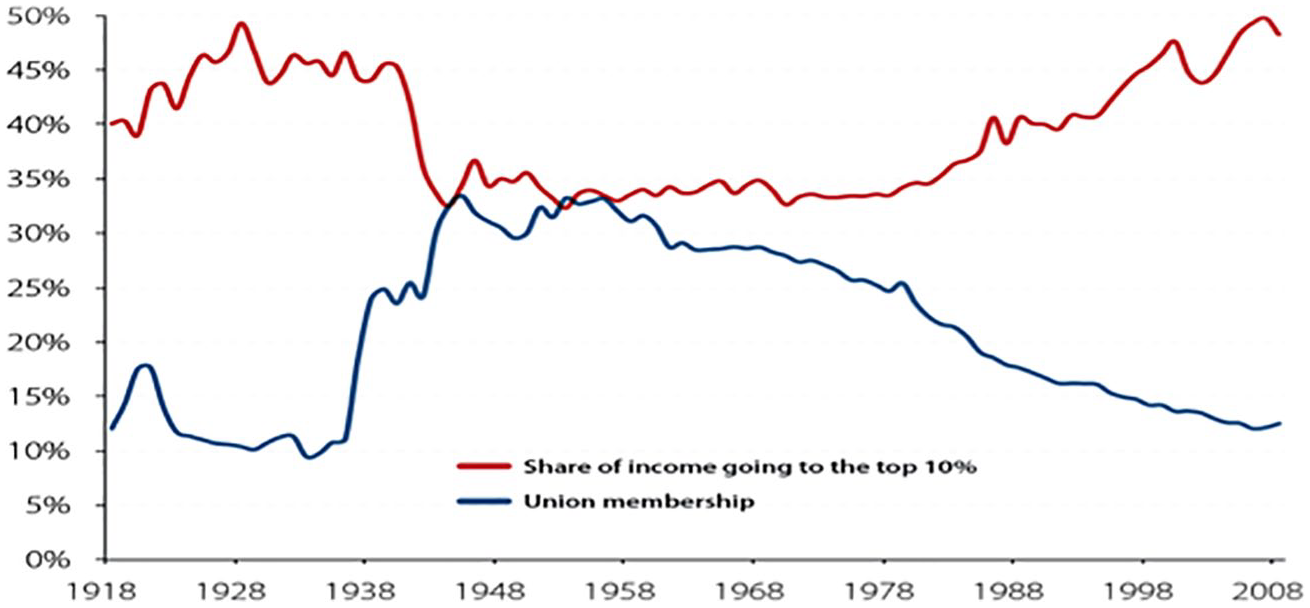
Unionization and share of income to the top 10%.
Other studies argue that also between 1975 and 1995 trade-union membership declined and inequality increased. Pontusson (2013) suggests that this can be explained by a weaker interest in equality and redistribution policies among workers whose living and working conditions had improved. Trade-union density alone is probably not enough to encapsulate the power relations in a labour market (Jaumotte & Osorio Buitron 2015), but the results are the same using other labour-market indicators: for instance, active labour-market policy, passive labour-market policy, bargaining wage coordination, unemployment subsidies, minimum wage, employment-protection legislation. Tridico (2018) shows that the more protection in the labour market, the lower the Gini level, and vice versa in a large longitudinal sample of OECD nations.
A similar result was obtained by Butcher et al. (2012) and by Tridico and Paternesi Meloni (2018) who found that minimum wages have an impact on wage inequality, particularly in the United Kingdom and the United States during the 1990s and 2000s. Jaumotte and Osorio Buitron (2015) also found that minimum wage reductions caused an increase in inequality but trade-union density played a much bigger role.
In short, the lesser role of collective bargaining and the individualization (Heyman 2005) of employment relations entail growing inequality in working conditions among employees both of the same sector and of the same company. The political and managerial discourse on flexible working relations has been explained with (and enforced by) the complexity of markets and global competition. This discourse and the consequent surrender to the authority of markets and management have become significantly stronger only very recently. Like the individuals that once traded their natural liberty for the greater power of the community, workers today accept hierarchy, imbalance of power and inequality in the employment relation for the greater good of the organization whose survival and profitability is the source of their salary.
Welfare and inequality
Public spending is connected to both macro and organizational inequality. On one hand, public spending redistributes resources to taper income inequality (wage and pension integrations, housing and other benefits); on the other hand, publicly funded services allow workers to join the labour market (healthcare, education, childcare and benefits for working parents, work insurance). In other words, public spending constitutes a partial remedy to inequality and allows labour markets to work more efficiently despite income and organizational inequality (Moreno-Ternero & Veneziani 2017).
However, while inequality has been growing, public spending on social services has declined, and so has the ability of the state to redistribute wealth during a period when it was needed. An ideological component of financial capitalism is the call to decrease the role of public spending. The welfare state represents to many another cost to compress, akin to labour. In order to improve firms’ competitiveness and to boost economic growth, advocates of the so-called ‘efficiency thesis’ argue that social spending needs to be reduced (Allan & Scruggs 2004; Castells 2004).
The development of corporate occupational-welfare policies (pension, healthcare, childcare, education services offered by the organizations in the form of employment benefits) can be observed in this perspective (Shalev 1996). Recently, they have been growing in a clear attempt to cover aspects of life and employment formerly fully supported by the welfare state.
As Figure 2 shows, there is a clear negative relationship between inequality and welfare expenditures in the sense that countries that spend more on welfare generally have a lower level of inequality (Tridico 2018).
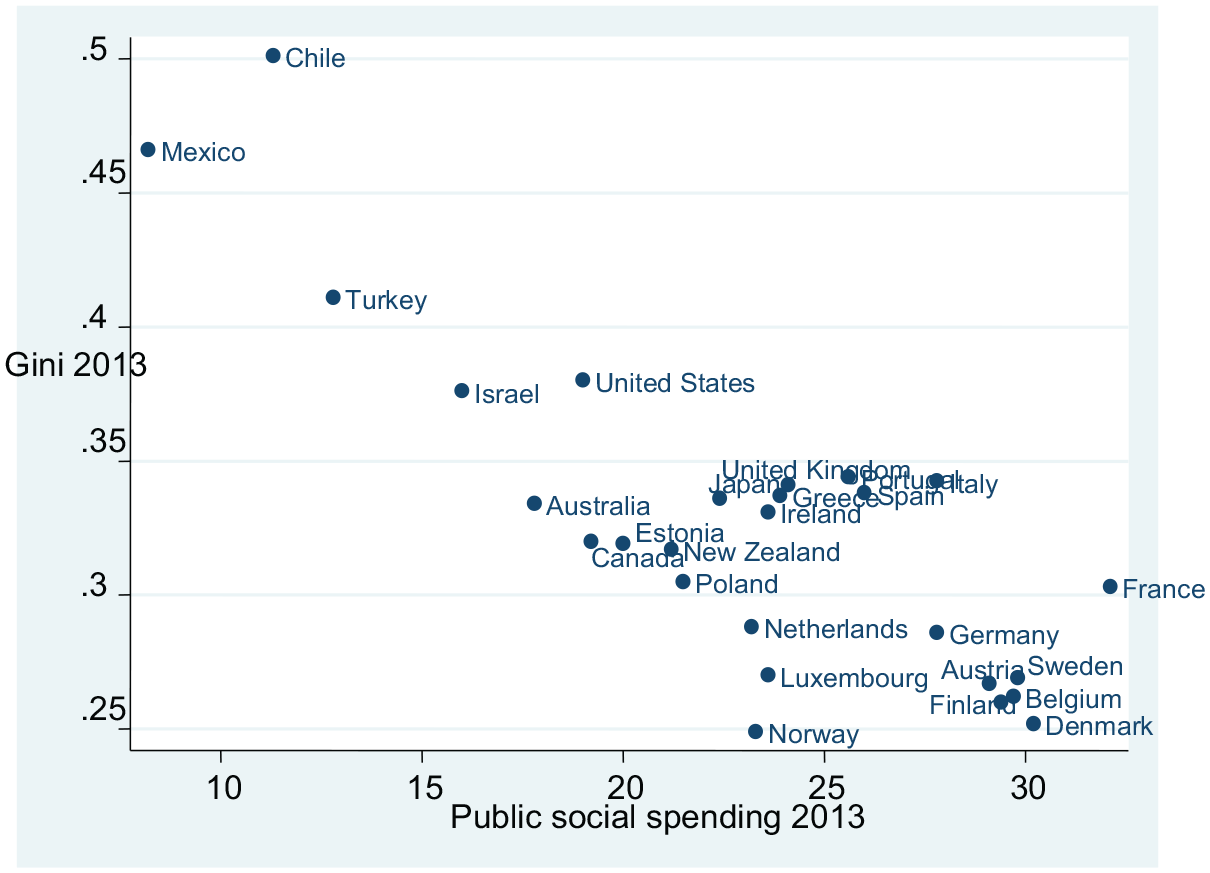
Inequality (Gini) and public social expenditure (% GDP), Tridico (2018), OECD data.
A recent study (Bapuji 2015) explains that cutting social spending would not only affect macro inequality, but would also negatively affect organizations. Cooper (2008) studied the variability of opportunities among workers of different social-class background in the US labour market. He argues that in a ‘risk society’, less public spending threatens the opportunities of the disadvantaged but at the same time actually endangers society’s ‘winners’. Van der Wel and Halvorsen (2014) found that commitment at work increases as social spending gets more generous, while Wang et al. (2015) found that pay disparity contributes to higher turnover and endangers workers’ participation and innovation.
In short, corporate occupational welfare is an issue of inequality because such a welfare culture, unlike a state public welfare, might allocate opportunities and resources on a non-progressive basis (everybody receiving the same benefits, regardless of income), if not a regressive one (the higher the position in the organization, the richer the occupational welfare-package received by the employee). Rousseau might argue that occupational welfare is an additional element of organizational social contracts. It was a phenomenon during Fordism and is re-emerging today as an explicit element of employment relations, while the provision of a welfare state declines. The surrender to the authority of management to enjoy occupational welfare is akin to the surrender to government to enjoy the provisions of public welfare. Both imply the acceptance of inequality.
Discussion
To sum up our review of macroeconomic inequality, inequality increases when financialization increases, when labour flexibility increases, when trade unions are weaker and when the level of public social spending decreases. Tridico (2018) has modelled those variables and proved their relationship with income inequality among OECD countries in the period 1990–2013.
At organizational level, it has not been possible to conduct longitudinal tests with an international dataset to model the causes of inequality, unlike what several studies have done at macroeconomic level. However, reviewing management and organizational literature, while it cannot provide equivalent data, does allow us to come to similar conclusions. Organizational inequality increases as per the effect of finance and financial incentives in organizations (Davis 2009; Erturk et al. 2005; Fligstein 1987), flexibility and individualization of employment relations (Bloom 1999; Crouch 2015; Heyman 2005), trade-union power and its formal role in industrial relations (Darlington 2009; Fox 1985; Meardi 2014; Ramsay et al. 2000), and the extent to which occupational welfare is an alternative to public welfare and contributes to intra and inter organizational inequality (Shalev 1996). Individual biases (World Bank 2015) and national culture (Le Garrec 2018) also explain different attitudes towards organizational inequality. These are the result of institutional work, co-optation and persuasion at either macro or micro level (Braverman 1974; Burawoy 1979; Cooke & Kothary 2001; Engels 1987; Fox 1985; Hofstede 1980; Tridico 2012; Holman 2013; Marx 1991 [1867]; Sennet 1998; Thompson 1963).
Inequality remains an issue of hierarchy at both the macro and organizational levels. As it was for Rousseau, so it is today but it is much more layered than in Rousseau’s day: inequality in society is the accepted degree of hierarchy among its members, inequality in the economy and at work is the extent to which, accepted or not, there is an imbalance of power, financial resources, remuneration of work and access to opportunities (Peragine 2004) and services. The increase in inequality is due to a radical change in the socio-economic model of advanced economies. This change involves a shift towards financialization, a pressure on labour through flexibility, the decline of trade unions’ power and the retrenchment of public social spending.
We have contributed to theory development with an original conceptualization at both the macro and micro level, combining insights from an economist and an organizational scholar. This unconventional approach demonstrates the usefulness of uniting economics and management literatures. Economists often overlook management and organization, thus either neglecting to support their arguments at the micro level or failing to defend accusations that their models are oversimplifying. Similarly, organizational scholars often overlook economics. The consequence of this is that organization studies rarely address the macro level implications (efficiency, well-being, unemployment, growth, innovation, inequality) of what happens at the firm level. In doing so, they also fail to realize that macro-level problems (such as inequality, poverty, unemployment) are rooted in individual and organizational actions.
Conclusion
Organizational inequality concerns all possible forms of divergence in the treatment of and opportunities for workers in the same organization. Finance plays a role in increasing the divergence of treatment of members of organizations and in justifying the acceptance of inequality. The evolution of human-resource management practices towards individualization of employment relations can also contribute to the institutionalization of inequality among workers. Some national institutions, whether systems of industrial relations or models of welfare state, may be able to slow down or accelerate organizational inequality.
The managerial rhetoric on flexibility, but also organizational and national cultures provide a justification for the acceptance of growing levels of inequality in organizations. Moreover, both macroeconomic and organizational inequality are based on the same discourse: policymakers (national level) and managers (organizational level) face inescapable decisions, actions that modernity makes unavoidable. As Rousseau might frame it, inequality is the consequence of accepting a social/organizational contract where, supposedly, progress is traded with equality and freedom as a mandatory path towards modernity. While Rousseau focused on the specialization of roles in the society (political, military, religious, administrative, etc.), Marx focused on the division of labour at work. In both cases, the acceptance of inequality resides in the acceptance as necessary of those hierarchical divisions, be these different roles in the society or different tasks in a factory, and the consequent income and wealth inequalities. Class is being accepted as a necessary characteristic of modern nation states (Pozo 2007) and functional to capitalism. Inequality is being accepted as a characteristic of both capitalism and class.
Organizational inequality is not in itself an explanation of macro inequality, which has to do with macro trends such as the increasing divergence between the remuneration of capital and the remuneration of labour. However, macro and organizational inequality have the same causes: reforms of labour-market regulation and weakening of trade unions. As such, both forms of inequality warrant greater joint attention from economists and organizational scholars.
Inequality is arguably among the core concepts of the social sciences, pivotal to the contemporary relevance of economic, sociological, political and cultural analysis. Yet, organizational inequality has been rarely acknowledged, let alone adequately conceptualized within the academy. This article is conceived as a modest contribution to the opening up of an important debate concerning the contribution of organizations, their dynamics and their modus operandi, to the reproductive capacity of contemporary forms of capitalism. Further study of the nature of organizational inequality, its causes, and its alignment with macroeconomic inequality, will enhance our conceptual and theoretical understanding of the economic dynamics and socio-political consequences of a capitalist model in which macroeconomic inequality and organizational inequality appear to have taken on an increasingly symbiotic role and significance.
We have focused on the effects of inequality, be it macro or micro disparity in pay or wealth. But the true inequality is the cause of those effects, our tolerance, acceptance of diversity of treatment and social and political hierarchy. Rousseau told us that we tolerate it because we accepted the social pact, as today we accept the corporate, organizational pacts. Marx would argue that the problem is the base, not the effects of the superstructure. Welfare state can mitigate the effects of inequality but not the causes and not our customary acceptance of social and political hierarchy. The redistribution operated by the tax system and by public services still gives for granted the primary inequality. Hence, the studies on macro and organizational inequality should focus not on the effects (and their partial mitigation) but on the origin (the base), and the economic, social and political institutions (the superstructure) that defend inequality as necessary and overall convenient in modern and complex societies.
Footnotes
Acknowledgements
We acknowledge the supportive and helpful comments received by prof. Alan Tomlinson and all the other colleagues involved in the review process.
