




Abstract
This article argues, through a study of cleaning workers, a need to reconsider the changing nature of unskilled work. In particular, how it has, ironically, become more complex and challenging in some cases due to economic and political developments. For example, in relation to questions of dirty work, stigma and issues of dignity, aspects of this literature recognise the difficulty of the work and its ‘distribution’. However, we argue a need to draw further attention to the ‘mechanics’, processes and complexities of this work and the way it is subject to significant contextual changes (e.g. the role of austerity) that create new complexities and challenges just as that work is being undermined and intensified. We use the voices of cleaning workers to reflect, in a rich detailed manner, the changes to their working environment and focus on the broader social perceptions of the work – from the public, employers and the workers themselves. Our analysis demonstrates a clear recognition of the complexity of that work through four dimensions – the changing spatial isolation of work; the growing context of violence due to the changing operational features of the job; the ongoing impact of state led austerity policies and limited resources, and the ongoing role of social stigma. We end the article discussing how workers’ control emerges as an important issue in a curious manner within this changing context.
Keywords
Introduction
Peoples’ perceptions of certain types of job are generally influenced by the level of salary associated with the job or whether it has occupational prestige (i.e. whether it is viewed as ‘professional’, ‘skilled’, ‘low skilled’ or ‘unskilled’). Depending on where it is placed in the occupational and pay hierarchy, it is then compounded by the status of a certain type of job. Of course, there are other influences which might stimulate what we refer to here as the social perceptions of a job and general value that it has, for example, the stigma associated with the image of a certain type of job such as whether it is viewed as being ‘dirty work’ (Ashforth et al. 2007; Ashforth & Kreiner 1999, 2014; Hughes 1958; Hughes et al. 2017). In such a case, it is not only about a job being viewed as ‘unclean work’ but also of it being a symbol of degradation to the work and the worker (Hughes 1958; Hughes et al. 2017). This also relates to questions of ‘dignity’ as seen in the dignity of work literature (Bolton 2007; Sayer 2007) with Sayer (2011) later focusing on questions of valuing the worker as a person through evaluating how people treat one another. However, our major argument is that, in relation to specific debates on questions of dignity, dirty work and the value of work, the existing literature recognises the worker, but tends less to recognise how people generally perceive and judge the skills and contribution of certain types of work, indeed their own work in societal terms: and how changes occur across various levels in relation to such work. We therefore consider these issues to question social perceptions of certain types of ‘lower skilled/unskilled’ work, be it by others, employers or even workers themselves. We specifically focus on the work of cleaning as a form of so-called ‘unskilled’ work. We argue that to contribute to a further understanding of this, there needs to be recognition of the nature of the work itself, and how it changes, with this being best explained through the voice of the worker doing the job themselves. The mechanics, processes, complexities of the work of cleaning and the way it is subject to significant contextual changes is not always a systematic part of various discussions. Hence, we suggest that these dimensions need to be considered if we are to further understand the changes and growing complexity of this particular job.
Through the use of research on various public sector employers in the North of England, the aim of this article is to consider the complexity of cleaning work and the processes of this work. We measure these through the introduction of various dimensions around which we structure our analysis. These dimensions are explored within the empirical section which is presented around four themes drawn directly out of the fieldwork data that point to the changes taking place in unskilled jobs. These broader themes, we argue, are not normally applied to the reality of such work and its changes, and they allow us to review the various pressures for change in unskilled contexts. First, we identify the growing spatial and locational isolation of work which requires a more autonomous independent reflection on one’s work. Second, the growing context of violence and threats due to the changing operational features of the job, as well as its isolation, require a greater awareness of such risks. Third, the ongoing impact of state led austerity policies and deeper questions of limited resources require greater worker discretion to overcome these challenges. Finally, the increasing role of social stigma attached to specific aspects of the work from the public sphere requires a greater resilience and resistance by workers. This latter dimension also leads to a greater need for a growing level – ironically – of discretion and control by workers, as they have to manage the social and physical consequences of the way their work is viewed. It is our contention, in terms of the cases and the nature of the workers we deal with in this article, that the value of their ‘dirty’ work and their dignity cannot be understood or sustained without also appreciating the nature of the work they are doing, its complexities and changes: in effect without understanding the labour process dimension and the broader politics of it as our different levels of analysis suggest. What is more, we need to see such changes and concerns through the eyes of the workforce and how they actually create a curious experience of ‘worker control’, as the discretion of the workforce is – ironically – widened in such a context. It is not simply a case of coping and resilience in the face of work intensification or de-skilling, but how the very nature of change and austerity measures introduced have placed the worker in a vulnerable, yet critical, position in relation to control issues. This in turn raises concerns among workers as to their appreciation and how they are valued at work, as well as how participation around tasks and jobs is emerging as an issue that needs further attention. Otherwise, it will simply remain a case of recognising difficulties at work.
Literature review: unskilled work, perceptions of that work and matters of dignity and dirty work
This article is focused on questions of work and perceptions of the value of particular jobs in what are termed low skilled or unskilled jobs. Much of this debate exists within a set of concerns among critical labour relations specialists and sociologists. In the main, these debates revolve around the increasingly degraded nature of work and employment. This has become an extensive debate concerning the end of ‘good’ and standardised ‘work’. The end of standardised and regulated employment has been the focus of other authors who have looked at the negative social outcomes of employment change in an age of labour market and social insecurity generally (Sennett 1999). In many cases, these concerns reference ongoing changes within the capitalist system regarding the way work is de-skilled progressively as discussed historically by Braverman (1974). More recently, the economic context of austerity and further labour market fragmentation have added a further dimension to this discussion.
In terms of the degradation of work and cleaners in particular, there are many debates focusing on the intensification of the work of cleaners and related changes, along with the response of trade unions (see for example Wills et al. 2009; Wills & Linneker 2012). These debates tend to be focused on the need for a ‘living wage’, general union representation and worker rights, with increasing attention being focussed on union organising debates and migrant workers (Tapia & Turner 2013; Wills et al. 2009; Wills & Linneker 2012) and less on matters of worker control and discretion. Questions of occupational roles and changes in the cleaning sector also tend to be discussed in terms of external labour market changes (wages and employment), although there is an increasing interest in what this means for the work in studies on care (Rubery et al. 2013; Rubery & Urwin 2011). These sets of studies outline how we need to appreciate the way work is valued by workers in sectors such as care even when it is challenging and ‘dirty’. Gill-McLure and Seifert (2008) contribute to this in noting that the managerial changes to these jobs has led to the ‘. . . deterioration of public service, which means that workers are subjected to public complaints and even violence . . .’ (p. 22): this suggests the need to engage with detailed research on these categories of workers. In terms of skills there has, for some time, been a growing sense that such cleaning work has been de-skilled and subject to greater work intensification and forms of scientific management (Aguiar 2001). Furthermore, there is a growing body of debates concerned with the consequences of such changes emerging from new forms of production and service delivery processes linked to a lean concept of the organisation (Carter et al. 2011; Stewart et al. 2009).
Our research focuses on these issues through a closer engagement with in-depth experiences of similar cleaning workers and their work in everyday lives. We argue that it is important to locate this in a broader understanding of the pressures of the undermining of the work yet, ironically, simultaneously making such work more complex. With respect to how the work is socially valued, we suggest that these debates be set alongside the work of Sayer (2011) particularly on ‘values’ and how the value of work is perceived. Values, he argues, are not just of subjective significance, but emerge as part of people’s understanding/reasoning of the well-being of themselves and their work, and how other people value these workers. We believe this offers an interesting analysis – and point of entry – of how certain categories of workers value themselves and their work, and how, in turn, others value these. However, a problem with Sayer’s approach is that the ‘job’ itself is not a part of the main discussions. Indeed, what workers do and the difficulties involved in what they do is not always a significant part of the discussions generally. However, Sayer (2009) also engages with issues of contributive justice in terms of both satisfying and unsatisfying aspects of work needing to be distributed more fairly and evenly (see his engagement with Gomberg (2007) on the structural complexity of work in Sayer (2009)). We, therefore, intend to draw this out as a key part of our discussions when reviewing the contradictory nature of the degradation of work.
Of course, a focus on questions people face in their everyday lives, including how people treat each other and value one another, has clear links with a more fundamental matter of concern to people – their dignity in the broadest sense of the term. It is accepted that dignity is notoriously difficult to define, as in Bolton’s (2007) examination of ‘dignity at work’ which exemplifies the social character of the human being, the importance of autonomy and not taking advantage of people’s vulnerabilities. Sayer’s (2011) work on dignity is also relevant wherein he argues that it is important to define dignity through examining the different ways it is used. Particularly, in everyday life and other feelings and conditions such as, ‘. . . integrity, respect, pride, recognition, worth and standing or status, (that) are positively related to it, and others, like shame, stigma, humiliation, lack of recognition or trust, (that) are negatively related to it’ (Sayer 2011: 192). Such negative connotations such as stigma are attached to the type of work in our study, as well as the notion that ‘cleaning’ can be categorised as ‘dirty work’.
Research on ‘dirty work’ transcends several themes/disciplines. Some examples are self-identity and stigma (Ashforth & Kreiner 1999), social and moral dimensions of dirty work (Ashforth & Kreiner 2014), and the ‘embodied aspects’ of the work (i.e. those undertaking the work based on gender, class, age and race – see Simpson & Simpson 2018) as well as the ‘physical and symbolic’ or ‘material’ dynamics involved in ‘staining’ (Simpson & Simpson 2018). Much of this work is based on the original writings on dirty work by Hughes (1958) who used the term ‘. . . to refer to tasks and occupations that are likely to be perceived as disgusting or degrading’ (p. 413). In fact, Sennett (1999) in his landmark studies on insecurity at work also considers dirty work in his analysis of employment change in an age of insecurity. However, we would argue that such debates may, at times, underestimate the active participation of ‘reflection’ that underscores the way in which ‘dirty’ workers can also make their jobs, not just skilled, but also view them with reflexive codes of pride. It is only recently that the reflexivity of workers has become more important in this debate. Hughes et al. (2017) focus on how the ‘symbolic’ and ‘material’ nature of work intertwines with the main focus on the workers’ encounters with dirt and how they formulate these encounters. What they also consider is the issue of ‘place and space’ which we earlier argued (McBride & Martínez Lucio 2011) could be given greater prominence in much of the literature. However, they refer to the ‘spatial’ in terms of how these workers are ‘out of place’ in a middle-class location and being predominantly in, what they categorise as, a working-class dirty job. Here, they position the location and encounters with the workers as disruptive and out of place and associate it directly with ‘class’. This is a very different notion of ‘place and space’ as is referred to in this article. More importantly, we would argue that they neglect the ‘labour process’ in their analysis and debates. Simpson et al. (2014) however, do consider the ‘meanings that refuse collectors attach to their work’ but in terms of how dirt is perceived, rather than how the work affects the job/worker. They also refer to dirt and ‘danger’, which we also argue is a neglected topic, although they refer to it in terms of danger of ‘contamination’ from the dirt as opposed to personal threats and violence due to the changing operational features of the job. Indeed, Hughes et al. (2017) do consider how refuse collectors are treated with disrespect (albeit symbolically), yet also generate meaning within such work by emphasising the ‘hard’ and ‘manual’ aspects of it (Hughes et al. 2017; Simpson et al. 2019). In fact, they argue that such workers may submit themselves to disciplinary power and accept little autonomy in their working lives as a consequence. These new interventions are key to the way such types of work are being understood, although this article aims to bring out the question of agency more clearly as well as the labour process contradictions that emerge from these types of work in a context of austerity.
Hence, overall, while we do acknowledge the important interjection of this work, we argue that the current debate is becoming constrained with an obsessive focus on ‘dirt’. We argue from our findings that, first, the idea of ‘space’ is more contentious. We view ‘spatiality’ in broader terms – not just class and inter-group relations, but vulnerability, exposure and isolation. In relation to this, and second, the growing context of violence and threats in this type of work is becoming a serious issue and needs further investigation. Third, this work should not be viewed as simply ‘unskilled’, which is an underlying assumption in most of these debates. We find that there are various contradictory developments in terms of the nature of the work itself: for example, evidence of ‘multi-tasking’ and an increase in the need for worker discretion just as the job is being undermined and undervalued. The role of the worker is, in many instances, becoming much broader both in relation to operational issues and their relations with the public and other workers. While one school of thought has argued that, with work intensification there appears to be a declining level of discretion (Green 2004), our own work builds on the alternative insights of work. Conducted by various teams of scholars, such work argues that discretion and control cannot be simply seen as increasing fragmentation, employer enforced flexibility or declining discretion, for they are combined and contextualised in different and competing ways (Gallie et al. 1998; Grimshaw et al. 2006; Rubery et al. 2016). In some respects, these analyses grate against more explicitly Marxist approaches that may be concerned with greater levels of de-skilling and organisational control being experienced by workers, as well as ongoing constraints imposed by management in terms of their discretion and work-related tasks (see Vidal 2019). This may be due to the constraints on management in an age of disconnected capitalism which fragments organisations and aspects of management (Thompson 2003). The experience of work may be dire as Vidal (2019) has noted in his review of debates on forms of control within contemporary work, but in our view it is also complex in new ways. Indeed, it is this that suggests that the analysis of contemporary work may sometimes downplay the way workers increasingly have to reflect on, and cope with, complexity and challenges, let alone the lack of any appreciation or recognition of this reality. This builds on critiques of what can be considered to be more teleological approaches to management control and de-skilling (and its inevitability as in Braverman 1974). These note more contingent and contradictory developments in the nature of changing skills and the ongoing tensions and shifts between direct forms of control and ‘responsible autonomy’ (Brown 1992; Friedman 1977). They also note a need for a greater realisation of the limits of managerial control generally.
It is for this reason we argue that, while we need to be clear about how we cannot ignore factors such as the importance of worker motivation, the nature of the job and its individual features and the overall effects of the work (Wrzesniewski and Dutton 2001), when discussing such issues, we do need to be alert to the unstable, dynamic and changing contextual factors, that can disrupt these features and push them to the forefront of worker experiences and lead to a political dimension within the debates. Discussions regarding the role of ‘practical wisdom’ and the role of ‘meaning’ at work – and not just technical or regulated forms of skills and activity at work – are thus emerging (Schwartz & Sharpe 2010) although labour process theorists appear oblivious to these. Yet, even when discussing concepts such as practical wisdom, there seems a static moral dimension (recognised but critiqued by Beadle & Knight 2012) in much of the justice in – and meaning of – work debate. Hence, our argument is that we need to be wary of changes and dynamics and how these push such questions to the forefront of workers’ experiences.
There is, consequently, a need for a labour process perspective to these debates – yet, we need to think of the question of the ‘job’ itself in terms of the operational and control aspects that much of these debates are missing, for workers are facing competing and contradictory demands on them which broaden some of their roles, tasks and responsibilities. More importantly, we need to understand these developments in relation to the operational aspects through the views of the workers actually performing them. Finally, we argue that it is important to contextualise these spatial, relational and operational questions in an economic context of change – in this case, the context of austerity state policies. Our research provides an insight into how such forms of work are deserving and need to be socially acknowledged, but also how they are engaging in social terms, significant in process, and meaningful as jobs and complex processes of work. We argue that valuing this work requires that we sensitise ourselves to dimensions we believe are important to the theoretical development of understanding the value of work but are missing thus far in the debates. This is a very distinctive aspect of the article which condenses features of worker experience to allow for a spectrum of interpretation allowing for greater internal (worker) and external (public) appreciation of the challenges and changing nature of such work that is (not should be or could be but is) attributed to the work.
First, the growing spatial and locational isolation of work which requires a more autonomous independent reflection on one’s work. Second, the growing context of violence and threats due to the changing operational features of the job, as well as its isolation, that require a greater awareness of such risks and behavioural changes. Third, the ongoing impact of political state led austerity policies leading to deeper questions of limited resources which require greater worker discretion to overcome these challenges. Finally, the increasing role of social stigma attached to specific aspects of the work from the public sphere which requires a greater resilience and resistance by workers. It is through these dimensions that we are able to provide a more dynamic, more grounded and less patronising approach to unskilled work. In placing these into context, the data draw on these features to ensure we ground social perceptions of the value of cleaning work within the detailed aspects of how they are perceived by the workforce, in relation to their own perceptions, the public and management. Also, by working across these dimensions, we can build on some of the insights made by interventions such as the dirty work debates, but contextualising changes in a more dynamic manner: this can be done by being sensitive to issues of location/space, operational features in terms of staffing levels, political and funding factors, and the general social views of the job itself. It also allows us to understand the nature of resistance within these forms of work and how there is a greater agency and complexity in these developments.
Background and research methods
The study is an embedded case study with multiple units of analysis. The context is the public sector with the multiple units being four public sector organisations centring on two regions – Yorkshire and Lancashire. While the potential limitations of the generalisation of the data are recognised – as this is a study of cleaning workers from four public sector unionised organisations in the North of the United Kingdom – the findings will arguably have a broader applicability as there is already an extensive literature on the role of cleaners in the United Kingdom public sector with which to make comparisons, and also contribute to that research already undertaken. The organisations in the study will be referred to as Yorkshire University, Yorkshire Council, Lancashire Council and Lancashire University in acknowledgement of confidentiality. The participants are left unnamed and unconnected with their workplace in order to secure anonymity. As this was a study of cleaning workers, representatives of all the major stakeholder groups were interviewed to collate rich detailed information and draw on the role and nature of their job and the social meaning of their work. Therefore, included in this study were managers and supervisors who could provide a broader view of company policies, history and accounts of how the jobs are managed. Trade unions were also important to this study as the changes to work and the labour market are challenging for unions dealing with a more fragmented operationalisation of work. Furthermore, they deal with broader health and safety issues such as stigma and danger at work – two themes central to this article. Nonetheless, the major intention of our research approach was to use the ‘voices’ of the accounts of individuals directly involved in this work sector.
We had two distinct categories of cleaners who could be categorised as internal and external cleaners (see Table 1). First, those in cleaning work in closed workspaces, such as university cleaners, council cleaners, laundry cleaners and school and central processing unit kitchen cleaners. These were predominantly female with 10 females and 4 males interviewed. We also had a second category of cleaner typically those who work in open spaces maintaining cleanliness in towns and cities such as domestic refuse collectors, refuse recycling collectors, street cleansing operatives, applied sweeper drivers and litter pickers. It should also be noted here that the findings suggest that ‘inside’ and ‘outside’ work shared common characteristics as we will show. The external cleaners were all male and we interviewed 11 individuals. We did not collate any information on ethnicity or background as this was not deemed essential to this particular study.
Categories of cleaners involved in the study with themes drawn from the data.
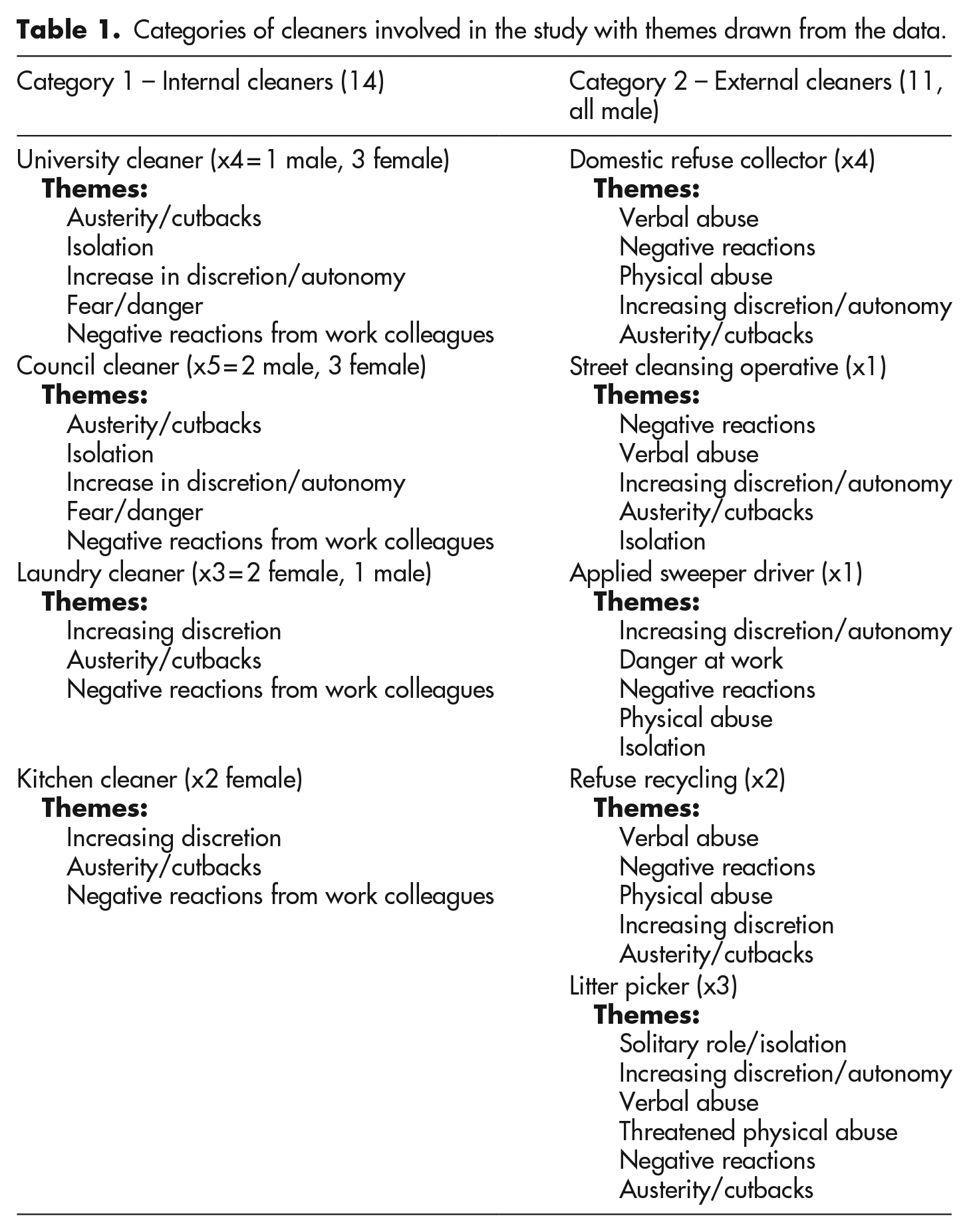
Field research was undertaken from 2012 to 2013 using a qualitative inductive case study approach. We developed an interview schedule to reveal the qualitative depth and detail of daily working lives, with space for respondents to speak freely and interviews lasted on average an hour. In all, 47 face to face interviews were undertaken with 7 union officials, 3 union representatives, 12 managers (in HR, Organisational Development, Ancillary Services) and 25 workers from differing specific categories across the cleaning sector. It should also be noted that all of the cleaners involved in our study were directly employed, not subcontracted. The interviews were then subjected to a manual analysis, with all interviews analysed independently and alternatively by both researchers using ‘double blind’ manual open thematic analysis of transcripts. This made it possible to establish a chronology of significant issues relevant to our specific argument, as we each independently drew out our themes, and in discussions on the basis of that, pulled together these four dimensions. As there were only 25 interviews, we did not need to use any software packages such as Nvivo and instead listened to peoples’ voices and lived work experiences to draw out the themes. The narrative below is presented around a series of the four main themes drawn out of the analysis of the workers’ voices using direct quotes by the workers themselves. The key research findings reveal that these workers faced a number of unique challenges in their working lives. They pick up on how the environment is changing in terms of the growing isolation of work, the context of violence and threats at work, the question of austerity, cutbacks and reducing resources making their work harder, as well as the need for workers to use discretion in relation to limited resources. The research is cross-sectional and not longitudinal, however, we reflected on the changes taking place through the experiences and observations of the research participants in relation to the different dimensions we identified and their understanding of collective experiences (Stephenson & Stewart 2001).
The challenge of the job of cleaning in the changing public sector
The impacts of successive neo-liberal policy agendas in the public sector, mainly in terms of privatisation and outsourcing since the 1980s, have made a huge impact in reshaping cleaning and related work in this sector and the public sector generally (Clark 2000; Crouch 2011). Our research points to a set of issues which supports the evidence of the degradation of this work in various ways. For instance, a move towards subcontracting the work and an ongoing reduction in staff has led to the point where it has become a more isolated job within a range of different workplaces and workspaces. There has also been the introduction of more systematic performance management and monitoring which has led to specific responses from cleaners in the way they prioritise work (McBride & Martínez Lucio 2016).
In what follows, we look at the question of the processes, mechanics, contextual nature and changes in the work in terms of the four dimensions we outlined earlier.
The growing locational and spatial isolation of work: reflection and calculation as a part of the job
Within our case study organisations, pressures for saving and cost cutting by management, has meant that there have been constant attempts to reduce staff. A major consequence of this has been to ask staff to work with fewer facilities and less support. This has also meant that there have been ongoing operational changes in terms of varying the parameters of work in spatial and task related terms. In the main, many workers have found they are now working more in isolation. In one example at Yorkshire University, a cleaner who had worked there for 16 years described how she used to work as part of a team, but due to cutbacks in staffing, her work had intensified as she now individually cleans the area that used to be cleaned by a team: … at the moment currently I’m doing two buildings. I’ve got two and a half hours to do those whole two buildings. They’ve got a list of what you’re supposed to do . . . but I’d much rather do my own thing . . .
She is now left to decide what she feels is a priority of the work, indicating a use of more discretion in the workplace, but due to negative reasons and causes. This was also highlighted in our Lancashire case studies. For example, council cleaners had to choose themselves between what teaching rooms within a school they had to clean and what to leave for another day. Within Lancashire University, office carpets were left according to a visual judgement that had to be made by the cleaner. Litter pickers at the Yorkshire Council each also highlighted the discretion that emerged due to the broader operational range of the work – in part due to the relative isolation.
One litter picker took us through the entire work day and his tasks, describing a much clearer sense of the solitary experience of these jobs. This is drawn out in the operational and spatial processes of his job: I start at half nine and I have a set round, like I do a block basically in the town centre, and then some of the streets surrounding that block, and that’s my area. And within that area I’m responsible for all the bins, all the litter, broken glass, cigarette butts, all the stuff, basically keep it clean. First thing on a morning I walk around and I check all the bins to make sure they’re not overflowing as people are going to start coming into town and having their breakfast and stuff like that. And then once I’ve done all the bins then I go back and get my dustpan and brush and I walk my round around again sweeping up where it wants sweeping, then have my dinner, more or less the same in the afternoon. By the time I’ve done it twice that’s about it, it’s time to go home. Finish at half past five.
What is drawn out from these particular workers is a sense of increasing discretion, which could be perceived, albeit superficially, as a further complexity of the work that undermines the use of the term ‘unskilled’. Furthermore, as Sayer (2011) argues, if an employer allows some discretion in the work, then employees’ sense of dignity may be greater (p. 200). However, our evidence demonstrated negative connotations in that an increase in their discretion also equated with working more intensively and working on their own instead of a team. This is something we argue needs recognition in the debates when constructing a framework of dignity for workers in such jobs. For consequently, there are contradictory features to this supposed increasing discretion at work, due to the context and consequences of such changes. Indeed, other interviewees began to draw out a growing sense of awareness of the context of the environment and the way it impacts on their work and decision-making.
The context of fear, violence and threats in the job due to operational changes, and the emergence of awareness and realisations among cleaners
The fact that many of these workers were isolated meant that some were also at greater risk contextually in terms of danger, fear, violence and threats. One female cleaner demonstrated how the unsocial hours of their work can be ridden with fear. She did not drive, and therefore, needed to take the bus to work. Prior to taking the bus, she had to take her baby son to her aunt’s house for childcare at 5.30am. She confessed that on ‘dark mornings’ she was sometimes fearful and felt threatened walking the route to her aunt’s and then to the bus stop in the dark and alone so early in the morning. This was clearly an indirect threat in terms of a perception of danger which we feel is important to highlight as it clearly affected her and this spatial dimension to her work: something not often recognised or appreciated.
Other workers who worked alone, explained how they had experienced more direct forms of threats due to their ongoing spatial exposure. Several street cleaners presented evidence of this in terms of negative reactions from members of the public: I get people come up and ask ‘Are you doing this for community payback?’ (Litter picker 1) The public look down at you. You get plenty verbal from people – like with my breakfast in a morning ‘. . . typical council workers, always sat down in f’ing café, they should be out working’, and all that . . . But you just bite your tongue really, because you can’t say too much, because it comes back on you. (Street cleansing operative)
Such negative reactions from the public extended to even physical abuse for some council workers as described by a domestic refuse collector: Oh, you get abuse all the time, like. I’ve had stuff thrown at me, bags and everything. They come out and swear and shout at you and everything else and we get told (by management) ‘if they start swearing at you or being abusive you just walk away’. So, I just walked away and they’ve thrown bags at me. Spat recently, they spat. Couldn’t believe it me – spat – just dirty isn’t it, just not right, spitting, it carries disease, it’s filthy. I did lose it a bit then, I must admit I did get a bit . . . I said ‘what are you doing?’ they said ‘F*** off you white B****’ I couldn’t believe it, I were like, are you mad?
Hence, the cleaning workers in our study, did not only need to exercise discretion with how to operationalise their work, but also in a locational and spatial context in terms of judging themselves how to deal with threatening situations. Once again, there are contradictory elements evident here, in particular, the idea of having more discretion suggests a positive aspect of the work. However, negative views of the work are much more prevalent, particularly in the way other people value these workers and what they do as a job – and also how the worker feels ‘valued’, not just as a person or citizen to be treated equally and fairly (as in Sayer’s analysis for example), but in terms of the challenges of the job they actually do. Many of these workers perceived recent cuts to their operations as a contributory reason for an increase in negativity by the public and were having to respond to this in various ways. The failure to appreciate this and respond to this aspect means that dignity-oriented discourses and studies need to be supplemented by an awareness of how workers have to deal with these tensions.
Austerity, cutbacks and worker responses in terms of discretion
There were many issues around austerity and cuts creating negative social perceptions of the work of the external cleaners’, not only between management and these workers, but also between some of the workers and of the workers themselves. This was mainly because of the extent of change, in terms of the need to use greater discretion and the challenges brought on by working in more varied locations with greater spatial exposure, but reductions in rewards, With our pay, I mean we lost a lot of money . . . one minute we were worth £9 an hour, and the next minute we’re worth £6 an hour. I mean, you do 20 years at a job and then somebody says, ‘I’m going to cut your pay by a third’. And then, you still do the same job. It’s disheartening. Because you feel . . . I think you feel worthless.
These cuts had caused a lengthy dispute that had left some ill feeling in the department, Twelve weeks with no money . . . I mean the unions helped us out, they did help us with strike funds and that, and rallies from other unions, to help us. And it did help. But at the end of the day there were a lot of people who . . . I mean, still, to this day, are still struggling . . . because they’ve got loans out to cover what they missed out . . . mortgage payments and things like that. We had deaths as well. We had people hang themselves in garages over that strike. Because they lost their houses, they lost everything. So it were a sad time for us all.
This strike had created a sense of workers not being valued, not only in the new challenges and roles they were facing in their work, but also the lack of remuneration and its declining levels. There were also some different cutbacks by the council that affected these jobs. As indicated earlier, some of the refuse collection workers suggested the cuts had also caused a rise in complaints by the public about the service as well as negativity about their work: … they keep cutting back, the council, keep wanting cutbacks, keep wanting to get rid of things, but you can’t cut it anymore. They took two rounds off, maybe more . . . and we’re getting more work and more work, we’re working longer hours, it’s just, oh it’s ridiculous. Less money and longer hours we’ve got to put in.
Within this context is the fact that management were relying on a greater discretion of this section of the workforce in terms of judging, not only what to do and how to deploy their labour, but they were also relying on these workers to evaluate the risks to them within and beyond their spaces of work. As discussed earlier, this included having to use discretion in terms of verbal and physical violence from the public.
Street cleaners also provided evidence to explain how greater discretion was needed in their job, not only in threatening or violent situations, but also when facing hazards to their health in the work they undertake: I can’t trust who I work with to do the needles (because he has learning difficulties), I’ve got a syringe box in the machine, so I sort all that out. Because you get a lot of needles up there, because there’s a world of addicts . . . And they drop needles and that all over the place, in bins, phone boxes and anywhere else. And they’re bloodied as well sometimes so you’ve got to be careful. (Sweeper driver)
We asked this street cleaner if he had received any training in supervision but he claimed that he had not been provided any training or support. In addition to that, he admitted, I’m his supervisor, sort of, yes but I don’t get paid for it!
Such roles are therefore expanding, to the point where they include managerial dimensions in terms of decision-making and using greater levels of discretion in terms of thinking through the consequences of them. However, again, it is contradictory, for here, the street cleaner is given more responsibility of supervising another worker – yet this is not valued remuneratively or by management. These are administrative features of their work which do not actually get recognised, even if self-management in job administration is extended to the worker themselves.
Stigma and feeling of being valued in the job and the role of resilience
In terms of stigma, and its related factors of dirty work, unpleasant work and risk, internal cleaners also provided negative evidence concerning the social perception of their work. This was not only from the public, but also their work colleagues and themselves.
For instance, cleaners in Yorkshire University mentioned the dirty work they endured and the unpleasantness of it, … the toilets, you’ll go in and the way that they leave everything, oh my god do they do this at home? And I think sometimes it’s just they don’t take into consideration that somebody else has to come in and clean this. And then you have to go home and eat, you know. Sometimes when you go into the toilets they are absolutely disgusting, you know, poo all over.
What this also demonstrates is how such cleaners feel unvalued in their job by others, and as a person, this cleaner claimed to still feel dirty when she went home to eat. There was other evidence of feeling devalued as a person, in particular from other work colleagues’ attitudes to their position as a cleaner, Sometimes you see staff and you’ll say hello and they just totally ignore you. If that is not looking down on me as a cleaner . . . because I’m sure if I was another lecturer or a student and said hello to you of course you’d say hello because it’s the polite thing if somebody is passing. You know, if they don’t hear fair enough, but they do hear, they will actually look in your face and just walk past. (University cleaner)
A porter/cleaner at the University gave similar evidence about his job and his work colleagues: Sometimes I think people look down on me. There’s certain people I speak to every day and then there’s certain people who just walk straight past. I might say ‘good morning’, nothing.
Another cleaner also explained that they were not consulted or informed as to any information pertaining to the university that might also affect them: We hardly ever know what’s going on, you know, we don’t . . . you just come in and . . . ‘oh this is happening today’ and that’s it. And the staff barbeque, we’ve never been invited to the staff barbeque, and we’re supposed to be part of the staff. You know, why can’t cleaners go to the staff barbeque?
This sense of a lack of appreciation, and even new challenges, of their job also extended to other workers in the study. These were in relation to external cleaners, some of whom demonstrated that, despite verbal abuse and a lack of respect from some members of the public, they still had a sense of feeling dignified despite others’ negative perception of their work: Sometimes I think, when you’re in town, people just look down their nose at you for being a cleaner and all that I’ve had kids throwing bricks at me and all sorts. Yeah, I’ve had police called and stuff. And people walk past and go ‘oh, I wouldn’t do that for a job’ and stuff. (Litter picker)
Their ability to reflect and think through how they are perceived and rationalise it is important as part of their resilience and response, even to the point where they internalise the critiques of what they do as problematic or meaningless: but this varies as the interviews above show. What is clear, however, is that the way the job is viewed externally is not received in a passive and uncritical manner: this ability to reflect critically on one’s declining or stigmatised status has also been picked up in various studies (see for example Savage 2015). It further represents a different feature of the increasing discretion workers have to develop when coping with changes at work in a context of austerity.
Discussion: appreciating the contradictions within changing patterns of work, the politics of its degradation and emergent issues regarding discretion
In the first instance, the research we conducted suggests that we need to further understand the contribution of the work of cleaning workers, normally considered to be ‘unskilled’ workers. We need to build on a set of debates on the nature of such work such as ‘dignity at work’ and ‘dirty work’ with a view to engaging and understanding the contradictions that emerge from the changes taking place in this work politically, economically and operationally. Through focusing on the work that they are engaging with, in terms of the changes and the dynamics, our analysis demonstrates a clear recognition of the increasing complexity of that work in some cases, and the inherent contradictions that exist within it. We suggest this requires a lot more focus at the centre of the discussions, and not solely in social and economic terms. We have used the voice of these workers as a way of understanding how they reflect on certain aspects of their job and these changes on how they realise the significance of their responses to the challenges met and the ‘practical wisdom’ or abilities they require. We did this through identifying four clear dimensions drawn out of the discussions with these workers: isolation at work, growing violence against staff, the impact of operational changes brought about by financial cutbacks and austerity measures, and the role of stigma in relation to types of work.
A concern, in our view, is that the literature to date focuses less on this increasing pressure to deal with such contingencies in the face of a challenging environment, partly because it has a universalistic view of worker dignity (Bolton 2007; Sayer 2007) and how bad aspects of work need to be distributed (Sayer 2009). Yet, the organisation of this type of work has changed and intensified (as Munro 2012 also argued), but what we have also found is a widening in both operational and administrative ‘tasks’ in varying situations at work, more responsibility in the job, managing and responding to differing control systems, as well as managing and working with vulnerable workers/colleagues and coping with challenges such as the threat and reality of violence. While others have acknowledged this work as being ‘dangerous’ and ‘dirty’ – in terms of operational processes and management dilemmas (Ashforth et al. 2007; Hughes 1958) – the economic context, as in this case of austerity and neo-liberal policies, can also contribute to reinforcing the trend of workers having to engage in new ways with their work and how they individually plan and execute it in order to sustain themselves and be resilient. It means they have to use their discretion more especially given the spatial (and not just social) isolation of their work as they labour – often alone – in schools or universities after or before teaching hours, or in parks and other public spaces. It is not just a case of workers creating narratives to justify such work or derive meaning of some form (see also Simpson et al. 2019) but of workers becoming aware of their critical position within these operational processes (irrespective of the sources of knowledge or wisdom they used to respond to them).
The research also reveals that workers in these areas are fully aware that what they do puts them in a very difficult position vis-à-vis other co-workers and non-cleaning colleagues who do not always understand what it is they do, what the importance is and what decisions cleaners have to make. As Hughes et al. (2017) also point out, these relational factors need to be acknowledged. Be it teachers, university lecturers or council staff, there was a sense in which cleaners had to deal with a serious lack of understanding of some of the security, health and safety and challenging aspects involved in the work they do. This in itself raised awareness among them of the growing complexity and contribution of their work explicitly (as we saw when discussing working in the darkness, the isolation of work or the use of hazardous materials). This is especially the case in a context where there is greater austerity and cutbacks in terms of the support for cleaning staff. The research shows workers being aware of these changes and how their work is pushing them into new sets of choices and decisions.
There is an array of literature on the organisational and political responses of cleaning workers and relevant trade unions, but we have emphasised the way the nature of the job itself changes and how it is related to how cleaners reconsider their roles and positions in more dynamic terms of was becoming important to them. This was, in part, a result of the impact of austerity and economic policies which are also rarely discussed in aspects of the literature on these types of workers when it comes to the valuing of their work.
It is for this reason that we think the emphasis on this work being ‘dirty’, or difficult, (or seen as meaningless and devoid of any systematic reflection) is part of the story. The manner in which the concept of dirty work has been integrated into various narratives and studies is a major step forward. However, this shift can potentially contribute to the stigmatising of the work itself in that it focuses on ‘dirtiness’ and ‘stigma’ and coping by finding meaning through various physical attributes of the job. It downplays the growing complexity in dealing with operational difficulties. There is, therefore, a sense of dramatism – or alarm – in various studies of dirty work rather than saying more about the nature of the work, the labour process and how workers negotiate their way through ‘dirty work’. We argue that we need to use the lenses of worker control and the contradictions of labour process developments to appreciate the way such work is changing and creating a new realisation of the value of such work.
Finally, returning to the question of dignity, Sayer’s work (2011: 198–199) concerning the way people are valued as individuals, and an end in their own right, not just a means, is also key. Workers are aware and concerned of who they are as individuals and whether what they do is viewed, understood and valued – or not. Savage (2015) points out how the more precarious and vulnerable classes are clearly aware of the stigma attached to them: along with the heightening political and media prejudice related to their status (see Jones 2011). Generally speaking, there is a new class politics based on differentiation from, and stigmatising of, certain groups of workers compared to the more positive identities that perhaps existed before (Sayer 2005: 81). The perspective of the worker in relation to what they do and are in terms of the way they work, or not, is significant within this current context. Moreover, the question of the ‘social perception’ of this work given the growing complexity that has been emerging needs to be understood, we would argue, in relation to the changing nature of the work across different dimensions and issues we have raised. It is not just about people treating each other fairly or equally or solely concerned with the basic terms and conditions of those in supposedly lower positions (Gill-McLure & Seifert 2008) – as important as these are – or of ways in which difficult or less meaningful aspects of work are distributed (Sayer 2009), but of appreciating the way contemporary changes in capitalism are shifting the nature and depth of work and, to use the terms, de-skilling or dirty work may only help us understand certain aspects of these changes. This is in part what is pushing issues of meaningfulness and the distribution of work further to the forefront as well as questions of discretion.
A broader approach linking to questions of work and occupations we would argue needs to concern recognising the ever challenging and unstable context and reality of their work – and the way workers respond to this individually and collectively – which means that the issue of dignity becomes of even greater importance as these jobs mutate and degrade. Hence, we need to expand the remit of the debate beyond an understanding of the bad working conditions of groups like cleaners – and who they are – but also how expansive, complex and difficult in operational and locational terms some of these jobs have become: and how workers in fact are aware of the critical role they are increasingly playing. The article has argued we need to think about what such workers do more broadly and how they understand these changes in a reflexive manner: and how they negotiate their way through these challenging contexts in terms of the broader and multi-dimensional contexts of their job. The experiences of work, as highlighted in this article, involve difficult decisions and discretion; a greater distance from other workers; dealing with the insecurity of large spaces which are isolated for a long part of the day, whether they are closed or open spaces; and coping with jobs that are being fragmented and individualised in an ever more negative manner.
Conclusion
Hence, first, the question of appreciating and understanding, so-called unskilled and increasingly intensified work, needs to be focused on a broadening and re-thinking of what we mean by ‘unskilled work’ in a context of austerity and political uncertainty. It also, second, needs to appreciate the breadth of tasks and decisions workers are sometimes taking on, as much by default, given the pressures on management and organisations generally. Third, we accept this does not herald a new and extensive moment of worker control in itself, but it does indicate that there are very real contradictory developments in the way workers have to cope and indeed broaden their engagement with work: there is increasingly a realisation of the manner in which different dimensions of work have to be responded to. It may be that in future issues of distributing aspects of work, or recognising them more positively, requires a broader debate on what ‘good’ work is and the broader echelons and involvement of its designs (see Beadle & Knight 2012) and not just ‘working conditions’. To this extent, broader issues of democracy and participation are essential – something the more institutionalised labour process debate tends in part to downplay due to a fascination with the micro and the particular (see Martínez Lucio 2010) although within the reality of industrial relations, these issues of discretion in work, and the distribution and control of various tasks, are being pushed further to the forefront due to current economic and organisational changes.
