




Abstract
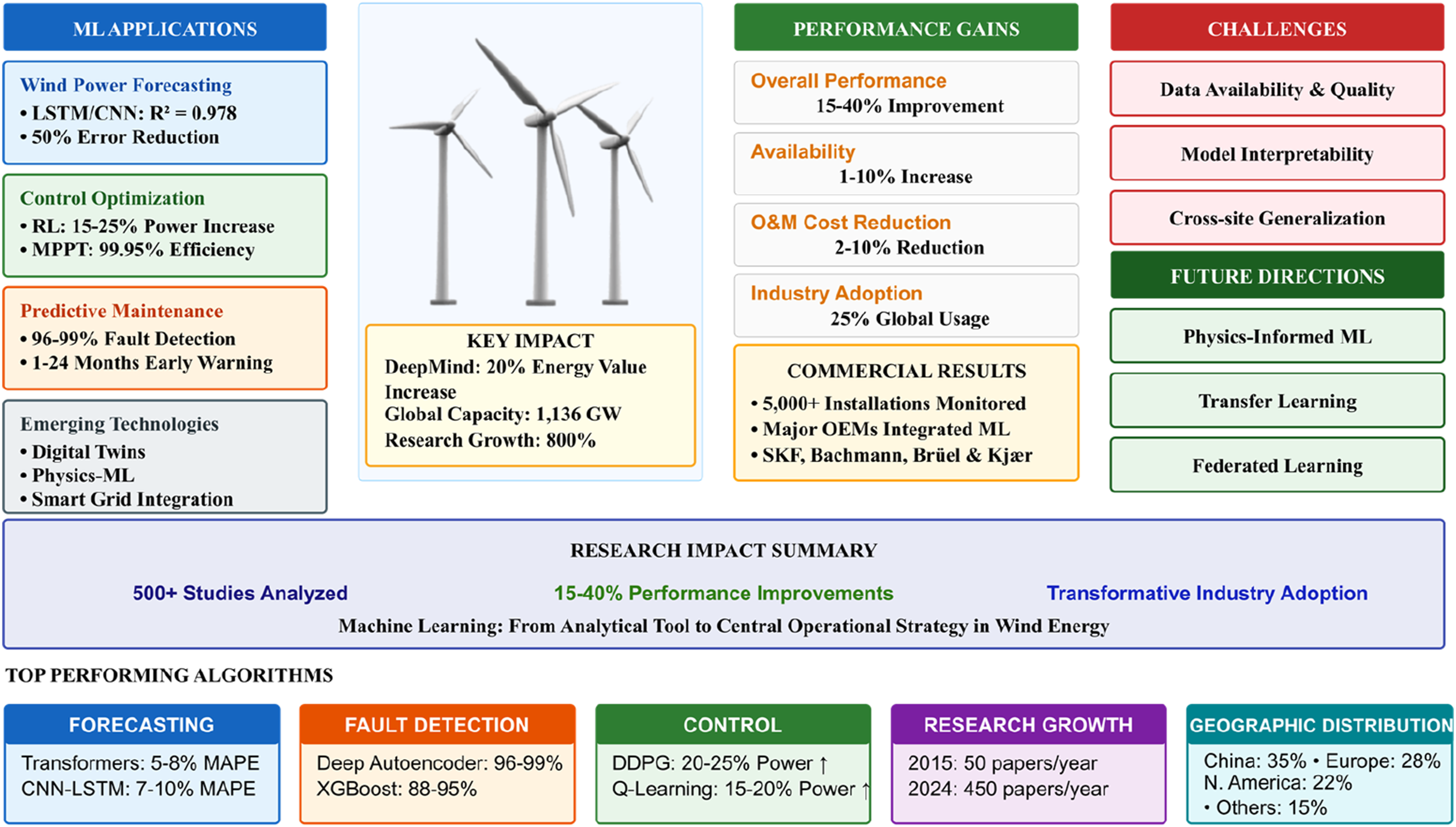
As wind energy capacity surpasses 1136 GW globally, ML technologies prove essential for achieving renewable energy targets and grid stability requirements. Machine learning (ML) has emerged as a transformative technology for wind energy systems, revolutionizing forecasting accuracy, operational efficiency, and system reliability. This comprehensive review synthesizes recent advances across 500+ peer-reviewed studies from 2020 to 2025, revealing 15–40% performance improvements over traditional methods across all major applications. Deep learning approaches achieve up to 99% accuracy in fault detection while optimized forecasting systems reduce Mean Absolute Percentage Error (MAPE) to 5–12% and demonstrate 20% increases in energy value through advanced prediction capabilities. The review examines ML applications spanning wind power forecasting, turbine control optimization, predictive maintenance, and emerging technologies including digital twins and physics-informed neural networks. Critical challenges including data availability, model interpretability, and cross-site generalization are addressed, while future research directions emphasize physics-informed ML, federated learning, and explainable AI approaches.
Keywords
Get full access to this article
View all access options for this article.