




Abstract
The Betz’s limit for the maximum efficiency of an ideal wind turbine imposes a maximum value of about 60% on the conversion of the kinetic energy of an airflow into work. In this paper, we analyze the reason for this value because, from a thermodynamic point of view, it can be 100%. The present work explains the reason for this difference, since it appears to be relevant from a didactic point of view. However, from a practical point of view, the Betz’s limit does not affect in any way the more useful and widespread expression for calculating the ideal maximum power of a wind turbine, which is at the origin of the referred limit. Complementarily, two approaches for the calculation of the theoretical maximum efficiency, in line with thermodynamics, are also presented in this work.
Introduction
The second law of thermodynamics imposes a limit on the conversion of heat, disorganized energy, into work, organized energy, given by the well-known Carnot efficiency. However, for the conversion of a form of organized energy, macroscopic kinetic energy, for example, as an airflow has, into another form of organized energy, such as work, for example, there is no limit, except that imposed by the first law of thermodynamics and the inherent principle of conservation of energy, that is, 100% (Çengel and Boles, 2015).
Therefore, the aforementioned reality contrasts with the well-known Betz limit for the maximum efficiency of an ideal wind turbine (Betz, 2013), from which it follows that the conversion into work of the kinetic energy of an incompressible fluid flow is limited to 16/27 (59.3%). It is important to note that two other authors who lived at the same time as Albert Betz did the same research on their own (Van Kuik, 2007).
Other authors, for example, Greet (1980) and Allahverdyan and Khalafyan (2021), point out errors in the calculation of the Betz’s maximum theoretical efficiency, calling the method’s utility into question. However, the most useful formula, which is the one that allows us to figure out a wind turbine’s maximum ideal power, cannot be argued with because it does not depend on the efficiency mentioned above. As a result, it is still in use today (Villanueva and Feijóo, 2010).
In the work of Allahverdyan (2020), a new model is proposed for the efficiency of converting flow energy into work for compressible fluids. This model takes into account both isothermal and non-isothermal flows, that is, work extraction from flow kinetic energy and from flow enthalpy, respectively. For the isothermal case, which is also looked at in this work but for incompressible fluids, an implicit efficiency expression was found that, when simplified to the ideal case, that is, one-dimensional and isentropic flow, gives the same expression as the one found in this work.
The apparent discrepancy between the maximum efficiency allowed by thermodynamics and that proposed by Betz is investigated in this paper, which begins by reproducing the steps that led to the calculation of the referred Betz limit. As a result, a simple explanation for this discrepancy is provided, which appears to be pedagogically relevant. In addition, two methodologies for calculating the theoretical maximum efficiency in accordance with thermodynamics are described in this work.
In the present analysis, it is assumed that there are no heat exchanges with the fluid, that the flow is isothermal and isobaric (dissipative effects are absent), which entails that the fluid is incompressible and that its entropy remains constant, as the thermodynamic state of the fluid remains unchanged under these conditions. In this work, the idea that the flow has organized macroscopic kinetic energy means that the velocity at the entrance and exit of the streamtube is one-dimensional.
Deduction of Betz’s theoretical maximum efficiency
Figure 1 schematically shows a streamtube commonly used in the study of wind turbines. The pressure and temperature of the air remain constant, so the fluid is considered incompressible. By the conservation of mass, we have that

where
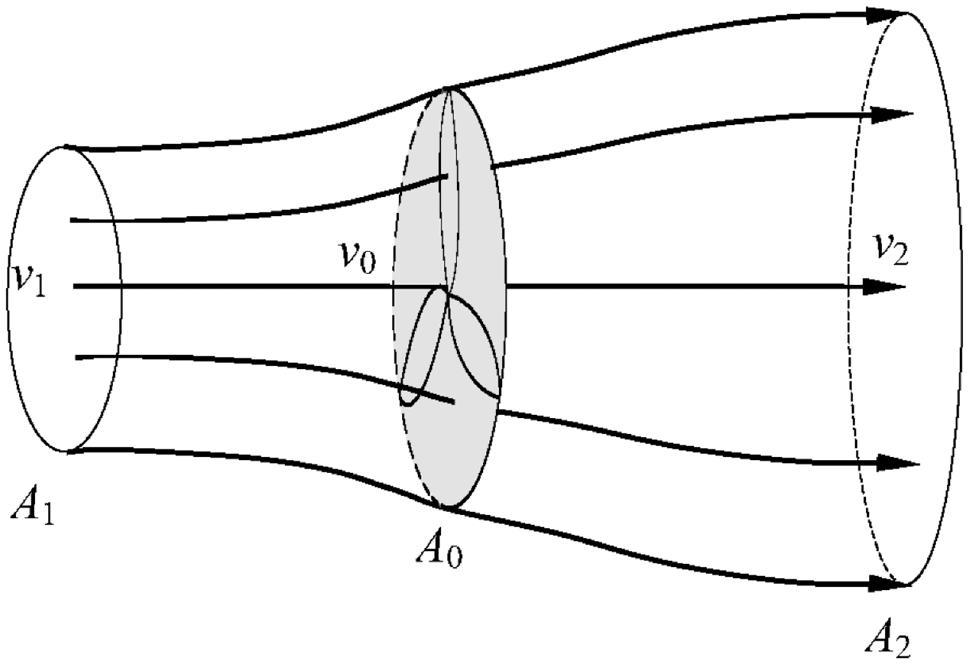
Schematic of a streamtube around a wind turbine.
Betz (2013) calculated the ideal power produced by a wind turbine, Pturb, of area A0 subject to a free stream velocity, v1. Ideally, this power is equal to that taken from the airflow. Two different approaches were used, first through the product between the flow velocity, v0, and the axial force, F, exerted by the flow on the rotor disk of area A0. Then, in a second way, through the product between the mass flow rate and the flow kinetic energy variation from points 1 to 2.
In the first approach, the force, F, is calculated through a momentum balance between points 1 and 2, equation (2).

Subsequently, the power is given by equation (3).

In the second approach, the power is calculated through the following equation.

By making equations (3) and (4) equal to each other, a value for v0 was found, as shown in equation (5).

Through an algebraic manipulation of the equations (3) or (4), and by replacing

a third and more informative expression for the ideal power that a turbine can produce, Pturb, was obtained, equation (7). Equations (3), (4), or (7) all represent the same variable, Pturb.

Differentiating the previous expression with respect to

This maximum arises since, keeping v1 and A0 constant, when varying v2, the mass flow rate will also vary, equation (1), due to the inherent variation of the areas since,

and

Since
Subsequently, having defined the power available in the air stream upstream of the turbine, Pupst, based on the independent variables ρ, v1, and A0, as being

Betz established the ideal efficiency of this energy conversion, η, as the ratio between the ideal power transmitted to the turbine, equations (3), (4), or (7), and Pupst, that is,

From equation (12), we can verify that η reaches the maximum value of 16/27 (59.3%) for
Figure 2 shows how η changes with v2/v1, equation (12), which proves that there is a maximum value for this definition of efficiency when v2/v1 = 1/3.
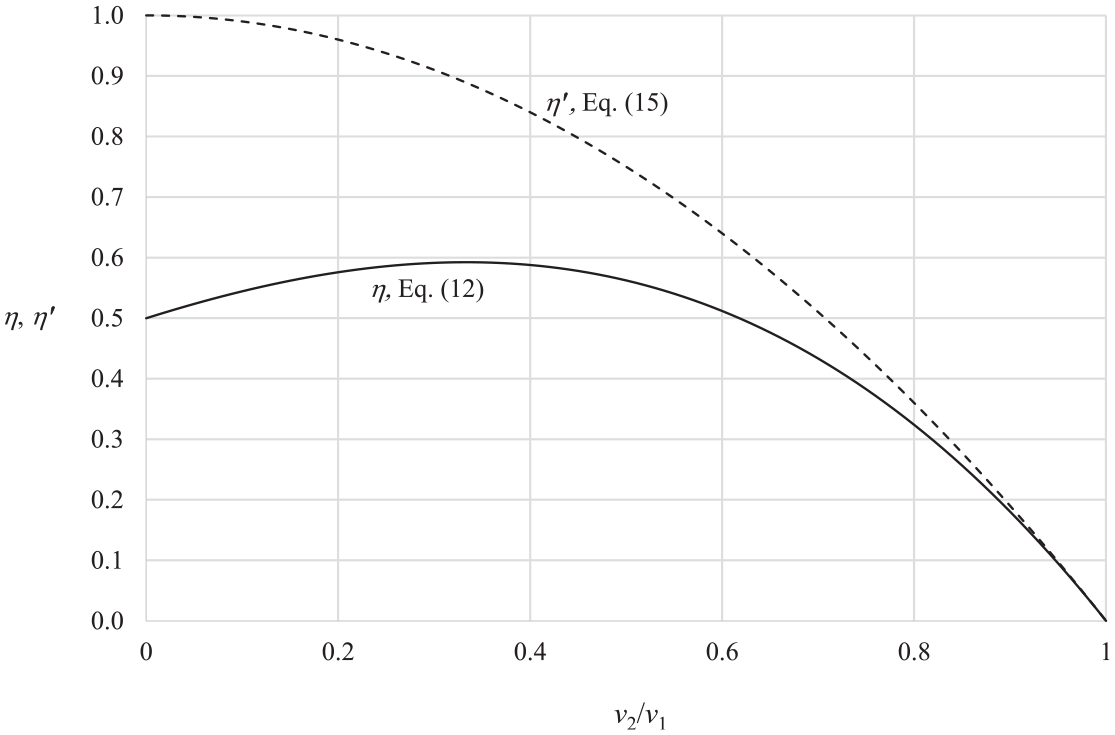
Turbine efficiency variation with v2/v1.
The work developed by Betz makes it possible to quickly find the maximum power that a given wind turbine can extract from an airflow by knowing the values of the independent variables v1, A0, and ρ, equation (8). It also gives a way to find the maximum efficiency of a wind turbine, equation (12), if equation (11) is used to represent the power available in the airflow, that is, the required input for the efficiency.
Approaches to efficiency that are consistent with thermodynamics
As mentioned earlier, thermodynamics allows us to state that the theoretical maximum limit for the conversion of macroscopic kinetic energy into work is 100%, so why is the Betz limit for the maximum theoretical efficiency significantly lower? The reason for this difference has to do with the fact that to calculate the maximum power available in the airflow upstream of the turbine, the expression given by equation (11) was chosen, which represents a value greater than the actual, which is equal to
Equation (13), or equation (14), which is the same as the previous one but changed to best demonstrate the difference between this method and the one used by Betz (2013), can be used to find out how much power from the airflow is actually available to the turbine,


Comparing equations (11) and (14), it can easily be seen that the ratio between the available wind power used in the Betz approach,
Defining an efficiency,

Figure 2 also shows the variation of
It should be noted that v2 = 0 does not mean that there is no flow. By equation (6), we have in this case that
For a given v1, when v2 increases, the same happens to the kinetic energy loss downstream of the turbine,
It is worth noting that the expression of Allahverdyan (2020), his equation (19), for the upper bound value of kinetic energy conversion efficiency, is obtained by replacing the velocities vi in the RHS of equation (15) by the ratio m/(ρ·Ai).
The relationship between the two efficiencies,

For the maximum turbine power, that is, for v2/v1 = 1/3, the efficiency
In order to have an ideal efficiency,

where Wturb is the useful power generated by the turbine.
The efficiency given by equation (17) evaluates the performance of a wind turbine in converting the flow’s kinetic energy variation per unit of time, that is,
Conclusion
The fact that the Betz limit for the maximum theoretical efficiency is less than 100% is directly related to the reference value chosen for the power available in the airflow upstream of the wind turbine. This choice gives rise to a power value that is up to twice as high as that physically available in the wind turbine, which is why the limit is less than 100%.
The existence of the inherent maximum limit of 16/27 can easily convey the undidactic idea that the conversion of macroscopic kinetic energy into work cannot theoretically reach 100%, a possibility that thermodynamics does not exclude at all. This work also refers to two alternative approaches for calculating wind turbine efficiency that are both in accordance with the first and second laws of thermodynamics.
It is worth mentioning that the expression deduced by Betz for calculating the maximum power produced by a wind turbine, equation (8), is not affected by any efficiency definition, and is also quite practical, since, in addition to provide realistic values, it only depends on the independent variables v1, A0, and ρ, and therefore continues to be used nowadays.
Footnotes
Declaration of conflicting interests
The author declared no potential conflicts of interest with respect to the research, authorship, and/or publication of this article.
Funding
The author received no financial support for the research, authorship, and/or publication of this article.
