




Abstract
At the end of our first year as Editors-in-Chief, we would like to take the opportunity to reflect upon the year that was and report on our efforts to make Prosthetics and Orthotics International the journal of choice for all those who wish to access, and contribute to, the rich and growing body of knowledge within the field of prosthetics, orthotics, and rehabilitation engineering. 1
In the interest of transparency and accountability, we wanted to take this opportunity to describe specific efforts that have been made to advance the journal, report key performance metrics from the previous year, and to speak candidly of the challenges that remain ahead for Prosthetics and Orthotics International.
Efforts to advance the journal
When we commenced our tenure as Editors-in-Chief at the beginning of 2019, we enacted a number of changes that have affected the day-to-day operation of the journal. These include the following:
Implementing a new editorial model that includes four Editors-in-Chief. 1 While Prosthetics and Orthotics International has historically been served by a single Editor-in-Chief, we felt an expanded editorial team was necessary. Given that the journal is not otherwise supported by a paid editorial staff, this allowed us to more effectively meet the many demands of leading a contemporary peer-reviewed journal. Throughout the year, we have worked together to improve the quality, consistency, and timeliness of all journal processes (e.g. submission, review, and publication); we have worked with our Associate Editors to enhance communications with authors; and we have worked with our Editorial Board to improve the visibility of the journal. We have also collaborated to update important policies like our Conflict of Interest Policy so that we might engender confidence in the decision making process. We have developed new administrative procedures and policies, like our Decision Appeals Policy, so that we might provide authors with a transparent and timely process for handling journal submissions and subsequent communications.
Updating and growing our Editorial Board to guide strategic efforts. 2 We developed new Editorial Board Terms-of-Reference in order to engage more effectively with board members and leverage their collective knowledge and expertise. Quarterly Editorial Board meetings have helped guide the strategic direction of the journal. Editorial Board members have contributed to new initiatives that include creating a social media presence via twitter, drafting new policies, exploring processes for mentoring new reviewers, and drafting recommendations regarding terminology and language.
Recruiting new Associate Editors to manage the peer review of incoming submissions. 2 We recruited an expanded pool of Associate Editors with the requisite skills and expertise to manage the diverse range of manuscripts submitted to the journal. We have worked closely with our Associate Editors in order to improve the rigor and timeliness of the peer review process. To acknowledge Associate Editors’ efforts and stewardship of manuscripts, their names are now included in the first page footer when an article is published.
Working closely with our publisher to improve journal processes and communications. We petitioned SAGE to provide a Peer Review Associate (PRA) who could be responsible for administratively triaging submissions to the journal, communicating submission status to authors, and assisting Associate Editors with administrative processes. Involvement of the PRA ensures that submissions conform to the journal’s submission requirements, thereby lessening reviewer frustrations and allowing them to focus their critiques on the scientific quality of the work, rather than editorial issues that can be corrected during initial administrative review.
In addition to undertaking efforts to effectively manage the day-to-day work of the journal, we have also sought out new opportunities to increase the visibility and impact of the journal, its content, and those who contribute to our success. Over the last year, we have
Published editorials in each issue under our stewardship.1,3 –6 These editorials were aimed at sharing with readers our vision for Prosthetics and Orthotics International; 1 providing readers a greater understanding of our peer review process; 3 inviting and encouraging authors to submit new types of articles; 5 promoting the use of clinical trial registers, systematic review registers, and reporting guidelines to improve the quality of research; 4 and sharing feedback we have received from readers and authors. 6
Celebrated the work of some of our outstanding peer reviewers. This year, we established and developed the SAGE Elite Reviewer prize to acknowledge reviewers based on the quality and timeliness of their reviews. 3
Encouraged qualitative research submissions through the creation of a new manuscript category for qualitative research with a word count appropriate to data presented in the form of first-person quotes. 5
Established a social media presence (@ProsOrthInt) to promote recent articles and new initiatives. 7
Hosted a face-to-face workshop at the 17th ISPO World Congress in Kobe, Japan, to gather feedback from readers and authors to help inform our strategic initiatives in the year ahead. 6
Supported the ISPO Executive Board’s deliberations to transition Prosthetics and Orthotics International from a print to an electronic journal.
2019 key performance metrics
As a journal, we had 241 original manuscript submissions in 2019 (see Table 1 for a breakdown by type of manuscript submitted) with an acceptance rate of 25% for manuscripts that received a final decision in 2019. Thanks to the hard work of our editorial team, we have seen a significant reduction in the time to first decision. The overall time to an initial decision for 2019 averaged 8 days without peer review and 41 days with peer review. We recognize it is important for an initial decision without review to occur quickly so that authors can find other alternatives for their submission. This also means that we only use peer reviewers’ valuable time for articles that have reasonable potential for publication in Prosthetic and Orthotic International. Likewise, we know that the speed of a decision after peer review is critical for authors who depend upon their publications for dissemination, reporting progress, and promotion. As such, we continue to make optimizing the time of peer review a priority.
Original and revised manuscripts, by publication type, submitted to Prosthetics and Orthotics International in 2019.

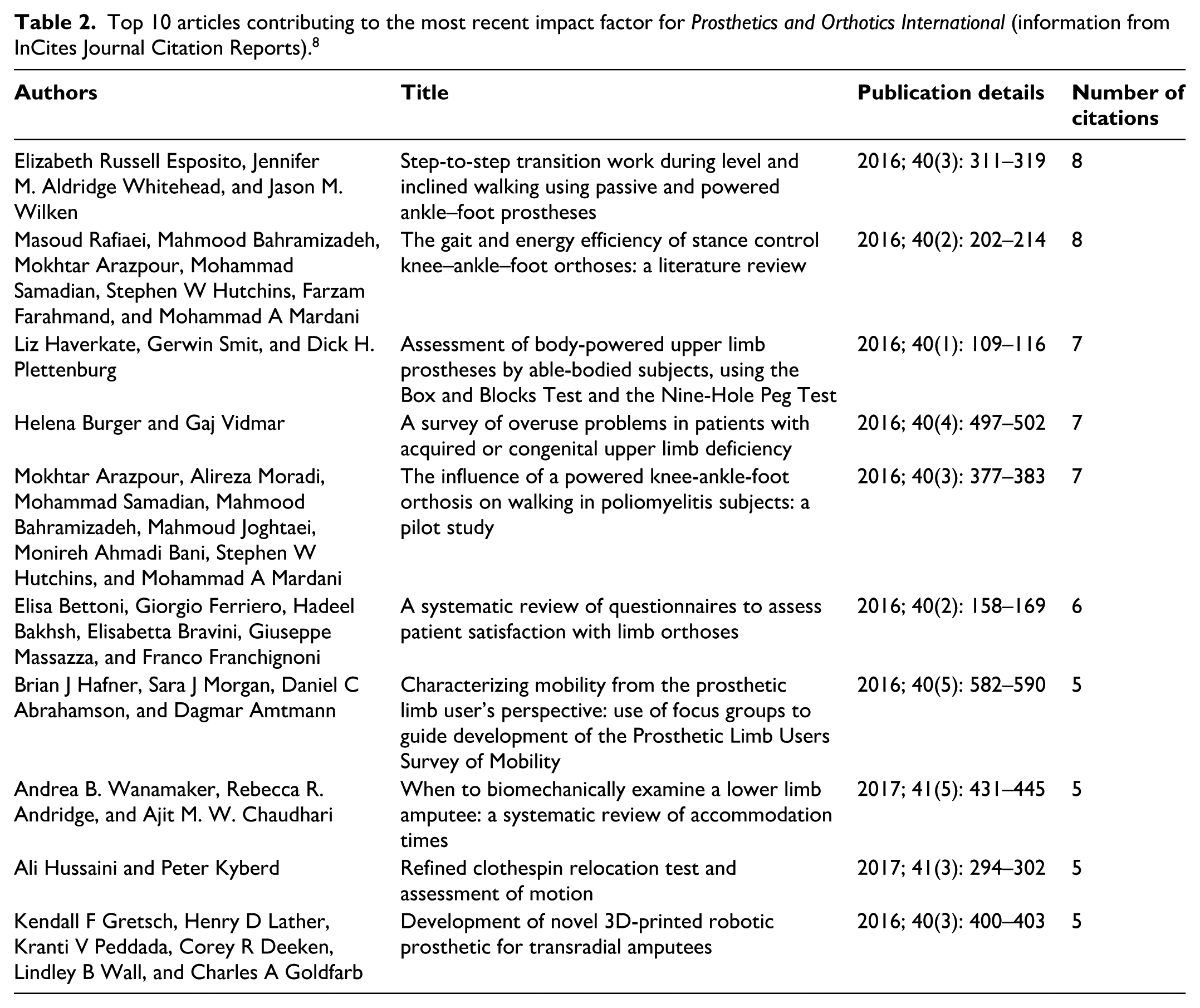
We were delighted that Prosthetic and Orthotic International’s 2-year Impact Factor increased to an all-time high of 1.482 (Figure 1). 8 The Impact Factor is a measure of the number of times an average article in a journal is cited over the previous two publication years. The Impact Factor therefore provides a measure of the relative importance or rank of a journal by quantifying how often articles published in a journal are cited. Table 2 indicates the 10 articles that contributed most to the most recent impact factor. 8 Full text usage of the journal (i.e. the number of PDF and HTML downloads from the journal) during 2019 was more than 200,000.

Impact factor and number of citations for Prosthetics and Orthotics International, 1997 to 2018 (calculated using data from InCites Journal Citation Reports). 8
Top 10 articles contributing to the most recent impact factor for Prosthetics and Orthotics International (information from InCites Journal Citation Reports). 8
Challenges that remain ahead
While much has been accomplished during the first year of our tenure as Editors-in-Chief, there remains much more to be done to realize our vision and address the challenges ahead. For example:
Increasing the number of high-quality articles published in the journal by encouraging both previous and new authors to submit their work for publication.
Continuing to improve the timeliness and quality of the peer review process to ensure that the journal remains an attractive option for leading researchers, clinicians, and educators.
Encouraging participation from a more diverse range of authors and reviewers, reflective of the journal’s international readership.
Increasing the quality and transparency of research published in the journal by requiring prospective registration of clinical trials and systematic reviews, as well as consistent use of reporting guidelines appropriate for the type of article.
Improving the journal’s reach and dissemination so as to enhance the impact of work published in the journal. This includes managing the transition of Prosthetics and Orthotics International to a fully electronic journal.
Building the capacity of our reviewers, Associate Editors, and Editorial Board members to create a pipeline of talented and experienced people who can effectively serve the journal in the years ahead.
Improving oversight and governance of the journal.
We are grateful to the many people who have encouraged our efforts and directly supported these initiatives by volunteering their precious time and valuable expertise. We would particularly like to acknowledge and thank our Editorial Board members for the work they do behind the scenes, our peer reviewers for their thoughtful and influential reviews, and the authors who have provided us with the opportunity to consider their research for publication. We acknowledge the expertise and time that reviewers volunteer to help identify high-quality submissions and improve the quality of manuscripts published in the journal. We are also grateful to members of the ISPO Publications Committee and our publisher SAGE for their engagement to improve the processes that underpin the effective operation of the journal. It is the collective effort of an entire community of people that has helped the journal continue to grow and we hope you will continue to support these collective efforts in the year ahead as we work toward achieving our vision for Prosthetics and Orthotics International.
Footnotes
Author contributions
All authors contributed equally in the preparation of this manuscript.
Declaration of conflicting interests
The author(s) declared no potential conflicts of interest with respect to the research, authorship and/or publication of this article.
Funding
The author(s) received no financial support for the research, authorship, and/or publication of this article.