




Abstract

Establishing a vision for a journal and enacting efforts to achieve that vision are some of the most important responsibilities for an Editor-in-Chief. Earlier this year, we presented our vision for Prosthetics and Orthotics International. 1 Over the last few months, we have worked diligently with our Associate Editors, members of our Editorial Board, and our publisher to enact that vision. While we have begun to see the fruit of our labours, we realize there is still much to be done.
We generally have few occasions to directly engage readers and authors in discussions related to the future of the journal. To address this issue, we recently led a symposium at the International Society for Prosthetics and Orthotics (ISPO) 17th World Congress, which was held in Kobe, Japan in October 2019. The symposium, titled “Growing the evidence base in P&O: a dialogue with the Prosthetics and Orthotics International editorial team,” 2 was intended as a means to solicit feedback from readers and authors who attended the World Congress.
The symposium was attended by 21 participants including 3 of the Editors-in-Chief and 5 Editorial Board members. Participants represented a diverse cross-section of the journal’s stakeholders, including allied health professionals, rehabilitation physicians, researchers and students from Europe, Australia, North America, and South East Asia.
During the symposium we shared our vision for the journal, discussed the new editorial structure and explained our efforts to address challenges such as improving the timeliness of the peer review process.3 -5 We also appreciated the opportunity to make transparent several metrics that mark how performance of the journal has changed during our early tenure as Editors-in-Chief (Figure 1), and articulate some of the challenges that we believe lie ahead. The central component of the symposium was a facilitated discussion where small groups of participants considered and responded to four guiding questions:
How can the journal better serve your needs and those of the broader community?
What should change in the years ahead and how might the journal be different in 5 years’ time?
What can we do to attract high-quality submissions to the journal?
Is there anything critical to the future of the journal we haven’t discussed?
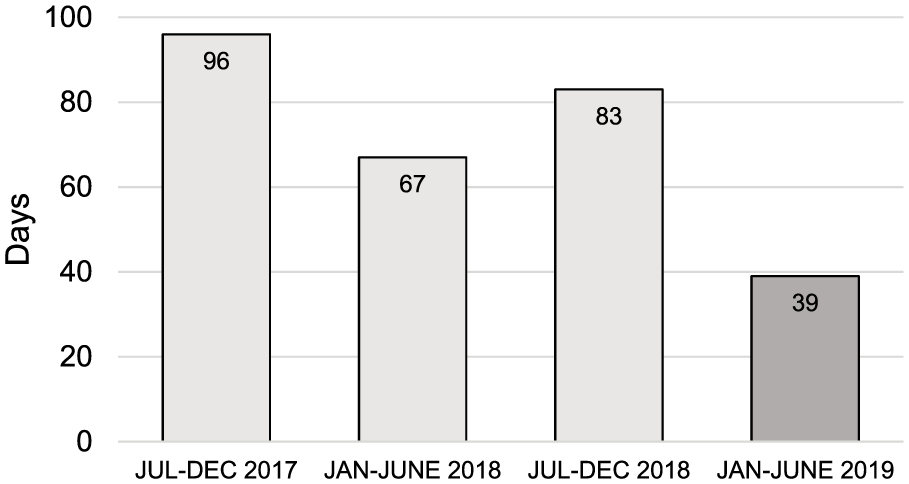
Key performance indicator of average days to first decision for POI over the last two years. Dark shading represents the period of the current editors’ tenure.
The resulting discussion provided an opportunity for participants to express their views and offer suggestions regarding the future of the journal. We were delighted with the thoughtful contributions that participants made and have summarised these within the following themes: content, dissemination, management and marketing.
Content
Content of the journal was a major point of discussion. It was perceived that prosthetics research has dominated the journal and feedback from participants suggested that there is a need to broaden the subject matter published in the journal. Participants also raised concerns about the clinical relevance of manuscripts published in the journal and suggested that all articles should have a strong clinical message. While participants noted the journal currently includes a clinical relevance statement as part of the structured abstract for each article, it was felt that more could be done to communicate clinical relevance. They also expressed a desire to see more articles reporting the results of clinical research.
In line with the above comments, participants expressed a desire for the journal to publish translational articles that synthesise current research and describe how it could or should influence clinical practice. Suggestions offered to address this issue were:
publication of clinical synopses that provide practicing clinicians with a summary of the major findings.
promoting awareness of systematic reviews and clinical practice guidelines to facilitate access to the best available evidence for clinical practice.
including a dedicated section promoting articles authored by students. It was anticipated that this initiative would encourage those just beginning their career to write and publish in the journal.
publishing information regarding the impact that previously published work has had on clinical practice.
Dissemination
The majority of participants suggested a transition to an electronic-only journal (i.e., suspending publication of the print version). Participants acknowledged that they had some concerns regarding accessibility by individuals in less-resourced countries. It was recognized that a potential benefit of moving to an electronic journal was the possibility to increase the length and level of detail presented in articles, without the additional costs associated with printing and mailing larger issues. However, as editors we also recognize that longer articles create other challenges in terms of reviewer burden and time to review.
Open access to articles was also considered an important issue for participants. While it was understood that publishers rely on subscriptions to finance their services, participants encouraged us to explore options to increase the number of open access articles published in the journal. Participants also spoke of the trend in academic publishing of making research data publicly available and encouraged this practice. While the journal currently offers the possibility to host additional material such as datasets, podcasts and images, few participants were aware of this option and few authors currently use this option. Participants felt that more could be done to communicate and promote this service.
Management
Some participants suggested there was need for greater diversity and representativeness, particularly through recruitment of prosthetic and orthotic users and representatives from low- and middle-income countries. We were also encouraged to involve students through mentoring initiatives and dissemination of information via social media. There was some suggestion that efforts should focus on improving the impact factor of the journal by attracting high quality manuscripts and improving the timeliness of peer review.
Marketing
Marketing and promotion of the journal was considered critical by participants for longevity of the journal. Hence, an active marking campaign was encouraged. Suggestions for marketing the journal included having members of the Editorial Board present the scope and initiatives of the journal at relevant national and regional meetings and improving the journal’s social media presence. Suggested social media initiatives included: Twitter, Facebook and community discussion boards.
Themed issues of the journal, targeting highly relevant topics or an issue highlighting the top 10 articles of the decade, were also suggested as marketing initiatives. We were also encouraged to invite high profile guest authors who do not typically publish in the journal to contribute manuscripts. This was considered a means of broadening the potential pool of contributors and readership.
Conclusion
We were thrilled with the level of interest and engagement from those who participated in the symposium, and the quality and thoughtfulness of the feedback provided. It was heartening to be part of such an open discussion and sharing of ideas with the genuine intent of improving the quality and relevance of the journal over time. There were many ideas and suggestions that we, as Editors-in-Chief, had not previously considered, and we are grateful for the contribution.
We appreciate the opportunity to hear from those with a genuine interest in the future of Prosthetics and Orthotics International. We encourage anyone who was unable to attend the ISPO symposium to contact us and share your suggestions for improving the journal. We look forward to implementing some of these ideas next year as we work to realise our vision for Prosthetics and Orthotics International.
Footnotes
Author contribution
All authors contributed equally in the preparation of this manuscript.
Declaration of conflicting interests
The author(s) declared no potential conflicts of interest with respect to the research, authorship and/or publication of this article.
Funding
The author(s) received no financial support for the research, authorship, and/or publication of this article.
