




Abstract

The scientific community is routinely working to improve the quality and transparency of research published in peer-reviewed journals. As Editors-in-Chief of Prosthetics & Orthotics International, we support these efforts and encourage authors to follow the recommendations produced by these initiatives when designing their studies, conducting their research and disseminating their study results. In this editorial, we review several actions that authors can take to improve quality and transparency of their research, with a specific focus on prospective registration of research and adherence to reporting guidelines.
Why is it important to promote quality and transparency in research?
It has been suggested that between 15% and 50% of clinical trials are never published 1 and that studies with results favouring the hypothesis are three to five times more likely to be published. 2 This phenomenon, termed publication bias, has major consequences for prosthetics and orthotics evidence, as it can result in an overestimation of treatment effects. Studies that are published may also be susceptible to bias. For example, authors may not present a clear and complete account of the research that was conducted or choose to report only a subset of the recorded outcomes. This phenomenon is termed reporting bias. Reporting bias adversely affects readers’ ability to assess strengths and weaknesses of a study, overemphasizes certain outcomes and omits others, and also leads to research that cannot be replicated.
What can authors do to promote quality and transparency in their research?
There are a number of efforts that authors can make to promote the quality and transparency of their research, including registering their study or review in a public register or using reporting guidelines and checklists to author their manuscripts.
Clinical trial registers
Clinical trial registers are databases of research protocols that have been developed to store, and ideally share publicly, information regarding the design, methods, and management of studies prior to their conduct and dissemination. The practice of registering clinical trial protocols has gained significant traction since the first registration of a clinical trial in 1994. 3 Since then, a number of governmental and professional organizations, including the World Health Organization (WHO), 4 the European Commission 5 and the United Kingdom’s National Health Service (NHS), 6 have endorsed registration of clinical trial protocols. Several of these organizations have also proposed criteria for listed registers. For example, the WHO registry network 7 requires registers to (1) be publicly and freely accessible, (2) be open to prospective registrants, (3) be managed by a non-profit organization, (4) have processes in place to ensure the validity of registration data, and (5) be electronically searchable.
In 2005, the International Committee of Medical Journal Editors (ICMJE) adopted a policy that medical journal editors require authors to show evidence that they had registered their clinical trial in a public register prior to enrolling participants. 8 Prospective registration of a clinical trial is recommended to avoid alteration or manipulation of study protocols during conduct of the trial; however, some databases permit retrospective registration. The process of making research protocols available from the outset is particularly beneficial for reducing publication bias and the likelihood of selective reporting as information entered into the register can be compared to information presented in subsequent publications. A further benefit of registers is improved access to information regarding ongoing research, which can help reduce unnecessary duplication of research efforts and may allow individuals with specific health conditions to identify and participate in clinical trials.
Systematic review registers
Registers also exist to store and index systematic review protocols. Registration of systematic review protocols has similar benefits to those described for clinical trial protocols. Registering a systematic review protocol is helpful to establish that a review on a specific topic is planned and/or underway, reduces the risk of duplicate reviews, increases potential for communication between researchers with common interests, and provides greater transparency when updating or reporting results from a systematic review.
Systematic Review protocol registers include the Campbell Collaboration, Cochrane Collaboration, and PROSPERO. The Campbell Collaboration register is focused on the effects of social interventions, the Cochrane Collaboration register is focused on the effects of health care interventions and the PROSPERO register is focused on the effects of both health and social care. Authors can post their systematic reviews in each of these registers free of charge. As with clinical trial protocols, systematic review protocols should be registered prior to their conduct to help avoid unplanned duplication and to enable comparison of review methods reported in the published article to those described in the protocol. Changes in emphasis that occur between protocols and completed reviews, such as adding or removing outcomes or changing the status of primary and secondary outcomes, have the potential to bias a review. 9 Registers do not preclude changes to protocols from being made but require that they be reported through updates to the register, thus holding authors accountable for justifying why changes were necessary in a publicly available audit trail.
Reporting guidelines and checklists
Reporting guidelines and checklists have been developed to facilitate completeness and transparency in research by improving the overall quality of published research articles. Guidelines specify and provide details about what should be reported in a manuscript, while checklists provide the means to ensure authors have complied with the guidelines. Reporting guidelines have been developed for a range of different study types, including different types of experimental and observational designs. Reporting guidelines are also available for different types of reviews, including systematic and scoping reviews.
Guidelines are particularly useful in assisting authors to prepare their manuscripts and ensure that relevant information is presented. They also encourage authors to provide the details necessary to facilitate reproducibility of the study. A number of studies have demonstrated that reporting guidelines improve the quality of published scientific articles,10,11 although adherence to reporting guidelines is often considered suboptimal.12,13
Journals increasingly require authors to complete and submit checklists as confirmation that their manuscripts comply with the associated reporting guidelines. For example, the CONsolidated Standards of Reporting Trials (CONSORT) checklist 14 for reporting of randomized controlled trials contains 25 items focusing on six key areas that must be addressed across various sections of a manuscript. The Preferred Reporting Items for Systematic reviews and Meta-Analyses (PRISMA) checklist 15 for reporting of systematic reviews contains 27 items that must be addressed in various sections of a manuscript when reporting a systematic review with or without meta-analysis. Both the CONSORT and PRISMA checklists require that authors publish a flow diagram illustrating progress of participants through the phases of the research study or articles through the phases of the review.
The EQUATOR (Enhancing the QUAlity and Transparency Of health Research) Network 16 is a valuable resource for authors wishing to learn more about reporting guidelines and maintains a database of reporting guidelines for various study designs. They also provide a flowchart, the EQUATOR Wizard, to assist authors in selecting the appropriate reporting guideline for a given study design.
What does Prosthetics and Orthotics International do to facilitate quality and transparency of research?
Prosthetics and Orthotics International endorses the ICMJE requirement that researchers prospectively register their clinical trials in a WHO-approved public registry but will also consider retrospective registration if, in the opinion of the editor, sufficient and appropriate justification is provided for why registration was not undertaken prospectively. Registration of systematic reviews is also encouraged, but not presently required.
When preparing a manuscript for a clinical trial or systematic review that has been registered, authors should cite the registration number both at the end of the abstract and in the methods section of their manuscript. These details should be blinded for peer review, but will be evaluated by the Associate Editor. Associate Editors will cross-check information presented in the manuscript with the relevant register and determine if there are any unexplained discrepancies that have not been addressed by the author. It is subsequently important that authors regularly update registered information and be proactive in providing an explanation or rationale for discrepancies.
Authors submitting manuscripts to Prosthetics and Orthotics International are encouraged to use reporting guidelines for any study design where a guideline is available. Inclusion of both CONSORT and PRISMA flowcharts and checklists for randomized controlled trials and systematic review, with or without meta-analyses, is also recommended. For both clinical trials and systematic reviews, CONSORT and PRISMA flowcharts should be included as a figure cited within the manuscript and a completed checklist should be uploaded as a supplementary file within the submission. Reporting guidelines for study types commonly published in Prosthetics and Orthotics International, and available on the EQUATOR Network, are presented in Table 1.
Examples of recommended reporting guidelines for study types common to Prosthetics and Orthotics International.
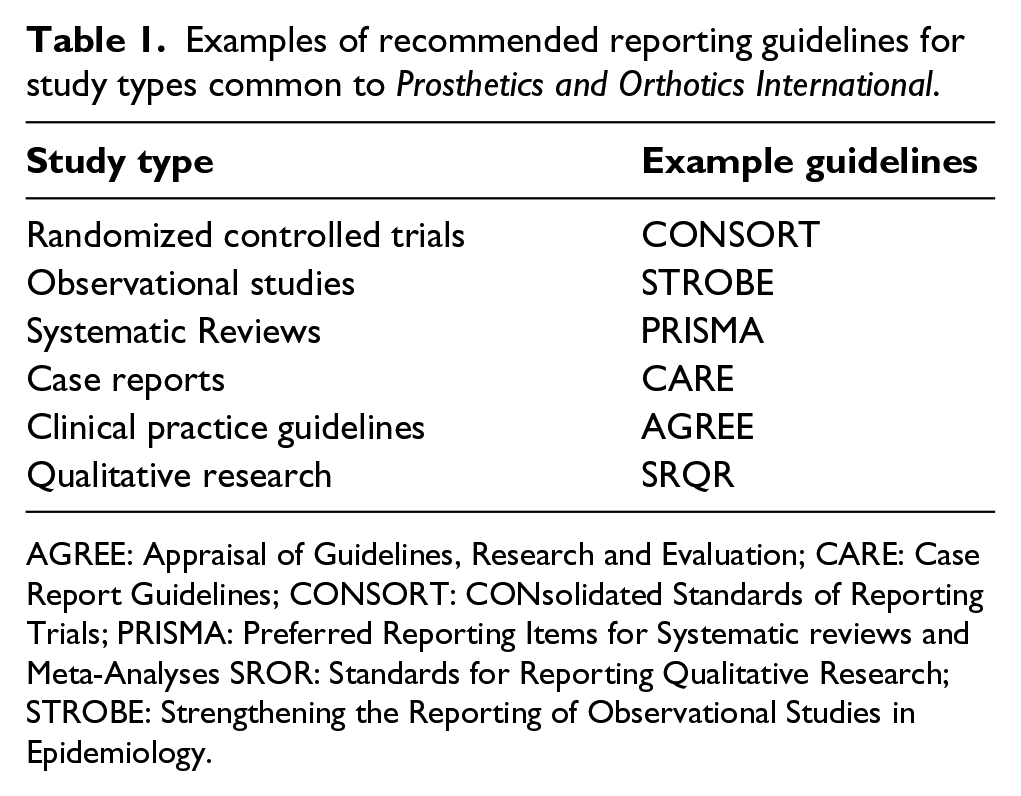
AGREE: Appraisal of Guidelines, Research and Evaluation; CARE: Case Report Guidelines; CONSORT: CONsolidated Standards of Reporting Trials; PRISMA: Preferred Reporting Items for Systematic reviews and Meta-Analyses SROR: Standards for Reporting Qualitative Research; STROBE: Strengthening the Reporting of Observational Studies in Epidemiology.
Impact that registers and reporting guidelines are having in orthotics and prosthetics research
Clinical trials and systematic reviews within the field of prosthetics and orthotics can currently be identified in all major registers. For example, a search for studies associated with the term ‘orthotic device’ in the WHO Clinical Trials Registry Platform identifies almost 400 trial entries and a search for the term ‘prosthetic limb’ identifies six entries. It is also promising to see that over 20 systematic reviews related specifically to the field of prosthetics and orthotics are currently registered in PROSPERO as ongoing or completed. By increasing awareness of the availability of registers to our readers and authors, we hope to increase the number of prospectively registered clinical trials and systematic reviews published in Prosthetics and Orthotics International.
Conclusion
Well-designed and appropriately conducted research is, on its own, insufficient to ensure study results are of high quality and presented with transparency to the public. Although quality and transparency of research evidence can never be guaranteed, prospective registration of clinical trials and systematic reviews and use of reporting guidelines can help to minimize bias and improve transparency of results presented in a research article. While prospective registration of trial or review protocols and use of reporting guidelines are not mandatory in Prosthetics and Orthotics International, we are increasing scrutiny of manuscripts in an effort to improve transparency and quality of the manuscripts we publish. We welcome feedback from readers/authors on whether or not registration of studies and reviews, as well as use of reporting guidelines, should be made mandatory.
Footnotes
Author contributions
All authors contributed equally in the preparation of this manuscript.
Declaration of conflicting interests
The author(s) declared no potential conflicts of interest with respect to the research, authorship and/or publication of this article.
Funding
The author(s) received no financial support for the research, authorship and/or publication of this article.
