




Abstract
We expect that many readers of Prosthetics and Orthotics International have had the privilege of hearing personal stories about the experience of living with a disabling health condition. The detail of these experiences can be profound, powerful and moving, as well as influential in shaping our understanding of the challenges faced by those living with injury or illness. As Editors-in-Chief of Prosthetics and Orthotics International, we see a unique opportunity to illuminate these experiences through rigorous qualitative research that can help inform clinical practice and further research.
Developing an understanding of these experiences and what they mean to people, requires qualitative research methods that involve systematically gathering, synthesising and interpreting data in the form of text or words. 1 These data are often obtained during one-on-one interviews or small group discussions, where details of the participants’ experiences can be explored and recorded. Audio recordings are usually transcribed and analysed line-by-line to characterise each participant’s experience. When these analyses are done with data from multiple participants, thematically-related experiences emerge. These themes are often described along with illustrative first-person quotes to evidence and support the researcher’s interpretation of the data. In this way, qualitative research methods provide a way to describe and characterise the experience and perceptions of participants in a systematic way that engenders trustworthiness in the findings, and provides high-quality evidence that can inform clinical practice or future research.
Given the value of qualitative research to explore and understand the experience of living with a disabling health condition, it is surprising that qualitative research has not been more prevalent in the prosthetics- and orthotics-related literature. While researchers have historically used quantitative methods appropriate to answer research questions related to physiological, functional, or biomechanical outcomes, there are opportunities to use qualitative methods to develop a richer understanding of significant life experiences. By way of example, many studies of return-to-work after lower limb amputation have used quantitative approaches to compare demographic and amputation-related factors in cohorts that have and have not returned-to-work.2 –5 The use of qualitative research methods would likely highlight the influence of other factors such as family and social supports, the physical environment, or employer perceptions of disability, that are described in contemporary models of work participation. 6 Rigorous qualitative research can also be used to establish a well-evidenced foundation for quantitative research that is grounded in the lived experience of participants, and focused on the factors most important to the long-term outcomes we wish to affect, such as return-to-work.
Does Prosthetics and Orthotics International publish qualitative research?
Historically, little qualitative research has been published in Prosthetics and Orthotics International (Figure 1). Qualitative research tends to be published in other rehabilitation-related journals (Figure 2). We believe the disparity likely reflects the fact that Prosthetics and Orthotics International does not have a specific submission category for qualitative research with a word limit that allows data in the form of words and first-person quotes to be included.
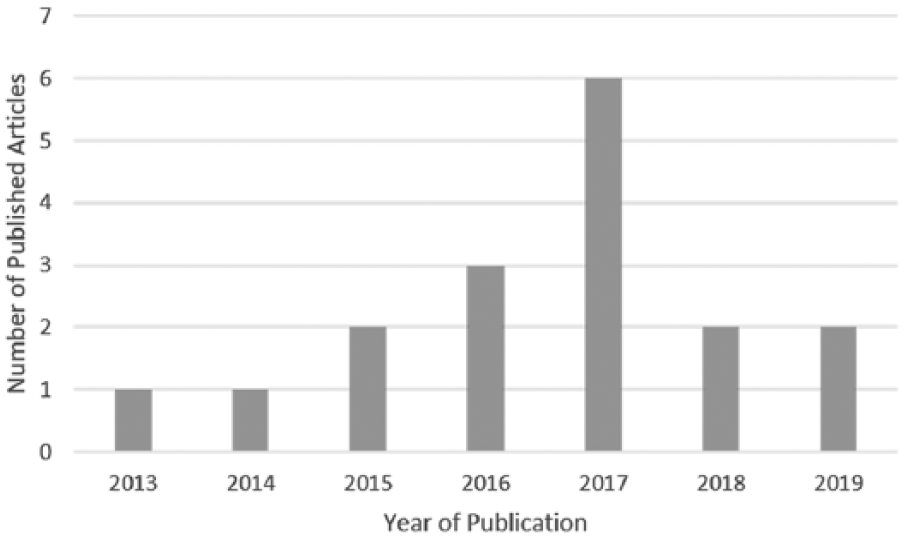
Number of qualitative articles published from 2013 to 15th June 2019 in Prosthetics and Orthotics International identified using the following PubMed search strategy: ((prosthetics OR orthotics) AND qualitative) AND “Prosthet Orthot Int”.
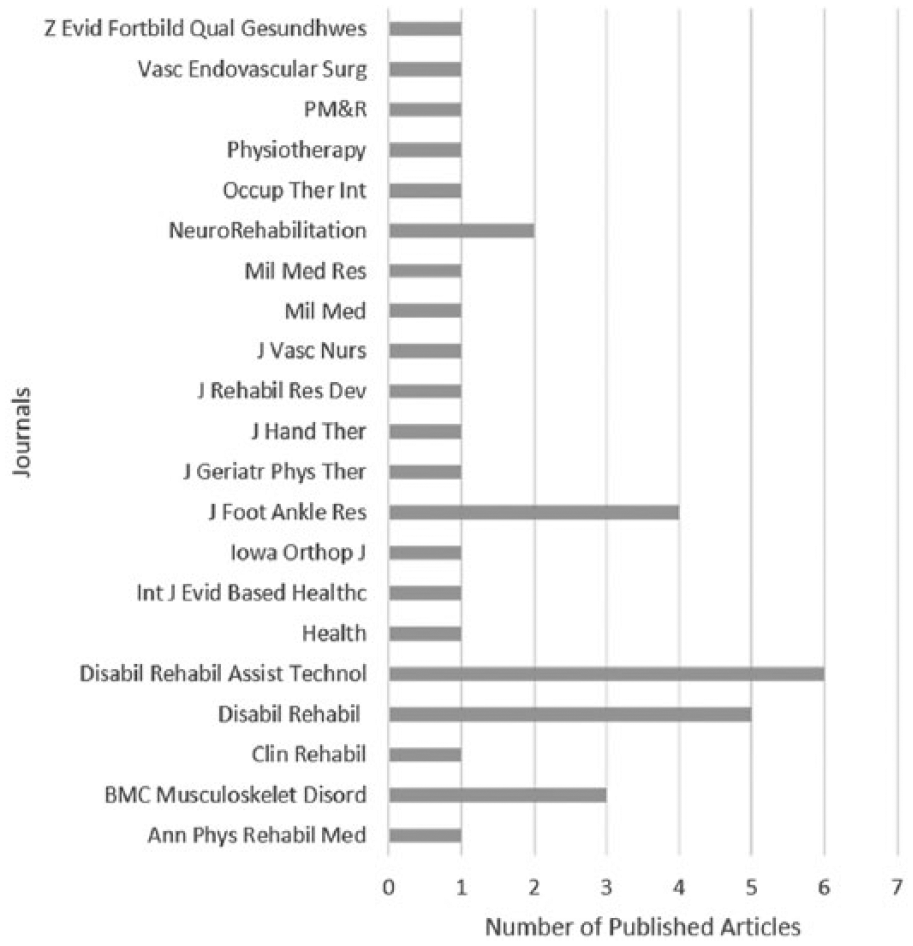
Number of qualitative articles published from 2004 to 15th June 2019 in other journals identified using the following PubMed search strategy: ((prosthetics OR orthotics) AND qualitative) NOT “Prosthet Orthot Int”.
Changes made to encourage qualitative research submissions to Prosthetics and Orthotics International
Two important changes have been made to the author guidelines to encourage high-quality, qualitative submissions to Prosthetics and Orthotics International. Firstly, we have added a new submission category specifically for qualitative research with the intent to solicit ethnographic, narrative enquiry, grounded theory or phenomenological studies. Mixed-methods studies (i.e., studies that use both qualitative and quantitative approaches) will also be considered under this category of submission. Secondly, qualitative research submissions will have a 5000 word limit for the main body of the article (i.e., background to conclusion), inclusive of all in-text data such as first-person quotes. The word limit is similar to that offered by other journals that publish qualitative research articles.7–10 Just like all submissions to Prosthetics and Orthotics International, manuscripts submitted under this new category will require a structured abstract (250 words) and a statement of clinical relevance (50 words).
Where first-person quotes are used to support and evidence the researcher’s interpretation, they should be succinct, appropriately truncated, and woven through the findings section as illustrated using this example describing the prosthetist/orthotists’ experience of their workspace. 11
The workshop environment includes exposure to background noise from extraction fans and more acute sounds from compressed air and pneumatic drills: When there are less people in the department the noisy machines are just not on as much … we get to the end of the day and we all talk about it [the noise] … I go home feeling more relaxed on days when everything [noisy machinery] hasn’t been on as much. (Julie)
In this way, it is clear that the author’s interpretation or characterisation of the experience is grounded in the participant’s own words. Where appropriate to the research aims, first-person quotes may also be presented in a table, as illustrated in this grounded theory example where the student experience of integrating research into the curriculum was categorised to guide further analysis and interpretation (Table 1). 12
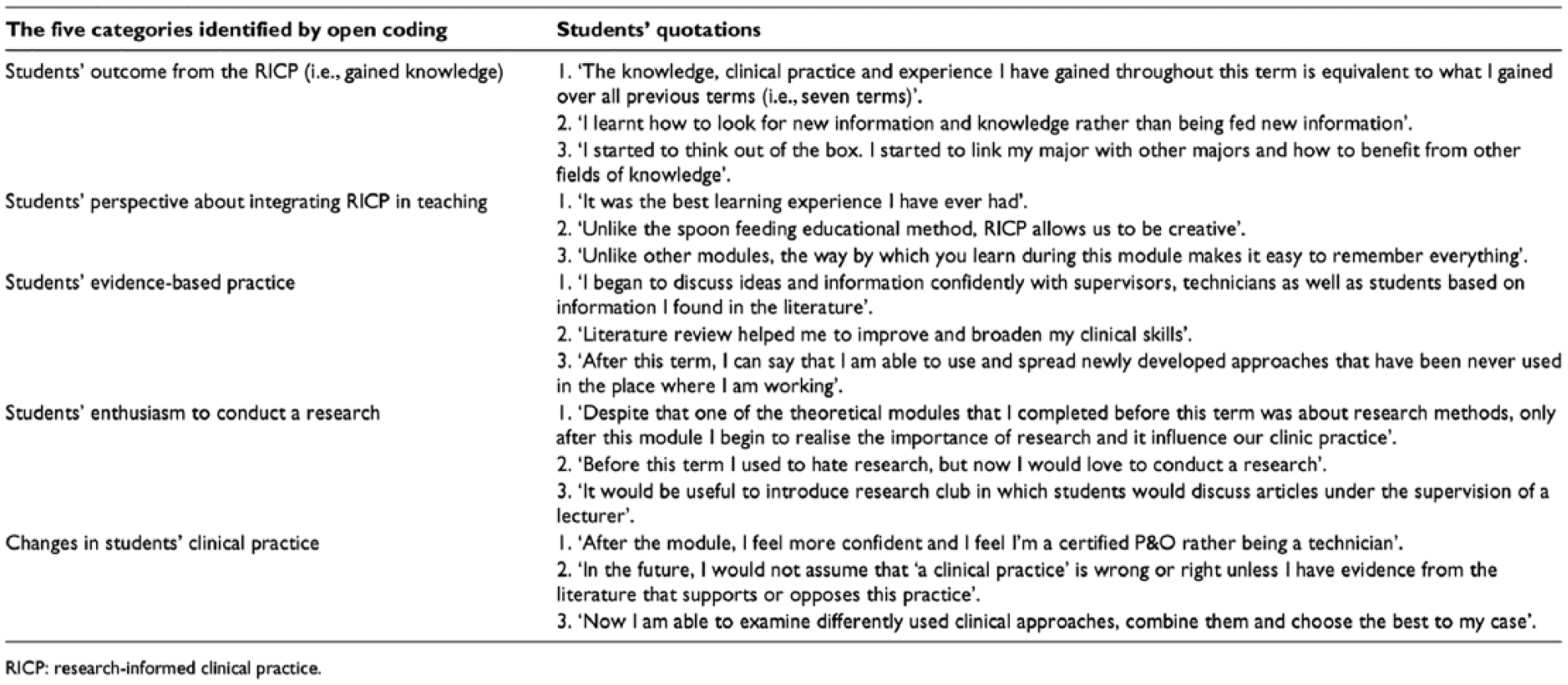
In this grounded-theory study, 12 open coding was used to generate these categories describing the student perspective of integrating research into an undergraduate prosthetic and orthotics curriculum. These categories were then used to guide further analysis of the interview data.
When preparing a qualitative submission, authors are asked to comply with qualitative reporting guidelines and checklists such as the Consolidated Criteria for Reporting Qualitative Research (COREQ) 13 or the Standards for Reporting Qualitative Research (SRQR). 14
Conclusion
We hope that high-quality, qualitative research will find a welcoming home in Prosthetics and Orthotics International given the creation of a new submission category specifically for qualitative research that allows in-text data, such as first-person quotes, to be reported as part of the word limit. In this way, the personal stories that illuminate the experience of living with disabling health conditions can help inform clinical practice and future research.
We encourage prospective authors who have queries about qualitative research articles to reach out to one of the Editors-in-Chief. We look forward to the opportunity to consider your qualitative research submissions for publication in Prosthetics and Orthotics International.
Footnotes
Author contribution
All authors contributed equally in the preparation of this manuscript.
Declaration of Conflicting Interest
The authors declare that there is no conflict of interest.
Funding
The author(s) received no financial support for the research, authorship, and/or publication of this article.
