




Abstract
Background:
Pavlik harness is the initial treatment for the infants with developmental dysplasia of the hip who have not yet begun walking.
Objectives:
The present study evaluates the variables which affect the duration of PH treatment for patients successfully treated.
Study design:
Cross-sectional study.
Methods:
Pavlik harness was employed for 140 hips of 87 patients with developmental dysplasia of the hip in our institution between 2010 and 2013. In all, 55 hips of 46 patients who were treated successfully with Pavlik harness were included in this study. According to Graf’s sonographic classification, 23 hips were Type IIC, 26 were Type IID, and 6 were Type III. The studied variables were (1) alpha angle, (2) age at the start of treatment, (3) laterality, and (4) gender. The variables were compared with the duration of Pavlik harness treatment.
Results:
A highly significant inverse correlation was observed between Pavlik harness application time and alpha angle at the start of the treatment (r = –0.050; p < 0.001). Bilateral involvement has statistically longer duration, when compared with unilateral involvement (r = 0.28; p = 0.036). No statistically significant difference was present between duration of treatment and age at the start of Pavlik harness treatment (r = –0.034; p = 0.804). There was no statistical significance between gender and duration of Pavlik harness (r = 0.201; p > 0.05).
Conclusion:
The duration of treatment was negatively correlated with the initial alpha angle. A change of 1 degree in alpha angle may alter the duration of treatment as 0.89 week calculated by the formula (Application time (Week) = 56.6 – 0.89 × alpha angle). Bilateral involvement may need longer Pavlik harness treatment.
Clinical relevance
Pavlik harnes generally is the first treatment method for the infants with DDH. This study suggest conclutions about how long time is the Pavlik harness should be kept on the infants? The main indicator is initial alfa angle which is negatively correlated with the duration of treatment.
Background
Developmental dysplasia of the hip (DDH) is the most frequent congenital disorder in the newborn, which consists of a spectrum of disorders between the developing femoral head and acetabulum including dysplasia, subluxation, and dislocation. The data regarding the reported incidence of the DDH on the basis of geographical areas varies from 1.7 per 1000 live births to 188.5 per 1000 live births.1–3
Miscellaneous screening procedures are accessible for early determination and management of DDH. Clinical screening of newborns covers medical history (family history, pregnancy) in addition to examination (Ortolani and Barlow maneuvers). More recently, the diagnosis of DDH was improved by hip sonography. Not only does hip sonography play an important role in the early diagnosis of hip dislocation, but also this screening method might serve as an early detection procedure for hip dysplasia.4–9 However, some authors advocated that hip sonography could lead to overdiagnosis and treatment.10,11
Several modalities could be employed in the management of DDH. The conservative treatment includes closed reduction and spica casting with or without traction and several splints and braces such as Frejka Pillow, Triple Diapers, Von Rosen Splint, and Pavlik harness (PH). PH, which is a functional bracing, was first used by Arnold Pavlik 12 who reported successful results in 1957. Nowadays, with reported success rate of 70%–98%, PH is regarded as the first choice of treatment for the patients in the first 6 months of infancy.13,14
In the literature, PH is preferred treatment method according to sonographic findings of patient. It was reported that PH for Graf Type III and Type IV hips was successful at an early age.4,8,10,11 To our knowledge, no certain data regarding duration of PH treatment are available in the literature. Age of the patient is regarded as the main factor determining the duration of treatment;3,4,7,10,14 however, to our knowledge, there is no study in the literature that specifically investigates the relationship between these two variables.
In this study, we aimed to evaluate the variables which affect the duration of treatment in patients who were diagnosed with DDH and treated successfully with PH.
Methods
Between 2010 and 2013, PH treatment was employed in the management of 140 hips with DDH in 87 patients. The exclusion criteria were (1) failed PH treatment and (2) alpha angle higher than 50 degrees in the initial sonogram. The term “failed PH treatment” referred that persisted types after 4 weeks’ harness treatment. Of 87 patients, 16 were excluded due to high alpha angles and 25 due to treatment failure. This study retrospectively evaluates the remaining 55 hips in 46 patients who were treated successfully with PH. According to Graf’s methods, 23 hips were Graf Type IIC, 26 were Graf Type IID, and 6 were Graf Type III (Figure 1). Data regarding four variables—(1) alpha angle, (2) age at the start of treatment, (3) laterality, and (4) gender—were collected. The average duration of PH treatment was 11.74 ± 6.17 weeks. The mean alpha angle and patient age at the beginning of the treatment were 46.2 (range = 35–49) degrees and 9.05 (range = 3–22) weeks, respectively. There was one-sided involvement in 37 patients and two-sided involvement in 9 patients. In all, 39 patients were female and 7 were male.
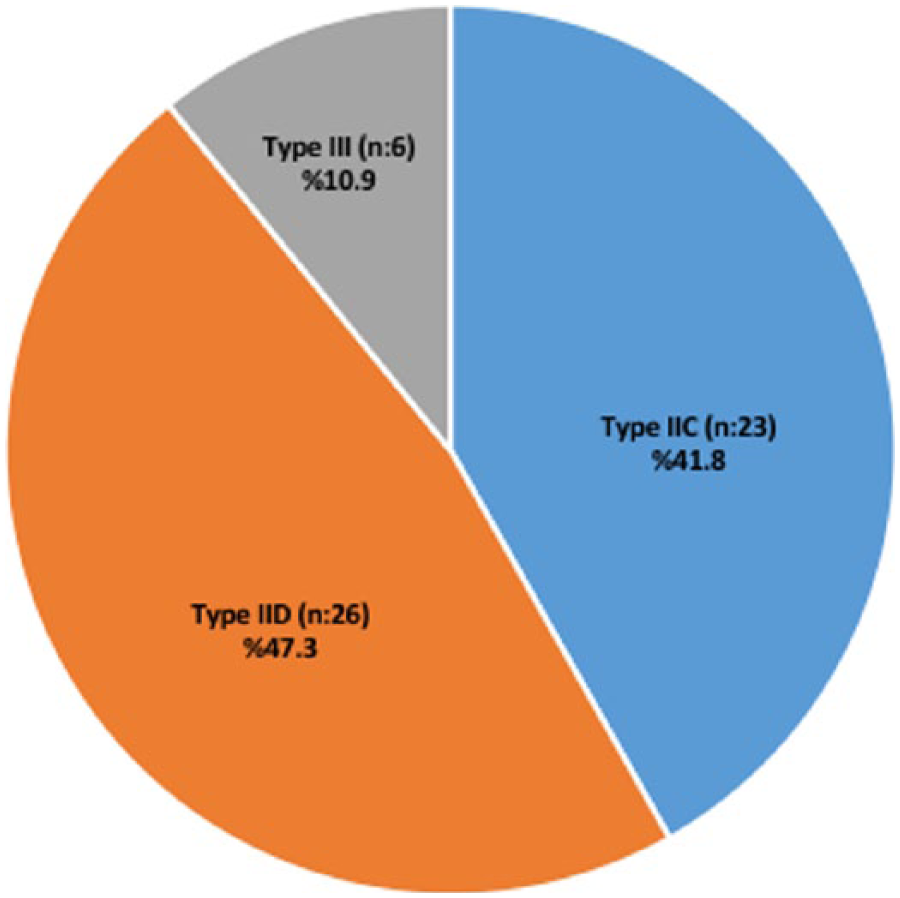
The quantile of initial sonograms, according to Graf’s classification.
Technique and follow-up
With a 7.5-MHz linear transducer (Toshiba Sonolayer SSA-270A, Japan), the infantile hip ultrasonography method of Graf was performed for children under 6 months of age, in accordance with the National Screening Program at our institution between 2010 and 2013. All hips were evaluated in standard lateral decubitus position as described by Graf. Sonograms were classified according to Graf’s classification (Figure 2).5,6
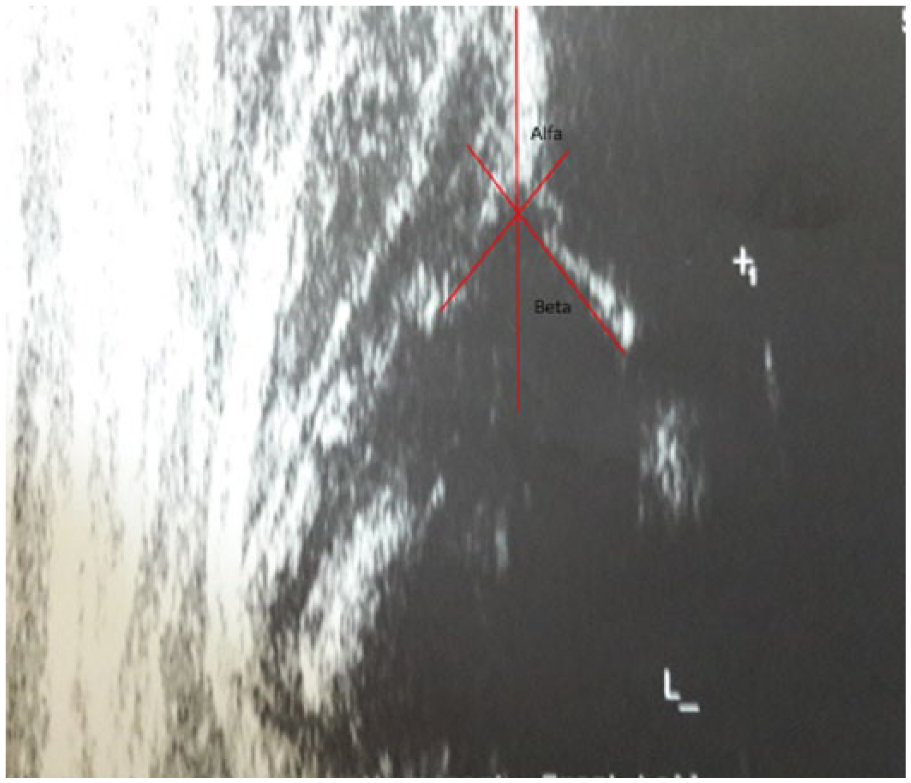
An example of the hip sonography. The sonographic view of Type IIC hip according to Graf’s classification.
Same brand was chosen for all harnesses; hips were positioned in the harness at 100 degrees of flexion and 30 degrees of abduction (Figure 3(a) and (b)). Patients were followed weekly for the first 4 weeks in order to check for compliance and complications such as femoral nerve paralysis. At the fourth follow-up, patients were assessed sonographically by the same senior orthopedic surgeon to assess the hip reduction. PH treatment was terminated if treatment failure was noted. Patients remaining on PH were called at 4-week intervals for serial sonographic alpha angle measurements. After achieving clinical stability or 50 degrees or higher values of the alpha angle, the treatment was terminated and transition was made to a night-time abduction orthosis for additional weeks or months.
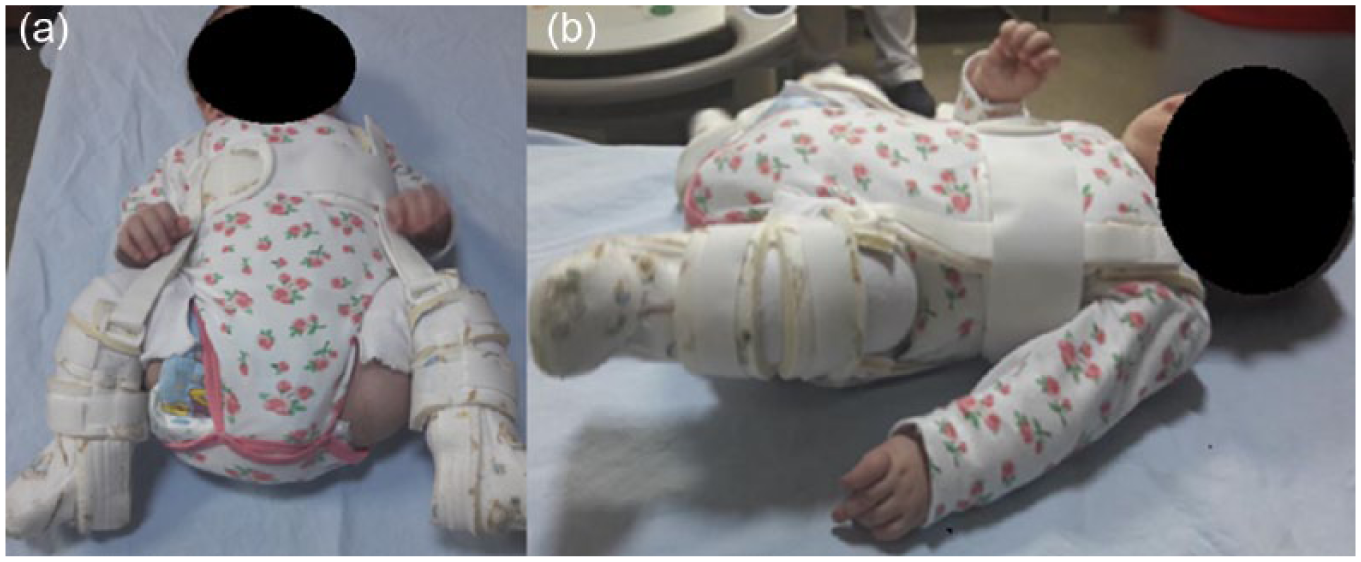
The position of the hips in the harness: (a) 100 degrees of flexion and (b) 30 degrees of abduction.
Statistical software package SPSS 20.0 (IBM Corp, 2011, Armonk, New York) was used for analysis. Descriptive statistics and Student’s t-test were used for comparison. Spearman’s correlation and linear regression analysis were used to evaluate the effect of variables on application time of PH. The timing of PH was formulated with a “y = a + bx” linear regression model. Significance thresholds were accepted as p < 0.01 and p < 0.05.
Results
There was a statistically highly significant inverse correlation between duration of PH treatment and the initial alpha angle (r = –0.050; p < 0.001). On the contrary, no statistical significant difference was found between duration of treatment and the age at the start of treatment (r = –0.034 and p = 0.804). In addition, there was no statistical significance between gender and duration of PH treatment (p = 0.201; p > 0.05). Laterality was a predictor to duration of treatment in linear regression analysis (r = 0.28, p = 0.036); bilateral involvement had statistically longer application time, when compared with unilateral involvement. The results obtained from the analysis of the variables are presented in Table 1.
The results obtained from the analysis of variables of 55 hips in 46 patients who had success with Pavlik harness.
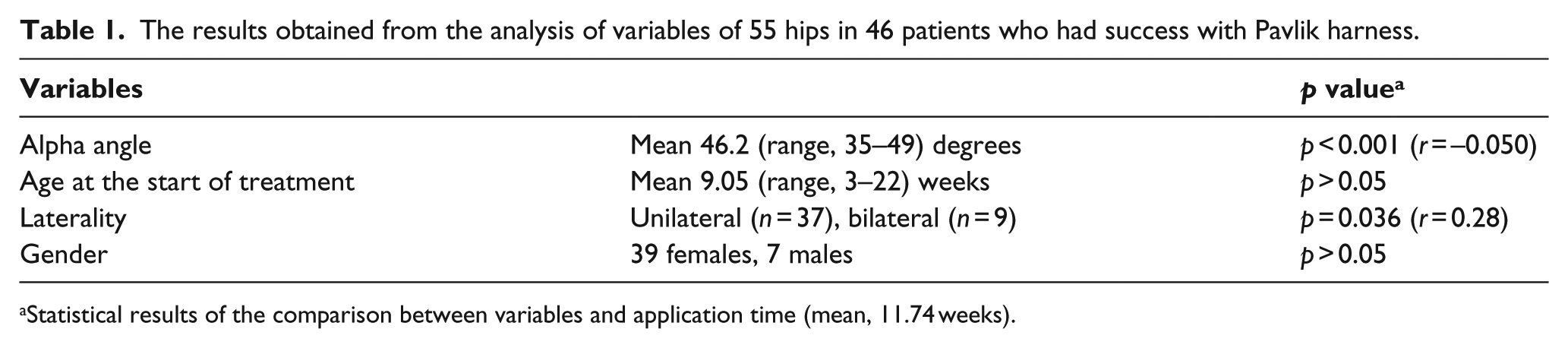
Statistical results of the comparison between variables and application time (mean, 11.74 weeks).
Discussion
PH is used widely with reported success rates between 58% and 99%. As a functional and dynamic splint, PH assists to keep hips in natural posture and to reduce the dislocated hip through gravity.4,7,11,13,15,16 Complications of PH treatment such as avascular necrosis of the femoral head and posterior wall problems of the acetabulum are reported in the literature as well.13,17 These complications might be minimized by hip sonography.4,8,10,17 A large number of clinical studies regarding factors affecting the success of PH treatment are available in the literature.4,7,10,18 Nonetheless, to our knowledge, there is no clinical study analyzing the relationship of these four factors with duration of PH treatment.
Regarding the duration of PH treatment in patients with DDH, various recommendations are available in the literature.4,7,10,18 As a general rule, a minimum of 3 months is required for patients under 3 years of age. Kokavec et al. 7 reported that the mean duration of PH treatment was 6.1 months in their patients with a success rate of 65% in dysplastic hips and a success rate of 34% in dislocated hips, respectively. Likewise, Kitoh et al. 18 found that a mean duration of PH treatment was 11.2 ± 22.3 months. Other authors proposed that the maximum treatment period for PH to be limited to 3–4 months.16,19–21 Bialik et al. 10 concluded that the mean duration of PH treatment was 11.5 ± 7.9 (range, 1–45) weeks. In their study, it was highlighted that the use of PH in patients older than 13 weeks particularly enhanced treatment period of PH. Another study by Atalar et al. 4 reported a mean treatment period of 8 (range, 5–11) weeks in patients with successful PH treatment. In this study, the mean application time for PH was consistent with the literature as 11.7 ± 6.2 weeks.
The risk factors for failure of PH treatment in DDH can be discussed in the literature, however. It remains controversial in the literature.4,22–24 On one hand, some studies found that Graf types, age at the start of treatment, and bilaterality were associated with the success rates of this treatment.4,17,24 Atalar et al. 4 emphasized that the beginning of PH treatment before 7th week of infancy is the key aspect determining factor for successful outcomes in the management of DDH. In some studies, on the other hand, these factors were not found to be correlated with failure in treating DDH with PH.22,23 In addition, some authors reported that the gender did not affect the outcome of PH treatment.4,13,22,23
This study, in contrast to previous studies in the literature, focused on a different aspect regarding the PH treatment. We specifically reviewed the variables which affect the duration of PH treatment. Therefore, only patients treated successfully by PH were included in the study, and alpha angle and bilaterality were found to be inversely correlated with application time of PH, and age and gender were found not to be correlated.
Association between the initial alpha angle and application time of PH was observed with a statistically highly significant inverse correlation (33.6%), using the linear regression analysis. When considering this statistical method, we considered that it may be possible to predict the application time of PH treatment using the alpha angle at the start of treatment in patients with Type IIC, Type IID, or Type III dysplastic hip. Estimated duration of PH treatment may be calculated with the equation of this linear regression analysis: the duration of treatment (week) = 56.6 – 0.89 × alpha angle. Each one-degree increase in alpha angle decreases the duration of treatment by 0.89 weeks. The most important limitation of this retrospective study is the relatively small number of patients.
Conclusion
Duration of PH treatment is not correlated with the age and gender of the patient, but is correlated with the initial alpha angle and bilaterality. The hip sonography provides a successful evaluation to treating physician in the management of DDH. The above-mentioned equation may aid to estimate the main application time for PH.
Footnotes
Acknowledgements
The authors would like to thank Mr. David Chapman from publication support office in Istanbul University, Istanbul Faculty of Medicine for English editing.
Author contribution
All authors contributed equally in the preparation of this manuscript.
Declaration of conflicting interests
The author(s) declared no potential conflicts of interest with respect to the research, authorship, and/or publication of this article.
Funding
The author(s) received no financial support for the research, authorship, and/or publication of this article.