




Abstract
Background:
Contact dermatitis is a frequent inflammatory skin disease. A suspected diagnosis is based on clinical symptoms, a plausible contact to allergens and a suitable history of dermatitis. Therefore, careful diagnosis by patch testing is of great importance because the patch testing is important to find out which allergen/material causes the complaints. Metallic allergens such as cobalt are among the most common causes of allergic contact dermatitis, but frequencies of contact dermatitis to these allergens may vary in different skin areas. Here, we report an unusual case of cobalt allergy on the skin contact with the prosthetic leg of a 30-year-old female patient.
Case description and methods:
The patient developed maculopapular and vesicular lesions on her contact region of residual limb to prosthetic leg.
Findings and outcome:
She underwent standard patch testing, which resulted in a strong positive reaction to cobalt chloride.
Conclusion:
This case report may serve to remind doctors to be aware of potential allergic reactions to prostheses and to enable them to recognize a metal allergy if it appears. Prosthetists should also be reminded of potential allergic reactions.
Clinical relevance
Cobalt can be used as an accelerator in making a prosthetic socket. Several cases have been reported concerning allergies to components of the prosthetic socket. This is the first report of sensitization to cobalt which is used in making a prosthetic leg.
Background
Contact dermatitis is an eczematous skin reaction caused by direct and usually repeated exposure to harmful objects or chemicals. In most of the cases, medical history and physical examination are usually enough for the diagnosis because the relationship between suspected agent and location of lesions is very typical. 1 In almost all cases, a patch testing is performed to identify the specific contact sensitizer. The determination of the correct agent(s) is important for further allergen elimination and to prevent possible new lesions caused by other objects which contain the same agent(s). However, only performing a patch test will not be sufficient.
The results from the patch test must be interpreted properly, so the objects that may contain the identified allergen can be determined, and patients should be advised to avoid the allergen(s). 2
In this case report, we are presenting a patient with a cobalt allergy which was identified by the patch test. The purpose of this report is to investigate an unusual feature of a relation between allergen (cobalt) which causes sensitization and an object (prosthetic leg) which includes this allergen. In most of the objects, the sensitizer allergen can easily be determined, but in this case, further investigation was required to prove the relation between the object and cobalt as a sensitizer agent.
Case description and methods
A 30-year-old female patient was admitted to an allergy out-patient clinic with itchy wheals on the residual limb of the left amputated leg. The patient’s left leg was amputated at transfemoral level with the diagnosis of osteosarcoma before 13 years of age. After the amputation, the patient started to use the prosthesis without any complaint on the residual limb region. She gained about 15 kg weight during pregnancy (29 years old). After pregnancy, it was necessary to provide her a new prosthesis, and she started to use a new shaft prosthesis with suction suspension system without liner.
Approximately 1 week later, vesicular lesions appeared in the contact region of residual limb and new prosthesis. On physical examination, maculopapular and vesicular lesions were detected on the skin of the residual limb which was in contact with the socket of the prosthesis (Figure 1). The diagnosis of the patient was thought to be contact dermatitis on the basis of medical history and present symptoms.
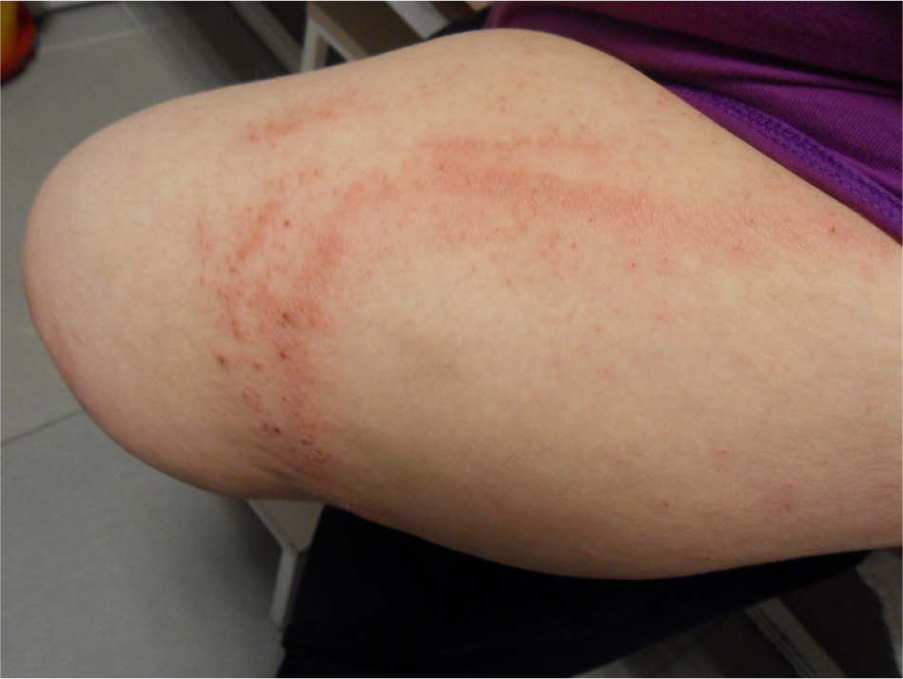
Maculopapular and vesicular lesions on the skin of stump.
Findings and outcomes
A patch test was performed according to the European standard series using the commercial thin-layer rapid use epicutaneous (TRUE) test. 2 The patient was informed about the test, evaluation at the end of the 72 h, and probability of earlier positive reactions. The patient was admitted with the complaint of severe itching one day after application of the test. The patch was removed and there was a extreme positive reaction with vesicles and bullous reaction (+++) to cobalt chloride (Figure 2). This antigen was removed from the test. The patch test was closed again in order to guide markers as the other allergens would come into first place and it was reevaluated at the end of 72 h. Usually, most of the patch test reactions occur at day 3 (72 h) or 4 (96 h). 3 Therefore, most centers interpret patch test results at 48 h (day 2) and at 96 h (day 4) after placement. We also evaluated the test again after 72 h. The patient also had a mild positive reaction with erythema, papules, and infiltration (+) to nickel. All other antigens were negative. Reactions were scored according to the international contact dermatitis research group (ICDRG) criteria. 4 The patient was treated with a topical corticosteroid (mometasone furoate cream 0.1%). The lesions regressed during the first week and completely disappeared in the second week of the treatment.
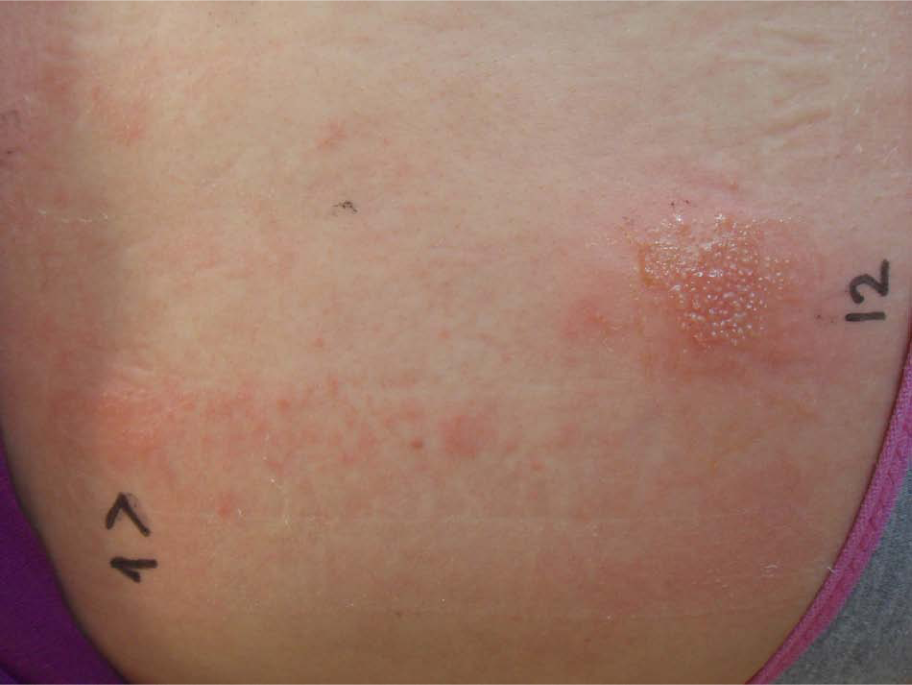
Positive patch test reactions for cobalt on the skin of stump.
Discussion
The prevalence of metal allergy is high in the general population, and it is estimated that up to 17% of women and 3% of men are allergic to nickel and that 1%–3% are allergic to cobalt and chromium. 5
Cobalt is a metal found naturally in soil, dust, and seawater. It is usually found in association with nickel. Cobalt and its salts have many uses. For instance, it is found in metal-plated objects, paints, cement, and vitamin B12. Several compounds of cobalt are very substantial in industry as they act as catalysts, speeding up important chemical reactions. 6 Cobalt is an essential catalyst. It is used for hardening property in dentistry, cardiology, gynecology, and orthopedic surgery such as prosthetic hips and knees. 6
Metals, especially cobalt and nickel, which are in contact with body fluids, may corrode and release metal ions that bind to proteins and activate T cells. 7 Hypersensitivity to the metallic implants remains relatively unpredictable and poorly understood. 8 Allergic reactions can be classified into immediate, which happen within minutes and are based on a humoral response (Types I–III), or delayed, which happen within hours or days and are based on a cell-mediated response (Type IV). The cell-mediated response is mediated by the T lymphocytes and especially by the CD4-helper cells. 8 Type IV delayed-type hypersensitivity (DTH) reaction is most common to nickel, chrome, and cobalt.6–8 The cobalt is considered to be candidate antigens/allergens for eliciting metal hypersensitivity responses, and this is usually a DTH reaction.7,9
When skin lesions occur on a residual limb after the use of a new prosthesis or persist after therapy, allergic contact dermatitis should be considered. Friction, sustained pressure, and humidity of the amputation residual limb may not only act as cofactors to increase the chance of allergic contact dermatitis but may also be primary factors in causing irritant contact dermatitis. When an allergic reaction occurs, it is important to rule out other causes of dermatitis and to determine whether the reaction is limited to the residual limb or to the part of the residual limb that is in contact with the prosthesis (as in, for example, the valve of a suction socket prosthesis). 10 Several cases have been reported concerning allergies to components of the prosthetic socket, such as resins, glue, rubber components, and leather preservatives.9,10 Dudek et al. 11 found the incidence of dermatologic conditions associated with the use of a lower extremity prosthetic to be 40.7%. In this study, skin irritations (17.6%), inclusion cyst (15.0%), callus (11.4%), verrucous hyperplasia (8.9%), blister (6.6%), fungal infection (4.9%), and cellulitis (2.1%) were detected.
Polyester resins are commonly used in many applications. Cobalt can be used as an accelerator in polyester resins. Cobalt as a catalyst enables the curing of unsaturated polyester resins at room temperature. The case of allergy to cobalt to polyester resins are more often related to ancillary chemicals in these resins, such as accelerators or catalysts, and cross-linking agents, rather than the polyester resins themselves, which rarely sensitize. 12
Conclusion
This is the first report of sensitization to cobalt which is used as a catalyst in prosthetic leg. Therefore, in addition to identifying cobalt as the causative allergen in this patient, we think this case will contribute to medical literature. When an allergen is identified, patients should be adequately informed about prevention. The patient was advised not to use the prosthesis and contact the prosthetics manufacturer company for cobalt-free prosthesis.
Footnotes
Author contribution
All authors contributed equally in the preparation of this manuscript.
Conflict of interest
The authors declare no conflicts of interest. The authors alone are responsible for the content and writing of this article.
Funding
This research received no specific grant from any funding agency in the public, commercial, or not-for-profit sectors.