




Abstract
This paper develops a framework for determining the linear elastic properties of non-periodic lattice structures. An element-based material assignment methodology is implemented that facilitates the generation and analyses of arbitrary patterns on a structured mesh. An adapted numerical homogenization strategy features the inclusion of a homogenized region in the neighbourhood of the domain boundary that validates the implementation of periodic boundary conditions for an arbitrary finite patch of a periodic or non-periodic lattice structure. To demonstrate the method, the linear elastic properties of an aperiodic lattice pattern based on the Penrose (P3) pattern is evaluated. Such a structure exhibits order without translational symmetry and consequently lacks a repeating unit cell. The isotropic performance of the aperiodic lattice structure is investigated and compared to that of the well-known square periodic lattice. The framework opens the door to the investigation and analyses of other novel cellular structures which are not based on a repeating unit cell. Additive manufacturing facilitates the physical realization of such lattice structures, presenting them as viable alternatives to conventional periodic structures in the aerospace and bio-engineering industries.
Introduction
Technological advances in additive manufacturing (3D printing) have relaxed the manufacturing constraints on complex geometries, motivating exploration of the space of material design for next-generation lightweight structures. 1 In response, material scientists and engineers are investigating novel ‘designed-for-purpose’ materials to broaden the scope of achievable material performance.2–4 For example, materials are being designed to replicate bone structures that exhibit remarkable robustness to arbitrary load paths, with capability to efficiently sustain multiple loading modes. 5 Such materials derive their mechanical properties from their meso-architectures as well as the chemical composition of the base material they are made from,6,7 and one area of research is in the use of cellular lattice structures.7–9 For example, cellular lattices have been integrated into the design of bespoke orthopaedic implants.10,11
Cellular structures are typically defined according to periodic repetition of unit cells. 9 The structural behaviour of periodic lattice structures is well understood,12,13 and by investigating such structures over multiple scales, homogenization techniques have been used to determine their effective (homogenized) mechanical properties.14,15 These effective properties determine the macroscopic behaviour of the periodic lattice, 16 and explicit analytical expressions have been derived for common periodic lattices, such as the square and hexagonal lattices, which describe their elastic behaviour when used as thin-walled honeycomb structures.12,17 However, a fundamental limitation associated with the use of periodic lattice structures is the requirement for over-designing to accommodate the existence of undesirable mechanical anisotropy.
In natural materials, such as bone, there exist pseudo-random structures which cannot be represented in repeatable fashion by periodic cellular structures. 18 To avoid the limitations of periodicity in designed structures, and taking advantage of the capabilities of additive manufacturing, alternative non-periodic cellular geometries have been explored, such as conformal lattices where meso-architectures of the lattice are locally orientated according to principal stress directions,19,20 or other geometries resulting from structural topological optimization.21,22 But simulating and analyzing the resultant behaviour of these geometries is difficult due to their underlying non-periodic geometry. The in-plane mechanical properties of cellular structures are often determined by the process of homogenization which involves determining effective elastic properties of a homogeneous equivalent phase. Most approaches to executing homogenization can be classified as analytical23,24 numerical15,16 or experimental.25,26 Many numerical strategies use asymptotic expansion homogenization to determine effective mechanical properties such as the effective stiffness tensor, ultimate strength or yield strength. For periodic structures, this involves defining a representative volume element (often a repeating unit cell) and applying periodic boundary constraints on opposite cell boundaries on a structured mesh boundary.27,28 Strain deformation analyses are then executed to yield the stress distributions from which effective properties are determined. 29 Even where the structures are non-periodic or are composites containing randomized inclusions of particles, efficient strategies have been developed to determine their properties by imposing periodicity in the neighbourhood of the boundaries representative volume element.30–32 Despite the reliability associated with the numerical homogenization technique described, the efficiency of the process relies significantly on the existence of a repeating unit cell which lies at the heart of lattice periodicity. Non-periodic lattice structures do not feature a repeating unit cell, and as a result a direct application of these techniques is inappropriate.
This paper presents a general method for simulating and analysing the linear elastic properties of non-periodic two-dimensional lattice structures. It builds on work by Imediegwu et al.33,34 where a numerical framework was presented in which lattice unit cells are defined on a structured mesh by assigning material properties spatially within the domain of a discretized unit cell according to a unique vector of radii parameters. The approach boycotted the challenges of manual geometry meshing for complex lattice structures and presented a means to evaluate parametric sweeps of geometric variables with automated mesh generation. We extend this methodology for non-periodic lattice structures by implementing an element-based material assignment on an arbitrarily chosen patch of a non-periodic pattern. The approach satisfies the requirement for identical mesh nodes on opposite boundaries of the numerical domain for the correct implementation of periodic boundary conditions. To satisfy the requirement for geometric periodicity in the neighbourhood of the boundary of the numerical domain, a homogenized region is introduced around the patch of interest. 35 Asymptotic expansion homogenization is iteratively applied to determine effective properties of the extended patch, with property reassignment to the homogenized region, until convergence of the mechanical properties are attained.
As a demonstration of the method, an analysis of aperiodically-ordered lattice structures is presented. Aperiodic crystallographic structures are ordered but not symmetric under any translation.36,37 They form a relatively new field of inquiry, modelling the structure of quasicrystals, which were first discovered in the 1980s.38,39 As a consequence, the concept of aperiodicity is often taken congruous to the idea of quasi-periodicity.40,41 Due to their unusual structure, metallic quasicrystals show remarkable micromechanics, more akin to ceramics than metals and they can be considerably more isotropic than periodic crystals – giving nearly uniform mechanical properties in all directions. 42 As such, mimicking the form of quasicrystals at the mesoscopic scale offers an interesting possibility for cellular structures, and their linear elastic properties are worthy of investigation, but difficult to simulate and analyze using methods that take advantage of periodically repeating geometry. Randomized techniques for stochastic metamaterials are also unsuitable since aperiodic tessellations possess long-range-order despite lacking local tessellation rules. 36 Recent investigations of mechanical properties of quasi-periodic metamaterials demonstrate that quasi-periodic structures offer intriguing possibilities for mechanical applications. 43 Beli et al. 40 demonstrated that quasicrystals with higher order symmetries allow for high equivalent stiffness characteristics. They also show that these intriguing aperiodic structures exhibit more uniform strain energy distributions in comparison to other periodic configurations. Somera et al. 41 demonstrated that the elementrary pattern shape plays a key role to the overall mechanical behaviour of these aperiodic lattices. The mechanical properties of an aperiodically-ordered lattice structure was recently investigated based on a lattice spring model. 5 However, we deem the patch for the aperiodic lattice structure simulated by Kim et al. 5 as non-representative - sufficient scale separation between the size of the cells and the computational domain is a strict requirement for numerical homogenization. To ensure sufficient cells of the aperiodic lattice are captured within the patch domain of our work, we randomly vary the centre of the numerical domain relative to the centre of the aperiodic pattern to generate a stochastic sampling of material properties for a range of pattern resolutions. We ensure that scale separation is sufficiently large to enforce invariance in mechanical properties for the resolution of choice through mesh and pattern resolution sensitivity studies. The derived framework supports the determination of directional Young’s modulus via rotational analyses, providing insight into direction-dependent and pattern resolution-dependent mechanical behaviour of a lattice structure based on the Penrose (P3) tiling. The result is the development of a robust numerical toolkit for generating and investigating aperiodically-ordered lattice structures. The family of aperiodic lattice structures are yet to be characterized and there are potentially an infinite number of aperiodic tilings. As a consequence, it is essential that the technique introduced in this work is rapid – suited to a wide range of aperiodic lattice geometries at arbitrary orientations. The framework is also applicable to periodic lattice structures, offering a means to validate its implementation against classical unit cell homogenization.
The next section introduces an aperiodic pattern and its generation. Details concerning the numerical strategies implemented follow leading up to the validation of the methodology. The section culminates in computational implementation of the method. Section 3 shows the performance of the exemplar lattice structure against Hashin-Shtrikman bounds. It also shows rotational analyses results in comparison to the well-known square lattice structure. Finally, Section 4 provides a summary of the work presented and presents a hint of future research directions.
Methods
The proposed framework is best introduced in the context of an example. For this purpose, we focus on non-periodic lattice structures based on the P3 aperiodic pattern, first introduced by Penrose. 44 The next sections present the pattern along with methods for generating lattice structures based on the pattern. We then introduce the framework for computationally determining the mechanical properties of these aperiodic lattices and validate the framework via consideration of the well-understood square-based lattice structure.
The Penrose (P3) pattern
The P3 pattern is an example of an aperiodic tiling. An aperiodic tiling is defined as one built up of cells (prototiles) in an ordered manner but without periodicity. Aperiodic order is an emerging mathematical field of inquiry that governs the crystalline structure of quasi-crystals. As a consequence, aperiodic structures are often associated with the term ‘quasi-periodicity’.41,43 The P3 pattern is composed of two rhombi prototiles, with acute angles
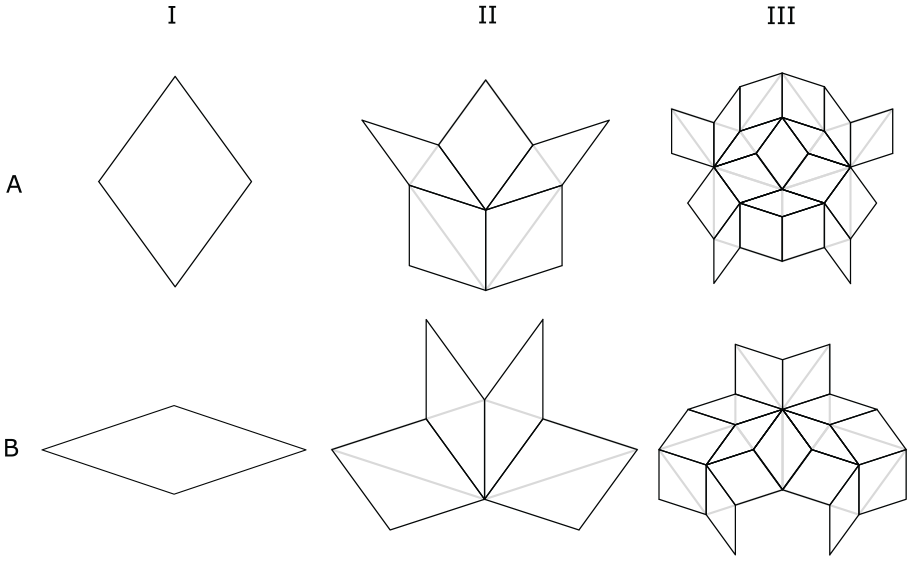
Penrose-P3 deflation.
Regarding the P3 patterns of this work, pattern generation commences with a prime rhombus prototile of type A, spanning a ‘large extent’ of the
Pattern generation
This section presents the methodology for the pattern generator algorithm. The algorithm has also been generalized to the creation of periodic patterns used for comparison. Consider a square patch of side,

The algorithm assigns the prime prototile to a repository of created prototiles. For ease of replication and given

The scaling parameter,

where
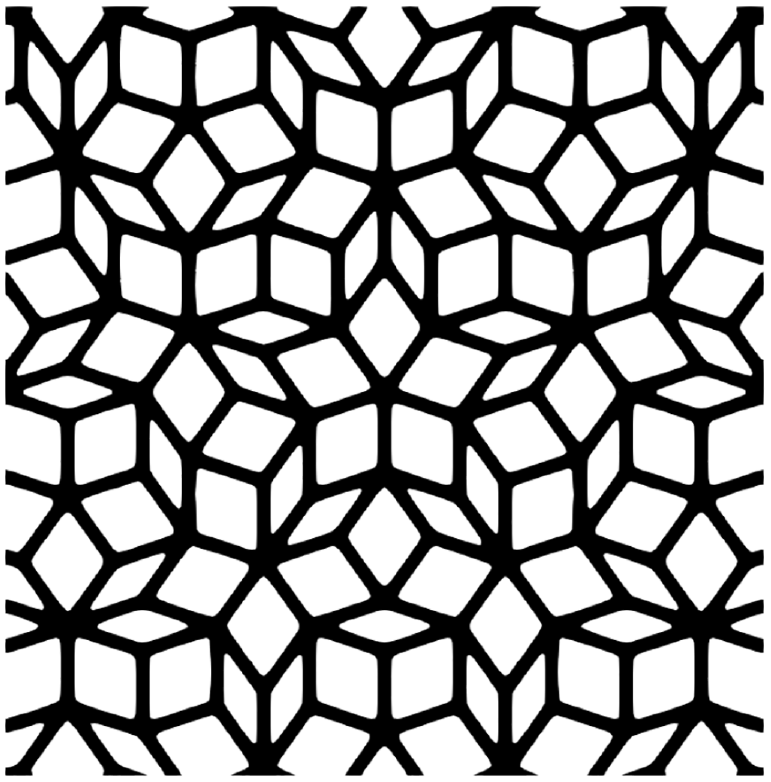
Arbitrary patch of a Penrose-P3 pattern, clipped by a square boundary.
Element-based material assignment
To generate the corresponding P3 lattice structure for onward finite element analyses, the domain enclosed by the aperiodic patch is discretized into a structured mesh and an element-based material assignment ensues. This methodology is motivated by the following finite element-based considerations:
A geometry-based representation requires a physical boundary for the application of boundary conditions and/or forces for the finite element analyses, significantly altering the effective mechanical properties evaluated.
The element-based approach affords better control of mesh discretization which facilitates the application of periodic boundary conditions.
The element-based approach facilitates automatic mesh generation for arbitrary lattice patterns of this work, presenting a technique to rapidly simulate the geometry and mechanical properties of a large family of novel aperiodic structures at arbitrary orientations. It is worthy of note to emphasize that the material assignment methodology has its limitations, particularly for low-density lattices. Mesh resolution must be increased with decreasing minimum thickness to sustain the reliability of the strategy. In this work, mesh discretization is a function of the minimum thickness such that at least 6 elements always lie across the minimum thickness for any given pattern.
The details of the element-based material assignment methodology is given as follows:
Consider the discretized section of the patch shown in Figure 3(a) with enlarged nodes for emphasis. For illustrative purposes, only a single cell is shown. The generated mesh is a structured triangular mesh. A structured mesh facilitates the implementation of periodic boundary conditions in the neighbourhood of the patch boundaries. Generated by the pattern generator of Section 2.2, green points in Figure 3(a) denote prototile vertex points of an illustrative type I rhombus prototile, with its sides shown in red dashed lines. Each mesh node must be mapped to a binary space based on its coordinate location relative to the line segments joining any pair of prototile vertex points. For each line segment, the black nodes (in the viscinity of that line segment) satisfy the following two conditions:
They lie within a distance
The orthogonal projection of their coordinate positions on the line segment belongs to the set [0,1].
Mathematically, the coordinate positioning of the black nodes are such that

and

where

and

For any line segment, the line end vertex points have coordinates

where

where
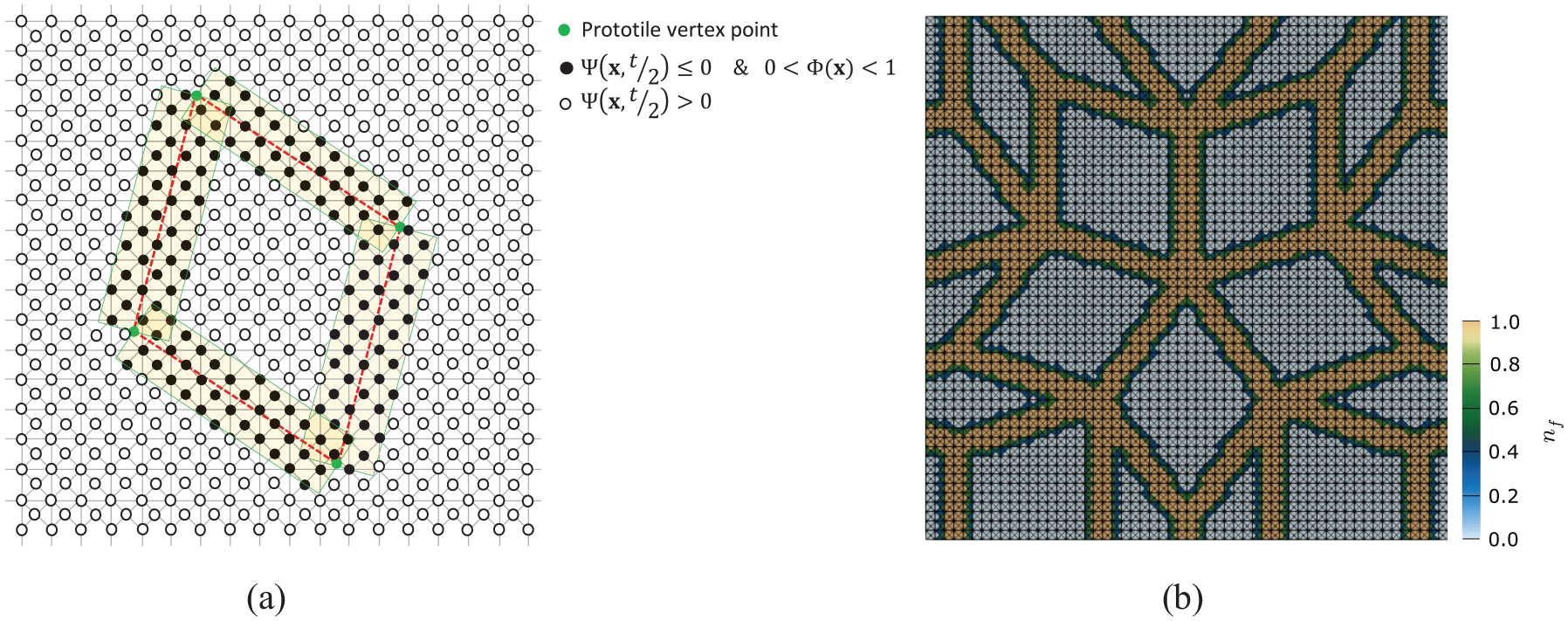
Illustration of element-based material assignment for aperiodic lattice structure generation: (a) node classification and (b) element classification based on node fraction,
Numerical analyses assumptions
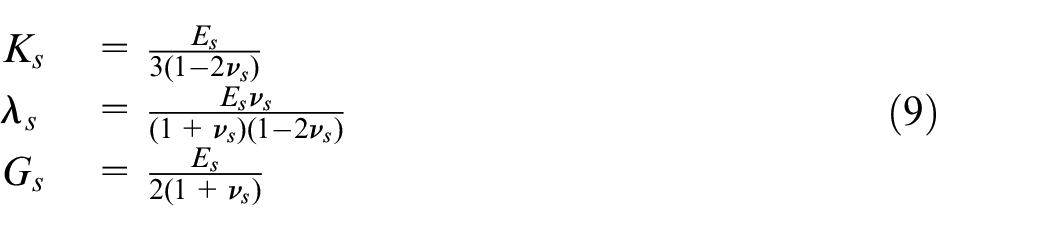
The description of the numerical analyses of the framework commences with a note on the background assumptions governing its implementation. Considerations have been limited to two-dimensional linear elastic theory so that the general relationship between the Cauchy stress tensor,

where
respectively, where
The relationship between strain and displacement,

Equations (8) to (10) define the linear elastic isotropic constitutive equations governing our problem formulations. Static equilibrium mechanics is also assumed so that

where
Mesh convergence studies
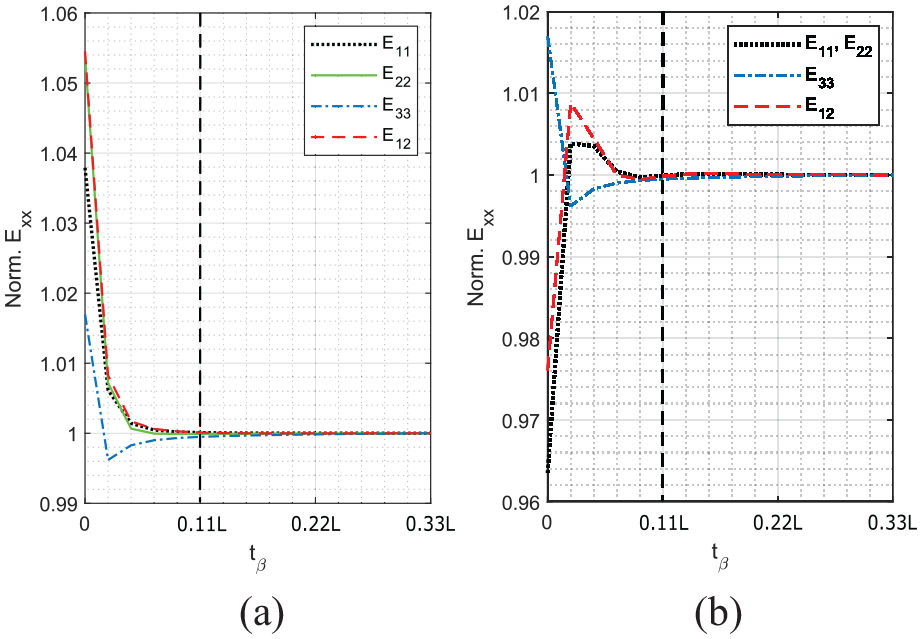
Mesh studies are critical to the successful implementation of the method presented in this work. A course mesh will present challenges with effective representation of the pattern and will increase the region of intermediate densities between the material and void regions. However, high mesh resolution, though giving converged mechanical properties, increases computational cost exponentially. An efficient meshing strategy that supports accurate numerical simulations but minimized computational cost is critical. Mesh convergence studies of this work involved discretizing the SRVE domain for a fixed P3 and SQR lattice patterns over increasing number of elements along each dimension. The number of elements were incremented from 100 to 800 elements in steps of 20 elements. Figure 4 shows the convergence plots for the components of the elasticity matrices of the square and P3 lattices of this work. All numerical analyses have been executed at 600 elements on each dimension to ensure convergence of the mechanical properties.
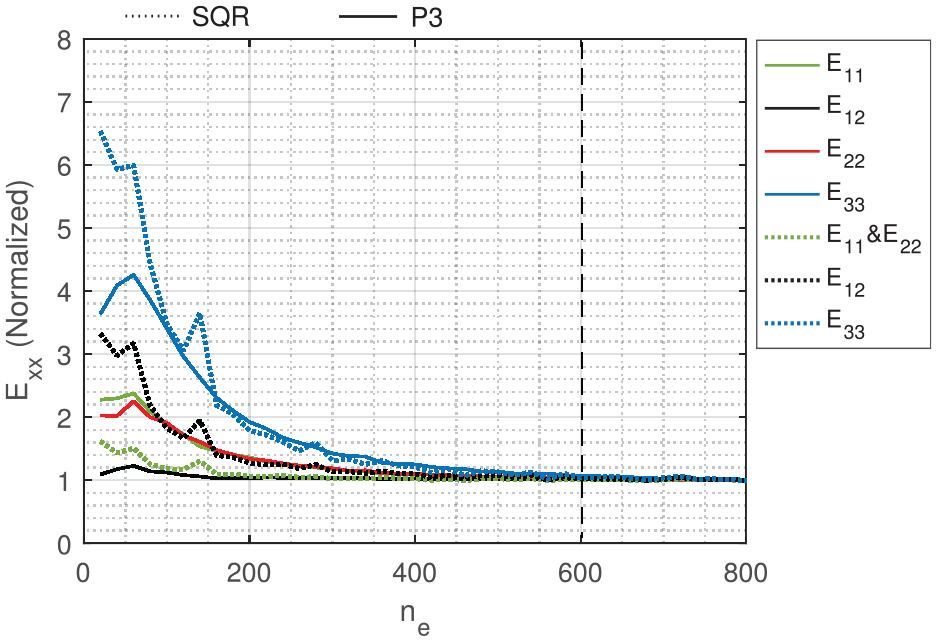
Mesh convergence, normalized elasticity components,
Homogenization with boundary phase inclusion
The effective mechanical properties of aperiodic structures can be determined by an adaptation to asymptotic expansion homogenization. Aperiodic lattice structures are not comprised of a repeating unit cell and hence it appears counter-intuitive to suggest that their mechanical properties can be determined by a similar procedure. In this work, asymptotic expansion homogenization is implemented to derive properties of aperiodic structures. This is supported by a theoretically-consistent adaptation that permits the use of periodic boundary conditions. The theory of homogenization is well documented in literature47,48 and will not be reintroduced in this work. However, the adaptation of the homogenization technique as applied to aperiodic structures is presented as follows:
Consider the aperiodic lattice structure generated by the element-based material assignment of Section 2.3. For ease of reference, the patch, which is a statistical representative volume element (SRVE), is referred to as the
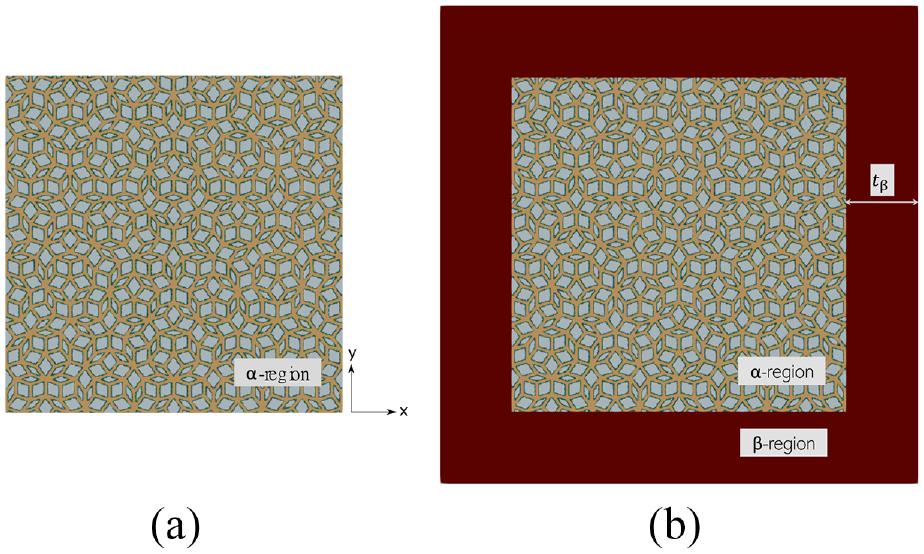
Simulation patches for aperiodic lattice structure: (a)
Next, a second region is introduced that bounds the
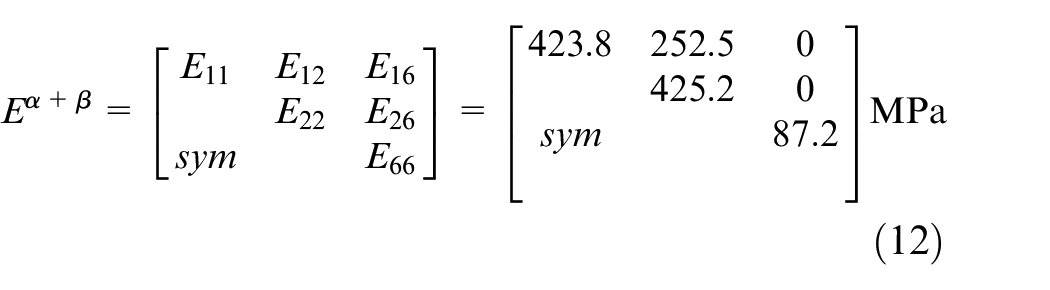
for
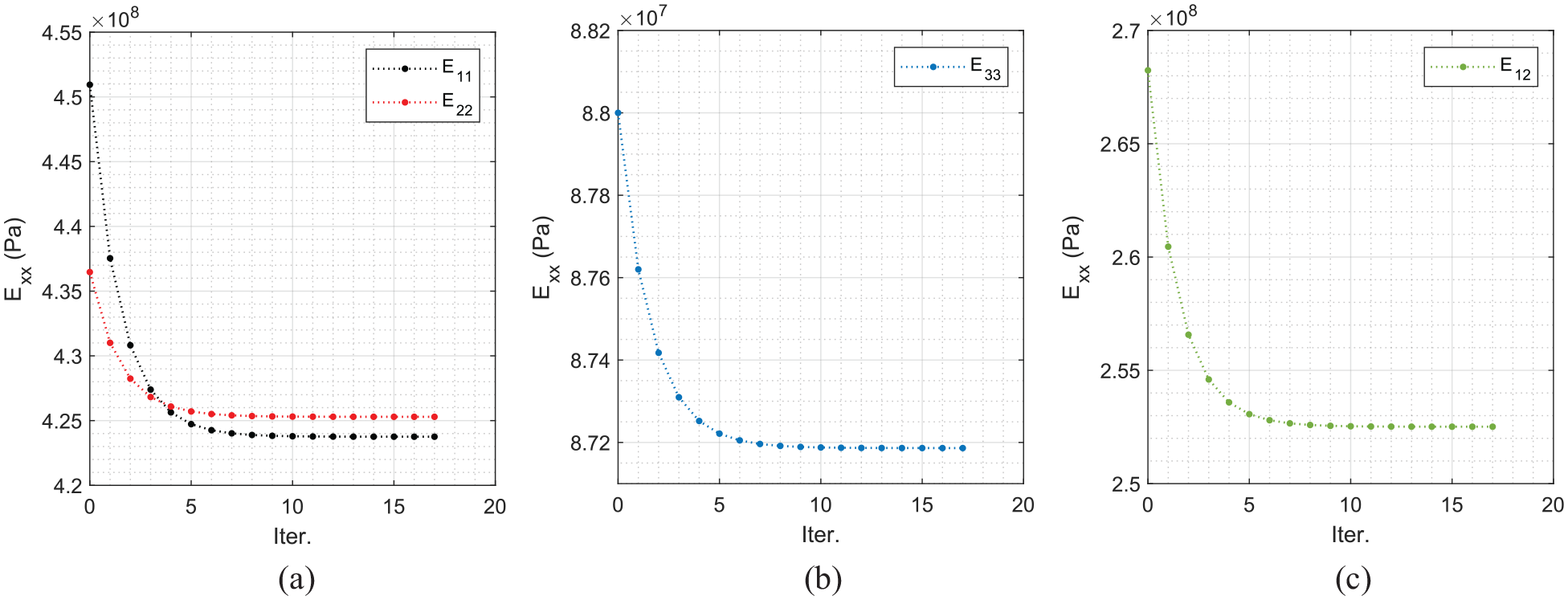
Elasticity matrix convergence plots: (a)
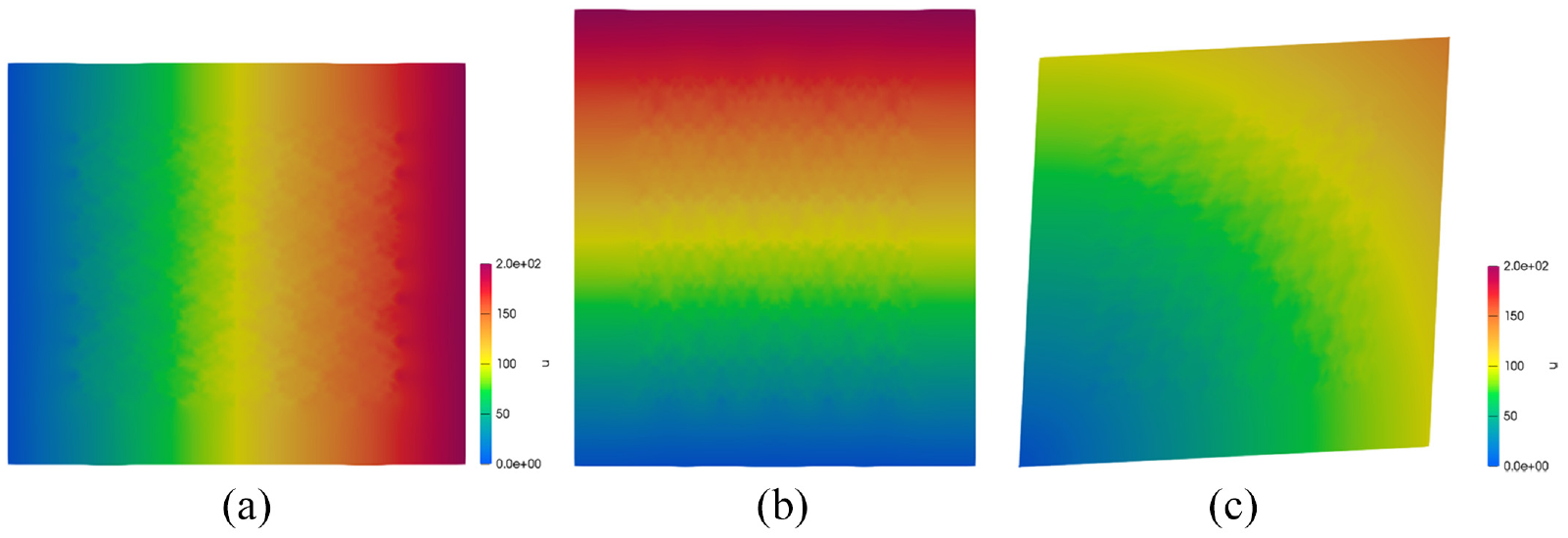
Displacement magnitude,
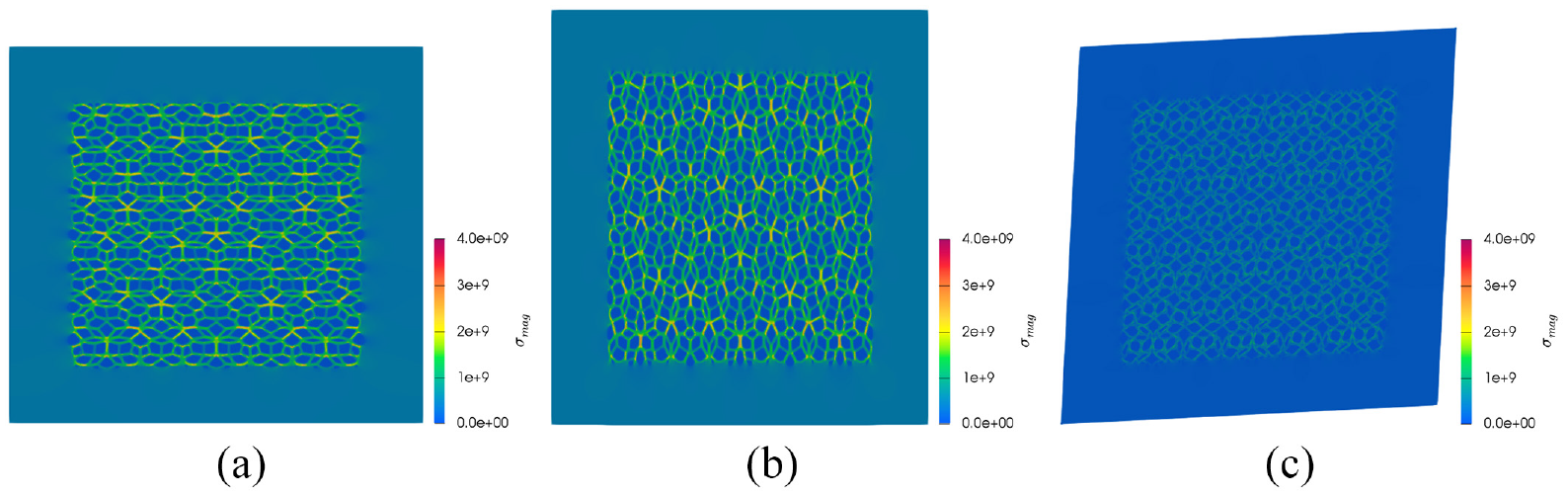
Stress magnitude,
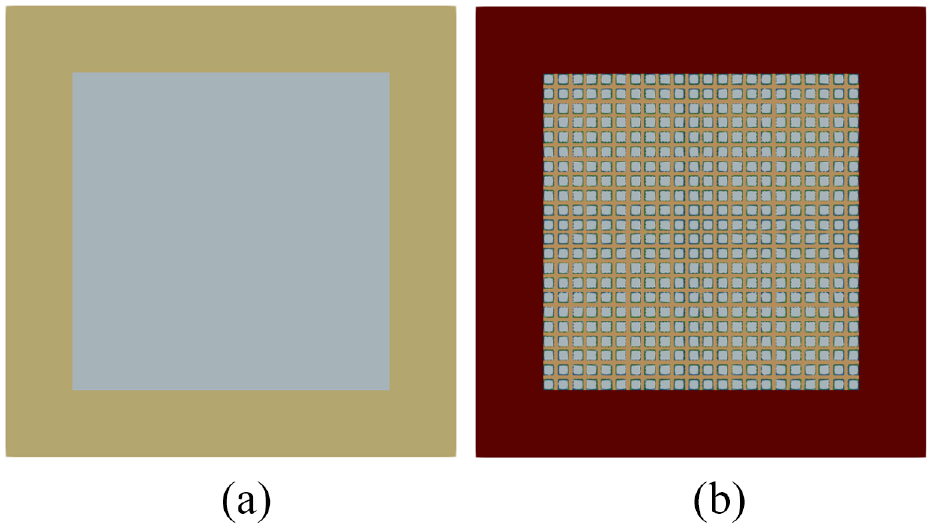
Square periodic structure for
Validation
To validate the framework implemented in this work, the mechanical properties of an arbitrary SRVE of a known periodic structure is determined. The results obtained are compared with the classical homogenization technique on a representative unit cell of the same square periodic structure. Material properties as documented by Gibson and Ashby
12
also serve as a benchmark as applicable to thin-walled honeycombs. Figure 10 shows good correlation of the classical homogenization technique with the representative volume element (RVE) and the adapted homogenization technique on the extended domain (PATCH) for the relevant components of the elasticity matrix and for
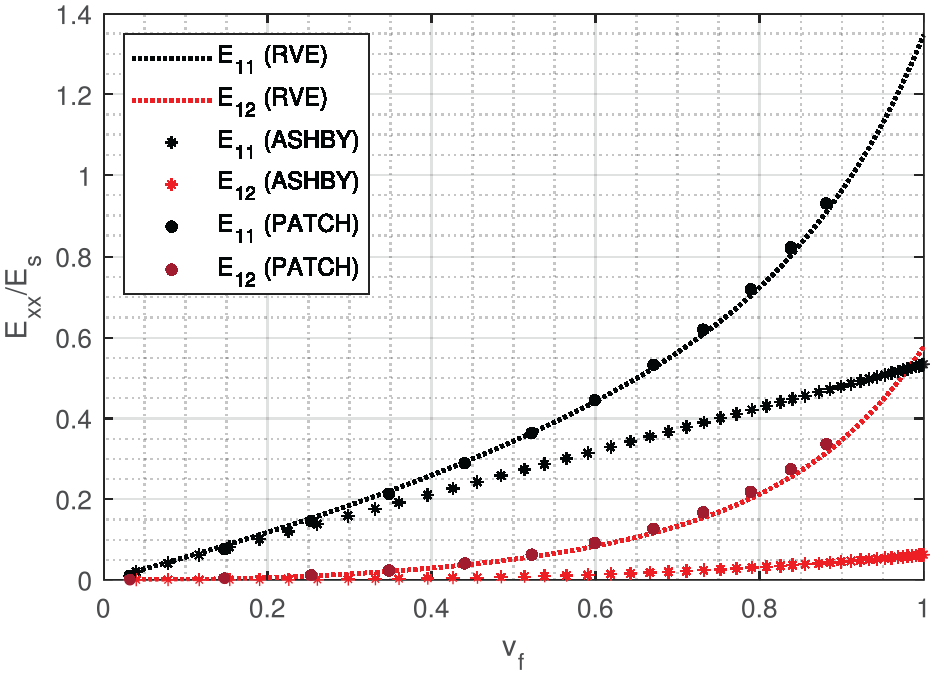
Validation of the adapted AEH technique.
Minimum
-region thickness,
The homogenized phase is essential to the methodology because it permits the use of periodic boundary conditions in the neighbourhood of the boundaries of the extended domain. However, its inclusion enlarges the computational domain. Too thin, and the
Effect of variations in finite SRVE centre and pattern resolution
To investigate the sensitivity of evaluated mechanical properties to pattern resolution, we execute a random sampling of the SRVE centre relative to the prime prototile centre point. For each pattern resolution as shown in Figure 12(a), the Young’s modulus in the x-direction was evaluated for 1000 randomly positioned SRVEs. Each boxplots depicts the variation in property evaluated. The plots present conventional statistical information associated to box plotting and the three pattern resolutions are shown in Figure 12(c). It can be observed that a resolution of
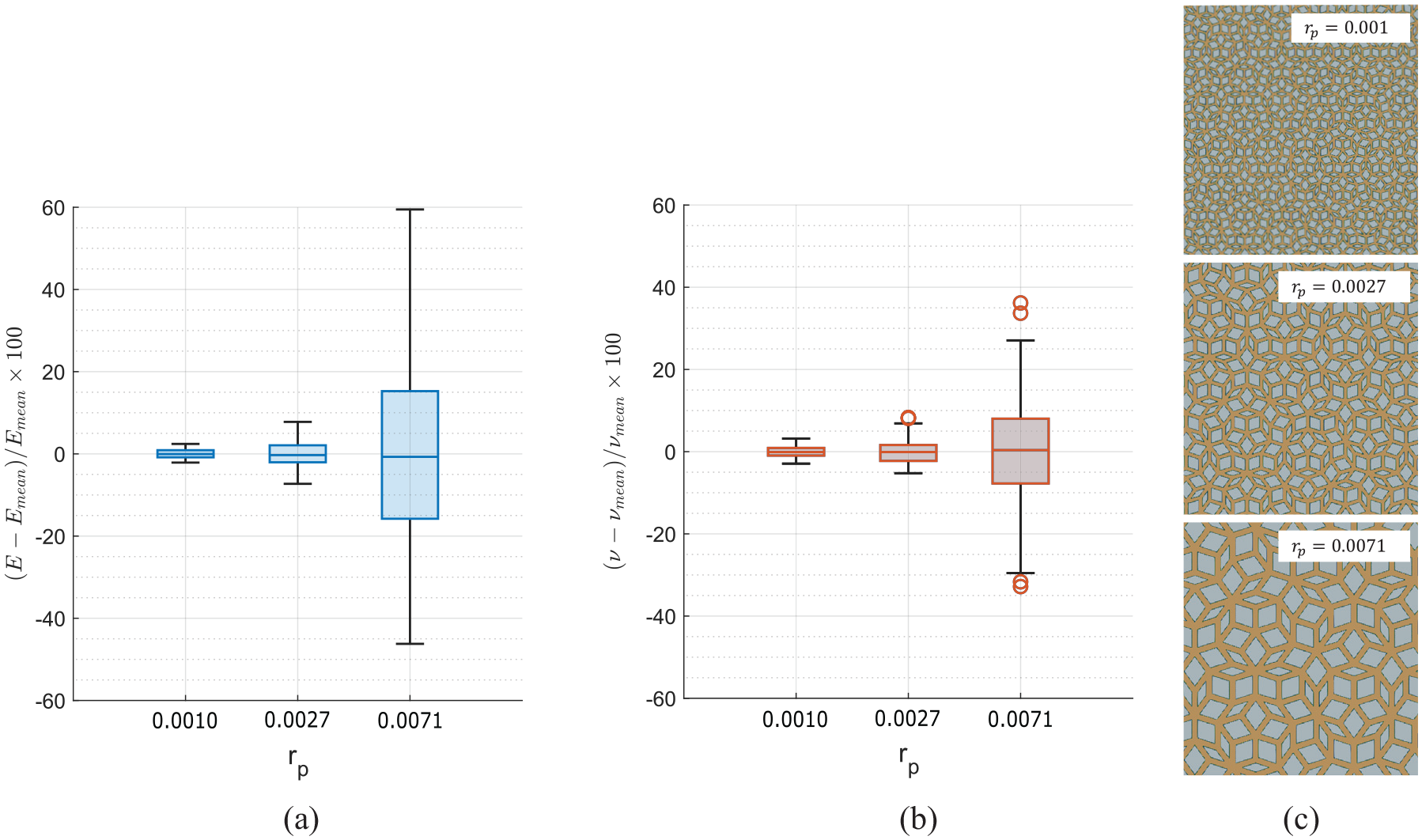
Boxplots illustrating the effect of variations in the finite SRVE centre for different pattern resolutions of the P3 lattice structure: (a) effective Young’s modulus in x-direction, (b) effective Poisson’s ratio and (c) pattern resolutions.
Computational implementation
All numerical formulations of this work have been implemented with FEniCS,49,50 an open source finite element solver based on the Python language. SRVE domain for typical simulations of this work featured mesh refinement comprising
Results and discussion
Performance against Hashin-Shtrikman bounds
Having established validation for the algorithm used to derive the elasticity matrix of aperiodic lattice structures, some mechanical properties of the Penrose P3 were investigated. The plots in Figure 12 show the variation of bulk and shear moduli of the P3 and SQR lattice patterns. The Hashin-Shtrikman bounds show the bulk and shear moduli limits for any composite made up of a mechanical mixture of two or more isotropic and homogeneous elastic phases.
51
In this work, our patterns have been modelled as composites predominantly composed of two materials, a base isotropic material and void (represented as a very weak isotropic material). A very small volume fraction (
Rotational analyses
To measure the degree of anisotropy associated with patterns in this work, rotational analyses were conducted. By varying the orientation of the prime rhombus in increments of
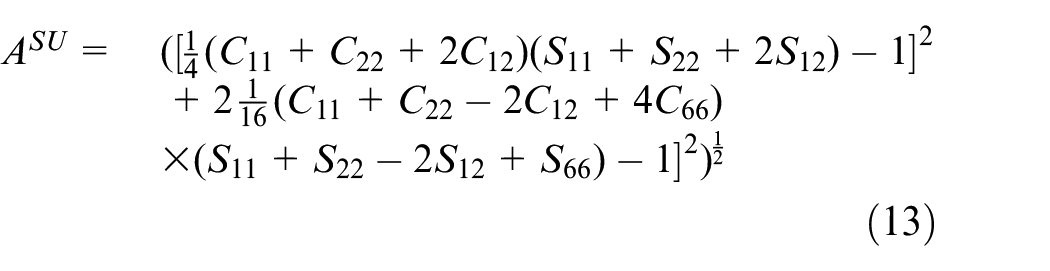
where the
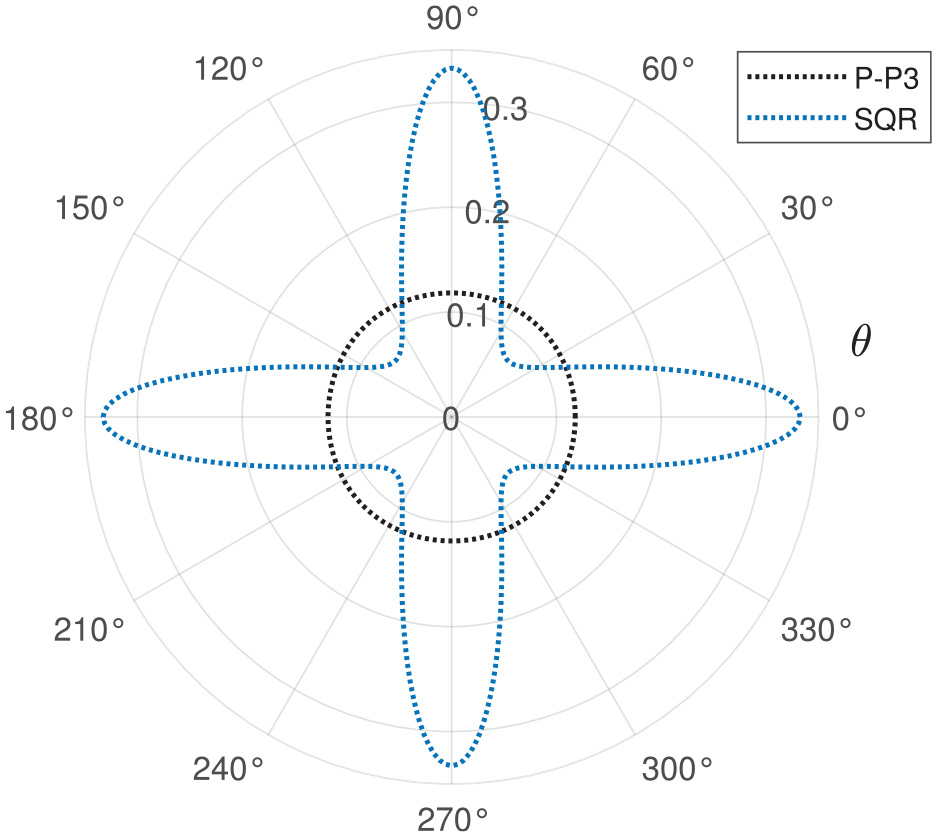
Directional Young’s modulus,
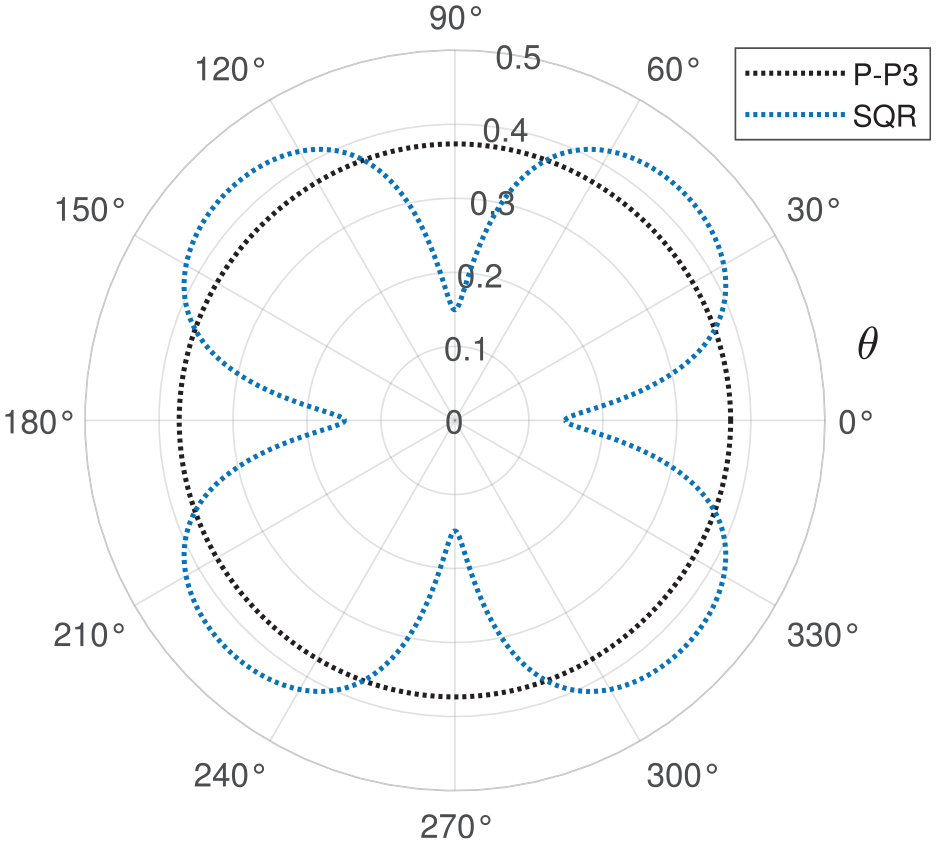
Directional Poisson’s ratio,
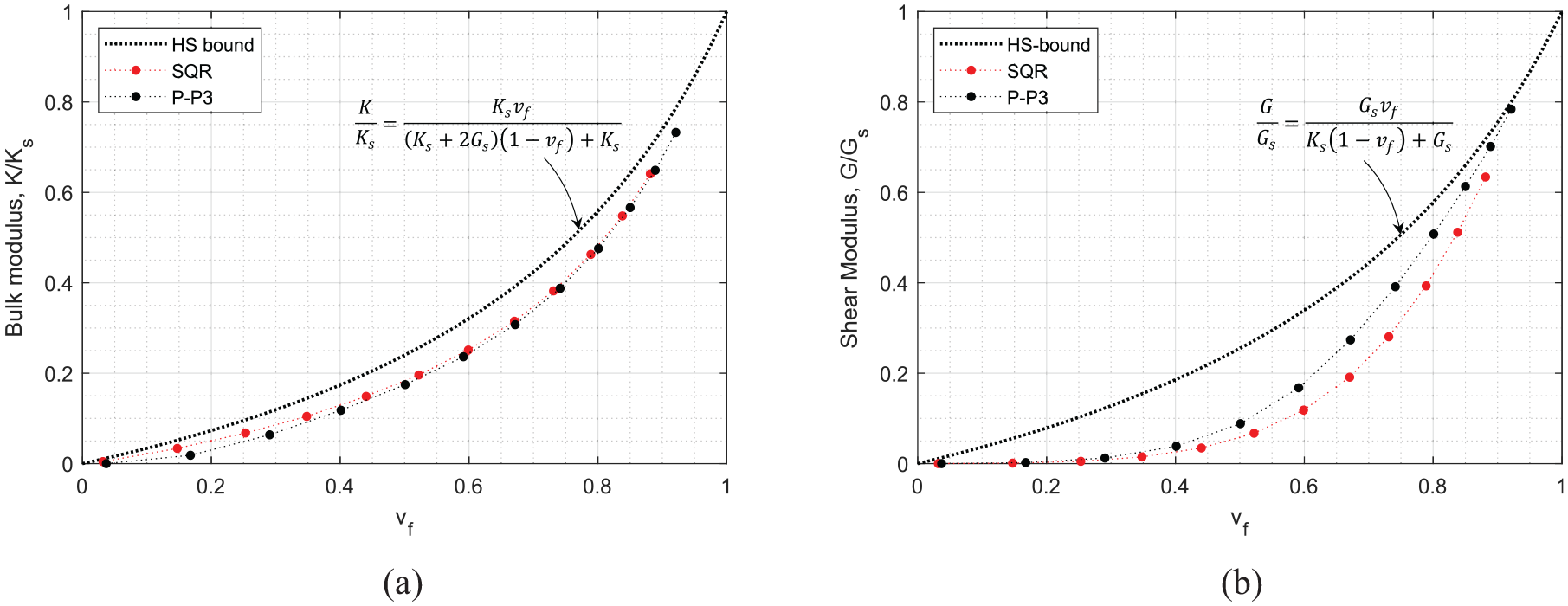
Effective bulk and shear moduli against Hashin-Shtrikman bounds: (a) normalized bulk modulus,
The universal elastic anisotropy index for the square and P3 lattice systems of this work are
Conclusion
Summary
A robust finite element framework has been developed and validated for determining the effective properties of non-periodic lattice structures. The framework is demonstrated by evaluating the mechanical properties of an aperiodically-ordered lattice structure based on the Penrose (P3) tiling, facilitated by an element-based material assignment methodology. An algorithm for designing P3 patterns was created following specific substitution rules, from which lattice structures were developed. The framework was validated by its application to the square periodic lattice structure. It also agrees with the Gibson-Ashby model for square periodic thin-walled honeycombs. The near-isotropic nature of the P3 lattice structure to pattern orientation was established, even for an arbitrary finite SRVE. The methodology implemented is robust and supports the rapid investigation of a wide range of novel aperiodic structures at arbitrary orientations. The framework is suited to periodic cellular structures as well, forming the basis for validation by comparison to unit cell homogenization.
Future directions
This study primarily documents a technique for determining the properties of aperiodic cellular structures, an example of which is the P3 aperiodic lattice structure. There exists a myriad of other aperiodic patterns from which lattice structures can be created and investigated. Infact, many aperiodic lattice structures generalize to three dimensions. This will be the focus of future work – an exploration of the material space populated by aperiodically-ordered lattice structures, leading up to the creation of a library of aperiodic lattice structures with their mechanical properties. We are aware of hexagonal and triangular lattice structures which also exhibit isotropic material behaviour. 12 However, the topology of aperiodic lattice structures integrate the element of aesthetics to possible structural design. Moreover, preliminary experimental investigation suggest astonishing non-linear response of aperiodic lattice structures to large deformation compared to periodic lattice structures. Consequently, computational validation of the non-linear elastic behaviour of aperiodic lattice structures is a worthy research direction. Ultimately, the integration of aperiodic lattice structures towards optimal structural design remains a key drive in the research of these emerging alternatives to periodic cellular structures within the aerospace and bio-engineering industries.
Footnotes
Appendix: Penrose P3 substitution rules
Type B substitution rules.
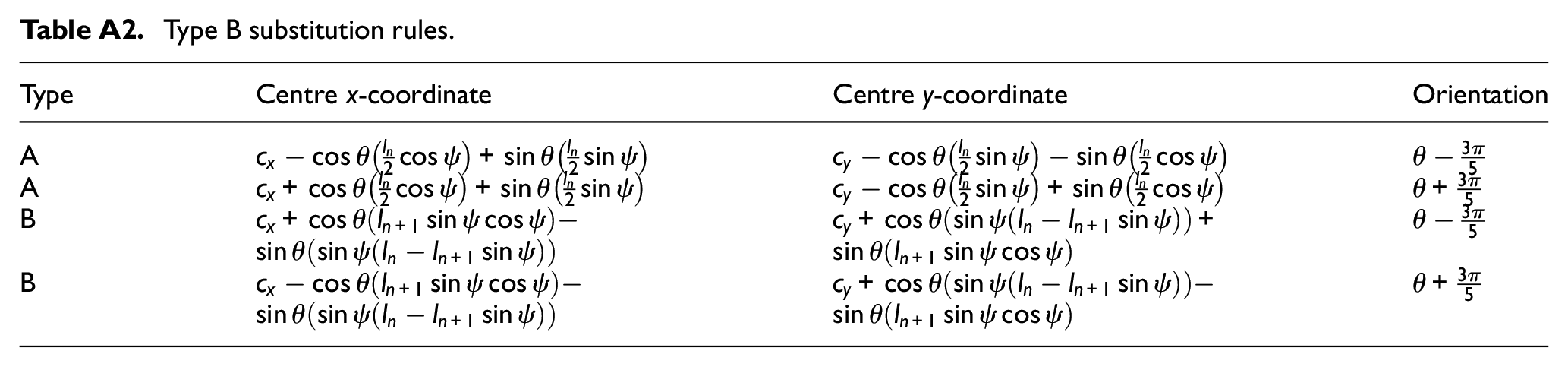
| Type | Centre x-coordinate | Centre y-coordinate | Orientation |
|---|---|---|---|
| A | |||
| A | |||
| B | |||
| B |
Declaration of conflicting interests
The author(s) declared no potential conflicts of interest with respect to the research, authorship, and/or publication of this article.
Funding
The author(s) disclosed receipt of the following financial support for the research, authorship, and/or publication of this article: The authors gratefully acknowledge the EPSRC for funding this research (Grant Ref: EP/V047108/1).
