




Abstract
Hydroclimatology is an expansive discipline largely concerned with understanding the workings of the hydrological cycle in a climate context. Acknowledging this, and given the burgeoning interest in the relation between climate and water in the context of working towards an improved understanding of the impacts of climatic variability on water resources, this progress report turns its attention to the connection between large-scale modes of climatic variability and hydrological variability in streams, lakes and groundwater. A survey of the recent literature finds that a plethora of teleconnection indices have been employed in the analysis of hydrological variability. Indices representing modes of climatic variability such as El Niño Southern Oscillation, the North Atlantic Oscillation, the Pacific North America pattern, the Pacific Decadal Oscillation and Atlantic Meridional Oscillation dominate the literature on climatic and hydrological variability. While examples of discernible signals of modes of climatic variability in stream flow and lake and groundwater level time series abound, the associations between periodic to quasi-period oscillations in atmospheric/ocean circulation patterns and variability within the terrestrial branch of the hydrological are far from simple, being both monotonic (linear and non-linear) and non-monotonic and also conditional on period of analysis, season and geographic region. While there has been considerable progress over the last five years in revealing the climate mechanisms that underlie the links between climatic and hydrological variability, a bothering feature of the literature is how climatic and hydrological variability is often viewed through a purely statistical lens with little attention given to diagnosing the relationship in terms of atmosphere and ocean physics and dynamics. Consequently, significant progress remains to be made in obtaining a satisfactory hydroclimatological understanding of stream flow, lake and groundwater variability, especially if hydroclimatological knowledge is to be fully integrated into water resource management and planning.
Keywords
I Introduction
The criticality of water for all life-forms on Earth is unequivocal. In this context, throughout the history of human society much activity has been focused on securing access to reliable water resources. The spectre of water insecurity and the threat to the sustainability of some livelihoods and societies, as an extant possibility if the projections of human induced climate change become a reality of the future, has engendered a burgeoning interest in the relation between climate and water within geography and cognate disciplines. This interest is manifest in the growth of the ‘inter-discipline’ of hydroclimatology. Originally defined by Langbein (1967) as the study of the influence of climate on the waters of the land, hydroclimatology, although not codified as such, has a long history, as noted by Mather (1991). Contemporary definitions of hydroclimatology include those of Hirschboeck (1988, 2009), Curtis (2010) and Shelton (2009). These present hydroclimatology essentially as a field concerned with understanding the mean, variability, trends and extremes of the hydrological cycle in a climate context; for example, unravelling the climate processes underlying extended flood-rich/flood-poor periods or anomalously long droughts. This characteristic distinguishes it from hydrometeorology and the analysis of short-term hydrosphere–atmosphere interactions in and around the synoptic timescale (Lettenmeier, 2000; Sene, 2016).
Hydroclimatology potentially embodies a wide range of climate and water related research areas enveloping the intra-seasonal to millennial time and the local to global spatial scales. For example, as noted by Hirschboeck (2009), topics of interest to hydroclimatologists might include the analysis of water balance components, drivers of soil moisture, ice and snowmelt dynamics, the variability of stream flow as determined by a range of modes of atmosphere–ocean circulation, changes in river regimes, land-atmosphere interactions, atmospheric water vapour flux, precipitation delivery mechanisms and determinants of extreme hydroclimate events such as flood-rich and flood-poor periods and the same for drought. Added to these topics, and given the interdisciplinary philosophy that underlies hydroclimatology, research on hydroclimate society interactions and their outcomes, and the development and analysis of water policy, are also likely to fall within the purview of hydroclimatology (Stahl, 2005).
Clearly, the scope of hydroclimatology is extensive. Accordingly, it would be inadvisable to address progress in this spacious field within the confines of this progress report. Given this, only research on climate mechanisms as drivers of stream flow, groundwater and lake variability is reported on here. This choice is justified on the grounds that understanding the large-scale climate drivers of hydrological variability in rivers, aquifers and lakes can inform seasonal to inter-annual hydrological forecasting and water resource management. Further, considering the large-scale ocean and atmosphere mechanisms that might play a role in hydrological processes extends thinking about the determinants of hydrological variability beyond the traditional catchment perspective with its focus on ‘local’ precipitation, evaporation and soil moisture.
II Climate mechanisms and stream flow, groundwater and lake variability
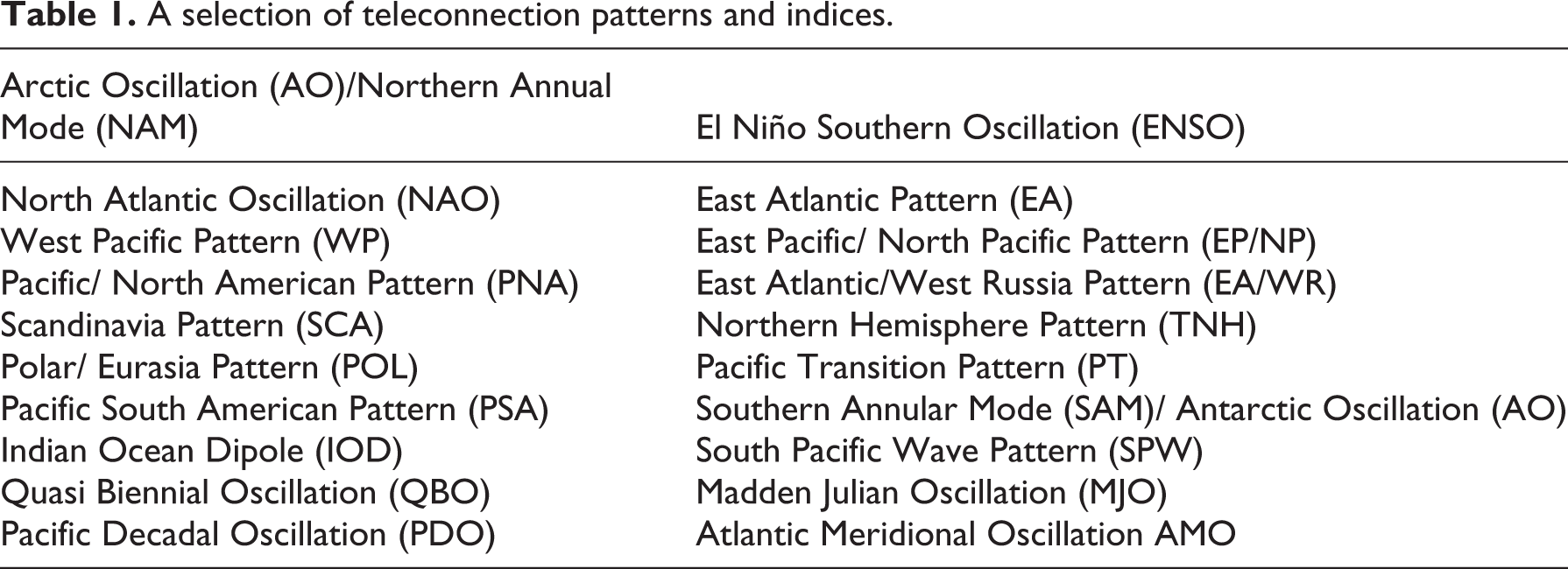
Stream flow, groundwater and lakes are important components of the terrestrial branch of the hydrological cycle with their mean state, variability and extremes connected to climate via a cascade of processes that link the physical state and dynamics of the ocean and the atmosphere with the land surface via the atmospheric branch of the hydrological cycle. Some of these process cascades have been posited in conceptual models that attempt to articulate the nature of pathways that connect atmosphere and ocean processes to hydrological variability in general (Bhagwat and Maity, 2014; Hannah et al., 2014; Kingston et al., 2006; Vihma et al., 2016). Within this cascade framework, and from a broad hydroclimatological perspective, of particular interest is the role of modes of climatic variability, which can be generally defined as quasi-periodic variations in ocean and atmospheric circulation patterns that possess an oscillatory behaviour, and their links with hydrological variability. A large number of modes of climate variability have been identified (Kucharski et al., 2010; Sheridan and Lee, 2015; de Viron et al., 2013), all of which could be considered as potential drivers of intra-seasonal to inter-decadal hydrological variability. Typically, temporal behaviour of each mode of climate variability is described by a teleconnection index with an associated acronym (Table 1); while there might be a commonly accepted acronym for each teleconnection, there may be many different versions of a particular index because different methods, data sets, atmosphere and ocean variables, criteria and sampling periods might be used in their construction. Teleconnection indices are therefore, in essence, statistical constructs comprising single numbers. Their raison d’etre is to capture a range of often complex ocean and/or atmospheric process interactions that give rise to multifaceted physical phenomena such as the El Niño Southern Oscillation. Given this, it is important to make a distinction between teleconnection indices as statistical constructs and the complex climate phenomena which they attempt to represent.
A selection of teleconnection patterns and indices.
Because most individual studies consider a range of indices in assessing the links between climate and hydrological variability, the literature reported on below is organised under the headings of stream flow, groundwater and lakes rather than a systematic presentation of specific teleconnection indices.
2.1 Stream flow
Some studies of climate stream flow associations follow what Yarnal (1993) refers to as an environment to circulation approach; modes of stream flow variability are identified first, aided by statistical analyses in the frequency domain, with climate-based explanations subsequently sought. For example, Sen (2012) used monthly discharge data and continuous wavelet transform to identify a dominant oscillatory mode in stream flow at the inter-annual timescale related to the Pacific North American (PNA) teleconnection pattern for the Southern Appalachian region of the United States. For Moldova, Briciu and Mihaila (2014) identified two broad categories of stream flow periodicities, namely 1–16.5 and 27.8–55.6 years, with the associated correlation matrix of the global wavelet spectrum suggesting that the North Atlantic Oscillation (NAO), East Atlantic/West Russia Oscillation (EAWRO) and Pacific Decadal Oscillation (PDO) are the main drivers of stream flow periodicities. Using annual flow data, Nalley et al. (2016) revealed significant periodicities in stream flow for Quebec rivers at 4, 4–6, 6–8 and greater than 8 years with wavelet coherence analyses demonstrating ENSO and NAO effects at the inter-annual scale at periodicities of 2–6 years, whereas the influence of the PDO revealed itself at periodicities up to 8 and exceeding 16 years. Interestingly, Nalley et al. (2016) also uncovered lag effects between teleconnection patterns and stream flow response with time delays to ENSO, NAO and PDO of 1–4 years. For north east Brazil, Genz and Tanajura (2013) found, using spectral analysis, inter-annual modes of stream flow variability at 2–3, 3–4, 7–8 and 11–12 years, noting, without offering explanations of the linking mechanisms, that the decadal frequency is consistent with SST related South Atlantic and ENSO indices.
While studies using annual stream flow data have revealed periodicities at annual timescales and beyond related to large-scale modes of ocean–atmosphere variability, analyses of seasonal stream flow data show inter-seasonal contrasts in periodicities and the possibility of varying associations with teleconnection patterns. This is apparent for north eastern Spain where Hernandez-Martinez et al. (2015) have shown, using singular spectral analysis, that while winter and spring stream flow demonstrates inter-annual variability with oscillatory modes in the region of 5.5 and 2.3 and 2.6 and 6.6 years, respectively, variability at the decadal scale is also apparent for spring stream flow. For both seasons, antecedent sea surface temperature patterns in the North Atlantic and Indian Oceans have been suggested as the main teleconnection, although it is noted that the physical mechanisms underlying these teleconnections are difficult to explain.
Although the literature touched upon to this point might indicate strong and stable long term climate stream flow variability relationships, this is not so, as shown clearly by Zamrane et al. (2016) for river basins in the high Atlas Mountains of Morocco, by Ionita et al. (2012) for the Rhine River basin and Switanek and Troch (2011) for the Colorado River. For the Rhine, stream flow variability has been found to be non-stationary with enhanced variability in the 8–16 year window from 1860 to 1900 and in the 2–8 and 16–30 year band after 1960. Although spring and autumn possess a similar distribution of variability modes, apart from autumn, which has a strong peak at a periodicity of 30–60 years, there is an inter-seasonal contrast in the nature of teleconnections for the Rhine, spring flow variability is related to SST anomaly patterns resembling those of ENSO, while North Atlantic SST anomalies are more important for autumn flows. Refreshingly, and in contrast to many of the studies that attempt to establish links between oscillatory modes of stream flow and teleconnection patterns, Ionita et al. (2012) point to excursions of the Atlantic and African jets away from their climatological pattern, with concomitant influences on moisture advection from oceanic areas driven by both regional and remote SST anomalies, as being a critical mechanism for determining seasonal variations in Rhine streamflow variability. For the Colorado River, despite strong coherence between time series of stream flow and AMO and PDO teleconnection indices existing for the observational period, Switanek and Troch (2011) cast doubt on the reliability of AMO and PDO as predictors of future stream flow behaviour because historical stream flow variability, reconstructed using tree rings, bears no resemblance to AMO and PDO periodicities.
Based on known linkages between sea surface temperature (SST) anomalies and variability in temperature and precipitation patterns, a number of studies have addressed directly SST–stream flow variability associations. For the UK, Kingston et al. (2013) have identified a horseshoe- or tripole-shaped pattern of North Atlantic SST anomalies, reminiscent of those associated with the NAO, as important precursors of summer stream flow drought across the UK. They note, however, that the atmospheric bridge linking SST and summer stream flow anomalies is far more complex than that represented solely by the NAO. Also focusing on stream flow drought, but for winter multi-annual events for the English lowlands, Folland et al. (2015) have shown that La Nina episodes, through producing winter rainfall deficits, are important for some multi-annual stream flow and groundwater drought episodes; stream flow drought indicators also show some evidence of weak links to ENSO as well. For stream flow variability in the Adour-Garonne basin in south western France, Oubeidillah et al. (2012) identified SST anomalies in the equatorial region of the Atlantic Ocean to be important as well as the AMO and NAO. Remote connections between stream flow and SST are also evident for some river basins in Africa. For example, Sittichok et al. (2016) have found for the Sirba watershed in West Africa that Pacific Ocean SST, averaged over the months March–June, is a good predictor of monthly stream flow for July, August and September. For the Nile River, Siam et al. (2014) and Siam and Eltahir (2015) note that, in combination, SST anomaly patterns in both the Pacific and the Indian oceans can explain up to 85% of the flow variability. In a study that considers both atmospheric pressure and SST anomalies as drivers of inter-annual US stream flow variability, Sagarika et al. (2016) note that variations in the surface thermal state of the Pacific Ocean leads stream flow anomalies by six months. At the inter-decadal scale, Sagarika et al. (2015) also observe a distinct regional specificity in the way PDO and AMO warm and cold phases affect US stream flow. For the Upper Colorado River basin (UCRB), a support vector machine model, which ingests SST data for the Hondo region in the central North Pacific and the NAO index, has been shown to produce reliable one year ahead predictions of stream flow by Kalra et al. (2013). In explaining the mechanisms that connect ocean and atmosphere processes with UCRB stream flow, they cite the work of Wang et al. (2010) (see section 2.3). With a view to improving the prospects of water management in general, Tsai et al. (2015) take a purely statistical approach, with little reference to climate mechanisms, to construct a ‘global teleconnection operator’ (GTO). The GTO is assumed to define a multi-linear association between SST and the hydroclimate for a specific region with the expectation that the level of sensitivity of climate over major river basins can be assessed.
Studies that directly assess the association between modes of climate variability and stream flow using teleconnection indices as a proxy of the large-scale climate drivers abound. Generally, these follow a circulation to environment approach (Yarnal, 1993) in that an a priori independent measure of atmospheric and/or ocean state, as captured by a given teleconnection index, is applied to the analysis of a surface environmental variable. In this way, the teleconnection index is viewed as the independent climate driver/forcing agent of stream hydrology. In an analysis of the atmospheric controls on runoff in western Canada, Bawden et al. (2015) identified both the PNA and PDO to be important, not only for playing a role in terms of inter-annual stream flow variability, but trends in runoff as well. For the west Canadian Arctic, Newton et al. (2014a, 2014b) have analysed the association between large-scale synoptic patterns and summer and winter stream flow moderated by teleconnection patterns, as described by indices for the Southern Oscillation and the PDO. They found a split-flow blocking pattern in summer and the winter positioning of high-pressure ridges and troughs over the Pacific Ocean and western North America to be critical for determining variations in hydroclimate, with the large-scale synoptic situations in turn influenced differently by contrasting phases of the SO and PDO. Also for western Canada, but for the situation of observed increases in inter-annual stream flow variability in the Fraser River basin, Dery et al. (2012) point to an increasing polarity of climate ENSO and PDO teleconnections as possible contributors to the greater range in annual runoff fluctuations. That an asymmetric effect may be a characteristic of ENSO and PDO stream flow teleconnections for western Canada is corroborated by the work of Gobena et al. (2013). This has revealed that warm El Niño and PDO phases tend to produce more consistent stream flow responses than their cool phases. Perhaps more crucially in relation to the efficacy of teleconnection indices for stream flow forecasting, Gobena et al. (2013) note exaggeration of asymmetric effects in the case of PNA and AO stream flow associations with only the positive PNA and negative AO phases affecting stream flow in a demonstrable way.
Other regions of the world for which ENSO stream flow associations have also been discovered include, for example, India where pre-monsoon stream flow in the Mahanadi River basin has been found to be positively associated with ENSO. As pointed out by Panda et al. (2013) this finding contrasts with the widely accepted inverse association between stream flow and ENSO for this period of the year. They cite the changing or non-stationary relationship between large-scale climate drivers and rainfall, and hence stream flow that has developed since the mid-1990s, as an explanation. Using multi-taper and maximum entropy methods to find periodicities, along with singular spectral analysis to enhance the signal-to-noise ratio, Rubio-Alvarez and McPhee (2010) have found that ENSO bears a greater influence on summer stream flow for a northern sub-region of southern Chile, while for its southern counterpart the AAO and PDO are important. At the decadal timescale, Nunez et al. (2013) have also noted some regional contrasts in the impacts of ENSO and PDO phase shifts on stream flow in Chile. In a consideration of the association between multiple ENSO indices and seasonal stream flow for west central Florida, Risko and Martinez (2014) found that tracking the eastward evolution of ENSO across the Pacific basin using the Niño 3.4 Index provided a good indication, up to seven months in advance, of the likely tendency of stream flow.
A teleconnection index largely conspicuous by its absence in stream flow variability analyses is the SAM, as highlighted by Li and McGregor (2017). Having controlled in their analyses for an increasing positive trend in the SAM index and the confounding influence of ENSO, they describe a complex relationship between stream flow variability across New Zealand and the SAM, dependent on season and hydrological region. In contrast to Li and McGregor (2017), who used measured stream flow, a number of workers have used tree ring chronologies as proxies of stream flow to analyse the influence of SAM on southern hemisphere stream flow beyond instrumental timescales. These studies have shown varying influences of SAM on constructed time series of streamflow for drainage basins across the southern half of South America and Tasmania, Australia (Allen et al., 2015; Araneo and Villalba, 2015; Lara et al., 2015; Munoz et al., 2016).
In contrast to large parts of the North and South American continents, parts of eastern and southern Asia and Australasia, where ENSO in tandem with the PDO seem to be important determinants of stream flow variability (Clark et al., 2014; Ouyang et al., 2014; Sahu et al., 2014), for regions immediately upstream or downstream from the Atlantic Ocean, inter-annual variations in stream flow appear to be attributable mainly to the behaviours of the NAO and AO, with these associations possibly moderated by the phase of the AMO.
For dry periods and thus anomalously low stream levels in Lithuania, Rimkus et al. (2014) highlight the role of atmospheric blocking processes and a predominance of meridional over zonal circulation and thus precipitation deficits, both commonly associated with negative NAO/AO phases. A similar situation is also evident for western and southern Romania, where strong negative NAO annual stream flow correlations can be found (Birsan, 2015). For north-eastern Romania, Mihaila and Briciu (2015) similarly demonstrated inverse NAO/AO stream flow associations, with these being strongest for the winter period.
As well as concurrent NAO stream flow associations, there appears to be evidence for NAO priming of stream flow outcomes several months later, as is evident for the Iberian Peninsula. Here, Hidalgo-Munoz et al. (2015) have found that the previous winter’s NAO state is a good indicator of autumn stream flow. For other seasons, the NAO is a far less convincing predictor of stream flow across the Iberian Peninsula. Further evidence of the seasonal dependence of NAO stream flow associations is available for Sweden where, in a consideration of the nature of the impact of atmospheric circulation variability, as described by five teleconnection indices (the NAO, East Atlantic (EA), East Atlantic/Western Russia (EA/WR), Scandinavia (SCA) and Polar/Eurasia (POL)), on hydropower production, Engstrom and Uvo (2016) have shown that NAO hydropower electricity production associations are strongest for the winter season, with little influence of the NAO on spring and summer production. Rather, during spring and summer an inverse association is described between the EA/WR teleconnection pattern and hydropower production, with the autumn season revealing little sensitivity to any of the teleconnection indices considered. In a similar vein, Wang et al. (2015) have used a range of possible teleconnection indices, along with the NAO, to assess the influence of regional and more remote teleconnections on stream flow in the headwaters of the Tarim River basin in north western China. Strongest associations were found between stream flow and an index describing northern hemisphere polar vortex area, with winter AO and NAO also demonstrating a significant influence. Upwind of the Atlantic Basin, Coleman and Budikov (2013) have assessed concurrent and delayed eastern US summer stream flow response to extreme phases of the NAO, finding in general that stream flow response was most sensitive to extremes of the NAO negative phase, with significant delayed effects up to three seasons. Importantly, they also note that NAO stream flow associations are season and region dependent, with relationships being both linear and non-linear and possibly influenced by trends in the NAO index. Similarly, Sheldon and Burd (2014) report strong seasonally dependent and alternating effects of distant climate drivers on Altamaha River discharge to coastal Georgia in the US.
While assessments of the impacts of teleconnection patterns on mean stream flow at a variety of timescales tend to dominate the literature, there is an increasing number of studies that consider potential links between measures of stream flow extremes and climate teleconnections (Hannah et al., 2014; Merz et al., 2014; Prudhomme and Genevier, 2011). For example, Mazouz et al. (2013) use redundancy and canonical correlation analysis to investigate the link between five possible teleconnection indices and four flow characteristics, describing the nature of heavy spring floods in southern Quebec. They found that the AMO and NAO are the main modes of climate variability associated with flood duration, timing, frequency and coefficient of variation such that delayed timing, higher frequency, relatively long duration and relatively weak variability of spring heavy floods is correlated with positive phases of the AMO and NAO. In the case of the Connecticut River basin, Steinschneider and Brown (2011) have found evidence for residual effects of the winter NAO, the springtime US east coast pressure trough and springtime North Atlantic Tripole SST pattern in records of summer ecologically relevant low flows. The atmospheric bridge that is thought to connect these large-scale atmosphere and ocean circulation patterns off the east coast of the US to low flows is moisture transport over the study region, as moderated by anomalous zonal and meridional atmospheric circulation regimes. In order to understand the nature of atmospheric drivers of flood frequency across the central US, Mallakpour and Villarini (2016) studied the impact of five teleconnection patterns related to the Pacific and Atlantic oceans. They found that, while there was some regional variation in the influence of the various modes of climatic variability on flood frequency, overall the PNA played a dominant role, with the negative phase of this teleconnection pattern favouring a high frequency of flood events through enhanced atmospheric moisture transport associated with anomalous high pressure over the southeastern US and low pressure over the western US. Also in the US, but for the Mid-Atlantic region, Armstrong et al. (2014) outline how the winter NAO impacts flood magnitude and frequency.
For devastating summer floods in Switzerland, Peña et al. (2015) have highlighted the role of the summer NAO pattern, noting that positive and negative phases are important for flood occurrence in rivers basins located on the southern and northern flanks of the Swiss Alps, respectively. In the Ammer River basin in southern Germany, Rimbu et al. (2016) have revealed that the negative phase of the EA–WR teleconnection pattern is associated with a higher frequency of summer flood occurrence than its negative counterpart. This is because the EA–WR negative phase is conducive to enhanced moisture transport from the Atlantic Ocean and the Mediterranean towards the Ammer region, as facilitated by a marked trough over western Europe and amplified upper level potential vorticity.
At the global level, Ward (2016) has assessed the link between inter-annual climate variability, as characterised by ENSO, and flood duration and frequency. He found that flood duration is more responsive to excursions in ENSO than flood frequency such that ‘neutral years’ had significantly short flood durations compared to El Niño and La Nina years, but notes at the level of individual river basins, both flood frequency and duration may be linked to ENSO.
A number of studies reviewed here (e.g. Coleman and Budlikov, 2013; Dery et al., 2012; Gobena et al., 2013; Li and McGregor, 2017; Sheldon and Burd, 2014) point to asymmetric or non-linear associations between teleconnection indices and stream flow variability. This characteristic has been addressed explicitly by Frauen et al. (2014), who conducted a number of atmospheric general circulation model simulations using idealised SST patterns representing eastern Pacific and central Pacific El Niño events of varying intensity in order to establish climate response. They found for El Niño stronger climate responses than La Nina events and that central Pacific events generate weaker non-linearities than eastern Pacific events. They posit that combinations of non-linear responses to stable SST patterns of varying signs and strengths (‘a linear ENSO’) and linear responses to fluctuating SST patterns (‘a non-linear ENSO’) explain the non-linear climate responses to ENSO, noting that any observed event is a combination of the linear/non-linear ENSO types. Along the same lines, but using observations on soil water levels, which have implications for stream flow, Liang et al. (2014) have highlighted the non-linear/asymmetric response of the hydroclimate of the Mississippi River basin to the two types of aforementioned El Niño, observing that eastern Pacific El Niño events lead to higher soil water levels while central Pacific El Niño events produce lower soil moisture levels.
While acknowledging that many stream flow teleconnection associations may be non-linear, Fleming and Dahlke (2014a) note that such connections are more often than not assumed by researchers to be monotonic. Given this, and building on other work of theirs (Fleming and Dahlke, 2014b) and that of others (Bai et al., 2012; Hsieh et al., 2006; Wu et al., 2005), they suggest that stream flow climate teleconnection associations can be non-monotonic and parabolic in nature. To support this contention, they studied the responses of annual flow volumes to El Niño and the Arctic Oscillation for 42 of the northern hemisphere’s largest ocean-reaching rivers, finding parabolic relationships for half of these, with a parabolic model being the optimal for describing stream flow volume climate teleconnection associations for eight of the rivers considered. As an example of the improved prospects for providing seasonal water supply forecasts, they cite the Sacramento River in California. Here, a parabolic model (quadratic relationship) yields a reduction in mean predictive error by 65% over an unsatisfactory monotonic model alternative. In general, Fleming and Dahlke (2014a) attribute the non-monotonic association between stream flow and modes of climate variability to catchment characteristics, such as whether glaciated or not, and antecedent conditions, but, most importantly, emphasise that their findings open the possibility of a paradigm shift in how climate teleconnection stream flow associations are viewed through an alternative non-monotonic lens.
2.2 Lakes
Lakes are of hydroclimatological interest because they may play an important role as attenuators of floods and droughts, contribute significantly to groundwater recharge and are a source of freshwater for a range of human activities. Accordingly, there is a mounting demand for climate information that will benefit the management of lakes, not only in terms of lake water quantity and quality, but also biodiversity and cultural aspects. The impact of climatic variability on lakes has been mainly established through the analysis of lake levels, lake inflow and outflow volumes and lake water balance, with analyses in both the frequency and time domains being applied to this research problem.
Probably because of their enormous economic importance and the availability of the requisite data (Hunter et al., 2015), the Great Lakes of North America and the St Lawrence River have received considerable attention in the literature. For example, Ghanbari et al. (2008) used frequency domain relationships between four atmospheric teleconnection indices and water levels for the Great Lakes, over the period 1948 to 2002, to reveal significant associations with a trans-Niño index in the frequency range of (3–7)(-1) cycles year(-1) and with the PDO at inter-decadal frequencies. Whereas the PNA pattern was found to be associated with lake levels in Lake Superior, Michigan, and Erie at inter-decadal frequencies, the AO displayed signals in lake levels for all lakes at the inter-annual timescale.
In relation to the frequency and timing of annual water level related drought and wetness indices for the Great Lakes, Assani et al. (2016) found that the NAO is inversely correlated with extreme drought indices for lakes Ontario and Erie while only Lake Superior displays correlations with the PDO (positive) and SOI (negative) for indices of extreme wetness, corroborating earlier findings of Biron et al. (2014) for St Lawrence River levels. In a study that focused exclusively on the influence of the NAO on the Great Lakes, and considered the concomitant trends of the NAO and Great Lakes’ water levels using a 95 year record, Dogan (2016) found that changes in the trend of lake levels occurred in 1965 and 1987, with the relationship between these changes and the NAO being in the same direction for the months of February to April, but reversed for June to August with an increasing zonal gradient of influence of the NAO from Lake Superior to Lake Ontario. Adding to the understanding of the climate response of the Great Lakes is the work of Watras et al. (2014), who have suggested that lake levels in the Great Lakes have been governed by a climatically driven, quasi decadal oscillation of 13 years for at least 70 years. Usefully, they identify the climate driver as the net atmospheric flux of water, possibly connected to mid-North Pacific large scale atmospheric circulation patterns that facilitate moisture transport over the Great Lakes from the Gulf of Mexico.
Elsewhere, but still for the case of the North American continent, Wang et al. (2010) have also uncovered a near decadal scale variation in water level for the Great Salt Lake (GSL). This is coherent with variations in SST referred to as the Pacific Quasi Decadal Oscillation (PQDO), in the so-called Hondo region in the tropical central North Pacific. The mechanism that links the PQDO with GSL levels has been identified by Wang et al. (2010) as a set of recurrent atmospheric circulation patterns that develop over the Gulf of Alaska associated with warm and cool SST phases in the Hondo region. These modulate synoptic transient weather systems and so atmospheric water vapour transport over the western US, thus producing the near decadal oscillations in GSL levels. The benefits of this finding for lake level forecasting is that there is, on average, a six-year inverse lag between the GCL level response and phase of the PQDO, such that long range predictions of the GSL in response to Pacific Basin based climate anomalies is a possibility. Also with long range prediction in mind, Sarmiento and Palanisami (2011) have used squared coherence followed by power spectral analysis to assess how lakes of the Mackenzie River basin respond to five modes of climatic variability, as described by teleconnection indices. For the southern half of the Mackenzie basin, inter-decadal variations in lake level are found to be linked to the PNA, with the PDO playing little if any role. At shorter timescales, in the range of 1.1–3 years, the PNA, ENSO MEI, AO and a North Pacific index were found to show relationships with lake level, but, as noted by these researchers, the degree of coherence is low because of smaller water level fluctuations compared to that at the inter-decadal scale.
Beyond the North American continent, impacts of climate on lakes, via teleconnections, are evident for a number of regions. For example, de la Lanza-Espino et al. (2011) have uncovered clear El Niño/La Nina impacts on water levels for Tecocomulco Lake, in the central basin of Mexico, noting that low (high) lake levels are associated with El Niño (La Nina) occurrences. These occurrences have intriguing societal consequences, given that during El Niño years the increase in near shore land area is used to increase the amount of land under cultivation. For Lake Urmia in north western Iran, the second largest hyper saline lake on Earth and the subject of much concern in the context of climate change (Alizadeh-Choobari et al., 2016), Jalili et al. (2016) have explored lake level variability in relation to the SOI and NAO using spectral and coherency analyses. They found significant coherency between lake levels and the NAO at 4.1 and 11.4 years and for the SOI between 4.7 and 5.7 years. Unfortunately, the mechanisms explaining these teleconnections are not provided. Further to the east, in the central Karakoram Himalayan region, Veettil et al. (2016) have revealed how supraglacial lakes on the Baltoro glacier system are sensitive to the PDO such that an increasing (declining) number of supraglacial lakes over the last four decades is related to El Niño (La Nina) occurrence embedded in PDO warm (cool) phases. In explaining the physical nature of the links, Veettil et al. (2016) cite the work of Kim et al. (2014) and the role of synchronous El Niño and warm PDO phases and La Nina and cool PDO phases with the former (latter) being conducive to an increase (decrease) in lake number. Using sediment core geochemical data for Lake St Lucia, Africa’s largest estuarine system, Humphries et al. (2016) demonstrate how past cycles of desiccation and hyper salinity have been controlled by ENSO intensification through this teleconnection’s impact on precipitation regimes.
Although it is assumed either implicitly or explicitly that ENSO related indices can assist with explaining hydroclimate variability in New Zealand (NZ), Kingston et al. (2016) find otherwise for inflow to and thus water levels of Lakes Ohau, Pukaki and Tekapo in the central South Island. Rather than concurrent links to large scale modes of variability (e.g. ENSO and SAM) they find, using partial least-squares regression and cross-wavelet analyses, that high lake inflows can be explained by variations in two NZ based circulation indices. These indicate that high (low) inflows and lake levels are coherent with high (low) north west to south east pressure gradients and thus strong north westerly (weak south westerly) atmospheric flows and moisture transport over the South Island of NZ. With respect to understanding the possible one season ahead impact of SAM on these lakes, through SAM stream flow links, the work of Li and McGregor (2017) is relevant.
2.3 Groundwater
Because groundwater represents an important resource that is being increasingly drawn upon for a variety of uses, there has been a growing interest in understanding the impact of large-scale modes of climatic variability on this resource. To this end, Lavers et al. (2015) undertook an investigation of the large-scale climate patterns that affected the nine highest and lowest groundwater levels in an important chalk catchment in southern England. They found for high groundwater levels, steep meridional atmospheric pressure gradients over the North Atlantic, resembling a strong positive NAO pattern, and strong fluxes of moisture over southern England to be important, while low groundwater levels were preceded by extended periods of blocking over and west of the British Isles. For Canada, Tremblay et al. (2011) examined the possible cause and effect linkages between four large-scale climate indices, namely the NAO, AO, PNA and the multivariate ENSO index (ENSO MEI), and groundwater levels, finding that the NAO and AO strongly influence groundwater level variability across Prince Edward Island while the PNA was more important for the Manitoba region.
In a more regionally focused study for the Canadian prairies, Perez-Valdivia et al. (2012) uncovered three major modes of variability in groundwater levels in the bands of 2–7, 7–10 and 18–22 years, which, with the aid of correlation and wavelet analysis, they associated with ENSO and the PDO, respectively. Low groundwater levels, associated with warmer and drier winters, were found to align with concomitant positive phases of ENSO and the PDO. Further south, Kuss and Gurdak (2014) have examined the climate drivers of the inter-annual and multi-decadal variability of groundwater levels in the principal aquifers of the US using singular spectrum, wavelet coherence and lag correlation analyses. ENSO and PDO were uncovered as exerting more control on groundwater levels than the NAO and AMO, especially for the principal aquifers in western and central US. In a similar vein, Huo et al. (2016) have used continuous wavelet transform and wavelet transform coherence analyses to identify modes of discharge variability for the Naingziguan Springs in China and relate these to ENSO, PDO and other indices describing the Indian summer and the west North Pacific monsoon systems. Modes of discharge variability with a periodicity of 3.4 and 26.8 years were found to be related to ENSO and PDO, respectively. Dong et al. (2015) also show for the Kumamoto Plains in Japan that groundwater levels are associated with ENSO related variations in temperature, precipitation and humidity conditions.
III Synthesis
Acknowledging that hydroclimatology is a vast field that addresses the physical and increasingly societal dimensions of the hydrological cycle, this report has necessarily focused on one of its sub-fields; namely, understanding the relationship between large-scale modes of climatic variability and hydrological variability in streams, lakes and groundwater. As for groundwater, the literature on lake and climate teleconnection associations is rather meagre when compared to that for stream flow. Further, the volume of work for the northern hemisphere dominates, most likely reflecting the hemispheric contrasts in landmass combined, possibly, with the global distribution of researchers working in hydroclimatology.
In general, the literature reported on here indicates existence of discernible signals of modes of climatic variability in time series that describe hydrological variability. Such signals have been revealed using a variety of methods, including those within the frequency and time domains and broad frameworks of analysis that follow either an environment to circulation or circulation to environment approach.
A rich diversity of teleconnection indices has been employed in the analysis of hydrological variability, with indices representing ENSO, the NAO, the PNA pattern and the PDO and AMO appearing the most in the literature either by default, because they have become the standard descriptors of climatic variability, or through a conscious decision informed by a hypothesis underpinned by physical process reasoning. Notwithstanding the reason why a particular index might be chosen to explore climate hydrological variability links, it is clear from the literature there is a lack of critical reflection on the extent to which an index and its nature of construction might influence the interpretation of any uncovered climate–hydrology associations. This is because, for any given climate phenomena or mode of variability, a number of indices may exist, each of which has been constructed using different methods, data sets, variables, criteria and sampling periods. Researchers therefore need to guard against the blind adoption of any one particular teleconnection index and instead make index selections based on the degree to which a candidate index fits with the ocean–atmosphere processes they wish to represent and the degree to which a specific teleconnection pattern is defined. Equally, researchers also need to ensure that physically plausible hypotheses are presented at the outset of any investigation of hydroclimatological variability rather than pursuing an inductive approach based on the hope that climate hydrology links will emerge from uninformed statistical analyses of multiple teleconnection and hydrological time series; much stands to be gained by climatologists with a solid grounding in climate processes and ‘statisticians’ working closely together.
While this report has portrayed a favourable situation in terms of applying knowledge about the links between modes of climatic variability and hydrological variability to the challenge of hydrological forecasting at intra-seasonal to decadal timescales, the complexity of large-scale climate–hydrological variability links needs to be acknowledged. Clear from the material presented here is that relationships may be conditioned on a particular period and/or season as well as being geographically dependent with the response of hydrological processes to modes of climatic variability ranging between concurrent and significantly delayed. Furthermore, relationships can be either linear or non-linear, with asymmetric hydrological effects of contrasting phases of modes of climatic variability a noticeable feature of the hydroclimatological variability for some regions. This points to the likelihood that hydrological responses may only be provoked when a ‘tipping point’ or threshold atmospheric circulation state, possibly in combination with land-based antecedent conditions, is exceeded. In terms of the range of teleconnection indices considered in this report, such a tipping point may be represented by a threshold teleconnection index value. If so, searching for such atmospheric circulation state related tipping points might represent one of the holy grails of hydroclimatology.
As implied above, a worrying feature of many analyses reported on here is that the relationship between climatic and hydrological variability is often viewed through a purely statistical lens with few physical explanations offered for why a hypothesised climate driver, as represented by time series of teleconnection indices and indices representing some dimension of hydrological variability, are related. In short, this report has exposed a need for a move beyond purely statistical/mechanical treatment of climatic-hydrological variability associations to one where diagnostic analyses are undertaken in order to divulge the underlying climate mechanisms in terms of atmospheric and ocean physics and dynamics that form the cascade of processes that link ocean–atmosphere interactions with the terrestrial branch of the hydrological cycle. With regard to this, it is likely that numerical climate models, in combination with hydrological models, applied at a range of spatial scales (e.g. sub-regional to regional) and run either in an ensemble or multi-model mode, will play an increasingly important role in shedding light on hydrological response conditioned on modes of climatic variability. Moving beyond a purely empirical approach to investigating the associations between climatic and hydrological variability will assist with providing explanations of the physical processes that connect climate and hydrology. Related to this is also the need for researchers to build into their experimental designs independent testing of any climate hydrology associations uncovered. More often than not, results are presented using the full record without an attempt to independently test robustness of associations using an independent test data set compromising teleconnection index and hydrological time series. With more defendable explanations of climate drivers of hydrological variability and independent testing of climate hydrology associations, it is likely that hydroclimatological information will enjoy a burgeoning sense of credibility within the water resource management and policy communities, and therefore assist substantially with managing climate related risk in the water sector.
Lastly, and perhaps most importantly, is the recognition that a fundamental constraint which continues to frustrate advances in the understanding of the impacts of modes of climatic variability on hydrological response, especially beyond the inter-annual timescale, is the scarcity of long reliable records of hydrological variability, as described by time series of streamflow and lake, groundwater and soil moisture levels. This is especially so for some regions of the world where climate and hydrological monitoring networks remain undeveloped or have experienced retirement due to dwindling financial and human capital.
Footnotes
Declaration of conflicting interests
The author(s) declared no potential conflicts of interest with respect to the research, authorship and/or publication of this article.
Funding
The author(s) received no financial support for the research, authorship and/or publication of this article.