




Abstract
This paper makes a conceptual intervention beside affirmationist and negative geographies. Deploying a novel linguistic-functional schema, it parses the latter's proliferating vocabularies, problematics, and conceptual formations. From this analysis, drawing on Adorno's negative dialectics and Minima Moralia, it introduces Minima Relata: empirically graspable constellations of attenuated socio-spatial life that persist without becoming otherwise in a post-affirmationist relational limit zone. To apprehend them, the paper advances attenuational lingering as a perceptual-critical-empirical geographic stance, alongside a grammar of registers and an aesthetics for differentiating these often obscured modalities of contemporary socio-spatial life.
It's a beautiful world we live
in
A sweet romantic place
Beautiful people everywhere
The way they show they
care
Makes me want to
say
It's a beautiful world
For you
It's not for
me
“Those who find everything beautiful are now in danger of finding nothing beautiful.”
Introduction
‘It’s a beautiful world we live in … it’s not for me’. The lyrics of Devo’s post-punk 1981 song offer a joyous celebration of a world overflowing with beauty, care, combed hair (yes really – in a different verse), and romance 1 . That is, until the final turn. In just four syllables, the song collapses its promise, revealing how a life that appears ideal and full to some can be closed off to others. This positive bait and negative switch echoes Adorno’s (1978) concern with a ‘comfortably affirmative phenomenology of things’ (Philo, 2021b: 14). Writing in exile in the US between 1944 and 1947, he cautioned against adopting an indiscriminate openness to the beauty of everything, arguing that such a stance risks collapsing the very category of ‘beauty’ itself. In the rapidly rising post-war consumer society he observed, where objects confront the subject in proliferating abundance, he became concerned with how a philosophical readiness to affirm value and good everywhere can erode both critical faculties and interpretive imagination 2 .
Fast forward sixty years and we can see how Adorno’s critique can be readily applied to post-millennium non-representational, relational geographies. Decidedly Deleuzian in tone and orientation (Anderson and Harrison, 2010; Wylie, 2010), these mobilise concepts of movement, process, events, assemblage, duration, and difference to challenge prevailing cold, unlively, dead (Thrift and Dewsbury, 2000) and disenchanted (Bennett, 2001) accounts of the modern world. Over time this body of work consolidated into a broader affirmationist ethos consisting of an ‘amalgam of moves: more-than-human, vitalist, affective, creative-geohumanistic, and more’ (Philo, 2025: 93) that privilege ‘the lively and Life, novelty and experimentation, and the generous and generative’ (Dekeyser and Jellis, 2021: 318). Yet critics (e.g. Lemke [2018], Klinke [2019] and notable for his sustained effort, Harrison [2007a, 2007b, 2008, 2009, 2015]) soon began to question what this ‘kind of normative vitalism’ (Romanillos, 2015: 565) or even ‘neo-vitalist turn’ (Gandy and Jaspar, 2017) omits or struggles to apprehend. In an influential intervention from outside the discipline, Osborne (2016), drawing on Canguilhem, argues that such a ‘generalising, processual vitalism’, in which all matter is analogically subsumed to process, risks eliding the more pathic dimensions of life – pathology, sickness, error – and with them the realities of weak, broken, or powerless lives. As he explains, ‘in stressing the ubiquity of processual becoming there is a tendency to collapse everything into itself … thus perhaps losing anything much to do with what is in fact … originally “original” to life’ (Osborne, 2016: 186). His account of ‘pathic vitalism’ thus gestures toward a corrective orientation, one capable of registering the norms, predicaments, and specificities of living beings having diminished ‘operational latitude’ (Osborne, 2016: 196) in their environment or milieu.
Amidst a now seemingly waning ‘zeitgeist for conceptualising relatedness, abundance, and enchantment’ (Rose et al., 2021: 27), a new negative current has emerged, one that aims to ‘question the limits of capacities, powers and relations’ (ibid: 2-3) and reveal what affirmationist accounts and their immanent becoming ontologies find hard to contain 3 . These negative geographies (Bissell et al., 2021) examine forms of life variously figured as outside relations, unknowable, useless, unheard, immobile, passive, or absent. Spanning existential pre-subjectivity and the asymmetry of alterity (e.g. Harrison, 2007b; Rose, 2021; Rose, 2025), metaphysical and spatial voids (Kingsbury and Secor, 2021), structural and embodied violence (Philo, 2017a), corporeal intensities such as pain, fatigue, and exhaustion (e.g. Bissell, 2009, 2010, 2021), abyssal subjects (Chandler and Pugh, 2023), exposures such as vulnerability (Harrison, 2008), negativity as ethics or modes of critique (e.g. Anderson, 2025; Dekeyser and Jellis, 2021), and related concerns – these works strive to define and relate to the ‘arcane phenomenality’ of the negative (Rose et al., 2021: 7). Yet grasping the negative conceptually, as evidenced by the proliferation of diverse terms – gaps, limits, voids, abyss, breaks, ruptures, nothing, nowhere – and often ‘presuming or collapsing them’ (Anderson, 2025: 72) is proving difficult. Coole (2000) suggests the same. She argues that negativity gains its meaning largely through opposition to the positive, rendering it at once compelling yet also elusive, and so resistant to precise delimitation. Here then, Adorno’s warning returns. Just as he cautioned that an indiscriminate affirmationism risks erasing the very category of beauty, so too a poorly differentiated, overly abstract, and often weakly affirmative negativity risks eliding certain persistent, often obscured and damaged forms of socio-spatial life, especially those more prevalent in these troubled times (Rose et al., 2021).
Most recently, a third more neutral strand has emerged. This questions the very terms and conceptual distinctions through which the affirmationist–negative binary is constructed and debated. Bodden (2023: 7) asks whether relational ontologies do so ‘completely ignore experiences of uncertainties and limits’ and, also, if relational and nonrelational geographies are as opposed in practice as is often assumed. Adopting Blanchot’s neither/nor neuter position, Carter-White et al. (2024: 477) argue for the ‘unsettling of the distinction between relation and non-relation’. Refusing both binary resolution and the abandonment of negativity, Dekeyser and Jellis (2021:318) advocate for geographies that sit “besides affirmationism”. They call for accounts that suspend the propensity to affirm, and which make ‘space for affects that are far from hopeful, (and) for those becomings-otherwise that do not increase capacities to act’. Pugh (2025) extends this line of inquiry further, asking whether these debates ultimately serve to widen geography’s capacity to think the modern subject and world.
Aims and structure of the paper
This paper intervenes in the affirmationist–negative binary within contemporary cultural geography. It explores the ontological and conceptual differences that structure their opposition, and identifies what lies outside, exceeds, or eludes both positions. While considerable attention has been given to the limits of affirmationist perspectives, far less work has subjected negative geographies to comparable scrutiny. Addressing this imbalance, via a novel functional-linguistic Negatives Schema, the paper first reveals conceptual and terminological tensions, gaps, and difficulties within the burgeoning field of negative geographies. Through its typology and the critical analysis it engenders, it then theorises a space of minimal, marginal, unbecoming, and persistent life that lies besides affirmationism (responding to Dekeyser and Jellis, 2021) and also besides negativism – ‘besides because it connotes both in addition to and yet apart from’ (2021: 323 in endnotes). From within this space, the paper situates Bodden’s question of relational limits, elaborates Blanchot’s (2010) neutering of the binary, and reformulates Osborne’s disciplinary pathic vitalism. Altogether, it aims to contribute to Pugh’s call to expand the horizon of geographic thought.
Inspired by Adorno’s (1973 [1966]) negative dialectics and its earlier fragmented aphoristic expression in Minima Moralia (1978, [1951]), I name this conceptual space Minima Relata. By Minima, I refer to lived experiences that are stuck, precarious, wounded, obstructed, pained, and/or vulnerable, and to the empty, closed, lost, hidden, blocked, unseen, and/or suspended spaces in which they arise. By Relata, I refer to fragile yet enduring “constellations” (after Adorno) of dispersed, juxtaposed objects, bodies, temporalities and affects in space, along with the capital, political, institutional, and environmental conditions that produce and (barely) sustain life within them. Together, Minima Relata designate concrete particularities of real lived experience that persist – just and without becoming otherwise – in a post-affirmationist, pre-relational limit, threshold zone of life 4 .
To support geographic apprehension of Minima Relata, the paper advances two linked contributions. First, adapting Adorno’s ‘micrology’ of dwelling with objects, fragments, and the particular to disclose what exceeds concepts and the limits of thought, I introduce attenuational lingering as a minimalogical practice for critically attuning to the often obscured forms, constellations, and conditions of Minima Relata. Second, I propose a grammar of registers for their apprehension and qualitative differentiation, along with options for their expression – including the aphoristic (following Minima Moralia). Together with Minima Relata, these define a conceptual, critical, empirical, ethical and aesthetic practice that – unlike dominant affirmationist (neo-) vitalist geographies – does not tend toward positivity, generativity, or becoming-otherwise, and – unlike most negative geographies – does not proceed from a transcendent nihilism or existential alterity, theorise space as voids, nowhere(s), ends or nonrelation, or lean toward redemptive resolution 5 .
The paper is structured as follows. Section One introduces the Negatives Schema and presents its typology and critical analysis of negative geographies. Section Two develops the conceptual case for Minima Relata and adds scaffolding theorisations. Section Three introduces attenuational lingering as a practice of ‘minimology’, drawing on Adorno’s Negative Dialectics. Section Four elaborates a grammar and aesthetics of Minima Relata, and includes three example outline aphorisms. The paper concludes with a summary and a review of the implications of this conceptual intervention for cultural geography. I begin by explaining the origins of the Negatives Schema.
1. Going back to ‘N’ roots
In any emergent ‘turn’, conceptual and other uncertainties inevitably arise. In negative geographies, Dekeyser et al. (2024: 202) testify to this by asking, ‘how does an insistence on radical alterity, emptiness and outsides extend or complicate foundational geographical concepts such as “space”, “world”, or “subjectivity”?’ And more simply, what even is the meaning of the term ‘the negative’? In my own efforts to comprehend this ‘negative turn’ (Thacker, cited in Dekeyser, 2020), I find several difficulties beneath the negative umbrella whose canopy is inscribed with many, often conflating terms. Seeking my own position there (or maybe besides it), what follows is my attempt to clarify the field and organise its problematics via a novel conceptual-functional linguistic typology that I call a Negatives Schema.
Origination of the Negatives Schema
The idea for a Negatives Schema began, quite simply, with a basic sound – ‘n’ – when it struck me that most of the words we use to talk about negation, absence, or loss begin with this same soft, elemental phonetic gesture: not, no, none, non-, nothing, negative, negativity, null and so on. It seems obvious now, but I Googled and discovered that the first sound most infants learn is ‘nah’, simply because it is easy to form in the mouth: the tongue hits the roof softly and out it comes. This perhaps not-so-remarkable insight was the seed for me to think more systematically about how different ‘n-prefixed words’ in negative geographies operate: What kind of work does each do? How do they differ in function? What do each exclude? What does it mean, for example, to say that something is non, negative or not? Hence, what began as a curiosity about a basic phono-semantic utterance became a deep summer-long inquiry into the varied ‘N-terms’ used in negative geographies, and how they engender different perspectives and positions within the field. Over the ensuing weeks, I explored etymologies, compared linguistic roots 6 , and differentiated terms, whilst simultaneously finding, reading and placing contemporary works of negative geography against them. Slowly, a full typology of ‘N-term’ functions emerged to distinguish themes and stances in the field, and the different problems and tensions they bear.
Altogether, the Schema identifies 13 negative functions organised into four higher-level clusters. These are (1) metaphysical – ontological – spatial, (2) phenomenological – (im)potential, (3) processual – temporal, and (4) ethical – political – critical. The sequencing of these categories, and of the functions within them, is deliberate. The Schema begins with negatives of existence and where the negative is found, followed by negatives in lived experience, to accounts of how negativity forms, persists or ends, and concludes with how negativity is perceived, judged, mobilised, refused or recuperated. Next, I summarise each cluster and their functions in turn.
Metaphysical – ontological – spatial negatives
This part of the Schema gathers geographies that explore negativity at its furthest metaphysical and ontological limits. The first of this cluster, the absent negative (function number 1 in the Schema) (using n-terms non, non-, none, and nothing), begins with negativity in its purest form. Here, concepts of nothingness, voids, outsideness, and the possibility of non-relation are considered in relation to their impacts or presence in space and worlds. In their book, A Place More Void, Kingsbury and Secor (2021) describe such ‘geography’s elsewheres’ as both ‘airy and empty’ ontological voids as well as epistemological voids. Yet they recognise the paradox of describing nothing by drawing on Parmenides’ inability to signify nothing without ontologising it, an impossibility that inheres in language itself. Rose et al. (2021) also discuss the struggles that language has when expressing the negative. They ask how to define that which is, by definition, not something. The closest they get is to say the negative is negation or the non, and then rely on metaphor: ‘it is the vanishing point, the empty cave echoing into nowhere, the bottomless pit where you drop the flashlight or toss the stone but hear no sound and see no light’ (18). In both of these first major collections of negative geographies, a core paradox is that the negative is always already waiting to be made something, and thus hovers at the very edge of sayability or the threshold of its relation to language or concepts.
The spatial negative (function 2) (using n-term nowhere) is where the nothingness of the outside or void touches space. Unlike the metaphysical absent nothing, negative geographies here conceive of limits, ruptures and breaks within the ordering of space and place. Here absence is not pure outside but a fracture within relational or ‘positive worlds’. Anderson (2025) interprets the negative as cuts and gaps in relations, distances of detachment, or intervals of disinvestment (see also Dubow 2020; Wylie 2017; Zhang 2021), and not absolute outsides. If absent negative is nothing as such, then the spatial negative is how nothing appears in and through place at its limits. Kingsbury and Secor (2021) introduce a qualitative dimension by describing the void as ‘more contaminant than container’ and as a displaced limit that unsettles place without being place itself.
A third function, the alterity negative (3) (not I, non-being, non-knowing, and non-symmetry) describes negative geography’s attention to the Other that is always present in the modern subject’s encounters in the world. It conveys the irreducible unknowability, enigma, and asymmetry of exposure – and the ensuing responsibility – that other faces and bodies place upon us. In every encounter with an Other, or the enigma of the future, there is an infinity or remainder of not knowing or non-recognition that cannot be assimilated into the ‘same’ (Levinas, 1969, 1998) or the totality of recognition and knowledge, and hence into relation. Alterity here names the always present asymmetrical outside that presses upon relations without ever being absorbed by them. This ontological position – a kind of pre-ontological exposure – argues that relation is always already bordered by that which cannot be related; it is the proximal non-relation that both enables and destabilises knowing, becoming, and doing, and so defines all possibility of relations itself.
Finally in this cluster, the aleatory negative (4) ((may) not) names negativity in its contingent, unpredictable form as the realm of chance, accident, and the ‘missed encounter’. Drawing on Althusser’s theorisation of history as aleatory or composed of encounters that may or may not ‘take hold’, this conceptualisation recognises that relational life is equally shaped by what never coheres, by meetings that fail, or by events that dissipate without consequence. Unlike the absent negative, which signals collapse into voided being, or the dissolutional negative (see function 9 below), which describes slow unravelling, the aleatory negative emphasises the ‘“and yet” the “may not” and the “not quite”’ (Mutter, 2025: 12) that leaves only disappointment or non-event. Here chance does not guarantee potential as it may open into nothing. Mutter (2025) warns against romanticising negativity as a source of recuperation, insisting instead that ‘not every situation of nothing harbours the latent potential for something’ (5). In this way, the aleatory negative captures the ambivalence of failed encounters: the potential that vanishes, the promise that falls flat, and the relation that never arrives. It situates negativity in the fragile contingency of life, where nothingness may persist as disjunction, a miss or silence. It is a geography of what might have been but never was, and one which acts as a riposte to forward-moving, additive, affirmational discourses (Mutter, 2025).
Across these four functions (1–4), geographies stage negativity through outsideness, whether as void, rupture, irreducible alterity, or aleatory encounter. Yet each runs into the same paradoxes. To just think the negative brings it into relation in some sense (Mutter, 2025); to name a void already fills it with something; to posit outsideness risks detaching negativity from the relational basis of geography itself; to frame alterity as infinite exteriority can render it empirically unreachable, and to dwell in contingency can influence the chance event. In practice, voids, ruptures, outsides, and encounters are always defined by the relations that enter, run through or bound them. Nothing is never absolutely nothing. A hole only exists because something bounds it; a blank tile in a moving tile puzzle game (using Kingsbury and Secor’s [2021] example of a void) is not a pure void but exists because of its edge-relations with adjacent tiles. Void then is always already relational: it is defined by its naming, limits and what surrounds it. As such, metaphysical–ontological-spatial negative geographies tend to oscillate between imagining transcendental, radical nothingness and exteriority, and acknowledging their impossibility. In doing so, they reveal both the generativity and the instability of the negative as a ground for geographical thought and empiricism.
Phenomenological – (im)potential negatives
The second conceptual-functional linguistic cluster of negative geographies situates negativity within lived experience, whether in embodied limitations, structural foreclosure, or deliberate withholding.
The first function, the embodied negative (5) (numbing, nervous, niggling, necrotic), anchors negativity in the body-mind relation. Pain, exhaustion (Bissell, 2021), depletion, anxiety, and other diminished body-mind states register as suffered (Philo, 2021a) intensities that overwhelm capacity and withdraw the embodied subject from affirmative relational ground. Within negative geographies, such intensities are variously understood as either overwhelming relational forces or as conditions in which relation is rendered unavailable. Bissell’s (2009, 2010) work on the body in pain shows how suffering offers ‘no handholds for relation’ (Rose et al., 2021). Here, pain cannot be reasoned with or transformed as it ‘grabs hold of us, crushing our resistance, and highlighting our impotence’ (27). Harrison (2007a), drawing on Levinas’s (1998) ‘useless suffering’ depicts ‘a never-ending instant … emptied of depth, meaning, and potential’ (595). Here, as in much negative geographical work, relation is not temporarily blocked but severed in ways that leave the subject without means of response. It is a privative nonrelationality – where agency and continuity are suspended and the negative persists as passive endurance.
The second function, the structural negative (6) ((can)not, not possible), shifts attention outward, locating incapacity in socio-political arrangements that systematically diminish life. Here negativity is not only endured but produced through systemic logics and techniques of administration, governance and capital. For example, Hitchen and Shaw (2019) describe austerity as producing ‘shrinking worlds’ where welfare retrenchment and bureaucratic attrition generate suffocating spaces in which depression consumes potentiality and shared vibrancy. Wilkinson and Ortega-Alcázar (2019) similarly describe a ‘right to be weary’ in the face of such attrition, a weariness born not of individual weakness but of institutionalised inertia. Anderson (2021) interprets boredom as an absence of desired intensity, tracing how restlessness and disaffection have been politicised, with ‘the promise of intensity’ (214) co-opted by right-wing populism. Unlike the embodied negative, which marks (typically) singular states of body-mind depletion, the structural negative reveals incapacity as politically engendered: a manufactured condition of ‘not-being-able-to’ at scale.
Third, the withdrawal negative (7) adds a further nuance: neither incapacity (‘I cannot’) nor outright refusal (‘I will not’), but the withholding grammar of Bartleby’s ‘I would prefer not to’ (Agamben 1999; Deleuze 1998; Melville 1856). Here negativity resides in deliberate not doing or acting. It is a form of non-response that cannot be resolved into either affirmation or negation. Harrison (2015), in On Being a Loser, radicalises this stance into a mode of existential hesitation, one that embraces negativity as a space outside productivity, politics, or the demand to affirm life.
Taken together, these three functions (5–7) map how negativity inheres in lived incapacity or (im)potentiality (Dekeyser et al., 2024). Yet tensions arise here too. Limits are typically conceived as challenges to be met or exceeded – following Deleuze’s accounts of limits (1968) – such that embodied and structural (im)potential is assessed in terms of what a body or life can still do and become rather than by what definitively negates or holds it down or back. Drawing on a Nietzschean reading of transfiguration (Strong, 1975), Osborne’s pathic vitalism is similarly figured as a will-to-power through which life immanently seeks to overcome, reorganise, and recover from error or breakdown. Across negative geographies too, there is a tendency to read diminishment through logics of resistance and potential, even as accounts fix negativity as incapable, absolute, or outside relations. The structural function makes a decisive advance by locating negativity in political economy, governance, and institutional design. Yet even here a tension persists: structural accounts can describe the production of abandonment yet lack a vocabulary for the minimal relational remainder – for how relations continue to hold, thinly and non-generatively, inside systems of administered conditions.
Processual – temporal negatives
The third cluster in the Schema situates negativity in change and temporality. These geographies explore how relations falter and remain across time in space through final cessation, gradual dissolution, or spectral persistence.
The finality negative (8) (no more, no longer, non-return, non-reversible, non-recuperable) names negativity as an irrevocable ending. Here relations, bodies, and worlds are unable to be renewed or recuperated. Romanillos (2011) situates this within ‘geographies on the other side of life’ by confronting mortality, vulnerability, and corporeal decline. Maddrell (2016, 2021) develops this further through geographies of grief, tracing how loss is lived affectively, bodily, and spatially. Finality thus names the arrest of relation as an irreversible closure of possibility, where negativity is marked by the hard finitudinal limit of death, extinction, or non-return.
The dissolutional negative (9) (nullifying, nihilating, neutering, non-generative) describes slow erosions and decline rather than ends or ruptures. It captures the gradual undoing of that which once cohered or functioned – spaces, bodies, objects – as ties fray and endurance thins. Dekeyser and Jellis (2021: 319) define this negative as ‘the coming apart or breaking down of concepts, passions, reason, bodies, ethics, lives and more besides’. Here negativity is an unravelling that destabilises without collapsing completely: a temporality of suspension, or one of slow decay. Dewsbury and Bissell (2015) similarly describe the ‘perilous zones’ of habit where the body persists only through repetitive accommodations to decline and fatigue, where everyday practices are exposed to fragility, wear, and breakdown. In this register, negativity is marked by enduring rhythms of deterioration. It is a process of dissolution in which becoming becomes difficult to maintain, and where creation is absent.
The third type in this cluster, the haunting negative (10) (not-gone, nebulous, non-contemporaneous) defines geographies of persistence, or of what is left within the present after dissolution or finality. Here, absence is not gone but lingers as trace, ghost, or atmospheric presence. Kingsbury and Secor (2021) describe such ‘spectral geographies’ as ‘a hole in the shape of someone or something lost or deceased, ruined or decayed’. Maddrell (2013) and Edensor (2005) show how ruins, memorials, and grief practices materialise loss, while Wylie (2010: 108) reminds us that ‘erasure is never complete but leaves a trace’. Haunting negatives thus dislocate linear temporality or clock time. In them, absence folds into presence, the past presses on the present, and futures are overshadowed by what still remains.
The three processual-temporal negative functions (8–10) raise further conceptual tensions. Finality can be overstated as sheer cessation, when in practice traces, remains, and grief persist. Dissolution accounts can describe endless ‘comings apart’ without specificity. Haunting geographies can romanticise ruins and ghosts, and tend to treat absence as fertile ground for metaphor. Again, the underlying problem is the negative conceived as outsideness whether as finality as pure end, dissolution as infinite unravelling, or haunting as spectral beyond. But process is not an abstract disintegration but a concrete attrition. It is the slowing or halting of lived time, the fraying of ties, and a suspending of movement. Memory too is not necessarily a ghostly outside but a trace within the present that comes to perception and action (Bergson, 2004). Again, the negative is never edgeless but is bounded, can be sensed as trace, and is readily made when spoken.
Ethical – political – critical negatives
The final cluster describes geographers’ ethical, political, and critical positions in relation to the negative. Whether a stance, mood, disposition, or style of questioning through which critique is enacted (Dekeyser and Jellis, 2021), this cluster is concerned with how the negative is handled, with how the conditions of negative life are critiqued, and with the ethical and political risks that attend to different orientations.
As an ethico-political orientation, the impasse negative (function no. 11) (nearly, not quite, nascent, non-resolving) describes a stance of remaining-with unresolved lived experience. Drawing on Mutter’s (2025) account of negative mobilities, it names a form of critical dwelling that bears witness to missed encounters, slippage, and postponement without recuperating them as latent potential or fixing them as absolute incapacity. Dekeyser and Jellis (2021) adopt a similar position, arguing for geographical accounts that remain with ‘the discomfort for that which is not – and perhaps cannot, or should not, be – celebrated, sustained, or cultivated’ (323).
Unlike impasse, the refusal negative (12) (not this, not that, no, never) defines a more decisive political stance. Chandler and Pugh’s (2023) ‘abyssal geography’, drawing on critical Black studies, abandons the figure of the modernist subject, instead foregrounding ‘the suspended, disappearing abyssal subject of nothingness’ (201), whose world is neither transparently available nor secured by modern or colonial ontologies. Here refusal is not the denial of a proposition but the rejection of the ontological grounds upon which a world is claimed to rest. Similarly, Blanchot (2010: 7) insists on preserving ‘the power of refusal’ as critique by keeping open that which cannot be affirmed, sustained, or integrated.
A third orientation, the dialectical negative (13) (negation), mobilises negation as a movement in thought. In Hegelian and later Marxian traditions, negation is a productive critical stance: a ‘negation of the negation’ that propels knowledge toward truth, reconciliation, or higher synthesis. Where refusal cuts off and the impasse negative remains-with, dialectical negation moves through, converting contradiction into passage.
Together, the three ethical–political-critical negatives 7 reveal the necessity but also the vulnerability of negative geographies. Refusal can harden into aestheticised futility; impasse can drift into passive resignation or ‘low affirmationism’ (Noys, 2010); dialectical negation can be reabsorbed as a motor of renewal, resilience, or transformation. Across these orientations, critics repeatedly identify the gravitational pull of recuperation – where negativity is made prematurely useful, meaningful, productive, or valuable within broader ethical or political horizons. Dawney and Jellis (2024) call-out this ‘lure of redemption’ in contemporary accounts of the ‘slow attritional violence of biopolitical life’ (153), where ‘chronic and cruddy conditions’ are reframed as openings onto ‘as-yet-undetermined – but presumably better – “new ways of living”’ (154). Exhaustion too, as they identify, is framed as a ‘threshold of transformation of forces ... a virtual state of creative becoming’ (Braidotti, 2019: 17). Similarly, burnout is viewed positively as a chance for ‘metamorphosis’ leading even to ‘success’ (Chabot, 2019). Such moves suggest the tendency to recuperate is not merely a methodological habit, but a deeply sedimented ethical structure intrinsic to Western (geographic) critique – one shaped by Christian-redemptive temporality, progress genealogies, and an underpinning processual, vitalist and anthropocentric framing of life as possibility (Dawney and Jellis, 2024).
Recent refinements of vitalist thought – in efforts to incorporate the pathic and negative – sustain rather than resolve this orientation. Greco’s (2021) formulation of vitalism as ethos, indebted to Canguilhem, Whitehead, and Altan via Osborne, explicitly rejects a generalised metaphysics of becoming, insisting instead on attentiveness, sensitivity, and the admission of death, pain, and pathos into life’s imaginary. Yet here too, the pathic is folded into an expansive ethical horizon, one in which every occurrence of the negative is held to ‘add value to experience, and should be honoured and respected as such’ (Greco, 2021: 64). And so it seems – whether affirming, pathic, or negative – an optimism and preference for recuperation persists: an abiding ethico-political commitment to life’s additive or transformative capacity, even in the face of diminishment.
Schema summary
The Negatives Schema reveals that negative geographies exhibit internal tensions, risks, and a recurring – if often tacit, sometimes weak – commitment to affirmationist logics (Noys, 2010). Across its four clusters and 13 functions, the negative emerges as an unstable conceptual and terminological domain – oscillating between absence and presence, inside and outside, persistence, and disappearance, dissolution and ends, and non-redemption and recuperation. Whilst neither invalidating the necessity of the negative nor suggesting a comprehensive diagnostic, the Schema demonstrates the conceptual fragility of negative geographies as a domain of research and writing, especially when seeking to counter affirmationist, vitalist dispositions. It is in response to this fragility that I now introduce Minima Relata.
2. The case for Minima Relata
I construct my case for Minima Relata by working through each of the four Schema clusters of negative functions, integrating critique of affirmationist positions where relevant.
First, in the metaphysical–ontological-spatial cluster of negative geographies, Minima Relata intervenes by refusing the existence of the pure nothing or void and by relocating negativity into the limit-edge and threshold of relations. Here, negativity arises where relation thins, stutters, or suspends, not beyond it in nonrelation. Absence is not abyss but bounded collapse – a collapsing world that still leaves a trace. Alterity is not infinite exteriority or a ‘vampiric pull’ (Rose, 2025: 137) but contains the slightest recognition of gesture or movement in the passing encounter. Void is never edgeless. Minima Relata thus insists that the only viable empirics of negatives in space are its threshold articulations where absence is never complete but minimally relational. Here, life persists, but only just – through strained affects, weakened attachments, obstructed movements, suspended temporalities, and fragile socio-spatial entity configurations. These conditions are not necessarily transitional states awaiting transformation, nor are they failures to be overcome, but concrete post-affirmationist, pre-relational limit forms of life that remain without becoming otherwise.
In the phenomenological dimensions in the second cluster, Minima Relata pluralises the registers of negativity in its accounts of minimal, marginal life (see Section Four). Whilst embodied negative geographies (function 5) re-materialise negativity and grant it experiential force, they tend to assign conceptual autonomy to singular affective states: pain, burnout, exhaustion, and other discrete concepts are abstracted from the attenuated, minimal relations by which they are endured. Yet even when sensations such as pain can totally paralyse, there is always some relation that props up the body – the bathroom floor, the sodden mattress, the fentanyl dose. As Adorno argues, when suffering is apprehended through individual concepts – whether in their immediacy or through instrumental and administered framings – it risks missing the non-identical excess of lived suffering that escapes conceptual capture. Addressing both these tensions, Minima Relata refuses embodied negativity to be conceptualised through singular sensations or forms alone, instead attending to the sparse, supporting relations through which such suffering persists.
In the temporal–processual third cluster, Minima Relata reframes negativity as lived thresholds of time where relations persist in fragile, attenuated, dispersed, and sparse form. Finality, for Minima Relata, is the no longer where traces remain, signalling that endings never exist in pure void but as residual presences that continue to shape life. Dissolution too is not an abstract or endless ‘coming apart’ but a stuttering tempo of attrition, fraying ties, and stalled movements that modulate how life endures over time. Haunting, likewise, is not a spectral beyond but the ongoing presence of absence within the present, where past losses and disavowed histories linger as conditions of experience. In all these senses, Minima Relata refigures temporality as neither linear cessation nor boundless erosion but as contingent rhythms in which negativity is registered and endured.
Finally, in the ethical–critical cluster, Minima Relata approaches negativity as a lived condition to be apprehended and inhabited rather than a passage awaiting redemption, synthesis, or futurity. Refusal functions as an insistence that diminishment and interruption need not be rendered productive or recuperable within a horizon of becoming otherwise. The dialectical operates here as a practice of persistence with rather than as a propulsion towards an alternative through contradiction and negation. Doing so reveals the non-identical, conceptual remainders of minimal, marginal relational life, a practice I elaborate in the next section.
Additional scaffolds
Minima Relata is further scaffolded by recent theorisations that seek to challenge the binary of affirmationist-negative positions. First, post-foundational geography conceptualises negativity as the immanent incompleteness of socio-spatial formations – an ‘outside which lurks within the inside’ (Dolar, 2016: 68; Landau-Donnelly and Pohl, 2023). Second, Blanchot’s neuter, as interpreted by Carter-White et al. (2024), unsettles the positive/negative binary by holding negativity in a neither/nor register that resists stabilisation as either relational or nonrelational. This gesture is conceptual rather than methodological. The work of attending to damaged and attenuated life is instead carried by Adorno’s insistence on object-based critique, non-identity, and micrological attention (as I elaborate in the next section). Third, as we have seen, Osborne’s (2016) pathic vitalism reorients vitalist thought by treating diminishment, pathology, and error as constitutive features of life rather than deviations from it. But again, while this move decisively challenges generalising, processual accounts of vitality, Minima Relata narrows Osborne’s position by refusing to treat pathos as a state necessarily oriented toward the power of recovery, reorganisation, or renewed capacity. Instead, as I have described, it attends to forms of life in which diminishment persists without resolution, expansion, or redemptive affirmation 8 .
Summary
Minima Relata builds its case by responding to the conceptual limits that structure both sides of the affirmationist–negative binary. It re-specifies negativity as minima in a metaphysical–ontological threshold at the pre-edge of relation: neither generative in the affirmative sense, nor reducible to sheer void, absence, or end. It is in this post-affirmationist, pre-relational limit zone – where life persists, but only just, in minimal, fragile forms – that negative life becomes empirically graspable and consequential. To apprehend such experiences, however, requires more than conceptual clarification. It demands a critical, ethical and empirical practice capable of lingering with minimal, attenuated lives without recuperation or abstraction. It is to such attenuational lingering as a stance for perceiving, distinguishing and writing Minima Relata that the next section now turns.
3. Attenuational lingering as a ‘minimology’ of Minima Relata
Inheriting Adorno’s insistence – his ‘micrology’ – on remaining with the particular, the damaged or fragmented, and the non-identical remainder of objects that exceeds concepts, thoughts, and their knowing, attenuational lingering recalibrates geographic attention to concrete forms of life that neither become nor resolve, but continue – thinly, minimally, and without redemptive horizon – as Minima Relata. Adorno’s Negative Dialectics (first published in 1966) and its formative Minima Moralia (1951) are therefore both critically and methodologically appropriate for informing such attentiveness. Only through a discipline of sustained lingering – or what Adorno names ‘tarrying’ – with objects, coupled with an ethics of acknowledgement (akin to Cavell, 1999), and a critique of attempts at Hegelian dialectical synthesis or resolution, can the objective truth of suffering be disclosed beyond abstractions of concepts, quantification, and the totalising universalities of immediate thought.
I now provide a brief elaboration of the key parameters of Adorno’s Negative Dialectics adapted for a minimology of Minima Relata – or attenuational lingering.
A minimalogical dialectic?
In Negative Dialectics, Adorno’s ‘objects’ – to which he accords priority across his philosophical work – name those material things, scenes, persons, and situations that resist conceptual capture. As he writes early on, ‘objects do not go into their concepts without leaving a remainder’ (Adorno, 1973 [1966]: 5). This remainder, or surplus, discloses how identity does not cover the whole ground of an object but ‘the fact that the concept does not exhaust the thing conceived’ (5). As Philo (2025) elaborates, what remains is the non-identical or non-conceptual – the often less apparent facets of an object that escape the simplifying force of identity-thinking. While uncritical thought can too easily settle for a seemingly singular, unified, and uncomplicated object, Adorno’s negative dialectics sees their non-identical surplus as constitutive rather than residual. The task of critique, then, is to give provisional identity, however inadequately, to non-identity itself – a task that can only proceed through a disciplined confrontation with what fails to coincide with our concepts, and by yielding to the primacy of the object.
For a geographer of Minima Relata, attenuational lingering aims to make non-identity perceptible for real lived experiences under conditions of attenuation. It attends to where life persists without transformation, resolution, or redemptive horizon, and examines the limits (and their consequences) of conceptual frameworks, administrative systems, and theoretical positions that too readily and quickly pass over their actual experience. In this practice, the object of experience is not a bounded thing but a fragile constellation of juxtaposed or spaced entities – such as bodily postures, routines, supporting surfaces, interfaces, delays, and makeshift arrangements – through which life is just about sustained. Attending carefully to these constellations, attenuational lingering holds fast to the principles of negative dialectics while extending their critical force into an empirical geographical domain. Furthermore, critique here does not emerge through abstraction or dialectical synthesis. Dialectical ‘cogitation’ does not ‘construe contradictions from above and progress by resolving them’, but instead ‘pursue[s] the inadequacy of thought and thing, to experience it in the thing’ (Adorno, 1973: 153). Attenuational lingering hence translates this injunction into a minimalogical orientation attuned to endurance, neglect, pain, suffering, and administered life – conditions that persist without becoming otherwise, yet remain empirically graspable.
In any Minima Relata, objects are typically banal and so are easily overlooked - precisely because they appear ordinary. Yet it is amongst these objects that lived relations endure under conditions of sickness, neglect, constraint, diminished support, bureaucracy, and pressures of administration. Further, attenuation typically presents as ordinary continuation; it is life going on without improvement, repair, or resolution and there is nothing much to see. A version of Adorno’s micrological practice – adapted for attenuated lives – is thus especially needed as a critical mode of perception. As he writes, ‘If the thought really yielded to the object, if its attention were on the object, not on its category, the very objects would start talking under the lingering eye’ (1973: 27–28). This yielding is not contemplative or quietist dwelling, but a critical discipline through which concepts are held in sustained contact with lived experience and scenes (of minimal relation) until their insufficiency becomes perceptible.
In the next section, I operationalise attenuational lingering through a grammar of registers of Minima Relata together with three brief examples of their aphoristic expression.
4. A grammar and aesthetic of Minima Relata
Where Minima Relata names post-affirmationist, pre-limit forms of marginal life, and attenuational lingering a stance for their critical apprehension and empiricism, I now provide a grammar of registers to help distinguish their concrete lived forms.
The registers
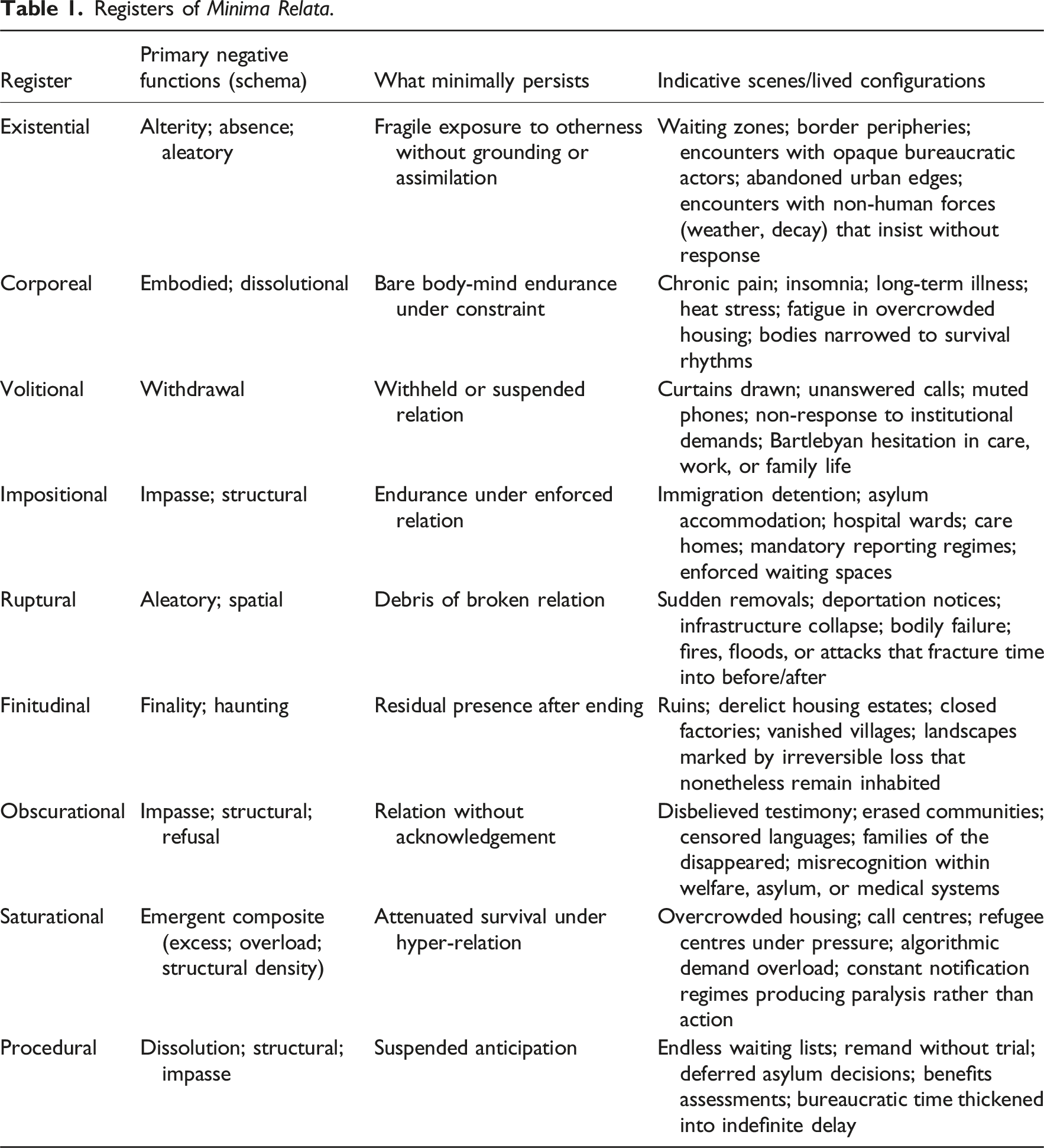
Each register of Minima Relata incorporates one or more of the Negative Schema’s 13 functions, yet none operates in isolation. In real lived socio-spatial situations, the registers fold into one another and can modulate across bodies, place, materials, temporalities, and infrastructures. In their minimal constellations, five elemental constituents recur in instrumental, attenuated and stark proximity: affect no longer propels action or possibility but holds bodies in place; bodies become fixed, stalled, or withdrawn; objects are few, often insistent, offering only the barest props for endurance; space becomes enclosing or conditional rather than navigable; and time falters or thickens, stretching into waiting, rupture, or irreversible loss. These elements are shaped and sustained by discernible political, capital, institutional, and environmental forces.
Registers of Minima Relata.
A brief aesthetic of Minima Relata
Finally, attenuational lingering also denotes a minimal mode of expression – an aesthetic of Minima Relata. This may take the form of fragmentary narrative, testimony, still images, short-form video, audio fragments, diaries, or social media posts that register interruption, suspension, or endurance without resolution. Again, these forms do not aim to complete experience or render it coherent, but to hold it in its incompletion.
What follows are three concise aphoristic outlines that ‘operationalise’ attenuational lingering across different concepts, scenes, and objects. Each selects a governing concept (asylum, pain, autism), situates it within a concrete lived scene, and attends to a specific object through which minimal life is sustained. In the style of Adorno's Minima Moralia: Reflections from Damaged Life, each could be extended into a longer aphoristic form. Here, however, they are deliberately condensed. Their purpose is not exhaustive description, but to show how attenuational lingering brings concepts into sustained contact with their object materialisations, and, by dwelling with them, to sense how they thin, strain, and deform under pressure. Each outline makes visible certain registers of Minima Relata activated in the scene and also the non-identical remainders that escapes conceptual capture. Taken together, they demonstrate examples of where and how minimal, attenuated relations persist, and how a geography of Minima Relata might perceive, distinguish, and write them.
The laminated sign hangs from the door handle, aged, provisional, easily reversed. But ‘Do Not Disturb’ presumes disturbance as the norm, rendering privacy a request rather than a right. Inside the hotel room, asylum does not shelter life but only suspends it. The family remains, but only as administered presence.
Whilst asylum names protection, what it offers is postponement. Life is held without direction. The door sign does not secure refuge but manages the access of others, shielding power from interruption. Rest then is only ever conditional and time belongs elsewhere.
The non-identical is a family spared but never fully received. It is survival organised as waiting, and relation reduced to bureaucratic containment.
The body at night lowers itself to the bathroom floor not as choice but as necessity. The tiles are cold, unforgiving, evenly spaced, grooved – indifferent to posture or need – designed for feet, not backs. Pain here is an atmosphere not an event. It is a duration without climax or end. The floor becomes a support only because nothing else will hold the pain. Relief does not arrive, just endurance.
Pain then as concept, names intensity, signal, pathology, quantity. But here it persists as bare corporeal survival, narrowed to breath, pressure, contact. The tiles do not soothe but merely stabilise. Relation persists only between the body and the surface.
Pain then exceeds its concept not by excess intensity, but by its ordinary, infrastructural persistence.
The boy crosses the same block again and again, pressing the button, waiting for the hand to turn green, stepping off the curb, returning. The city reads this as malfunction or risk. Inclusion presumes participation, flexibility, adaptation. But here relation persists through repetition. The crossing is not a transit but regulation – a way of holding intensity at bay. Movement here does not open possibilities but stabilises survival.
The remainder lies in a form of relation that resists optimisation. What appears purposeless is in fact necessary. The city’s demand for flow fails to register a life organised around attenuation.
Conclusion and implications for cultural geography
A cultural geography attuned to Minima Relata departs from both affirmationist thought and its negative counter-positions. It neither celebrates vitality, nor reduces negativity to nonrelation, voids, limits, or ends. Instead, it provides a new empirical grammar and aesthetic for apprehending socio-spatial scenes where relations endure but only tenuously. Ontologically, Minima Relata reconfigures negativity as persisting in attenuated, diminished, or obstructed socio-spatial-temporal forms. These unsettle the binary of relational and nonrelational thought, and furnish a novel conceptual apparatus for perceiving fragile endurance at the thresholds of life. Politically, Minima Relata sharpens critique by disaggregating the ways in which power constrains and exhausts. By revealing differentiated lived modalities in its registers, it supports diagnosis of how capital, governance, and infrastructure operate unevenly across bodies, times, and spaces, and why varied negativities demand corresponding critical and practical responses. Ethically too, Minima Relata cultivates acknowledgement without redemption. By naming the persistence of unbecoming life in the registers, it resists collapsing suffering into absence or recuperating it as latent creativity. Rather, its ethical value lies in sustaining attention to pre-limit threshold relations without subsuming their experience into closure or repair. Finally, Minima Relata holds methodological and practical value. The registers steer geographic inquiry toward those spaces, atmospheres, traces, residues, and suspensions that would otherwise remain unseen or illegible. They provide a vocabulary for distinguishing conditions of minimal life and a diagnostic for interpreting how they take shape. In doing so, Minima Relata expands cultural geography’s critical and perceptual repertoire, offering a way of thinking and practicing that is more attuned to the persistence of bare life at its thinnest edges.
Coda
The opening epigraphs framed the stakes of Minima Relata: Devo’s ironic celebration of a ‘beautiful world’ that is ‘not for me’ and Adorno’s warning that beauty found everywhere is beauty found nowhere. Taken together, the epigraphs foreground two enduring risks for contemporary cultural geography. On the one hand, affirmationist qua vitalist approaches may translate diminishment into latent capacity, resilience, or becoming, smoothing over lives that do not transform. On the other, negative geographies risk casting absence as an absolute outside – void, abyss, nonrelation – or allowing negativity itself to be recuperated through resilience narratives, dialectical synthesis, or hopeful futures.
To conceive of Minima Relata is to acknowledge both the fragile spaces through which life is lived and the fragile concepts through which life is known: marginalised, lost, precarious, yet persisting lives, alongside the surpluses of their lived experience that exceed our knowing. Minima Relata therefore offers a conceptual, perceptual, empirical, and critical intervention: one that theorises attenuated, minimal forms of life whilst remaining attentive to the residues and non-identical remainders of the (disenchanted) concepts and objects we use to account for them. For it is in this space that barely lived relations endure, minimally, beyond our gaze, exceeding the identities of concepts, and beside both affirmationist and negative accounts. Such is the promise of Minima Relata: a geography of real, diminished, unbecoming life, and a geography accountable to the limits of concepts, perception, and thought itself.
Footnotes
Acknowledgments
The author thanks three anonymous reviewers for their comprehensive engagement with the first draft. He also thanks Joe Gerlach for an early review, and his and Maria Fannin's guidance and encouragement to publish the paper.

Funding
The author received no financial support for the research, authorship, and/or publication of this article.
Correction (March 2026):
The in-text citation of (Dewsbury and Jellis 2021) changed to (Dekeyser and Jellis, 2021).
Declaration of conflicting interests
The author declared no potential conflicts of interest with respect to the research, authorship, and/or publication of this article.