




Abstract
We theorize the epistemological orientations and methodological possibilities of cycling as a sociotechnical, kinesthetic, and emplaced practice relevant across human geography. Foregrounding the liminalities, contingencies, and improvisational potentials of cycling, we highlight how its unique pacing and capacity to traverse and transcend infrastructural and social constraints foster embodied engagements. Our cycling experiences illustrate the activity’s generativeness across research lifecycles. We conceptualize cycling as an exemplar of kinesthetic methodologies, which integrate body, machine, and motion in ways that deepen embodied knowing, inspire serendipitous interactions, prompt reflection on positionality, and expand possibilities for understanding the world in and across place.
Introduction
Embarking by bicycle to follow the Nam Ou dams, I found myself at the heart of colossal transformations of landscapes and livelihoods. The Nam River – a critical tributary of the Mekong River in northern Laos – is the site of a massive series of seven cascade hydropower projects. These dams, emblematic of Chinese infrastructure development and the enclosure of Asia’s waterscapes, cast a shadow over the ecology and connectivity of communities lining the river’s edge. Aware that research access to dam sites is often monitored, I opted to travel (potentially less conspicuously) by bike. However, because the disjointed road network made following the whole cascade by vehicle impossible, I traveled by bike and wooden longboat, cycling as far as the road allowed, then switching to boats downstream. At each dam, I shouldered my bike off the boat, then cycled along new reservoirs and construction roads, before hauling my bike onto another longboat. This mode-switching was necessitated by the massive disruptions caused by the dam project, which has dramatically reshaped fishing, farming, and the connectivity of boat-reliant villages. On the longboats, boat people spoke of dwindling fish populations and the foreclosure of their movements and livelihoods by the dams. Cycling amidst the cacophony of water crashing downstream, the imposing presence of blasted hillsides, eerily still reservoirs concealing remnants of submerged structures, and the scale of each dam, I felt the tensions of this profoundly altered landscape. The reservoirs flattened the once undulating, nutrient-carrying river, impeding the water and my bike from moving downhill, imprinting the riverway's physical transformations in my legs, arms, and back as I rode and carried my bike.
These fieldnotes illuminate some of the epistemological and methodological possibilities of cycling as part of research. As Jessica followed the Laos–China corridor and railway, moving by bike shaped the possibility of avoiding unwanted scrutiny. The infrastructural limitations of the roads and the mode-switching potentiality of cycling catalyzed encounters with residents on boats. The interplay of body, bike, villages, and profoundly altered land, road, and waterscapes calibrated unique insights into the complexities of megaprojects, as the staggering scope of change to waterscapes, topography, and the built environment was observed, discussed, and felt in visceral, embodied ways.
Despite substantial literature on mobilities and mobile methods in geography and robust cycling studies literature, there are few systematic theorizations of cycling methodologies and their particular epistemological potentials. Early references to cycling in fieldwork suggest that bicycles balance speed, cost, and travel distance, while enabling close observation and access (Richardson, 1883; Slater, 1969). More recent discussions consider power and place in fieldwork and grapple with the embodied and affective dimensions of knowing through bicycle mobilities (Jones, 2005; Larsen, 2014; Latham and Wood, 2015; Lee, 2016; Simpson, 2017; Spinney, 2009; Spinney, 2015). Other works center bicycle autoethnographies and ride-alongs, or techniques for gathering and analyzing data on bicycle mobilities, such as video, audio, physiological, and locational data from mobile devices and data uploaded to cycling platforms (Jestico et al., 2016; Larsen, 2014; Lee, 2016; Lloyd, 2020; Spinney, 2006, 2011; Sun, 2017). These perspectives are vital. Yet cycling, as a way of moving, sensing, and experiencing space and time, has broader and more nuanced epistemological and methodological possibilities and latent potential for illuminating crucial questions about place, sociospatial relations and encounters, and human–environment relations.
Our paper builds a more synthetic framing of cycling as a geographical research practice, motivated by Latham’s (2020, 666) exhortation for reflections on how geographers think “through and with method” and by the expansion of cycling worldwide. 1 We offer a reflexive analysis of how geographers come to understand and interpret the world through cycling and situate the activity within a framing of kinesthetic methodologies, which we conceptualize as approaches that foreground embodied, emplaced, self-propelled movement in knowledge production. At the intersection of mobile and sensory methods, we define kinesthetic methodologies as the physical act of propelling the body through space, with this movement actively shaping the contours of perception, experience, and understanding. Cycling serves as just one of many possible modes of movement. Similar approaches have been adopted in fields like performance studies, where bodily engagement with movement has illuminated how the senses, subjectivities, and social relations are co-constituted in motion (Cancienne and Snowber, 2003). Yet there remains potential for geographers to further explore how kinesthetic methodologies can enrich ways of knowing and seeing the world. Our core claim and contribution is that the unique possibilities of cycling as a geographical research practice can be understood by theorizing cycling as an emplaced kinesthetic methodology.
In sections 2 and 3, we synthesize concepts from interdisciplinary scholarship on mobile methodologies and social science cycling studies to build a framework that accounts for the unique epistemological orientations and methodological possibilities of cycling as a geographical way of knowing. The mobility turn in geography and related fields has established some of the epistemological affordances of motion, including dynamic encounters with sociospatial and socio-temporal relations; sensorial or felt modes of embodied knowing; and serendipity and surprise. We synthesize these ideas with concepts from cycling studies to conceptualize cycling as a distinctly sociotechnical and geographic practice that (1) constitutes meaning, encounter, experience, and subjectivity; (2) considers the liminalities of cycling practice; and (3) accounts for the contingency of cycling practice and meanings within particular places and times. This framework offers a means of apprehending how cycling shapes epistemological and methodological possibilities in dynamic, sensorial, and emplaced ways. We show the generative potential of cycling methodologies beyond their typical deployment for the study of cycling itself and argue for positioning cycling as one research praxis within a wider suite of kinesthetic methodologies.
In section 4, we explore the epistemological and methodological insights that arise from cycling, drawing examples from our own experiences ranging from daily commutes to long-distance bike tours across Asia, North America, and Europe. Specifically, we attend to the sociotechnics, liminalities, and emplacements of cycling in order to illustrate how cycling, as a way of moving that fuses body and machine, and structures epistemological orientations and interpretive possibilities. We also reflect on our positionality as cyclists, attending to when and where the activity enables access to previously closed-off sites. At the same time, we consider the factors that condition perceptions of cyclists in ways that can render them visible or invisible, such as gender, race, age, and the frequent solo travel that cycling-based fieldwork necessitates. In all three of our cases, this has at times meant traveling alone as a woman.
While our respective research programs center different questions in different places, we share a commitment to cycling in our everyday lives and research alongside an interest in how cycling shapes our observations of and encounters with people, places, infrastructures, and environments. Mia is a political geographer who studies infrastructure development in places imagined as frontiers, namely, the Arctic and orbital space. She has used a bike to get around cities like Seattle, San Francisco, Los Angeles, and London. Her research into Arctic spaceports led her to cycle across Shetland’s four main islands in 2022 to the SaxaVord spaceport being built at the archipelago’s northern end, and she has bike-toured elsewhere in Scotland, England, and Spain. Jessica is a human geographer and political ecologist studying infrastructure, issues at the environment-society nexus, and global China. A regular cycle commuter in places spanning Yunnan, Berkeley, Boulder, Salt Lake City, and Vancouver, she has incorporated cycling into her fieldwork in rural Laos and China and undertaken multi-week bike-touring trips in Taiwan, New Zealand, Laos, and China. Sarah is an urban geographer who studies place-based politics and community struggles over homelessness, impoverishment, and gentrification-based urban revitalization in Chicago and Seattle. As a lifelong commuter cyclist, her urban geographical cycling is direct, when she is riding to, through, and from a particular research site, but also ambient, as in the research-relevant encounters or observations that arise in riding as part of everyday urban life. 2
Moving, seeing, sensing, and encountering: Towards kinesthetic methodologies
Geographers’ engagement with mobilities is robust, originating in efforts to move beyond sedentarist orientations to space and place to consider how embodied sensations, emotions, and affects constitute place, socialities, and spatialities (Cresswell, 2006; Sheller and Urry 2006; Urry, 2007). Across social, cultural, political, and urban geographies, scholars have examined different modes (driving, cycling, walking, running, riding, or being a passenger) and purposes of mobility (commuting, recreation, and health), as well as the kinesthetic, sensory, and spatial dimensions of various forms of bodily movement, such as dance or martial arts (Bissell, 2016; Cancienne and Snowber, 2003; Cresswell, 2011; Fincham et al., 2010; Merriman, 2020; Norcliffe et al., 2023). Others have examined the social specificities of mobilities and how they are co-constituted with race, gender, age, dis/ability, class, and other structures of difference (Edwards and Maxwell, 2023; Mason et al., 2023; Merriman, 2017; Warren, 2017). At a broader scale, researchers have considered the intersection between mobilities and racial-capitalist hierarchies of value (Springgay and Truman, 2022), the sensory and affective dimensions of urban walking (Middleton, 2010), as well as the need to rethink mobility itself as a material-semiotic transformation of energy entangled with power, racialization, and environmental exhaustion (Davidson, 2021). The drawing of such large-scale connections makes sense when considering that the invention of steam-powered movement in the 18th century played a large role in inducing the current climate crisis.
The mobility turn in geography sparked a proliferation of innovative methods, including go-along interviews, participant observation on the move, and techniques for generating and interpreting data on and in motion, such as location, route, and speed data, biorhythms of moving bodies, and video and audio recordings (Fincham et al., 2010; Hein et al., 2008; Jestico et al., 2016; Sun, 2017; Vergunst, 2010). These methodologies are well-represented in cycling studies, with mobile autoethnographies, ride-along interviews, participant observation, and immersive audio/video recordings all gaining traction as techniques for understanding cycling embodiments, affects, spatialities, and socialities (Fincham, 2006; Larsen, 2018; Lee, 2016; Lloyd, 2020; Spinney, 2006, 2011). Across human geography, mobile methods are part of ongoing efforts to transcend the hegemony of linguistic and visual methods and the representational limits of text and imagery, instead offering insights into space, place, and human–environmental relations through pre-representational or nonrepresentational bodily experiences or perceptions such as sound, touch, sensation, and movement (Cox, 2017; Foley, 2015; Spinney, 2006). Geographers have shown the potential of mobile, embodied, and immersive encounters with lands, lives, and infrastructure to illuminate sociospatial relations and meanings (Bissell, 2016; Brown and Shortell, 2016; Mason et al., 2023). Similar commitments in anthropology and sociology have given rise to sensory ethnography (Howes, 2019; Ingold, 2000; Pink, 2008) and live methods (Back and Puwar, 2012; Sheller, 2014). These immersive approaches are closely related to mobile methods, as they seek to extend interpretation beyond the (typically) one-directional acts of seeing and hearing to more embodied, multisensory engagements. They direct ethnographic attention to mind–body–environment connections through intentional practices of being with research participants—walking, eating, cycling, sitting, and so on (DiCarlo, 2025; Larsen, 2014; Lee and Ingold, 2020). Importantly for geographical research, some writing on sensory ethnographies attends to how place shapes embodied sensations and social encounters (O’Neill, 2023; Pink, 2008).
These studies demonstrate the capacity of mobile methodologies to provide unique insights into temporalities, spatialities, and human–environment relations, beyond what is typically knowable through sedentarist techniques. Pierce and Lawhon (2015) and Mason et al. (2023) trace how walking as an embodied practice of observation and experience can reveal structures, subjectivities, and politics of sociospatial formations such as boundaries, borders, infrastructure, territorialities, occupations, and inhabitations. Other work points to how mobile methods may illuminate microfeatures or microgeographies of place (Finlay and Bowman, 2017; Hein et al., 2008), fleeting or ephemeral actions, experiences or meanings of place (Spinney, 2009), more-than-human elements of place (Foley et al., 2020), and mundane experiences or place features likely to be forgotten, unseen, or unmentioned by researchers or participants in sedentarist methods (Brown and Shortell, 2016; Fincham et al., 2010; Middleton, 2010). Some trace how spatiotemporal patterns of movement offer insights into sociospatial experiences and meanings of encounters with landscapes and infrastructures (Brown and Shortell, 2016; Larsen, 2018; O’Neill and Roberts, 2019; Spinney, 2006). Movement in and through a place may evoke consciousness of other spacetimes in ways that inspire new research directions. O’Neill and Roberts (2019) show how walking methods in biographical research can evoke memories of the past, while Back and Puwar (2012: 10) explore how sensations, observations, and reflections on mobility can prompt speculative re-imaginations of “...future inhabitations and relationships.”
Mobile and sensory/immersive methods are unique not just for what they make legible in research but how they do so. Some suggest that these approaches are characterized by their conceptual and epistemological openness, centering pre-representational ways of knowing that foreground sensations and experiences as opposed to language, symbol, or inscription. Boas et al. (2020: 143), for instance, hold that mobility has inherent “heuristic potential.” As method, movement offers a conceptual tool and means of formulating theoretical claims (see also Ingold, 2000; Lan, 2016; Wunderlich, 2008). Others characterize this epistemological openness as rooted in unpredictability, arguing that mobilities and immersion tend to catalyze encounters with people, objects, practices, activities, feelings, sounds, and smells that are noticed because of “...unexpected relationalities with the environment, the body and the senses. Presented with serendipity, surprise, strange encounters, alternative ways of categorizing and knowing the world emerge” (Back and Puwar, 2012: 10; see also Fujii, 2015). The bodily exertion of movement has also been conceived as epistemological, as in Ingold’s (1993) discussion of “muscular consciousness” (Bachelard 1969)—the idea of knowing and feeling landscape contours through the effort of traveling on foot, which echoes in Spinney’s (2006) and Cox’s (2017) reflections on cycling. Others point to characteristics of motion itself as epistemologically significant, noting how speed or pace, stoppages or flow, and rhythms and iterations may cue (or impede) awareness of topography, human and non-human presences, built or environmental conditions, and much more (Jensen, 2010; Larsen, 2018; Brown and Shortell, 2016).
Discussions of mobile methods also point to ways in which all these epistemological valences—relational encounters, bodily sensations, rhythms and patterns of motion, and the affective, emotional, and physical responses they provoke—are differentiated across modes and ways of moving. For instance, a cyclist encounters human and physical environments in a more immediate and embodied way than someone moving through the same environments inside a vehicle (Larsen, 2018; Spinney, 2010). Pedestrians, cyclists, and car drivers all encounter road infrastructures, but their access, speed, and directional agency in these encounters differ, with implications for what can be sensed, felt, and experienced (Jones, 2012). Some people stroll unassisted on two feet, while others walk with assistive devices of various kinds. Various modes of ambulation affect experiences of movement and encounters with infrastructure, influencing what is and can be known and sensed through mobilities (Edwards and Maxwell, 2023).
This discussion of mobile and sensory/immersive methods lays the groundwork for understanding the unique epistemological possibilities of cycling as a research practice. It also demonstrates the importance of theorizing kinesthetic methodologies as distinctly combining mobility, sensoriality, and proprioception. Reading across these literatures, we note that mobile methods are sometimes but not always sensorial or immersive (e.g., audio or video diaries of participants’ journeys center mobility, but the researcher is not in motion). Some immersive methods involve mobilities, while others do not (e.g., an ethnographer participating in a community meal). We conceptualize kinesthetic methodologies as the intersection of these two frameworks: Research practices that are mobile and sensorial and embodied. Kinesthetics—the study of body motion and people’s perceptions of their movements—center the “sensing or feeling the motion” (Herman and Hollingsworth, 1992: 2). In their physicality and tactility, kinesthetic methodologies are a distinct approach that involves not just looking, listening, or interacting while moving through space but also being closely attuned to how one’s body mediates those perceptions and experiences. Articulating kinesthetic methodologies invites reflection on the interpretive significance of tactile, muscular, and sensory engagements with place; the kinds of ethnographic encounters that may be enabled or prevented through propelling bodily movement; and the ways in which the kinesthetic qualities of different bodily propulsions may shape knowledge and knowing in research. Our formulation of kinesthetic methodologies aligns with and extends prior writing on mobile methods and sensory and immersive ethnography by drawing attention to the unique epistemological affordances of body-powered movement.
All kinesthetic methods involve body-powered movement: A cycling researcher and a walking researcher move with and through the lifeworlds they study. But the kinesthetic qualities of these forms of embodied motion are unique. Different languages and cultures are sensitive to various aspects of what can be felt and noticed by cycling, as the many words for “bicycle” suggest. The French vélocipède translates as “swift-footed,” while the German fahrrad means “drive wheel” and the Estonian jalgratas “leg wheel.” In Japanese, 自転車 means “self-revolving vehicle,” and in Chinese, 自行车 translates to “self-propelled vehicle” and 脚踏车 to “foot-pedalled vehicle”. Centering kinesthetics invites attention to how the body and its extensions—whether minimalist sandals, single-speed bicycles, or heavily engineered snowmobiles—mediate the relationship between perception and the environment. Whether in the form of walking down a city street, handcycling through a quiet park, kayaking across a choppy bay, or skiing down a powdery slope, kinesthetic methodologies shape possibilities for sensing and understanding the world in manifold ways.
Some of these propositions appear in prior auto-ethnographies of cycling. Spinney (2006) conceptualizes spatial knowledge made through cycling as felt in the overlayering of kinesthetic practice, landscape, and the gearing ratios of a bicycle. Jones (2012) and Larsen (2014, 2018) trace how knowing through cycling draws upon sensescapes composed of vehicle traffic, topographies, road surfaces, weather, and more. These insights emerge from studies of specific kinds of cycling mobilities and geographies, such as psychosocial experiences of sport cycling, embodied routines in commuter cycling, or affective discipline of cyclists in and through auto-centric road infrastructures. While these works were not conceived as systematic framings of cycling methodologies, they do suggest that accounting for what is unique about knowing through and from a bicycle requires thinking through multiple vectors: kinesthetics, machines, infrastructures, rules, built and “natural” environments, and more. In the next section, we delve into the cycling studies literature to more fully articulate a framework for kinesthetic methodologies in human geography, with cycling as an illustrative form.
From studies of cycling to cycling geographies: Sociotechnics, liminalities, and emplacements
Social science research on cycling is vast, studying it as a mode of transportation, sport, and recreation, a vehicle for social and political critique, a means of identity performance or nation building, a catalyst for community formation, and more (Christensen, 2017; Furness, 2010; Norcliffe et al., 2023; Oldenziel, 2017). Scholars have traced histories and geographies of cycling (Horton et al., 2007; Jones and Azevedo, 2013; Norcliffe, 2016), analyzed patterns of race, gender, age, class, and dis/ability with respect to who cycles (or not), and for what purposes, and explored how these dynamics differ globally (Bernstein, 2016; Brey et al., 2017; Inkle, 2023; Joshi and Baby, 2023; Raab, 2023; Ravensbergen et al., 2019). Cycling has been studied as a political economic relation, including the role of consumer-oriented “cycling culture” and cycling infrastructure development in urban gentrification (Herrington and Dann, 2016; Stehlin, 2015), and cycling as a structure of precarious labor for bicycle messengers and platform-mediated delivery services (Fincham, 2008; Lee et al., 2016; Popan and Anaya-Boig, 2023). Cycling has also been examined as a locus and medium of activism, protest, and public pedagogy through studies of DIY urbanism, Critical Mass 3 events, and racial equity-oriented bicycle tours (Deadwyler, 2016; Furness, 2007; Mirande and Williams, 2016).
Though much of this literature has not directly discussed cycling methodologies, it offers vital resources for theorizing what is unique about cycling as a geographical way of knowing through how it situates cycling as a social, technical, and spatial practice. In the previous section, we situated cycling as a kinesthetic method. Yet it is not only the kinesthetics of embodied propulsive motion that carry epistemological and analytic significance but the ways in which these bodily practices constitute and are given meaning through particular emplacements. From the cycling studies literature, we identify several propositions that help illuminate cycling as a kinesthetic practice that is uniquely emplaced, with distinct implications for how the cycling researcher generates knowledge.
First, cycling studies theorize the activity as sociotechnical: body and machine mediate practices, experiences, perceptions, and meanings, requiring researchers to attend to the infrastructures, technologies, and physical capacities that enable or constrain cycling (Cox, 2019; Duggan, 2020). Bodily and technical needs, terrain, weather, and infrastructure all condition cycling’s rhythms: how far or fast one travels, where and how often to stop, and how one encounters others (Jones, 2005). Bicycles enable intermodal mobilities across roads, trains, ferries, sidewalks, paths, or no infrastructure at all, while cyclists often navigate infrastructure that was designed to prioritize drivers or pedestrians (Horton et al., 2007; Latham and Wood, 2015; Spinney, 2009, 2020). Bodies, infrastructures, and machines co-constitute cyclist needs: shaping where they rest, shelter, wait, warm up (cool off), shower, or seek assistance, equipment, or alternative transportation in a breakdown. These aspects of cycling’s sociotechnicality and emplacement mediate the possibilities and socialities of encounters with other “co-present mobile subjects” (Egan, 2021: 23): cyclists, pedestrians, drivers, children playing, tourists, people gathered at a roadside stop, and so on. We add that cycling’s sociotechnics also configure spacetimes, as they constitute experiences of place and distance, knitting together some places and holding others apart. For instance, bicycle mobility is less route- and schedule-dependent than auto, train, or airplane mobilities—barring when one needs to mode-switch and hop on a ferry, for instance.
Theorizations of cycling as sociotechnical extend to the subjectivities of cyclists (Golub et al., 2016; Spinney, 2006). The cycling subject is seen and situated through the bicycle, inseparably connected to it as mobility technology and its associated meanings, but also through their perceived age, gender, race, and bodily capabilities. This hybrid sociotechnical subject is imbued with meaning through normative imaginaries about who does or does not ride and why. Bicycles and related objects can signal or perform identities and social locations through visible attributes like bike type, condition, specialized gear, and so on. Meanings associated with the cycling subject also arise from the ways they are seen or understood to inhabit infrastructures: Riding on roadways designed for and dominated by cars or trying to reduce risk by riding on sidewalks or pedestrian paths, for example, gives rise to social scripts about cyclists as risk takers, rule breakers, nuisances, perplexities, or dangers (Jones, 2005).
Second, cycling studies theorize the emplacements of cycling and cyclists through their perceived and enacted in-betweenness or liminality. In auto-centric places such as many North American cities, bicycles and cyclists are frequently understood as matters and mobilities out of place (Aldred and Jungnickel, 2013; Spinney, 2009), yet elsewhere, say Amsterdam or Copenhagen, they may be embraced as decidedly in place. Others conceive of the liminality of cycling through its infrastructural affordances. While movement by car, airplane, or boat requires specialized infrastructures, cycling demands much less, allowing the activity to unfurl any and everywhere. Cycling infrastructure, such as protected paths, signals, or signage, is rare in many places, and cyclists must often inhabit infrastructure designed for vehicles or pedestrians. Cyclists chart their own creative multi-modal and counter-infrastructural trajectories: riding on sidewalks, over and around barriers, going entirely off-road/path, taking the bike on mass transit, and carrying or pushing it on foot (Aldred and Jungnickel, 2013; Furness, 2007; Jones, 2005). Amidst these shifting practices, Jones (2012) situates cycling liminalities in terms of their embodiments and affects, tracing the co-presence of fear, pleasure, joy, and excitement; strength and fatigue; slowness and speed. These liminalities inflect the situated visibilities and invisibilities of cycling. Locating the in/visibility between speed and slowness, Luiselli (2014: 34) observes: “The bicycle is halfway between the shoe and the car, and its hybrid nature sets its rider on the margins of all possible surveillance … allow[ing] the rider to sail past pedestrian eyes and be overlooked by motorized travellers.” Aldred (2013) and Lee (2016) argue instead that the liminal in/visibility of cyclists is predicated on socio-infrastructural constructs: In car-centric places, cyclists are simultaneously hypervisible as a stigmatized presence and overlooked or even dehumanized by drivers (see also Delbosc et al., 2019; Stephens et al., 2019; Zheng et al., 2020).
Finally, the cycling studies literature underscores that the constitution and meanings of various cycling practices take shape within particular places and times. For instance, in India, cycling has been associated with impoverishment (Joshi and Joseph, 2015), while in postsocialist China, it has come to signify masculinity and elitism (Christensen, 2017). In the Netherlands, cycling has shifted from expressing an egalitarian aesthetic toward performing urban upper-class cosmopolitanism (Kuipers, 2013). Within urban growth initiatives, cycling has been marginalized and stigmatized in Brazil (Jones and Azevedo, 2013), yet valorized in northern Europe (Caimotto, 2020). Other research attends to localized sociospatial relations and politics, showing, for instance, how cyclists and cycling infrastructure (bike racks, bike lanes, bike-share docks) are understood through local struggles over gentrification, platform amenities, safety, and policing (Everett, 2017; Leszczynski and Kong, 2023; Lubitow, 2016). These accounts of the geohistorical specificities through which cycling is constituted and made meaningful prompt vital reflexivities in cycling methodologies. They offer ways to think through how a cycling researcher may be perceived and how they themselves may encounter, sense, and understand the world from a bike.
The conceptual insights we have drawn from social science studies of cycling situate the activity as a particular kind of kinesthetic practice that is emplaced and made meaningful through multiple sociomaterialities (bodies, machines, infrastructure) and through the prevailing sociospatial relations and norms of particular places and times. Attending to the sociotechnics, liminalities, and place-specific significations of cycling builds a more expansive foundation for exploring cycling as a geographical kinesthetic methodology, one whose embodied mobilities, sensorialities, and dynamic emplacements offer unique epistemological affordances.
Bicycle epistemologies and methodologies
In this section, we explore how the kinesthetics and emplacements of cycling shape its epistemological and methodological possibilities, drawing from ethnographic reflections prompted by our cycling experiences in China, Laos, Taiwan, the U.S., and U.K. We show how the sociotechnics, liminalities, and emplacements of cycling condition its epistemological orientations and interpretive possibilities for this kinesthetic means of traversing places. More relationally and reflexively, we reflect upon how the world makes sense of us as cyclists navigating familiar and unfamiliar landscapes, again with attention to how these (mis)apprehensions can provoke new research observations or directions. The three subsections that follow explore how the cyclist moves through, senses, and understands the world from their bike, and how they are seen and not seen.
From liminal spaces to close encounters
In our experiences, the epistemological openness of cycling, particularly its tendency to evoke generative surprise, is not entirely unstructured but shaped by the liminalities and emplaced rhythms of cycling. For instance, Jessica’s cycling in seemingly remote places in China catalyzed meaningful surprise by navigating diverse road infrastructure: Planning routes in a Tibetan prefecture of Yunnan province, I anticipated busy multi-lane highways full of people and vehicles. Yet, I often rode these massive roads alone, cutting through remote areas devoid of traffic or apparent signs of inhabitation, a surprise that cued my attention to the intrinsic contradictions of surrounding infrastructure development projects. In such remote areas, I frequently encountered unmapped dirt roads, which I expected to lead to more isolated places. Yet mixing and matching different routes catalyzed surprise. One day, I pedaled an unforeseen route off the highway, down a dirt road through spring grassland flowers. Instead of leading to deeper isolation, the road gave way to an eruption of makeshift structures, heavy machinery, and the distant hum of excavation – a major project where I least expected it. These seemingly chance encounters with unexpected manifestations of China’s infrastructural and extractive landscapes were not incidental nor random. Rather, they were enabled by the bicycle's capacity to mobilize diverse paths. From ambitious road expansions to clandestine mining operations to massive, deserted highways, these surprises prompted deeper understandings of the scope, pace, and incongruities of infrastructure projects and their implications for nearby communities and environments.
For Mia, cycling has also prompted serendipitous insights by setting in motion encounters with place, conditioned by the demands of a long-distance journey: places to stay, rest, and refuel. Planning a bike-touring trip across Shetland led to a fortuitous fieldwork opportunity: The trip was intended as a recreational stop en route to Norway and Sweden, where I planned to research the development of two spaceports. During my holiday in Shetland, seeking accommodation roughly every 60 kilometers, I needed a place to stay on Unst, the northernmost island. I discovered that the hostel at the former Royal Air Force base could no longer be booked, for the entire facility was being transformed into a spaceport. With this type of infrastructure already on my research radar, my visit for leisure turned into fieldwork on the fly. I found alternate accommodation in Unst within cycling distance of the budding spaceport so that I could visit it several times. Cycling back and forth between town and the development site in a place with only a few hundred residents, I was both conspicuous and familiar. Becoming the “girl on the pushbike” allowed me to strike up conversations with people working at the incipient spaceport and locals on the side of the road tending to their Shetland ponies. These encounters were facilitated by the oddity of cycling across a wet and windy landscape where most visitors and residents drive.
In these ways, cycling offered a “corporeal engagement” with an unanticipated research site, opening up unexpected places and perspectives (Latham and Wagner, 2021).
Sometimes the bicycle itself catalyzes meaningful surprise. Sarah’s Chicago-based research engaged a neighborhood fighting for services, affordable housing, and public safety after decades of extraction and abandonment: Riding through the neighborhood, a breakdown rendered my bike unrideable. Pushing it toward the bus stop, I was shocked to encounter a newly opened bike shop in the borderlands of the neighborhood. Over the years of cycling these major commercial streets, I had observed little to no change in the streetscape of corner stores, boarded-up shops, and storefronts repurposed by churches and nonprofits. Within this experiential frame, I immediately noticed the bike shop as a perplexity. Its development confounded the categories of places I had heard long-term residents calling for over many years: A pharmacy, a hardware or grocery store, a “sit down place” (restaurant, coffee shop). But neither was it the sort of “hang-out store” that residents argued were sites of troublemaking and police harassment. Carrying this perplexity with me over time, I began to hear residents and organizers articulating an additional kind of place, repeatedly framed as “not for us”: new developments they understood as prefiguring their neighborhood as desirable to elite newcomers, sowing seeds of their eventual displacement.
In these ways, cycling encounters with urban landscapes cued my ethnographic attention to a range of sociospatial claims and politics being made and contested. This example further underscores the variegated affordances of different kinds of kinesthetic mobilities. The potential for a sudden forced transition to walking (in this case due to the “unrideability” of the machine) is inherent to moving by bike, and this abrupt shift to the slower cadence of walking prompted my noticing of a new and anomalous presence in the streetscape.
Sense from motion
The rhythms, cadences, and temporalities of cycling constitute unique modes of paying attention to place and people through what is felt and observed through kinesthetic mobilities. Consider, for example, Jessica’s experience cycling through the bustling urban landscape in Taipei, particularly along the Dihua Street Market during Lunar New Year: I weaved through narrow streets lined with colorful lanterns, dodging families shopping and other cyclists and vehicles. Amidst the smells of lunch and the dings of cyclists warning of their approaches, I became attuned to life unfolding around me. The fleeting glimpses of residents buying holiday gifts and the subtle shifts in weather and light throughout the day all contributed to my sensory impressions. Paying attention through motion offered me immersion in the flows of urban life. The staccato stop-start, pedal-push pace of moving by bicycle in crowded streets, together with the distance I could travel in a day, amplified my attention to changes in these rhythms and flows as I traversed a range of social contexts and spaces.
The sociotechnics of cycling also structure rhythms of riding, which, in our experience, hold a dynamic tension between hyperfocus and unstructured reflection. Following Larsen (2018: 41), cyclists are “...nakedly exposed to the affective intensities of topographies, ghastly weather and dangerous cars, buses and lorries.” Cycling requires intense focus on one’s surroundings for safety and survival. Yet it simultaneously conditions opportunities for unstructured reflection as the cyclist moves through well-known, protected, or quiet spacetimes, relatively untethered from other attentional demands. This dynamic of hyperfocus and reflection, Everett (2017) argues, catalyzes iterative cycles of observation, noticing, and reflecting as cyclists traverse a familiar place.
The contours of knowing from a bike are sometimes observational, arising from what is seen, the questions these observations prompt, and the research curiosities that may brew over time. For instance, Sarah’s Seattle commute passes a viaduct that has been the site of struggle for years, as the city tries to remove and prevent tent encampments, and unhoused people reinhabit and rebuild. After an eviction several years ago, the city installed rip-rap stones under the overpass—hostile architecture aimed at preventing inhabitation: One morning, my hyper-focused cycling gaze immediately spotted a change: The stones had been rearranged into shapes and patterns (Figure 1 Stone sculpturing at a communal gathering place sheltered by an overpass, Seattle (photo: Sarah Elwood).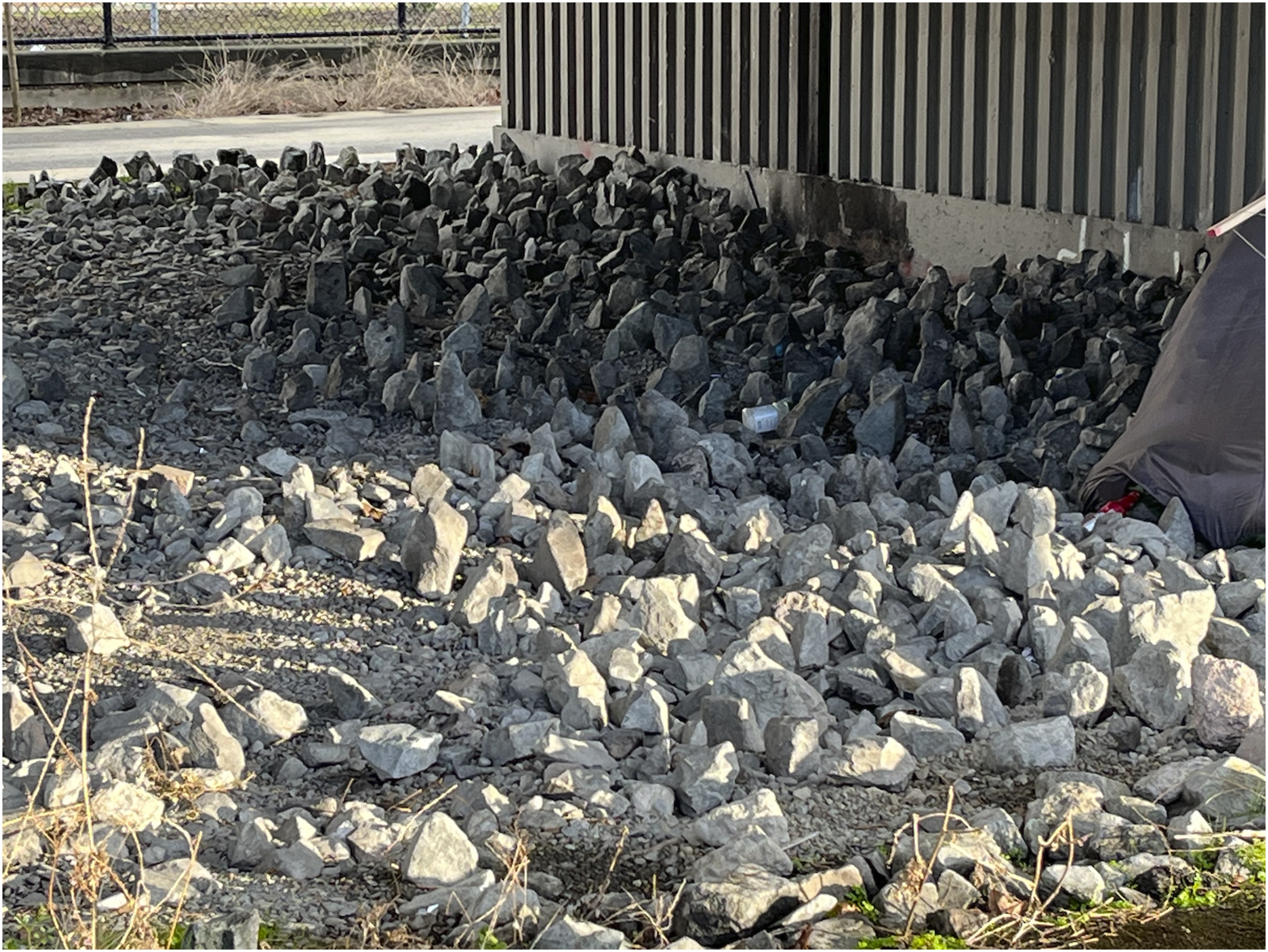
The contours of emplaced knowing from a bike are also sensorial. Jessica’s cycling in Laos underscores the entwining of the senses with the surrounding infrastructures of the bike, road, other vehicles, and village: From the bicycle, I could feel the wind rushing past me, hear the roar of engines, and smell the acrid tang of exhaust fumes. These sensations attuned me to local rhythms and routines, moving in sync with the ebb and flow of activities around me. On northern Laos’s steep, meandering roads, I felt oddly in sync with large trucks as their gears lurched the heavy vehicle uphill, not unlike the grind of moving my body and bike with slow, heavy legs (Figure 2 Cycling in a slow line of trucks over a mountain pass in Luang Namtha, Laos (photo: Carl Zoch).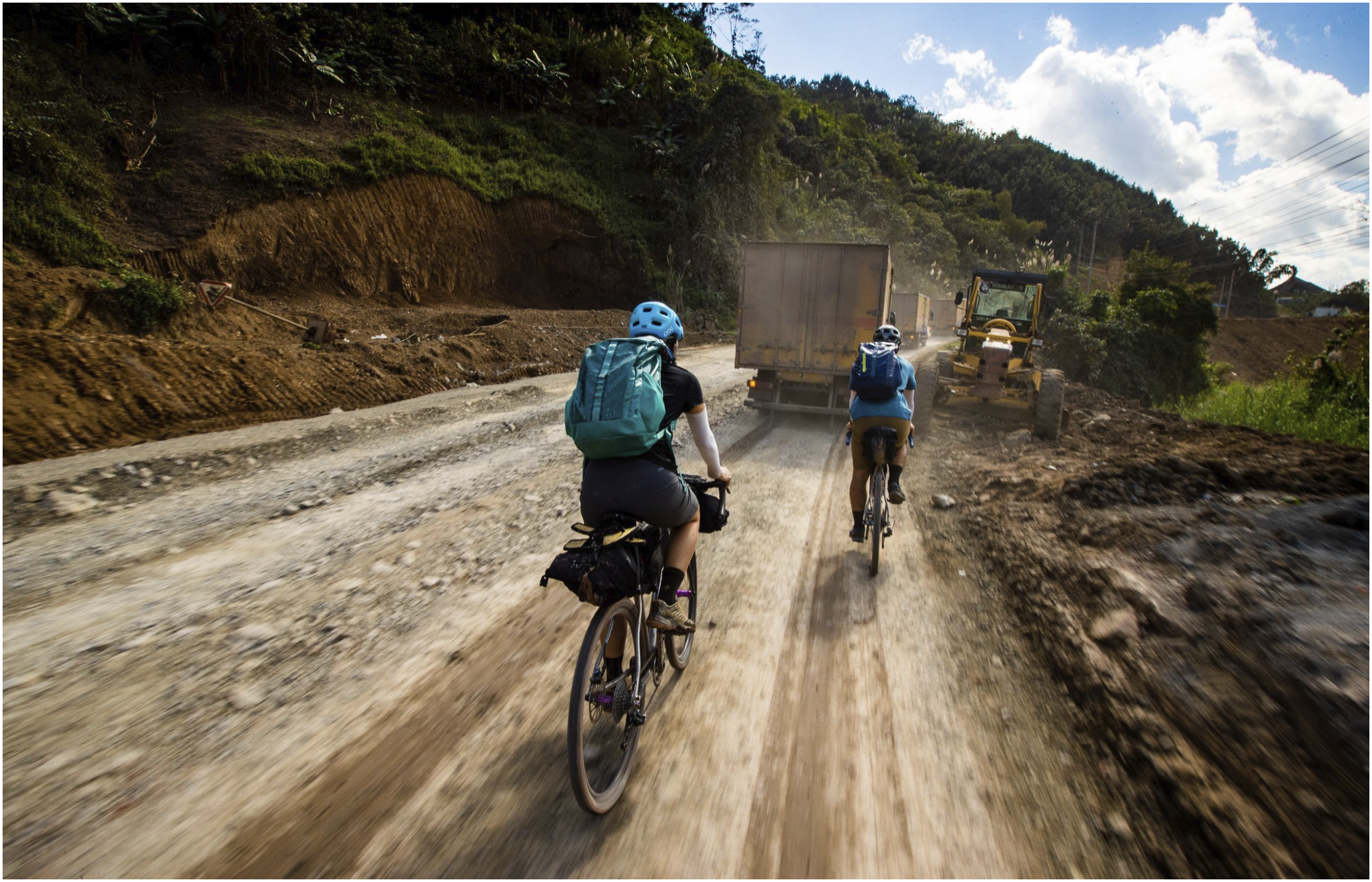
Perceptions and positionalities of the cyclist
The sociotechnical embodiments and dynamic emplacements of cycling and its hybrid subjects inform not only how and what the researcher knows but also how they are known, shaping ethnographic encounters and offering interpretive windows onto sociospatial relations. Mia’s experiences in Shetland (Figure 3) illustrate how perceptions of a cyclist constellate through emplaced understandings of who cycles and where, in ways that structure the cyclist’s in/visibility and in- or out-of-placeness: As I interacted with Shetlanders on my journey, ferry operators, spaceport employees, and schoolchildren routinely referred to me as “the girl on the pushbike.” When unpacked through the sociotechnics of cycling, this simple phrase speaks volumes. The wording signals hypervisibility: my presence was unusual enough that it had either been remarked upon by others or made me recognizable after a single sighting. In Shetland, although the roads are lined with UK national cycle route signs, the salience of my bike and its panniers signalled an out-of-placeness that residents perceived at the nexus of gender, machine, and emplacement: A lone female riding a non-motorized bike along these rural roads. The interpretive frames through which residents situated my out-of-placeness (gender, youth, pushbike, riding solo) simultaneously seemed to condition their perception that I was unthreatening: approachable, strange but unsuspicious, and perhaps in need of help.
4
My out-of-place-ness tended to spark curiosity and affirmative engagements, opening windows onto ongoing social and spatial change in Shetland. Like everyone else who needed to travel across the archipelago, I used inter-island ferries. Years ago, drive-on ferries replaced the passenger-only ferries that were once the mainstay of inter-island transport. In a village called Yell, I waited to board the ferry, my waterproofs soaked through from a heavy downpour. A crewman took pity on my sodden self, allowing me to board early to sit in the warm, dry passenger room for a good half hour before the ferry departed. I sat there hoping to eventually meet some locals and strike up a conversation, but no one came to join me. Instead, everyone stayed in their cars after boarding. Later, on land, I heard residents criticize the transformation of Shetland’s ferries from a walk-on to drive-aboard system, lamenting the loss of spontaneous conversation over a quick cup of tea due to people’s reluctance to leave their cars. As a geographer interested in the politics of infrastructure, these anecdotes offered clues to the societal effects of transportation development, which I was able to relate to my experience of having to switch modes en route. Cars allow seamless movement on and off the ferry, enabling drivers to remain ensconced within the comforts of their four-wheeled vehicle. But as a cyclist, with nowhere to sit unless I was in motion, during the stop-and-go maritime interludes of my bike tour, I had to make use of the otherwise empty public sitting rooms. The first author bike tours on the empty roads of Shetland in a rare moment of sunshine. Trailed only by her shadow, cycling during such moments of solitude allows reflection on infrastructure, place, and the self as a researcher.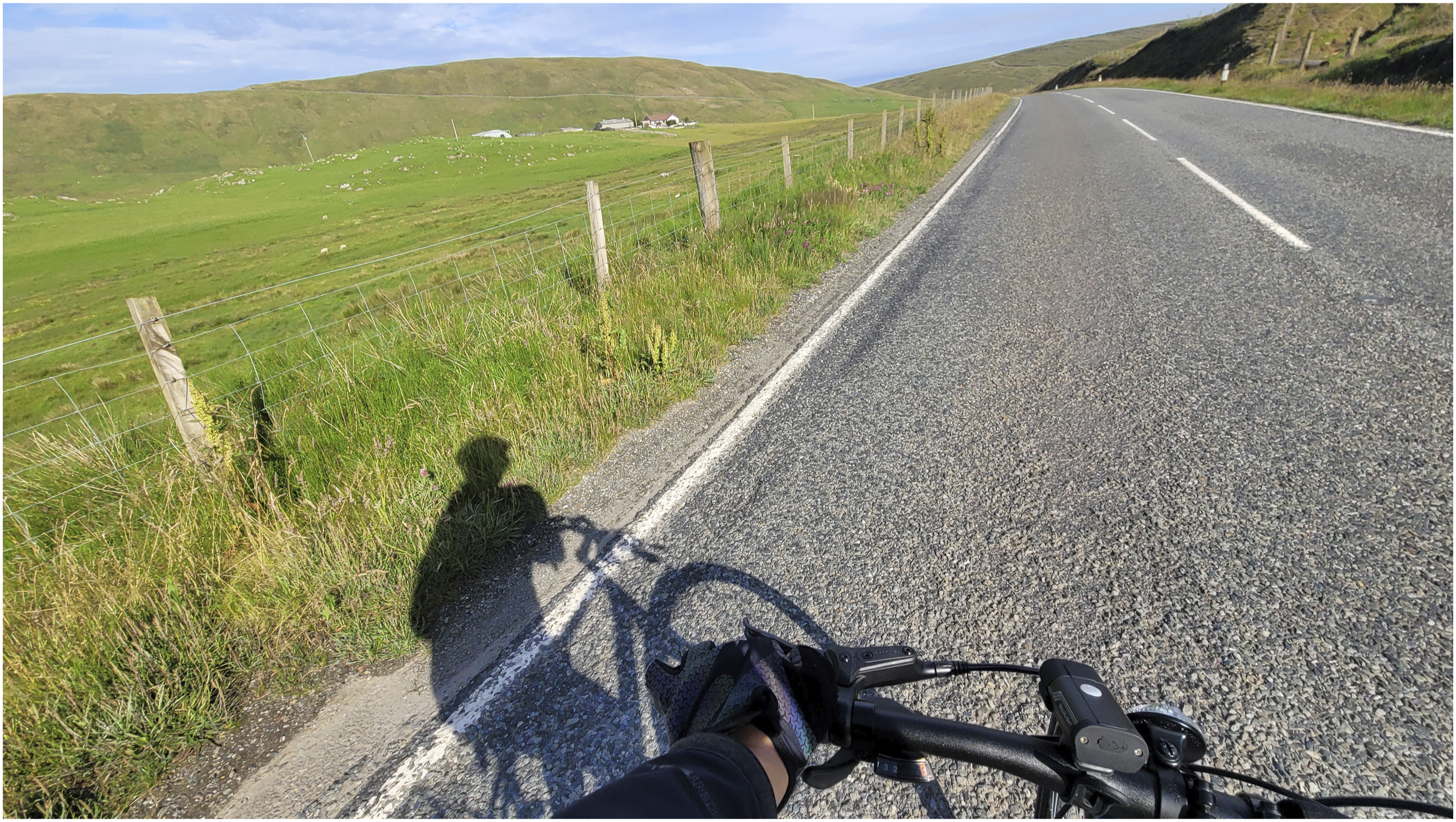
While cycling generally opens more rather than fewer encounters, onboard a car ferry, the passenger room offered a space for quiet reflection—along with much-needed drying of rain pants and a chance to eat some biscuits without them getting soggy—rather than serendipitous conversation.
Reflexive analyses of when, where, and why we are seen and made sense of as cyclists hold rich interpretive possibilities, offering a basis for understanding the sociospatial dynamics of our research sites. As Sarah cycled to and from the site of her Chicago research, residents often commented upon her out-of-placeness: It was quickly clear that a white woman on a bicycle was hypervisible in this majority Black and Latinx part of the city (indeed, I rarely saw any other cyclists on my journeys). Over time, residents shared misapprehensions of who they and others thought I might be. These seemingly casual conversations revealed vital insights into the place. On the west side, an older Black woman I sat with at neighborhood meetings said, laughing, “We saw you the other day and my grandson said, ‘Granny, is she the police?’.” I laughed with her, but also felt, more viscerally than ever before, Black residents’ experiences of whiteness, over-policing, and Chicago’s enduring racial segregation. By contrast, on the east side, longtime residents misapprehended me differently, saying things like “I thought you were the City,” or reporting that their neighbors thought I must be a yuppie. These striking differences in how residents living mere blocks from one another understood my cycling body were an interpretive perplexity. In time, I came to see that these different interpretations were parts of the whole. The entire area was targeted by local government and developers as a site for recapitalization, but the process was unfolding differently. Discourses of crime and disorder as a threat to “community development” were driving racist policing on the west side, while on the east, property speculation had already begun in earnest, increasing the presence of (predominantly white) homeowners, developers, inspectors, and assessors. While it would have been unusual to see most of these actors traveling by bike, residents nonetheless interpolated a white newcomer into these categories.
Just as reflexive examination of one’s visibilities as an emplaced and embodied cyclist may prove generative for research, so too can the researcher-cyclist’s particular in/visibilities and in- or out-of-placeness. For Jessica’s experiences in Chinese Special Economic Zones (SEZ), the bicycle provided a kind of “cover.” Because the SEZ was located at the main international border crossing, tourists regularly passed through. Although cycle-tourists did not usually frequent the SEZ, it was not uncommon to see them using this border crossing. The bike became part of how I was understood in this place. As a white foreigner on a bike, I was perceived as a tourist curious about massive construction endeavors. This assumption allowed me to explore construction sites independently and ask questions about the ongoing changes. In one instance, I was able to cycle between projects that I had been restricted from in earlier attempts made on foot. My presence was interpolated into the particular sociospatial frames of the place, understood as an outsider but a familiar type, a tourist, who might be allowed to move about more freely than, say, a foreign academic. Emplaced perceptions of my race, gender, and bicycle mobility came together to make me out-of-place, yet in place, visible yet invisible. These dualities allowed me to come and go without the scrutiny that might have been given to vehicles or pedestrians.
The cyclist’s potential fugitivity, of course, raises questions around the ethics of access, which must be considered carefully. In some contexts, bikes expand a person’s range of movement and their ability to pass behind doors that would otherwise remain closed. In other contexts, however, that same person may find themselves more easily targeted or harassed, unable to escape as they might in a car or on a motorcycle or quickly hide as they might on foot. For some cyclists, their race and gender may mean their movement on a bike is more likely to be perceived as transgressive, in ways that make their cycling mobilities limited and fraught with hostile, even life-threatening encounters (see Osei and Aldred, 2023).
Through these reflections, we have sought to show how the embodied sociotechnics, sociospatial and infrastructural liminalities, and dynamic emplacements of cycling as kinesthetic methodology can inspire a range of research encounters, questions, and interpretive insights. We model how reflecting upon where, how, and why one moves by bike offers insights for the cyclist-researcher. These insights arise not only “in the field” but also in the places and movements of everyday life on a bike. Narrating some of our cycling experiences through the framework of kinesthetic methodologies, we trace the interplay of body, bicycle, and place across the process and lifecycles of research. Cycling can catalyze research questions and lead to new field sites and ethnographic insights. The machine-body rhythms and infrastructural emplacement of cycling condition epistemological spaces by drawing attention to tensions between speed and slowness, flow and impedance, hyperfocus and open reflection. We have shown how the embodied, sensorial, and attentional dimensions of cycling, as a kinesthetic methodology, constellate perceptions and positionalities of the cyclist-researcher in and through particular places. Reflexive engagement with cycling as kinesthetic method holds rich interpretive potential for understanding geographically specific sociospatial relations as well as provoking questions of visibility, access, and ethics.
Conclusion
The experiences detailed here will likely resonate with cyclists. The range of emplaced encounters we describe may also strike a chord with ethnographers. Our contribution at the intersection of these two worlds shows how cycling can spark new ways of sensing and making sense of the world—ones that are distinctly kinesthetic. Our intervention makes contributions across several literatures. First, we add to the mobile methods literature by expanding its strong focus on walking methodologies and introducing a related group of kinesthetic methods. We build on accounts of cycling ride-along techniques and technologies by offering a more holistic theorization of cycling as an emplaced kinesthetic research practice. A key element of this contribution is our emphasis on how the sociotechnical assemblage of a given mode of moving, whether a bicycle, kayak, or wheelchair, shapes its epistemological and methodological affordances. Our cycling vignettes from the field and our daily lives reveal mobility, and more specifically kinesthetics, as an epistemological orientation that emerges at the intersection of sociotechnics and embodied, emplaced movement, fostering sensorially rich encounters with surrounding worlds.
For cycling studies, including research of cycling geographies, we extend treatments of cycling methods beyond auto-ethnography and ride-along participant observation to offer a more expansive vision of the epistemological and even ontological potential of cycling. We contend that cycling builds knowledge in specific ways and forms conceptions of places in manners distinct from walking, driving, or taking a train. We have shown how cycling can be generative across research lifecycles, from sparking research questions and identifying new field sites to carrying out fieldwork and discerning new research directions, literally and metaphorically. For writing on cycling methodologies, we offer a detailed and nuanced account of the epistemological affordances of cycling, which are implicit in all but a few prior works. We show broader potential for cycling methods in geographical research, spanning studies of urban racial projects to global infrastructural development. We showcase the creative breadth of insights that can accrue from cycling methodologies in the hopes of broadening their uptake.
Cycling-based methods present challenges that warrant attention, raising concerns beyond our present scope. Bicycles and related gear can be expensive and burdensome to maintain or transport to research sites. Researchers must devote substantial efforts to route planning, navigating unfamiliar places, and ensuring personal safety. Local attitudes or policies may also shape who feels safe or welcome to cycle, sometimes reinforcing gendered, racialized, or cultural inequities. Crucially, not all bodies are able—or inclined—to cycle, and insisting on cycling as a default approach risks reproducing ableist norms by excluding those for whom it is inaccessible. Even among those who do cycle, an overemphasis on this mode of travel may privilege certain ways of moving and knowing while occluding others. In other contexts, governmental “green” agendas promoting cycling may perpetuate narrow, privileged worldviews, which overlook that cycling may not be universally available or desirable. These criticisms underscore the need to recognize the social, political, and bodily constraints that can limit cycling’s inclusivity and methodological possibilities. Our intention is not to elevate cycling as a singular or superior method, nor to ignore the complexity of mobility infrastructures that pose safety and accessibility challenges. Instead, we use the activity as an exemplar of a broader range of movement-based methodologies. We highlight the possibilities of cycling as one way to expand our methodological toolkit, recognizing that its applicability and epistemological openings will vary based on geographic contexts, existing infrastructure, and personal abilities. Additionally, the world from a bicycle is necessarily a landed world. Cyclists remain grounded in terrains traversable by road, path, or trail, leaving other domains like ports, oceans, or skies beyond reach. These liminal and littoral spaces require different mobilities and methodologies to access and interpret. As such, cycling methods must be understood as partial, situated within a broader landscape of kinesthetic approaches. By foregrounding cycling’s affordances alongside its exclusions, we encourage methodological pluralism attuned to how different modes of movement shape what and how we come to know.
Cycling is one among many possible expressions of kinesthetic methodologies. We invite researchers to attend to the embodied and structural dimensions of modes of inquiry combining mobility, sensoriality, and proprioception. Beyond cycling, countless other kinesthetic approaches can also illuminate how researchers embody and experience space. Each engages different senses and fosters particular sociospatial interactions and emotional responses, thereby shaping the kinds of knowledge produced. We hope this framework inspires researchers to look to kinesthetic methodologies not just as a means of doing research on the move but as intentional praxes of using one’s body in ways that develop sensorial, emplaced knowing. By centering how we move as integral to what we can know, we hope to inspire a broad and reflective adoption of kinesthetic methodologies to deepen understandings of the world. This invitation is not limited to scholars but also offers food for thought to all interested in cycling, whether seasoned enthusiasts, novices, or those curious about its intellectual potential. Cycling can be a means of transportation or staying healthy, or a fun or competitive sport. It can also offer an invaluable means for insight and engagement through its unique meeting of body, mind, and machine.
Footnotes
Author note
Authors are listed alphabetically to signify equal contributions.
Acknowledgments
We are grateful to the editor and reviewers for their incisive and constructive input, which has helped us strengthen the paper, and to one another for embarking on this collaborative writing. Mia thanks her interlocutors and road- and ferry-side encouragers in Shetland. Jessica is grateful to her many cycling companions, interlocutors, and doctoral research support for her rides in Laos and China. Sarah acknowledges research leave support from the University of Washington College of Arts and Science and the Saint Andrews University Global Fellows Program, which provided vital time and space for her contributions.

Funding
The author(s) received no financial support for the research, authorship, and/or publication of this article.
Declaration of conflicting interests
The author(s) declared no potential conflicts of interest with respect to the research, authorship, and/or publication of this article.