




Abstract
A sense of vibrancy infuses accounts of geographical concepts, yet the prosaic endeavour of making them remains unexamined. Engaging Deleuze and Guattari, who regard concepts as composed of mutable matter with the ability to bring unexpected variations, this paper discusses attempts to deploy concepts less as semantic units belonging to a rarefied realm of theory than multimodal processes that facilitate experimentation with differently embodied and emplaced issues. Offering three critical figures to complement these efforts—the unevental, the unruly, the uncommon—the paper revisits the precarious design of a speculative research artefact to diversify practices and pedagogies of conceptualisation within geography.
I Introduction
Concepts animate geography. They are said to ‘proliferate’ (Simon and Randalls 2016, 11), have ‘open, temporary and mobile’ features (Clifford et al., 2008; xiv), ‘lack […] fixity’ (Agnew and Livingstone 2011, 12) and incite ‘struggle’ (Theodore et al., 2019, 10) when percolating through disparate communities of enquiry (Johnston and Sidaway 2015). Concepts also carry ‘world-making potentialities’ (Simon and Randalls 2016, 7) that enable interventions and foster ‘prefigurative’ thinking about alternatives (Cooper 2017, 336). And yet, although geographers are ‘concept-creating entities’ (Agnew and Livingstone 2011, 12), core assumptions about the form and function of concepts appear intact: they are treated primarily as semantic units bound to theoretical systems and articulated via the medium of academic writing. For Cooper (2014, 26-44), this ‘scholarly’ approach has led to an oversight of the ‘generative ground through which concepts develop, change, thrive, get stuck, and carry power.’ Conceptualisation, after all, occurs within diverse ‘material and technological cultures’ (Greenhough 2016, 38-39), where the thinkable is shaped by—among other factors—the ‘evolving spatialization of cognition’ as it converges with multimodal interfaces and platforms (Lynch and Del Casino 2020, 383).
Entering into dialogue with Deleuze and Guattari’s final co-authored book, What is Philosophy? (1994), this paper asks whether attention to making could enhance critical reflection on geographical conceptualisation. While Deleuze and Guattari have faced scrutiny of late, their orientation to concepts remains understudied within the discipline (MacFarlane 2017; Roberts and Dewsbury, 2021). Deleuze and Guattari apprehend concepts not as pre-existing ideas conveyed through words, but as dynamic compositions that delineate new domains of potentiality. Acquiring variegated guises, concepts are irreducible to any overarching framework and act as lively ‘miniature theories,’ assembled from a wide range of materials and tested in different situations (Bal 2002, 22). Instead of employing concepts as purely signifying elements, Deleuze and Guattari (1994, 77) invite an enquiry into their changing constituents and conditions: a concept is ‘well-made’ when it allows for ‘stimulation, a sort of modulation’ that sets thought along unforeseen paths.
Continuing to extend and modify the work of Deleuze and Guattari, the paper considers making as an interrogative practice that probes the process of thinking and its ability to move beyond itself. It illuminates facets of conceptuality neglected by Deleuze and Guattari, whose writings valorise the capacity of concepts for variation while disregarding their existence as uncertain arrangements and the effort required to sustain them. The paper thus turns to the field of speculative design, which, as Dunne and Raby (2013, 80) suggest, eschews the formulation of complete, functional products in favour of ‘thought-experiments—constructions, crafted from ideas expressed through design.’ Speculative design is a strategy for exploring the conceptual dimension of making by provoking ‘an alternative that through its lack of fit with this world offers a critique’ (Dunne and Raby 2013, 43; DiSalvo 2015; Escobar 2018; Ratto 2011; Wakkary 2021). Concepts—irrespective of their relative materiality—possess a ‘designerly element’ that can be reconfigured to bypass ‘predefined articulations’ and evoke ‘what might be rather than what is fully realized’ (Von Busch 2022, xiv). This aligns the paper with practice-led geography, where curating (Sachs Olsen 2021), drawing (Brice 2024), arts-based learning (Engelmann 2024) and other endeavours of making indicate how ‘a concern with composition […] is also a concern with conceptual thinking’ (Hawkins 2015, 250). When concepts appear through the ‘interaction of sentient practitioners and active materials in the generation of form’ (Hawkins and Price 2018, 4), they turn into speculative designs demanding a constant reassessment of their capabilities.
This argument will progress through two parts: the first relying on Deleuze and Guattari to examine the consequences of understanding conceptualisation as making and the second cutting across their approach by proposing three critical figures applied to the development of a speculative research artefact. The unevental highlights the infrastructures of conceptualisation and the need to question established modes of creation and circulation, which compel thought along certain trajectories; the unruly refers to the inclination of concepts to mutate in ways that resist assimilation into prevalent schemas; the uncommon draws out the connective dimension of concepts and the challenge of engendering types of thought attuned to difference and wary of the expansionist tendencies of knowledge-formation. Taken together, these figures may begin to augment current practices and pedagogies of geographical conceptualisation.
II Deleuze and Guattari on making concepts
According to Cooper (2014), a prevailing view of concepts situates them within the realm of theory from which they are enrolled to offer insight into empirical issues. 1 This has perpetuated an impression of concepts as ‘generalities floating above the ‘real’ world [or as] elements in some kind of autonomous mental film through which a material life ‘below’ becomes intelligible’ (Cooper 2014, 35-36). Deleuze and Guattari’s orientation countervails these and adjacent assumptions in three ways. First, concepts are speculative because they do not behave as propositions—true or false claims about the world—but intervene in situations by reaching beyond appearances, bringing ‘new variations and unknown resonances’ that can act as a ‘contour […] of an event to come’ (Deleuze and Guattari 1994, 28-33). An event signals a fundamental disruption that alters the conditions of reality—not necessarily as an immediately discernible occurrence but by opening a vector of transformation. Rather than depicting actual circumstances, concepts chart sites of potentiality within everyday life, granting access to what Deleuze and Guattari (1994, 35-60) call a ‘plane of immanence’—an unqualified field of pre-personal forces in states of motion and rest, where something new might commence (Patton 2010; Smith 2012).
Geographical concepts rarely function as mere descriptors but are understood as inhering in and often interrupting arrangements of power and knowledge (Simon and Randalls 2016). Deleuze and Guattari, however, consider concept and world as equally indeterminate and therefore as capable of inducing unexpected differences in each other that exceed their prior forms (Smith 2003). 2 Advocating an active remaking of concepts, Deleuze and Guattari (1994, 28) warn against ‘those who criticize without creating, those who are content to defend the vanished concept without being able to give it the forces it needs to return to life.’ Along these lines, Bondi and Davidson (2011, 595-596) claim that geography should encourage conceptualisations that avoid the ‘categorical violence’ of totalising theories by ensuring that thought, instead of reinforcing ‘sharp and stable […] boundaries,’ stays alert to the ‘amorphous’ features of existence.
Deleuze and Guattari consequently raise a particular challenge for conceptual practices within geography: whether enough latitude is provided for concept and world to display their singularity by forming a novel composition that ’changes both the field of study and the concept itself’ (Malins et al. 2006, 514-515). As demonstrated by Ash et al. (2018, 170-171), concepts may be approached as ‘tiny autonomous machines of thought’ that ‘cross between a whole range of interfaces.’ Through the concepts of unit, vibration and tone, the authors are not presenting a comprehensive theory but an adaptable vocabulary tracing engagements between digital devices and users, which ’work across multiple bodily registers’ and cannot be captured without attention to specificity (Ash et al., 2018, 170). This suggests how concepts and empirics can be brought into a mutually constitutive relation, where the former are not overdetermining the latter but resonate together and acquire new cadences through their encounter. 3
Second, Deleuze and Guattari (1994, 23) widen the expressive scope of concepts by treating them less as carriers of meaning and more as ‘nondiscursive’ configurations that bring impersonal intensities, ‘a residue of activity from [their previous] role,’ a ‘rhythm […] in the flow of thought’ (Massumi 2002, 20). 4 McCormack (2013, 83-90), for instance, transposes the concept of diagram into the area of performance to facilitate novel interactions among dancers, turning it into a choreographic device that instead of representing the prevailing state of things, lays out alternative lines of movement that impel bodies into certain kinds of entanglement. McCormack (2013, 8-10) thus employs geographical concepts as ‘performance-based techniques’ with the ability to open ‘possibilities in a field of activity’ (McCormack 2012, 728). Concepts are not brought to bear on empirical moments after a particular event has occurred but are rather present throughout the research, continuously saturating it with generative potential.
As Cooper (2014, 26) remarks, while academics are constantly reimagining concepts, imbuing them with ‘flexible and evolving’ qualities, they often rely on specialised writing as the principal medium for conceptualisation. Concepts, however, are irreducible to linguistic content, as they can take a variety of expressions that transcend any organised system of signification and still possess a distinctive ‘conceptual force’ (Hawkins 2015, 252).
5
Sachs Olsen’s (2021) involvement in curating the Oslo Architecture Triennale 2019, for example, rendered a textured array of articulations of degrowth, enabling the concept to travel through diverse media, from furniture to installations, and assume a wide range of properties that were critically debated among disparate audiences. Brice (2024, 215) describes similarly how habits of conceptual thinking within geography can be actively unmade and remade through the practice of drawing, which ‘operates as a mode of transformative encounter rather than simply a technique for the illustration of pre-formulated concepts. […] the researcher must not only attend to the object or field of observation but become involved in processing those observations using a range of sensory, cognitive, kinaesthetic, and affective faculties, and – perhaps most importantly – must commit themselves to composing and decomposing prior conceptions in the rigour of seeing that process through.’
Third, conceptualisation is a distributed, impersonal process: ‘everywhere there are forces that constitute microbrains, or an inorganic life of things’ (Deleuze and Guattari 1994, 213). The motif of the brain does not denote fixed structures but unexpected, nonlinear ‘cerebral movements’ that ramify across heterogeneous components (Deleuze and Guattari 1994, 211). More than a biological organ, the brain indexes the contingency of thinking and the inventive pathways taken by concepts in response to changing situations, as the brain possesses ‘a capacity to disconnect determinisms and to establish unpredictabilities’ (Grosz 2012, 4). Another motif deployed by Deleuze and Guattari to investigate these fugitive qualities of thinking is the ’conceptual persona,’ which neither coincides with factual or fictional individuals, nor signals an ownership of ideas (Lambert 2019). Akin to Nietzsche’s Zarathustra, Plato’s Socrates or Descartes’ Cogito, a persona functions rather as a nonhuman ‘operator’ or ‘intermediary’ that articulates the process of concept-creation—an invented ‘agent of enunciation,’ it describes the distinctive movement of thought (Deleuze and Guattari 1994, 61-83) and the relations between its components that ‘render possible the exercise and experience of […] creative thinking’ (Deleuze and Guattari 1994, 75-76).
The motifs of the brain and the conceptual persona, then, demonstrate that conceptualisation involves not only the rearrangement of theoretical elements within the sphere of semantics but experimentation with ways of mediating and ‘narrating’ the process of thinking (Alliez 2004, 81). For Hayles (2012, 19), ‘[c]onceptualization suggests new techniques to try, and practices to refine and test concepts, sometimes resulting in significant changes in how concepts are formulated.’ It entails accounting for the expanding range of entities, from sensors (Turnbull et al., 2023) to art devices (Engelmann 2024), which reshape thinking across contemporary milieus where conceptualisation unfolds within diverse ‘cognitive assemblages’ that interact with human capabilities and incorporate mechanisms not immediately available to reflection (Hayles 2017, 119; see Lynch and Del Casino 2020). 8 In what follows, these ideas will be refracted through the assembly of a speculative research artefact.
III Concept work: Unevental, unruly, uncommon
Although Deleuze and Guattari markedly advance understandings of conceptualisation, they hold an uncompromising view of the process by privileging the variation of concepts across a plane of immanence, while neglecting to examine in sufficient detail the constrained everyday conditions under which concepts are made, including how they are ‘gravitationally situated’ within bodies and their environments (Simonetti 2017, 60), as well as how they might be weighed down by particular accountabilities and attachments (Povinelli 2021, 5-7). For Rabinow (2011, 119-124), ‘concept work’ cannot occur solely on the plane of immanence accessible via Deleuze and Guattari’s philosophical method, but also requires ‘venues’—settings that, instead of diluting the singularity of thinking, allow it to be ‘adjusted, remediated, and ramified’ through the trialling of concepts in response to fluctuating circumstances.
Proposing the critical figures of the unevental, the unruly and the uncommon, this section offers a series of incisions into Deleuze and Guattari’s account to address unexamined features of concept-making during a three-day workshop organised by the Industrial Design Department at Eindhoven University of Technology in the Netherlands. 9 Over 30 participants—from artists and anthropologists to designers and geographers—were invited to establish teams of two and compose research artefacts investigating ‘everyday futures’ within a world where design is increasingly called upon to cultivate strategies for ‘challenging anthropocentrism’ (Ávila 2022, 14) and approaching ‘humans and nonhumans [as] bound together materially, ethically, and existentially’ (Wakkary 2021, 234). Engaged in speculative enquiry, the participants were asked to ’think through making’ and, as Drazin (2014, 42-46) writes, to initiate ‘material forms and tweaks’ joining together bodies, ideas and things—the ‘plethora of stuff [where] concepts exist as a kind of flux.’
The term ‘design’ is often associated with a prior framework guiding the creation of an artefact and ‘making’ refers to the messy material interactions required to generate it, but speculative practitioners collapse this distinction by understanding the latter as a mode of thinking in its own right. While the resulting concepts might not resemble their usual academic counterparts, they are equally conditioned by processes that—echoing the ’research-creations’ of practice-led geography (McCormack 2013, 190)—rarely serve a simple ‘illustrative’ purpose but instead actively transform thought, for instance by exploring and expanding its ‘emergent aspects’ (Boyd and Barry 2020, 309).
1 Unevental
For Wakkary (2021, 233), humans are one component within an ‘agentic […] assembly that together designs things.’ Deleuze and Guattari attest to this dispersed quality of thinking, yet Hayles (2017) observes how their insistence on the need for concepts to summon an event and assist the creation of novelty neglects an integral feature of thought: its dependence on systems that, albeit capable of contingencies, structure the process through determinate arrangements. As Simonetti (2017, 60) elucidates, Deleuze and Guattari exaggerate ‘the capacity of concepts for creating things,’ while omitting to study the appearance of the former from ‘ecological encounters […] and the forces of the medium in which [they] coexist.’ Deleuze and Guattari’s preference for the evental—and its supposed break with the prevailing situation—might only lead to the suppression of the unevental aspects of concept work: those ordinary, unremarkable moments when the conditions fail to generate a decisive shift. 10
The initial stages of the workshop were permeated by the unevental. As a site for conceptualisation, the Design Department was equipped with standard production technologies, from laser cutters to 3D printers, which could be operated with the aid of organisers. Concept work was therefore already embedded within an ‘epistemic infrastructure’ that, as Lury (2021, 11-13) writes, highlighted ‘the ways in which knowledge-making requires and installs supports in the world.’ After introductory presentations on ‘wearables’ and ‘embodied interaction design,’ we—my partner was Vidmina Stasiulyte, a fashion designer with an interest in environmental relations—began discussing the creation of a body-worn device that could both mediate an investigation into and enhance ‘sensory and affective awareness’ of ecological entanglement (Engelman 2024, 261). Our thinking, however, came to an abrupt standstill, as the fabrics, electrical wiring, circuit boards and other parts we gathered at our desk refused to connect. While we recognised that, within speculative making, a concept appears through material engagement, we found ourselves at a remove from the setting and unable to integrate its practices and procedures.
Labouring with the research artefact, we incrementally learned to inhabit the uneventalness of thinking, noticing how a concept may be composed of parts lacking the intensity described by Deleuze and Guattari. The making forced, following Hawkins (2019, 975), a ‘slowing down’ of thought by revolving around matter that ‘acts back, […] guides the maker, [and] is not simply [there] to be manipulated’ (Hawkins and Price 2018, 12). Staying within this process yielded an insight: how conceptualisation need not involve the creation of complete forms but examining, as Drazin (2014, 46) explains, thinking in a ‘state of incipience’. Analogous to Lury (2021, 205), who proposes a critical orientation to ‘methods themselves as objects as well as means of research,’ enquiring with a concept can also entail enquiring into its shifting constituents and capacities, as well as the more-than-theoretical structures from which they emerge.
Attending to the materialities of conceptualisation, then, may bring out the vast hinterland of entities that think with—and sometimes for—geographers. Hayles (2017, 10-11) challenges academics to become more invested in the media shaping their thought-practices—media that often rely on ‘nonconscious’ information processing and sensory filtering, facilitating aspects of conceptuality even without reflective awareness. Although geographers have addressed the ongoing expansion of ‘more-than-human cognition’ (Lynch and Del Casino 2020, 385) within the context of proliferating algorithmic power (Amoore, 2020) and artificial intelligence (Lundman and Norström 2023), there has been limited consideration of how automatisation affects concept work. MacFarlane (2017, 305), for example, investigates recent geographical citation data on Deleuze and Guattari, whose concepts appear deeply imbricated with a digital economy, where, MacFarlane claims, they assume a ‘mimetic function,’ repeating rather than resisting established thought. Thornton (2018, 430-435) similarly demonstrates how the discipline is inextricably embedded within the ‘marketplace’ of platforms, which assign values to words via ranking and profiling systems that reward well-cited sources and give precedence to specific cultural features and forms of ‘linguistic privilege’ (Müller 2021, 1441). This raises questions about the extensive cognitive assemblages on which contemporary knowledge-production depends, here taking the form of an institutional space equipped with certain resources and techniques that invited speculation but also framed it in potentially constraining ways (Hawkins and Price 2018, 6-7). Acknowledging the unevental structures of conceptualisation may thus serve as an incentive for closer critical analysis of the components that participate in geographical thinking and, as the next section indicates, for interventions aimed at altering its circumstances.
2 Unruly
Although Deleuze and Guattari engage concepts as restless entities said to occupy the edge of chaos, they seem remarkably coherent by adhering to a logic that affirms a philosophical system laid out beforehand (Povinelli 2021). 11 As Cooper (2014, 126-127) remarks, exploring the profoundly uncertain effort of sustaining concepts can reveal how they ‘lose or fail to exert force [and turn into] designs that do not take off.’ This may not denote flawed reasoning that requires correction through enhanced theoretical rigour but stresses the inescapable unruliness of concepts: how could a concept settle when it is modulated by the ‘agency of unpredictable materials’ involved in its making (Hawkins and Price 2018, 9-10)? As Dunne and Raby (2013, 100) furthermore claim, some things need to be ‘glitchy, strange, disruptive’ to express their conceptual potential. Engelmann (2024, 256), for instance, recounts an attempt to teach geography undergraduates about the concept of atmosphere through floating devices, whose fragility to the elements reminded the students that thinking ‘in a time of worsening climate crisis’ entails ‘belonging to volatile conditions rather than mastering them.’ Instead of fixing the concept of atmosphere, it was exposed to a dynamic environment that demanded constant responsiveness.
This was also the case during the workshop. Feeling confined by the institutional context, we went outside and wandered amid campus trees, stumbling across twigs, bark and leaves laying on the ground. Drawn to their variegated shapes and surfaces, we started to collect them randomly, holding this mosaic of decaying matter and carrying it back to our desk, which we covered with a jumble of organic and synthetic fragments. We then tested haphazard combinations, reacting to how they felt in the hand, against the skin. Intermittently, we could discern something taking form. Disjointed words announced themselves, converging on the nascent arrangement, yet not fully coinciding with it either: a set of devices worn as jewellery, close to the body, generating irregular, barely perceptible haptic feedback from sensors that track chemical processes, moisture levels, diameter growth and other phenomena pertaining to a tree’s life. For lack of suitable terms, we settled on empathy as a mode of environmental entanglement and wondered if the artefact might defamiliarise its anthropocentric framing by conveying indecipherable pulses and vibrations from afar, confusing customary notions of intimacy and distance, knowing and unknowing. Empathy, as we understood the word, mutated during our reconfigurations, suggesting only a hesitant entanglement, even its impossibility. A piece of sensing jewellery. A box with fragments of past entanglement.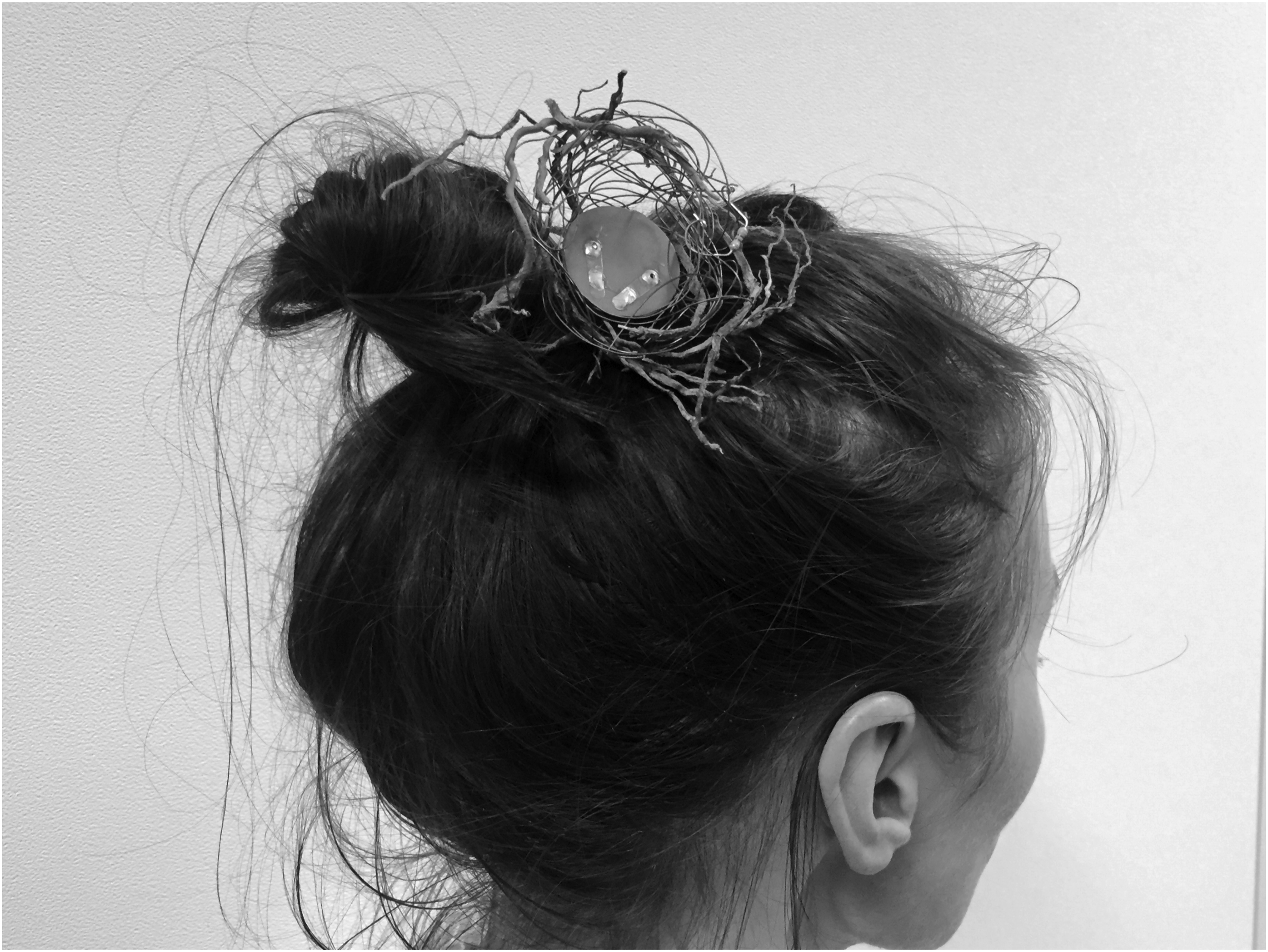
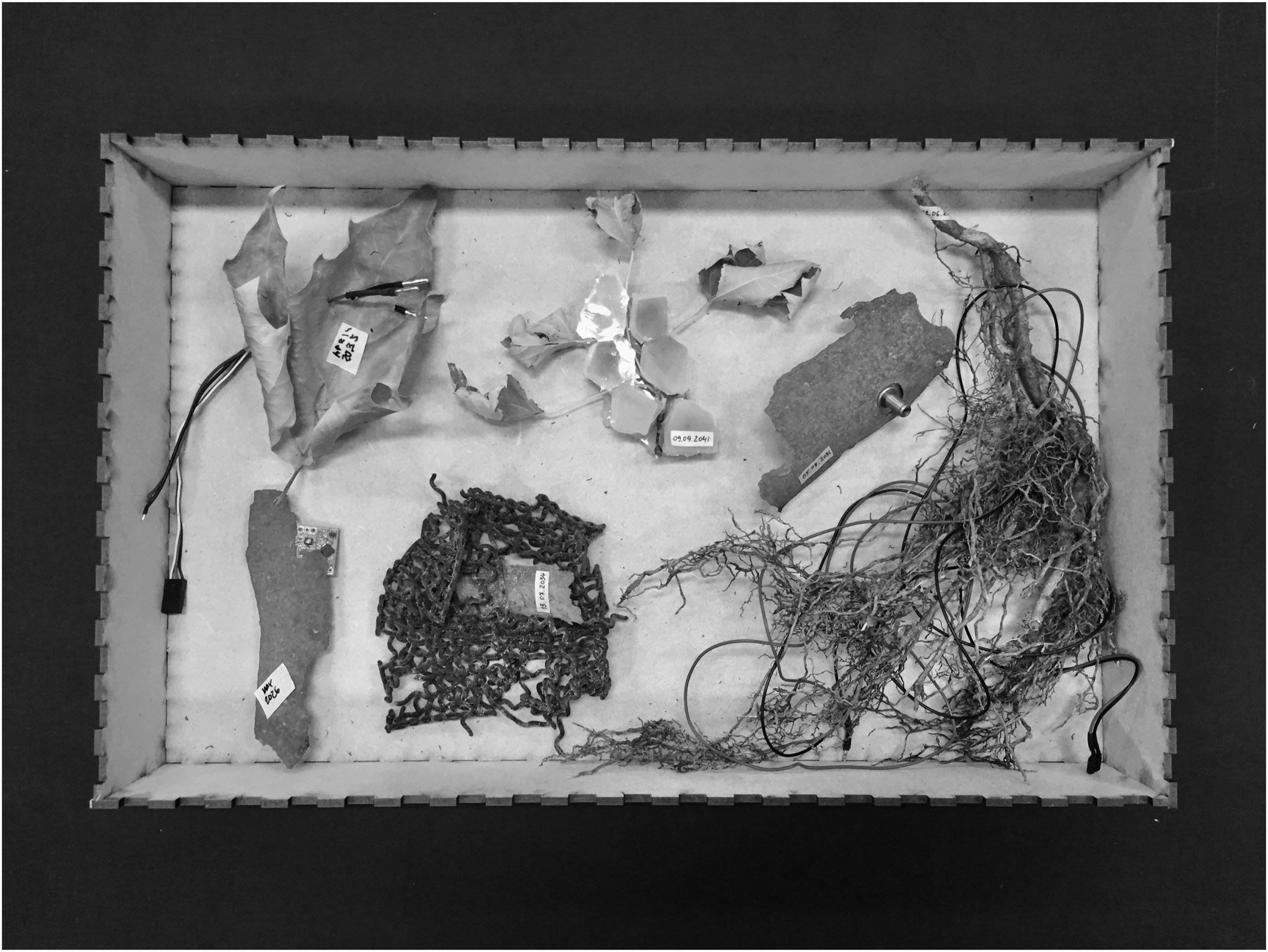
Contrary to Deleuze and Guattari’s effort to grow the capacities of concepts, unruly ones can be allowed to push against their limits—even to the point of falling apart. It is evident that empathy 12 flickered into being during the workshop, becoming reshaped by encounters with arrangements of organic and synthetic materials that caused the word to lose some of its prior connections to notions evoking shared emotion and understanding. Rather than a dominant (linguistic) concept, however, empathy was one among several replaceable components of the artefact, offering a provisional, incomplete way of organising and orientating thought about environmental relations. Empathy was yet another unruly feature of concept work, belonging less to a theoretical ‘meta-language’ than an ‘infra-language,’ meant to serve as discardable scaffolding for the research artefact (Latour 2005, 30). When probing alternative media of thinking, concepts seldom emerge as ‘discrete entities,’ instead disappearing into a miscellany of bodies, things and words that are not ‘easily representable as exhibits or displays’ (Rabinow 2011, 144).
Exploring the unruliness of concepts, Cooper (2014) engages with informal, situated practices of utopian thinking at the Toronto Women’s and Trans Bathhouse, where the community actualises new kinds of intimacy and touch within a safe setting. For Cooper (2014, 127), care ethics appears to overlook sexualised bodies and their experiments with pleasure and vulnerability, prompting her to wonder whether care is becoming an overpowering concept in need of substitution with alternatives ‘lighter in their attachments and investments, [as well as] equivocally constructed?’ Cooper (2014, 126-127) detects a tendency to idealise concepts: ‘questions get closed down as academic debate fixes on the flaws, contradictions, and subsequent repair of the concept in question. Energy flows into justification—why care is the best way of conceptualising and carving out good relationships—and successful concepts move into, and indeed sometimes colonize, new discursive terrains.’
Facilitating the unruliness of concepts involves accepting their ‘alienness,’ defined by ‘contingent conditions, interactions, and affects that change us but, at the same time, escape us’ (Salter 2015, 241). A concept might even be allowed to slip beyond the control of geographers, as in the case of LeRon Shults (2022), who rethinks Deleuze and Guattari’s concept of assemblage through AI-simulations of complex adaptive systems. LeRon Shults (2022, 118) explores the spontaneous emergence of artificial societies through devising conceptual set-ups that might be ‘unethical’ or impossible to realise, bringing out not only the distributed, nonhuman dimension of thinking but a widening array of resources for conceptualisation. For Hayles (2017, 115-120), these include nonconscious elements that ‘transform the [...] conditions under which human cognition operates,’ for example, by enabling its ‘digital entanglement,’ via sensors, with other lifeforms, such as animals and plants (Turnbull et al., 2023, 4). Composing the artefact, we wanted to query this entanglement and, as the next section will show, establish whether relational notions of conceptuality are sufficiently receptive to difference (Hayles 2025, 78-79).
3 Uncommon
For Massumi (2002, 20), Deleuze and Guattari’s concepts foster ‘connectibility’—they are circulating entities recombining with others to facilitate transformation. And still, concepts might also defy relationality. Povinelli (2021, 7) draws on the French-Caribbean philosopher and poet, Édouard Glissant (1997) to wonder ‘whether any concept matters outside the world from which it comes and towards which it intends to do work.’ Claiming that concepts are a ‘gathering from […] actual regions of existence,’ Povinelli (2021, 130) reflects on the inheritances of colonial violence and examines concepts as fraught with situated entanglements that travel with difficulty—if at all. As Povinelli (2021, 5-7) notes, Deleuze and Guattari’s conceptuality is narrowly invested in advancing their philosophical project, at times eclipsing the strained conditions for thought. This raises the question whether concept work should instead enable an uncommoning grounded in difference, without presuming mutual understanding is attainable—or even desirable (De la Cadena 2015, 6).
The uncommon featured during the later phases of the workshop. We developed an assortment of designs contained in two boxes: one holding ‘sensing jewellery,’ such as headpieces reminiscent of bird nests, the other fragments of past entanglement, such as obsolete electronic components entwined with exfoliated bark (Figures 1 and 2). In the display text, we maintained the need for avoiding an uncritical expansion of empathy, whose ‘inescapable limits’ are revealed when confronted with processes that ‘will never become entirely knowable.’ 13 This was accentuated by the deliberate elimination of functionalities within the design—including the capacity for data recording and storage—which aimed to allow a degree of adjacency, but not full entanglement, between wearer and tree. The movements of the latter were to be felt only as faint pulses and vibrations, implying separation as much as proximity, as if the terms of entanglement remained perennially unsettled. As Marder (2012, 260) writes, any assumption of an ’elemental commonality’ in this context is problematic as ‘plants and their peculiar ontology should be interpreted as embodied limits to empathy and as points of resistance to a totalising vitalism.’ A similar incompatibility defined the workshop as a whole for us: it was a setting where the sheer multitude of ideas, materials and disciplines frustrated efforts towards a shared appreciation. Our creations made their momentary, somewhat incoherent appearance, only to be dismantled again, perhaps to be recycled into other concepts.
There is an assumption across the discipline of concepts as units with continuously expanding relational capacities. Concepts, for example, serve to ‘sensitize attention to become more attuned to different elements of experience,’ not necessarily by lending the world added meaning but rather by facilitating nonrepresentational modes of awareness (McCormack 2013, 10). An overlapping view is that concepts, although undoubtedly contested and incomplete, remain inherently movable and shareable (Johnston and Sidaway 2015; Theodore et al., 2019). As a consequence, there have been attempts at diversifying collaborative conceptualisation beyond the academia, including research by Corsín Jiménez and Estalella (2016, 145), whose work with urban communities to generate creative spaces in support of experimentation with the concept of infrastructure raises critical questions about the ‘resources that we use in the making of theory, as well as about theory more amply as an open-source endeavour.’
Although the above efforts have engaged a wealth of media that invite a multitude of ‘authorial agencies’ and ‘relations of commoning’ (Adema 2021, 117, 194), they tend to assume the availability of an accessible forum for negotiating convergences and divergences between types of knowledge. For Rabinow (2011, 151), the commitment to extend concept work may lead to a proliferation of ostensibly inclusive projects, whose ‘esoteric’ modes of expression actually sustain a ‘totality’ of ideas that might elicit only restricted crossover. Even gestures towards ‘decentering’ Euro-American conceptualisation—including a transnational study developing an ‘enriched vocabulary’ for urban geography—appear to perpetuate existing conventions by involving primarily scholars, seen as mediators capable of bringing ‘processes from the different territories in conversation with each other’ (Schmid et al., 2018, 33).
These narratives of collective conceptualisation can be qualified with Verran and Christie’s (2014, 58-59) decolonial databasing project involving a platform for storing cultural items, from sounds to images, collected by Aboriginal peoples in Australia. Along with diverse stakeholders, Verran and Christie (2014, 68) designed a living archive that would avoid imposing ‘preemptive categorization’ on indigenous culture via a system embedded in settler colonial notions. For Verran and Christie, databases embody ontological commitments that surreptitiously shape knowledge—for instance, the concept of wäŋa (an approximation of ‘place’ in Yolngu) does not ‘assume that places exist in the here and now as single, whole things. Places might achieve a form of ephemeral singularity when a firing or some other such collective activity occurs—if all the correct people are present and things are done in a correct manner. Those ephemeral unities of actual existence are achieved reenactments of an originary act of creation by spiritual ancestors. For this reason, to organize our digital resources within a database under the category of “place,” for example, might easily compromise the here-and-now ontic work that Aboriginal knowledge practices demand’ (Verran and Christie 2014, 68).
Wäŋa is imbued with singular qualities, consisting of variable relationships to ancestry, land and practice, which refuse to ascribe definite meaning to the concept or subsume it into a unitary system. Accordingly, Verran and Christie (2014, 75) sought to fashion an alternative data structure for bringing together—and holding apart—diverse knowledge traditions, allowing them to ‘connect in partial […] ways’ (Verran and Christie 2014, 75). This was accomplished through an information architecture enabling Aboriginal communities to constantly reorder its metadata (the organising principle of the database), even to ignore it completely. Instead of a ‘museum’ for permanently storing Aboriginal culture, the platform became a ‘site of performance’ where communities could experiment with creative resources in a way reflective of their place-attachments (Verran and Christie 2014, 72). As Christie and Verran (2013, 307) write, the platform entailed ‘bringing together unstable configurations for a particular collaborative performance, but without destroying their ability to fall apart, to return to their full potential for reconfiguration.’
Turning again to the speculative artefact, it is evident that concepts can also fracture connection. Like the sensing jewellery, concepts may even function in a self-limiting way, rather than accumulating knowledge at all costs—an argument that resonates with Jazeel’s (2016, 658-661) account of ‘untranslatability,’ moments when the impossibility of conveying concepts from one place to another reveals the expansionist inclinations of the discipline (Jeyasingh 2025). Christie and Verran (2013, 308) suggest that concept work could be based on the realisation that ‘possibilities for total separation [between knowledges] need also to be ensured.’ Contra Deleuze and Guattari, geographical thinking does not have to consist in an endless variation of concepts but can sustain intervals where differences are registered and upheld. This approach stands apart from projects built around ‘spaces of confrontation’ where disagreement is considered crucial to debate (DiSalvo 2015, 5). It intersects with forms of ‘abyssal’ enquiry, which question the assumption that dialogue—even when inviting disagreement—is achievable, as it overlooks the radical ruptures in reality sustained by entrenched violences, forcing certain bodies into a position of nonbeing and denying any shared experience of the world (Chandler and Pugh 2023, 2024; Povinelli 2021).
IV A pedagogy of making geographical concepts
The uncertain passage of the speculative artefact, then, can clarify the geographical implications of Deleuze and Guattari’s view of conceptualisation as making, which refrains from applying concepts as pre-formed entities and experiments with their multimodality to deepen understanding of the varying circumstances of thinking. While the critical figures of the unevental, the unruly and the uncommon mark a departure from the philosophy of Deleuze and Guattari (1994, 77-78), they remain compatible with their ‘pedagogy of the concept’—an orientation relying less on theory than ‘taste,’ the evolving ability to discern the ‘undetermined,’ the ‘being-potential,’ within a concept. Making a concept involves tinkering with its composition in anticipation of an ‘adventure’ (Stengers 2005, 156). As indicated by the convoluted journey of the artefact, embarking on such an undertaking asks for a constant relearning of the shifting features of a concept, whose ‘conditions of creation’ have to be analysed as ‘singular moments’ (Deleuze and Guattari 1994, 12). Rabinow (2011, 204) comprehends this pedagogy as inherently recursive, because each iteration of a concept—however successful or unsuccessful—can always be incorporated into its subsequent articulation. Making concepts may thus lead to an accrual of skills, yet these cannot rely on overly normative ideas: ‘we might reflect on skill and its acquisition less in terms of identifying a ‘lack’ and rather more through a celebration of the possibilities of learning and doing’ (Hawkins 2019, 974). 14
Evoking a distinctive pedagogy of concepts, the three figures hold particular relevance for geography. First, the unevental prompts reflection on the divergent, more-than-theoretical arrangements of concept work (Cooper 2014; Greenhough 2016). Irrespective of the media deployed to express a concept, making can uncover the numerous conscious and nonconscious entities that structure thinking and steer it along particular paths. Attending to such ‘cognitive assemblages’ (Hayles 2017, 119) offers critical insight into, among other things, the automatisation of geographical practices, which are inflected by an expanding array of devices and platforms (Maalsen 2024; Turnbull et al., 2023), whose opaque operations require scrutiny, especially in the context of artificial intelligence (LeRon Shults 2022; Lundman and Norström 2023). Alert to sites of conceptual creation and circulation, making illuminates crucial aspects of thinking that exceed immediate experience and might require additional methods to become discernible—for example, the computational analysis widely used in digital humanities, where the examination of vast corpora reveals how academic efforts, albeit dispersed across a broad field, are often shaped by ‘supra-agential cognitive strategies’ that ‘provide the enclosures within which thinking takes place’ (De Bolla 2013, 5). The unevental is hence a call for interventions into the many mediations of conceptuality and an invitation to reconfigure their workings in order to explore ‘what kinds of intelligences might [yet] emerge’ within the discipline (Lynch and Del Casino 2020, 385).
Second, recognising the unruliness of concepts as speculative designs implies embracing their unpredictable functioning—at times seemingly alien—and accepting ‘not-knowing’ as an integral part of concept formation (Wakkary 2021, 245-250). This avoids treating concepts as ‘waiting for us ready-made’ (Deleuze and Guattari 1994, 5)—for instance, as ‘canonical concepts’ sustained through specialised language within academic communities (Johnston and Sidaway 2015, 58-60)—and brings into relief the profound situatedness of geographical thinking. Such an approach could also move attention away from ‘idealist’ styles of concept work, which, as Cooper (2014, 26-29) claims, are excessively concerned with the elimination of theoretical ‘imperfections,’ while neglecting the messy interactions through which concepts emerge and evolve. Admitting unruliness thus entails accounting for the erratic trajectories of concepts with corresponding changes in their capabilities, whether gained, modified or lost—trajectories that may involve breakdown, even ‘disaster’ (Engelmann 2024, 256). Regardless of the outcome, providing opportunity for the unruly may foster an extended register of conceptualisation, stimulating alternative ‘compositional strategies’ (Hawkins 2015, 252) that support experimentation with concepts and their potential to ‘make a difference’ (McCormack 2013, 79).
Third, contrary to the assumption that geographical concepts—despite being contested and contingent (Johnston and Sidaway 2015; Theodore et al., 2019)—enable the exchange of ideas across heterogeneous settings, acknowledging their uncommoning dimension suggests they can equally undermine such tendencies by carrying accountabilities and attachments that remain untransferable and untranslatable (Jazeel 2016; Jeyasingh 2025; Povinelli 2021; Verran and Christie 2014). The speculative artefact destabilised the notion that concepts are capable of forging ever-new associations among bodies, objects and places, instead asserting the reality of unbridgeable difference. It qualified the framing of the workshop by highlighting the tenuousness, even impossibility of entanglement between the entities involved in the process of making. This provokes the question of what conceptualisation could encompass in a world defined by the unattainability of certain types of connection, as demonstrated by recent investigations into negativity (Bissell, Rose and Harrison 2021), nothingness (Pohl 2024), voids (Kingsbury and Secor 2021) and other modes of nonexistence, which undermine the primacy of the relational across the discipline by drawing attention to that which escapes or is violently excluded from it (Chandler and Pugh 2024). Rather than grounding concept work in an aspiration towards connection, might it be possible, for example, to envision conceptual forms that ‘make nothing’ by ‘arresting […] the ongoing process of becoming’ to clear a space for the uncommon among entities to manifest itself (Cloninger 2021, 134-136)? And what practices of conceptualisation would allow a concept not only to diversify continuously, in line with Deleuze and Guattari (1994), but to encounter its limit—to disintegrate and disappear? In such circumstances, a concept must confront the prospect of its unmaking—that it, similar to the finite and fragile speculative designs discussed in this paper, has indeed reached its end point.
Footnotes
Acknowledgements
This paper has benefitted from the incisive comments of Noel Castree, Rob Imrie, Andy Morris, as well as the Editor and the reviewers of Progress in Human Geography. I am grateful to Lenneke Kuijer, Nicola Spurling and the Industrial Design Department at Eindhoven University of Technology for organising the workshop, and to my collaborator Vidmina Stasiulyte, whose attentive approach to making transformed my understanding of conceptuality. All remaining errors and omissions are mine alone.

Funding
This work was partially undertaken through an Open University FASSTEST scholarship project, supported by the Centre for Scholarship and Innovation at the Faculty of Arts and Social Sciences.
Declaration of conflicting interests
The author declared no potential conflicts of interest with respect to the research, authorship, and/or publication of this article.