



Abstract
In this paper, we propose a theoretical and conceptual framework for articulating and studying changes in the global economic landscape and illustrate this framework in the current context. The framework pivots around the notion of rescaling, which is interpreted from a human agency perspective. We disentangle three theoretically distinct dimensions of rescaling and show how they play together using concrete examples. The theoretical and conceptual framework links the intended and unintended consequences of globalisation to current rescaling efforts, and allows us to investigate when, why, and how changes to the geography of economic relationships occur.
Keywords
1 Introduction
In her thought-provoking study of the global textile industry, anthropologist Jane Collins noted in 2007 (397f) that ‘globalization is not a ghost, and it is not like gravity. It is made up of decisions and actions, struggles and negotiations carried out in a large number of specific places where people live and work’. Reinforcing this point, Peter Dicken (2015) in his book ‘Global Shift’ inspired numerous scholars to capture the qualitative changes to economic relationships characterising the era of globalisation, including documenting its contribution to rising inequality and environmental damage. Accordingly, globalisation is defined as the deepening of the functional integration of economic relationships in global production networks, which are coordinated by powerful transnational corporations and facilitated by technologies that shrink time and space such as ICT and transport technologies. Globalisation emerged in the 70s and gained traction in the late 80s embedded in a neoliberal doctrine, which promoted deregulation, financialisation, free trade, reduction of progressive taxation, and a slim government (Naidu et al., 2020). Until recently, globalisation has been on the rise.
Macro-economic data suggest we have entered a new era and provide strong evidence that the long taken-for-granted increase in global economic integration has considerably slowed since the onset of the global financial crisis in 2008. While the patterns to some degree depend on the chosen indicators (see Figure 1), this observation holds true, for example, for trade volumes and Foreign Direct Investments (FDI) as a share of GDP, both peaking right before the 2008-09 financial crisis. The significance of this shift is captured in a 2023 documentary on US industrial policy under President Joseph Biden (Garrahan, 2023). In it, Martin Wolf, the Chief Economic Commentator for the Financial Times emphatically exclaims ‘We thought we were in the era of free market globalisation and now we are not’! FDI and trade as share of GDP. Source: World Bank Data.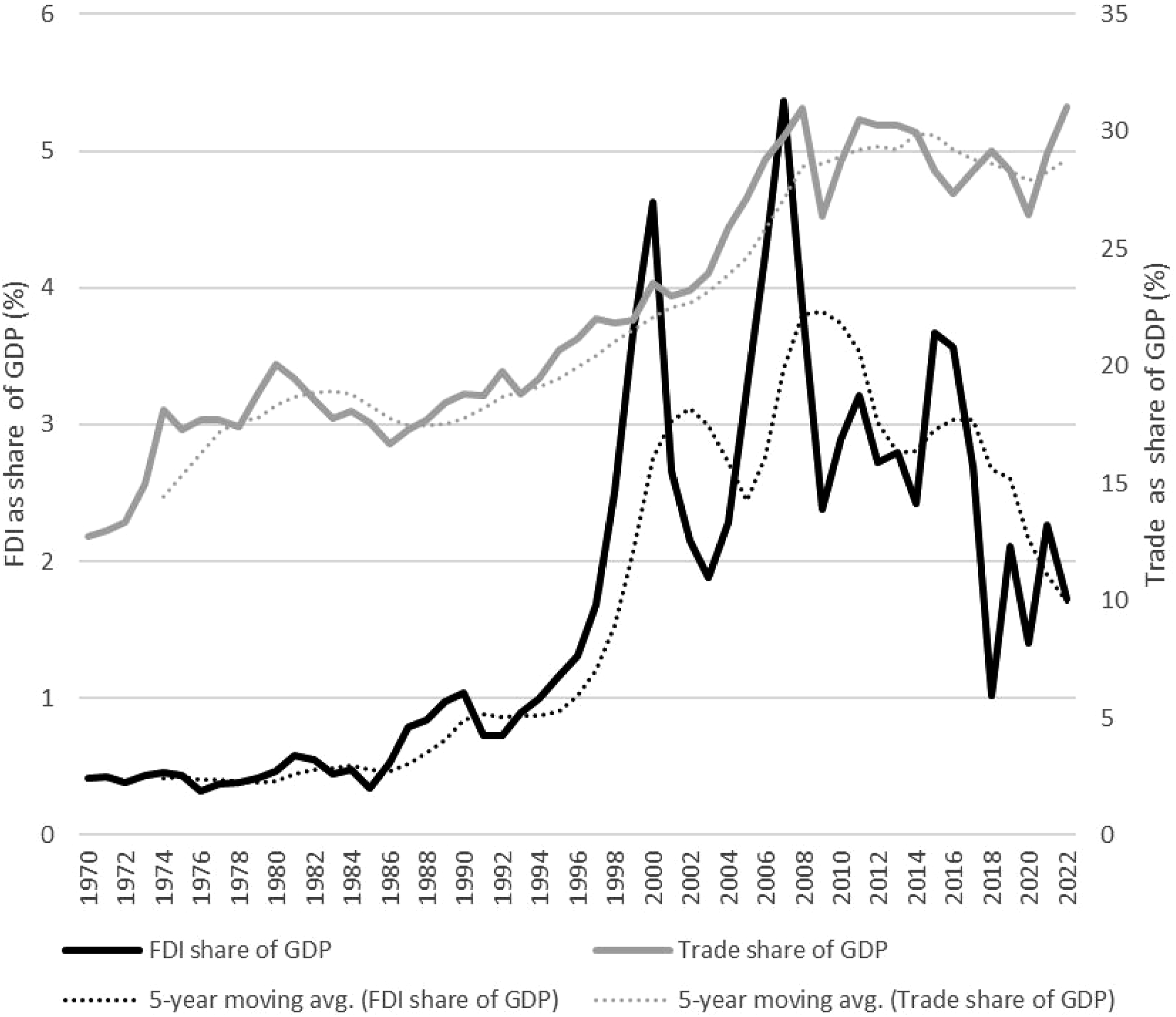
A voluminous research collection exists on the rise of globalisation in past decades and its uneven and at times devastating consequences. Less clear is what this current period of apparent global retreat means for the organisation of economic relationships across geographical space (Butollo et al., 2024) and especially for the well-being of industries and communities, which have struggled to keep up with global integration. The existing literature on globalisation does not sufficiently address why and how these unintended environmental and societal consequences mobilise agency to reshape the very rationales and conditions, which were driving the processes of globalisation. Nor does it help us imagine or evaluate the emergence of alternative economic relationships and structures. In this article, we therefore develop an interpretive lens for better articulating the changing global economic landscape and pursue two main objectives: First, to provide a theoretical and conceptual framework to study shifting geographies of economic relationships; and second, to illustrate this framework in the current context, providing preliminary empirical insights about ongoing transformations of economic relationships.
As regards the first objective, we propose a theoretical and conceptual framework pivoting around the notion of rescaling. The approach to the first objective is, in section 2, to introduce how the concept of rescaling has been used in the literature (e.g. Mansfield, 2005; Miörner and Binz, 2021; Swyngedouw, 2000), and propose a human agency perspective to rescaling. Building on this basis, we develop an integrative theoretical and conceptual framework of rescaling for studying changes in the structure of economic relationships across geographical space. To this end, we draw first on some foundational literature in human geography, such as time geography (Hägerstrand, 1970), the concept of scale (Brenner, 2001; Gibson et al., 2000), and its implications (Asheim, 2020; Martin and Sunley, 2022) to define the spatio-temporal dimension of rescaling. We then relate the spatio-temporal dimension of rescaling to a socio-institutional and techno-economic dimension, which we argue are fundamental for shaping rationales and conditions for the structuring of economic relationships. As regards the socio-institutional dimension, we draw on institutional theory and its application in the context of sustainability transitions (Fuenfschilling and Truffer, 2014), addressing, for instance, the co-evolution of institutions (Rip and Kemp, 1998), processes of reconfiguration and (de-) institutionalisation (Barley and Tolbert, 1997; Geels and Turnheim, 2022), and institutional work (Lawrence and Suddaby, 2006). Concerning the techno-economic dimensions, we build on work in evolutionary economics and international business providing insights into how techno-economic paradigms shape the scope and scale of economic activities (Dosi, 1982; Nelson, 1980; Perez, 2009) and influence how organisations structure their operations across geographical scale (Ambos et al., 2021; Azmeh and Nadvi, 2014; Schubert et al., 2018).
As regards the second objective, we discuss how the unintended consequences of globalisation have led to agentic responses to reshape the rationales and conditions for the structuring of economic relationships. While the future will tell whether we are indeed in a new post-neoliberal and post-globalisation era as some commentators claim (Aiginger and Rodrik, 2020; Foroohar, 2022; Krugman, 2022), we discuss three important contemporary developments from a rescaling perspective: (i) the increasing importance of new industrial policies illustrated by the massive invest in America agenda, (ii) the diffusion of new and potentially disruptive process technologies such as automation, robotisation, and AI, illustrated with a case in shipbuilding, and (iii) the increasing momentum of social movements for sustainability transitions, as exemplified with sustainable textile and fashion. We have chosen these three examples because they provide different perspectives on the interplay between spatio-temporal, socio-institutional, and techno-economic rescaling processes, which hold potential to shape the conditions and rationales for the structuring of economic relationships. We suggest that the proposed rescaling framework is useful to study the complex processes driving the geography of economic relationships and provides a unifying language that connects multiple disciplinary perspectives. It is also relevant from a societal perspective as rescaling has been used as a strategy to affect economic relationships and their outcomes.
II Rescaling: A theoretical and conceptual framework
2.1 The concept of rescaling
Human geography features a longstanding debate over the notions of scale and rescaling (Agnew, 1994; Brenner, 1998; Jessop, 2002; Swyngedouw, 1997). Two main perspectives stand out. Scholars approaching the concept of rescaling from a political economy perspective tend to understand it as a process of social construction that manifests in political, economic and material structures (Brenner, 1998; MacKinnon, 2010; Smith, 1993; Swyngedouw, 1997). This perspective sees scales as the result of broad socio-spatial processes (e.g. capital circulation and state regulation) that exist prior to any emergent social activity and are the result of past processes of social construction (Brenner, 2001; MacKinnon, 2010; Paasi, 1991). Post-structural approaches have criticised this perspective for often overemphasising ‘vertical’ (hierarchical) links between territorially defined scales (e.g. local, regional, national, global) and for being too categorical in its identification of scales based on their material dimensions (Jones et al., 2017; Leitner and Miller, 2007; Massey, 2005). In its extreme, a post-structuralist understanding of rescaling focuses entirely on ‘horizontal’ socio-spatial relations and the reshuffling of the mosaic of routines, power dynamics, and discourses that constitute differently scaled sets of institutionalised practices. 1
Our understanding of the notion of rescaling takes inspiration from middle-ground positions that incorporate both socio-institutional and techno-economic structures while acknowledging the non-hierarchical and non-fixed nature of scales (MacKinnon, 2010). Mansfield (2005) argues that activities or processes are not defined by a single scale but are constituted through interactions across multiple ‘scalar dimensions’. For example, environmental regulations set at the national level can still involve a complex interplay between global, regional and national actors, who navigate and utilise differently scaled policies to achieve specific goals. Rescaling from this perspective is not about a mere shift of activities from one vertical scale to another but involves actors’ engagement in reconfiguring scalar boundaries which changes the way they interact with social, economic, and political processes. Accordingly, rescaling is not just happening to actors, but actors engage intentionally and purposefully in rescaling processes. Furthermore, the complexity of rescaling needs to be acknowledged as multiple rescaling processes tend to co-occur and interact, which can be very different in nature, reinforcing or contradicting each other.
Thus, we propose a human agency perspective to rescaling. Human agency captures the ability of people to make observable differences in the world (Gregory et al., 2009). It manifests in intentional, purposeful and meaningful actions, and their intended and unintended consequences (Grillitsch and Sotarauta, 2020). While there are variations in human agency approaches, they share a focus on the relationship between agency and structure (Archer, 1982; Bhaskar, 1998; Giddens, 1984; Jessop, 2005). Thus, the intentionality of actors as well as their possibilities to affect the world depend on the structures they are embedded in. The structures this article is primarily concerned to explain are the historically developed, yet changing economic relationships across geographical space (cf. Dicken, 2015). Now we can define rescaling as an agentic process in which multiple sets of actors engage with the aim to change the rationales and conditions underlying the structuring of economic relationships, and the intended and unintended consequences of this engagement.
As rescaling focuses on changing rationales and conditions, the underlying mode of agency is projective and future-oriented working towards an end, which is perceived as more desirable for the engaged actors than the current state (Emirbayer and Mische, 1998; Garud and Karnøe, 2001). The intentionality of actors to engage in rescaling can vary widely, with potentially diametral perceptions of desired societal outcomes (e.g. from growth to de-growth). Actors’ abilities to shape narratives and imaginaries, and to resolve contestations about possible futures constitute an important social element of rescaling, which is integrated in the framework. Given its focus on changing rationales and conditions for the structuring of economic relationships, rescaling covers shifting patterns, changes in directions, and transformations, rather than adaptations of economic relationships within established rationales and conditions. In other words, rescaling is about breaking with the structural coherence resulting from previous rounds of interaction (Jessop, 2005).
The link between agency and structure in the proposed rescaling framework is constructed by considering how historically developed economic relationships and their intended and unintended consequences shape the purpose and possibilities for rescaling (see Figure 2). Anchoring this in the current context, the question would be how economic relationships and their consequences, as they have developed during the era of globalisation, affect the purpose and possibilities for actors to change rationales and conditions for the structuring of economic relationships in future. For instance, unintended consequences of globalisation such as environmental and social harm, value chain insecurities and geopolitical tensions feature prominently as rationale for weighty policies like the European Green Deal or the Inflation Reduction Act in the US (European Commission, 2021; Garrahan, 2023). The purpose of these policies is in part to address the unintended consequences of globalisation and relates essentially to the desired direction of travel, which actors, in this example US and European policy makers, aim to realise through their rescaling efforts. Furthermore, historically developed economic relationships during the era of globalisation distribute the possibilities to shape rescaling processes differently between actors and across space, thus creating inequality and uneven power relations (Kano et al., 2020). Rescaling: A theoretical and conceptual framework.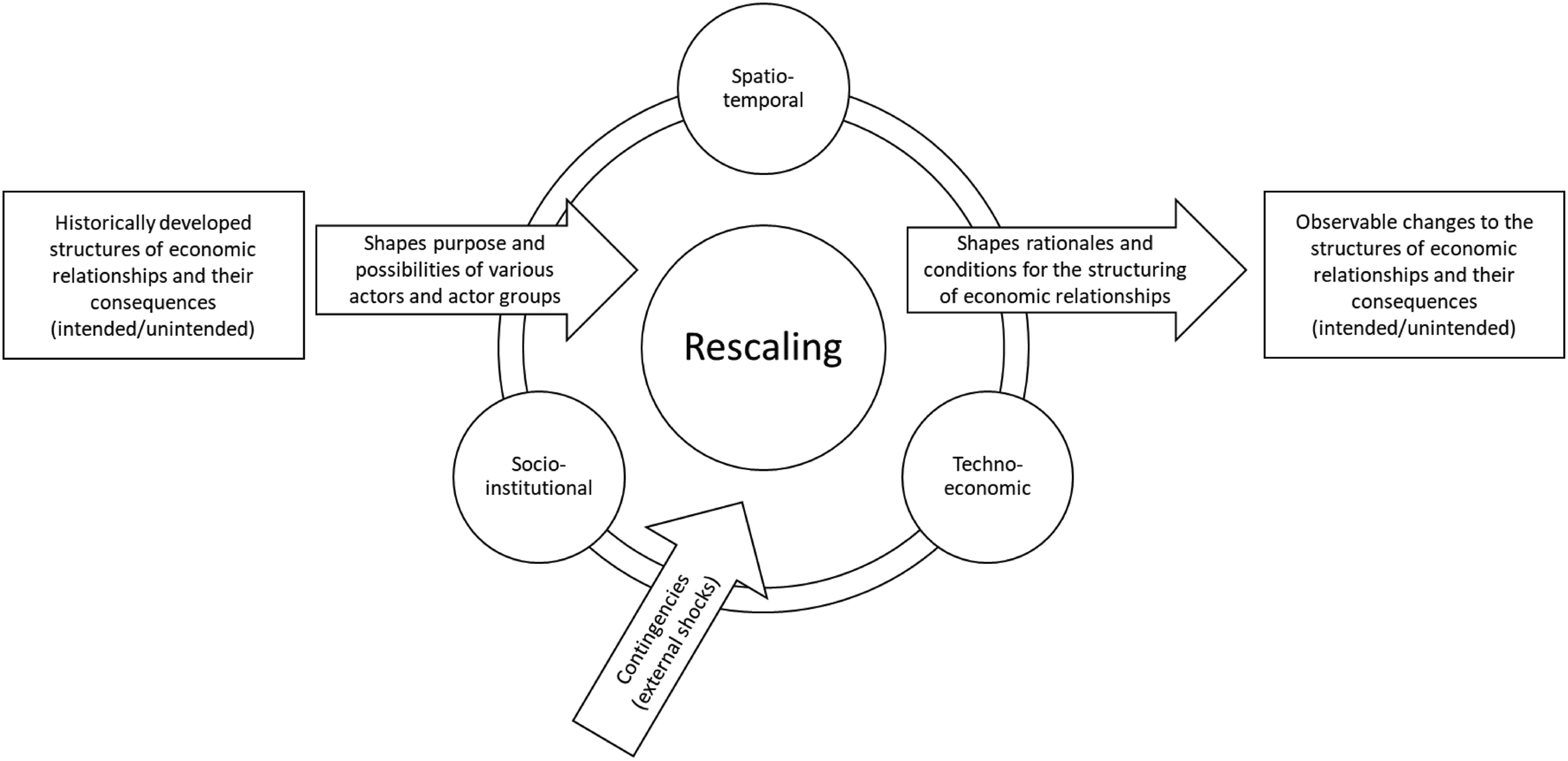
To capture the multi-dimensional nature of rescaling, we propose to differentiate between three dimensions: spatio-temporal rescaling, socio-institutional rescaling, and techno-economic rescaling. Spatio-temporal rescaling refers to the expansion or contraction of economic relationships in space and time (Dicken, 2015; Hägerstrand, 1970). Socio-institutional rescaling is concerned with the (un)structuration of informal and formal institutions and the (dis)integration of social practices (Barley and Tolbert, 1997; Geels and Turnheim, 2022; Rip and Kemp, 1998). Techno-economic rescaling captures changes in the scale of economic activities as well as economies of scale based on the choices made by and available to economic actors and the direction of technological development (Krugman, 2009; Nelson, 1980; Perez, 2009). These three dimensions of rescaling have some similarities with previous conceptualisations of co-evolving systems. For instance, Nelson (1995) argued for the co-evolution of industry structure, technology, and supporting institutions. However, as compared to such conceptualisations, the rescaling framework extends the scope of each dimension to cater for the complexity of rescaling while keeping theoretical coherence within each dimension and relates the three dimensions to the structuring of economic relationships incorporating an agency perspective. Relating to Nelson (1995), socio-institutional rescaling pays attention not only to supporting institutions but also to social practices and social movements. Techno-economic rescaling relates technology specifically to business models, and the scope and scale of economic activities. Spatio-temporal rescaling captures industry structure through the focus on economic relationships but unfolds them in time and space. Below, we describe each of the three rescaling dimensions in more detail.
2.2 Spatio-temporal rescaling
The nature and consequences of any economic process relate to and depend on the nature of the social world and historical context in which it occurs (Martin and Sunley, 2022). Positioning economic processes in a specific spatial and temporal context is therefore necessary to develop understanding about changes in the globalised world (Asheim, 2020), and, consequently, analysing shifts in the structuring of economic relationships requires a fine-tuned analytical lens of these spatio-temporal relations. A starting point for developing such an analytical lens is time geography, which pays attention to people’s movement in space and time, and the associated material constraints to what people can do (Hägerstrand, 1970). Likewise, goods, capital and information move in space and time, which is also subject to material constraints. The constraints can be alleviated with technology (e.g., transportation technologies facilitate the movement of people and goods, and communication technology facilitate the flow of information) or institutions (e.g. trade regulations facilitate the flow of goods, financial regulations facilitate the flow of capital). Hence, the expansion or contraction of economic activities in space and time depends on techno-economic and socio-institutional conditions.
Moreover, time and space are not abstract notions detached from the object of study, in this case the structuring of economic relationships, but intrinsic properties of such an object (Asheim, 2020; Harvey, 1973). This means that the structuring of economic relationships cannot be understood in isolation of the historic and spatial contexts with which they are entangled, and that therefore contextual analysis is necessary to understand the structuring of economic relationships. This captures also how the multiple social, institutional, economic, or technological processes associated with the transformation of economic relationships are nested in constitutive spatial hierarchies (Gibson et al., 2000). Economic agents are contained in neighbourhoods/clusters, which are contained in cities, which are contained in regions, which are contained in nations, which are contained in the global economy (Brenner, 2005). In such complex, constitutive hierarchies, larger units are not simply the aggregation of smaller units. Spatial scales evolve relationally within tangled vertical hierarchies of territorial units that are linked to the horizontal networks, where other processes are operating (Brenner, 2005). Thus, the meaning of any geographical scale can only be grasped relationally, in terms of upwards, downwards, and sidewards linkages to other geographical scales. Processes occurring at any spatial level are affected by mechanisms occurring horizontally, at the same level, and vertically, at levels below and above. Moreover, patterns that appear to be ordered at one level may appear random at another (Gibson et al., 2000). Thus, there is no single ‘correct’ level to study rescaling; rather it should be examined from a multi-scalar perspective.
At the same time, embracing the spatial context of rescaling is not possible without explicitly referring to the specific temporalities by which it is produced (Martin and Sunley, 2022). Each geographical scale is constituted through its historically evolving positionality within a larger relations’ grid of vertically ‘stretched’ and horizontally ‘dispersed’ economic or industrial processes (Brenner, 2001). Geographical scales can be ruptured and rewoven through the very processes they enable. Thus, rescaling should be understood not only through interacting multiple spatialities, but also through interacting temporal modalities that characterise and define it – (historical) time frame, tempo, duration, and sequence (Martin and Sunley, 2022). Time, acceleration and urgency are, for instance, part of the rationale of the green transitions, and simultaneously contested because of democratic and justice implications (Skjølsvold and Coenen, 2021). These temporal modalities not only interact with each other, but also operate differently at different spatial scales and in different places (Massey, 1992). From this perspective, rescaling can also be conceptualised as a means and agentic strategy through which various actor groups attempt to reorganise the balance of power, manage relations, and influence economic and industrial development.
Overall, understanding rescaling requires a willingness to engage with the spatial and historical context in which economic agents make decisions, and to track the multi-scalar and multi-temporal generative processes and sequences involved. This aspect makes it important to dig into the long-term changes in the constitution of capitalism, and relate rescaling process to the political, economic and financial regimes that enable or constrain it (MacKinnon et al., 2009). Here, spatio-temporal rescaling should not be analysed per se but rather in relation to socio-institutional and techno-economic rescaling. Spatio-temporal rescaling is an analytical lens through which shifts in the structuring of economic relationships across geographical space can be studied but also relates, in real world terms, to boundary conditions which determine what kind of rescaling is possible, where, and when.
2.3 Socio-institutional rescaling
The notion of socio-institutional rescaling relates to the (un)structuration of informal and formal institutions and the (dis)integration of social practices. The institutionalisation of the globalised world has brought about a range of dominant actors and networks (e.g. transnational companies and global value chains); practices, rules and regulations (e.g. intellectual property rights, taxes, duties); technological standards (e.g. ISO norms) and cultural expectations (e.g. low prices). All these elements have co-evolved into a ‘configuration that works’ (Rip and Kemp, 1998) and maintains the status quo. Rescaling implies a reconfiguration of established patterns and relations across different socio-institutional scales (Geels and Turnheim, 2022) through processes of (de-)institutionalisation (Barley and Tolbert, 1997; Berger and Luckman, 1966).
The concerted/distributed responses by governments and communities to recurring ecological, economic, and geopolitical crises can drive rescaling in the socio-institutional dimension. For example, recent studies have shown how new types of policy has increased the relevance of local urban experimentation for sustainable innovation vis-à-vis in-house R&D by large firms (Sengers et al., 2021). Similarly, activities by international organisations (e.g. the World Bank, WHO, ISO) at the sectoral level increasingly shape development and diffusion of trajectories of sustainable technologies globally, while some argue that national efforts, industrial policies and incentive structures appear to decline in importance (Fuenfschilling and Binz, 2018; Miörner and Binz, 2021). On the other hand, the revival of industrial policy in the US and Europe, and the debate about de-coupling or de-risking of value chains suggest a shift in scale from global to trading blocs or nations, and may diminish the role of international organisations (Aiginger and Rodrik, 2020; Foroohar, 2022; Krugman, 2022). At the nexus of industries and organisations, incumbent organisations may drive (de-)institutionalisation processes from within the industry (Turnheim and Geels, 2019) that changes established modes of production and consumption in (sustainable or unsustainable) ways that brings about important questions regarding social cohesion, re-skilling of workers, adequate policies and practices of unlearning and unmaking (Feola et al., 2021; Rogge and Johnstone, 2017). These insights from the literature show that socio-institutional rescaling is not a single process from one scale to another but rather captures a multitude of processes, which may reinforce or contradict each other.
Moreover, core value propositions often differ across societal, sectoral, industrial and organisational scales (Jeannerat and Crevoisier, 2022). These range from economic growth as the overarching rationale for actors’ activities, to societal and environmental value orientations that provide a broader frame of incentives for actors to innovate (Yap et al., 2022). Recently, sustainability has arguably been established as a core value at the level of society, but its influence permeates unevenly across sectors, industries and organisations, sometimes being adopted solely on a symbolic or discursive basis (Bauer and Fuenfschilling, 2019; Stål and Corvellec, 2018). Diverging value orientations between scales may create frictions and institutional complexity that drives rescaling between scales that are characterised by different sources and degrees of path-dependencies and lock-ins (Simoens et al., 2022).
Socio-institutional rescaling may be an active strategy as literature on institutional work and institutional entrepreneurship illustrates (Fuenfschilling, 2019). Actors engage in activities to (de-)legitimise narratives, develop value propositions and establish new institutional infrastructures (Baumgartinger-Seiringer et al., 2022; Heiberg and Truffer, 2022; Jeannerat and Kebir, 2016). This alters the relationship between activities taking place at the scale of society, sectors, industries, and organisations, and thus may entail a shift in influence and power (e.g. from public to private, from local to national, or vice versa). For instance, in a recent article Madsen (2022, 349) shows that rescaling away from subnational to national decision-making in the Danish waste management systems has been conceived because municipalities acted as incumbents holding back a transformation. As such rescaling ‘opens opportunities for transformative change by altering power relationships between actors in a socio-technical system and thus may have the potential to both destabilise actors in the regime and empower niche actors’. The challenge is that institutional work may also be used to safeguard or promote the uptake of more unsustainable technologies or the de-legitimation of potentially more sustainable innovation (Fuenfschilling and Truffer, 2014). For instance, the diffusion of digital marketplaces, platforms, and the sharing economy exemplified by Amazon, Uber or AirBnB create tensions between firms and states when it comes to the negotiation of labour laws and the provision of health care and insurances (Frenken and Fuenfschilling, 2021). Hence, it is important to recognise the strategic importance of socio-institutional rescaling in the current reconfiguration of the economy and its global relations.
2.4 Techno-economic rescaling
Technology and economies of scale are intrinsically linked and constitute a fundament of economic thought. This can be traced back to Smith (1776) who, in ‘The Wealth of Nations’, relates economies of scale to the division of labour, specialisation, and technology development. Innovation induces changes in technologies and thereby alters the relative productivity of capital, land and labour, as well as the possibilities to substitute labour with capital (Wadley, 2021).
Technological change ranges from being incremental to revolutionary and paradigmatic (Dicken, 2015). Technological revolutions and techno-economic paradigm shifts reshape the possible scope and scale of economic activities (Dosi, 1982; Dosi et al., 1988; Perez, 2009). Such shifts often relate to the introduction and diffusion of general purpose technologies (Bresnahan and Trajtenberg, 1995; Lipsey et al., 2005), which, over time, diffuse in the economy and trigger new configurations through industrial interactions, demand pressures and technological competition (Cantner and Vannuccini, 2012). This implies that techno-economic rescaling is not a seamless process where inputs can be arbitrarily scaled as may be suggested by a classical production function approach. Which scale economies are possible depends on the technology used and, therefore, changing economic scales may need the development/appropriation of different technologies, which causes substantial frictions. An approach that emphasises the frictions related to rescaling treats technologies as ‘recipes’ (Auerswald et al., 2000; Nelson, 1980, 2003). Changes to the direction of technological change and the employed recipes result from a combination of supply-side changes to innovation processes, networks undergirding the economy, demand-side changes, and exogeneous shocks to the economy such as the recent COVID-19 health crisis.
In the era of globalisation, emphasis was given to more incremental changes, reaping the benefits of returns to scale (Krugman, 2009) and exploiting a global division of labour (Azmeh and Nadvi, 2014), which allowed massification and homogenisation. This was achieved by, for example, offshoring simpler production tasks to developing or catch-up countries and concentrating high-value knowledge activities in advanced economies’ value chains (Ambos et al., 2021). This set-up of fine-slicing global value chains led to short-term gains in cost-efficiency. Yet it also made them vulnerable. First, increasing geopolitical tensions pose considerable problems for the reliability of global value chains. On the policy side, this has already led to an increased emphasis on industrial policies and the call for technological sovereignty (Edler et al., 2023; March and Schieferdecker, 2023). Second, the pandemic has caused major disruptions of global value chains leading Kano and Oh (2020) to argue for a governance of reliability of global value chains, which can also imply a partial renationalisation. Third, combined with pressures towards more sustainable production systems, a reorganisation of global value chains to become more regional and circular has been proposed, which holds the promise of reducing negative environmental impact and of making production systems more resilient (Kennedy and Linnenluecke, 2022).
These pressures on the organisation of economic relationships in value chains across geographical space are multifaceted and will play out differently dependent on the industrial and geographic context (Butollo et al., 2024). However, a general feature is that changing economic relationships in response to the pressures links to changes in scale and scope of technology development and innovation. It stands to reason that firms will often try to deal with such pressures by following trodden paths but just at a smaller scale. This strategy often fails because of the loss of economies of scale, which will very often amplify the problems (Dewitt, 1998) and give rise to self-enforcing downward spirals (Tao et al., 2020). Because technologies are recipes (Dosi and Nelson, 2010), simply downscaling activities by using less input will often not even be possible. Instead, techno-economic rescaling can require a shift from one technology to another, which will deeply change the organisation of economic activities and the direction of technological development. These required changes will thus be highly disruptive, potentially creating a techno-economic tipping point and thus will bring great challenges in adaptation.
An active coping strategy thus requires disrupting trodden technological paths, which will imply changing technological recipes. Because of the disruptive potential of changing recipes, for firms this will imply changes in the specialisation of production, alteration of supplier relationships, realignment of managerial responsibilities and internationalisation (Rico et al., 2021). Firms engaging in such active adaption strategies often show a much better ability to cope with crises and sometimes even leave them behind more competitive than before (Dewitt, 1998). For example, automation reduces the dependency on cheap labour (exploitation of people) and digitalisation allows for more flexible production, possibly making smaller scale production economically viable (Brettel et al., 2016; Enrique et al., 2022). An example of the latter is the transition from fordism to postfordism in the 1970s and −80s, where the use of computer aided machinery achieved the same productivity in SMEs in industrial districts in the Third Italy as in mass producing large firms, exploiting economies of scope (Asheim, 2000). In that respect, changes in technology entail a need for adaptation, but also open-up economic opportunities, which are more in line with the needs for transformation resulting from, for example, the disruption in global value chains, weakening international institutions, or climate change.
III Rescaling: Towards a transformation of economic relationships after the era of globalisation?
With the aim to reinforce the theoretical arguments developed in section 2, we now discuss empirical evidence through the lens of the suggested framework. This article started out from the claim by some commentators that the era of globalisation has come to an end (Aiginger and Rodrik, 2020; Garrahan, 2023). We are not able to answer conclusively whether we are in a new era of structuring of economic relationships, which is qualitatively different from the era of globalisation, as only future can tell. Also, in relation to the details of world trends, the presented evidence can only be seen as indicative. Yet we propose rescaling as theoretical and conceptual framework with analytical purchase to investigate and understand shifts in the geography of economic relationships. Furthermore, we argue for the existence of contemporary rescaling processes that may result in such a shift.
In this section, we illustrate the rescaling framework by first discussing the consequences of the era of globalisation, which have affected the purpose (directionality) of actors’ engagement, and then by elaborating on three contemporary developments from a rescaling perspective: (i) the increasing importance of industrial policies aimed at addressing unintended consequences of globalisation, (ii) the diffusion of recent process technologies such as automation, robotisation and AI, and (iii) the momentum of social movements for sustainable development. We selected the three examples because they are well suited to illustrate rationales and possibilities of actors to engage in rescaling, and how and why the interplay of different dimensions of rescaling over time affect the structuring of economic relationships.
3.1 Consequences of the era of globalisation
The era of globalisation has led to the organisation of 50% of world trade in functionally integrated global value chains (World Bank, 2020). On the one hand, globalisation provides possibilities for international collaboration and knowledge sharing, increased productivity due to specialisation and economics of scale, and for smaller firms and emerging economies to integrate in the world economy without mastering the whole production process (OECD, 2021). On the other hand, globalisation is a source for inequalities and power struggles because global value chains are hierarchical and orchestrated by dominant transnational corporations (Kano et al., 2020). Most value and power are captured through knowledge-intensive activities such as research and development, headquarter activities, finance, etc. Competition in global value chains is then a struggle about upgrading from simple to knowledge-intensive activities through learning processes, conditioned among others by the governance of global value chains and the strength of regional and national innovation systems (Hobday and Rush, 2007; Lema et al., 2018).
While the dependency relationships, the unequal distribution of value in global value chains, and the barriers for upgrading and development have been extensively discussed in the literature, the issue at stake in this paper is the main organising principle, which in a liberal market economy like the US, where most transnational corporations controlling global value chains are located, is to maximise shareholder’s value through cost reductions and profit maximisation. This meant extensive offshoring ‘driven by an ideology celebrating short-term financial gains above everything else’ (Breznitz and Adler, 2021). Yet, even though lead firms in global value chains, including tech-giants such as Apple, Google, or Amazon control the most valuable knowledge, intellectual property, and financial resources, there have been productivity gain problems associated with globalisation (Capello and Cerisola, 2023). Moreover, geopolitical frictions such as the Ukraine war or the rivalries between US and China for technological supremacy are another source of pressure affecting globalisation (Krugman, 2022).
Furthermore, due to the increasing power of transnational cooperations, it has become increasingly difficult for nation states to govern global value chains giving transnational corporations more possibilities to exploit weak labour and environmental standards, and differences in tax regimes. So that ‘… the current grand challenges are related in a non-trivial way to companies’ wrongful business conduct, especially that of large multinational corporations which have grown to rival governments in size, and have proven to be powerful agents capable of shaping the global governance agenda’ (Giuliani, 2018, 1577). As regards social impacts, Bachelete (2022), UN High Commissioner for Human Rights, says ‘[t]he human rights impacts of global supply chains are clear: the use of precarious and informal employment is expanding at a rapid rate. Workers, especially migrant workers, are becoming ever more vulnerable, subject to a raft of human rights violations at the hands of their employers’ and this share is expected to grow considering the expected increase in climate migrants.
3.2 Industrial policy
The era of globalisation was characterised by the free trade agenda safeguarded by a series of international WTO agreements such as GATT about the trade of goods, GATS about the trade of services and TRIPS about the protection of intellectual property. Moreover, cross-national trade agreements (e.g. EU common market, CETA, NAFTA, EU-Japan Trade Agreement) had institutionalised such a rule-based free-trade system. Yet these institutions are increasingly challenged following a call to adapt international relations towards a new reality where economic policies are not limited to economic goals but may also reflect national strategic interests, the resurrection of industrial policy and the emphasis on technology sovereignty being clear signals (Aiginger and Rodrik, 2020; Bassens and Hendrikse, 2022; Criscuolo et al., 2022). While these policy approaches make sure to differentiate themselves from calls for autarky, they do have in common that they put weight on the notion that blind trust on rule-based free-trade and free-knowledge approaches may turn against countries if their trading partners do not respect these rules anymore (Edler et al., 2023, March and Schieferdecker, 2023).
Industrial policy has been practiced for decades to promote a country’s industrial and economic growth by a pro-active government through tax incentives, regulations and R&D support. Earlier examples are Japan, Taiwan and South-Korea’s industrial development in the 1970s and 1980s (Senghaas, 1985). Often industrial policy builds on a combination of import substitution in the earlier phase, supported by infant industry protection to build competitive advantage, and export orientation in later phases when competitive advantage has been achieved (Nam and Li, 2012). The new phase of industrial policy, however, is driven by three specific factors, viz. Geopolitics and security risks, climate and environmental change, and rising inequalities caused by deindustrialisation and offshoring of manufacturing jobs. These new industrial policies constitute socio-institutional rescaling by state actors to change the rationales and conditions for the structuring of economic relationships. They intend to achieve spatio-temporal rescaling (e.g. reshoring or friendshoring, which refers to relocating economic activities to countries considered as political allies) and call for techno-economic rescaling, for instance, to substitute cheap labour with other forms of production (see section 3.3 on process technologies).
A notable illustration is the once-in-a-generation investment by the US federal government in clean energy and infrastructure resilience under the Biden-Harris administration. Three historic bills totalling over US$3 trillion make up what is now called the Investing in America Agenda. These are the Infrastructure Investment and Jobs Act (2021), the Creating Helpful Incentives to Produce Semiconductors (CHIPS) and Science Act (2021) and the more contentious Inflation Reduction Act (2022). All told, these three bills contain over 500 different funding programs, each aimed at advancing an ambitious, yet environmentally critical national goal to become carbon neutral by 2050. While the impact of these historic US investments will take decades to unfold, they have already redirected private investments to clean energy. According to the researchers from a partnership between the Rhodiun Group and MIT, clean energy investments in the United States have increased by more than 80% since 2021, adding to more than $230 billion in 2023 alone (Bermel et al., 2024). While most of this investment comes from the private sector firms and corporations, it is driven by the availability of generous federal grants, loans and tax breaks, all intentionally designed to ‘crowd in’ private capital (Roberts, 2024).
The form of rescaling represented with this federal leadership is two-fold. First, as regards the spatio-temporal, these investments help to reshore previously globalised value chains to bolster existing US manufacturing strengths in electric vehicles and solar panel assembly while also building new domestic production in previously underdeveloped areas like battery storage, wind turbine manufacturing and clean hydrogen. Sizeable tax credits are given to foreign-owned companies and their subsidiaries to locate production facilities within the contiguous United States. Added benefits accrue to these firms and their US-owned counterparts, which choose to source from US-based suppliers. Consumer tax credits then reinforce domestic production decisions, with EV tax credits available for the purchase of only those vehicles with substantial domestic content. While there is long-standing debate within the environmental policy arena over the limits of motivating change through taxation policy alone, this is currently the best alternative to achieve required industry standards and related regulations given the highly polarised nature of the political environment in the United States.
The second rescaling effect of this path-breaking federal agenda reverses this directional flow – meaning it is less the case of something global becoming national and more about building out what is already happening at the state and local level. What is most critical here is a mix of creative yet enduring institutional innovations that have long resided at a local level, though admittedly with considerable geographic variation and unevenness. These innovations are promoted through social movements centred on economic and racial equity. The movements recognise that concerns over job quality, affordable housing access, environmental justice and other areas of economic opportunity are best addressed through formal and reinforcing institutional arrangements. Interestingly, in the process ‘top-down’ socio-institutional rescaling represented by the federal agenda combines with ‘bottom-up’ socio-institutional rescaling pushed by social movements emphasising economic and racial equity, and thereby induces a deeper change in the rationales and conditions for the structuring of economic relationships.
The US Department of Energy’s long-standing loan program – which has been amplified through both the Infrastructure Investment and Jobs Act and Inflation Reduction Act – is one illustration of local to national socio-institutional rescaling. Each loan application, whether for a new battery manufacturing facility or a clean hydrogen plant, is now assessed on the inclusion of a robust and actionable Community Benefits Plan. This plan is expected to articulate how the project will advance a range of community benefits, from living wage jobs and local hiring to wrap-around social services and worker housing – all shaped by the needs of marginalised communities and their residents. Community Benefits Frameworks have long been tied to state and locally subsidised development projects in the United States (Lowe and Morton, 2008). Social justice advocacy groups in Southern California initiated this model in the early 2000s, creating a template that was replicated in other progressive communities over the course a two decades (Meyerson, 2007). The recent adoption of Community Benefits by a federal agency that has traditionally focused on more technical aspects of energy use is both novel and transformative. Other examples exist that take a proven tool for advancing local-level economic and worker justice and scale them to propel national development – resulting in a multi-scaler institutional infrastructure for advancing further local adoption and impact.
The new developments in industrial policy resonate with the argument of Sabel and Zeitlin in their seminal article from 1985 on historical alternatives to mass production, it is politics and policy and not specific features of technologies that determines the direction in which economies are moving, which they call ‘the world of many possible worlds’ (p. 162) and ‘the many worlds view’ (p. 164). This points to the importance of agency and agentic actions to carry out socio-institutional rescaling in realising transformative policies. Such policies are not mainly dependent on technological capabilities but on the capacity of the political system and politicians to implement the necessary policies, regulations, and policy reforms, including to obtain legitimacy and support in and from the public.
3.3 Process technologies
The era of globalisation was made possible by the development of technologies that were shrinking time and space such as information and communication technologies and transport technologies (Dicken, 2015). These technologies coupled with the free-trade agenda during the era of globalisation created the spatial flexibility, which allowed firms to exploit economic scale and cost advantages in functionally integrated global value chains (Gereffi, 2020). With recent and prospective advances in automation, robotics and artificial intelligence, the exploitation of economic scale and cost advantages in low-income countries may become less important. This is because these technologies increase flexibility in production (Brettel et al., 2016; Enrique et al., 2022) and reduce labour intensity in production, potentially resulting in disruptive impacts of technological change on labour markets (Brynjolfsson and McAfee, 2014). For instance, Graetz and Michaels (2018) find that increased robot density raised productivity and wages but reduced the employment share of low-skilled workers.
There is substantial evidence to suggest that advancements in process technologies allow for techno-economic rescaling with significant impact on the geography of economic relationships. These technologies influence decisions related to localisation, centralisation, reshoring, flexibility, skill requirements, and employment patterns (Wadley, 2021). Economic considerations have been a key driver in the adoption of automation. One primary motivation for adopting automation is the potential for cost reduction. Automated systems can often perform tasks more efficiently and consistently than human labour, leading to decreased production and operational costs, as well as increased reliability and performance. This is because in more advanced economies, automation has become an alternative to offshoring to reduce labour costs. Previously, tech-hubs like Silicon Valley have benefited from the influx of lower-cost and/or foreign (often Indian) technicians (Xiang, 2007). Their innovations have later been exported back to the Global South, impacting sectors such as agriculture and transport and potentially undermining local livelihoods (Lee, 2018).
This reshuffling of the global workforce could be particularly concerning for less developed economies, which may see automation as a threat to their competitive advantage of cheap labour in accessing global value chains (Kugler et al., 2020). Overall, there is evidence that automation in high-cost countries reduces the low-wage employment in third countries. Artuc et al. (2023) showed that robotisation leads to a significant reduction in net imports from less developed countries within the same sector. A 10% increase in robot density in Northern countries is associated with a 6.0% increase in their imports from less developed countries and a 12.0% increase in their exports to these countries, such that net sectoral imports from the South decline by 5.9%. The positive impact of Northern robotisation on imports from the South is mainly driven by exchanges of parts and components. Gravina and Pappalardo (2022) analyse the impact of robotisation in a group of European countries (EU15) on employment dynamics and found an association with a decline of sectoral employment in emerging economies, especially in Asia. This observation illustrates how techno-economic rescaling in the form of appropriating new process technologies is related to spatio-temporal rescaling with a changed international division of labour.
More specifically, automation has had significant negative impacts on transportation and distribution workers, who often bear the real costs of affordable shipping through low wages, challenging working conditions, and unstable employment (Danyluk, 2018). While automation has led to job losses in certain sectors, it has also created new job opportunities. The result is a need for labour ‘re-skilling’ or ‘up-skilling’, as workers adapt to automation and transition to roles higher up the value chain. Automation technologies require skilled workers for tasks such as programming, maintenance, and oversight, leading to an increased demand for expertise in robotics, artificial intelligence, and automation systems (West, 2018). Hence, automation has both a displacement effect reducing employment (Acemoglu and Restrepo, 2020; Dengler and Matthes, 2018; Lee, 2018) as well as an upgrading effect as firms become more productive and can expand production and employment, including potentially an increased activity abroad (Stapleton and Webb, 2020).
The relevance of process technologies for rescaling is illustrated by the maritime industry in Ulsteinvik, Norway. During the era of globalisation, it was able to withstand global competition by emphasising innovation and knowledge-intensive activities locally combined with outsourcing of labour-intensive activities or importing cheap labour, for example, from Eastern European countries, to work in local yards (Asheim et al., 2017). However, this strategy became increasingly hard to maintain because firms faced quality issues and were losing innovation and manufacturing capabilities due to outsourcing, and thus competitive advantage in the long run. At the same time, importing cheap labour became increasingly difficult as wage expectations went up in source markets abroad (Grillitsch and Asheim, 2023). To address these challenges, some firms started to invest in automation and precision technologies, reducing labour intensity and upgrading manufacturing and innovation capabilities. Furthermore, the establishment of iKuben, a cross-industrial cluster organisation, aimed at supporting industry with automation and robotisation, and recently AI and sustainability transitions. This illustrates how local actors engaged in techno-economic and spatio-temporal rescaling to break out from what they perceived to be a problematic consequence of the historically developed structure of economic relationships.
Automation was initially pursued mainly as a strategy to reduce reliance on cheap labour. However, over time, local actors developed a more comprehensive progressive narrative and positioned this narrative explicitly against a traditional narrative of globalisation (Grillitsch and Asheim, 2023). Accordingly, automated local production would cut greenhouse gas emissions by avoiding long-haul transport of steel constructions, by using renewable energy in the production process, and by minimising material use with precision technologies. Sourcing raw materials for such production in the Nordics would secure value chains and further reduce the environmental impact. Automated local production would also serve national and European security interests, as the ability to manufacture ships is important for countries with long coastlines (European Commission, 2022). The use of robotics has been shown to decrease the human hazard rate, which remained relatively high in shipbuilding (Lee, 2014). Automated local production would require upgrading local jobs and capabilities, and thereby have a regenerative effect on regional development. Hence, in this case the initial bottom-up process of local actors to restructure their economic relationships was later related to and motivated by unfolding socio-institutional rescaling processes to address national security concerns, climate change, and uneven development, thereby illustrating the interplay between different dimensions of rescaling.
3.4 Social movements
The negative consequences of the era of globalisation have propelled social movements pushing for sustainable development, including efforts to increase democratisation, inclusivity, accountability, justice, and equity (Avelino et al., 2016; Seyfang and Smith, 2007). The recent years have seen a considerable increase of global social movements whose visibility has been amplified by social media, such as the #metoo-movement, Fridays for Future, Extinction Rebellion, or Black Lives Matter. While these types of social movements are discursively very global, action is often local with people gathering for local demonstration and civil unrest actions. In general, one can observe a tendency for many sustainability movements – social and environmental – to call for a fundamental socio-institutional rescaling of the economy that changes the ways in which civil society, the state, and industry relate to each other (Hess, 2018). Oftentimes, social movements call for smaller, more local, and more inclusive structures, which would imply both spatio-temporal and techno-economic rescaling (Fischer et al., 2017; Schmid et al., 2021). This has, for instance, been seen in the de-growth movements (Demaria et al., 2013), in research on urban living labs (Voytenko et al., 2016), or in many community-oriented initiatives aiming at the ‘unmaking’ of capitalistic structures (Feola et al., 2021).
The US textile and apparel industry provides an example of rescaling, which is related to a growing social movement in support of better, more environmentally responsible working conditions. In the early 20th century, the US was an international leader in textile and apparel manufacturing. That changed over the course of a century, as the nation became a net importer of manufactured textile and fibre-based products, especially from low and middle-income nations, including China. This national trend, however, obscures considerable intra-national regional variation and with it an opportunity to learn from efforts to rescale to smaller spatio-temporal geographies. In the early-1900s, the centre of textile and apparel manufacturing shifted from the US Northeast to the US Southeast, attracted by lower regional labour costs and low rates of unionisation – the latter kept at bay by coordinated (and at times violent) actions taken by local government and industry leaders to suppress workers organising. By the 1950s, roughly half of all U.S.-based textile and apparel manufacturing was concentrated in three southeastern states: North Carolina, South Carolina and Georgia (U.S. Department of Labor, 1969; Minchin, 2012).
While the pressures of deindustrialisation were initially confined to the mid-west and Northeast of the U.S., southeastern states began to feel the squeeze from low-cost imports in the late 1970s. The textile industry was especially vulnerable, as were other traditional manufacturing industries like furniture and tobacco-processing. The 1994 North American Free Trade Agreement between the US, Canada and Mexico intensified the pressure on the domestic textile and apparel-making industry, as did the end to international quotas with the expiration of the international Multi-Fiber Agreement in 2005, resulting in a flood of Chinese-made imports. Considering the flood of Chinese imports, US firms attempted a techno-economic rescaling, this time by leveraging high levels of debt throughout the 1990s, often to fuel corporate expansions through mergers and acquisitions. By the late 1990s and early 2000s, many of these overleveraged firms were forced into bankruptcy, the most notable of which was Pillowtex. In 2001 the company shuttered all its U.S. and Canadian manufacturing plants resulting in one of the largest single day manufacturing layoffs in US history. Around 7000 workers lost their jobs on July 30th 2003, with 4000 based in North Carolina alone (Minchin, 2009; Starnewsonline, 2003).
Some southern states responded to these reinforcing challenges by transitioning away from textile manufacturing entirely. Not North Carolina – it followed a different course, with state-level institutions doubling down on effort to drive industry regeneration through technological innovation. This socio-institutional rescaling aimed at changing the rationales and conditions for the textile industry away from cost-competition towards innovation-driven development. The textile college at North Carolina State University, the Textile Technology Center at Gaston Community College, and the Hosiery Technology Center (now called the Manufacturing Solutions centers) have been most active in this ongoing effort. Through a series of coordinated initiatives, these institutions and other critical partners like the National Science Foundation have repositioned North Carolina as the national centre for non-woven textile innovation. These efforts in turn have led dozens of international firms from as far as Denmark, Italy, and Israel to set up state-of-the-art manufacturing and research facilities in North Carolina. As a result of this continued technology-centred approach to rescaling, North Carolina has the nation’s largest non-woven textile workforce, with 30% of the world’s top 40 non-woven companies operating in the state (Economic Development Partnership of North Carolina, 2020).
But other concurrent socio-institutional rescaling efforts are equally notable, especially as they are helping to shore up more labour-intensive parts of the industry by responding to calls for socially and environmentally responsible manufacturing alternatives. Core to this effort is a coalition called The Industrial Commons and its sister organisation, the Carolina Textile District (CTD). Formed in 2013, the CTD is a novel value chain initiative that helps North Carolina textile and apparel manufacturers connect with textile designers making sewn goods in the United States (Lowe et al., 2018). Since its start, CTD has helped hundreds of small and medium-sized firms secure production contracts from a new generation of textile designers and makers. Most of these clients are based in large- and mid-size metropolitan regions, including Los Angeles and New York, as well as urban centres closer to the CTD’s rural North Carolina base. During the pandemic, CTD expanded their clientele further, connecting smaller networks of manufacturers with neighbouring health and childcare facilities to produce protective masks and gowns (Lowe and Vinodrai, 2020b).
In this regard, the CTD is linked to techno-economic and spatio-temporal rescaling processes as place-based and place-connecting relationships are strengthened between legacy manufacturing regions and dynamic urban and institutional centres (Lowe and Vinodrai, 2020a). At a basic level, the CTD enables textile and apparel manufacturers throughout the southern region of the US to reduce their dependence on global product lines that are volatile, price sensitive, and standardised by competing for smaller batch, design-intensive orders. To augment this strategy, they pull together institutional supports around product design and prototyping to attract the attention of thousands of domestic designers. But CTD offers much more than a means to stabilise textile establishments and employment. They centre their rescaling efforts on social and environmental concerns. Initially this process involved educating smaller manufacturers about the desires of newer designers to offer living wage jobs and environmentally accountable forms of manufacturing. From there, CTD took steps to help manufacturers improve working conditions and reduce wasteful and environmentally damaging practices.
This example illustrates how actors’ engagement in shaping the rationales and conditions for the textile industry have had noticeable effects on the structuring of economic relationships in this industry, and observable social and environmental improvements. However, it remains to be investigated how rescaling processes towards a more sustainable textile industry relates to, competes with, is challenged by and challenges ongoing unsustainable practices such as ultra-fast fashion (Sharpe et al., 2022). Also, rescaling processes and their impacts need to be investigated in those places and countries that currently account for the bulk of low-cost production, making fashion and clothing affordable for the masses.
IV Conclusions
Are we currently experiencing a transformation of economic relationships across geographical space, which is different from the era of globalisation? We have engaged in an exercise of theorisation and empirical analysis to allow scholarly investigation and informed speculation about this question. The discussed evidence suggests that underlying rationales and conditions for structuring global economic relationships are fundamentally changing, which will have lasting impacts on their geography. The evidence includes trend changes of macro-economic figures as well as qualitative changes in macro-economic policy as evidenced in new industrial policies such as the massive invest in America agenda (Aiginger and Rodrik, 2020; Bassens and Hendrikse, 2022; Criscuolo et al., 2022), in the application of process technologies such as automation, robotisation and AI affecting the spatial division of labour (Artuc et al., 2023; Gravina and Pappalardo, 2022; Kugler et al., 2020), and in social movements that push for new and more sustainable ways of producing and consuming goods as illustrated with the textile and fashion industry (Lowe and Vinodrai, 2020a; Schmid et al., 2021; Seyfang and Smith, 2007). These qualitative changes are fundamentally agentic responses from different actor groups to the unintended consequences of the era of globalisation, such as environmental damage, uneven development, and national security risks, which were unveiled by recent crises such as COVID-19 and the Ukraine war.
This article proposes a theoretical and conceptual framework to articulate and investigate such changes in the structuring of economic relationships across geographical space. In doing so, it connects to but also goes beyond the analysis of the drivers and consequences of globalisation, as performed for instance, in the work on the ‘Global Shift’ by Dicken (2015). The framework pivots around an agentic interpretation of the notion of rescaling. Rescaling is conceptualised as the social engagement of multiple sets of actors to change the rationales and conditions underlying the structuring of economic relationships, and the intended and unintended consequences of such engagement. This perspective proposes a link between agency and structure, where previous rounds of structuring influence the purpose and possibilities of diverse sets of actors to engage in rescaling and make a change to the future structuring of economic relationships. Hence, the framework relates the structuring of economic relationships during the era of globalisation, and its intended and unintended consequences to current attempts of rescaling. The framework suggests that changing geographies of economic relationships result from the interplay between various rescaling processes and contingencies produced through crises such as COVID-19 and the Ukraine war. The complexity of rescaling processes is conceptualised as an interplay between three interrelated but theoretically distinct dimensions of rescaling, namely, spatio-temporal, socio-institutional, and techno-economic rescaling. As rescaling is understood as the engagement of actors to change rationales and conditions for the structuring of economic relationships it holds explanatory power for shifts in patterns, changes in directions, and transformations of economic relationships, rather than for the adaptation of economic relationships within existing rationales and conditions.
The concrete examples discussed in this paper illustrate in several analytical angles how the structuring of economic relationships across geographical space can be articulated and studied using a rescaling perspective. The examples show that different actors at different levels engage in efforts to shape the rationales and conditions for structuring economic relationships, from federal level policy makers pushing through new industrial policies, firms and industry actors changing business models and technologies, to bottom-up social movements calling for more sustainable modes of production and consumption. Furthermore, the examples demonstrate that these rescaling processes, pursued by different actor groups and at different levels, play together in intricate ways to shape the structuring of economic relationships in concrete cases. This draws attention to the interplay between different dimensions of rescaling in concrete contexts, that is, what is possible, when, why, and for whom depends on the historically developed structures of economic relationships. Rescaling as a theoretical and conceptual framework thus considers history, context, and agency to explain changing geographies of economic relationships.
Footnotes
Acknowledgements
We thank the community at CIRCLE for several rounds of constructive critique.
Declaration of conflicting interests
The author(s) declared no potential conflicts of interest with respect to the research, authorship, and/or publication of this article.
Funding
The author(s) disclosed receipt of the following financial support for the research, authorship, and/or publication of this article: The following funding contributed to this work: Research Excellence Programme on Agenda 2030 from Lund University [2022-204], Hamrin Stiftelse [2024-01], Swedish Research Council for Sustainable Development [grant number 2022-00585].
