



Abstract
This paper addresses the relationship between light and mental health through a multifaceted inquiry into the complex and contested condition of ‘Seasonal Affective Disorder’ (SAD). It does so by first charting a disciplinary neglect of seasonal depression in ‘geographies of mental health’, followed by a consideration of broader philosophical ideas about human sensibilities and the place of light in life. These interpretative resources are brought into correspondence with both clinical debates about the legitimacy of SAD as a phenomenon and the role of culture in the experience of light-affected sadness. The paper culminates by outlining a future research agenda for a cultural geography of SAD in the context of climate-changed environmental light.
I Introduction: Situating SAD
Seasonal Affective Disorder (SAD) is a complex condition with a mixed history of clinical recognition and individual annual self-management. Popularly referred to as ‘winter depression’ or ‘winter blues’, it can present variously as a deep lowering of mood, lack of energy, reduced levels of sociability or general difficulties experienced coping with everyday living, according to a seasonal cycle. Recorded patterns of occurrence vary. In the UK, SAD is said to be nationally significant, with regional differentiation (e.g. estimates for Scotland cite a clinical incidence rate of 9% compared to a UK 6%: Rosenthal, 2013: 19). Some claim a global epidemiology for SAD with overall prevalence at higher latitudes, albeit with most of this evidence in relation to the US, where the condition was first diagnosed (Rosen et al., 1990). Others contending that ‘these correlations do not hold across studies globally, suggesting that biological, environmental, and sociocultural factors may play important but varying roles in shaping prevalence’ (Drew et al., 2021:1). Indeed, SAD prevalence in places that experience extreme low-light conditions in the winter has been lower than hypothesised, highlighting the importance of examining differing cultural practices that might mitigate – or, indeed, exacerbate – SAD experiences. Drew et al. (2001: 6) tellingly reflect that: … most assessments of SAD rely exclusively on a Western clinical paradigm and measurement scales. However, qualitative research examining culture, language, and lived experiences of seasonality can reveal important divergences between local and clinical conceptualisations of seasonality.
In this article we chart interdisciplinary understandings of the SAD spectrum of winter-affected and depressed behaviour, before then advancing a case for understanding SAD as a neglected human-geographical experience alongside other nature-impairments and weather-related embodiments (Bell et al., 2019; also Bell, 2020; Bell and Foley, 2021). The exercise is variously staged. First, we situate SAD in relation to neglected questions of seasonality, mental illness and health, drawing predominately on ‘geographies of mental health’ literature, extending into humanistic scholarship on the phenomenology of experiencing light and wider weather-worlds. From these conceptual framings, we examine SAD as a clinical construct and ongoing interdisciplinary debates about its diagnostic status, as well as clinical scepticism about the so-called ‘folk knowledges’ about winter-place-depression. We then examine emergent philosophies of light in order to understand more about the embodied experience of SAD, going on to consider the need to explore cultural-geographical variabilities in the condition and its affective resonances with people, in place. Penultimately, we comment on how the diverse forms of knowledge in SAD’s orbit – variously clinical, public and personal – can contribute to ongoing geographical engagements with SAD that are at once phenomenological, cultural, social and political. To conclude, we propose a distinctive agenda for a cultural geography of light and mental health. By foregrounding lived experiences of SAD, figured as one of a new register of climate-related mental health conditions and eco-anxieties, we highlight an under-developed aspect, and future domain, of human–environment relations (Cunsolo et al., 2020).
II SAD geographies
To begin it is vital to situate SAD within academic frames that point to the importance of seasonal experience in relation to human well-being and ways-of-being in the world. A key starting point for the critical consideration of seasonal mental ill-health is Durkheim’s (1951) founding sociological inquiry into ‘seasons of suicide’ and his suggestion that common global patterns of ‘early summer suicide’ in many human populations and cultures are social rather than meteorological in causation. Durkheim claimed that the highest numbers of suicides occurred during ‘the time when social life is at its height’ (Durkheim, 1951: 119). The spike in occurrence was not attributable to the sun, or light or temperature directly, but rather indirectly as these features gave rise to more ‘excitable sociality’, contributing to his famous conclusion that suicide had distinct modes related to varying imbalances between social integration and moral regulation.
The relation between suicide and seasonality has remained in question since Durkheim’s early attention (for a recent review and summary, see Yu et al., 2020), with multi-year, multi-community studies reaffirming the observed early spring/summer peak, while acknowledging patterns significantly ‘heterogenous in shape’, influenced by ‘climate, demographic and socio-economic conditions’ (Yu et al., 2020: 9). Seasonal suicide studies speculate on the cause of this global pattern with reference to biochemical states: ‘levels of serotonin, a neurotransmitter that regulates emotion, are sensitive to weather variability and light exposure, so springtime changes in expression may be associated with increased suicidal behaviour’ (Yu et al., 2020: 5). There are, however, also suggestions of social or psychological causation: ‘People may also experience disappointment with excessive expectations for a new start, which is a plausible psychiatric mechanism to explain the spring peak in suicides’ (Yu et al., 2020: 5). Stopping short of in-depth review, it is nonetheless clear that the value of these debates lies in observing how seasons and mental ill-health, seasonal light and behaviour have been deemed important in cross-disciplinary study for more than a century; although comment has been minimal in human geography (see Kevan, 1980, for a notable exception). 1
Geographers have contributed substantively to researching mental ill-health but have neglected questions of seasonality, climate, weather and light. Wolch and Philo (2000) highlight three ‘waves’ of geographical studies of mental health and ill-health, reflective of major genres of ‘geographical thought’ in the later-20th century. They identify a ‘first wave’ attending to ‘spatial-distributional questions’, ranging from work on the locations of mental healthcare provisions from older-style asylums to ‘post-asylum’ community care through to studies focussed on how mental ill-health might be caused or exacerbated by environmental conditions, notably ‘urban stressors’. A ‘second wave’ was then shaped by human geography’s ‘cultural turn’ (Wolch and Philo, 2000: 144) and a variety of theoretical framings through which to rethink logics of ‘difference-making’ that underscore material geographies of mental ill-health, predicated on ‘the appearance of a social-cultural geography alert to the making and living of everyday worlds, a prominent focus [being] … the intimate mixings of identity and place’ (ibid: 146). At the turn of the millennium, Wolch and Philo (2000: 149) were also writing in anticipation of an emergent ‘third wave’ of research that would harness a variety of theories and methods to enable insight into both nuanced ‘place-specific happenings’ and more structurally determined ‘space compressing’ processes’ concerned principally with welfare restructuring in different urban-global contexts.
Subsequently there has been limited attention to specific ‘diagnostic geographies’, including work on Obsessive-Compulsive Disorder (OCD) (Segrott and Doel, 2004), bipolarity (Chouinard, 2012), phobia and panic (Callard, 2006; Davidson, 2003), social anxiety (Boyle, 2019, 2024), panic disorder (Sánchez-Rodilla Espeso, 2022) and also Tourette’s syndrome (Beljaars, 2020; Jones 2018), building on earlier qualitative attention to schizophrenia (Park et al., 1994) and psychotic delusion (Parr, 1999). Lived experiences of depression, however, remain under-researched in cultural-health geography, compared to public or interdisciplinary writing addressing the condition (see commentary from Peake and Mullings, 2019 on depression). Common clinical characteristics of depression are considered in some geographical literature but commonly analysed with reference to multi-level spatial analysis of neighbourhood mental health, categorised within ‘common mental health disorders’ and related to a range of variables (for examples, see the journal Heath and Place). Some variants of health geography do consider ‘the life course of place’ with regards to anxiety and depression (Pearce et al., 2018), prompting reflection on how ‘whole’ human lives are enabled or constrained by different kinds of nature relations, notably with ‘green spaces’ (see also Birch et al., 2020), but none explicitly consider relations with seasons, seasonal weather and light. Indeed, it is necessary to revisit older ‘asylum geographies’ for such considerations – usually narrowly in relation to locational decisions for facilities (Philo, 1987, 2004) – or quite other parts of geographical inquiry explicitly concerned with human–nature relations from phenomenological perspectives.
One tradition of thought helpful for further contextualising the academic study of SAD is ‘humanistic geography’, a diverse collection of philosophically charged work characterised by comment on both positive and negative environmental relations (e.g. Ley and Samuels, 1978, and see related discussion in Boyd et al., 2022). Tellingly, Tuan’s (1980) early work on ‘landscapes of fear’ elaborates a grand history of human–nature relations characterised by negative dynamics largely arising from the powers of nature to limit human lives, foreshadowing recent renewed interest in ‘negative geographies’ of sociality (Bissell et al., 2021). Arguably, the ‘topophobic’ (see also Trigg, 2016) dimensions of ‘being-in-the-world’ are best acknowledged not as an essential human response to place but as a dynamic anxiety in relation to depressed social and economic conditions, aesthetics or the degradation of places and landscape. The reflexive tropes at work in this genre of writing have been typically accompanied by attempts to identify and describe taken-for-granted aspects of human life via ‘open, empathetic methods’ (Seamon and Larsen, 2020: 4) directed towards engaging with a world of ‘others’ (including place, landscape, natures and people). Such work is now broadly accepted as an experiment with philosophical, particularly phenomenological, thinking as the means to explore human–world relations. It seems, then, that there are important disciplinary precedents, characterised by attention to reflexive environmental experiences that encompass negative (anxious and depressed) and positive feeling-states, which might energise thinking about how to understand SAD geographies. This work can be seen as doing more than collating variables that allegedly produce or mark seasonal depression, as in versions of health geography or SAD epidemiology. Rather, it offers a philosophical framing for thinking further about dynamic but ritualised relations with light and weather in place.
The continuation of a phenomenological tradition as the frame for ethnographic encounters with seasonal weather and light underpins Vannini et al.’s (2012: 361; also Vannini and Taggart, 2015a, 2015b) writing on weathering climate in Western Canada: ‘Weather has occupied a somewhat “absent-presence” in sociological, economic, anthropological, historical, cultural, and [human] geographical research’. Although a decade on, this statement requires modification – see, for instance, Bell et al. (2019) on seasons as ‘ensembles of weather’, Endfield (2019), Endfield and Veale (2017) and Veale et al. (2014) on weather and place and Engelmann (2023; also Engelmann et al., 2022) and Verlie (2019) on affective meteorological atmospheres – there is something particularly instructive about the deployment of a distinctive anthropological sensitivity to modes of dwelling with weather, as opposed to social science work which seeks to unpick its social construction. Vannini et al. (2012: 368) latch on to the challenges of living with, and in, a wet-cold climate or what they term ‘a weathering of place’: We can understand how people weather places as a form of somatic work. To weather means to subject oneself to the elements, to undergo exposure to challenges, to somehow adapt … To weather also means to struggle, to endure, to suffer, to brave, and to strive to cope with climatic elements, at times even failing, experiencing pain and discomfort … Dwelling with weather is a skilful practice, a way of shaping our place in the world.
Here the elements are understood as lived phenomena (Ingold, 2000, and see further below), and as a medium through which ‘we’ humans live, rather than a material object of perception, a perspective key to envisioning the SAD-ness that lack of light brings to those who find wintering difficult. Indeed, Bell et al. (2019: 277), while exploring the impacts of sight-impairment, emphasise how geographical studies: … can fail to recognise the importance of light in shaping one’s experience of the world. In our study, the quality of light (influenced, for example, by cloud cover, glare after rain, dappling effects, the angle of the sun’s light and seasonal change) emerged as particularly important in shaping experiences of well-being, impairment and disability within different relational configurations.
Such experiential weather-worlds, Bell et al. (2019) point out, make winter negatively impactful for people with reduced access to quality light, of sufficient intensity, prompting questions about the ‘vernacular adaptions’ made by those with sensory conditions to everyday elemental landscapes. Such prompts are relevant, not only as a call for sustained attention to embodied light-worlds, certainly for those whose (mental) health depends on it, but also as an argument ushering in forms of experimental inquiry aimed at understanding and sharing personalised, transient and uncertain encounters with light as an affective phenomenon. A fuller elemental and atmospheric consideration of light awaits. First, attention must turn to how SAD experiences have come to be defined and contested in interdisciplinary scientific and clinical research communities.
III The place of light in clinical histories of seasonality
A Washington Post report (Rovner, 1981, online) describing cutting-edge research by ‘chronobiology-psychiatrists’ at the US National Institute of Health marks a useful starting point. The press article noted inquiries underway into the relationship between light, melatonin-production and biological rhythms (Lewy et al., 1982; Rosenthal et al., 1984b). Researchers had become interested in seasonal rhythms of certain ‘cyclical mood disorders’ after working with a small number of patients who reported experiencing recurrent low mood and energy in winter, followed by feelings of ‘hypomania’ in summer. They had discovered that an experimental treatment offering exposure to bright light had been able to lift one patient out of depression. Interested in expanding the trial of their new ‘light therapy’, the psychiatrists issued a call for volunteers ‘with depression cycles seemingly related to seasonal changes … people who suffer severe symptoms, not the poetic melancholy of spring and fall’ (Rosen et al., 1990, online, np.).
Norman Rosenthal, the psychiatrist who had initially approached the Post, recalled in a Wellcome Trust Witness Seminar about SAD (Overy and Tansey, 2014: 9; Rosenthal, 2013: 14-15) how ‘Thousands of people responded from all over the country’, leading to the first controlled study of ‘seasonal rhythms’ in the population at large. Rosenthal (1984: 76) connected such lived experiences with references to seasonal cycles of mood in the earliest writings on ‘environmental psychology’, such as Hellpach’s (1911) foundational Geopsychischen Erscheinungen and Kraepelin’s (1921: 139) initial accounts of ‘Manic-Depression’, which found patients experiencing a ‘moodiness [that] set in in autumn and pass[ed] over in spring, “when the sap shoots in the trees,” to excitement, corresponding in a certain sense to the emotional changes which come over even healthy individuals at the changes of the seasons’. As a condition, SAD therefore emerged through a combination of clinical experiment, patient-generated evidence, historical precedent and, via national media coverage, broad public interest.
Three years later, Rosenthal’s group had published the first clinical description of Seasonal Affective Disorder (SAD), a ‘syndrome characterized by recurrent depressions that occur annually at the same time each year’ associated with reactions to changes in climate, latitude and quality of daylight (Rosenthal et al., 1984a: 72; Rosenthal, 2013), as well as a diagnostic tool for the evaluation of ‘seasonality’, the Seasonal Pattern Assessment Questionnaire (SPAQ) (Rosen et al., 1990; Rosenthal et al., 1984a, 1987). Rosenthal’s team continued to refine techniques of ‘light treatment’, testing the effects of variations in light intensity and timing (Rosenthal, 1993; Rosenthal et al., 1985; Wehr and Rosenthal, 1989), and in 1987 seasonal mood disorders gained professional recognition when a ‘seasonal pattern’ modifier was added for depression and bipolar disorder to the revised 3rd edition of the American Psychiatric Association’s Diagnostic and Statistical Manual of Mental Disorders (DSM-III-R) (Traffanstedt et al., 2016: 825).
By the early 1990s, Rosenthal (1993: 8) was able to express satisfaction at seeing SAD and light therapy ‘enter the scientific and clinical mainstream’, despite early scepticism from colleagues who ‘considered it strange and eccentric’. He led the appeal for a programme of future research clarifying the biological functions of SAD and ‘how light works’. Researchers in psychology and allied disciplines have variously met this call, conducting comparative studies of SAD across cultures (Kasof, 2000; Saheer et al., 2013) and latitude (Rosen et al., 1990; Mersch et al., 1999). Light therapy has since been studied in greater depth (Eagles, 2009; Weil, 2015), while others have developed an evidence base for alternative treatments through antidepressant medication, Vitamin D supplements, Cognitive-Behavioural Therapy (CBT) and exercises in yoga or mindfulness. Melrose (2015) provides a useful overview of this literature (see also Magnusson, 2000). By 2009, alongside the preparation of the new edition of the DSM-V, Rosenthal (2009: 852) argued that sufficient evidence had amassed to justify the reclassification of SAD from a ‘seasonal pattern’ of depression (as in the DSM-III-R and DSM-IV) to an ‘independent disorder’ of its own: The clinical picture is distinct: patients with seasonal affective disorder, predominantly women, become regularly depressed in autumn and winter and experience remission in spring and summer. They experience characteristic atypical vegetative symptoms during their depressive episodes and have a history of reactivity to environmental light (the more the better).
As clinical understandings of SAD developed, news stories like the Post’s became a regular feature of the annual reporting cycle, intensifying in October and November news feeds, particularly across the Global North. In 2016, a series of sceptical articles displaced the usual coverage (Middleton, 2016: see Figure 1). Lying behind this newfound scepticism was a study by clinical psychologists identifying no ‘seasonal fluctuations’ in depression from a cross-sectional, population-wide study in the US. Traffanstedt et al. (2016: 832) called into doubt the role of sunlight exposure in depression, arguing that ‘merely being depressed during winter is not evidence that one is depressed because of winter’, and thereby downplaying SAD – clinically re-cast as ‘major depressive disorder with seasonal variation’ – to the status of a ‘folk psychological construct with limited empirical support’ that should not be granted clinical and societal consequences such as legal entitlements. Example of popular media sources questioning the status of SAD (Middleton, 2016).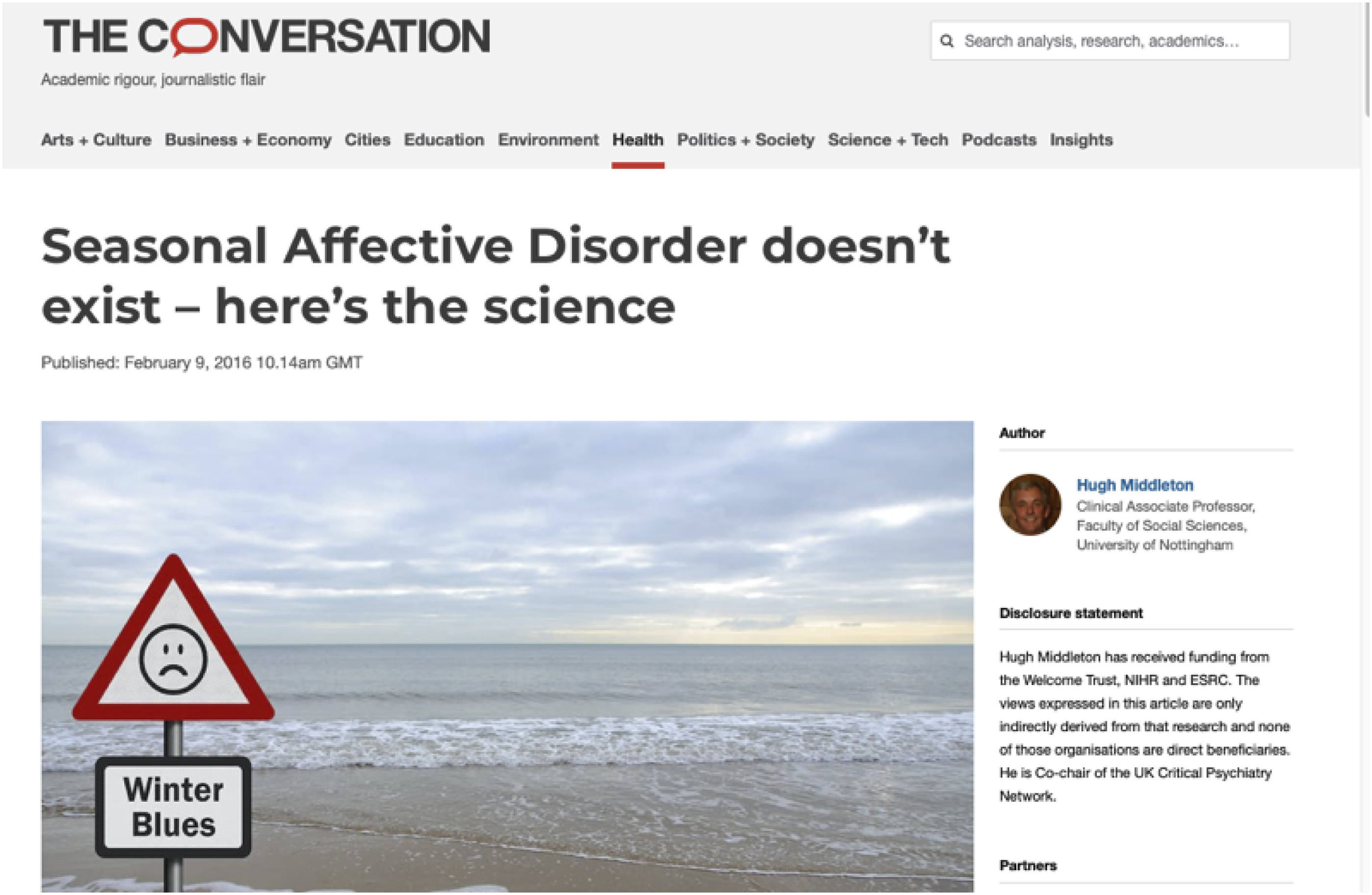
SAD scholars responded to the sceptical commentary rehearsed in popular media coverage with their own claims about overgeneralisation based on inadequate methods. Winkler et al. (2017: 54-55) offered a range of criticisms: the failure to gather longitudinal data about respondents’ medical histories; ignored treatment status of subjects, rendering invisible anyone experiencing SAD but in possession of adequate coping strategies; too simplistic groupings of US states and populations by latitude without a sufficiently ‘differentiated approach that does not lump meteorologically unique regions into one group’; and inadequate engagement with existing literature on the relationship between mood and season, and light treatment. Young (2017, pp.752-3) advanced a similar critique, going on to challenge the authors’ narrow interpretation of SAD aetiology as a ‘response to reduced sunlight’. For Young, to counter scepticism about the ‘existence of SAD’ from Traffanstedt et al. (2016), matters of differentiation about ‘in what people, in what symptoms, and at what times’ SAD is experienced needed to be investigated. Implicitly rather than explicitly, questions concerned with cultural and seasonal geographies were evidently also at stake in this debate about clinical recognition.
Offering another line of critique against SAD, Hansen et al. (2008) observed how they ‘did not recognise [themselves] in Rosenthal’s claim that northern Norwegian researchers lacked the ‘creativity or enthusiasm’ to undertake a study of SAD due to their own wintertime ‘low energy level’ (Rosenthal, 1993). They noted how linking changes in biological rhythms to the reduction of sunlight during wintertime, and thereby suggesting that experiences of SAD are greater at higher latitudes, had been subject to repeated challenge (e.g. Axelsson et al., 2004; Levitt and Boyle, 2002; Saarijärvi et al., 1999). Following the initial confirmation of SAD (see Lewy et al., 1982), Hansen et al. (2008) remarked that the phenomenon was strangely absent in areas where resident populations experience extended winter darkness, such as the far north of Norway. They stated that, for instance, ‘mid-winter insomnia’ is a far more prevalent condition for the psychiatric community of Tromsø than the wintertime lethargy of SAD, offering a markedly qualitative account of Norway’s wintertime light contrasting with the assumption of its wintertime absence: Of course, the dark period is generally considered to be a very special time of the year, a time with sleeping-problems for many, and some lack of energy. On the other hand, the subjective experience of the dark period varies much with the weather conditions: when the sky is clear, there are fascinating changes from darkness to dim light during the day, and the sky and the landscape have beautiful shades of blue. The northern light is also abundant in this period and is a great attraction (Hansen et al., 2008: 121-122).
Such objections not only contribute to ongoing debate about the clinical bases of SAD aetiology, but they also introduce a persistent concern about the culturedness of SAD and, more generally, of light experience. In a Norwegian ethnographic study, Stuhlmiller (1998, p.155), for instance, argued that symptoms of SAD can be viewed as absorbed into ‘natural seasonality’ rather than becoming a ‘cause of distress’.
In a related argument, Drew et al. (2021, 6-7) drew on Lock and Kaufert’s (2001) idea of ‘local biologies’ – in which experiences of disease arise within a conjuncture of psychological, cultural and environmental interactions – arguing for the importance of developing ‘culturally responsive health and wellness services’. Meanwhile, in an anthropological study of SAD as a ‘culture-bound syndrome’, Harrison (2004: 598) reflected that experience of the condition arises through ‘dichotomies between natural and social time which tend to be commonly experienced only in certain kinds of societies’. Building on this claim of cultural specificity, he added that: It is the sociocultural setting that determines whether time can be experienced as something capable of affecting one’s subjective states … Seasonally patterned affective disorders, which are patterns lending themselves to specifically biomedical explanations, can emerge as distinct syndromes only where social time and natural time have in this way grown apart in subjective experience (Harrison, 2004: 598-599).
While these approaches to culture suggest localised, though somewhat normative, interpretations of the psycho-social states, Rosenthal and other proponents of SAD have adopted a different, arguably over-generous, approach to the culturedness of SAD, making reference to ‘foreign’, particularly Scandinavian, concepts which can be viewed as a cultural acknowledgement of SAD-like conditions, such as lappsjuka, ‘which means the sickness of the Lapps, which is essentially SAD’, and Icelandic skamdegistunglindi, ‘meaning the depression of the short days’ (Overy and Tansey, 2014: 10). Here, therefore, the phenomenon of SAD gets treated as consistent across cultures, with difference arising in popular dispositions toward, and treatments of, the phenomenon. Strikingly, Rosenthal has even asserted that SAD and human biological rhythms reflect an inescapable ‘biological heritage’ (Overy and Tansey, 2014: 38). If consideration of scientific debate serves to confirm the complexity of our human relations with environmental light and mental health, in the next section we turn from such clinical concerns to readdress questions about ways of seeing and spatialising light from specific philosophical perspectives.
IV Reflecting luminous environmental experience
Reflecting expansively on the experience of light, environmental anthropologist Ingold (2022) makes an important intervention, posing the question of ‘What in the world is light?’ His preferred approach to an answer is by the long route, seeking to understand light as a phenomenon differently apprehended by the physicist, for whom it is a ‘fundamental constituent of our universe’, and the phenomenologist, to whom it ‘lies at the heart of human experience’. The challenge of any inquiry into light’s existence, Ingold (2022: 85) maintains, is significant not because of insufficient knowledge about how light constitutes itself in the lived world but rather as the consequence of two fundamentally different, seemingly incommensurable forms of understanding light: We know a great deal about it, and yet we do not know what it is … Light has no stable ontological foundation, not because in the present state of knowledge we are still some way from a definitive explanation, but because what light is depends on where we are coming from. There is no right way that would enable us to pronounce with confidence on what light actually is, as if all other expressions were illusory or metaphorical.
The rigour of Ingold’s interrogative inquiry notwithstanding, his mission is to establish a means by which light’s existence can be understood as a human universal that is found everywhere; his exercise of establishing ‘where we are coming from’ demands that theories of light are charted on a map of ideas and associated cultural representations. What remains unaddressed is the possibility of light being a phenomenon experienced in particular ways by particular people in particular places, where its presence in life-worlds is refracted by coordinates of location and latitude. The availability, quality and intensity of light experienced as a local attribute can differ dependent on, say, access to green spaces or proximity to the coast and thus is an elemental part of local human geographies which are consequential for, and correlative with, individual health and wellbeing. The debates amongst the Norwegian researchers noted earlier, and others who resist any easy association with simple lines of latitude, light and depression, speak directly to this point.
In the great bulk of research concerned with subjective experiences of the outward world – of people, places, environments and objects – the presence of light is something that tends to go unacknowledged. Light is simply there: consistent, ever-present, finding its way into every corner and crevice of the social fabric. Of late, cultural geographers and social anthropologists, along with scholars in cognate humanities subjects, have observed how often light has been taken-for-granted, in historical inquiries as well as studies of contemporary life. Commonly, being en-lightened – in a setting where light is present and illuminating what is apprehended – has comprised an unacknowledged environmental pre-condition for diverse kinds of study, concerned with encountering places and their social fabric, the production of public spaces and contestations over cultural landscapes. Here, sunlight or daylight is treated as the default experiential setting in which qualitative research operates; ‘day-centrism’ in turn depending methodologically on subjects’ abilities to apprehend a visible world (Orange, 2018). Edensor (2013, 2015, 2017) has done much to establish this critical response and shape its approach: ‘The perception of light and gloom is an existential dimension of experiencing space and time. Although rhythms of light and dark play out differently according to geography, all sighted people perceive, sense, act and construe meanings of space, place and landscape according to diverse, changing qualities of luminosity and murkiness’ (Edensor, 2015: 559).
This realisation has resulted in the emergence of diverse sociocultural works examining geographies of light, as well as of the night and of the dark, in tandem offering opportunities for more experimental multi-sensory, embodied forms of research practice. Attention paid to the day’s ‘other half’ has materialised in a diverse range of ‘night studies’ or ‘dark studies’ (Bille and Hauge, 2022; Dunn and Edensor, 2022; Ebbensgaard, 2022; Ebbensgaard and Edensor, 2020; Edensor and Bille, 2019; Högström and Philo, 2023; Morris, 2011; Shaw 2022), variously addressing questions of illumination and architectural design, the operations of a night-time economy and culture industries and efforts to protect conditions of natural darkness. Although not explicitly tackling matters of mental health and diagnosed light-affective disorder, consideration given to the twilight hour (Davidson, 2015) is especially noteworthy since it attends to a transitional phase of the day, asking how an aesthetics of diminishment and enclosure has been expressed in the literature and art. Defined by and configured through the relative absence of light, these spaces of gloom, darkness and night-time – differentially modulated through starlight and moonlight, and designed, managed or regulated through the diverse use of artificial lighting and public infrastructures – extend far and wide, from private homes and city streets, into gardens, parks, fields and forests.
Le Gallic and Pritchard (2019) have offered the view that dark and light should be treated as cultural counterparts, rather than opposites. Their argument aligns with an earlier case made for an ‘anthropology of luminosity’, in which Bille and Sørensen (2007) indicate the value in ethnographic studies sensitive to the material and immaterial dimensions of light and how it is understood to shape or arrange a particular version of the world. Empirically, their concern is with domestic interior design and the emergence of hygge as a stylistically appealing aesthetic in which the use of light is central to feelings of belonging and contentment (Bille and Sørensen, 2007). This appeal for a socialisation and spatialisation of light as a constitutive element of everyday life can be positioned as part of a broader intellectual shift occurring across the social sciences and humanities which seeks to conceptualise ‘atmospheres’ as affective transpersonal phenomena, formed of agencies, forces and affordances, in which life-worlds take place or that pass through those life-worlds (Adey, 2014; Sumartojo and Pink, 2018). The challenge of envisioning forms of research practice more sensitively attuned to experiential atmospheres has been directly associated with non-representational theory (McCormack 2018; Vannini 2015), allied with philosophical consideration given to materiality and immateriality as states in which more-than-human worlds take shape. Assorted autoethnographic experiments have been essayed, adopting different modes for conducting, documenting and writing atmospherically and elementally textured research (Engelmann and McCormack 2021; Stewart 2007), sometimes borrowing from, or undertaken in collaboration with, creative practitioners who are acknowledged as having a longer track-record of such activity (Carpenter, 2020; Engelmann, 2023). A broader groundswell of intellectual inquiry, some of it coalescing under the interdisciplinary labels of geohumanities and environmental humanities, has treated weather-worlds, elemental experiences and aspects of seasonality as phenomena deserving of cultural attention (Harris, 2015; Strauss and Orlove, 2003).
In sum, attention has turned to the ways in which the light upon-, air around- and skies above play affective parts in our perception and ways-of-being. What becomes most consequential are everyday feelings associated with climactic conditions and seasonal cycles, as well as their adjustment and alteration, or disturbance and glitching, through anthropocentric intervention. This agenda now extends to forms of atmospheric alienation and feelings of existential displacement, limit or collapse, recently gathered together as ‘negative geographies’ (Bissell et al., 2021). While the affective dimensions of light on lived experience have seldom been subject to spotlighting or sustained attention, what is noteworthy about atmospherically inclined inquiry is the level of attention paid to worldly sensing and well-being as embodied, situated and relational. Such thinking informs the article’s penultimate section which returns to questions of culture and SAD, as a contribution to thinking about light-worlds which also encompasses well-being, ill-health and clinically defined conditions.
V Cultural geographies of SAD
The interdisciplinary and clinical debates about seasonal depression suggest ways in which greater cultural sensitivity can become an asset in ongoing reasoning about how SAD is experienced. As Callard (2016: 206–208) has observed, distinct ‘socio-spatial assemblages’ are constructed and mobilised by clinicians in order to locate new psychopathological affects in the world and to regulate the kinds of observational practices and methods through which to ‘identify and then to intervene upon that affect’. In this sense, debates over the spaces and cultures of SAD, its validation or de-legitimisation, including its common adoption by ‘the folk’ if not always the clinicians (and see Callard and Perego, 2021, for patient-made body knowledges), can be interpreted as part of a dynamic – multifaceted, multiply-placed – negotiation of how light matters for human health and wellbeing.
The relationship between culture and psychiatric diagnosis remains open and dynamic. In the most recent DSM-V, the concept of ‘culture-bound syndromes’ – denoting locality-specific patterns of aberrant behaviour ‘limited to specific societies or culture area … localized, folk, diagnostic categories that frame coherent meanings for certain repetitive, patterned, and troubling sets of experiences and observations’ (quoted in Yamada and Marsella, 2013: 10) – has been replaced by the new concept of ‘cultural concepts of distress’ or CCDs (Lewis-Fernández and Kirmayer, 2019). The change reflects a desire to confront earlier essentialist, colonialist and racist categorisations of non-Western conditions as ‘deviant’, as well as the assumption that Western-diagnosed conditions necessarily extend globally (Carlson, 2013). Being entered in the DSM nonetheless risks masking the complicated and unresolved relationship between conditions deemed ‘cultural’ and those which are not. Acknowledging CCDs takes an important step toward understanding ‘socially and culturally resonant means of experiencing and expressing distress in local worlds’ (Nichter, 2010: 405), but a distinction is still retained and a hierarchy of more and less ‘useful’ or ‘applicable’ knowledges arguably persists between narrowly defined ‘technical constructs’ of psychiatric disorders and ‘taken-for-granted’ popular or ‘folk’ constructs: These [latter] expressions of suffering are translated into psychiatric disorders by clinicians during the diagnostic process … [P]sychiatric disorders are very different from CCDs both in their semiotics and their pragmatic function. One way to conceptualize their relationship is to think of psychiatric disorders as what is left when CCDs are subjected to a process of abstraction and decontextualization that emphasizes the formal, structural aspects of the presentations over the idiosyncratic, narrative components (Lewis-Fernández and Kirmayer, 2019: 788-789).
Scepticism about SAD, relegating it to a simple ‘folk construct’, is a signature feature of the condition’s clinical history. However, expressions of disbelief and doubtfulness ought also grapple with intertwined and contested cultural geographies. In popular media coverage the rebarbative, sometimes vituperative, treatment of SAD, challenging its existence and ‘reality’, has obscured the nuance of clinical debates in ways that recall Rosenthal’s more than 40-year-old distinction between people experiencing seasonal ‘depression cycles’ and those experiencing the ‘poetic melancholy of spring and fall’. In this sense, some of the difficulties of winning clinical acknowledgment for SAD may well stem from the all-too relatable notion of experiencing a bout of the ‘winter blues’, actually serving to obscure the particularities of individuals suffering more intensely and chronically from a seasonal lack of light.
‘Is seasonal affective disorder real? The truth is complicated’, read one contribution from the 2019 cycle of SAD news stories (https://www.cbc.ca/news/canada/north/seasonal-affective-disorder-in-depth-1.5391434). Arguably, this statement gets closest to the current state of clinical understandings of SAD and how light relates to human mental health. Notably, recent social media content signals a new willingness of ‘Millennial’ and ‘Gen Z’ cohorts to adopt SAD as a cultural if not clinical construct (see Figure 2). This entangling of clinical, generational, popular, personal and ‘folk’ histories of SAD sketches a newly uncertain socio-spatial and environmental terrain upon which affective disorders are experienced and shared or shunned. It also reveals instances of SAD ‘epistemic injustice’ (Fricker, 2007: 1) where the patients’ ‘capacity as a knower’ is discredited either through prejudice or ‘a gap in collective interpretive resources’ that inhibit the ability to make sense of their embodied experiences. Cultural resurgence of SAD for ‘Millennials’ and ‘Gen Z’ (Jones, 2021).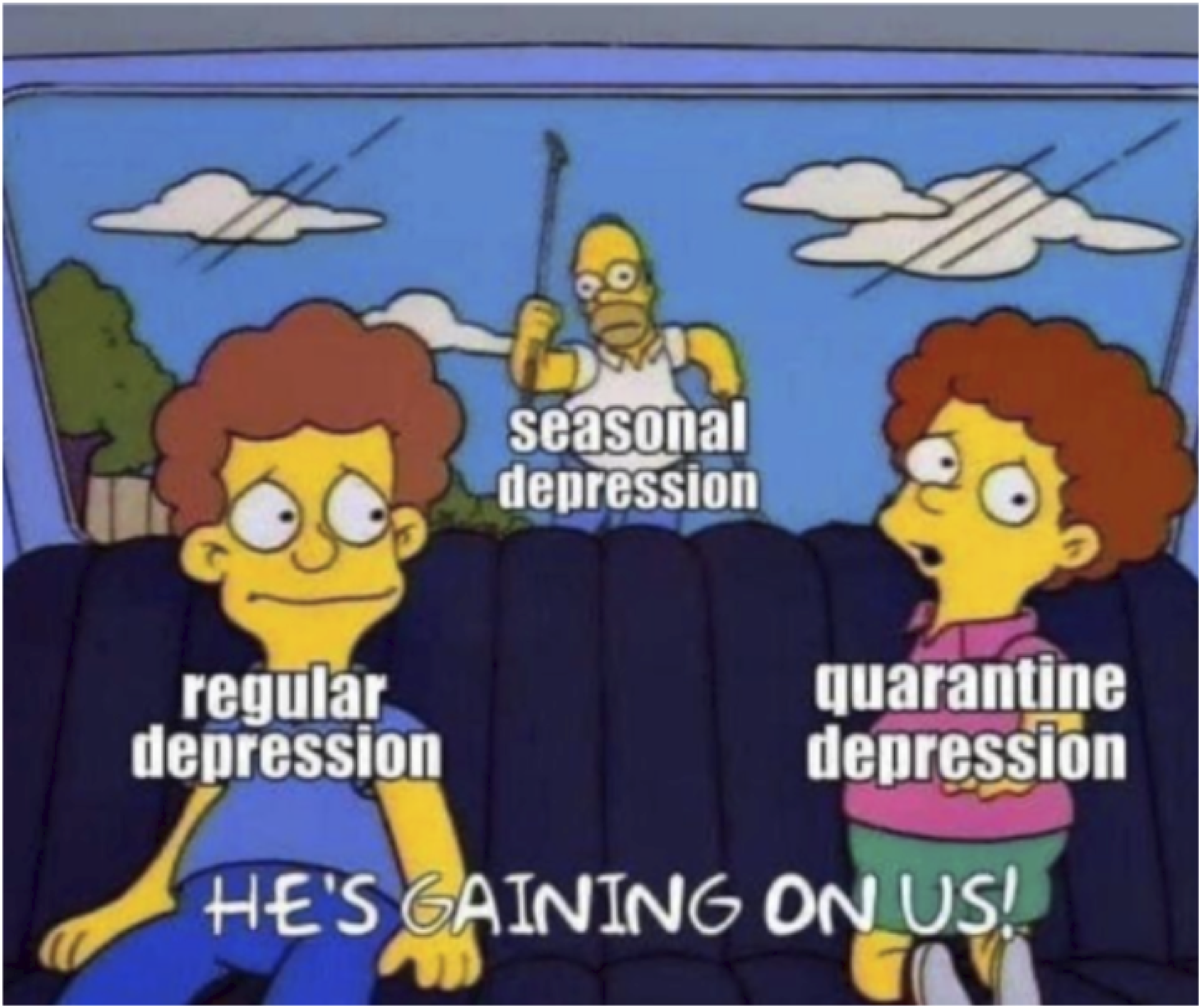
In Jones’s popular media article, however, testimonials of Gen Z subjecthood demonstrate not just awareness of, but resistance to, injustice, drawing SAD-experience into cultures of disability activism: ‘It is deeply upsetting and disappointing when people don’t take SAD seriously’, he continued. ‘It’s real ... and it has an impact on my social and occupational functioning. When SAD strikes, there are plenty of condescending, invalidating people ... who would prefer that I suck it up, which is how our culture has traditionally dealt with mental health concerns — by ignoring or downplaying their severity rather than finding solutions. What else can I do but deny them my silence?’ (Jones, 2021, np.).
Through one lens, the uncertain relationship between ‘folk’ accounts of those experiencing SAD and variously affirmative and sceptical clinical accounts of it qua ‘disorder’ highlights an injustice whereby not only a person’s word but also their world is denied credibility, maybe turned upon them via a normative injunction to ‘toughen up’. Through another lens, SAD itself is rendered a contested or ‘interpretive resource’: while the ‘folk’ interpretation of ‘winter blues’ has popularised awareness, it may also have rendered the particularity of lived experience for those suffering from SAD harder to acknowledge as something other than a cultural ‘poetic melancholy’ (Rosen et al., 1980). In this case, it would signify less a ‘gap in our shared hermeneutical resources’ (Fricker, 2007: 6-7) and more a certain crowdedness, an over-abundance, of voices making claims about – and laying claim to – SAD. Whether, and how, ‘light works’ (or, indeed, how ‘dark works’) is thus a shared cultural question grappled over in personal diaries and clinical trials, newspaper articles, self-help groups and other experiments in collective activism as people confront the challenge of recognising – or refusing – their own experiences in others.
VI Conclusion: Lighting up future experiences of SAD
The biggest problem is that we don't make light matter - we don’t understand - we don’t have the awareness - of how much light is actually impacting all of us every single day and every single cell in our bodies (Sharon, SAD expert-by-experience, May 2022).
Beyond contributing in the ways outlined above, we see value in venturing a distinctive research agenda directed at ‘making light matter’ and thinking about how light works in, and on, human life. This can be delivered as a version of cultural geography more fully attuned to cultures of luminosity and locality, investigating placed-based ways of managing changing light. The geographer’s role here is in facilitating, or co-producing, creative cartographies of light and sensitised understandings of light-affected health, well-being and ill-health. Such an interventionist mode of doing research would seek to make light matter via the application of creative practices, combined with hearing testimony and giving voice, so as to identify diverse ways to communicate, narrate and represent enlightened-worlds. One challenge likely to be faced centres not so much on the diverse ways in which humans perceive or place seasonal light, but rather on how light and lux (its recognised scientific unit of measure) will continue to fluctuate with greater unpredictability during an age of climate crisis (and see Verlie, 2019). Thus, it is apt to conclude with a speculative research agenda for light and sadness attendant to this planetary context, as well as to particular socialities and imaginaries (Machen et al., 2023).
SAD has been discussed above as having a complex human, cultural geography, one intimately connected with places and the material and elemental specificity of where we are, as well as accepting that ‘what light is depends on what we take this world to be’ (Ingold, 2022: 85). The complex geographies of anxiety and sadness relating to climate change are only beginning to surface (Boyd et al., 2022), and by ‘making light matter’ we can begin to itemise what seem set to be emerging methodological, epistemological and narrative challenges for the geography’s disciplinary communities. (i) Engaging new place-light scholarships. Research can be attentive to dynamic micro-scaled atmospherics and luminous relations, so that in, for instance, Aberdeen, we might attend to seasonal light beyond designed illumination (Ebbensgaard 2022; Edensor and Millington, 2009) to incorporate ‘expanded sensibilities’ of tones and colours of light, as ‘especially in winter, the silvery stone matches the often gloomy skies above this Scottish city to generate a pervasive greyness’ (Edensor, 2023: 5). Edensor’s (2023: 1) invitation is to think with light and colour relationally in place, given that ‘a brief consideration of the places we inhabit may immediately solicit recognition of the changing intensities of sunlight that condition how colours appear, particular seasonal colours that shift sensory experiences’. Acknowledging that place, light and colour are sensorially connected is no revelation, perhaps, but how might light-sensitive scholarship adjust when such relations are disrupted by unseasonal, constant cloud cover, persistent ‘haar’ (Morris, 2013), ‘smog’ or smoky skies from drought-fed wildfires (Varkkey, 2022)? Indeed, Varrkey (2023) suggest that haze ‘can be understood as a new ‘season of the Anthropocene’. Such developments, new atmospheric and lux-related change will require reinvigorated work with concepts of visibility, aesthetics and mental health. As Hyslop (2009: 182) argues: ‘visibility is an environmental quality that is valued for aesthetic reasons that are difficult to express or quantify’. Building on current weather and atmosphere-related scholarship (Endfield, 2019, Engelmann, 2021), the implications of climate-changed light, visibility and colours of places for SAD experience and scholarships remain to be fully explored. (ii) Engaging creative methods. Embodied relations with changing light that are difficult to quantify will require creative methodologies and new ‘climate imaginaries’ (Machen et al., 2023) to experiment with ways of knowing and communicating SAD (as one among many climatic-related eco-anxieties). Creative approaches might include speculative narratives, geo-poetics, filmmaking, podcasting, photography and other exhibitable media currently deployed at the geohumanities and health interface (Atkinson and Hunt, 2020). Bell’s work on blindness and ‘more-than-visual’ sensing offers an important exemplar, indicating how creative experiments aid the understanding of how diminished light is something felt and not just seen. In this vein, people experiencing SAD might not just and only be disadvantaged by winter or climate-related light filtering or dimming, but instead be learning from disabled others to ‘open attitudes’ which strive for an ‘unravelling of both negative and positive stereotypes that limit people’s understanding of what varied bodies can do’ (Bell, 2020: 96). Here, a creative exploration of such embodied sensibilities might take place via a ‘geohumanities methodology [that] privileges the creative and the transdisciplinary’ (De Leeuw, 2022: 97), adopting a world-making praxis to intervene in non-clinical ways that alleviate, or unwork, experiences of SAD. (iii) Engaging emotional narratives and voices of experience. In future, research could provide insights into the chief concerns of individuals affected by SAD and the key elements of their wintertime seasonal experience. As such, it would play a crucial role in granting greater legitimacy and recognition of environmental distress beyond narrow clinical debates; a situation that has sometimes to date limited clinicians’ ability to assist those experiencing forms of seasonal and environmental distress. As Rehling and Sigston (2020: 38) suggest, with reference to solastalgia (Albrecht et al., 2007), working to understand the concepts that help individuals identify and articulate their experience is a crucial step in turning toward the therapeutic task of what can be done to help. Their argument highlights a need for critical reflection about the role and task of clinical practitioners, particularly within efforts to understand and address emotional and mental health challenges associated with environmental change and crisis. One possible pathway for such research is to learn from decolonial efforts to reimagine psychiatry as a critical practice of ‘disalienation’ and emancipation, as in the decolonial work of Fanon (2018 [1956], in Robcis, 2020). This strategy may be preferable to assigning psychiatry the task of dispensing legitimacy on a given condition through diagnosis. Instead, it would seek to lend insight to the social and material institutions previously contributing to an individual or group’s alienation from their environment and in dialogue with those experiencing it.
More than a decade ago, at the landmark Welcome Witness seminar on SAD, Rosenthal had his own explanation for the lack of standardised treatment for SAD through the administering of artificial light via specialist box-lamps. He noted how for the global pharmaceutical industry ‘light is not a drug and not patentable’ (Overy and Tansey, 2014: 23). In essence, Rosenthal was making plain the non-profitability of light-treatment. If this remains to be the case, further cultural research into experiences of SAD ought to provide insights into commonplace strategies and adaptations for coping with light-affected seasonal distress (De Vet, 2017), with a focus on local and intimate experiences of living through environmental-light crisis. Work of this sort would also go some way towards addressing Verlie’s (2019) call to research ‘climatic-affective atmospheres’ that includes more holistic attention paid to the meteorological. Thinking with these experiences can help to understand the personal qualities of crisis ‘intimately embedded in and through everyday lives as they are lived’ (Hall 2019: 490). As the possibilities of feeling SAD about light in climate-changed futures play out for many more of us, such an approach may well be the best treatment possible.
Footnotes
Acknowledgements
We are grateful to our critical reader, Chris Philo. We also acknowledge very helpful anonymous review comments and our editor, Noel Castree, for guidance that improved the paper. We thank our experts-by-experience in the Wintering Well Collective and Project Advisory Team. Data from the ESRC ‘Living with SAD’ research project is deposited with the UK Data Service.
Declaration of conflicting interests
The author(s) declared no potential conflicts of interest with respect to the research, authorship, and/or publication of this article.
Funding
The author(s) disclosed receipt of the following financial support for the research, authorship, and/or publication of this article: This paper stems from the ‘Living With SAD’ research project funded by the Economic and Social Research Council Award ES/V002473/1.
Corrected (September 2024):
Article updated to correct Shawn Bodden's affiliation.
