



Abstract
Coastal communities have long been at the periphery of human geography. Nonetheless, the coasts present a rich context to understand and deconstruct processes of displacement—enclosure, ocean grabbing, gentrification, and financialization—and the salience of adjacency claims as resistance. While scholars have theorized that the coast’s spatial specificity may enable communities to raise adjacency claims, scholarship has not reconciled the degree to which coastal communities should benefit from marine resources and ocean spaces. This displacement-adjacency framework and research agenda provide a lens to study discourses, cases of contestation, and the potency of such protests of interrelated coastal displacement processes.
Keywords
I Introduction
The coast is the physical meeting of the sea and land, shaped and determined by the ebb and flow of the tides. As terrestrial edge, coasts allow entry to and exit from the sea, with implications of this adjacency (Arias Schreiber et al., 2020; Bennett et al., 2018; Foley and Mather, 2018; Foley et al., 2015). The importance of proximity to fishing grounds, marine resources, maritime routes, and coastal and ocean spaces expands and contracts due to ecological, economic, social, political, and cultural factors that are dependent on various channels of governance. Located at land’s terminus, coastal communities represent absolute peripheries in terms of physical geography, all the while being central in national imaginaries, relegated as extractive hinterlands, or overlays of their location and mobilities (Carter and Ounanian, 2019; Urry, 2007).
With the decided interest in the future of coastal communities and their oncoming transitions, the coasts present a rich context to understand and deconstruct processes of displacement—enclosure, ocean grabbing, gentrification, and financialization—and the potency of adjacency claims. Nevertheless, coastal communities have been at the periphery of human geography and other social sciences, where such work is often designated as “applied.” This paper strives to rectify geographers’ tendencies to concentrate on terrestrial environments and marine affairs scholars’ inclination to publish in journals explicitly focused on ocean and coastal studies.
We argue that inquiries into ongoing and future transitions of coastal communities would benefit from conceptualizing change through processes of displacement, specifically through the intersection of ocean grabbing, gentrification, and financialization. While gentrification scholarship is expanding from a historical urban centrism, it has not paid sufficient attention to coastal areas as a unique subset of the rural to date. This paper also attends to gentrification and ocean grabbing’s connections to financialization, understood as the “increasing dominance of financial actors, markets practices, measurements and narratives… resulting in a structural transformation of economies, firms…, states and households” (Aalbers, 2015: 214). We conceptualize enclosure as a means of “clearing the coast” for displacement processes and posit adjacency as a possible means of resistance.
Based on the above, this paper aims to (1) identify parallels and gaps specific to coastal communities in ocean grabbing, gentrification, and financialization literatures and (2) formulate a research agenda combining these literatures and applying them to coastal communities to study transition and constructions of adjacency as resistance. We argue that adjacency claims manifest in the resistance toward (a) ocean grabbing, (b) gentrification, and (c) financialization and come in both literal and figurative formulations. Investigating adjacency claims as forms of resistance to these three phenomena will unite often disconnected research domains and give further insight into constructions of peripherality and forms and effects of displacement.
The body of this article is divided into five main sections. Section II introduces the notion of enclosure as a means of preparing the grounds for displacement, which we see as a common denominator of the three literatures. Enclosure and the Blue Economy serve as thematic introduction of this article’s impetus, echoing the authors’ own starting point and segue to ocean grabbing in Section III. Following this, Sections IV and V unpack gentrification and financialization literatures, respectively, highlighting intersections between the literatures as well as the overlap between marine and terrestrial geographies. We close the paper with Section VI, our research agenda suggesting directions for future research that would unite these streams of inquiry and center coastal communities within human geography scholarship.
II Enclosure: Laying the ground for displacement
We begin this section with literature on fisheries enclosure to illustrate an archetypical trajectory of coastal communities and continue to other scholarship documenting the clearing of coastal incumbents via “disaster capitalism” 1 and discriminatory practices. For the past 25 years, fisheries social scientists, including geographers, have documented the evolution and effects of enclosure and commodification, namely, the introduction and expansion of tradable catch share programs 2 that winnowed access to livelihoods in coastal places (Carothers and Chambers, 2012; Chambers et al., 2017; Foley et al., 2015; McCay, 1995; Murray et al., 2010; Pálsson and Helgason, 1995; Pinkerton and Davis, 2015). After more than a decade into the implementation of transferable catch shares, coastal communities will likely move into what Kokorsch (2017: 68) terms, “post-quota development,” or “a strategic transition in times of precarious resource entitlements towards an economy not based on extractive fisheries.” As documented, in the absence of fishing opportunities, coastal communities, especially those characterized as peripheral, witness outmigration (Eythórsson, 1996; Hamilton and Butler, 2001; Hamilton et al., 2004; Hamilton and Otterstad, 1998; Kokorsch, 2017; Kokorsch and Benediktsson, 2018) yet resist associated geographic concentration and consolidation of fishing access privileges (Arias Schreiber et al., 2020; Ounanian, 2016, 2019a).
The impact of enclosure in coastal places has not been limited to fisheries access and natural resource-based livelihoods. Affording persons access to the shore to recreate—bathe, swim, sail, and walk—has also witnessed enclosure and privatization, especially in the post-WWII era (del Castillo, 2023; Hadjimichael, 2018; Kahrl, 2016, 2018). Littoral zones are historically rooted in the public trust doctrine, which allows the public to access coastal areas for navigating, fishing, hunting, and, in some instances, wellbeing-promoting activities such as recreation and bathing (Eagle, 2016; Freedman and Shirley, 2014; Hellums and David, 2011; Kahrl, 2018; Thom, 2012). Additionally, property ownership in coastal areas was primarily communal (res communis) but often (willfully) misinterpreted as open access (res nullius) and later privatized (Bromley, 1992; Mansfield, 2007; McEvoy, 1986; Ostrom, 1990; Schlüter et al., 2020). The enclosure of the ocean and coastal commons has implications for access not only to fisheries but also other food provisioning such as (subsistence) gleaning, mariculture, coastal agriculture, and pluriactive livelihoods.
1 Clearing the coast and “Stage 0”
Enclosure also comes ashore. In diverse contexts, authors have demonstrated how acute events such as powerful storms induce a series of removals and displacements that are further amplified by state intervention—or lack thereof—with the shared purpose of commodifying and privatizing coastal space (Chhotray, 2022; Cohen, 2011; Gould and Lewis, 2018; Schuller and Maldonado, 2016). Kahrl (2016, 2018, 2020) traces dispossession of public beaches and communal coastal land, especially those areas once held by Black communities in the United States, through policies that both intended to segregate and later to desegregate American society (Kahrl, 2016). The cooptation of coastal areas once publicly accessible but now privatized has also been discussed by scholars from and working in the Mediterranean and South America (Ballinger, 2004; del Castillo, 2017, 2023; Hadjimichael, 2018). Connecting multiple drivers of change, “coastal capitalism” recognizes “the commodification of the beach as a commercial asset, exploitation of natural resources and environmental engineering of coastal zones and bodies of water for aesthetic and recreational purposes, and the transfer of public lands to private entities” (Kahrl, 2016: 4).
Chhotray (2022) identifies the discursive power of “wasteland” and “emptiness” as integral to lagging state intervention on behalf of poor coastal farmers and the transformation toward aquaculture. Emptiness—recasting the sea and shore as “unpeopled”—has been an explicit strategy of (eco)tourism developments and conservation (Barbesgaard, 2018; Benjaminsen and Bryceson, 2012; Cohen, 2011; Gould and Lewis, 2018; Kahrl, 2020). Little attention has been paid to the notion of fisheries enclosure as a form of (state-sponsored) clearance, making the ground fertile for the rhetoric of rehabilitation and revival and the emergence of gentrification and displacement. Recognizing such policies and management instruments as means of removal or clearance is essential for recognizing the “frontier” ethos situated in the oncoming Blue Economy wave, as argued by Knott and Mather (Knott and Mather, 2019, 2021) and the wider ocean grabbing literature (to be discussed more in the following section).
Moskowitz (2017) supplements Clay’s (1979) original four stages by which gentrification typically unfolds with “Stage 0” to indicate a preconditioning phase highlighting the role of the state in structural disinvestment, removals, and clearances (Moskowitz, 2017). In a similar vein, Gonzalez and Waley (2013) highlight the roles of the state “preparing the ground” in retail gentrification. Fisheries decline, “crisis,” and subsequent introduction of transferrable catch shares parallel the “managed into decline” of cities such as Liverpool and subsequent gentrification as detailed by Paton and O’Connor (2019). We relate fisheries enclosure, disaster capitalism, and coastal capitalism to the notion of “Stage 0,” laying the foundation for coastal gentrification and the displacement this entails.
Adjacency as resistance
In marine scholarship, adjacency is “often invoked with reference to economically vulnerable adjacent small-scale fisheries and coastal communities marginalized by the encroachment of distant water industrial fishing fleets” (Foley et al., 2015: 4). Foley and Mather (2018) have further worked with claims of adjacency rights, defining them as, “the idea that people living in close proximity to resources ought to have priority in accessing and benefitting from those resources” (Foley and Mather, 2018: 3). Nonetheless, Marine Affairs scholars, including those critical of the ocean enclosure movement, have grappled with the tension between the universality of the seas (e.g., Grotius’ Mare Liberum, freedom of movement, and protection of subsistence needs) and their territorialization (e.g., Selden’s Mare Clausum, ocean enclosure movement, UNCLOS, and marine spatial planning). Moreover, international ocean governance has yet to reconcile the degree to which coastal communities—those invoking their adjacency to the sea—ought to benefit from marine resources (Cruz Carrillo, 2023).
III The Blue Economy’s revival discourse and ocean grabbing
Conflicting narratives of marine spaces—“crowded seas” versus “oceans of opportunity” and in between—coalesce in the overlapping rhetoric of Blue Economy, Blue Growth, Blue Capital, and variations therein. Pinning down the Blue Economy and its discourses has been the pursuit of many (Boonstra et al., 2018; Morrissey, 2021; Schutter et al., 2021; Silver et al., 2015; Voyer et al., 2018). The Blue Economy’s growth paradigm may set the emphasis too heavily on private beneficiaries, leaving coastal community viability and the wellbeing of their inhabitants off the agenda (Brent et al., 2018, 2020; Christiansen and Schutter, 2019; Heidkamp and Morrissey, 2019; Lewis, 2019; Morrissey, 2021). Others call for the Blue Economy to better address and share the wealth with coastal communities and bring back places and communities that have suffered under neoliberal policies and the cumulative effects of speculation—both in fisheries and coastal real estate (Balata, 2015).
There are at least two interpretations of Blue Economy. The first and most mainstream of these is that of Blue Economy as highly capitalized investments intended to economize or commodify natural resources and provide a means of framing and regulating those activities. However, Lewis (2019) also identifies more radical environmental agendas centered on (s)low or no growth with concerns for environmental and coastal community impacts of a frontier-oriented development of the oceans and coasts. Nonetheless, Lewis’ (2019) definition cannot contend with the growth hegemony. The rhetorical strength of the Blue Economy lies in its persuasive capacity as “a ‘common sense’ and productive way forward, capable of achieving triple [sustainability] wins” (Schutter et al., 2021: 104673) and stimulating growth. Scholars working in post-disaster settings pinpoint “green transition” rhetoric as means to promote (eco)tourism, aquaculture, and other Blue Economy sectors as regional revitalization (Chhotray, 2022; Cohen, 2011; Gould and Lewis, 2018), while others note the “frontier” mindset that entraps coastal communities into the promise of revival after previous eras of ruin without adequately addressing community benefits of new maritime activities (Bennett et al., 2021; Knott and Mather 2019, 2021).
The “frontier” rhetoric that characterizes the Blue Economy emerged from a period of state-sponsored clearances (enclosure of coastal commons and commodification of access) with recognizable displacement effects. Answering the lacuna of fishing access, decommissioning of shipbuilding wharves, and other economic opportunities, the Blue Economy promises much. The question remains whether the Blue Economy will bolster coastal communities or continue to hollow them out, gentrify, and calcify growing inequalities through ocean grabbing and further infusions of capital.
1 Ocean grabbing and the possibility of “grabbing back”
Connected to Blue Economy, there is coalescing literature applying the concept of “land grabbing” and its mechanisms of dispossession and appropriation to oceans and coasts (Barbesgaard, 2019; Benjaminsen and Bryceson, 2012; Cohen, 2011). Scholars have been connecting calls for development in the Blue Economy to the phenomenon of ocean grabbing (Barbesgaard, 2018; Bennett et al., 2015; Brent et al., 2018; Mallin and Barbesgaard, 2020), which has also taken related forms as coastal grabbing (Bavinck et al., 2017) and blue grabbing (Benjaminsen and Bryceson, 2012). Bavinck et al. (2017) note the “pejorative quality” and the deliberate choice in the use of grab. With links to Harvey’s (2004) “accumulation by dispossession,” the concept of “coastal grab” is defined as “the appropriation of coastal space—including sea and land—by interests external to the community” (Bavinck et al., 2017: 2). Two impacts are recognized: (a) exclusion from, or prohibited access to, space and resources and (b) capacity to make decisions in the name of resources or environmental conservation.
In contrast, Foley and Mather (2018) argue that social scientists should widen their scope and loosen their normative positioning of ocean and coastal grabbing beyond its “pejorative” usage to examine local, indigenous, and occupational communities’ provocations in the form of adjacency claims. Furthermore, the authors tie the situation of peripheral, coastal communities suffering from enclosure in other fisheries, as motivation to claim—or re-claim—access to other fisheries as means of community and cultural persistence (Foley and Mather, 2018; Said and MacMillan, 2020). We will return to “grabbing back” later in the article. Nonetheless, undercurrents of adjacency claims may also be visible in social license to operate for Blue Economy activities (Alexander, 2021; Smits et al., 2017; Voyer and Van Leeuwen, 2018) and in newly proposed community benefit funds associated with offshore wind farms (Department of the Environment, 2023; Government of Ireland’s Department of Environment, 2023).
Ocean grabbing not only takes the form of resource extraction but also conservation via marine parks/protected areas, climate offsets, and other “Blue Capital” ventures (Barbesgaard, 2018; Bavinck et al., 2017; Benjaminsen and Bryceson, 2012; Bennett et al., 2015; Song et al., 2021). Barbesgaard (2018) differentiates blue-growth-driven ocean grabbing as it manifests as “in production,” as seen in continued or new resource extraction, versus taking marine space “out of production” in the case of blue carbon projects, such as mangrove-based climate offsets (Barbesgaard, 2018). Seen in this light, Barbesgaard (2018) underscores the economic power of both for-profit and non-profit entities, which translates into the power to determine how marine resources and spaces are managed, conserved, or used. Focusing on mangroves in Southeast Asia, Song et al. (2021) show that the emergence of the “Blue Capital” frame largely ignores local community needs, seeing coastal spaces as unpeopled, and thus opens for capital investments in the form of climate offsets. These “grabs” thus result in a change in property regime with implications for who holds decision-making power and responsibility over certain spaces (Bavinck et al., 2017; Ribot and Peluso, 2003). Other scholars have probed the particularities of the transferability of fishing quotas and their making into financial assets and securities, urging further investigation into the intertwining processes of marketization, commodification, and financialization (Dobeson 2018, 2019, 2020; McCormack 2017).
In summary, ocean and coastal grabs cover more than a simple dominant-marginalized dichotomy but center on displacement (via dispossession and accumulation) and call for adjacency claims as resistance. Furthermore, while ocean grabbing sets attention offshore, coastal grabbing opens a dialogue with gentrification scholarship, which has seldom attended to the specificity of the shore. However, we argue that with a recognition of enclosure as clearance and attention to coastal grabs, gentrification scholarship offers a lens that can be productively applied to the coast to understand both its parallels and particularities.
IV Gentrification
Within gentrification literature, debate remains on the matter of displacement, which carries normative concerns for the outcomes of those who move out, and what some researchers see as a more benign process of replacement (see review and discussion by Brown-Saracino, 2017). However, displacement is a concept inherent in critical approaches to gentrification. In Glass’ original definition, gentrification hinges on the displacement of the working class by a newly arriving middle class and resulting change in the social character of a district (Glass, 1964). Displacement is the fulcrum of gentrification in this definition, and an essential element of any critical understanding of gentrification, a point convincingly asserted by Marcuse (1985) among others (Elliott-Cooper et al., 2020; Slater, 2009; Smith, 1996). Hubbard (2017: 1) identifies the “wholesale cultural changes at the local scale” that occur because gentrification is a form of “indirect displacement,” corresponding to Marcuse’s (1985) “displacement pressure.” This describes not the “moment of displacement” as such but rather the gradual change of a neighborhood over time to suit a different social class: When a family sees the neighborhood around it changing dramatically, when their friends are leaving the neighborhood, when the stores they patronize are liquidating and new stores for other clientele are taking their places, and when changes in public facilities, in transportation patterns, and in support services all clearly are making the area less and less livable, then the pressure of displacement already is severe. Its actuality is only a matter of time (Marcuse, 1985: 207).
Nearly 40 years after Marcuse’s writing, his description captures coastal communities’ witness to change along their waterfronts and retraction of services due to centralization (Arias Schreiber et al., 2020; Gerrard, 2013, 2017; Ounanian, 2019a). Even with the presence of tourism or other maritime sectors, coastal communities confront questions of how to support those living in absolute and imagined peripheries (Carter and Ounanian, 2019; Ounanian, 2019b; Pafi et al., 2021). There are documented feelings of loss in fishing communities and how communities grapple with transition and increasing cultural heritage narratives (Flannery et al., 2022; Nadel-Klein, 2000, 2003; Ounanian, 2016, 2017, 2019b).
We argue that gentrification holds a vivid place in the public discourse and remains on the research agenda precisely because of its displacing effects. Concerns around these displacing effects relate to the physical displacement of long-time residents and often marginalized communities—motivating resistance and protest (Zukin et al., 2009). However, these concerns are also rooted in the quiet lament for the cultural loss of special places and diffusion of social networks that were once emplaced (Brown-Saracino, 2007, 2010). Thus, there is figurative or metaphorical displacement in the shifts in meaning and social spaces, as well as the more literal displacement of individuals and communities from particular spaces.
The emotional and sociocultural impacts of displacement or the fear of displacement (Baeten et al., 2017) is especially informative, highlighting the important insights from retail gentrification (Zukin, 1990, 2008; Zukin et al., 2009). Retail gentrification studies support the idea that gentrification is not simply about “rising rents” (although this is also a factor in the process of retail gentrification) but the capacity to consume (and feel comfortable doing so) and feel “at home” in a space. In other words, it supports the idea that gentrification is indeed constituted by both direct and indirect displacement.
As the retail spaces of gentrified neighborhoods come to reflect “the consumption practices and identities of gentrifiers” (Bridge and Dowling, 2001: 93)—as opposed to those of incumbent residents—they contribute to displacement pressure. Gonzalez and Waley (2013) and Ji (2021) identify “first movers” or “pioneers” of gentrification that enjoy “discovering a place” before the mainstream and frequenting it. Gentrifiers moving into an area begin changing the composition of retail, tailoring it to the preferences of fellow gentrifiers, thereby establishing new social spaces that exclude “old-timers,” making them feel unwelcome (Ji, 2021). As a location becomes increasingly “successful,” the new local (gentrifying) retailers are replaced by more experienced retailers and larger businesses that can afford the inevitably increasing rents (Zukin, 2008; Zukin et al., 2009). This dynamic of displacement is through retail gentrification first enacted on original residents and consumers, and subsequently on the gentrifying “pioneers” themselves, as larger chains and global capital seeks to exploit the emerging gentrified space and its consumers.
1 Gentrification: Expanding to the rural, but little acknowledgement of the coast
Gentrification scholarship is skewed toward metropolitan settings. Although Phillips and Smith (Phillips and Smith, 2018a, 2018b) push back on gentrification studies’ urban preoccupation, their explorations of rural gentrification still fixate on the motivations of rural gentrifiers and the forms of investment, renovation, rebuilding in “the countryside” or former agriculturally dependent communities. Scholars have been working to identify the contours of gentrification in rural settings (Ghose 2004; Mamonova and Sutherland 2015; Phillips 2002, 2004, 2010; Phillips and Smith 2018a, 2018b), but inquiries into the characteristics of—or even existence of—coastal gentrification remain scarce. 3 There are only few studies explicitly interested in coastal community gentrification (Brown-Saracino, 2007, 2010; Colburn and Jepson, 2012; Gould and Lewis, 2018; Heidkamp and Lucas, 2006; Kahrl, 2020; Thompson, 2012; Thompson et al., 2016). This lacuna may be in part because much of the rural gentrification literature is rooted in rural studies, which has an agrarian orientation, if not an interior bias. Nonetheless, Phillips and Smith (2018b), along with Brown-Saracino’s review (2017), establish that looking at gentrification in rural or peripheral contexts, especially in connection to second homes, coastal resorts, and amenity-based relocation, deserves further inquiry.
Interest in particular coastal communities for holidays, second homes, retirement residences, and other amenity-oriented purposes make coastal communities and their housing stock attractive (Thompson et al., 2016). Gentrification may come at a cost of further transforming coastal communities from inhabited to (seasonally) visited places (Ounanian, 2016, 2017, 2019b; Thompson, 2012). Notably, the literature on second homes in the rural space has a particularly Scandinavian focus, especially in Norway and Sweden (Back and Marjavaara, 2017; Halfacree and Ellingsen, 2010; Hidle et al., 2010; Nielsen et al., 2004; Overvåg, 2009; Rye, 2011; Steffansen, 2017; Tress, 2002; Velvin et al., 2013). The Scandinavian context is interesting because of the distinct tradition among these countries of planning or zoning summerhouses or non-year-round residences and having different taxation schemes. Nonetheless, there have been some calls to relax certain provisions (Olesen and Carter, 2017). In questions of changing coastal communities and residential structures, Australia and New Zealand seem to be on the leading edge (Freeman and Cheyne, 2008; Kelly and Hosking, 2008) with some scholarship from the United States (Colburn and Jepson, 2012; Heidkamp and Lucas, 2006; Thompson, 2012; Thompson et al., 2016).
2 Working waterfronts
Land-use change and shifting business profiles also play out in the “working waterfronts” debates in coastal communities (Ounanian, 2015; Portman et al., 2009, 2011; Smythe, 2010). Coastal space is often limited, constraining land use in coastal communities with impacts on the demand and supply of coastal property and access to the shore and coastal waters. Alongshore and in harbors, water-dependent, related, and enhanced users have operated businesses supporting maritime enterprises and activities but run a special displacement risk because of their spatial and littoral-proximate needs (Smythe, 2010). These “working waterfronts” have increasingly become part of the debate on structural changes in coastal communities, especially fisheries enclosure and further commodification (Breen and Rigby, 1985; Faghin, 2014; Moore, 1987; Ounanian, 2015; Portman et al., 2009, 2011).
There are ongoing debates on “working waterfront” interventions and transitions (Lange and Ounanian, 2020; Ounanian, 2015, 2019b), and these issues remain salient both in popular press and academic inquiries (Loring and Harrison, 2020). Nonetheless, working waterfront literature remains undertheorized, with few connections made to the larger gentrification literature. Answering this gap would connect the importance of water-dependent use and crowding effects and displacement, while also locating the working waterfront challenges under the more universal phenomenon of gentrification. Theoretical progress could be achieved by combining concepts and patterns of retail gentrification in empirical studies of working waterfronts and water-dependent users, where displacement essentially equals erasure. Therefore, scholars ought to attend to this form of gentrification and connect it further to the discussion of coastal grabbing and the changing Blue Economy.
To summarize, gentrification scholarship appears to be tangential to the coast, but inserting the concepts of indirect displacement, retail gentrification, amenities migrants, and Stage 0 into conversation with coastal transitions would be fruitful. The lament of rising housing costs, especially for properties affording easy access to coastal waterways or providing ocean views, is anecdotally observed by residents and researchers in coastal communities; yet studies tracking changing (commercial, residential, and seasonal) property values alongside coastal community and Blue Economy transitions are rare. Before discussing future directions for research, we turn to the third body of literature with relevance to commodification and speculation, which unites property studies from both fisheries and Blue Economy and housing and real estate: financialization.
V Financialization
Aalbers (2015: 214) defines financialization as, “The increasing dominance of financial actors, markets, practices, measurements and narratives, at various scales, resulting in a structural transformation of economies, firms (including financial institutions), states and households.” Finance’s new dominance signals a new phase in the growth of capital, in which an increasing number of goods, firms, and economic activities are turned into tradable financial assets such as shares, bonds, and securities (Aalbers, 2015), and thereby subjected to new financial logics, the influence of investors, and speculation. In addition, financialization has displacement effects. The pursuit of profit and raised value can exclude and displace both potential buyers and potential/current renters who can no longer afford to live in certain areas (August, 2020; Madden and Marcuse, 2016; Teresa, 2016). The same is true for other forms of retail and industrial property and commodified goods (e.g., fishing quotas) with the effect of displacing businesses and even entire industries from certain areas, and individuals and communities from certain sectors.
Under financialization, economies undergo a structural change concerning how profit is produced, where financial channels account for an ever-increasing proportion of accumulation (Krippner, 2005). Closely related to financialization, assetization reflects the process in which traditionally non-financial objects are transformed into “resources which generate income without a sale” (Birch, 2015: 122). Instead of value through sale as with a commodity, the value of an asset is based on presumed future income streams (Ward and Swyngedouw, 2018), and thereby influenced by wider global economic trends and speculation. Thus, objects and property become a financial asset over and above their use value. According to Rolnik (2013) under financialization, housing’s “exchange value” as a salable asset comes to overshadow its use value as a home, further encouraging investment in property (including summerhouses and second homes) as a means of accumulation. In fisheries and marine industries, the “exchange value” of assets such as tradable quotas or fish factories comes to dominate their use value, a means of leveraging or securitizing further investments or loans as much as a means of catching fish (Dobeson, 2018, 2019; Knott and Neis, 2017; McCormack, 2017). In both instances, the role of finance, fictitious capital and speculation are key; value is determined through future revenue streams, related to future (and global) economic trends.
The influence of financialization (based on assetization) on both property markets (August, 2020; Jacobs and Manzi, 2020; Madden and Marcuse, 2016; Teresa, 2016; Wijburg, 2020) and on fisheries and ancillary activities (Dobeson 2018; Knott and Neis 2017; McCormack 2017) has been investigated, as well as other areas, for example, bio-economy (Birch, 2017), nature (Ouma et al., 2018), and energy (Klagge and Nweke-Eze, 2020). Furthermore, the increasing interest in financial instruments for marine biodiversity conservation and climate mitigation, for example, blue bonds, blue carbon offsets, and debt-for-ocean swaps, has the potential to repeat colonial dispossessions (Perry, 2022) and raise other justice issues (Barbesgaard, 2018; Dencer-Brown et al., 2022; Herr et al., 2019; Song et al., 2021; Standing, 2023). Emergent themes include increasing levels of commodification and assetization, the potential for value grabbing, a potential change in the role of adjacency (Foley and Mather, 2018; Jacobs and Manzi, 2020; Knott and Neis, 2017; Ward and Swyngedouw, 2018), and displacement effects (August, 2020; Dobeson, 2019; Madden and Marcuse, 2016; Teresa, 2016).
Assetization calls into question the role of adjacency to claiming value. Jacobs and Manzi (2020) raise the idea that the financialization of land has in effect resulted in land becoming liquid, not tied to local geography but rather global circuits of finance. Land is “de-contextualized” from the local, with its control and exchange value shifting to a global circuit of finance rather than actors adjacent to, or indeed directly on, said land. Similarly, the involvement of global finance in fisheries during financialization means that profit and accumulation is not necessarily accrued by those doing the fishing, or even in the local area, but by potentially international investors and/or particular “quota kings.” 4 This raises the possibility that coastal communities might lose out in the situation of a finance-driven Blue Economy paradigm. Recognizing the increasing interest of financial actors, their power to determine access and allocation, and their potential counteraction to adjacency, the paper calls for an interwoven research agenda on displacement through financialization, gentrification, and ocean grabbing along the coast.
VI Assembling a research agenda via a displacement-adjacency framework
We argue for a blend of the terrestrial and “blue” research agendas, using coastal communities as meeting point. Gentrification scholarship, although expanding from its urban centrism to its iterations in rural places, ought to analyze coastal areas as distinct, but also as a subset of these two areas. Furthermore, “blue” scholarship with overlapping foci of the blue economy/growth/capital and ocean/coastal grabbing ought to expand with empirical studies intended to answer whether coastal communities and their inhabitants will be bypassed by the Blue Economy and (further) displaced or will find opportunities to gain benefits and participate. Financialization—and the constitutive ideas of commodification and assetization—may indeed supercharge the Blue Economy, ocean grabbing, and gentrification. Thus, this literature provides a lens for understanding change, including new actors and power dynamics in coastal communities and governance. Combining research looking at gentrification and ocean grabbing, as well as financialization, offers a means to dissolve this land-sea divide in the literature and view the parallels and shared components of these processes.
Our proposed displacement-adjacency claims framework enables a holistic approach to study the three aforementioned phenomena and proposes a means to open analysis of adjacency claims as more than territorial (Figure 1). Visual summary of the conceptual framework including clearing the coast, the mechanisms of displacement, and adjacency claims as resistance. We view enclosure as clearing the coast and Stage 0, which both facilitates and results in further manifestations of ocean grabbing, gentrification, and their overlay. We further conceptualize financialization as a “supercharging” force upon and within both gentrification and ocean grabbing, and thereby enclosure/coastal clearances, manifested through commodification and assetization. Adjacency is located as a potential source/site of resistance to these forces.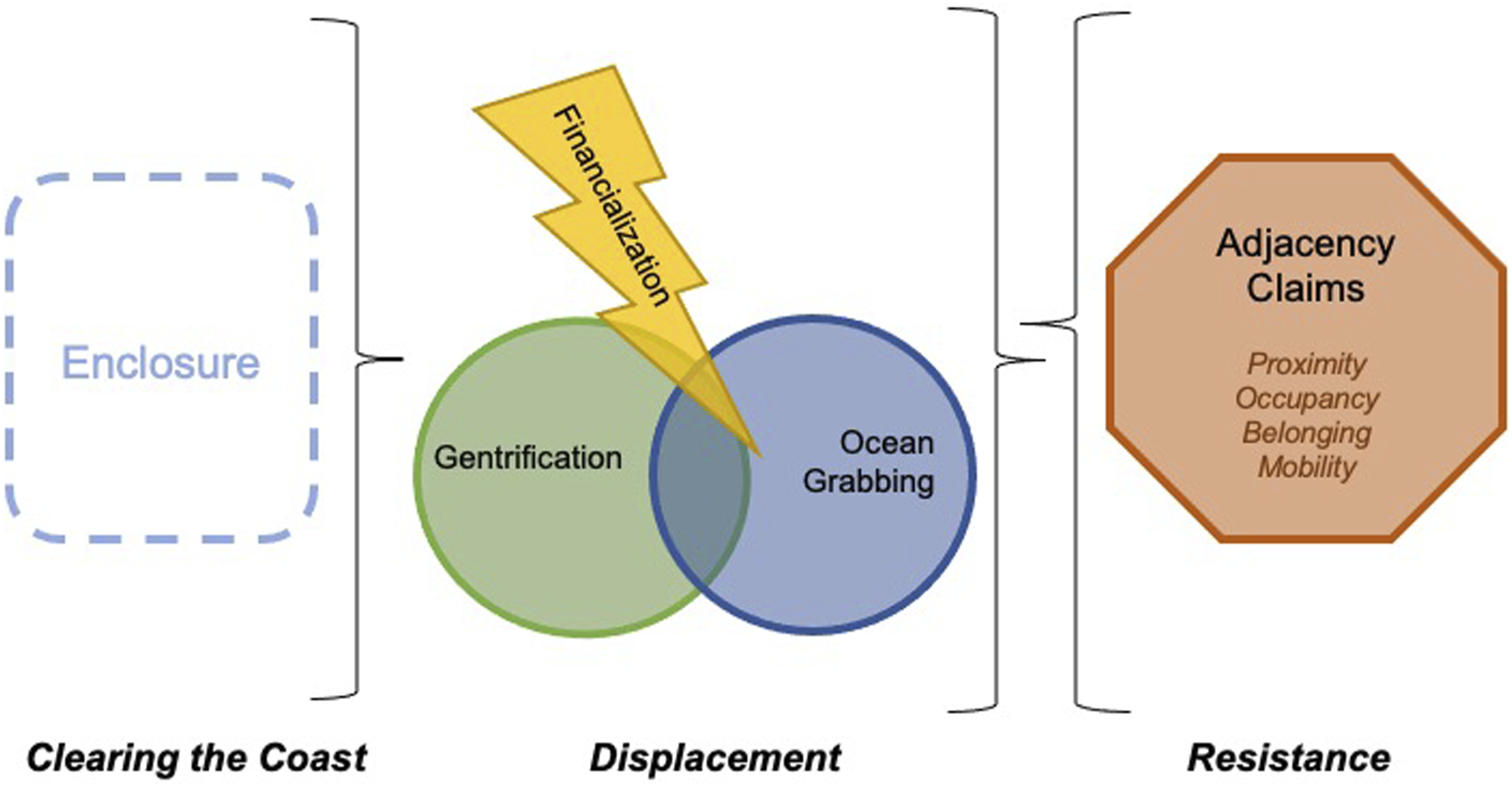
Supported by calls from others (Elliott-Cooper et al., 2020; Marcuse, 1985; Slater, 2009), this research agenda seeks to realign gentrification enquiry toward displacement and the recognition of removal and clearances that occur as a result. These removals and clearances arrive via occupational and spatial displacement (enclosure), subsequent processes of marketization and commodification (often through neoliberal policies), and financialization (speculation and ownership as means of increasing wealth). Such a critical approach to studying gentrification and its impacts on peripheral, coastal communities will enable scholars to investigate potentially unique characteristics of coastal gentrification and understand various configurations of adjacency claims that come ashore.
Adjacency provides the means to unpack the specificity of coast but should also go beyond territory via claims based upon proximity, occupancy, mobility, and belonging. We hypothesize that adjacency claims are expressed in terms of proximity to the sea; length of occupancy or tenure; movement to, from, and through spaces; and belonging in varied constructions. Proximity to the water or emplacement along the coast is the dominant dimension of adjacency (Foley and Mather, 2018). The other three proposed dimensions provide a means to see adjacency as more than proximity. Belonging relates to who is and is not considered a community member, which is important for determining who receives any agreed upon benefits from successful claims of adjacency. Belonging may also link to length of occupancy or tenure as a means of establishing membership, but goes further with heritage, lineage, identity and user groups, and communities of meaning (Ounanian et al., 2021). This conceptualization follows McCormack’s observations and theorization of nostalgia as resistance to the repercussions of fisheries management neoliberalization (McCormack, 2017). We include mobility, which is important for those who must traverse marine and littoral spaces for access to harvesting areas or landscapes holding spiritual, aesthetic, or recreative importance or other cultural, social, and economic benefits. In total, the focus is on what coastal community actors are saying and what they mean when they employ adjacency claims.
Additionally, what remains unresolved is the legitimacy of adjacency to claim territory, access, or benefits or the potency of the argument at higher governance levels and in questions of justice and overlapping claims. Such tensions or potential conflicts relate to the issues raised in Section II on universality of the seas versus territorialization. Such tensions remain in international ocean governance debates and issues of arbitration to this day. The legacy of the UN’s Convention on the Law of the Sea and the balance sought in the International Seabed Mining Authority and current debates about marine bioprospecting, Marine Genetic Resources, and Areas Beyond National Jurisdiction (Blasiak et al., 2018; Tiller et al., 2020; Wabnitz and Blasiak, 2019) highlight the unresolved question of who ought to benefit from coastal and marine spaces and their resources. Thus, we can see that while some regimes will have settled on what is and is not legitimate in terms of adjacency claims, their potency is another issue. An argument may be legitimate within a legal frame, but the strength and saturation of the discourse to change outcomes is another issue (Ounanian et al., 2019). Lastly, adjacency claims will also recognize resistance toward global financial actors and how such commodification puts greater pressure on resources and real estate once embedded in communities.
1 Avenues for future research
Finally, we propose an inexhaustive list of potential directions for research within the domain of coastal community transitions, mechanisms of displacement, and adjacency claims as resistance. Gentrification’s inland bias (in connection to both urban and rural inquiries) should be addressed to investigate the specific iterations of coastal gentrification in (a) working waterfronts and (b) second homes and their relationships to year-round residences. Pulling from the opposite direction, scholars should call “back into port,” the ocean grabbing literature with its “at sea” bias, to refocus on whether and how coastal community needs are addressed, not only in planning and policy frameworks but also among scholars critiquing these initiatives.
We suggest the following directions: (1) Utilize the retail gentrification lens to understand concerns about cultural change and displacement in coastal communities, specifically (former) fishing communities and those experiencing enclosure of coastal commons. Similarly, incorporate retail gentrification theory and analysis to bolster presently atheoretical discussions of working waterfronts, especially in rural and urban settings. (2) Address agrarian bias in rural studies and related investigations of rural gentrification by expanding to coastal regions and case studies. Second homes, amenity migrants, and retirees in coastal areas provide a worthy starting point. Furthermore, property value dynamics, retail gentrification, and planning/regulatory alternatives to housing designations (e.g., Scandinavia as compared to more liberal housing markets like the United States) all pose potentially fruitful areas of investigation in “blue” rural studies. (3) Extend Blue Economy scholarship with more empirical studies, especially those investigating local entrepreneurship and how the four proposed dimensions of adjacency claims do or do not underpin such efforts. As other authors (Foley and Mather, 2018; Said and MacMillan, 2020) have noted, investigations of coastal communities “grabbing back” by asserting adjacency claims and how others accept or contest those claims will carry the scholarship forward. (4) Map and trace enclosure in marine space with changes in (commercial, waterfront, and residential) real estate values over time, especially in places undergoing a transition from pluriactive and fishery-based economies to tourism- or recreation-based economies. Use policy introductions as key time points for pre- and post-analysis and explore means of studying diaspora of fishers and fishing families out and away from coastal communities. (5) Combine the ocean grabbing, gentrification, and financialization frames in investigations of blue bonds, carbon credit markets, and transferrable catch shares as financial assets to understand the scale and interactions among them as displacement mechanisms. Or alternatively, are coastal communities embracing these “blue” financial instruments? (6) Expand questions to how mobile, global capital may challenge adjacency claims via proximity, occupancy, and belonging and accountability beyond borders even further. Propose questions of equity and the importance of access—to resources, spaces, and capital—and the effects of transformation from objects of use to objects of investment (fisheries, housing, and coastal spaces). (7) Investigate the power of financiers in multiple property regimes in Blue Economy spaces offshore, nearshore, and onshore, including local real estate markets. How do both local elites and global venture capitalists (seek to) influence local planning and governance and national, regional, and international marine governance and regulations? (8) Widen investigations outside of the traditional “heartlands” of the various theories discussed. For instance, look beyond the Global North for coastal clearances and enclosure, financialization (e.g., Chinese-backed fishing trawlers), and gentrification. Ask questions of whether such displacement mechanisms are performing similarly or differently in Latin America, the Mediterranean, etc. On the flipside, adopt the lens of ocean grabbing in contexts outside the Global South.
VII Conclusion
We began this paper from the premise of pulling geographers to the coast and ushering more marine affairs scholars into human geography. By tracing enclosure of marine resources and access, we can recognize that coastal areas and the seas have been proclaimed as frontiers, rhetoric endemic to ocean grabbing and gentrification. Thinking of these processes as clearance allows us to realize that coastal areas have been primed for gentrification; yet little gentrification scholarship has taken an explicit interest in this geography. The coast should be recognized as a missing place, one misunderstood in terms of terrestrial and maritime economic forces, property regimes, and the interconnection between them and gentrifying processes.
Relatedly, the arguments for the Blue Economy as economic and ecological savior arrive after such periods of removal and displacement. Scholars have worked on this topic in the abstract, but empirical inquiries—especially those synthesizing cases—are few. The proposed displacement-adjacency framework will help understand the implications of Blue Economy initiatives. Will they help offset the previous era of clearances and transform coastal communities into vibrant, livable communities? Or will these initiatives further hollow-out coastal communities of their year-round inhabitants and increase inequalities, making coastal places only available to economic elites, further calcifying this developmental trajectory?
Furthermore, this agenda has relevance beyond the coasts. It offers insights to marginalized communities and how the macro-trends of financialization and gentrification may further peripheralize community members, opening discussions of these communities’ futures. Combining these areas of inquiry allows us to think through implications in offshore, inshore, waterfront, and onshore spaces. Debates on ocean grabbing and gentrification are about striking a balance between continuity and change and the implications for transition. Expanding adjacency claims as more than territorial through the presented typology provides a lens to study discourses, cases of protest and contestation, and the potency of such protests in governance. In the marine domain, society must thread the needle by neither accepting the tyranny of local vigilantes and preordained notions of ownership of the seas nor the stealth influence of hypermobile capital and dispossession.
Footnotes
Declaration of conflicting interests
The author(s) declared no potential conflicts of interest with respect to the research, authorship, and/or publication of this article.
Funding
The author(s) received no financial support for the research, authorship, and/or publication of this article.
