



Abstract
Despite increasing calls on the state to manage major challenges, in the existing literature, the state – and public sector activities more generally – tends to be overlooked as an agent of regional change. The role of public sector jobs is often taken for granted, with diverse empirical findings being strongly influenced by geography and time period, if they are considered at all. We discuss two main threads of research on contemporary public sector employment that could enhance our understanding of the role of the public sector in regional development (i.e. human capital formation and diversification).
I Introduction
As evidenced in relation to both the Covid-19 pandemic and the ever-present climate crisis, the precise role of the state varies in the way it exerts an influence on the economy, distributes resources, actively interferes in the market economy and mitigates its downswings (Martin, 2021; van der Ven and Sun, 2021). Moreover, varieties of capitalism also influence how actively the state takes part in local and regional development (Hall and Soskice, 2001), and thus to what extent social and spatial justice are considered in relation to macro-economic efficiency (Martin, 2021). Despite claims that state-controlled activities can stimulate regional development (e.g. Jefferson and Trainor, 1993, 1996; Marshall et al., 2005) and should lead the economy actively by shaping and creating new markets (Mazzucato, 2011), the distribution and activities of the public sector are seldom included in central regional development narratives or in empirical analyses of regional development. Consequently, although government employment constitutes about 20% of total employment throughout Europe (European Commission, 2021), and up to 45% when education, health and social work are included (Rodriguez and Camacho, 2008), we know very little about how such public sector jobs contribute to the local economy and local development, or how they affect other sectors of the economy.
One should also acknowledge that political leadership covers transnational, national and local initiatives and can take many forms. In the Fordist era, spatial Keynesianism focused on facilitating the redistribution of economic activity to promote equal development within the national territory while making less developed regions follow in the footsteps of the more developed ones. Later in the early post-Fordist era, political leadership was transformed into more supply-driven policies in which the efficiency of the market was relied on to create fertile grounds for economic development in both urban and rural regions. This was particularly prominent in the policy versions of economic clusters (cf., Porter, 1990) and the creative class (Florida, 2002), in which local and national leaders were to develop attractive regions that accelerated investments. However, in economic geography, there is also a strong tradition demonstrating that market-led development and increased local responsibility tend to create structural differences between regions that cause opportunities in the regions to develop very differently (Massey, 1979, 1984; but see also Rodriguez-Pose and Gill, 2004), hence to be directly linked to increasing regional disparities (Iammarino et al., 2019).
The aim of the present paper is to shed light on the role of public sector jobs in regional development. This is done by addressing two interrelated issues. First, we address the role of the public sector and how, in recent decades, neoliberal policies have placed the public sector in a marginal position on regional development agendas. Second, we discuss how, and under what circumstances, public sector employment can indeed promote regional development. This aim is inspired by a surprisingly large gap in the literature concerning how public sector jobs influence local labour-market dynamics in both the short and long terms. To address this gap, the first section offers a review of the literature on the relationship between government structure, varieties of capitalism and regional development and how the role of the state has changed during recent decades. Section 3 addresses the nature of public sector jobs as a tool of regional development. By discussing the available literature, this section highlights the substantial lack of knowledge about the links between public sector jobs and regional development, even tough such jobs constitute a relatively large share of total employment. It also shows how the findings on, and thus perceptions of, the role of the state vary across space and time. On this basis, we argue that the neoliberal shift in governance, in combination with a strong emphasis on innovation-driven policies of economic growth, favours market-led development and downplays the role of the public sector. We then suggest two ways of opening this black box to enhance our understanding of the role of the public sector in regional development. These suggestions are aimed firstly at the extent to which public sector employment should be understood as either a regional motor or a regional drag. Second, we ask how public sector employment can be seen as an engine of migration and human capital formation to indirectly create better opportunities for both growth and diversification. While the focus is on the more advanced capitalist economies more generally, specific Scandinavian examples will be used more frequently, as it is in these economies that the state has historically had a very prominent regional presence. In doing so, the present paper will qualify our understanding of the role of the public sector in regional development by assessing to what extent the state can be seen as a regional agent of change.
II From Fordism to Covid: The changing role of the state in advanced economies
Many studies have analysed the evolving role of the state and the public sector in modern capitalism since the latter half of the twentieth century. While some accounts have focused on how the political landscape affects the local or regional level (e.g. Gray et al., 2023; Harvey, 1989; Martin, 2021), others have focused more on the macro-scale (e.g. Christophers, 2016; Rodrik, 2018). It is beyond the scope of the present paper to provide a detailed overview of the large volume of literature on this topic. Suffice it to say here that most of these accounts have focused on the regulatory features of the state and on how the state is (or is not) able to regulate modern capitalism, including the impact the state can have on rent-seeking, inequality, welfare supply and crisis adaptation. 1 Nevertheless, we believe that a brief background is necessary to situate the paper in its broader context.
In the period after the Second World War, Keynesian-inspired ideas were at the centre of economic policies and thus informed ideas on regional development. Governmental institutions implemented expansionary fiscal policies to stimulate demand as a tool to generate growth and employment. Besides infrastructural projects and tax reductions, the growing public sector was largely used as a lever for generating jobs and stimulating territory-wide demand. After nearly three decades of steady and stable economic development based on an interventionist state and social welfare, in combination with the regulation of international finance and trade (e.g. Martin, 2021), a shift in governance took place following the economic crisis of 1973, accompanied by ‘a general transition in [the] dynamics of capitalism from a Fordist-Keynesian regime of accumulation to a regime of flexible accumulation’ (Harvey, 1989: 5). This shift is often associated with the ideas of the so-called Chicago School, which advocated marketization, commodification, financialization and globalization in preference to an interventionist Keynesian state. In the UK and the US, Margaret Thatcher (1979–1990) and Ronald Reagan (1981–1988), respectively, became the symbols of this transition, which succeeded in dismantling the public sector, which was accompanied by decentralization and deregulation of regional policies. While the geographical implementation of this new regime varied, it influenced economic policies throughout the advanced capitalist world, including the social democratic Nordic countries, where, for example, conservative and liberal parties also came into power and adopted the ideas behind the neoliberal reforms in the UK and USA, although initially not in as radical a fashion as in the two aforementioned countries (e.g. Harvey, 2005; Knudsen, 2020; Rönnblom et al., 2022). This general transition towards more liberal political discourses, which in Europe was also facilitated by the EU and the continuous renegotiation of the state, challenged the wriggle room for state-driven regional development, something that has been further analysed and explained by researchers like Brown (2015) and Mouffe (2013), who have both discussed the merging of political rationalities with market rationalities in terms of the depoliticization of the public.
Without a doubt, this new consensus brought about widening social and spatial inequalities. Coupled with two major crises (the Great Recession of 2008 and the pandemic of 2020 and thereafter), both of which have had a huge impact on the capitalist economy and required massive state intervention to mitigate the impacts of both crises, calls are increasingly being made for a new economic paradigm that can resolve current socioeconomic inequalities (Coates, 2018; Martin, 2021; Rodrik, 2018). As has widely been noted, the 2008 crisis asked national governments to bail out the financial sector to prevent the capitalist system from collapsing. Many governments have since developed specific post-2008 programmes of public sector austerity and downsizing, with particularly pronounced austerities in relation to existing long-term experiences of public sector ‘neoliberalization’, significant exposure to economic risk following financial sector crises, and incumbent governments with ideological commitments to ‘roll back’ public expenditure (Crescenzi et al., 2016; French et al., 2009; Peck, 2012).
Nevertheless, as noted in the case of Greece, previous public investments strongly influenced regional resilience to the financial crisis (Psycharis et al., 2022). Public investments can hence be considered a risk-mitigating tool that enhances regional growth and improves resilience. As argued by Psycharis et al. (2022), this crisis-mitigating effect may have different channels: most often public spending comes in the form of infrastructure investments (Christopherson et al., 2010; Iammarino et al., 2019), but it also takes the form of investments in education and R&D that improve the quality of human capital and increase the attractiveness of regions (Kitsos and Bishop, 2018; Petrakos and Psycharis, 2016). The exact cost and long-term consequences of the Covid-19 pandemic, subsequent rising energy costs and widespread inflation are still unknown, but there is no doubt that the wide-ranging state intervention implemented since 2020 will influence both the crisis-management potential of cities and regions and the role the state can, and should, play in future development (see, for example, Gray et al., 2023). Thus, the past 15 years have shown the need for a state that can interfere, if need be, by underpinning and facilitating economic activities proactively. This is especially imperative if the climate crisis is to be resolved in a spatially and socially just manner (e.g. Eadson and Van Veelen, 2023). An interesting observation is that, although the Great Recession of 2008 and the Covid-19 pandemic of 2020 were both global crises that were rapidly resolved, the responses to them were national and indeed varied greatly across countries, which seems to be the case for responses to the climate crisis as well (e.g. van der Ven and Sun, 2021).
This implies that countries and governments implement shock-mitigating policies in different ways, as well as that the implemented policies have different outcomes that are likely to influence future developments differently. This is also the case if the focus is placed on the regional scale. It is widely recognized that capitalism can be pursued in different forms. Hall and Soskice (2001) introduced the concept of varieties of capitalism to capture this diversity and argued that national differences in organizing capitalism result in different national institutional frameworks that support different forms of economic activity. They distinguished coordinated market economies (CME) from liberal market economies (LME) as the two archetypes of capitalism. CMEs are characterized by an extended government structure, substantial welfare services and formal rights for workers. This allows governments on all levels to be proactive in using the public sector as a tool in regional planning processes. LMEs are characterized by greater passivity and a belief that the market will balance out supply and demand so that the supply of public welfare is less pronounced. In LMEs, therefore, governments have fewer opportunities to intervene in economic development. However, Haagh (2019), among others, argued that, while the varieties of capitalism approach ‘…has accounted for variation in the level of performance’ (Haagh, 2019: 158), it has not ‘…fully explored the full implications for policy coherence, governance quality, and state capacity’ (Haagh, 2019: 178). In particular, as exemplified by Martin (2021), the precise regional implications within these broader groups of regulation are played out differently, as in most cases macro-economic efficiency comes before ideas about social and spatial justice. This, in turn, has privileged dynamic city regions where perceived returns on investments are higher and has structurally left some places ‘behind’ (Pike et al., 2023; Rodriguez-Pose, 2018).
Such regional variations are highlighted in the substantial volume of research in recent decades on the relations between innovation, entrepreneurship and regional development. Theoretical approaches to understanding first national (Edquist, 1997; Lundvall, 1992) and later regional innovation systems (Cooke et al., 1998; Asheim and Isaksen, 2002) focus on how government can underpin, impact and institutionalize cooperation between research facilities and private corporations, with the goal of creating competitive infrastructures both nationally and regionally. This is also mirrored in the competitiveness-inspired cluster literature, in which the state does have a role, but mainly as a provider of (specialized) knowledge, facilitating networks and other forms of market support (Porter, 1998). This is therefore relatively well aligned with the broader ideas on devolution within European spatial policy, in which already prospering regions tend to have the greatest capacities to identify and support new growth paths (Rodriguez-Pose and Gill, 2004). Similar ideas could be traced in the policy versions of the creative class argument that also has inspired local policy in recent decades (Florida, 2002). In short, such strategies imply a strong emphasis on the local responsibility of stimulating growth by creating images and projects that are attractive to both people and investments (Lauermann, 2018) and that make their spatial territory successful (and, more recently, smart and sustainable). However, while these threads of literature have acknowledged and included national and local government, and thus the public sector, they have also tended to reduce the public sector to the status of a passive partner that facilitates regional development. In sum, this has led to a policy development paradox in which stagnating regions have been advised to stimulate growth according to a paradigm that has systematically disfavoured precisely these regions (e.g. MacKinnon et al., 2022).
In more recent contributions, however, the state and local and regional governments have been portrayed more as agents. This particularly concerns more transition-oriented approaches in which the state and its regional bodies do play a role in steering innovation processes in certain more sustainable directions (see, for example, Coenen et al., 2015; Hansen, 2022), but also in the emerging literature on agents of change in which local policymakers could exert some agency to facilitate regional renewal (Grillitsch and Sotarauta, 2020). However, in both cases, the state or local agents are still mainly regarded as facilitators of innovative change processes, although calls for transnational policy coherence are being made with regard to, for example, procurement (e.g. Grillitsch and Asheim, 2023). Along these lines, Anselmo and Cascio (2011) argued that the public sector does indeed play a pivotal role in local development beyond providing an overall direction for the market (Mazzucato, 2011), because in most advanced capitalist economies it is the largest purchaser of goods and services. Public procurement can thus be a very strong driver for introducing local innovation and supporting entrepreneurship and job creation at a relatively marginal cost if it is steered in this direction. From their perspective, this entails an end to strictly cost-related indicators, instead enabling consideration of aspects that support broader development and address major challenges like climate change and the energy supply.
The literature presented above provides a brief overview outlining our common understanding of the role of the state in terms of facilitating capitalist development, on the one hand, and securing basic needs for its citizens, on the other. This literature comes in considerable volumes and documents the changing nature of government structures by focussing on the shift from neoliberal agendas in the 1980s and 1990s, thus putting an emphasis on dismantling the welfare state, cluster policies and regional innovation systems as a way of renewing our understanding of how global capitalism needs a state that can act proactively and help to stabilize economic fluctuations and pandemic crises. However, the bulk of the previous conceptual and empirical literature on regional development does not address the essential question of how state-driven regional development programmes influence local labour-market dynamics for better or worse. A central argument in this debate is that long-term job growth is the ultimate outcome of regional development policies because employment provides incomes to individuals and to the local economy. In the next section, we specifically address the lack of knowledge concerning how public sector employment and relocation schemes influence regional employment and point towards research trajectories that have the potential to increase our knowledge about how local labour markets respond to changes in public sector employment.
III The role of public sector employment in regional development: Some ways forward
The share of the workforce employed in the public sector varies across space and different varieties of capitalism, but regardless of whether governments favour LME or CME, a significant part of the total employment in the EU is within (or funded by) the public sector (European Commission, 2021; Rodriguez and Camacho, 2008), as well as paving the way to private sector innovations (Mazzucato, 2011). Thus, rather than being an anonymous black box of diverse service provision, the public sector contains a variety of jobs with various degrees of complexity. This is also a segment of the economy this, in theory at least, can be regulated on non-market terms. In Scandinavian countries like Denmark, Norway and Sweden, public sector employment has long been integrated into regional development policies, and in recent years massive redistributions of government functions from the capital regions to more peripheral and struggling regions have taken place, especially in Norway and Denmark. These kinds of policies can be regarded as a modern type of spatial Keynesianism that redistributes wealth by creating jobs in areas where the market fails to do so. However, more than based on empirical findings, our current understanding of the regional impacts of public sector relocation remains very limited, and associated discussions are typically based on ideological motivations and mainstream economic assumptions about (macro-)economic efficiency (see, for example, recent discussions on state involvement in the green transition by Johansson and Kriström (2022)). Thus, in this section, we discuss how the state can influence local labour markets and regional development more directly by creating job opportunities on a regional scale.
Acknowledging that public sector employment can play a substantial role in regional development enables a discussion on the size and nature of public sector activities in combination with governments’ room for manoeuvre. This discussion often starts from Baumol’s (1967) two-sector model, in which the economy consists of a public and a private sector. Taking the example of publicly funded higher education, a sector with relatively constant productivity compared to manufacturing, rising costs (wages) are expected to impede growth in the non-progressive (public) sector, implying that the costs of running public sector activities will increase without limit over time. To bear these costs, Bacon and Eltis (1978) offered an influential argument, according to which increasing running costs will necessarily lead to higher taxation and ultimately to inflation and/or lower rates of profit in the market sector. In the longer run, this would impede overall investments and growth. While such arguments agreed with the burgeoning Washington Consensus, Jefferson and Trainor (1993) argued that the evidence on the relationship between public expenditure and economic growth is mixed. In their overview, they indeed identified both positive and negative correlations between public expenditure and growth (see also a review of O’Riordan, 1990). Consequently, Jefferson and Trainor (1993) suggested that, while the canonical assumptions of the two-sector model may seem plausible, there are reasons to challenge the strong notion that productivity in the public sector is low compared to that in the market sector. Based on their arguments, there is no such thing as a correct or optimal size for the public sector in relation to the market sector. It is more a question of opportunity costs. Resources devoted to the public sector are typically not available to the private sector, and the social benefits of their use in the public sector must be set against the benefits forgone in the private sector. How the marginal social benefits are distributed and valued will tend to be based on individuals’ value judgements, so that opinions will differ concerning the optimal allocation of resources between the two sectors. This is something that necessarily shifts over time depending on political paradigms, business cycles and sudden ‘shocks’ or extreme pressures (Martin, 2021).
In economic geography and regional studies, both theoretical and empirical attention has been paid to dividing private sector activities into tradable and non-tradable activities. Tradable activities are those that produce exportable goods and services regionally or nationally, which traditionally means the manufacturing sector. Non-tradable activities are those that provide basic goods and services that are produced and consumed locally, for example, legal services, food, barber shops, groceries, etc. Although the lines between tradable and non-tradable activities are becoming more blurred than they were a few decades ago (see, for example, Henning, 2019), the understanding of tradable versus non-tradable goods and services remains, especially in theoretical frameworks that are based on trade, like those of Krugman (1991) and his followers. Without a doubt, it is also possible to use the distinction between tradable and non-tradable activities when considering public sector activities. This division can be helpful when discussing the potential of public sector employment as a tool for development in economic geography and related regional studies. Non-tradable public sector jobs can be defined as the types of services that are strongly correlated with residential and demographic patterns, such as day-care, public schools, healthcare, local administrative tasks and planning. Conversely, other public tasks are less sensitive to the settlement patterns of citizens and serve larger geographies, if not the entire national territory. Examples include state-level government administration, the military, some healthcare activities and higher education institutions (HEI). Due to the less direct link between concentration on the population and public sector activities in what could be referred to as the tradable part of the public sector, these activities are open to relocation based on non-market terms.
Consequently, these more mobile activities have been subject to discussions on relocation based on the political aspiration to uphold local employment in declining areas (Marshall et al., 2005; Marshall, 2007). According to Jefferson and Trainor, the relocation of tradable public sector jobs could ‘not only improve national output by utilizing unemployed or underemployed factors of production in the northern regions [of the UK], it can also reduce pressure of demand in southern regions [of the UK] which historically have tended to “overheat” during periods of growth’ (Jefferson and Trainor, 1996: 39). Whether such so-called spatial equilibriums will arise is, of course, an open question, but arguments for relocation also have somewhat broader justifications. In CME like Sweden, for example, the relocation of public authorities has traditionally been used by the state as an important policy instrument to redistribute authority and resources across regions (Hudson and Rönnblom, 2007). Hence, apart from levelling out spatial differences in employment, this is partly related to the distribution of political power across the national territory. However, this strategy is less pronounced in contemporary policy. The relative concentration of state-controlled jobs has increased in Stockholm since early 2000s, according to a recent evaluation by the Swedish National Audit Office (Riksrevisionen, 2023). This implies that about 60% of all state-controlled headquarters and 30% of all state employees are located in Stockholm (where about 23% of the population lives) and that 50% of all state employees are located in the three largest metropolitan regions in Sweden. In Norway and Denmark, both central governments have more recently implemented clear strategies to decentralize government functions to rebalance economic development. In Denmark, for instance, a large-scale plan in two steps was carried out in the period from 2016 to 2022 (Regeringen, 2015, 2018). The plan relocated 8,900 central government jobs from the Copenhagen area to other places in Denmark to provide jobs and attempt to revitalize growth outside the main urban areas (equal to approximately 1% of all employed in the public sector [KL, 2022]).
However, the effects of such initiatives have only been documented to a very limited extent and, as shown further below, they are heavily influenced by the regional and national institutional context. Instead, academic and particularly public discussions related to relocation schemes have tended to focus more on the logic of relocation (Sjöstedt-Landén, 2012) and the associated risks of moving public sector activities from the core to the periphery due to the increased distance from centres of political power and assumed skill shortages, both hampering efficiency (Sjöstedt-Landén et al., 2017). This is the case despite the few, if any, signs of any efficiency losses, according to recent evaluations (Riksrevisionen, 2023). Thus, while economic, knowledge-based and organizational perspectives on the pros and cons of public sector relocation are widely discussed, the wider regional impact of relocating public sector jobs to the regions is seldom assessed. Therefore, we call for future studies to offer more substantial diagnoses concerning why relocation may only affect the local employment of certain regions and not others, as argued by Jeon and Lee (2023).
Studies of public sector employment and regional development.
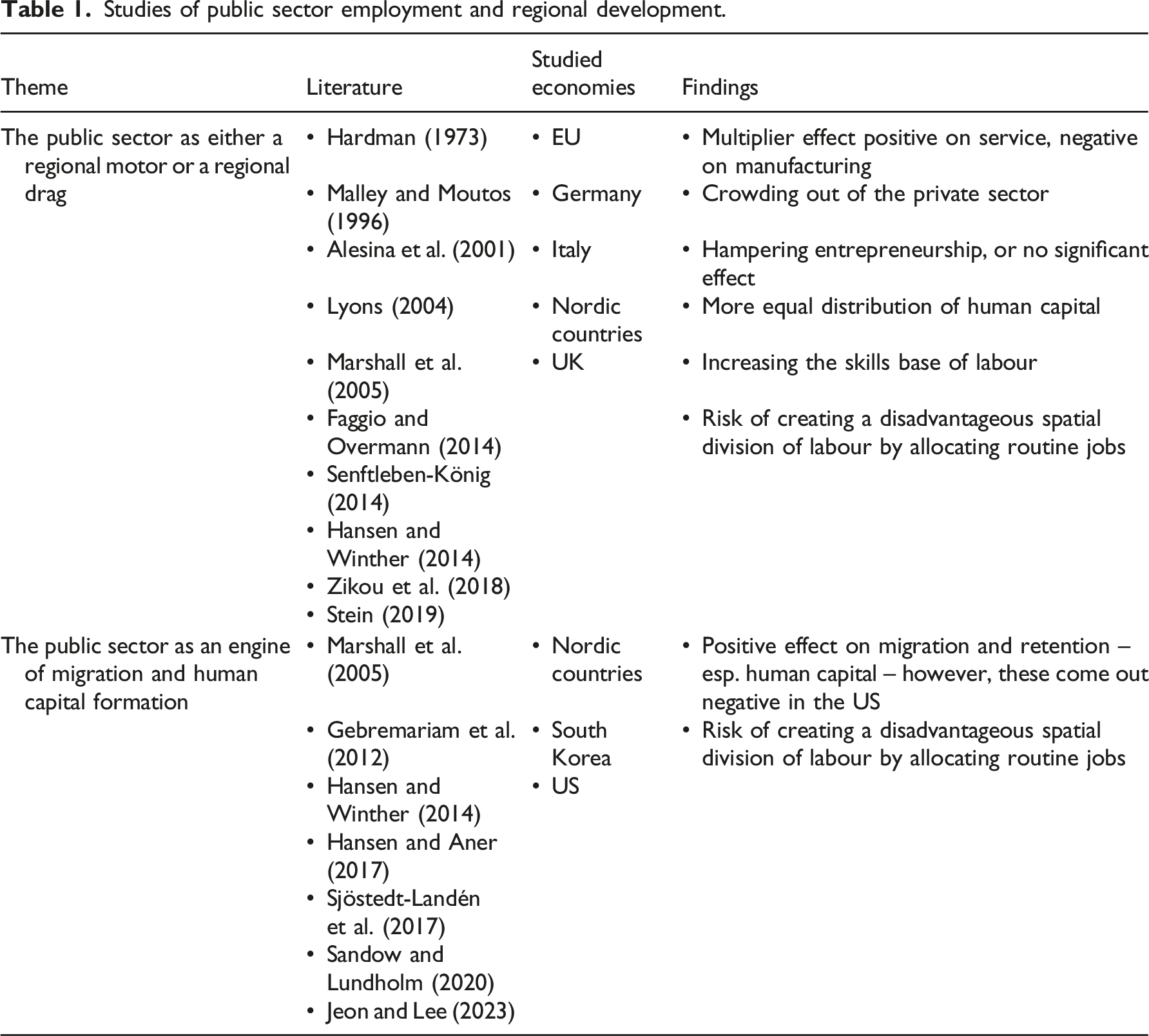
1 The public sector as a regional motor or drag?
The local multiplier effects that emerge from public sector employment constitute perhaps the best-studied area concerning the links between the public sector and regional development. Most other quantitative accounts have been limited to secondary employment data on overall regional public sector employment (Marshall et al., 2005), have used input-output models to trace how the local supply is likely to respond to an increase in economic activity (Miller and Blair, 2009) or used macro-economic models comparing nations that find inconsistent effects on both private sector employment (Boeri et al., 2000) and unemployment (Edin and Holmlund, 1997; Algan et al., 2002).
According to Lyons (2004), decentralization in the UK led to the creation of about 25,000 new jobs outside the larger London area, something that balanced regional growth trajectories (Marshall et al., 2005). Directly analysing public sector multipliers in the UK, however, Faggio and Overman (2014) found no general short-term (5-years) effects on the private sector. Nevertheless, disaggregated, they showed that 0.5 jobs in construction and services are created for every public sector job, while 0.4 jobs are destroyed in the manufacturing sector. Hence, non-tradable private sectors may face a higher demand for goods, on the one hand, while also supplying intermediate goods and services and therefore growing by hiring local unemployed, non-locals or existing residents in tradable sectors, on the other (see also Anselmo and Cascio, 2011). At the same time, these processes could also crowd out manufacturing jobs due to the higher costs of land and inputs. One South Korean assessment did find positive employment effects from decentralization, but this was particularly caused by the migration of public sector employees to the destination areas rather than by any spillovers (Jeon and Lee, 2023). In a similar vein, Riksrevisionen (2023), in its audit of Swedish relocation policy, concluded that neither of the relocated agencies performed worse after the move from Stockholm or had lower overall costs of operation, but that the regional effect varied depending on the distance from the capital. The closer to the capital the new location was, the fewer the regional effects due to commuting from the capital and hence the lower the local multipliers and tax revenues. When the location was beyond commuting distance from Stockholm, these regions experienced higher rates of in-migration as well as diversification towards especially high-skilled services, as the demand for goods and particularly for services increased in the area. In the case of Denmark, early evidence indicates that recent relocation schemes have proved more expensive than expected and have been accompanied by a substantial loss of knowledge within the relocated agencies, because employees have not relocated to the same degree as the jobs (Berlingske, 2016).
However, there are also examples of when the public sector may have less of a positive regional influence. Using historic data on Sweden, Malley and Moutos (1996) demonstrated a crowding-out effect of private sector employment by public sector employment growth during the period 1964–1990, when the public sector expanded heavily. Similar results have been found for the UK (Hardman, 1973) and Germany (Senftleben-König, 2014), without explicitly knowing whether the larger share of public sector employment prohibited private sector activities in these particular segments (i.e. the opportunity costs discussed above). Other negative effects identified in the literature include a direct dampening effect on both entrepreneurship (e.g. Zikou et al., 2018) and overall employment (Alesina et al., 2001). In the latter case, the authors argued, based on Italian data, that negative socioeconomic effects on the creation of private employment may result from a predominance of well-paid and stable public sector jobs. It is therefore argued that high-paid public sector jobs will affect the tradable sector negatively if citywide wages, house prices and the prices of non-tradable goods and services increase (Faggio and Overman, 2014). Similar to the studies above, Stein (2019) finds no significant relationship between a high share of public sector employees in Norwegian municipalities and the number of start-ups. However, when controlling for various parameters such as city size, unemployment rates, demographic characteristics, etc., Stein (2019) identified a significant positive relationship between cities with universities and high start-up rates. This highlights the important role of the public sector as a provider of both education and new ideas that could spur local innovation.
Apart from creating (temporary) replacement jobs, balancing regional differences (Jefferson and Trainor, 1993, 1996) and potentially spurring (or deterring) diversification via entrepreneurship (Stein, 2019; Zikou et al., 2018), the public sector may also have more direct regional effects. Innovation and knowledge production require qualified labour, and by supplying educational opportunities, the public sector significantly impacts the formation of skills and human capital. The most evident example is the location of HEIs like universities. It is commonly argued that HEIs increase the human capital stock of regions in terms of graduates who migrate to an HEI and then remain there after graduation. However, as Winters argued (2018), although the number of regional graduates in the US does increase the stock of human capital, it does not do so proportionally to the number of graduates. This is basically because locating an HEI in a region will not by default cause graduates to remain due to the potential regional mismatches that can lead to the over-education and out-migration of graduates, a particularly high risk in less opportunity-rich regions, as has been exemplified in several different contexts (Chatterton and Goddard, 2000; Faggian et al., 2017; Rehak and Eriksson, 2020). In short, the regional employment effects of HEIs depend greatly on the match between the region’s demand structure and the human capital produced. Regions that also specialize in synthetic knowledge bases tend to be more likely to experience strong multipliers from HEIs (Eriksson and Forslund, 2014). Compared particularly to other public sector activities under situations of austerity, HEIs also tend to be counter-cyclical and to expand during recessions.
This potential magnet of competencies may thus boost the local skills base and diversify the regional economy (Illeris, 1996), as also evidenced in Sweden (Riksrevisionen, 2023). It is widely accepted that concentrations of human capital increase the competitiveness of regions and that these have been a driving force in industrial restructuring and employment growth patterns (Glaeser et al., 1992; Moretti, 2010). Moretti and Thulin (2013), for example, found significant multiplier effects from new jobs in manufacturing, though this was strongly conditioned by the types of jobs that were created. From jobs requiring a university diploma, the multiplier effect was far higher than for jobs with no formal requirements. They therefore suggested that regions that lag behind should target new employers with high levels of human capital. Nevertheless, the influx of ‘white-collar jobs’ does not necessarily influence regional employment (Hardman, 1973). This could partly be because of difficulties in finding workers with the appropriate skills, partly due to low shares of employees moving from the core to more peripheral regions (Jeon and Lee, 2023), and partly due to the automatization of production processes (re-)producing a distinct spatial division of labour (Henning and Eriksson, 2021).
To sum up, relocation and the spatial distribution of state-controlled activities are indeed surrounded by great ambiguity and strong normative claims are often made about them. While this is typically a direct way of equalizing spatial differences, the broader employment effects tend to be diverse and are strongly affected by regional characteristics and broader institutional settings.
2 The public sector as an engine of migration and human capital formation
While the potential relocation of public sector activities from economic cores to peripheries and the effects of such relocation are regularly discussed in the literature, the migration or retention of people is an often-overlooked outcome of the public sector debate, even though this is the most straightforward mechanism for regional development (Jeon and Lee, 2023; Sjöstedt-Landén et al., 2017). The rarity of migration across regions is well established, especially in CME where welfare services are relatively evenly distributed across space and not directly tied to employment. If migration occurs at all, it is often connected with enrolment in higher education or with finding a first job after graduation (Chatterton and Goddard, 2000; Faggian et al., 2017; Hansen and Aner, 2017; Rehak and Eriksson, 2020). The distribution of qualified jobs therefore matters for migration. For instance, Hansen and Winther (2014) found that highly educated employees in the Danish public sector provide a more equal distribution of human capital across Danish regions than do highly educated employees in the private sector. They therefore argued that the public sector, compared to the private sector, contributes to the regional stock of human capital by raising the level outside the main markets.
In the literature, assessments of how this equalizing process may influence future migration vary. Gebremariam et al. (2012) argued that, in Appalachian counties in the US, higher local tax levels, which are usually assumed to be correlated with an extensive local public sector, typically discourage in-migration and encourage out-migration. However, the opposite has been reported by both Hansen and Aner (2017) and Sandow and Lundholm (2020). In contrast to the US findings, both studies showed that one key factor in highly skilled workers moving from core to non-core regions in Denmark and Sweden, respectively, was the opportunity to balance job opportunities in the public sector with affordable housing and the quality of life that non-core regions offer. In fact, when comparing counter-urban migrants in Sweden, the vast majority leaving the larger metropolitan regions for smaller regions had occupations like doctors, nurses, teachers and public servants, indicating the selectiveness of the urban wage premium and the better possibilities to balance work-life commitments outside the larger urban areas. This also shows how the organization of national economies can influence the perception and outcomes of economic policies. In the Appalachian case, given the LME in the US, increasing local taxation following public sector expansion leads to out-migration, whereas in the CME model of both Sweden and Denmark, this can actually lead to an increase in relatively attractive jobs. One explanation for this difference may be that there are practically no regional differences in taxation levels in Denmark or Sweden compared to the US, and thus, the economic gain compared to the amenity gains of moving elsewhere is less clear in the Scandinavian countries.
This potential role of the public sector in being able to attract workers to places also draws attention to the role of government structures and the scale of regional government autonomy when looking at the relationship between public sector jobs and regional development, as well as at how regions with different characteristics respond to changes in the level of public sector jobs. One main concern regarding public sector relocation is the types of employment functions that are relocated. Marshall et al. (2005) argued that relocation can have positive impacts on the receiving region if a significant number of professional and senior administrative jobs are on offer. However, if only routine jobs are relocated, this can reproduce the divide in skills composition between core and non-core regions, leading to an even more marked spatial division of labour. If the public sector does indeed facilitate a more homogeneous distribution of human capital compared to the private sector (Hansen and Winther, 2014), we can expect a spillover effect of human capital from the public sector to the private sector, as labour tends to flow between sectors. This can have a positive effect on the private sector, especially in regions where human capital is low. As shown by Hansen and Aner (2017), university graduates migrated to peripheral areas to enter public sector jobs with the intention of leaving after a few years. This group believed that the work tasks they had in the public sector were more challenging than they could experience elsewhere and thus regarded public sector jobs as an opportunity to acquire experiences they would not have a chance to acquire elsewhere. As a result, job opportunities in the public sector can be viewed as stepping-stones for newcomers to the labour market, where the public sector is considered a place to obtain skills and experience and thus increase their future employability. Naturally, this dynamism applies to most sectors, but as reported by Hansen and Aner (2017), it was quite clear that entering the public sector to acquire valuable experience for future employability was a strategy that some new graduates used. Thus, public sector jobs can act as a source of labour upgrading to accommodate people with skills and capabilities that are in demand in other sectors. It might be more relevant to investigate this sort of strategy in some types of jobs compared to others. For example, the highly educated might be more inclined than craftsmen to follow such a lead. However, this indicates that the public sector can be understood as a work environment that equips labour with skills and knowledge that are highly valued in other sectors or other places.
Thus, depending on which jobs are created or relocated, the public sector can also improve employability for newly graduated students. As a result, the argument goes, the public sector puts non-central regions in a better position if the often-stressed positive correlation between human capital and job growth applies simultaneously with the sending areas benefitting from reduced congestion (Jeon and Lee, 2023). This raises important questions concerning whether or not public sector jobs create local multiplier effects, what kinds of effects these are based on the jobs created, how these jobs can contribute to long-term human capital formation, and if they can, where this happens. As noted in the Swedish audit of past relocations, the positive externalities (in-migration and diversification into knowledge-intensive services) were more pronounced in regions where complex tasks were relocated and where a local supply of skills was already present. The potential benefits in both core and peripheral regions can be compared to the arguments made by Martin (2008), which are that there typically exists some sort of rhetorical ‘trade-off’ between regional equality and national growth and efficiency, and that pursuit of the former tends to undermine the latter, which usually justifies the allocation of resources based on market forces. As Martin later argued (2021), the success of leading regions is thus not simply the outcome of ‘efficient market forces’, but is often significantly underwritten by large state expenditures and subsidies that further reinforce the returns on investment in leading regions compared to those lagging behind.
IV Discussion and conclusion
The aim of the present paper has been to discuss two interrelated issues. First, the role of the public sector in economic geography focussing on regional development, and second, how, and under what circumstances, public sector employment can indeed be used as a policy tool for regional development.
By reviewing the notably limited literature in economic geography and related disciplines focussing on the public sector, it is striking to see that, despite employing a substantial share of the regional workforce (often ranging between 20% and 40%), public sector employment is seldom considered to play an active role in regional development processes. Instead, the focus tends to be on the public sector as a facilitator and service provider to the private sector. We argue, however, that the public sector should be regarded as something more than just a service provider and instead be understood as a more active agent of change that, through its activities and spatial distribution of jobs, co-creates economic geographies. For example, prevailing notions of what constitutes a local labour market and the skills embedded therein, and ultimately how we theorize localized clusters, regional innovation systems or agglomerations, clearly hinge on the dynamics of private sector jobs, but public sector activities are also involved in these processes. While this broader take on the economy has drawn some attention in recent foundational approaches (e.g. Hansen, 2022), the foundational economy makes no clear distinction between whether activities are private or public. Thus, although asking for a more diverse conceptualization of the economy, the role of politics cannot really be considered without explicitly accounting for how central governments, through political decisions, distribute jobs and power resources in their territory.
As far back as the 1960s, Winnick (1966) brought up the conflict between place prosperity and people prosperity policies, stressing the importance of, and conflict over, developing economic policies that assist individuals, places and regions while considering welfare distribution in the geographical redistribution of economic activities. However, more than half a century later, it is striking how absent public sector employment has been, and still is, in this regard. While relocation logic (or lack thereof) is often discussed, how exactly the relocation of public sector jobs influences the private sector within different varieties of capitalism and regions, endowed with different resources and characteristics, remains something of a black box. Empirical studies have found both positive and negative (or insignificant) effects on regional employment, but as shown above, this varies across different time periods and institutional contexts, and clearly depends on the industry mix in the region. As with any other entry or exit, the local effects naturally depend on the types of activity that are relocated, the extent to which these functions require skilled personnel and the exact types of skills needed. For example, relocating routine tasks from the economic core to a peripheral region may increase skill levels in the latter, on the one hand, while locking such regions into a development path that is difficult to move away from, on the other. This is hardly the aspired-for engine of change. It could also increase vulnerability to automation pressures and future rationalizations. Thus, if we are to utilize public sector employment as a tool in regional development, rather than perceiving public sector jobs as either a means of achieving ‘spatial equilibrium’ or as a waste of public resources, we need more research on exactly how the presence of the public sector influences labour-market dynamism, under what conditions and where.
As recent findings from the Nordic countries suggest, public sector jobs can prove to be a key attractor of talent outside the metropolitan regions (Hansen and Aner, 2017; Sandow and Lundholm, 2020) if they are relocated beyond commuting distance (Riksrevisionen, 2023). This is mainly related to the fact that many of these jobs (e.g. teachers, nurses, administration, etc.) require higher education and thus signal a greater potential for horizontal mobility due to the spatial distribution of immobile public sector activities. Also, job opportunities in the public sector can be regarded as stepping-stones for university graduates in non-core regions. Based on qualitative material (Hansen and Aner, 2017), public sector jobs can, for example, act as a source of regional upgrading by accommodating people with the skills and capabilities in demand in other sectors and other places. Such a mechanism is likely to be more relevant in some types of jobs than in others. For example, the highly educated might be more inclined than craftsmen to follow such a lead. Nevertheless, this role is probably also shaped by varieties of capitalism, and while public sector jobs are a key redistributor of human capital in Scandinavia, findings in the US suggest the opposite is true due to, for example, higher taxation. This is a notion that calls for greater geographical wisdom, beyond UK and US hegemonies, when theorizing regional development, in general, and the role of the public sector, in particular.
In light of recent calls, the present paper is an attempt to rethink economic geography in relation to regional development and to consider broader social dimensions (e.g. Martin, 2021), as well as to take up the baton of early contributions demonstrating the rebalancing potential of public sector activities (e.g. Jefferson and Trainor, 1993). This, in turn, could allow us to develop a better understanding of the anatomy of just and inclusive regional development and the relationship between the public and the market. This is not least the case when there is an emergent state-led race to pioneer the green transition and remain competitive, while questions of the spatial and social distribution of welfare effects tend to be neglected (Eadson and van Veelen, 2023). Based on this discussion, we therefore call for more detailed assessments of the role of public sector activities in the economic geography of regional development. As suggested by Jeon and Lee (2023), this would include qualitative in-depth assessments designed to understand why certain regions benefit from relocation more than others do. Such analyses should also approach region-specific motives and the aspirations of workers entering public sector jobs or switching between the two sectors. The latter aspect could be assessed by analysing job mobility and post-mobility outcomes, but also by means of interviews with private sector employers to understand the processes of knowledge sourcing and skills provision. Future studies could also employ micro-data, which are increasingly being made available to researchers in many countries, to assess detailed characteristics of workers in relation to education, experience, origin, age, gender, etc., the goal being to elucidate who is employed in the public and private sectors in different types of regions and determine how that has changed over time. In so doing, it would be possible to assess the long-term influence of the presence of the public sector on regional human capital formation and to decide whether and where the public sector may contribute to a more geographically even distribution of human capital.
Footnotes
Acknowledgments
An early version of the paper benefitted greatly from comments received at the Global Conference on Economic Geography in Dublin 2022. We are also grateful for the constructive comments from the editor and the three referees. All usual disclaimers apply.
Declaration of conflicting interests
The author(s) declared no potential conflicts of interest with respect to the research, authorship, and/or publication of this article.
Funding
The author disclosed receipt of the following financial support for the research, authorship, and/or publication of this article: This work was funded by Riksbankens Jubileumsfond and the research program “A promised land?” (grant number M22-0029).
